
Moulson A.J., Herbert J.M. Electroceramics: Materials, Properties, Applications
Подождите немного. Документ загружается.

2.7.1). The GL theory produces useful rationalizations concerning super-
conductors in general. One of these concerns the ‘coherence length’ x,a
characteristic of a superconductor and a measure of the distance superconductor
properties extend into a normal material. The coherence length is related to T
c,
the smaller x the higher T
c
. As examples, for Pb (T
c
¼7.2 K) x ¼ 87 nm and for
the high temperature superconductor, Bi
2
Sr
2
CaCu
2
O
x
(T
c
¼89 K) x ¼ 1.8 nm.
The very small x-values for the ceramic superconductors have significant
implications as far as their processing is concerned.
The relative magnitudes of l and x determine whether a superconductor is
Type I or II. If l 4 x the superconductor is Type II.
Understanding and controlling the behaviour of the ‘vortices’ which develop
as an applied magnetic flux penetrates Type II superconductors is critical to their
successful exploitation. If the superconductor is carrying a current, then the
vortices experience the expected electromagnetic Lorentz interaction force and
move. In fact, under an applied magnetic field, vortices are continually entering
the material, moving through it and leaving. This motion of a magnetic vortex
induces an e.m.f. which leads to an effective electrical resistance and energy
dissipation; in the specialist literature this resistive effect is referred to as a
‘viscous drag’ opposing the vortex movement. If the process continued and the
temperature exceeded T
c
the material would revert to the normal state. Therefore
basic research is focused on learning more concerning how the vortex population
is arranged and how it moves. In particular, materials’ engineers seek means of
preventing its movement, that is by ‘pinning’ at irradiation-induced defects,
dislocations and microstructural defects, including grain boundaries, second
phases, etc.
Preventing vortex motion by ‘pinning’ is also critical to the development of the
HTS magnets discussed below.
4.7.3 Ceramic high- T
c
superconductors (HTSs)
Access to the Handbook of Superconducting Materials edited by D.A. Cardwell
and D.S. Ginley [34] and the Handbook of Superconductivity edited by C.P. Poole
Jr [35] is recommended. The review by R.J. Cava [36], focused on the structures
of the high-T
c
superconductors, should also be consulted.
A significant step in the history of the HTSs was the discovery in 1966 of
superconductivity in the oxygen-deficient perovskite SrTiO
3d
, containing some
barium or calcium substituted for strontium. Although the T
c
value was very low
(0.55 K), in retrospect it can be seen as the first superconducting ceramic. In 1979
a T
c
of approximately 13 K was discovered for BaPb
0.75
Bi
0.25
O
3
, which also has
the perovskite structure.
The breakthrough came in 1986 when J.G. Bednorz and K.A. Mu
¨
ller [37]
reported superconductivity with T
c
¼35 K in the semiconducting ceramic,
222 CERAMIC CONDUCTORS
TEAMFLY
Team-Fly
®
(La,Ba)
2
CuO
4
, which has the layer perovskite K
2
NiF
4
structure. The discovery
won them a Nobel prize.
This discovery stimulated what can only be described as frenzied research in
many laboratories throughout the world which quickly resulted in the discovery
of YBa
2
Cu
3
O
7d
, the so-called ‘123’ phase, or YBCO, with a transition at a
temperature as high as 93 K. There are also bismuth-based high-T
c
super-
conductors, which are described below.
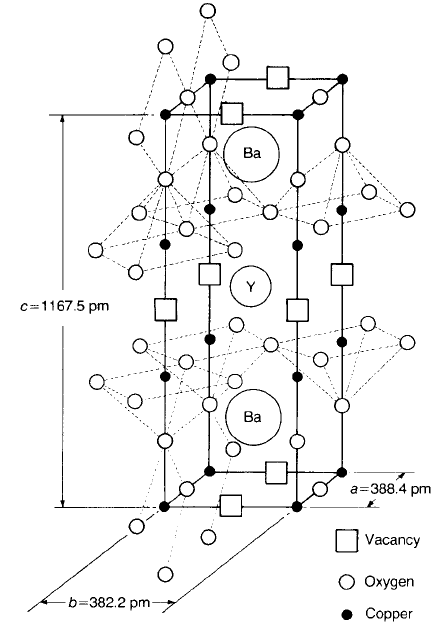
The structure of YBCO is closely related to that of perovskite as evident in
Fig. 4.54, which shows the unit cell consisting of three perovskite-type cubes with
Cu ions at the corners and O ions at the centres of the cube edges. The top and
bottom cubes contain Ba and the centre cube Y.
The practical significance of the discovery, apart from the fact that it suggested
the possibility of a room temperature superconductor, is that the T
c
is above the
boiling point of liquid nitrogen (77 K), a cheap refrigerant.
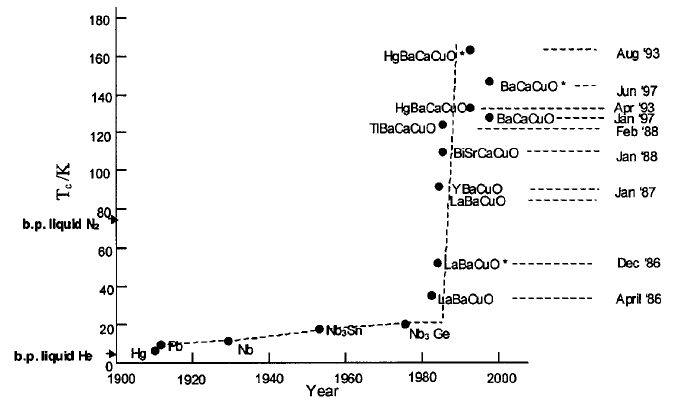
The remarkable progress stimulated by the work of Bednorz and Mu
¨
ller is
illustrated in Fig 4.55.
HIGH TRANSITION TEMPERATURE SUPERCONDUCTORS 223
Fig. 4.54 The structure of YBa
2
Cu
3
O
7d
.
The presence of Cu–O planes is a critically important structural feature of the
HTSs. Two such planes are evident in Fig. 4.54 separated by a plane containing
Y ions and oxygen vacancies. It is accepted that the Cu–O planes are a
requirement for high temperature superconductivity in this class of ceramic. The
structure of the prototype HTS, Bi
2
Sr
2
CaCu
2
O
x
(designated ‘Bi-2212’) has two
such adjacent planes and a T
c
of 80 K, and a similar compound, Bi
2
Sr
2
Ca
2
Cu
3
O
x
(Bi-2223) has three sets and a T
c
of 110 K. There are also thallium-based
analogues e.g. Tl
2
Ca
2
Ba
2
Cu
2
O
x
with a T
c
of 125 K, but thallium is toxic.
A compound which held out great promise has the precise and surprising
composition, Ca
0.84
Sr
0.16
CuO
2
. It consists entirely of Cu–O planes separated by a
layer of the alkaline earth elements, randomly arranged but in a fixed ratio. In
the light of the experience outlined above, the fact that the compound consists
entirely of Cu–O planes pointed to exceptionally high T
c
values, if it could be
suitably compositionally modified, and attempts to achieve this were undertaken.
The task proved difficult until synthesis at high pressure and high temperature
(typically 50 kbar; 1000 8C) was tried. A modified composition was prepared and,
although not of great significance in itself, the work stimulated a strong interest
in high pressure synthesis, an interest which has continued.
The record for the highest T
c
is held by pressure-formed HgBa
2
Ca
2
Cu
3
O
9
with
134 K measured at normal pressure and 166 K under high pressure.
224 CERAMIC CONDUCTORS
Fig. 4.55 T
c
against time illustrating the remarkable development following the discovery in
1986 of the high temperature superconductors. (*under pressure) (Adapted from Chu, C.W.
(2000) ‘High temperature superconducting materials: present status, future challenges, and
one recent example – the superconducting ferromagnet’, Physica C, 341–348, 25–30.)
The perovskite structure is, of course, of special significance in the
electroceramics context since the ferroelectric perovskites are dominant in the
ceramic capacitor, PTC thermistor and electromechanical transducer industries.
The structure favours the existence of soft modes (low frequency phonons) as
evidenced by its tendency to instability, for example the ferroelectric–paraelectric
transition. Instability is evident in the case of the ‘123’ compound which exhibits
a tetragonal-orthorhombic transition in the region of 700 8C (the exact
temperature depends on the oxygen content). Extensive twinning, very
reminiscent of ferroelectric domain structures, is observed.
4.7.4 The properties, processing and applications of HTSs
Reference to the texts by F.C. Moon [38] and that edited by H. Maeda and K.
Togano [39] is recommended. The Proceedings issue [40] covers the present status
of the materials, processing and applications and the article by D. Larbalestier
et al. [3, pp. 368–77] reviews HTSs for power applications.
Important characteristics
Efforts directed to develop HTSs to commercial products are confined to the
RE–123 compounds, where RE ¼rare earth element, Y, Nd, Sm, etc., and the
Bi-based materials. As far as the former type is concerned the discussion is
confined to YBCO, the most prominent of the RE–123 family. YBCO has the
advantage of a higher J
c
value at 77 K than the Bi-based materials (10
10
Am
2
compared to 10
9
Am
2
) although the comparison is not an easy one to make
since the values are so dependent on specimen form, doping, applied field, etc.
More importantly, the Bi-based powders have a flat, clay-like morphology and
this is very significant when it comes to fabrication. In contrast YBCO particles
tend to be equiaxed.
For the reasons summarized below, the coherence length x, and irreversibility
field H
irr
are two parameters of special significance in the processing of HTSs.
The coherence length (x) To attain one of the principal goals, namely to
achieve maximum values of J
c
and B
c2
, the spacing of features which are not
intrinsically superconducting, such as second phases and grain boundaries
should be 44 x.
The grain boundaries constitute barriers to the supercurrent flow and their
width should, ideally, be less than x. Values of x for the high-T
c
superconductors
lie in the range 1–100 nm (depending upon applied field strength) and so in their
processing close attention has to be given to optimising microstructure and
texture.
HIGH TRANSITION TEMPERATURE SUPERCONDUCTORS 225
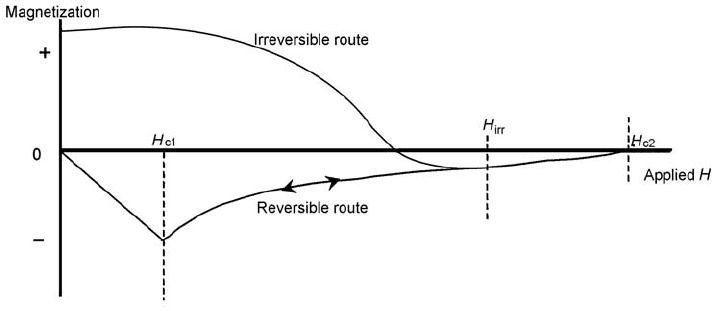
The irreversibility field (H
irr
) Figure 4.56 illustrates the events as a magnetic
field is applied to and then removed from a Type II superconductor below its
critical temperature. At applied fields up to H
c1
the response of the material is as
expected for a Type I material. That is the field is excluded (the Meissner effect)
and the material behaves as a perfect diamagnetic. At applied fields above H
c1
there is some flux penetration and this increases until the material becomes
normal at H
c2
.
As the applied field is removed the route the M–H curve takes depends upon
the extent to which the vortices are ‘pinned’. With no pinning the magnetization
remains negative and fully reversible, that is in the opposite sense to the applied
field.
If the vortex population is pinned so that it is not in equilibrium with the
applied field, then the M–H curve takes the irreversible route as illustrated. The
pinned vortices contribute an M in the same sense as the applied H since they are
the penetrated field, and as the applied field is reduced the þM manifests itself
just as it does for an ordinary permanent magnet. The pinned field is aptly
described as the ‘trapped field’.
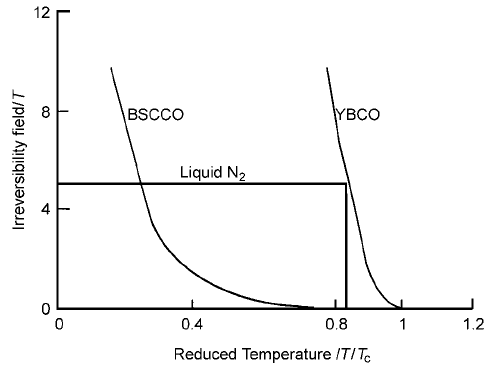
The irreversibility field (H
irr
), which has to be measured experimentally, is an
important parameter since it determines the size of the final M developed. As
expected H
irr
depends upon temperature, and irreversibility field v. temperature
curves are shown in Fig. 4.57. It is apparent that at liquid nitrogen temperature
YBCO is suited to permanent magnet applications whereas Bi-2223 is not.
Because of the energy dissipation accompanying vortex motion and referred to
earlier, vortex pinning also raises J
c
.
In summary, under the usual operating conditions the ceramic HTSs are
characterized by the presence of flux vortices and materials engineers are
226 CERAMIC CONDUCTORS
Fig. 4.56 The reversible and irreversible routes taken by the magnetization of a Type II
superconductor as the applied magnetic field is reduced from a value larger than H
c2
.
learning how to ‘pin’ them. This is necessary because in current-carrying
applications their movement is accompanied by energy dissipation, and in the
production of quasi permanent magnets they constitute the ‘trapped’ magnetic
flux, so determining the strength of the magnet.
Processing high-T
c
superconductors
Intensive efforts are being made to exploit bulk and tape HTSs for a variety of
applications including magnets for magnetic levitation (‘maglev’) and for energy
storage, current leads and fault current-limiters and cables for power generation,
control and transmission.
As discussed in Chapter 3, the fabrication of bulk oxide ceramics usually starts
with a powder and this can be prepared via solid state reaction (also loosely
referred to as the ‘mixed oxide’ route), or by ‘wet chemical’ routes.
As an example, the preparation of Bi-2223 compound starts with Bi
2
O
3
, PbO,
SrCO
3
, CaCO
3
and CuO powders which are well mixed, in a typical case in
acetone in a mill using zirconia media. The mix is calcined at 800–900 8C and the
calcine ground and granulated. To avoid the occurrence of carbon residues in the
grain boundaries, which are said to have a deleterious effect upon J
c
and T
c
,
certain of the processing steps are carried out in pure oxygen or in vacuo [42].
There are a variety of routes described as ‘wet chemical’. For example an acid
(HNO
3
) solution of the metal nitrates is prepared and the oxalates precipitated
by the addition of oxalic acid and ammonia, to control pH. Because of mixing on
HIGH TRANSITION TEMPERATURE SUPERCONDUCTORS 227
Fig. 4.57 Irreversibility curves for candidate HTS ceramics: at liquid N
2
temperature T/T
c
(YBCO) 0.83 and for Bi-2223 0.79. (After D.A. Cardwell [41].)
an atomic scale the reaction to form the oxides can be carried out at a relatively
low temperature of about 700 8C.
‘Spray-drying/calcination’ and ‘spray pyrolysis’ would typically start with a
solution of nitrates of the metals. In the former case, the solution is sprayed into
a warm (250 8C) enclosure where the granules are collected and subsequently
calcined and, in the latter, into an enclosure at a temperature sufficiently high so
as to simultaneously effect the decomposition and reaction to form the oxides.
Leads and ‘fault current-limiters’ Current leads and fault current-limiters are
the first large scale commercial applications of Bi-based HTSs. Current leads
significantly improve efficiency of liquid helium-cooled magnets.
In principle, components can be formed by any standard ceramic fabrication
route. The densification step involves a partial melting and a controlled
recrystallization, and attention has to be given to sintering/annealing atmo-
spheres to achieve the required stoichiometry. Leads have also been formed by
melt-casting.
Because the J
c
in the a–b plane of Bi-HTSs is several orders of magnitude
larger than that in the c-direction, it is necessary to have the latter normal to the
lead length. The following tape-casting route is one which was developed to
achieve optimum texture.
The organic-based tape-casting slurry consisted of the usual solvents,
plasticizers and binders (see Section 3.6.6) and Bi-2212 powder (approximately
3 mm particle size). The slurry also contained MgO fibres of diameter and length
in the range 5 mm and 100 mm respectively. These fibres formed the substrate onto
which the platelets grew epitaxially during the partial melting–recrystallization
stage. The slurry was tape-cast into sheets, a process which aligned the MgO
fibres in the plane of the sheet and in the casting direction. The tape-cast sheets
were cut into strips, stacked and consolidated by warm-pressing. Short lengths of
silver foil were incorporated into the ends of the stack prior to laminating to
provide the contacts. After the organics were burnt off the lead was fired in
oxygen when partial melting and recrystallization occurs. The final step was an
anneal in argon with 2 vol.% oxygen to adjust the stoichiometry. The result was
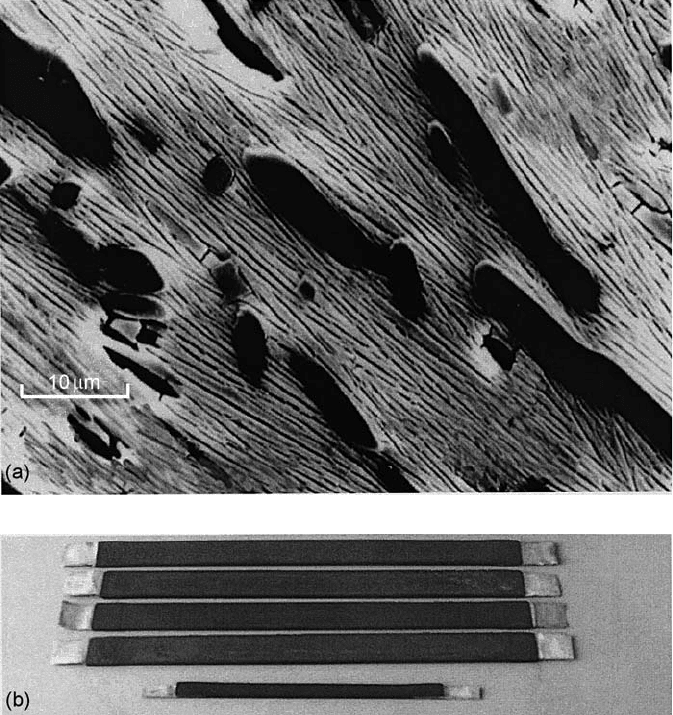
a well textured structure as shown in Fig. 4.58(a). Complete leads are shown in
Fig. 4.58(b).
An alternative manufacturing route exploits the powder-in-tube technology
described below, except that a metal with poorer thermal conductivity replaces
the silver matrix.
The function of a current lead is to improve the efficiency of liquid helium-
cooled superconducting electromagnets. The current is fed to the coils in three
stages. The first comprises cooled copper leads (the resistivity of a metal falls
with falling temperature) which are joined to the HTS leads, connected in turn to
the low temperature superconductor (e.g. Nb
3
Sn). The heat management is such
228 CERAMIC CONDUCTORS
that the HTS is cooled to 66–77 K by the liquid helium, and the copper by cold
He vapour.
A fault current-limiter is a component which protects power transmission and
distribution systems from surges caused by, for example, a lightning strike,
fulfilling a function similar to that of a varistor (see Section 4.3.1). The limiter
should be capable of reducing the fault current to a fraction of its peak value in
less than a cycle. Because for this application the requirement is for low J
c
, fault
current limiters are already a commercial product. In the case of the lead shown
in Fig. 4.58(b) the fault current is limited to a safe value within 5 ms of the arrival
of the current ‘spike’.
HIGH TRANSITION TEMPERATURE SUPERCONDUCTORS 229
Fig. 4.58 (a) Micrograph of lead section; see text for details (b) Bi-2212 current leads; the
longer lengths are approx. 325300 mm. (Courtesy of the IRC in Superconductivity and
Department of Materials Science, University of Cambridge, UK, ABB Corporate Research,
Switzerland and Advanced Ceramics Ltd., UK.)
Cables via the ‘powder-in-tube’ (PIT) method The approach is especially
suited to processing Bi-2223 into leads and cables for power applications. A
silver or silver alloy tube, filled with the partially reacted precursor powders
formulated to yield Bi-2223, is drawn down to a wire 1–2 mm diameter. The wire
is rolled into a tape if that is the required form, usually with a width-to-thickness
ratio of approximately 10:1. The composite is then heated to 800–900 8C when
the powder partially melts. The recrystallization process is controlled and the
pure Bi-2223 phase develops with large grains oriented so that the Cu–O planes
lie parallel to the silver surface to optimize J
c
.
Cables for handling power can be made up from the tapes which are wound
in a manner similar to standard cabling practice with a surrounding corrugated
(to facilitate bending) steel duct for carrying the liquid nitrogen refrigerant.
Lengths totalling in excess of 150 km have been manufactured for electro-
magnet applications. A commercially important objective arising because of the
demand for increased power, is the replacement of existing electric power
transmission cables with high-T
c
superconducting cables. This is economically
attractive in large and highly developed and congested cities such as Tokyo,
London and New York, where space in the existing underground ducts is
running out and enlarging them would be unacceptably disruptive to day-to-
day city life.
Detailed cost analyses are made before such expensive ventures are
undertaken, but there seems little doubt that the next decade or so will see
HTS cables steadily replacing metallic conductors for power distribution in
locations where the economic benefits are justified.
The strong inverse dependence of critical current density on magnetic field at
77 K is a limitation associated with Bi-2223 tape. This necessitates operation at
lower temperatures for certain applications (e.g. electromagnets) when the cable
is subjected to strong magnetic fields. This limitation does not arise with the
(RE)BCO system and intensive efforts are being made to manufacture suitable
tapes.
Engineering the required texture in a (RE)BCO tape is a much more complex
matter than in the case of the Bi-2223 tape. One approach is to prepare a nickel
tape with a carefully controlled crystalline surface texture. This forms the
substrate for the development of a correspondingly textured thermally grown
oxide layer which, in turn, forms the substrate for the epitaxial growth of MgO
by electron beam evaporation. The textured MgO serves as the substrate for the
epitaxial growth of the 1 mm thick (RE)BCO via pulsed laser deposition.
High field gradient ‘magnetic separation’ is an old technology being
increasingly exploited for the purification of liquids. Applications include the
removal of heavy metal ions from laboratory waste water, purification of
china clay for the paper industry, recycling waste water used in the steel
industry and recycling of grinding sludge in glass polishing industries, for
example in the manufacture of cathode ray tubes. Bi-2223-based electromagnets
230 CERAMIC CONDUCTORS
are being introduced leading to significant increases in efficiency. It is anticipated
that the Bi-2223 cables will eventually be replaced with those incorporating
(RE)BCO.
Tapes by dip-coating The process is essentially as described in Section 3.6.6.
A silver or silver alloy tape is passed through a slurry of the partially reacted Bi-
2223 powder dispersed in an organic vehicle. The coated tape is heated at
800 8C in air to remove organics and then at nearly 900 8C when partial melting
and controlled recrystallization takes place.
Bulk magnets Because of the many potential applications, including magnetic
levitation for transport, magnetic separation, bearings and energy storage, the
development of ‘quasi-permanent magnets’ is an important branch of HTS
technology. The practical maximum field developed by the best rare earth
permanent magnets is 1.0 T. From Fig. 4.57 the H
irr
field for YBCO at 77 K is
approximately 5 T, and trapped fields in excess of 3 T have been reported at this
temperature.
The various common processing routes to producing bulk (RE)BCO can be
exploited. Although there seems to be no obstacle to obtaining high T
c
values
with sintered material, there is with regard to obtaining high critical current
densities J
c
. The basic reason for this is the presence of ‘defects’ of various kinds,
particularly grain-boundaries, which interfere with current flow. This has led to a
focus on the growth of single crystal forms of (RE)BCO by ‘melt-processing’. By
this approach, crystals possessing values of H
irr
and J
c
attractive for permanent
magnets are being grown. The technology is reviewed by D.A. Cardwell [41] (see
Fig. 4.59) and by M. Murakami [43].
Melt-processed crystals contain many defects, including dislocations, twin
planes and non-superconducting particles, which act as the essential pinning
centres. The deliberate engineering of a fine dispersion of precipitates of the non-
superconducting ‘211’ phase, Y
2
BaCuO
5
, has been a major breakthrough
permitting trapping of the strongest fields, for example 10 T at 42 K. A penalty is
the occurrence of microcracking around the inclusions due to differential thermal
expansivities between inclusion and matrix.
During the magnetizing process, and in the final fully magnetized state,
complex mechanical stress fields which can be large enough to cause fracture are
developed. The stresses originate from the Lorentz forces (see Section 9.1.2) on
the fluxoids which, through flux-pinning, are transferred to the material. In the
final fully magnetized state, when the magnetizing field is removed, the screening
currents associated with the non-uniform fluxoid distribution result in the critical
current density J
c
flowing throughout the volume. The stresses are the result,
then, of the interaction between J
c
and the penetrated induction B
p
. They are
tensile throughout the bulk and any defect of ‘critical’ dimensions (or larger) will
lead to immediate fracture or, in the case of smaller defects, possible eventual
HIGH TRANSITION TEMPERATURE SUPERCONDUCTORS 231