
Moulson A.J., Herbert J.M. Electroceramics: Materials, Properties, Applications
Подождите немного. Документ загружается.

fracture following sub-critical crack-growth. T.H. Johansen [44,45] discusses the
rather complex underlying physics.
Considering a specific example (see Question 20), if a cylindrical, circular
section superconductor is magnetized along its length the critical current density
J
c
, flows throughout the volume in circular paths in planes perpendicular to the
axis of the cylinder. The interaction of J
c
with the penetrated induction B
p
, leads
to tensile stresses of magnitude B
2
p
=2m
0
.
The cross-breaking strength of YBCO is very variable with typical values
lying in the range 25–50 MPa. The strengths are significantly increased by the
inclusion of stress-relieving silver particles, by resin-impregnation and by ‘steel-
banding’; with 20 wt% Ag addition strengths as high as 100 MPa have been
achieved.
Permanent magnets are exploited in magnetic bearings for a variety of
applications ranging from machine tools to energy storage. In an experimental
energy storage application flywheels, having a construction based on carbon
fibre-reinforced plastic and mounted on YBCO magnetic bearings, are spun
up to very high speeds (50 000 r.p.m.) during low power demand periods
and their kinetic energy drawn off at peak demand times. Japanese research is
aimed at developing flywheels having a stored energy of 10 MW h, a quantity
appropriate to load-levelling at the power distribution sub-station stage (see
Section 4.5.2).
232 CERAMIC CONDUCTORS
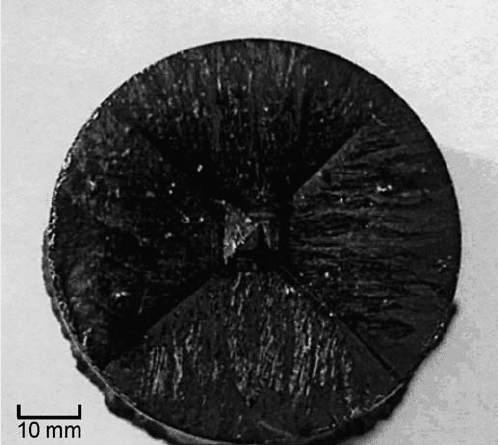
Fig. 4.59 Large grain of ‘melt-processed’ YBa
2
Cu
3
O
7d
(YBCO) fabricated in the IRC in
Superconductivity, University of Cambridge, UK. (Courtesy of of D.A. Cardwell.)
TEAMFLY
Team-Fly
®
4.7.5 Superconducting electronics ^ thin ¢lms
The Josephson junction
In 1962 a postgraduate student, Brian Josephson, working in the University of
Cambridge, and later to win a Nobel Prize, predicted that Cooper pairs should
be able to tunnel through a thin (approximately 1 nm) insulating barrier from
one superconductor to another with no electrical resistance [46]. This ‘quantum
tunnelling’ was confirmed by experiment and is known as the ‘Josephson effect’.
The superconducting electronic devices exploit Josephson junctions.
The Josephson effect can be explained in terms of coupling across the barrier
of the wave functions describing the Cooper pair populations in the super-
conductors on either side of the barrier. The wave functions maintain their
meaning for a distance approximating to the coherence length x mentioned
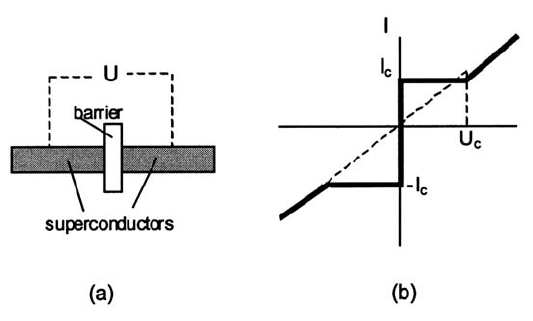
above. Fig. 4.60(a) shows a barrier separating two superconductors and Fig.
4.60(b) the current flowing at zero applied voltage. If the tunnelling current
reaches a critical value (I
c
) (typically 51 mA), then a voltage appears across the
junction, and for larger currents there is an oscillatory component with a
frequency dependent upon the applied voltage. When a voltage is applied across
the junction it has no effect on the tunnelling current until a critical value (U
c
)is
reached beyond which the current/voltage relationship is ohmic. The critical
voltage is related to the energy required to split the Cooper pair and a result of
the BCS theory is that this energy is given very nearly by 3.53 kT
c
Critical
voltages lie in the range 1–100 mV.
An application of Josephson junctions is in superconducting quantum
interference devices (SQUIDS). Figure 4.61 shows two Josephson junctions
passing a current with a magnetic induction B, through the ring of area A.
HIGH TRANSITION TEMPERATURE SUPERCONDUCTORS 233
Fig. 4.60 (a) A Josephson junction. (b) The current–voltage characteristic of a Josephson
junction.
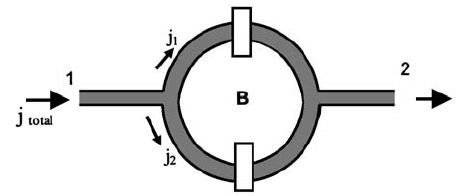
The currents passing through the junctions are arranged to be slightly larger
than the critical currents so that a voltage appears across them. A magnetic
induction through the ring results in an interference effect arising because the
wave functions describing the Cooper pairs have a different wavelength
depending upon whether the currents pass in a clockwise or anticlockwise
direction with respect to the direction of B. The result is that the voltage
appearing across the junctions varies periodically with the strength of B. The
SQUID is the basis of single quantum flux (SQF) devices, capable of measuring
extremely small magnetic fields of order 10
6
F
o
where F
o
¼ h=2e, the quantum
of magnetic flux, or ‘fluxon’ (the concept has already been encountered above in
connection with the magnetic induction penetrating a Type II superconductor).
Growing ¢lms and forming devices
High-T
c
superconductor electronics is based on thin (typically 100 nm) films of
YBCO. The films are grown epitaxially on to, typically, MgO or sapphire
substrates. In the case of growth onto sapphire an intermediate buffer layer of
ceria is deposited to assist in the lattice match and to suppress interdiffusion
between film and substrate. The usual methods of growing thin films are
exploited including, most commonly, magnetron sputtering, pulsed laser
deposition (laser ablation), vapour phase epitaxy and chemical solution
deposition (see Section 3.6.9).
For forming devices the well established methods for patterning in
microelectronics, photolithography/etching, are exploited.
Applications
The switching between states, a characteristic of Josephson junctions, is
applicable to binary-based logic circuits; there is no voltage across the junction
for currents below the critical current I
c
, but one appears for currents greater
234 CERAMIC CONDUCTORS
Fig. 4.61 Two Josephson junctions comprising a superconducting quantum interference
device (SQUID).
than I
c
. The SFQ device can also be exploited as a binary logic element, the
presence or absence of a fluxon in the SQUID ring corresponding to a ‘1’ or ‘0’.
The attraction of such superconductor devices lies in the very fast switching
times, of the order 10
12
s. However there is much development work to be done
before HTSs make a significant impact on a technology dominated by silicon and
gallium arsenide.
The SQUID is exploited for the detection and measurement of extremely small
magnetic fields and finds medical, geophysical and military applications. A
medical application is in magnetoencephalography (MEG), the recording of the
very small magnetic effects caused by neural currents in the brain. The
measurements must, of course, be made in an environment free from extraneous
magnetic field pollution. Even the earth’s magnetic field is approximately 10
9
times stronger than those being measured and so magnetic screening is of
paramount importance. Very effective screening enabling the MEG equipment to
be used in the vicinity of strong sources of magnetic interference (lift motors and
transformers) is achieved by surrounding the patient and SQUID sensor array by
a large (1.65 m0.65 m) hollow Ni cylinder, plasma spray-coated with a 1 mm
thick Bi-2223 layer and cooled by He vapour.
Thin film YBCO devices are achieving commercial success in microwave
communications technology. The explosive growth in mobile phone usage is
forcing the operating frequency upwards from the current 800–900 MHz band to
the 2 GHz band. Because the propagation losses are larger at the higher
frequency the base station receiver sensitivities need to be optimized. Also,
because of the increased number of subscribers signal selectivity is critical.
YBCO-based thin and thick film antennae and filters are under development for
these applications. The surface resistivity of YBCO at 10 GHz and 77 K is nearly
two orders of magnitude lower than that of copper at the same frequency and
temperature. This results in very high Q-values (high selectivity) and an YBCO
cavity resonator (see Section 5.6.5) with a Q-value of 400 000 at 10 GHz is in
service.
4.7.6 The future for HTSs
The silver matrix Bi-2223 cables are a commercial reality but they suffer from a
very steep dependence of the critical current on magnetic field at 77 K and so for
some applications use is restricted to the lower temperatures. The critical current
for (RE)BCO depends far less strongly on magnetic field and so offers a wider
range of possible applications. However, the full potential of the (RE)BCO
family will be realized only when the technology for fabricating cables is
perfected so as to minimize the ‘weak link’ grain boundary effects. When this
technology is fully developed it will be possible to generate large volume
(410 m
3
) fields of strength 45 T and the applications field opens up, especially
HIGH TRANSITION TEMPERATURE SUPERCONDUCTORS 235
in conjunction with trapped field magnets for high speed magnetically levitated
transport systems.
With regard to ‘trapped field magnets’ the technology has been steadily
improving with both the development of Nd-BCO and Sm-BCO varieties which
are potentially capable of trapping stronger fields than YBCO at 77 K. The
mechanical strength of the (RE)-BCO ceramics is a limiting factor and they are
prone to fracture under the stresses developed as a result of the strong magnetic
fields to which they can be subjected. Also the ingress of water and its subsequent
freezing leads to fracture, a problem which has been alleviated by resin-
impregnation.
Understanding of vortex pinning mechanisms will steadily develop and with it
the technology of optimising compositions and structures of materials for
trapped field magnets, particularly the melt-textured, large grain varieties.
The introduction of high-T
c
superconductor technology into the mobile
communications arena will continue.
Computer circuits based on the very fast switching effects associated with
Josephson junctions are very much at the experimental stage and their
development will pose many problems. However, because circuit line widths in
superconducting logic circuits are not as demanding as in conventional
semiconducting circuits, devices can be made from YBCO using very
conventional photolithographic equipment and techniques. If inexpensive
superconducting microcircuits become a commercial reality then they will
make a very significant impact upon the technology as a whole.
In summary, the past decade has seen impressive developments in HTS
technology embracing cables, bulk materials and electronics. The progress seems
set to continue especially with regard to materials design and processing
technologies. Penetration of components into the commercial market will
inevitably grow.
Problems
1. A thin-film nichrome resistor in the form of a rectangle of dimensions 1 mm5mm is
deposited on to a glass substrate. Estimate the thickness of the film for the resistance
measured between electrodes contacting the 1 mm edges to be 1.0 kO. The resistivity of
‘nichrome’ may be taken to be 1:07 10
6
O m.
Calculate the surface resistivity of the nichrome film. [Answers: 5.35 nm; 200 O/
&]
2. An electroded disc of thickness 1 mm is connected to a 2 V supply. Using the idealized
model given in Fig. 4.9(b) estimate the electric field across the IGL given that
t
r
¼ 1 nm and d
g
¼ 20 mm. Assume the resistance of the IGLs to be dominant.
[Answer: 10
7
Vm
1
]
236 CERAMIC CONDUCTORS

3. The a value for a ZnO varistor is 15 and k
I
¼ 9:3 10
38
, the potential difference
and current being measured in volts and amps respectively. Calculate the p.d. across
the varistor for currents of 0.1, 1, 10, 100 and 1000 A. If a device needs protection
against transient voltages in excess of 300 V, show how a varistor having the
characteristic defined above can be connected to afford protection. [Answers: 252,
294, 343, 400, 466 V]
4. An NTC thermistor has a B value of 3000 K. What is its temperature coefficient of
resistance at 27 8C? [Answer: 3:3% K
1
]
5. The resistance (R) of an NTC thermistor varies with temperature according to
R ¼ R
1
expðB=TÞ. Calculate the critical maintained voltage drop across the
thermistor above which thermal runaway would occur for an ambient temperature
of (i) 300 K and (ii) 360 K. The thermistor characteristics are as follows:
R
1
¼ 4:5 10
3
O, B ¼ 3000 K;1=k
th
¼ 3:3 10
2
WK
1
.
Calculate the new critical voltages if the surroundings of the thermistor change so
that the heat dissipation factor (1=k
th
) is modified to 5:0 10
2
WK
1
. [Answers:
6.35 V, 3.36 V; 7.82 V, 4.13 V]
6. Suggest a basic composition for a PTC thermistor that will ‘switch’ at around 30 8C.
7. The tracer diffusion coefficient for oxygen ions in a particular cubic stabilized
zirconia is measured and found to fit the relationship
D ¼ 1:8 10
6
exp
Q
kT
m
2
s
1
where Q ¼ 1:35 eV.
Assuming a transport number for oxygen ions of unity, estimate the electrical
conductivity at 1000 8C. Assume a unit cell of side 280 pm. [Answer: 2:0Sm
1
]
8. The CSZ material described in Question 7 is used to form an oxygen meter which is
measuring an oxygen pressure of 10
10
atm relative to a reference oxygen pressure of
1 atm. Under the operating conditions it is believed that oxygen permeates across the
wall of the cell at a rate limited by the transport of positive ‘holes’. Estimate the
molar oxygen flux given that the membrane is 1 mm thick and that the transport
number for ‘holes’ at 1000 8Cis10
3
. [Answer: 3:3 10
6
mol m
2
s
1
of O
2
]
9. A disc-shaped piece (1 cm
2
area1 mm thick) of the CSZ referred to in Questions 7
and 8, carrying porous electrodes across the two faces, serves as a membrane
separating an oxygen atmosphere from an enclosure of volume 10
4
m
3
. If the
membrane is maintained at 100 8C and the enclosure at 300 8C, estimate the rise in
oxygen pressure in the enclosure if oxygen is pumped into it for 1 h by a potential
difference of 1 V maintained between the disc faces. [Answer: 90 kPa (0.9 atm)]
10. One side of an oxygen meter is exposed to oxygen in equilibrium with a mixture of Ni
and NiO at 1300 K, and the other side is exposed to air at 101 kPa. If the cell e.m.f. is
PROBLEMS 237

0.596 V, calculate the standard free energy change at 1300 K for the reaction
2NiþO
2
¼ 2NiO. [Answer: 247 kJ]
11. SnO
2
crystallizes in the rutile structure with cell dimensions a ¼473.7 pm;
c ¼318.6 pm, and there are two formula units per cell. Calculate its theoretical
crystal density. Relative atomic mass of Sn ¼ 118.7. [Answer: 7.002 Mg m
3
]
12. What volume of oxygen gas at STP is equivalent to a monolayer of oxygen ions
chemisorbed on 1 g of a lightly sintered compact of 200 nm diameter tin oxide
particles? [Answer: 1 ml]
13. A lightly sintered compact of monosized 20 nm diameter, Sb
2
O
5
-doped (1 wt%) tin
oxide particles is conditioned in an enclosure so that the surface is atomically clean.
With the compact held at 300 8C oxygen gas is steadily admitted to the enclosure and
the electrical resistance of the compact monitored. At a stage in the process the
resistance shows a marked increase. Estimate the fraction of surface covered by the
chemically adsorbed species at this stage. [Answer: 2%. Hint: consider Eq. 4.49]
14. Describe the construction of a tin oxide-based CO gas-sensor paying particular
attention to essential design features.
15. (i) The sun’s energy is derived from a nuclear reaction which, overall, results in the
fusing of the nuclei of 4 hydrogen atoms to form the nuclei of 2 helium atoms,
together with 2 positrons. In the process approximately 0.7% of the mass of the
hydrogen is converted into radiation energy. Estimate the quantity of this energy
relative to that derived from combusting hydrogen according to the reaction
H
2
þ
1
2
O
2
! H
2
O:DH
0
298
¼286 kJ
How does the energy released according to the above chemical reaction compare
with that available from a practical hydrogen fuel cell, given that DG
0
298
¼228 kJ?
Explain why there is a difference.
(ii) Estimate the time a standard cylinder of hydrogen would last if the gas were used
to fuel a PEM cell stack supplying the typical UK family home with electricity for
non-heating purposes during winter, stating and justifying assumptions made. What
advantages, if any, would be derived from using a low temperature (500 8C) SOFC
for the same purpose? A standard cylinder contains about 7 m
3
of gas at STP
(cylinder pressure 125 atm. (12.6 MPa)). [Answers: (i) 1 kg of hydrogen converted to
helium releases an amount of energy equivalent to that released by burning at least
4.4 kt of hydrogen at constant pressure. (ii) A reasonable estimate would be 1to2
days]
16. Give a quantitative estimate of the relative annual energy requirements for
maintaining living comfort (23 8C) in two locations where the outside temperatures
are averaging, respectively, 13 8C and 33 8C. The effects of relative humidity on
comfort may be ignored.
238 CERAMIC CONDUCTORS
17. Discuss the relative merits of the tubular and planar SOFC designs. With special
reference to the electroceramics involved and to their processing, sketch a feasible
design for a planar SOFC stack running at 900 8C.
Such a stack, running at 900 8C, is made up of 100 individual cells connected in
series. The YSZ electrolyte in each cell is a layer having dimensions
100100 mm200 mm. From the data in Fig. 4.31 estimate the power deliverable
into a resistive load of optimum value.
Suggest and quantitatively justify a strategy for reducing the dissipated power
density in the stack, whilst maintaining the same power output in a resistive load.
[Answer: 6.25 kW]
18. At a stage in the discharge of a Na/S battery operating at 350 8C all the sulphur has
been converted to the polysulphide Na
2
S
5
. Further discharge leads to the formation
of Na
2
S
3
according to the reaction
4NaðlÞþ3Na
2
S
5
ðlÞ!5Na
2
S
3
ðlÞ
when the cell e.m.f. is 1.78 V. Given that the free energy of formation of Na
2
S
5
(l) at
350 8C, is 400 kJ mol
1
, estimate the free energy of formation of Na
2
S
3
(l) at the
same temperature. [Answer: 377 kJ mol
1
]
19. Under normal operation at 250 8C a ZEBRA type cell discharges according to the
overall reaction:
2NaðlÞþFeCl
2
ðsÞ!FeðsÞþ2NaClðsÞ
for which the cell e.m.f. is 2.35 V. Given that the standard free energy of formation of
NaCl at 250 8Cis367 kJ mol
1
calculate the standard free energy of formation of
FeCl
2
at the same temperature. What are the operational disadvantages associated
with the Fe cell when compared with the Ni ZEBRA cell? Ref. [7] discusses the
matter. [Answer 280 kJ mol
1
]
20. A HTS in the form of a circular cylinder, length 6 cm and diameter 3 cm, is
magnetized along its length. The critical current density J
c
is flowing throughout the
volume and the strength of the trapped magnetic induction measured at the centre of
the flat end-faces and parallel to the axis (B
o
), is 5 T.
(i) On a diagram show the directions of the currents flowing and the principal
stresses, and
(ii) estimate the magnitude of the stress and, given that K
1c
¼1 MPa m
1/2
, the size of
the strength-limiting defect. Repeat the calculations for a similarly measured trapped
induction of 10 T.
(iii) Comment on the risk of failure during the magnetizing process.
Consulting [44] and [45] will be necessary. [Answers: (i) 40 MPa and 600 mm;
(ii) 160 MPa and 40 mm]
PROBLEMS 239
Bibliography
1. Buchanan, R.C. (ed.) (1991) Ceramic Materials for Electronics, 2nd edn, Marcel
Dekker Inc., New York.
2. Forrest, C.W., Kennedy, P. and Shennan, J.V. (1972) The fabrication and properties
of self-bonded silicon carbide bodies, in Special Ceramics 5, The British Ceramic
Research Association, Stoke-on Trent, UK.
3. Various authors (2001) Materials for clean energy, Nature, 414, 331–77.
4. Minh, N.Q. and Takahashi, T. (1995) Science and Technology of Ceramic Fuel Cells,
Elsevier, Amsterdam.
5. Kordesch, K. and Simander, G. (1996) Fuel Cells and their Applications, VCH,
Weinheim, Germany.
6. Larminie, J. and Dicks, A. (2000) Fuel Cell Systems Explained, John Wiley and Sons
Ltd., Chichester.
7. Rand, D.A.J., Woods, R. and Dell, R.M. (1998) Batteries for Electric Vehicles, John
Wiley and Sons Ltd., Chichester.
8. Ramanarayanan, T.A., Singhal, S.C. and Wachsman, E.D. (2001) High
Temperature Ion Conducting Ceramics, The Electrochemical Society: Interface, 10,
Summer, 22–7.
9. Sudworth, J.L. et al. (2000) Toward commercialisation of the beta-alumina family of
ionic conductors, MRS Bull. 25, 22–6.
10. Minh, N.Q. (1993) Ceramic fuel cells, J. Am. Ceram. Soc. 76, 563–88.
11. Steele B.C.H. (1996) Materials for high-temperature fuel cells, Phil. Trans. Roy. Soc.
Lond. A 354, 1695–710.
12. Steele, B.C.H. (2001) Material science and engineering: the enabling
technology for the commercialisation of fuel cell systems, J. Mater. Sci. 36(5),
1053–68.
13. Singhal, S.C. (2000) Advances in solid oxide fuel cell technology, Solid State Ionics
135, 305–13.
14. Galloway, R.C. and Haslam, S. (1999) The ZEBRA electric vehicle battery: power
and energy improvements, J. Power Sources 80, 164–70.
15. Fray, D.J. (1996) The use of solid electrolytes as sensors for applications in molten
metals, Solid State Ionics 86/8, 1045–54.
16. Go
¨
pel, W., Reinhardt, G. and Ro
¨
sch, M. (2000) Trends in the development of solid
state amperometric and potentiometric high temperature sensors, Solid State Ionics,
136/7, 519–31.
17. Gibson, R.W., Kumar, R.V. and Fray, D.J. (1999) Novel sensors for monitoring high
oxygen concentrations, Solid State Ionics, 121, 43–50.
18. Fray, D.J. (2000) Potentiometric gas sensors for use at high temperatures, Mater. Sci.
Technol. 16, 237–42.
19. Moulson, A.J. and Roberts, J.P. (1958) Water in silica glass, Trans. Br. Ceram. Soc.
59, 388–99.
20. Iwahara, H., Esaka, T., Uchida, H. and Maeda, N. (1981) Proton conduction in
sintered oxides and its application to steam electrolysis for hydrogen production,
Solid State Ionics 3/4, 359–63.
240 CERAMIC CONDUCTORS
21. Yamaguchi, S., et al. (2000) Basicity and hydroxyl capacity of proton-conducting
perovskites, Solid State Ionics 136/7 191–5.
22. Iwahara, H. (1995) Technological challenges in the application of proton conducting
ceramics, Solid State Ionics 77, 289–98.
23. Schwandt, C. and Fray, D.J. (2000) Hydrogen sensing in molten aluminium using a
commercial electrochemical sensor, Ionics 6, 222–9.
24. Kale, G.M., Davidson, A.J. and Fray, D.J. (1996) Investigation into an improved
design of CO
2
sensor, Solid State Ionics 86/8, 1107–10.
25. Moseley, P.T., Stoneham, A.M. and Williams, D.E. (1991) Oxide semiconductors:
patterns of gas response behaviour according to material type. In: Technology and
Mechanisms in Gas Sensing, Moseley, P.T., Norris, J.O.W. and D.E. Williams (eds),
Adam Hilger, Bristol.
26. Lantto, V. (1992) Semiconductor gas sensors based on SnO
2
thick films. In: Gas
Sensors, G. Sberveglieri (ed.), Kluwer Academic Publishers, Dordrecht, pp. 117–67.
27. Go
¨
pel, W. and Schierbaum, K.D. (1995) SnO
2
sensors: current status and future
prospects, Sensors and Actuators B26–27, 1–12.
28. Shimizu, Y. and Egashira, M. (1999) Basic aspects and challenges of semiconductor
gas sensors. MRS Bull., 18–24.
29. Morris, L. and Williams, D.E. (2001) Pt(II) as an electronically active site in the room
temperature CO response of Pt-modified gas sensitive resistors, J. Chem. Phys. B.
105, 7272–9.
30. Williams, D.E. (1999) Semiconducting oxides as gas-sensitive resistors, Sensors And
Actuators B-Chemical, B57, pp. 1–16.
31. Volger, J. (1968) Superconductivity, Philips Tech. Rev. 29, 1–16.
32. Vidali, G. (1993) Superconductivity: the Next Revolution?, Cambridge University
Press, Cambridge.
33. Kresin, V.Z. and Wolf, S.A. (1990) Fundamentals of Superconductivity, Plenum Press,
New York.
34. Cardwell, D.A. and Ginley, D.S. (eds) (2002) Handbook of Superconducting
Materials, Institute of Physics, London.
35. Poole, C.P. Jr. (ed.) (2000) Handbook of Superconductivity, Academic Press, London.
36. Cava, R.J. (2000) Oxide Superconductors, J. Am. Ceram. Soc. 83, 5–28.
37. Bednorz, J.G. and Mu
¨
ller, K.A. (1986) Possible high-T
c
superconductivity in the
Ba-La-Cu-O system, Z. Phys. B-Condensed Matter, 64, 189.
38. Moon, F.C. (1994) Superconducting Levitation, J. Wiley and Sons, Inc., New York.
39. Maeda, H. and Togano, K. (eds) (1996) Bismuth-based High-Temperature
Superconductors, Marcel Dekker, Inc., New York.
40. Proceedings of the 13th International Symposium on Superconductivity – ‘Advances
in Superconductivity XIII’ Physica C, (2001) 357–360.
41. Cardwell, D.A. (1998) Processing and properties of large grain (RE)BCO, Mater. Sci.
Eng. B 53, 1–10.
42. Yamada, Y. et al . (1991) Microstructural and transport properties of high J
c
Bi
(2223)/Ag tapes, Physica C 185–189, 2483–4.
43. Murakami, M. (ed.) (1992) Melt-processed High-temperature Superconductors, World
Scientific, London.
BIBLIOGRAPHY 241