
Moulson A.J., Herbert J.M. Electroceramics: Materials, Properties, Applications
Подождите немного. Документ загружается.

44. Johansen, T.H. (2000) Flux-pinning-induced stress and magnetostriction in bulk
superconductors, Supercond. Sci. Technol. 13, R.121–37.
45. Johansen, T.H. (2000) Pinning-induced stress during activation of bulk HTSs as
trapped-field magnets, Supercond. Sci. Technol. 13, 830–5.
46. Josephson, B.D. (1962) Possible new effects in superconductive tunnelling, Phys. Lett.
1, 251.
242 CERAMIC CONDUCTORS
TEAMFLY
Team-Fly
®

5
DIELECTRICS AND
INSULATORS
‘Ceramic dialectrics and insulators’ is a wide-ranging and complex topic
embracing many types of ceramic, physical and chemical processes and
applications. Broadly speaking over the past century there have been clearly
discernible trends; for example, in the case of electric power transmission to
higher line voltages for greater transmission efficiency. Radio broadcasting and
radar technologies made their appearance and as they developed to operate at
steadily increasing frequencies and power levels, so too did the demand for
ceramics tailor-made for a variety of essential components. But it is the
‘computer’ and ‘communications’ technologies which have had the most
significant impact on ceramic insulators and dielectrics. Here, because of the
development of silicon and GaAs semiconductor integrated circuits, the trend
has been to lower operating voltages and to frequencies in the 1–10 GHz range.
The need for ‘miniaturization’ has accompanied the demand for increased
computing power and the advent of satellite and mobile communications.
With the increase in complexity of equipment, for example a mobile phone of
the next generation and suited to ‘Bluetooth’ technology may well contain a few
hundred capacitors, about half that number of resistors and perhaps a few tens
of inductors. This dramatic increase in passive component packing density is
placing a strain on surface mount technology, and on reliability because of the
large number of solder joins. The problem is being addressed through efforts to
develop fully integrated three dimensional ceramic packages with the active,
semiconductor circuits and components which cannot be integrated because of
their size, mounted on the surface. This technology is based on low temperature
co-fired ceramics (LTCC).
To structure a discussion around all these developments is not an easy task
and we have attempted to assist in intelligibility by presenting it in two parts.
Electroceramics: Materials, Properties, Applications. 2nd Edition. Edited by A. J. Moulson and J. M. Herbert.
& 2003 John Wiley & Sons, Ltd: ISBN 0 471 49747 9 (hardback) 0 471 49748 7 (paperback)

Part I is focused on capacitors, providing the oportunity to introduce the many
important ideas relating to their performance and, indeed, to the wider
application of dielectrics and insulators. Part II is concerned with the important
ceramic types and their applications.
The monographs [1] and [2] are recommended for supplementing the
discussions.
PART I CAPACITATIVE APPLICATIONS
5.1 Background
Dielectrics and insulators can be defined as materials with high electrical
resistivities. Dielectrics fulfil circuit functions for which their permittivities e and
dissipation factors tan d are also of primary importance. Insulators are used
principally to hold conductive elements in position and to prevent them from
coming in contact with one another. A good dielectric is, of course, necessarily a
good insulator, but the converse is by no means true.
Just as there is no perfect insulator, neither is there a perfect dielectric, and in
the various usage contexts some parameters are more suitable than others for
describing the departure from perfection. For example, a power engineer would
focus attention on the loss factor e@ ¼ e
0
tan d (Eq. (2.102)) because it is
dissipation of energy and the attendant heating and wastage which are the chief
concerns. An electronics engineer would be more concerned with tan d, and
certainly so when dealing with oscillator and filter circuits which exploit the
electrical resonance phenomenon. The sharpness of tuning at resonance depends
on the ‘quality factor’ or Q of the circuit: the higher is Q the lower is the damping
and the sharper is the resonance. Q is determined by the components comprising
the circuit and, in particular, by the dielectric properties of the materials used;
tan d is a material property and its reciprocal is Q. In dealing with dielectric
heating a significant parameter is the dielectric conductivity s
a:c:
¼ oe@ ¼ oe
0
tan d
(Eq. (2.98)). These various parameters are a measure of essentially the same
thing, i.e. the dissipation of energy in the dielectric in an alternating electric field.
In some applications of ceramics in electronics their insulating rather than
dielectric properties are significant. Examples of such applications are substrates
on which circuits are constructed, parts of variable air capacitors and coil
formers. These are essential constructional parts whose function is simply to
support circuits, capacitor vanes or coils respectively, and the ideal material
244 DIELECTRICS AND INSULATORS
would have e
r
¼ 1 and tan d ¼ 0 ðQ ¼1Þ across the desired frequency and
temperature ranges – in fact a solid vacuum would be ideal!
The uses to which insulating ceramics are put are many and varied; although a
very large number of types have been developed to meet particular demands it is
possible to discern certain trends, and it is around these that the following
discussion is developed. One such trend has been meeting the demands set by the
increase in line voltages as power transmission networks have developed; another
is the move towards higher frequencies as telecommunications systems have
advanced. With regard to the latter trend, it is shown in Section 2.7.2, that the
power dissipated in an insulator or a dielectric is proportional to frequency. This
explains the demand for low-loss dielectrics for high-frequency applications.
High-loss-factor dielectrics for high frequencies cannot be tolerated, partly
because excessive power dissipation can lead to unacceptable rises in
temperature, and even breakdown in high-power devices, and partly, and more
importantly, because the resonances in tuned circuits become less sharp so that
the precise selection of well-defined frequency bands is not possible.
Before embarking on a detailed consideration of the application of dielectrics
and insulators, it is opportune to focus attention briefly on ‘dielectric strength’
and ‘thermal shock resistance’. Both properties demand careful consideration in
certain applications of dielectrics and insulators. They are by no means simple to
define and, generally speaking, it is necessary only to develop some appreciation
of how component and operational parameters determine them.
5.2 Dielectric Strength
Dielectric strength is defined as the electric field just sufficient to initiate
breakdown of the dielectric. The failure of dielectrics under electrical stress is a
complex phenomenon of very considerable practical importance. Theories have
been developed to explain what is termed the intrinsic strength of a material.
Single crystals have usually been used to measure this, with the specimen
geometry and electrode arrangement carefully designed and the ambient
conditions closely controlled. Under such conditions reasonably reproducible
data and satisfactory agreement with theory are obtained. Unfortunately electric
strength depends markedly on material homogeneity, specimen geometry,
electrode shape and disposition, stress mode (d.c., a.c. or pulsed) and ambient
conditions, and in practice inadequate control is often exercised over these
variables.
In the industrial situation thermal breakdown is the most significant mode of
failure and is avoided through experience rather than by application of theory.
Nevertheless it is important to appreciate the mechanisms leading to thermal
breakdown. A third mode of failure, referred to as discharge breakdown,isof
importance in ceramics because it has its origins in porosity.
DIELECTRIC STRENGTH 245

5.2.1 Test conditions
Electric strength data are meaningful only if the test conditions are adequately
defined: for example, if d.c. loading is employed the rate of voltage increase
should be specified, if pulsed voltages are used the rise time should be specified
and if a.c. loading is adopted the frequency and waveform should be specified.
The importance of sample geometry can be appreciated from Fig. 5.1. With the
geometry (a), although a large volume of the specimen is stressed, failure is likely
to be initiated from the electrode edges where the average electrical stress is
magnified by a significant but uncertain factor. With the geometry (b) failure
would probably occur at the centre where the stress is a maximum and known.
Therefore more meaningful data are likely to be obtained using geometry (b).
When testing electric strength there is the risk of ‘flash-over’ across the
specimen surface between the electrodes. This is avoided by making the
measurement with the specimen immersed in an insulating liquid, such as
transformer oil, which displaces air from the ceramic surface.
5.2.2 Breakdown mechanisms
Intrinsic breakdown
When a homogeneous specimen is subjected to a steadily increasing voltage
under well-controlled laboratory conditions, a small current begins to flow which
increases to a saturation value. As the voltage is further increased a stage is
reached when the current suddenly rises steeply from the saturation value in a
time as short as 10
78
s and breakdown occurs. The very short rise time suggests
that the breakdown process is electronic in character.
Intrinsic breakdown is explained as follows. When the field is applied the small
number of electrons in thermal equilibrium in the conduction band gain kinetic
energy. This energy may be sufficient to ionize constituent ions, thus increasing
the number of electrons participating in the process. The result may be an
electron avalanche and complete failure. Intrinsic breakdown strengths are
typically of the order of 100 MV m
71
.
246 DIELECTRICS AND INSULATORS
(a) (b)
Fig. 5.1 Cross-sections of disc specimens for measurement of electric strength: (a) standard
flat disc; (b) recessed disc.

Thermal breakdown
The term ‘thermal breakdown’ is restricted to those cases in which the
breakdown process can be described in terms of the thermal properties of the
dielectric.
The finite d.c. conductivity of a good dielectric results in Joule heating; under
a.c. fields there is additional energy dissipation. If heat is generated in the
dielectric faster than it can be dissipated to its surroundings, the resulting rise in
temperature leads to an increase in conductivity and to dielectric loss. These are
the conditions leading eventually to ‘runaway’, culminating in breakdown. The
situation is identical with that already discussed in detail in Section 4.4.1, in the
context of the negative temperature coefficient (NTC) thermistor.
Attempts have been made to develop a comprehensive theory of thermal
breakdown, but solutions to the governing differential equation can be found
only for the simplest of geometries. Another serious obstacle to achieving a
realistic theoretical description is that the functional relationships connecting
charge movement with field and temperature, and thermal diffusivity with
temperature, are invariably very poorly defined. The expression
U
b
/
l
oa
d
e
0
tan d
!
1=2
’ ð5:1Þ
for the breakdown voltage U
b
of a flat disc with a.c. applied across its thickness
identifies the important parameters which include the temperature coefficient of
loss factor a
d
and ’ which is a function of specimen thickness and heat transfer
to the environment. It is evident that the variables determining thermal
breakdown fall into one of two categories. One is concerned with material
properties, i.e. thermal conductivity l and loss factor, and the other with
operational conditions, i.e. frequency, specimen dimensions and heat transfer to
the surroundings. In practice, lack of sufficiently precise information regarding
the various parameters precludes the possibility of developing an equation
corresponding to (5.1).
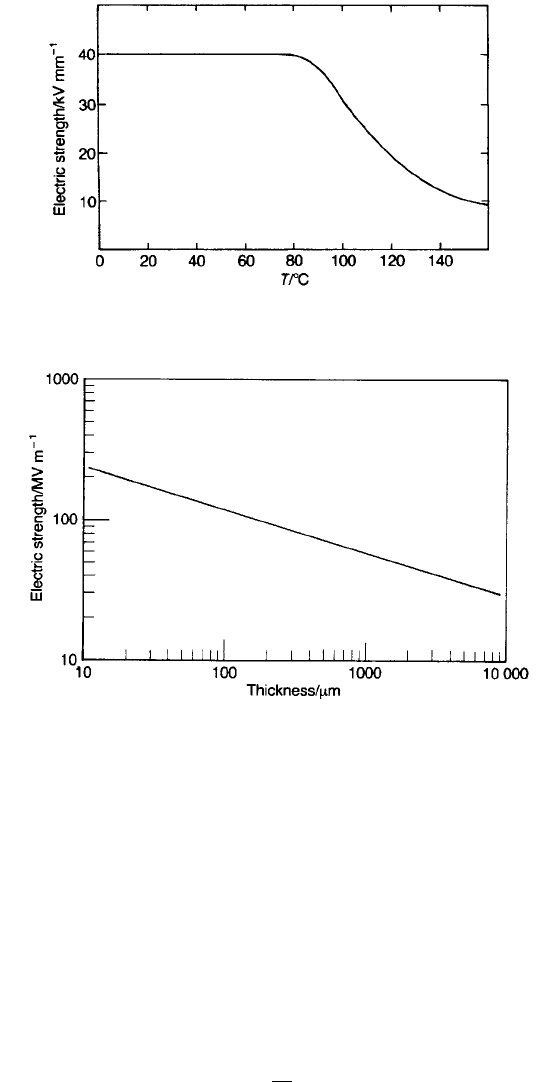
The effect of temperature on electrical breakdown for an aluminous porcelain
shown in Fig. 5.2 illustrates the expected marked decrease in strength arising
through thermal breakdown of the glassy phase initiated above a critical ambient
temperature (see Section 2.6.3).
Discharge breakdown
A ceramic is rarely homogeneous, a common inhomogeneity being porosity.
There is strong evidence to show that breakdown can be initiated at pores and
that the occurrence of gas discharges within pores is an important factor. There
DIELECTRIC STRENGTH 247
is a close apparent analogy with the mechanical strength of ceramics, where
probability of failure depends upon the occurrence of defects, one of which is
critical under the imposed conditions. Just as with the mechanical analogue,
electric strength depends upon specimen size, because a decrease in size reduces
the probability of occurrence of a critical defect at the given stress. A typical plot
of electric strength against specimen thickness is shown in Fig. 5.3.
The mechanism of breakdown originating from discharges in a pore is by no
means self-evident, but the starting point is that the electric field in a pore is
greater than that in the surrounding dielectric. For a disc-shaped cavity with its
plane normal to the applied field E, the field E
c
within the cavity is given by
E
c
¼
e
r
e
rc
E ð5:2Þ
248 DIELECTRICS AND INSULATORS
Fig. 5.2 Dependence of electric strength on ambient temperature for an aluminous porcelain.
Fig. 5.3 Dependence of the electric strength of alumina ceramic on specimen thickness.
where e
rc
is the relative permittivity of the cavity gas and has a value close to
unity, and e
r
is the relative permittivity of the dielectric. For a spherical pore
E
c
¼
3
2
E ð5:3Þ
provided that e
r
e
rc
.
When the voltage applied to a porous dielectric is steadily increased a value is
reached when a discharge occurs in a particular pore. Under d.c. conditions the
discharge is quickly extinguished as the field falls in the cavity. Then, following
charge leakage through the material, the sites will recharge until discharge occurs
again. The interval between discharges will depend upon the charge leakage time
re (see Eq. (5.10)), which can have minimum values of approximately 10
2
s for
ceramics at room temperature.
How discharges within pores lead to total breakdown of the dielectric is a
matter for debate. It may result from the propagation of a discharge ‘streamer’
through the ceramic, possibly progressing from pore to pore and encouraged by
the increased electric stress to which the material between discharging pores is
subjected and perhaps also by enhanced stress in the material close to a
discharging pore. Alternatively, failure might be a direct consequence of the
generation of heat by the discharge. Estimates of the rise in temperature in the
material immediately adjacent to a discharging pore range from a few degrees
Celsius for a low-permittivity ceramic such as alumina to about 10
3 8
C for high-
permittivity ferroelectric ceramics. Clearly the larger the pore is the more likely it
is to lead to breakdown.
DIELECTRIC STRENGTH 249
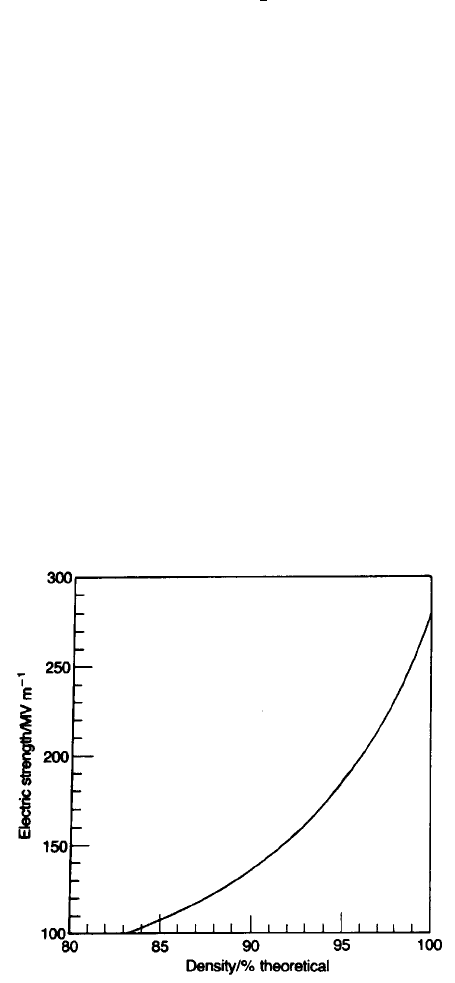
Fig. 5.4 Dependence of electric strength on specimen density (high-purity alumina).
Because discharges occur every half-cycle under a.c. conditions, breakdown is
more likely than in the case of applied d.c., when the leakage time determines the
discharge rate. Accordingly, a.c. breakdown voltages are lower than those for
d.c.
Although there may be doubt concerning the mechanisms by which discharges
lead to failure there is none regarding the fact that high electric strength is
favoured by low porosity. A typical plot of density against electric breakdown
strength is shown in Fig. 5.4.
Long-term effects
In some materials the prolonged application of electric stress at a level well below
that causing breakdown in the normal rapid tests results in a deterioration in
resistivity that may lead to breakdown. There are a large number of possible
causes, and the effects may not show up in the brief tests carried out during
development and production operations.
Among the possibilities are the effect of the weather and atmospheric pollution
on the properties of the exposed surfaces of components. They will become
roughened and will adsorb increasing amounts of moisture and conductive
impurities. Surface discharges may occur which will result in further deteriora-
tion due to local high temperatures and the sputtering of metallic impurities from
attached conductors.
Electrochemical action takes place under d.c. stress both on the surface and in
the bulk of materials. It may cause silver to migrate over surfaces and along grain
boundaries, thus lowering resistance. Sodium ions in glassy phases migrate in a
d.c. field and vacant oxygen sites migrate in crystalline phases. Such changes
result in local variations in electrical stress that contribute to breakdown.
The effects of differing geometries, materials and operating conditions provide
a large number of possibilities for eventual failure which can only be mitigated by
good design based on experience. Prolonged tests under practical running
conditions are necessary before a new material becomes generally acceptable.
Gradual processes that may lead to failure are discussed in the sections
concerned with particular materials (see Sections 5.4.1 and 5.6.2).
5.3 Thermal Shock Resistance
Thermal shock resistance (TSR) is of importance in both the fabrication and
applications of many electronic ceramics.
Precise evaluation of TSR is difficult for many reasons, one being that a failure
criterion which depends on the application has to be adopted. For example, a
refractory lining to a furnace may repeatedly crack during thermal cycling but,
250 DIELECTRICS AND INSULATORS

because its structure retains its overall integrity, it has not ‘failed’. However, a
glass beaker is usually regarded as having failed when it cracks. A criterion for
failure therefore has to be defined for every usage situation, and the same applies
to TSR testing. A small crack developed in a porous specimen need not constitute
‘failure’, but in a dense ceramic intended for advanced engineering applications it
probably would. TSR is very dependent upon component shape and this, together
with the precise mode of testing, is an important variable. Despite these real
difficulties a useful guide to TSR is the quantity ls
c
=a
L
Y,wherel is the thermal
conductivity, s
c
is the strength, Y is the Young modulus and a
L
is the coefficient
of linear expansion. Therefore materials with high l and s
c
and low Y and a
L
are
favoured for high-thermal-shock applications. Because s
c
=Y is approximately
constant (about 10
73
) for many ceramics, the significant parameters determining
TSR are l and a
L
. However, it must be emphasized that this is only a rough guide
and the matter of TSR, like electric strength, is extremely complex.
5.4 Capacitors
Capacitors can fulfil various functions in electrical circuits including blocking,
coupling and decoupling, a.c.–d.c. separation, filtering and energy storage. They
block direct currents but pass alternating currents, and therefore can couple
alternating currents from one part of a circuit to another while decoupling d.c.
voltages. A capacitor can separate direct from alternating currents when the
capacitance value is chosen such that the reactance 1/oC is low at the frequency
of interest; similarly it can discriminate between different frequencies. The charge
storage capability is exploited in, for example, the photoflash unit of a camera.
The operational capabilities of the various capacitor types are compared with
the help of the characteristics described below.
5.4.1 Capacitor characteristics
Volumetric e⁄ciency
Volumetric efficiency, as the name implies, is a measure of the capacitance that
can be accommodated in a given size of capacitor. In the case of a parallel-plate
capacitor of area A and electrode separation h,
C ¼ e
r
e
0
A
h
ð5:4Þ
and the volumetric efficiency C/V is given by
C
V
¼
e
r
e
0
h
2
ð5:5Þ
CAPACITORS 251