
Moulson A.J., Herbert J.M. Electroceramics: Materials, Properties, Applications
Подождите немного. Документ загружается.


that is it is directly proportional to the relative permittivity and inversely
proportional to the square of the dielectric thickness. Volumetric efficiency is an
important parameter, particularly in the context of multilayer ceramic capacitors
(see Section 5.4.3) where its maximization depends upon the development of
novel ceramic compositions and the technology of fabricating extremely thin and
electrically sound dielectric layers.
Of course, for a given working voltage U
w
, the dielectric thickness cannot be
reduced indefinitely because the electric field E ¼ U
w
=h would eventually attain
the breakdown value E
b
. In fact, to achieve acceptable reliability the working
voltage must be less than the normal breakdown voltage E
b
h by a factor Z so that
ZU
w
¼ E
b
h ð5:6Þ
From Eqs (5.5) and (5.6) the maximum permissible energy density is given by
CU
2
w
2V
¼
e
r
e
0
E
2
b
2Z
2
ð5:7Þ
Equation (5.7) indicates that e
r
E
2
b
is a figure of merit for dielectrics that are to be
used at high fields. The various types of capacitor are compared on the bases of
volumetric efficiencies and typical working energy densities in Table 5.1.
d.c. resistance
Ideally, the d.c. resistance of a capacitor is infinite, but in practice it will have a
finite value R
L
. In the case of the parallel-plate capacitor, and confining attention
to the dielectric,
R
L
¼ r
h
A
ð5:8Þ
where r is the resistivity of the dielectric. A charged capacitor will discharge
through its own resistance according to
QðtÞ¼Q
0
exp
t
t
ð5:9Þ
in which Q(t) is the charge remaining at time t, Q
0
is the original charge and
t ¼ R
L
C is the time constant of the capacitor. t depends only on the dielectric
material, as is evident from substituting from Eqs (5.4) and (5.8):
R
L
C ¼
h
A
r
e
r
e
0
A
h
¼ e
r
e
0
r ð5:10Þ
Although the above analysis is applicable to the great majority of standard
capacitors, there are exceptions. For example, where very high working voltages
(41 kV) are involved, the d.c. resistance may be determined by that of
252 DIELECTRICS AND INSULATORS
TEAMFLY
Team-Fly
®

interelectrode surfaces. To avoid this the outside surfaces of such capacitors need
to be kept scrupulously clean and dry.
Equivalent parallel and series resistance
When an a.c. voltage is applied to a perfect capacitor, no energy is dissipated.
However, a real capacitor dissipates energy because of lead and electrode
resistances, d.c. leakage resistance and, most importantly, dielectric losses. These
account for the capacitor’s ‘dissipation factor’ or ‘loss tangent’ tan d.Itis
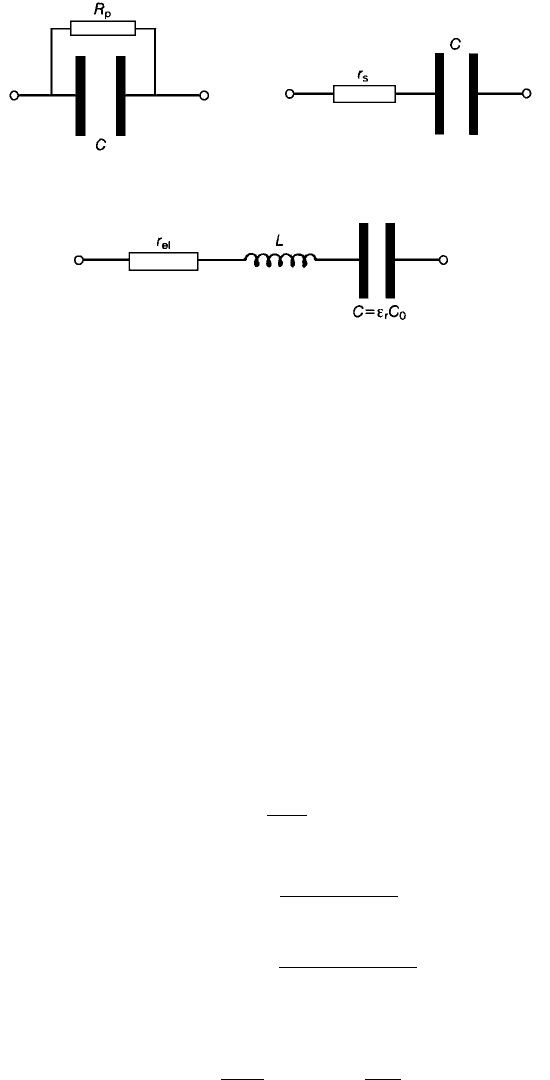
sometimes convenient to regard the ‘lossy’ capacitor as an ideal capacitor
shunted by a resistance R
p
or in series with a resistance r
s
, as shown in Fig. 5.5.
It is readily shown that
R
p
¼
1
oC tan d
and r
s
¼
tan d
oC
ð5:11Þ
According to Eq. (5.11) R
p
and r
s
are explicitly inversely proportional to o;
however, it must be remembered that, in general, C and tan d depend on o and
temperature. Therefore the matter is more complex than appears at first sight.
CAPACITORS 253
Table 5.1 Typical values of volumetric efficiency and energy density for the various types of
capacitor
Capacitor type
Volumetric efficiency
(mFcm
3
)
Typical working energy
density*
(mJ cm
3
)
Electrolytics
Aluminium 10 500
Tantalum chip 600 30
Double layer carbon (‘Supercapacitors’) 3 10
6
2500
Polymer film**
Wound 0.02–2 1–10
Multilayer polymer 5 1
Mica 5 10
3
not relevant***
Single layer ceramic
NP0/C0G 10
4
0.25
Z5U/Y5V 8 10
2
0:1
Ceramic multilayer
NP0/C0G 0.5 1.5
X7R 30 35
Z5U/Y5V 300 40
The values, derived from manufacturers’ data sheets, are only intended to permit general comparisons to
be made; capacitor coatings and cases are not allowed for in estimating volumes.
NP0/C0G, X7R, Z5U/Y5V are defined in Table 5.10 and Fig. 5.40.
*The values are calculated based on stated maximum ‘working’ voltages.
**The quoted values are an estimate from data for polystyrene, polypropene, polyester and polycarbonate
capacitors.
***Mica capacitors are used for stability in RF circuits where the energy density is irrelevant.
In considering the practical application of capacitors, the equivalent series
resistance (e.s.r.) is more significant since it carries the total current passed by the
capacitor.
Resonance frequency
The equivalent circuit for a capacitor shown in Fig. 5.6 is more representative at
high frequencies than those shown in Fig. 5.5, as it takes separate account of the
resistance r
el
and the inductance L of the leads and electrodes and of losses in the
capacitor dielectric (for the meaning of C* ¼ e
r
* C
0
, see Section 2.7.2).
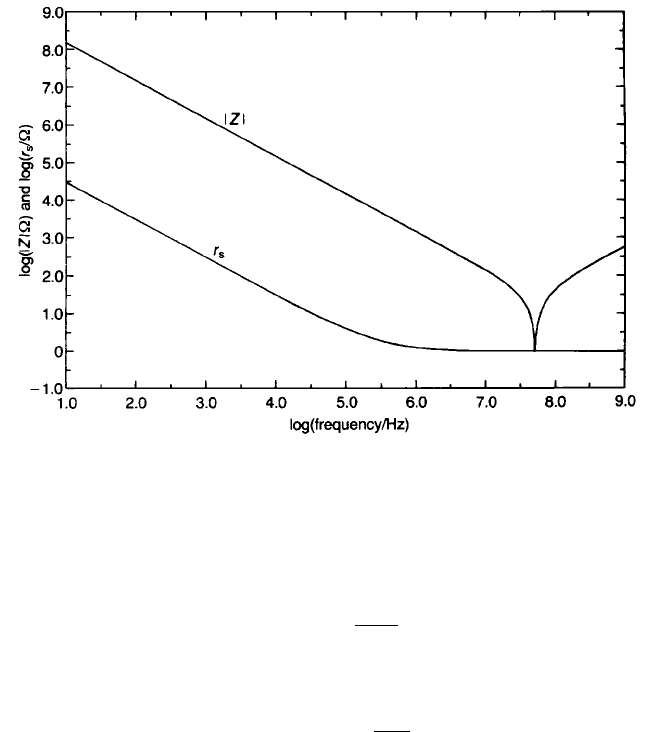
It is instructive to examine how the equivalent circuit for a typical capacitor
responds to frequency. As an example we choose a mica capacitor with the
following characteristics, which are assumed to be independent of frequency:
C ¼ 100 pF, L ¼ 100 nH, tan d ¼ 2 10
4
and r
el
¼ 1 O. Now
Z ¼ r
el
þ joL
j
oC*
ð5:12Þ
¼ r
el
þ j
(
oL
l
oC
0
ðe
0
r
je@
r
Þ
)
¼ r
el
þ j
oL
1 þ j tan d
oC
0
(1 þ tan
2
d)
!
ð5:13Þ
Because tan
2
d 1, it follows that
Z r
el
þ
tan d
oC
0
þ j
oL
1
oC
0
ð5:14Þ
254 DIELECTRICS AND INSULATORS
Fig. 5.5 Parallel and series resistance models of a lossy capacitor.
Fig. 5.6 Capacitor with series inductance and resistance.
in which the sum of the first two terms is the equivalent series resistance r
s
.
Evidently, as o increases, r
s
decreases and approximates to r
el
. Figure 5.7 shows
r
s
and jZj plotted as functions of o, where
r
s
¼ r
el
þ
tan d
oC
0
and
jZj¼
r
2
s
þ
oL
1
oC
0
2
1=2
ð5:15Þ
Clearly the resonance effect places an upper limit on the frequency at which the
capacitor can normally be used. Above resonance the reactance of a capacitor is
inductive (oL), and this is significant for some applications. For example,
ceramic multilayer capacitors, which are discussed later, are commonly used to
decouple high-speed computer circuits, and a prime function is to eliminate noise
which has frequency components above the resonance frequency. Therefore the
inductive reactance must be kept to a minimum.
Breakdown and degradation
Breakdown and degradation have been discussed in general terms in Section
5.2.2. Breakdown in a capacitor results in the replacement of a reactive insulating
CAPACITORS 255
Fig. 5.7 Frequency response of the equivalent series resistance r
s
and the impedance jZj for a
typical mica capacitor ( C ¼ 100 pF, L ¼ 100 nH, R
el
¼1 O, tan d ¼ 0.0002).
component by either a low-resistance short circuit or an open circuit, usually
with disastrous consequences as far as the overall circuit function is concerned.
The probability of its occurrence must therefore be kept to an absolute
minimum. Certain types of capacitor, e.g. metallized polyester film and
electrolytics, have self-healing properties such that a breakdown causes a brief
short circuit followed by a rapid restoration of normal reactive behaviour. So far
no method of making a ceramic unit self-healing has been devised, and therefore
recommended working voltages are usually about a factor of 5 below the
minimum breakdown voltage.
The breakdown field of a dielectric in a capacitor is generally well below its
intrinsic dielectric strength since it is largely governed by the concentration of
flaws (metallic inclusions, pores, surface roughness, etc.) and the design of the
electrode structure. For instance, metal from the electrode may penetrate into
surface cracks in a ceramic and form conductive spikes which will have high fields
at their tips. There will also be high fields at the edges of conductors in parallel-
plate structures. This is avoided by special design features in units intended for use
at high voltages, but these features result in increased bulk and cost.
The effects of moisture must be limited by ensuring that the residual porosity
in ceramics consists of isolated pores so that water does not penetrate into the
bulk. Units must be protected from humidity either by encapsulation in polymers
with a low permeability to water vapour or by enclosure in sealed metal cans.
Tests for long-term deterioration can be speeded up in some cases by
performing them at higher temperatures and using an Arrhenius relation to
estimate the probability of failure under normal working conditions. However, it
is essential to check the validity of the relation between failure rate and
temperature since there may be effects that are stronger at low temperatures than
at high. For instance, liquid water will disappear above 100 8C and so any
electrochemical effects occurring at lower temperatures will be eliminated.
Degradation must be distinguished from the process known as ‘ageing’ (cf.
Section 2.7.3) which occurs in ferroelectric materials. Ageing is due to the
presence of ferroelectric domains and to a change in the mobility of the walls
between them as time passes. The changes that occur in the properties do not
lead to an increase in the probability of breakdown, only to a limited fall in
permittivity and small changes in other properties. Since the dissipation factor
diminishes, ageing has some beneficial aspects.
5.4.2 Non-ceramic capacitors
It is desirable to have, as a background to a discussion of ceramic capacitors,
some knowledge of alternative dielectrics and the capacitor structures used with
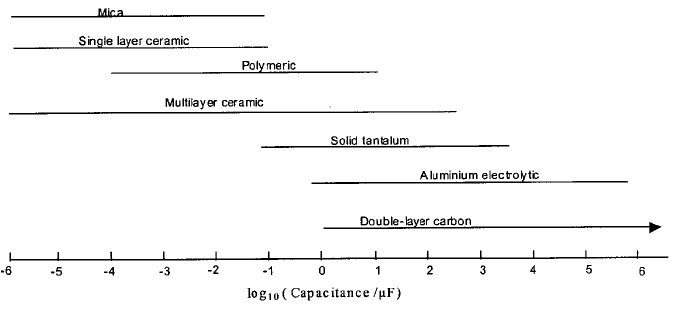
them. The principal types are described below and their capacitance ranges
indicated in Fig. 5.8.
256 DIELECTRICS AND INSULATORS
Polymer-¢lm capacitors
Essentially polymer-film capacitors comprise dielectric films (polymer or paper
or both together) interleaved with aluminium electrodes, either as aluminium
foil or, more commonly, in the form of a layer evaporated directly on the
dielectric, and rolled together. They are sealed in an aluminium can or in epoxy
resin. Because the dielectric films and evaporated electrodes have thicknesses of
only a few microns and about 0.025 mm respectively, volumetric efficiencies can
be high. The dielectric films are polystyrene, polypropylene, polyester,
polycarbonate or paper; paper dielectrics are always impregnated with an
insulating liquid.
The use of metallized electrodes on certain polymers provides the capacitor
with self-healing properties during manufacture and throughout its working life.
If breakdown should occur at a fault in the dielectric layer, the local heating
causes the deposited aluminium in the vicinity to evaporate, leaving an area bare
of metal around the hole produced by the breakdown.
Polystyrene capacitors have exceptionally low tan d values (510
73
), making
them well suited for frequency-selective circuits in telecommunications equip-
ment. Polymer capacitors are widely used for power-factor correction in
fluorescent lighting units, and in start/run circuitry for medium-type electric
motors used in washing machines, tumble-dryers and copying machines for
example. They are also used in filter circuits to suppress radio frequencies
transmitted along main leads. Such interference ‘noise’ may originate from
mechanical switches, furnace controllers and switch mode power supplies; it not
only spoils radio and television reception but can also cause serious faults in
data-processing and computer equipment.
CAPACITORS 257
Fig. 5.8 Capacitance ranges covered by commercial capacitor types.
Aluminium electrolytic capacitors
The aluminium electrolytic capacitor comprises two high-purity (99.99% Al)
aluminium foil electrodes, approximately 50 mm thick, interleaved with porous
paper and wound into the form of a cylinder. One electrode – the anode –
carries an anodically formed alumina layer approximately 0.1 mm thick. The
completed winding is placed in an aluminium can where the porous paper is
vacuum impregnated with one of a number of possible electrolytes (e.g. adipic
acid or ammonium pentaborate). The ‘formed’ aluminium foil is the anode, the
Al
2
O
3
layer is the dielectric and the electrolyte together with the ‘unformed’
aluminium foil is the cathode. After the capacitors have been sealed in the can,
they are ‘re-formed’ by subjecting them to a d.c. potential sufficient to heal any
possible damage to the oxide layer caused during manufacture. Provided that the
anode is maintained at a positive potential during use, minor breakdowns in the
Al
2
O
3
dielectric will be healed by electrolytic action. Both aluminium foils are
etched to increase their effective areas (by a factor of over 20 for low-voltage
capacitors) and this, together with the very thin dielectric, leads to high
volumetric efficiencies.
Aluminium electrolytic capacitors are exploited in a range of applications and
their relatively low cost makes them attractive for printed circuits for car radios,
stereo equipment, pocket calculators, digital clocks, etc. Also, the very high value
capacitors are used in large photo-flash equipment and for voltage smoothing.
A particularly important application for aluminium electrolytic capacitors is in
switch mode power supplies (SMPSs) which are now extensively used, especially
in computer systems. In this application the capacitor is used essentially to
smooth a rectified voltage, but it inevitably passes a ripple current I which,
because of the capacitor’s e.s.r., r
s
, leads to power losses I
2
r
s
. The switching
frequency determines the size of an SMPS, and frequencies have increased from
about 50 kHz to about 300 kHz over the past decade. This has led to the
multilayer ceramic capacitor’s challenging the aluminium electrolytic in this
important application, and the signs are that it will continue to do so.
Tantalum electrolytic capacitors
There are two types of tantalum electrolytic capacitor: ‘wet’ and ‘solid’. Both
varieties consist of a porous anode made by sintering tantalum powder at
1800 8C in vacuum. In the wet type the porous structure is impregnated with
sulphuric acid, anodized to form a thin layer of Ta
2
O
5
and encapsulated in a
tantalum container that also serves as the cathode. The use of sulphuric acid
gives a lower e.s.r. than that of the aluminium electrolytic and increases the
temperature range within which the unit can be run. In the solid type the liquid
258 DIELECTRICS AND INSULATORS
electrolyte is replaced by MnO
2
and the cathode can be graphite paint overlaid
with silver. The units may be encapsulated in a polymer.
Because tantalum capacitors are very stable with respect to temperature and
time and have high reliability, they are widely used, particularly in large main-
frame computers, military systems and telecommunications.
Double-layer carbon capacitors
When two electrodes are immersed in an electrolyte and a small potential
difference is applied between them, anions (negatively charged) move close to the
anode and cations (positively charged) move close to the cathode. Provided the
applied voltage is below the dissociation voltage for the electrolyte, electric
double layers are established close to the electrodes. The very small separation
(0.5–1.0 nm) of the opposite charges is mainly resonsible for the high electrical
capacitance associated with the double layers. The principle has been known for
more than a hundred years, but it is only within the last decade that interest in
double-layer carbon capacitors (DLCCs) has intensified.
In the DLCC the electrodes are carbon as this has an exceptional combination
of chemical enertness, electrical conductivity and low cost along with availability
as a material with high surface area to volume ratio. A variety of electrolytes is
used. If the electrolyte is aqueous then the applied voltage must be limited to
below approximately 1.2 V to avoid dissociation of the water molecule. Some
non-aqueous electrolytes are used that raise the operating voltage to close to 3 V.
The capacitance which can be packed into a given volume depends, of course,
upon the surface area (typically approximately 2500 m
2
g
71
) of the carbon
electrodes and this is commonly a woven carbon fibre cloth. A non-conducting
porous membrane separates anode from cathode. Single cells offering a
capacitance greater than 2000 F at 3 V are available commercially. Cells are
connected in series to raise the operating voltage.
The applications for the capacitors are many and varied but fall into three
main categories. One is to provide back-up power when batteries are changed or
the main power fails in, for example, video-recorders and cameras, or for TV
channel and car radio settings. In another type of application the capacitor is
used as the main power source, for example for toys and watches. It is also used
for the illumination of public information signs, the primary source being solar
power.
Other possible, and more significant, applications are in connection with road
transport, for example, ‘load-levelling’ and ‘regenerative braking’. In load-
levelling large capacitor power packs would be used in tandem with the primary
power source which may be a battery, a fuel cell or an internal combustion
engine (see Section 4.5.1). In regenerative braking the capacitor has the
CAPACITORS 259
capability to store energy extracted during braking, making it available for
subsequent acceleration.
A drawback inherent in the carbon capacitor is the low working voltage of the
basic cell. The high working voltages, for example 500 V, required for some
‘transport’ applications, necessitates connecting many capacitors in series, at the
cost of volumetric efficiency.
The capacitor is discussed in detail by R. Ko
¨
tz and M. Carlen [3].
Mica capacitors
Mica for use as a dielectric is obtained from the mineral muscovite
(KAl
2
(Si
3
Al)O
10
(OH)
2
) which can be cleaved into single-crystal plates between
0.25 and 50 mm thick.
One common construction consists of mica plates carrying fired-on silver
electrodes stacked and clamped together to form a set of capacitors connected in
parallel. The assembly is encapsulated in a thermosetting resin to provide
protection against the ingress of moisture which would increase both the
capacitance and tan d.
Special features of mica capacitors are long-term stability (for example,
DC=C 0.03% over three years), a low temperature coefficient of capacitance
(TCC) (+10–80 MK
71
) and a low tan d.
5.4.3 Ceramic capacitors
Of the various geometrical forms of ceramic capacitor, discs, tubes and
multilayer, world-wide production is dominated by the multilayer variety.
Since the first multilayer ceramic capacitor (MLCC) was introduced in the
early part of World War II there have been two principal development trends.
One is towards smaller sizes and higher capacitance values, that is towards
maximizing volumetric efficiency, and the other is cost reduction. These
developments have had to be accompanied by improved reliability, which
assumes increasing relevance as the number of capacitors in a given piece of
equipment, for example a PC or mobile phone, steadily increases.
These developments have only been possible because of a continuing
improvement in understanding of the basic solid state science of the ceramic
dielectrics, of the electrode metals and of the interaction between the two, and
particularly of the technologies of ceramic powder production and the MLCC
fabrication processes.
260 DIELECTRICS AND INSULATORS
Classes of dielectric
Ceramic dielectrics and insulators cover a wide range of properties, from steatite
with a relative permittivity of 6 to complex ferroelectric compositions with
relative permittivities exceeding 20 000. For the purposes of this discussion
insulators will be classed with low permittivity dielectrics, although their
dielectric loss may be too high for use in capacitors. Reference should be made to
Table 5.10 and Fig. 5.40.
Class I dielectrics usually include low- and medium-permittivity ceramics with
dissipation factors less than 0.003. Medium-permittivity covers an e
r
range of 15–
500 with stable temperature coefficients of permittivity that lie between +100
and 72000 MK
71
.
Class II/III dielectrics consist of high-permittivity ceramics based on ferro-
electrics. They have e
r
values between 2000 and 20 000 and properties that vary
more with temperature, field strength and frequency than Class I dielectrics. Their
dissipation factors are generally below 0.03 but may exceed this level in some
temperature ranges and in many cases become much higher when high a.c. fields
are applied. Their main value lies in their high volumetric efficiency (see Table 5.1).
Class IV dielectrics contain a conductive phase that effectively reduces the
thickness of dielectric in capacitors by at least an order of magnitude. Very
simple structures such as small discs and tubes with two parallel electrodes can
give capacitances of over 1 mF. Disadvantages are low working voltages, mostly
between 2 and 25 V and high losses. ‘Barrier layer’ capacitors are now very little
used and regarded as, practically speaking, obsolete.
Form and fabrication
Ceramic capacitors must either be low in cost in order to compete with polymer-
film units or must possess special qualities that assure them of a market. The
structure and method of manufacture of a capacitor are governed by a
combination of these requirements.
Discs and tubes Discs can be formed by dry pressing calcined and milled
powders containing some 5–10 vol.% of an organic binder. Alternatively, they
can be cut from extruded ribbon or band-cast tape. The pieces are fired in small
stacks and, when suitably formulated, do not adhere strongly to one another
during sintering. The furnace atmosphere must be fully oxidizing for composi-
tions (other than Class IV) containing TiO
2
, both at the peak temperature and
during cooling. After firing, silver paint is applied to the major surfaces and the
discs are briefly refired in a single layer at 600–800 8C.
The next stages are usually fully automated. The discs are fed between clips
formed from the tinned copper wire that will eventually form the leads. They are
first warmed over a heated solder bath which is then briefly raised so as to
CAPACITORS 261