
Moulson A.J., Herbert J.M. Electroceramics: Materials, Properties, Applications
Подождите немного. Документ загружается.

technologies in general can be found elsewhere, for example in the monograph
edited by W. Gerhartz [12] and in recent overviews [13,14].
During the few decades prior to 1980 the square magnetic hysteresis loop
ferrite ‘cores’ dominated computer memory technology. The binary information
was determined by the sense of the magetization around the core. They were
non-volatile and intrinsically ‘radiation hardened’ and still used in 1990 for
specialized applications, for example military, where those attributes were
essential. They have been totally displaced by the semiconductor memory
offering much higher storage density and speed. It is interesting that FeRAMS
(see Section 5.7.5), the ferroelectric analogue offering high storage density, high
access speed and non-volatility, are now manufactured commercially.
In the conventional tape-recorder the recording medium consists of small
needle-shaped particles dispersed in an organic binder and supported on a
flexible polymer film. The traditional recording technology is ‘longitudinal’, that
is the induced changes in magnetization occur in the place of the film. Most tapes
incorporate particles of g-Fe
2
O
3
(maghemite, which has a defect spinel structure)
that are synthesised chemically in the form of needles typically 0.2 to 0.5 mm long
with aspect ratios in the range 5 to 10. The needles are single domain and the
magnetic anisotropy arises as a result of the different demagnetizing fields along
the length and perpendicular to it (‘shape anisotropy’). The spontaneous
magnetization lies along the length of the needle and the coercive force is
typically in the range 50 to 100 kA m
1
.
The record/read head, positioned close to or in contact with the recording
surface, is essentially a gapped soft electromagnet (e.g. Mn-Zn ferrite) positioned
so that the fringing field in the gap intersects the magnetic particles in the tape.
The signal fed to the head coil modulates the field which, in turn, switches the
magnetization in the particles. In play-back mode the modulated magnetization
in the tape induces voltages in the coil as the tape moves relative to the head. The
‘bit’ length, the minimum distance between magnetization reversals, is about
1 mm, corresponding to one half wavelength in analogue recording.
Perpendicular recording, which involves magnetization changes normal to the
plane of the tape or disc, has attracted considerable interest because of the higher
storage density offered than with longitudinal recording. This is because the
magnetic state of a particular bit is not subjected to the demagnetizing field from
a neighbouring bit of opposite polarity, whereas in the case of longitudinal
recording it is, placing a lower limit on bit spacing. Small (typically
0.080.030.1 mm
3
) barium hexaferrite particles are arranged to lie with
their c-axes (the preferred direction of magnetization, or ‘easy’ direction; see
Section 9.2.2) perpendicular to the plane of the tape [12]. Although the
technology has not been adopted the interest stimulated the development of
routes to preparing suitable powders. These included both ‘mixed oxide’
followed by milling, and ‘chemical’, including ‘hydrothermal’ [15]. A rather novel
route involved fusing the barium and iron oxides with boric oxide to form a glass
532 MAGNETIC CERAMICS
TEAMFLY
Team-Fly
®
from which the barium hexaferrite particles were precipitated, the glass being
removed by acid dissolution.
Pure iron particles, coated to inhibit oxidation, are now used to an increasing
extent for data storage and may ultimately totally displace the ferrites.
The hard disk of a computer exploits thin magnetic metal films with a present-
day data storage capacity of about 10 Gb in
2
whereas in the case of flexible tape
memory systems incorporating magnetic particles the capacity is about 100 times
smaller.
Applications exploiting magneto-optical e¡ects
Magneto-optical recording exploits the Kerr effect which describes rotation of
the plane of polarization on reflection from a magnetic material. Both the Kerr
and Faraday effects (the latter describing rotation of the polarization plane on
passing through a transparent magnetic material) are exploited in optical signal
processing.
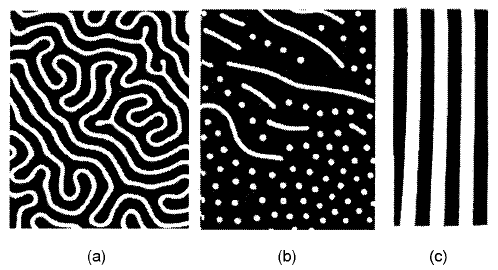
If a thin transparent layer of anisotropic magnetic garnet is viewed through a
crossed polarizer and analyser system in a microscope, a pattern of the type
shown in Fig. 9.50(a) is seen. This pattern is due to the Faraday rotation effect
which was discussed in Section 9.3.4. Domains magnetized in a direction normal
to the film rotate the plane of polarization of incident light in one sense while
those magnetized in the reverse direction rotate it in the opposite sense, so that
the domain pattern is observable in the light emerging from the analyser. If a
field is now applied normal to the film, one set of domains expands while the
other shrinks as magnetization in a single direction becomes established
(Fig. 9.50(b)). There is a stage before magnetization is complete when the
remaining domains, which have their magnetizations in the opposite direction to
APPLICATIONS 533
Fig. 9.50 The various domain structures observable in epitaxial iron garnet films: (a) maze,
(b) ‘bubbles’, and (c) stripe.
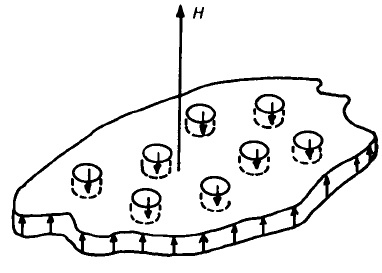
the field, are in the form of short circular cylinders with their axes normal to the
film and appear under the microscope as circular ‘bubbles’ (Fig. 9.51).
These effects are shown by all magnetic materials that have uniaxial
anisotropy, and the size of the stable bubbles is inversely proportional to the
saturation magnetization; thus barium ferrite and metallic cobalt give bubbles of
diameter about 0.05 mm and 0.01 mm respectively. Garnet is a cubic structure and
therefore does not have uniaxial anisotropy in the massive form. When it is
grown as a single-crystal epitaxial layer on a substrate of differing composition,
strain is induced by the mismatch between the lattice dimensions of the magnetic
garnet and the substrate. This is enhanced on cooling to room temperature by
the difference in thermal expansion between the two garnets and results in an
anisotropic axis normal to the film. The anisotropy and magnetization of the
film, and consequently the size of the bubbles, can be adjusted by replacing
yttrium by other rare earths and iron by other trivalent cations such as Ga
and Al. Y
2.6
Sm
0.4
Ga
1.2
Fe
3.8
O
12
is a typical formulation giving bubbles of
diameter 4–8 mm in films of similar thickness to the bubble diameter.
In 1990 there was strong interest in data storage devices which exploited trains
of small ‘bubbles’ injected into a garnet film; the presence or absence of a bubble
representing the binary-coded information. Bubble memories offered the
advantage of non-volatility but are now commercially unimportant because of
inadequate access speed.
It is also possible to develop ‘stripe’ domains as shown in Fig. 9.50(c), the
domain geometry being determined by fields applied in the plane and
perpendicular to it. The pattern as a whole can be rotated by rotating the in-
plane field. The stripe pattern, arranged to have an appropriate spacing by the
applied magnetic field, can act as a diffraction grating, the paths of light passing
through it being controlled through corresponding changes in the applied
magnetic field. The effect has the potential for switching signals in optical
communications systems (cf. Sections 8.3.5 and 8.4).
534 MAGNETIC CERAMICS
Fig. 9.51 Schematic diagram of bubbles showing directions of magnetization.
An important application for garnets is for isolators in optical communica-
tions systems. Reflections from end-faces of components and interconnections in
an optical transmission line have a destabilizing effect on the operation of the
laser sources and have to be eliminated. This is achieved using an optical
‘isolator’, the optical analogue (l typically in the range 1.30–1.55 mm) of the
microwave isolator described in Section 9.5.5.
An optical isolator comprises a magnetic garnet crystal plate sandwiched
between crossed polarizing elements, and a permanent magnet for applying the
necessary field. The device allows the transmission of forward light whilst
blocking any reflected light. Such isolators are incorporated in the semiconduc-
tor laser modules and so are miniaturized with overall dimensions typically
363 mm. Bi-substituted iron garnet is used for the active element because of its
low saturation magnetization and large rotating power, and rare-earth magnets
are employed to apply the appropriate magnetic field.
For one particular commercial isolator ((YBi)
3
(FeAl)
5
O
12
; precise details not
disclosed) an optical rotation of 1060 deg cm
71
is quoted for a wavelength of
1.55 mm which compares with 175 deg cm
71
for YIG (Y
3
Fe
5
O
12
). An additional
advantage offered by the substituted garnet is a smaller saturation magnetization
of 60 mT compared with 178 mT for YIG.
The substituted garnet plates can be produced by slicing from a single crystal
rod grown by the floating zone method or, more economically, from thick films
grown onto a host substrate by liquid phase epitaxy (see Section 3.11). The plates
are lapped, polished, coated with antireflection layers and then diced to produce
the final elements (2 mm side by 100 mm thickness) ready for assembly into
the isolator.
There are many potential applications for thin film magnetic garnets, including
wave-guiding in the plane of films, and image storage and display technologies.
The monograph by A.K. Zvezdin and V.A. Kotov [16] is recommended for a
comprehensive treatment of the materials and magneto-optical applications.
9.5.5 Microwave devices
The elementary description of microwave propagation in magnetically saturated
ferrites given in Section 9.3.4 provides a basis for an understanding of the
principles of operation of devices such as circulators, isolators and phase shifters,
all of which find extensive use in microwave engineering. For example, a
circulator might be used in a radar system where a single antenna is employed for
both transmitting microwave power and receiving a reflected signal, as shown
schematically in Fig. 9.52(a).
An isolator is a device which allows microwave power to be transmitted in one
direction with little attenuation while power flowing in the reverse direction is,
ideally, completely absorbed. It is used to avoid interaction between the various
APPLICATIONS 535
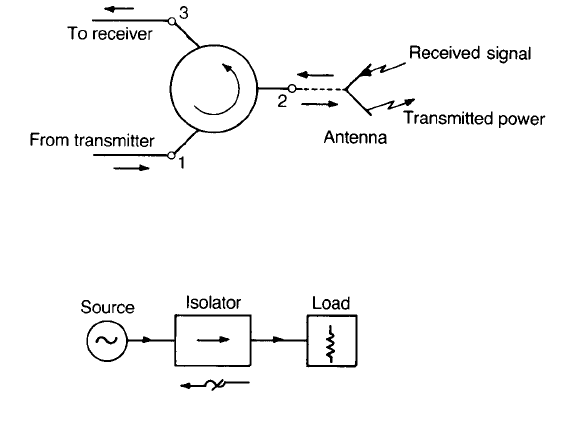
parts of a microwave system. For example, in high-microwave-power industrial
processing systems it is essential to prevent the high-power source – a magnetron
for instance – from instability and destruction due to reflected power from the
load. This function is illustrated diagrammatically in Fig. 9.52(b).
An example of the use of ferrite phase shifters is in a phased-array antenna.
This comprises an array of coherently radiating dipoles, in which the microwaves
from each are controlled in phase and amplitude. The main beam emitted is
produced by interference between the radiation from the individual elements; the
phase difference between the radiation from the individual dipoles determines the
attitude of the beam in relation to the array. Stepwise changes in the phase
differences thus make it possible to control the direction of the beam
electronically. In fact the individual phase shifters can be controlled by a
computer, thus enabling a single immobile array to perform inertialess search,
acquisition and tracking functions simultaneously on a large number of targets.
These devices are described in the following section, but first the Faraday
rotation isolator is briefly discussed because it illustrates the basic ideas; at one
time it was an important device but it has now been superseded, principally by
the junction circulator.
Faraday rotation isolator
Figure 9.53 shows the essential parts of a Faraday rotation isolator. The electric
field of the forward wave is perpendicular to the plane of the resistive card (a thin
536 MAGNETIC CERAMICS
Fig. 9.52 (a) Schematic diagram of a circulator for a radar system; (b) an isolator.
(a)
(b)
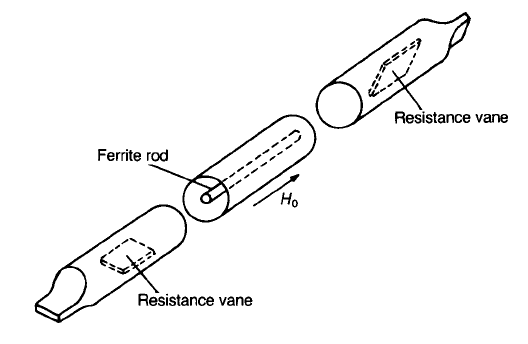
vane of absorbing material such as a coating of nichrome deposited onto a thin
glass strip) and so it passes it with little attenuation. The length and
magnetization of the ferrite and the applied field H
e
are chosen so that the
plane of polarization of the radiation is rotated by 458 in the correct sense for it
to pass into the right-hand guide without reflection. Radiation propagated in the
reverse direction will also be rotated by 458 so that the plane of polarization is
now at 90 8 to that of the forward wave. Therefore it will not propagate in the
left-hand guide, and also the resistive card will be in the same plane as the electric
vector so that the radiation is absorbed.
Although this type of isolator has largely been superseded by other types, it
has advantages at very high frequencies over devices which necessitate the ferrite
operating at resonance: the very high applied magnetic fields required for
millimetre wave resonance isolators are avoided.
Y-junction circulator
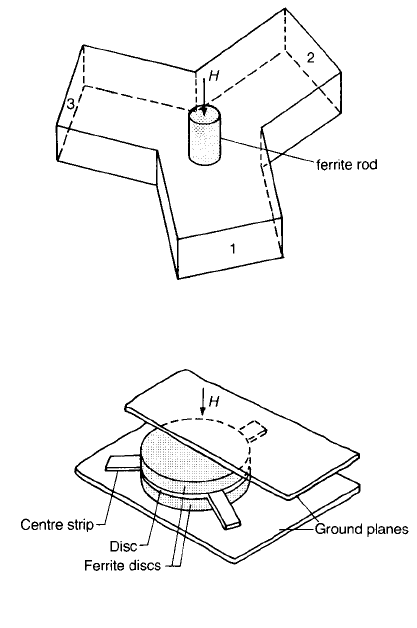
The most frequently used ferrite device is a three-port circulator in waveguide or
stripline configuration, as illustrated in Fig. 9.54. In the waveguide configuration
a ferrite cylindrical disc is located symmetrically with respect to the three ports. In
the stripline configuration two ferrite discs are placed on each side of the strips. In
both cases a magnetic field is applied perpendicular to the planes of the discs.
Unlike the case of the Faraday rotation isolator, even an elementary
description of the operational principle of the circulator is not easy, involving
as it does the dimensional resonance of the microwave field within the ferrite
cylinder. In this context the word ‘resonance’ does not signify ‘gyromagnetic
resonance’ but a standing-wave resonance determined by the dimensions of the
APPLICATIONS 537
Fig. 9.53 Faraday rotation isolator.
ferrite (cf. Section 9.3.1). In the particular resonance modes excited, the electric
field vectors are perpendicular to the plane of the disc. The field configuration
generated can be regarded as two counter-rotating patterns which, because of the
applied field H, do not resonate at the same frequency. This is because of the
different permeability values depending on whether the magnetic component of
the microwave field is rotating in the same or the opposite sense to that of the
electron precession. By appropriate choice of dimensions and biasing field,
depending on the operating frequency, the positions of the maximum and
minimum electric field can be made to coincide with the port positions. For
example, for power entering port 1 (Fig. 9.54(a)) the electric vector E can be
arranged to be zero opposite port 3, so that no voltage exists there and in
consequence no power leaves; because E is a maximum opposite port 2, power
passes through it. The device therefore acts as a transmission cavity with power
entering at port 1 and leaving at port 2. Because the device is symmetrical, power
entering port 2 will set up similar field configurations resulting in power leaving
538 MAGNETIC CERAMICS
Fig. 9.54 Y circulators in (a) waveguide and (b) stripline configuration.
(a)
(b)
port 3 and port 1 will be isolated. Similarly, power entering port 3 is transmitted
to port 1 and port 2 is isolated.
In addition to its use as a circulator, the device can be operated as an isolator,
by terminating one of the ports with a matched load, or as a microwave power
switch, by reversing the sense of the biasing field.
Phase shifters
The phase of a microwave passing along a guide can be shifted by inserting pieces
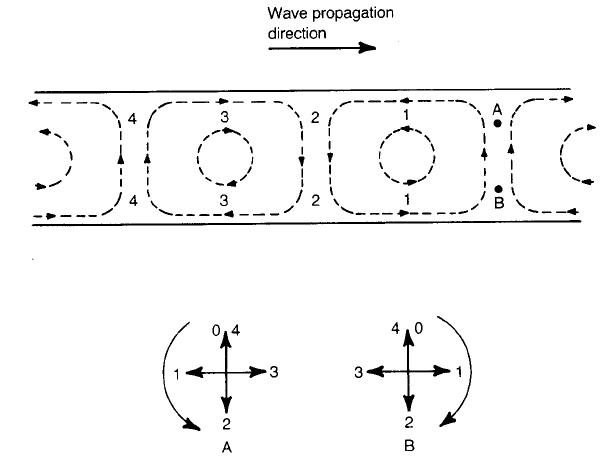
of ferrite at appropriate positions. For example, in a rectangular guide along
which the simplest microwave field configuration (TE
10
mode) is propagating, the
magnetic field component is circularly polarized in the plane of the broad face of
the waveguide at a distance approximately a quarter of the way across the guide;
on the opposite side of the guide the magnetic field component is circularly
polarized in the opposite sense. This can be seen from Fig. 9.55 which shows the
instantaneous magnetic field configuration looking down on the broad face of
the guide. As the pattern propagates from left to right the field directions at A
and B change as indicated, as the field configurations at points 1, 2, 3 and 4 arrive
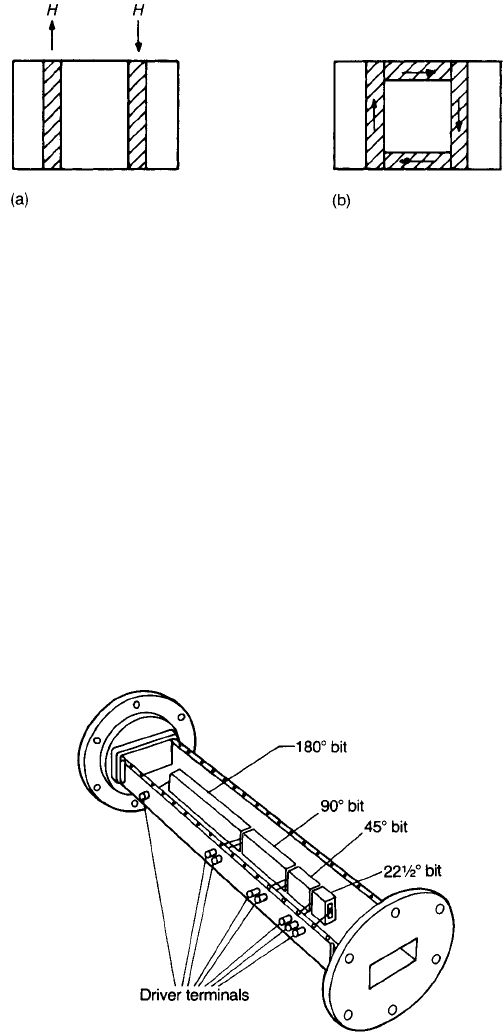
at A and B. Therefore if two slabs of ferrite are positioned in the guide and
magnetic fields, well below resonance strength, are applied as shown in Fig. 9.56,
the effective path length of the wave is altered and a phase shift is introduced.
APPLICATIONS 539
Fig. 9.55 Magnetic field configuration looking down on the broad face of a waveguide
propagating the TE
10
mode.
It is worth noting that if the ferrites are magnetized to resonance and a
forward wave is absorbed by the ferrite, it will be relatively unaltered in the
reverse propagation direction. The device can therefore function as an isolator.
A development of the configuration of Fig. 9.56(a) is to complete the magnetic
circuit using permanently magnetized ferrite pieces, as shown in Fig. 9.56(b); this
is the basis of the ‘latching ferrite phase shifter’. The static magnetization may
now correspond to positive or negative remanence. Thus the phase can be shifted
by a magnetizing pulse through wires threading the core. By using a series of
such phase shifters in the feeder to a dipole of an antenna, the overall phase shift
can be controlled over a range of steps as small as desired. The control is digital
and can therefore be computer directed, forming one element of a ‘phased-array
antenna’.
The way in which the ferrite parts are arranged in the guide is illustrated in
Fig. 9.57. Because considerable power can be handled by radar phase shifters the
540 MAGNETIC CERAMICS
Fig. 9.56 Phase shifters: (a) non-reciprocal isolating arrangement; (b) latching.
Fig. 9.57 Schematic diagram of a four-bit latching phase shifter; the driver terminals pass
current pulses along the central conductor to switch ferrite bits (cf. Fig. 9.56(b)).
inevitable heat developed has to be removed. This can be achieved by ensuring
good thermal contact between the ferrite and the metal parts. BeO and BN
ceramics can be designed in as heat sink materials.
Microwave ferrite types
Perhaps more than in most other examples that can be cited of materials
exploitation, designing a ferrite for a particular microwave application is a
compromise: a desired value for a particular parameter is generally achieved at
the expense of the optimum values of other parameters. Nevertheless, a select
number of spinel and garnet compositions have become favoured for microwave
applications.
As is evident from the discussion in Section 9.3.4, saturation magnetization is
an important parameter. In the nickel spinel family M
s
values ranging from 400–
40 kA m
71
(4pM
s
¼ 5000–500 G) can be tailored by substituting Zn
2+
for Ni
2+
to raise M
s
or by introducing Al
3+
to the B sites to lower M
s
. Lowering M
s
also
increases the power-handling capability of the ferrite since it partly determines
the power threshold P
c
(see Section 9.3.4) of the microwave at which spin-wave
resonance sets in. Nickel ferrites are used to best effect for applications at X-band
frequencies and above and, because of their large spin-wave linewidth, for
handling high peak power levels. Undesirable features of the nickel spinels are
their magnetic and dielectric loss factors which are higher than acceptable for
some applications.
The magnesium ferrites have M
s
values ranging from 200 to 40 kA m
71
(4pM
s
¼ 2500–500 G). Small additions of Mn
2+
are found to suppress the
formation of Fe
2+
which would increase dielectric losses due to electron
hopping. As in the case of nickel spinels, the addition of Al
3+
, which goes mainly
into the B sites, leads to a reduction in M
s
.
The lithium spinels Fe
2+
(Li
1þ
0:5
Fe
3þ
2:5
)O
4
have M
s
values ranging from 380 to
32 kA m
71
(4pM
s
¼ 4800–400 G). They have exceptionally high Curie tempera-
tures – up to about 670 8C – and so the M
s
values are relatively insensitive to
temperature under normal operating conditions. M
s
values can be reduced by the
substitution of Ti
4+
into B sites, with additional Li
1+
for charge compensation.
Coercivity can be tailored by the addition of Zn onto A sites which reduces
anisotropy; zinc addition also increases M
s
. Addition of Co
2+
increases the
power-handling capability (see Sections 9.1.7 and 9.3.1). Care has to be exercised
in the sintering to prevent the formation of Fe
2+
and consequent poor dielectric
properties; small quantities (about 1%) of Bi
2
O
3
are added to reduce sintering
temperatures and so alleviate the problem. Except for the low insertion loss,
where the garnets have a clear advantage, the lithium spinels are regarded as
having superior properties for most situations.
APPLICATIONS 541