
Vaccari D.A., Strom P.F., Alleman J.E. Environmental Biology for Engineers and Scientists
Подождите немного. Документ загружается.

called independent assortment. For example, the fruit fly Drosophila has four
pairs of chromosomes, one of each pair coming from each parent. However, its egg
cells, which are haploid, may contain chromosome 2 from the father and chromo-
somes 1, 3, and 4 from the mother, or any other combination.
10. All of the genes on a chromosome tend to segregate together. Therefore, genes on
the same chromosome are not assorted independently. Their traits tend to be passed
on to the next generation toge ther. The tendency for genes on the same chromo-
some to be inherited together is called gene linkage.
11. Recombination caused by crossing-over in meiosis acts to weaken linkage
between genes on the sam e chromosome. Because of crossing -over, a maternal
chromosome in a gamete may include pieces of the paternal chromosome. The
closer together two genes are located, the less likely that crossing-over will
separate them and the stronger will be their linkage. Two genes that are at extreme
ends of the same chromos ome will exhibit weak linkage and in fact may show
independent assortment, behaving as if they were on different chromosomes.
6.1.1 Mendel’s Experiments
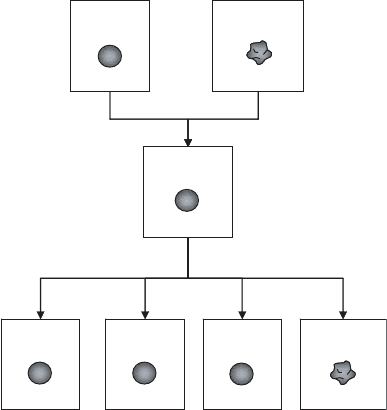
Mendel studied the inheritance of seven traits in the pea plant. For example, one trait was
seed shape. Mendel had a variety that produced either round or wrinkled seed. He started
with two sets of true-breeding plants, one that produced only round seeds and another that
produced only wrinkled seeds. When he crossbred them with each other, all of the off-
spring had round seeds (see Figure 6.1). It would seem that the ability to produce wrinkled
seeds had been lost. However, if a number of plants produced in this way were allowed
to self-fertilize (self-pollination is the normal mode of fertilization in the pea plant),
one-fourth of the offspring had wrinkled seeds!
Round
seeds
(RR)
Wrinkled
seeds
(rr)
All round
seeds
(Rr)
Round
seeds
(RR)
Round
seeds
(Rr)
Round
seeds
(Rr)
Wrinkled
seeds
(rr)
True-breeding
(homozygous)
parent
generation
F
1
generation
(all heterozygous)
F
2
generation
Self-fertilization
Figure 6.1 Cross-breeding between two pea plants homozygous for seed shape. (Based on
Postlethwait and Hopson, 1995.)
118
GENETICS
The explanation for this result is as follows. True-breeding plants are those that have
been self-bred for many generations. As Problem 6.1 shows, this results in plants that are
homozygous in all their genes. If we represent the gene for seed shape by R for round seed
and r for wrinkled seed, the true-breeding round-seed plant would have its two alleles
represented by RR, and the homozygous wrinkled-seed plant would have genotype rr.
The round-seed plant could produce only one type of gamete: R. Similarly, the
wrinkled-seed plant could only produce r gametes. Thus, the offspring produced by mat-
ing these two plants could only be heterozygous: Rr. The fact that all of the offspring of
this generation had round seeds demonstrates that R is the dominant allele and r is the
recessive.
The offspring, being all heterozygous, produce gametes half of which are R and half r.
Randomly mating these would produce genotypes of about 25% RR, 50% Rr, and 25%
rr. Since R is dominant, both RR and Rr, or about 75% of the offspring, would have
round seeds. The remainin g 25% are homozygous recessive and would express the
gene for wrinkled seeds. The reappearance of the wrinkled phenotype and the proportions
involved proved Mendel’s hypothesis of the particulate transmission of hereditary traits,
the principles of paired alleles, the existence of dominant and recessive alleles, and the
existence of segregation of alleles in gametes.
Mendel demonstrated the principle of independent assortment by examining the phe-
notypes for two genes at a time in similar experiments. Another phenotype of Mendel’s
pea plants had to do with seed color. Yellow seeds were dominant over green seeds in his
variety. True-breeding plants with yellow round seeds would be homozygous for both
genes (YYRR). True breeding plants with green wrinkled seeds would also be homozy-
gous, but in this case, they would be double recessive for both traits (yyrr). A cross
between these two plants could only be YyRr, heterozygous for both traits, and therefore
expressing the dominant yellow, smooth seed phenotype.
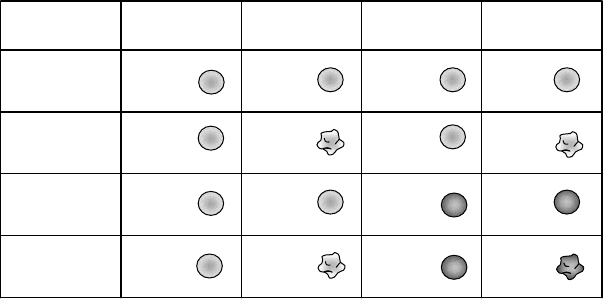
However, the gametes of these offspring could be of four types: YR, Yr, yR,oryr.
When allowed to self-fertilize, the possible crosses can be found by constructing a
Punnett square (Figure 6.2). The possible gametes are listed along the top and left.
Each type has equal probability of occurring. Thus, each cross represented by a box
within the square occurs in the same proportion of the population. Just as expected
from the single- trait experiment, one-fourth of the population will have wrinkled seeds
yyrr
Green,
Wrinkled
yyRr
Green,
Smooth
Yyrr
Yellow,
Wrinkled
YyRr
Yellow,
Smooth
yr
yyRr
Green,
Smooth
yyRR
Green,
Smooth
YyRr
Yellow,
Smooth
YyRR
Yellow,
Smooth
yR
Yyrr
Yellow,
Wrinkled
YyRr
Yellow,
Smooth
YYrr
Yellow,
Wrinkled
YYRr
Yellow,
Smooth
Yr
YyRr
Yellow,
Smooth
YyRR
Yellow,
Smooth
YYRr
Yellow
Smooth
YYRR
Yellow,
Smooth
YR
yryRYrYR
Gamete
Genotype
Figure 6.2 Dihybrid cross. The gametes are formed by plants that are heterozygous for both traits.
HEREDITY 119

and one-fourth will be green. Assuming that two events are independent, elementary
probability theory gives the chance of them occurring simultaneous ly as the product of
the two probabilities:
1
4
1
4
¼
1
16
. This is the proportion shown in the Punnett square to
be both green and wrinkled.
If the seed color and shape genes were linked by being on the same chromosome, the
gametes listed across the top of Figure 6.2 would not occur with equal probability. For
example, suppose that the two genes were so close together that meiotic recombination
practically never separates them. Then one chromosome comes from the YYRR plant and
the other from the yyrr. Only YR and yr gametes would be produced, and one-fourth of
the next generation would have green, wrinkled seeds. Of course, the strength of the link-
age can vary, producing a range of distributions.
By looking at the proportions of different phenotypes in breeding experiments, geneti-
cists can determine if genes are linked, establishing that they are on the same chromo-
some. By examining the strength of the linkage, a relative distance can be determined
between genes. This led to the development of genetic mapping, the determination of
the relative position of genes on a chromosome. Genetic mapping was invented by an
undergraduate student, Alfred H. Sturtev ant, while he was working with Thomas H. Morgan,
the scientist who first explained linkage.
A gene may have more than two types of alleles associated with it. For example, the
basic human blood types A, B, AB, and O are caused by the combination of three alleles:
A, B, and O. Allele A results in a sugar called type A to occur on the surface of a person’s
red blood cells. Allele B results in a different sugar called type B. Allele O does not result
in the formation of any sugar. Alleles A and B are codominant; that is, both are expressed.
A person who is heterozygous AB produces cells with both sugars and has blood type AB.
A person with genotype either AA or AO will have only type A sugar and will have blood
type A. Genotypes BB or BO result in type B blood. Allele O is recessive, so to have type
O blood, a person must have homo zygous genotype OO. In this case, a single gene with
three alleles results in six possible genotypes but only four phenotypes.
Some factors, such as height or stature, are controlled by two or more pairs of genes,
giving rise to a range of phenotypes. Traits resulting from two or more genes are called
polygenic. In addition, some alleles can be associated with more than one phenotypic
effect. Other genes can have their expression modified by environmental effects.
6.1.2 Sex Chromosomes
Recall that the somatic cells in animals contain chromosomes in pairs that are similar.
After replication, each chromosome looks like a pair of sausages tied together. The
pairs may have varying lengths and they may be bound at different points. If bound
near the middle, they resemble an X. If bound near one end, they look like a Y. However,
in most animals one pair can be dissimilar. The chromosomes of one of the 23 pairs
in humans are called sex chromosomes. It contains the genes that determine a person’s
gender, among other things. In females, both chromosomes of this pair are X’s; in
males one of the pair is much smaller and has the Y form. The Y chromosome contains
a gene for a factor that stimulates the formation of male sexual structures, and thence
the male sex hormones. The absence of this gene results in the formation of a female.
Thus, each cell in a female contains an XX pair of sex chromosomes, and each cell in
a male contains an XY pair. Chrom osomes other than the sex chromosomes are called
autosomes.
120 GENETICS
Because the chromosome pairs are separated by meiosis in the formation of gametes,
the gametes from females (egg cells) can have only X chromosomes. Half of the gametes
from males (sperm cells) have X and half have Y chromosomes. Thus, the sperm deter-
mines whether the individual resulting from fertilization will be male or female.
6.1.3 Genetic Disease
Many diseases are caused by genetic defects. The corresponding alleles may be dominant
or recessive and may be found on autosomes or on sex chromosomes. Some genetic dis-
eases are associated with extra chromosomes or missing pieces. An example of a domi-
nant autosomal genetic disease is Huntington’s disease. It results in neurological
degradation leading to death. Because the symptoms do not appear until a person is
about 40 years old, the victim may already have produced a family, potentially passing
the trait on. The children of the victim are left knowing that they have a 50% chance
of having the disease themse lves. Since the 1980s, it has been possible to test these
offspring for the gene, which, however, results in several types of ethical dilemmas
(see Problem 6.2).
Many genetic diseases are caused by recessive genes on autosomal chromosomes.
Albinos have a recessive defect on chromosome 11, which prevents formation of pigments
in skin, hair, and eyes. Cystic fibrosis is caused by a chromosome 7 gene, which results in
a defect in a membrane protein. Affected individuals produce excessive mucus, which
harms respiratory and digestive function. One in every 11,000 persons born in this country
inherits a defect in chromosome 12, resulting in phenylketonuria. Those affected lack
an enzyme to metabolize the amino acid phenylalanine. The condition exhibits partial
dominance. Heterozygous individuals have about 30% of the enzyme activity as normal
people. Unchecked, it can cause retardation. However, routine screening at birth makes it
possible to avoid disease symptoms by careful dietary control. In addition, affected people
must avoid foods containing the artificial swe etener Aspartame, which is an amino acid
dimer of phenylalanine and aspartic acid.
Several conditions are caused by recessive alleles on the X chromosomes. Since males
have only one copy of X, they can inherit these conditions only from their mother. Exam-
ples of these conditions are color blindness for green, inability to form the enzyme
glucose-6-phosphate dehydrogenase, Duchenne muscular dystrophy, and two forms
of hemophilia. Since many X-linked genetic disease s are fatal when homozygous, only
heterozygous females survive gestation. They themselves do not exhibit the disease
and are called carriers. They pass the gene for the disease to (on average) half their
daughters, who also become carrie rs, and to half their sons, who exhibit symptoms of
the disease.
Another type of genetic disease is that related to chromosomal abnormalities such as
extra or missing chromosomes, chromosome breakage, or translocation (the exchange of
genetic material between chromosomes). Errors during meiosis can cause extra or missing
chromosomes. A person with a single X chromosome and no Y becomes a sterile female.
Some people have one or more extra sex chromosomes. One in 1000 males is XXY. These
individuals are ste rile, have tall stature and diminished verbal skills, yet normal intelli-
gence. One in 1200 females is XXX. Many are normal, but some exhibit sterility and
mental retardation. XYY males tend to be above average in height and below normal
in intelligence. Prison inmates have been found to have a higher incidence of this disorder,
although XYY males in the general population do not show any unusual tendencies.
HEREDITY 121
Missing autosomes are usually fatal before birth, and extra autosomes are fatal in infancy,
with the exception of the smallest autosome, number 21. Having three chromosomes is
called trisomy. Trisomy 21 is the cause of 95% of Down syndrome. Affected persons
show numerous characteristics, including an eyefold similar to thos e of oriental people,
short stature, and small heads. They are retarded and susceptible to various diseases,
including respiratory and heart problems, and to Alzheimer’s disease in older persons.
The rate of Down births increases rapidly with the age of the mother, from 1 in 1000
at age 30, to 1 in 100 at age 40, and 1 in 50 at age 45.
Cancer is a result of a series of mutations (see Section 6.2.3). If some of these are
inherited, a person is more susceptible to cancer, since fewer mutations remain to
occur. For example, a gene associated with breast cancer has been discovered on chromo-
some 17 that is responsible for about 10% of all cases. Women with the mutation have an
80 to 90% chanc e of contracting the disease.
6.2 MOLECULAR BIOLOGY
In recent times the most dramatic advances in biology are coming from the field of mole-
cular biology. Although this title could describe any area of biochemistry, it is usually
taken to represent the study of processes involving genetic material that controls the activ-
ity and destiny of every individual cell. Genetic processes determine how cells differenti-
ate into brain cells and stomach cells. Genetic control ensures that the brain cells do not
secrete hydrochloric acid, as the stomach cells do.
It may seem incredible that the 23 DNA molecules in the haploid human genome can
contain enough information to descr ibe a human being completely. A simple comparison
can be made to memory in a binary computer. Each of the 3.2 billion positions in the
human genome can be occupied by one of four nucleotides. The number of possible com-
binations is 4
3.2 billion
, which is 2
6.4 billion
. Thus, the human genome has the information
capacity of a 6.4-gigabyte binary memory. Think about how much memory would be
required to specify the design of a human. The brain alone consists of about 10
12
nerve
cells, each with an average of 10
3
connections! A way around this paradoxical situation is
to consider that the genes might only specify a set of rules that generate the structure
rather than the detailed design of the structure. The new mathematical fields of chaos
and complexity theory described in Section 2.5 show that exquisitely detailed structures
can result from exceedingly simple rules.
Even more surprising is to discover that the human genome codes for only about
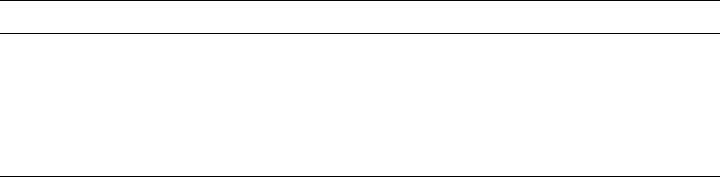
25,000 polypeptides (Table 6.1). Details of the remarkable mechanism by which the
TABLE 6.1 Amounts of Genetic Material in Several Organisms
Organism Nucleotides Genes Chromosomes
Homo sapiens 3.2 billion 20,000–30,000 23
Drosophila melanogaster (fruit fly) 120 million 12,500 4
Saccharomyces cerevisciae (yeast) 15 million 6,000
E. coli 4 million 4,000 1
Bacteriophage l 45,000 (est.) 35–40 1
HIV (AIDS) virus 9
Source: Based on Klug and Cummings (1997).
122 GENETICS
DNA code is transformed into those proteins are summarized below. Several of these
processes have environmental significance. Others are of interest simply because they
explain the working of the machine of life, or for the utilitarian reason that scientists
are learning to manipulate (i.e., ‘‘engineer’’) the processes to our own purposes, and
we wi ll have to make societal and individual choices about their use. We are interested
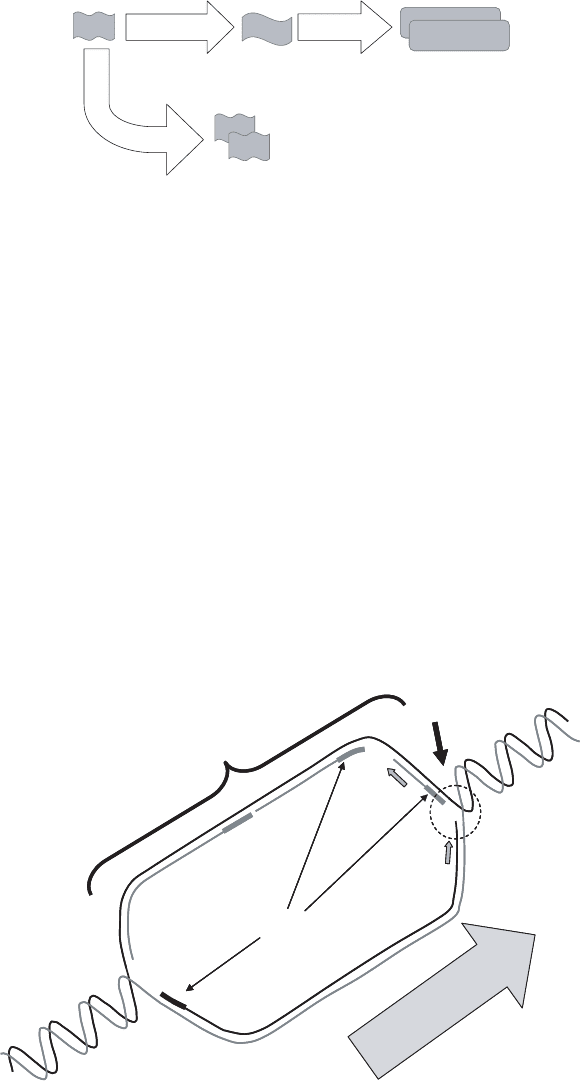
primarily in three processes (Figure 6.3), which we discuss in turn.
Replication is the production of two DNA molecules from one. As described in Sec-
tion 4.6, this occurs during the interphase of mitosis as the cell prepares to divide. The
basic mechanism is similar for prokaryotes and eukaryotes. The DNA of eukaryotes exists
in the nucleus wrapped around a complex of special proteins called histones. The com-
plex must be dissociated for replication to occur. Furthermore, eukaryotes typically have
on the order of 10,000 times as much DNA as prokaryotes, and it is present in a number of
linear DNA molecules rather than a single ring as in prokaryotes. It would be worthwhile
at this point to review the description of nucleic acids in Section 3.6.4.
The replication process starts with an uncoiling of the DNA double helix. Then
the double strands are separated at a special origin, forming a replication bubble (see
Figure 6.4). Replication then proceeds along the DNA molecule, expanding the bubble
DNA
Replication
DNA
DNA
Transcription
mRNA
Translation
Polypeptide
Figure 6.3 Cell processes involving genetic material.
3’
5’
5’
3’
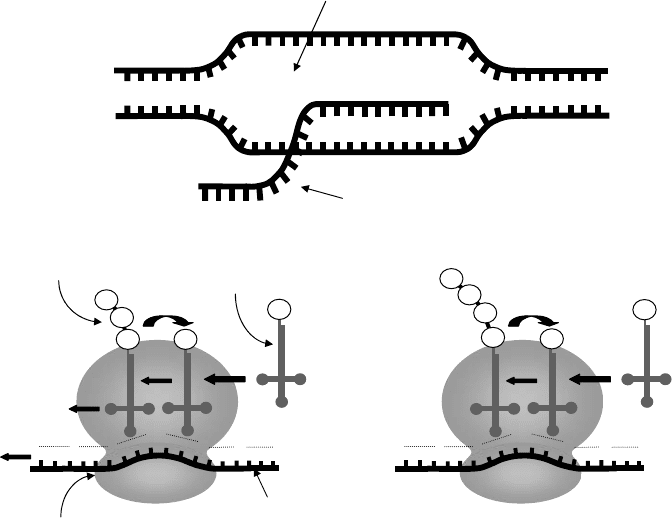
Primers
Overall direction
of DNA synthesis
Replication fork
Replication
bubble
Overall direction
of DNA synthesis
Figure 6.4 DNA replication, showing how the replication fork proceeds, opening up the
replication bubble and leaving two complete double strands behind it.
MOLECULAR BIOLOGY 123
in one direction only. The point where the DNA separates at the end of the replication
bubble in the direction of synthesis is called the replication fork. Prokaryotes have
only one replication fork, whereas eukaryotic DNA has tens of thousands. Thus, eukar-
yotic DNA replication can occur simultaneously at numerous points on the molecule,
increasing the overall speed of the process.
A short piece of RNA known as a primer is attached to the DNA at the origin. This
provides a free nucleotide end for the DNA chain to start building on. Free nucleotides
diffuse into the replication fork and pair up with the exposed nucleotides on the single
strands of DNA. Recall, as shown in Figure 3.14, that the two strands of the DNA run
in opposite directions, and the two ends can be designated by the terminal bonding carbon
number on the base: namely, either 3 or 5. DNA synthesis can proceed only in a direction
toward the 5
0
end of the molecule. Since the two strands run in opposite directions, the
‘‘wrong’’ strand has to add new primers repeatedly as the fork moves along, and synthesis
proceeds backward in short segments. The primers are removed periodically and the gaps
filled.
The final step is the formation of the ester bonds between the phosphate groups and the
sugars, linking the adjacent nucleotides togethe r. This is accomplished by a group of
enzymes known as DNA polymerase. A DNA polymerase molecule moves along the
pair of separated DNA strands just behin d the replication fork. The replication fork and
the DNA polymerase travel along the DNA strand, leaving two complete double helix
strands in their wake. Each cell has several types of DNA polymerase. Because prokar-
yotes have only a single DNA molecule with a single o rigin of replication, they have few
molecules of the main form of DNA polymerase (15, in the case of Escherichia coli).
Eukaryotes, on the other hand, have about 50,000, so as to be able to copy the large gen-
ome rapidly. As we shall see, DNA polymerase is also an important tool in genetic engi-
neering.
Not infrequently, the wrong nucleotide will have moved into position for polymeriza-
tion. DNA polymerase can detect these mistakes, back up, remove the offending nucleo-
tide, and then continue forward again. This is called proofreading, and it greatly
increases the accuracy of the replication. The overall error rate is about 10
9
. Thus, a
human egg or sperm with its 3.2 billion base pairs will have an average of three errors
each. Some of these errors will have minor effects; others will render the zygote nonvi-
able, resulting in a spontaneous abortion. Some errors may result in hereditable defects,
and a very few may actually produce hereditable advantages to offspring. Advantageous
errors contribute to the natural variation that drives evolution.
6.2.1 Protein Synthesis
Each gene contains the instructions that determine the sequence of amino acids in a single
polypeptide. (Recall that a protein consists of one or more polypeptides). As described in
Section 3.6.4, each sequence of three nucleotides, which is called a codon, codes for one
amino acid. The four nucleotides can form codons in 4
3
¼ 64 ways. Since there are only
20 amino acids, most can be coded by more than one codon. Thus, it is said that the code
is degenerate. In addition, there is one codon to indicate START, the beginning of a gene,
and several to indicate STOP at the end. The START codon also indicates the amino acid
methionine, making it the only codon with two purposes. Table 6.2 is a complete list of
codons with their corresponding amino acids.
124 GENETICS
Remarkably, the coding scheme is nearly universal in all organisms, from bacteria to
humans. This underscores the unity of life and makes it seem likely that all living things
on Earth arose from the same primitive organisms. Of practical significance is the fact that
a gene from a human, when inserted into bacteria by genetic engineering techniques
described below, can be expressed by the bacteria. In other words, bacteria can be
made to produce human protei ns.
Now, let’s examine the mechanism by which the DNA code results in protein synthesis.
The two fundamental steps are called transcription and translation. Transcription converts
the DNA code into an intermediate molecule called messenger RNA (mRNA). The mRNA
leaves the nucleus for the cytoplasm, where it combines with ribosomes in the process of
translation, wherein the mRNA sequence is translated into an amino acid sequence, pro-
ducing a polypeptide. Translation occurs on the ribosomes, using the mRNA as a tem-
plate. Another type of RNA, called transfer RNA (tRNA) acts as a ‘‘shuttle,’’ bringing
individual amino acids to the mRNA–ribosome complex, where they are polymerized into
the protein. With this outline of the process, let us now examine it in more detail.
The DNA never leaves the nucleus, so transcription occurs in the n ucleus. Transcrip-
tion, or mRNA synthesi s, is catalyzed by the enzyme RNA polymerase. The RNA poly-
merase particle is thought to ‘‘patrol’’ the DNA molecule until it comes upon one of
several specific sequences of nucleotides called promoters. The promoter is a signal to
start forming mRNA from the DNA template. It is located a fixed number of nucleotides
before the actual beginning of the gene (usually, 10 to 35 bases upstream). Unlike DNA
replication, no primer is needed, just the AUG start codon. The RNA polymerase simply
begins to link nucleotides togethe r, complementary to the template strand of DNA.
Wherever the DNA has an adenosine residue, the mRNA is given a uracil, T produces
TABLE 6.2 mRNA Coding Dictionary
Second Position
First ——————————————————————————————— Third
Position U C A G Position
U UUU phe UCU ser UAU tyr UGU cys U
UUC UCC UAC UGC C
UUA leu UCA UAA STOP UGA STOP A
UUG UCG UAG STOP UGG trp G
C CUU leu CCU pro CAU his CGU arg U
CUC CCC CAC CGC C
CUA CCA CAA gln CGA A
CUG CCG CAG CGG G
A AUU ile ACU thr AAU asn AGU ser U
AUC ACC AAC AGC C
AUA ACA AAA lys AGA arg A
AUG met ACG AAG AGG G
START
G GUU val GCU ala GAU asp GGU gly U
GUC GCC GAC GGC C
GUA GCA GAA glu GGA A
GUG GCG GAG GGG G
MOLECULAR BIOLOGY 125
A, C produces G, and G produces C. For example, if a section of the DNA template has
the bases TACGGTGAT, the resulting mRNA will be AUGCCACUA, with the following
resulting amino acid (AA) sequence:
DNA : TAC GGT GAT
RNA : AUG CCA CUA
AA : methionine proline leucine
Note that the other complementary DNA strand is not directly involved. Although it
could be used to form mRNA b y another RNA polymerase working in the opposite direc-
tion, in most cases this is not a functional gene. Furthermore, in eukaryotes only, most
genes have sections within their sequence that do not ultimately code for amino acids.
These sections are called introns. The sections that do code for amino acids are called
exons. Initially, the eukar yotic mRNA contains both. The introns are excised and the
remaining exons spliced together before the mRNA goes on to participate in protein
synthesis. Whether introns perform any function is unknown.
In prokaryotes, the mRNA can enter the translation process to produce proteins even
before its synthesis is completed. As one end of the RNA is being synthesized, proteins
can be produced at several points along the already completed length. In eukaryotes,
however, the mRNA must first diffuse out of the nucleus into the cytoplasm. In either
case, the mRNA then associates with a ribosome particle to begin the translation process
(Figure 6.5).
The transfer RNA (tRNA) is relatively small, consisting of only 75 to 90 nucleotides
(Figure 6.6). One form exists for each amino acid. The tRNA are folded and looped to
form a ‘‘cloverleaf’’ structure. The amino acid binds to a section near the paired ends
of the molecule. One of the loops has three chemically modified nucleotides that are com-
plementary to the mRNA codons corresponding to its amino acid.
The ribosome is a particle consisting of several RNA strands and several dozen pro-
teins. Recall that it is associated with the endoplasmic reticulum. Ribosome s are the cel-
lular machine that brings all the players together for protein synthesis. These include the
mRNA, which forms the blueprint, and the tRNA with associated amino acids. First, the
mRNA is bound to the ribosome. One of the codons is presented, and a corresponding
tRNA binds to it. The next codon of the mRNA is presented and attracts another
tRNA. The two amino acids are then joined in a peptide bond, the mRNA moves over
by one codon, and the assembly is ready for another tRNA to bring in another amino
acid. Repeated cycles elongate the polypeptide chain until a STOP codon is encountered
on the mRNA and the new polypeptide is released.
The flow of information in the process just described is from DNA to mRNA to
protein. However, certain viruses, called retroviruses, can form DNA from an RNA tem-
plate. They use a special enzyme called reverse transcriptase. Human immunodeficiency
virus (HIV), which causes the disease AIDS, is a retrovirus.
6.2.2 Gene Regulation
Cells do not continually produce all the proteins coded for by their genes. This would be
wasteful or even disruptive. Therefore, there must be some means to turn genes on or off,
or to control their rate of expression. For example: Prokaryotes respond to the presence of
substrates to produce enzymes to metabolize a particular substrate only when needed.
126 GENETICS
This has significance in the biodegradation of chemicals. Multicellular eukaryotes can
also turn genes permanently on or off, to reflect the specialized roles of particular
tissues.
Some enzymes are produced continuously regardless of the environmental conditions.
Others are produced only when the substrate is present. The latter is called enzyme induc-
tion. For example, the cytochrome P450 enzymes responsible for biotransformation of
xenobiotic compounds are induced by many of these substances, including components
of tobacco smoke and polynuclear aromatic hydrocarbons.
The production of some enzymes is inhibited by the presence of some molecule in the
environment. This is called enzyme repression. Both of these types of regulation are
transcription-level control, controlling protein synthesis by affecting the production of
mRNA.
Studies of E. coli led the French geneticists Franc¸ois Jacob and Jacques Monod to pro-
pose the operon model of genetic control in 1961 to explain both induction and repression.
In the operon model, a biochemical function is associated with a cluster of genes , includ-
ing structural genes. Structural genes are genes that actually code for enzymes. Other
genes control the expression of the structural genes. The control genes include a repressor
x
x
G
C
x
x
x
x
x
x
x
G
A
T
T
A
x
x
x
x
x
x
x
x
x
x
x
x
x
x
C A
G
C T
A
G G A
T
C
C
T
G
T
T G A T C C T A G G A C A
x
x
x
x
x
x
x
C
G
A
C
G
C
T
G
A
U
G
C
G
A G G A U C C U
U
C
A
C
A
C
U
Unzipped DNA double helix
mRNA
A
U
G
C
U
C
A
A
C
G
ACG
G
C
A
C
U
LeuPro
Met
Arg
Gly
C
G
A
C
G
U
A
A
G
U
CGC
C
C
A
U
U
Leu
Pro
Met
Arg
Gly
1
2
3
Ser
3
3
mRNA
tRNA
Ribosome
Polypeptide
(
a
)
(
b
)
Figure 6.5 (a) Transcription and (b) translation. In transcription, messenger RNA is formed from
the DNA template at the chromosome. Subsequently, the mRNA is transported to the cytoplasm,
where it encounters ribosomes and participates in translation. In translation, mRNA is used as a
template to produce polypeptides. The numbered arrows indicate the approximate sequence of
events.
MOLECULAR BIOLOGY 127