
Vaccari D.A., Strom P.F., Alleman J.E. Environmental Biology for Engineers and Scientists
Подождите немного. Документ загружается.

policies were used to restrict immigr ation of certain Asian and European populations that
were termed genetically inferior. Eugenics had its ultimate expression when it provided
the ‘‘scientific’’ basis for the racial policies of the Nazis before and during World War II.
Where the capab ility exists, so will the temptation. Will parents seek to amplify the gene
for human growth hormone in their offspring so that their children could become heftier
football linemen or taller basketball players? The ability to select the gender of one’s off-
spring by amniocentesis and abortion is already causing problems in some cultures.
A more immediate set of risks are the problems of confidentiality and discrimination
associated with the newly developed capability to test for genetic predisposition to certain
diseases. As mentioned previously, a gene has been discovered that predisposes women to
breast cancer. Women who test positive for this gene can protect themselves by aggressive
monitoring or by preemptive surgery. However, insurance companies may refuse to issue
life or health insurance to women who possess this gene although not all will actually
contract the disease. As a result, many women whose family history suggests that they
might have the gene refuse to be tested.
Extensive genetic screening of African Americans for the genetic disorder sickle-cell
anemia was conducted in the 1970s. However, it has now been practically halted because
affected persons were not adequately counseled, some suffered job discrimination as a
result, and suspicions arose between the African America ns and the predominantly
white medical establishment that administered the program . Three lessons were learned
from this:
1. A person must be able to realize a direct benefit from participation in genetic
screening, such as by its leading to therapy or prevention.
2. Results must be held in strict confidence.
3. Advice must be provided about the meaning of the outcome for that person, and for
his or her relatives.
Controversy exists over whether we should allow new life-forms to be patented. With-
out patent protection, companies would be reluctant to develop useful new organisms. The
U.S. Patent and Trademark Office has issued patents for oil spill–eating bacteria and
pesticide-resistant crops. Some have sought to patent portions of the humane genome
that were sequenced without even knowing their function. However, these patent claims
have been denied.
6.4 GENETIC VARIATION
Genetic variation drives adaptation and evolution. The early eugenici sts and modern pro-
ponents of ‘‘ethnic purity’’ ignore the fact that heterozygous organisms tend to be more
vigorous. Many alleles are responsible for lethality, sterility, or other defects when they
are homozygous. Thus, inbreeding in populations with diverse genotypes usually results
in a loss of fitness, defined as the probability that an organism will produce offspring. In
one species of fruit fly, almost 70% of chromosomes 2 and 3 contain alleles that cause
male sterility when homozygous.
Many domesticated plants and animals have been inbred for centuries, with nonvigor-
ous offspring eliminated through artificial selection. Nevertheless, the vigor of some of
138 GENETICS
these can be increased by crossing them to form hybrids. Hybrid crops are often more
productive. However, the vigor commonly declines with subsequent generations in hybrids,
so the hybrids must be regenerated from the original breeding stocks for each planting.
In natural populations, inbreeding is more often deleterious. About 6.7% of human
genes are heteroz ygous. Inbreeding in human populations increases the rates of sponta-
neous abortions, birth defects, and genetic disease. Many endangered species have very
low heterozygosity. The cheetah is only 0.07% heterozygous, giving it a low capacity to
adapt to changes such as to challenges from new disease organisms. Within humans, the
variation between racial subgroups is accounted for by about 10% of the genome. The
difference in skin color between Europeans and Africans is controlled by only two to
five genes.
Genetic variation between species can be studied by looking at the number of differ-
ences in (1) the amino acid sequence of one of their proteins, or (2) the nucleotide
sequence of a particula r gene. At the genetic level, the distinction between similar species
can be very small. Two species of fruit fly, for example, differ in DNA sequence by only
about 0.55% located at about 15 to 19 genes. Yet their morphology and breeding beha-
viors are drastically different.
The amount of time that has elapsed since two species diverged from a common ances-
tor is sometimes known from paleontologica l data. By examining the number of protein or
nucleotide sequence differences that separate two such species, it is possible to calibrate a
molecular clock, to measure the time since other species diverged by evolutionary
change. These data can be used to construct genetic ‘‘family trees,’’ called phylogenetic
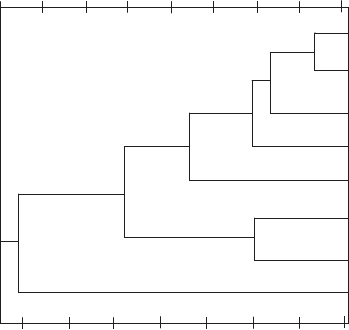
trees, to show the degree of relationships. For example, the phylogenetic tree in Figure 6.9
was developed on the basis of a measure of DNA hybridization. This value was calibrated
by comparison with fossil evidence to determine the rate at which mutations accumulate
in the genome. The figure shows that chimpanzees and humans are mor e closely related to
each other than either is to the gorilla. This type of analysis has led to revision of many
taxonomic classifications formerly based on measures that are more ambiguo us.
Millions of years ago
20
30
10
0
8
21
0
4365
7
∆T
50
H
Chimpanzee (Pan troglodytes)
Pigmy Chimpanzee (Pan paniscus)
Human (Homo sapiens)
Gorilla (G. gorilla)
Orangutan (Pongo pygmaeus)
Common Gibbon (Hylobates lar)
Siamang (H. syndactylus)
Old World Monkeys (Cercopithecidae)
0.7
1.8
2.3
3.7
2.2
5.2
7.7
0.7
1.8
2.3
3.7
2.2
5.2
7.7
Figure 6.9 Phylogenetic tree for some primates. (Based on Klug and Cummings, 1997.)
GENETIC VARIATION 139
Phylogenetic trees can also be constructed using differences among individuals in a
single species. The mitochondrion has its own DNA, separate from the chromosomes
of the nucleus. This DNA is inherited only from the mother. A molecular clock was
constructed using RFLPs of human mitochondrial DNA. The results indicate that all
humans have a common female ancestor who lived 200,000 years ago.
6.5 SEXUAL REPRODUCTION
Simpler organisms, such as unicellular ones, reproduce by asexual reproduction,in
which offspring are produced by a single individual. The offspring have the same geno-
type as the parent. Examples of asexual reproduction range from binary fission in bacteria
to vegetative propagation of plants by cuttings or the budding of the hydra, a jellyfishlike
animal.
In sexual reproduction, offspring are produced by combining genetic material from
two distinct individuals. The offspring are genetically different from either parent by vir-
tue of having a combination of the genes from each. Sexual reproduction evolved as a
strategy to greatly increase variation within a population. Recombination during meiosis
can combine pieces of two genes from alleles from different parents to create novel genes.
This facilitates adaptation to changing conditions. When environmental conditions
change, it is likely that some subset of the population will have a genotype that is
more appropriate than the majority of the popul ation to the new conditions. This minority
will tend to flourish, establishing a new majority that is better adapted. To put it
succinctly: Sex produces variation without mutation. This is the advantage that sexual
reproduction confers on a species.
In diploid organisms that reproduce sexually, the germ cell line alternates between hap-
loid and diploid with each generation. The transformations from one to the other are per-
formed by the processes of meiosis and fertilization. Meiosis converts diploid cells into
haploid cells, which become the gametes. In fertiliza tion, two gametes unite to create the
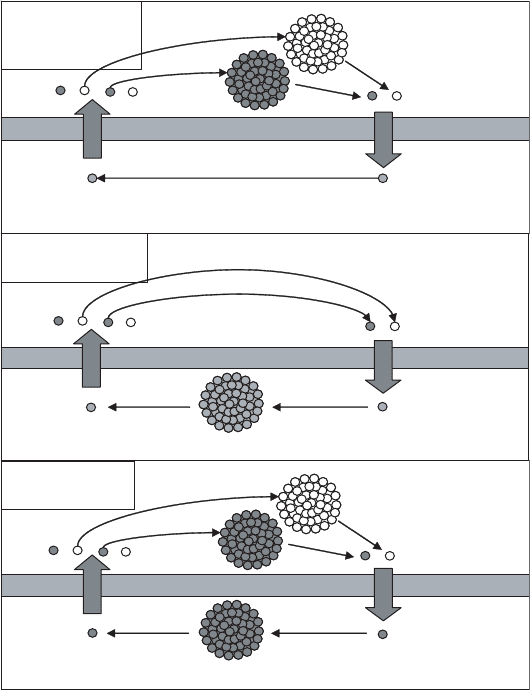
diploid zygote cell. Around this basic plan, there are three variations (Figure 6.10).
In zygotic meiosis, the haploid cells produced by meiosis are called spores. Spores are
haploid cel ls that can undergo mitosis, producing a multicellular haploid organism. [In
contrast, gametes are haploid cells that must fuse (in the process of fertilization) to
form diploid cells, which in turn divide mitotically to form a multicellular diploid organ-
ism.] Spores reproduce to form a haploid multicellular individual (or many unicellular
ones). These individuals eventually produce gametes, which through fertilization produce
a diploid zygote. The zygote then immediately undergoes meiosis. The zygote is the only
diploid form in organisms with this type of life cycle. Organisms with this life cycle
include the fungi and some algae, such as Chlamydomonas.
Gametic meiosis is a life cycle wherein meiosis produces haploid gametes almost
directly. Subsequent fusion of two gametes in fertilization results in a diploid zygote,
as in zygotic meiosis. However, in gametic meiosis the zygote now forms a multicellular
individual. Thus, the diploid form is the only multicellular form, and it dominates the life
cycle. This life cycle is characteristic of most animals, some protists, and at least one alga.
In animals, the female gametophyte is the egg , and the male gametophyte is the sperm.
In sporic meiosis, multicellular forms appear after both meiosis and fertilization.
The haploid organism is called a gametophyte; the diploid form is a sporophyte. This
plan is typical of all plants and many algae. Sometimes the gametophyte looks like the
140 GENETICS
sporophyte (e.g., certain brown algae). In most plants, they are distinct. In simpler plants,
such as mosses, the gametophyte is larger than the sporophyte and is self-sufficient nutri-
tionally. In the higher vascular plants the sporophyte is dominant and the gametophyte
depends on the sporophyte for nutrition. In the most extreme example, in flowering plants
the female gametophyte has only seven cells and the male gametophyte (pollen) has only
three.
PROBLEMS
6.1. Consider what would happen in Mendel’s experiment with a single trait if another
generation were produced by self-fertilization. What proportion of the total popula-
tion would be heterozygous? What about after yet another generation?
You should see that the proportion of heterozygous organisms becomes smaller
and smaller. If repeated many times, every organism will ultimately have a genotype
consisting of a mix of double recessive and double dominant genes. This is how a
Gametic meiosis
(most animals)
Meiosis
Fertilization
Zygote
Diploid individual
Zygotic
meiosis
(fungi)
Meiosis
Fertilization
Zygote
Sporic meiosis
(most plants)
Meiosis
Fertilization
Zygote
Diploid Sporophyte
Gametes
Haploid individuals
Gametes
Haploid Gametophytes
Spores
Gametes
Figure 6.10 Types of life cycles in sexual reproduction. (Based on Raven et al., 1992.)
PROBLEMS 141
‘‘true-breeding’’ population is produced. In many species, especially of animals, this
can be harmful, because although many recessive traits may be helpful to the
organism as a hybrid, they can be harm ful as a double recessive. The gene for sickle-
cell anemia is an example. When heterozygous it is thought to confer resistance to
malaria, but as a double recessive it causes a crippling sensitivity to oxygen
deprivation. The risks from true breeding provides a biological justification for
social taboos against incest and marriage between close relatives.
6.2. What are some of the ethical problems that could be created by the existence of a test
for the Huntington’s disease gene?
6.3. Use your calculator to compute the number of copies produced by 20 doublings,
which would occur in that many cycles of the polymerase chain reaction.
REFERENCES
Fried, G. H., 1990. Schaum’s Outline : Theory and Problems of Biology, McGraw-Hill, New York.
Glieck, James, 1987. Chaos: Making a New Science, Viking Penguin, New York.
Klug, W. S., and M. R. Cummings, 1997. Concepts of Genetics, Prentice Hall, Upper Saddle River,
NJ.
Mullis, Kary, The polymerase chain reaction, Scientific American.
Oerther, D. B., S. Jeyenayagam, and J. Husband, 2002. Fishing for fingerprints in BNR systems, Water
Environment and Technology, Vol. 14, No. 1, pp. 22–27.
Postlethwait, J. H., and J. L. Hopson, 1995. The Nature of Life, McGraw-Hill, New York.
Raven, P. H., R. F. Evert, and S. E. Eichhorn, 1992. Biology of Plants, Worth Publishers, New York.
Rawls, R. L., 1997. Optimistic about antisense, Chemical and Engineering News, June 2.
Williams, P. L., and J. L. Burson (Eds.), 1985. Industrial Toxicology: Safety and Health Applications
in the Workplace , Van Nostrand Reinhold, New York.
142
GENETICS

7
THE PLANTS
Plants and fungi were once classified into a single kingdom (together with the plantlike
protists). They are now distinguished into separate kingdoms. They have in common the
facts that they are mostly multicellula r, mostly nonmotile, and their cells possess a cell
wall (although of different compositions). Fungi are heterotrophic, eukaryotic organisms.
They are discussed in Chapter 10 with the microorganisms, even though they include
multicellular macroscopic forms.
Plants are multicellular, photosynthetic, eukaryotic organisms. Their environmental
importance begins with their being the basis of almost all ecosystems, fixing atmospheric
CO
2
into organic matter that provides food for other organisms, and producing oxygen.
Other environmental concerns involving plants (both positive and negative) that are more
directly affected by human activities include:
Protection of soil from erosion
Sequestration of carbon dioxide produced by fossil-fuel combustion
Forest damage from acid deposition
Damage to plants from urban air pollution
In addition, plants are now being used increasingly for pollution control, in a process
called phytoremediation. For example, certain grasses have been found to concentrate
heavy metals, including radionuclides, from contaminated soil. Poplar trees are being
investigated for the remediation of groundwater contaminated with volatile organic
compounds.
Plant cells are characterized by cellulosic cell walls, they store carbohydrates as starch,
and they contain both chlorophyll a and b. The major trend in the evolutionary develop-
ment of plants is increased dominance of the sporophyte. As you move to the higher
Environmental Biology for Engineers and Scientists, by David A. Vaccari, Peter F. Strom, and James E. Alleman
Copyright # 2006 John Wiley & Sons, Inc.
143

divisions, the gametophyte phase becomes less and less conspicuous, and increasingly
dependent on the sporophyte for survival. Another structure that distinguishes more com-
plex plant divisons from the simpler ones is the presence of vascular bundles. These are
bundles of cells arranged in columns spanning the length of the plant. They conduct water
and minerals from the roots upward and the products of photosynthesis from the leaves to
the rest of the plant. The development of vascularization enabled plants to grow to great
heights. We first describe the taxonomy and then examine the physiology of the dominant
plant division, the flowering plants.
7.1 PLANT DIVISIONS
There are 12 existing divisions of p lants, arranged in four groups (Table 7.1). The
bryophytes comprise the mosses and related divisions. They lack specialized vascular
tissues for transport of nutrients within the plant, which limits them to a height of only
several centimeters. Instead of roots, they have rhizoids, which are filamentous cells that
act primarily as anchors, not for absorption. They require moist conditions for their motile
sperm cells to reproduce. (Some plants that are called mosses are not bryophytes. For
example, reindeer moss is a lichen, and the Spanish moss that hangs from branches of
trees in the southeastern United States is actually an angiosperm.) The genus Sphagnum
includes 350 species of peat mosses. The gametophyte dominates, forming masses of
green plants. They grow in temperate and cold bogs, where they acidify their environment
to a pH as low as 4.
The second group is the seedless vascular plants, which includes the fer ns. They
developed several adaptations suited to drier conditions. These include vascular systems
TABLE 7.1 The Divisions of the Plant Kingdom, Organized into Groups
Bryophytes The nonvascular plants
Division Bryophyta Mosses (9500 species)
Division Hepatophyta Liverworts (6000 species)
Division Anthocerophyta Hornworts
Seedless vascular plants Vascular plants that reproduce by spores
Four divisions are extinct, four remain
Division Psilotophyta Includes Psilotum, a tropical plant and greenhouse weed that lacks
both roots and leaves
Division Lycophyta The club mosses, 1000 living species; during the Carboniferous
age some grew to 40 m in height
Division Sphenophyta A single genus: Equisetum (horsetails), 15 species
Division Pterophyta The ferns (11,000 species, mostly in tropical climates)
Gymnosperms ‘‘Naked seed’’ plants: provide protection and nutrition
Division Cycadophyta Cycads: palm-like plants (palms are monocot angiosperms)
Division Ginkgophyta Only one surviving species: Ginkgo biloba
Division Gnetophyta Gnetophytes: 3 genera with 70 species
Division Coniferophyta Conifers: 50 genera, 550 species
Angiosperms The flowering plants
Division Anthophyta 235,000 species
Monocots (65,000 spp.)
Dicots (170,000 spp.)
144
THE PLANTS
for the transport of water and nutrients to upper plant parts, specialized roots for absorp-
tion, a waxy cutin layer on leaf surfaces to reduce evaporation, and the production
of lignin to provide structural strength for taller plants. Before the Cretaceous age,
144 million years ago, in the time of the dinosaurs, ferns dominated in tropical climates,
forming large trees. Although the living plants are now gone, their carbonized remains are
the basis of today’s coal deposits. The familiar fern plant is a sporophyte that produces
spores on the underside of the fronds. When the spores fall on a suitable surface, they
produce a small gametophyte. This, in turn, produces eggs and motile sperm cells that
fertilize and grow into a mature sporophyte. Ferns may also reproduce asexually from
horizontal stems called rhizomes.
The third group is the gymnosperms, or ‘‘naked seed’’ plants. The seed is formed after
fertilization. It contains the embryo, which is a young sporophyte. It also cont ains a quan-
tity of starch for use by the embryo during germination. An outer seed coat provides
protection. In conifers, gnetophytes, and angiosperms, seeds are formed when the
ovule, which contains the egg, is fertilized by the pollen grain, the male gametophyte.
This arrangement eliminates the requirement that there be free water present in order for
fertilization to happen, as is needed by all seedless plants.
Of the four gymnosperm divisions, by far the most familiar is that of the conifers. They
include 50 genera with 550 species. One is the redwood (Sequoia sempervirens), the tal-
lest terrestrial plant, at up to 11 m in diameter and 117 m high. Others are the pines, firs,
spruces, hemlocks, cypresses, junipers, and yews. Most bear their seeds in cones, except
for the yew, which contains them in a fleshy fruitlike structure. The bark of the Pacific yew
(Taxus brevifolius) has been found to contain a substance, called taxol, that is used as a
treatment for breast and ovarian cancer. Most conifers keep their leaves for several years
and do not lose them all at once. A few conifers, however, are deciduous; that is, they lose
their leaves at the end of the growing season. These include the European larch (Larix
decidua) and the bald cypress (Taxodium distichum).
The cycads form tall trees that resemb le palms, with the difference that the trunk is
covered with the bases of leaves that have been shed as the tree grew taller. New leaves
are grown only at the top of the trunk. (Palm trees are monocot angiosperms.) Cycads
produce compounds that are neurotoxic and carcinogenic. They harbor cyanobacteria
and thus contribute to nitrogen fixation. Gnetophytes include many unusual plants,
such as Welwitschia, which grows mostly below the soil, as well as trees, vines, and
shrubs. Some are very similar to dicotyledonous angiosperms. Ginkgo includes a single
species of tree, Ginkgo biloba, that was known to the West from fossils but was thought to
be extinct. It was subsequently found cultivated on temple grounds in China and Japan,
but apparently was not found anywhere in the wild. It is now cultivated throughout the
world and is easily identified by its unique fan- shaped leaves. It is exceptionally resistant
to air pollution and thus has found use in urban parks and alon g roadsides.
The final group is that of the angiosperms, the flowering plants. Angiosperms have
dominated the land for 100 million years. Their rise paralleled that of the mammals,
both of which were relatively insignificant during the tenure of the dinosaurs. The single
division of the angiosperms is called anthophyta, making these two terms synonymous.
They are distinguished by the presence of flowers, fruit, and a distinctive life cycle. Most
familiar plants are angiosperms, from the millimeter-sized duckweed (Lemmaceae)to
100-m-tall Eucalyptus trees; from the aquatic water lily (Nymphaea odorata) to the
Saguaro cactus (Carnegiea gigantea). Although mostly autotrophic, it includes parasitic
and saprophytic species. For example, the Indian pipe (Monotropa uniflora) lacks
PLANT DIVISIO NS 145
chlorophyll but obtains nutrients from the roots of other plants through an association with
fungi.
The angiosperms are divided into two classes: monocotyledones and dicotyledones
(monocots and dicots, for short). The names refer to the embryonic leaves of the seed.
Monocots have a single leaf (called a cotyledon), dicots have tw o. They can be distin-
guished by looking at the starchy food-storage part of the seed, called the endosperm.
Rice and corn are monocots and have a single endosperm. Dicots, such as peanut or
bean, have two. Even without seeing the seeds, the two are easily distinguished. Monocot
leaves have parallel veins, as in grasses. Dicots have a network venation, such as in oak or
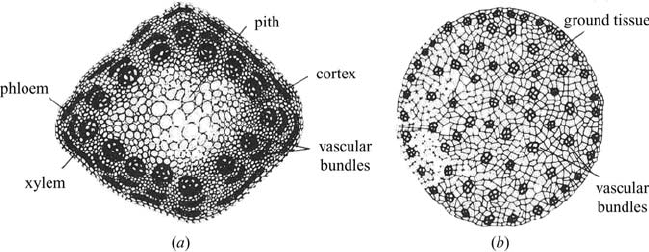
maple leaves. In monocots the vascular bundles (described in the next section) are usually
arranged throughout the cross section of the stem, as in celery. Th e vascular bundles of
dicots are arranged in a ring (Figure 7.1).
7.2 STRUCTURE AND PHYSIOLOGY OF ANGIOSPERMS
Since angiosperms are the dominant terrestrial plants and are of such economic impor-
tance, we describe them in more detail than the other divisions. Agriculture results in sev-
eral types of environmental impacts, including extensive monoculture and contamination
from pesticides and fertilizers. Therefore, understanding plants would be a useful back-
ground for managing these sources of pollution.
7.2.1 Water and Nutrient Transport
The vascular bundles consist of two types of conducting tissues, xylem and phloem.
Xylem is the main water- and mineral-conducting tissue. It consists of columns of cells,
some with perforations through the ends of each cell, through which materials move. At
maturity the xylem cells lose their protopl asm, forming nonliving hollow tubes. Phloem is
the food-conducting tissue that transports substances to and from the roots and leaves.
The vascular bundles consist of xylem and phloem, as well as other tissues. In dicot
stems there is a layer of growing cells called the cambium layer between the xylem and
phloem in each bundle. The cambium extends from one bundle to the next, forming a ring
all the way around the stem. This narrow layer just below the bark of trees is the only
Figure 7.1 Microscopic cross sections through dicot (a) and monocot (b) stems. (From Fried,
1990. # The McGraw-Hill Companies, Inc. Used with permission.)
146
THE PLANTS
place where growth occurs in the stem. Xylem is formed toward the inside of the cam-
bium, and phloem toward the outside. Each season produces a new layer of xylem, visible
as the ‘‘tree rings’’ of a stump. Wood consists of dead xylem cells, most of which still
conducts water and minerals. A tree can be killed without cutting it down simply by
destroying the cambium all the way around the tree, a practice known as girdling. Length-
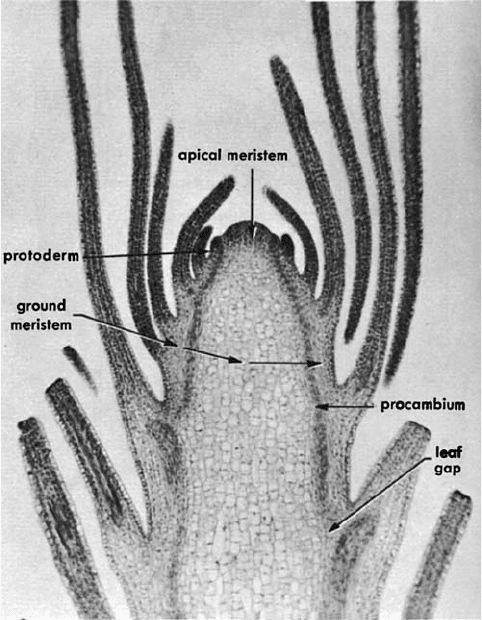
ening of a plant occurs mostly by growth at the tip of the shoot, called the termin al bud
or the apical meristem (Figure 7.2). Other buds produce branches or leaves.
The root is the underground portion of the sporophyte . Their main function is ancho-
rage and absorption, but they may also be used in storage (as in carrots and potatoes).
Monocots form a shallow fibrous root syst em. Gymnosperms and most dicots form a
main root called a taproot that grows straight down. Roots of some trees have been
found to penetrate 30 to 50 m into the soil. Most of the tree roots involved in absorption
are in the top 15 cm and extend out beyond the crown of the tree. Roots of the corn plant
(Zea mays) penetrate up to 1.5 m, and spread horizontally 1 m around the plant. The sur-
face area of roots is greatly increased by the formation of root hairs, which grow from
cells at the surface of the roots (Figure 7.3). As the plant grows, it maintains a balance
between the leaf surface area and root surface area, so that water, minerals, and carbohy-
drates are formed in the proper proportion for growth. The roots absorb minerals by active
Figure 7.2 Microscopic cross sections through an apical meristem. (From Weier et al., 1970.)
STRUCTURE AND PHYSIOLOGY OF ANGIOSPERMS 147