
Vaccari D.A., Strom P.F., Alleman J.E. Environmental Biology for Engineers and Scientists
Подождите немного. Документ загружается.

gene and an operator region. The operator region is the location where RNA polymerase
binds to the DNA to begin the transcription process. The repressor gene produces a
protein that binds to the same location in the absence of substrate, preventing gene expres-
sion. When the substrate is present, it binds to the repressor protein, causing it to release
from the operator region, and allowing transcription to proceed.
For example, E. coli has three enzymes that play a role in cleaving the disaccharide
lactose into glucose and galactose. When there is no lactose in the medium, E. coli
does not produce the enzymes because the repressor protein is bound to the operator
region of the operon containing the three genes. When lactose is present, it binds to
the repressor protein, changing its shape and causing it to release from the operator
region. The enzym es are then produced by the transcription and translation process.
In enzyme repression, the repressor protein normally cannot bind to the operator
region. However, a corepressor molecule can bind to the repressor, changing its shape
to one that does bind the operator region, stopping expression of the structural genes in
the operon. For example, E. coli can produce enzymes to synthesize the amino acid tryp-
tophan. However, when sufficient tryptophan is present in the growth medium, there is no
need for the enzyme, and indeed, it represses its own production.
Eukaryotes also have transcription-level control. However, they also exert control in
posttranscription stages, such as by controlling mRNA splicing, transport, and stability,
by controlling translation, or by modifying the activity of the protein product.
Similar to operator regions, eukaryotes have promoter and enhancer nucleotide
sequences that interact with proteins called transcription factors to activate transcription
(in contrast to prokaryotic repressors). Steroid hormones act through this mechanism.
They bind to protein transcription factors, and this complex then binds to DNA and acti-
vates transcription.
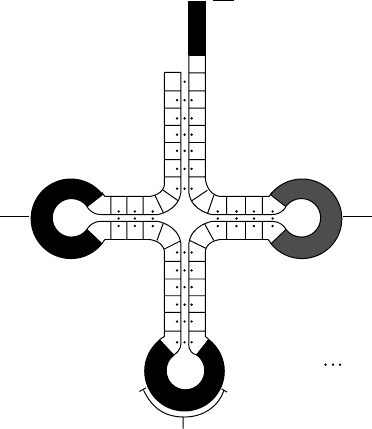
anticodon
attachment site for an amino acid
3′
5′
GC
binds with
amino-acid
activating
enzyme
binds with the
ribosome
hydrogen bonds
Figure 6.6 Structure of the transfer RNA molecule. (From Fried, 1990. # The McGraw-Hill
Companies, Inc. Used with permission.)
128
GENETICS
Another mechanism for preventing expression of a gene is by changing the DNA che-
mically. Specifically, a methyl group is added to some of the cytosine nucleotides, pre-
venting transcription to mRNA.
Certain white blood cells in vertebrates produce antibodies in the blood. Antibodies
complex with and inactivate foreign substances that may be toxic or infectious. The anti-
bodies are highly specific proteins, each designed to react with a different foreign sub-
stance. The body produces millions of different kinds—many more than the number of
genes in the chromosomes! To achieve this type of variety, the cell can actually rearrange
the DNA sequences for antibody production. Rapidly growing tissues, such as egg-produ-
cing tissues or cancerous tumors, can increase the rate of gene expression by making
many copies of the gene or by stockpiling mRNA for later use.
A rem arkable and poorly understood feature of gene regulation in multicellular organ-
isms is their ability to choreograph gene expression from embryonic development through
specialization in the adult. Somehow, the ability of a cell to produce insulin must be
turned off in the zygote, then turned on later, but only in certain cells in the pancreas.
Similarly, each tissue must have specialized genes that determine its function, distinct
from all others in the organism. The ability to ‘‘clone’’ animals, even mammals, from
a single somatic cell taken from an adult is proof that each somatic cell contains the entire
genome.
6.2.3 Mutations
A mutation is a change in the hereditary information contained in an organism. With
most mutations, if the genotypic change is expressed phenotypically, cell death results.
In a few cases survival is possible, with altered function. In rare cases, the mutation
may actually aid the cell. Usually, it does not. In somatic cells, some mutations may be
an initiating step in the formation of cancer. In germ (reproductive) cells, mutations may
be passed on to the offspring, resulting in either teratogenesis, genetic disorders, or in
some cases producing cancer that develops later in the offspring. Mutations can be caused
by chemical or physical agents such as natural or industrial chemicals or radiation.
Mutation results from one or more changes in the sequence of nucleic acid bases in the
DNA molecule. The effect can be illus trated by looking at what happens when a single
change is made in the base sequence, in what is called a point mutation. There are three
types of point mutation: base-pair substitution, insertion, or deletion. In the first, base-
pair substitution, only a single amino acid in the final protein is affected (Figure 6.7).
This type of mutation has a reasonable probability of not having a large effect. For exam-
ple, if the protein being coded for is an enzyme, and the affected amino acid is not at the
active site nor greatly affects the shape of the enzyme, the enzyme may still function nor-
mally, or almost normally. Also, note that because of the degeneracy of the genetic code,
there is a chance that a base-pair substitution will still result in coding for the same amino
acid.
The other two types of mutations have a much greater potential for disastrous conse-
quences: base-pair insertion and base-pair deletion mutations. These are collectively
called frame-shift mutations, because by changing the number of base pairs, they affect
the reading of every codon that follows. Unless the mutation occurs near the end of the
protein, a large number of amino acids will be changed, probably destroying its function.
The sequence in Figure 6.7 is read from left to right, with location of mutations and
altered amino acids marked by underscores. Shown are the sequence for the DNA strand
MOLECULAR BIOLOGY 129

that is being expressed, its complementary DNA strand, the messenger RNA formed from
the sequence, and the resulting amino acid sequence.
If the mutation does not leave both strands of the DNA molecule with the proper com-
plementary pair at a point, special repair enzymes can attempt to und o the damage. Of
course, the mechanism is not perfect. Sometimes there is so much damage that informa-
tion is lost. The repair enzymes excise or replace damaged parts of the DNA molecule, but
consequently, may leave point mutations.
Mutations have the potential for causing heritable genetic disorders. However, this is
less of a concern than the potential for causing cancer. Most heritable genetic disorders
are due to genes already in the human gene pool. Some even confer advantages in special
situations. For example, sickle-cell anemia, although disabling for those who are double
recessive, may give partial immunity from malaria for those who are single recessive.
Similarly, it is thought that single-recessive carriers of the cystic fibrosis gene may
be relatively resistant to cholera. Nevertheless, exposure to mutagens can increase the
frequency of genetic disorders such as those in Table 6.3.
6.2.4 DNA Repair
Cells have a variety of processes for repa iring damage to DNA. First, the damage must be
of a form that can be detected by a repair mechanism. Deletion of one or more base pairs
results in a chemically correct DNA molecule and cannot be fixed by enzymes. However,
removal of one base from a pair, replacement of one base with a noncomplementary base,
or other chemical changes to the nucleotides produce recognizable distortions in the DNA
molecule.
NORMAL SEQUENCE
Compl-DNA ATG TCC TGT CCA TGG GGA CGA
DNA TAC AGG ACA GGT ACC CCT GCT
mRNA AUG UCC UGU CCA UGG GGA CGA
Amino acid Met Ser Cys Pro Trp Gly Arg
BASE-PAIR SUBSTITUTION
Compl-DNA ATG TCC TAT CCA TGG GGA CGA
DNA TAC AGG ATA GGT ACC CCT GCT
mRNA AUG UCC UAU CCA UGG GGA CGA
Amino acid Met Ser Tyr Pro Trp Gly Arg
BASE-PAIR INSERTION
Compl-DNA ATG TCC TGG TCC ATG GGG ACG A
DNA TAC AGG ACC AGG TAC CCC TGC T
mRNA AUG UCC UGG UCC AUG GGG ACG A
Amino acid Met Ser Trp Ser Met Gly Thr
BASE
Compl-DNA ATG TCC TT_C CAT GGG GAC GA
DNA TAC AGG AA_G GTA CCC CTG CT
mRNA AUG UCC UU_C CAU GGG GAC GA
Amino acid Met Ser Phe His Gly Asp
-PAIR DELETION
Figure 6.7 Types of point mutations with examples.
130
GENETICS

For example, a particular type of damage caused by UV radiation is the formation of
covalent bonds between the pyrimidine residues of two adjacent thymidine bases. (Nor-
mally, the bases are joined only through the sugar–phosphate groups.) This thymine
dimer produces strain in the DNA molecule. The bonds can be removed by a special
enzyme called photoreactivation enzyme. Interestingly, this enzyme requires a photon
of blue light to com plete the repair. It is present in humans as well as prokaryot es.
Another type of repair involves several enzymes . Excision repair uses a variety of
enzymes that ‘‘patrol’’ the DNA molecule, remove bases that they recognize as damage,
and patch the molecule using DNA polymerase. Any damage that distorts the double helix
structure can stimulate this mechanism.
Some humans have an inherited autosomal recessive condition called xeroderma pig-
mentosum. These persons are exceedingly sensitive to getting skin cance r from exposure
to sunlight. The condition can be diagnosed in infancy, enabling people to lead fairly nor-
mal lives by protecting themselves from exposure to the sun. The condition seems to be
related to a number of different mutations, including about seven that affect excision
repair, and to reduced activity of the enzyme that uses blue light to repair thymidine
dimers.
A third repair mechanism, called recombinational repair, comes into play when
damage is missed by the other mechanisms, but comes to interfere with the replication
process.
6.3 GENETIC ENGINEERING
Knowledge of the chemistry of DNA has made it possible to manipulate this material in
useful ways. This leads to a category of techniques variously called molecular biology,
TABLE 6.3 Partial List of Human Genetic Disorders
Chromosome abnormalities
Cri-du-chat syndrome (partial deletion of chromosome 5)
Down syndrome (triplication of chromosome 21)
Klinefelter syndrome (XXY sex chromosome constitution; 47 chromosomes)
Turner syndrome (X0 sex chromosome constitution; 45 chromosomes)
Dominant mutations
Chondrodystrophy
Hepatic porphyria
Huntington’s chorea
Retinoblastoma
Recessive mutations
Albinism
Cystic fibrosis
Diabetes mellitus
Fanconi syndrome
Hemophilia
Xeroderma pigmentosum
Source: Based on Williams and Burson (1985).
GENETIC ENGINEERING
131
biotechnology,orgenetic engineering. Most of the applications involve the ability either
to place genes from one organism into the chromosomes of another or just to be able to
analyze the DNA at various levels of detail. The former application makes it possible, for
example, to produce human proteins such as hormones in bacterial cultures or to place
genes for hereditable human diseases in laboratory mice to facilitate the experimental
study of therapies. In the emerging area of gene therapy, humans with genetic diseases
such as cystic fibrosis can potentially be ‘‘infected’’ with viruses carrying the normal ver-
sion of the genes, replacing the function of the defective genes.
There are other ways to exploit our knowledge of molecular biology for medical uses.
The drug zidovudine (AZT) is similar to normal thymidine but lacks an OH group at
a point where it is linked to other nucleotides to form DNA. AZT competes with the
thymidine, preventing the completion of DNA synthesis. Fortunately, this effect is
more pronounced in DNA synt hesis caused by the AIDs virus than the cell’s normal
DNA synthesis.
Another therapy on the horizon is antisense drugs, which are synthetic nucleotide
polymers that bind select ively to mRNA from a particula r gene, interfering with synthesis
of the corresponding protein. If the mRNA structure for a protein is known, an antisense
drug can be designed to be complementary to 17 to 25 of its bases. This gives the drug
high specificity, and since cells may make thousands of protein molecules from each
mRNA, the antisense drugs could be effective in very low doses. Antisense drugs are
being designed to block expression of cancer and virus genes, as well as normal
human genes in special cases. However, delivery of these drugs to the cell interior is a
problem.
DNA analysis include s DNA fingerprinting. This technique can be used forensically,
such as to identify the person that a blood stain or hair root came from. It can be used
to determine paternity conclusively. It can also be used to determine another type of rela-
tionship—that between species, in the development of taxonomic family trees. Another
emerging area with direct relevance to the environmental field is the use of DNA analysis
to make positive identification of disease-causing organisms, including waterborne
parasites.
6.3.1 DNA Analysis and Probes
DNA sequencing is the complete determination of the sequence of nucleotide bases in a
DNA molecule. Several methods have been developed to do this, involving radioactive
tracers or fluorescent dyes and electrophoresis separ ation. The technique using dyes has
been automated, making the process faster and relatively inexpensive. Sequencing has
made it possible to identify the nucleotide seque nces associated with origins of replica-
tion, regulatory regions adjacent to genes, and of course the genes themselves. For exam-
ple, in eukaryotes, the location of a gene is marked by a promoter sequence, followed a
fixed number of nucleotides later by a START codon, and ending with a STOP codon.
When the sequence is known, the amino acid sequence of the corresponding protein
can be determined. Although the gene may include introns, comparison with known pro-
teins can often find the corresponding prot ein.
Another powerful technique is the ability to cut DNA molecules at specific locations.
Restriction enzymes have the property of being able to make a precise cut in a double-
stranded DNA molecule at or near a specific nucleotide sequence. About 200 different
132 GENETICS

ones are known, each of which recogniz es a different sequence. For example, one called
EcoRI comes from E. coli and catalyzes the following reaction:
GAATTC ) G þ AATTC
CTTAAG EcoRI CTTAA G
Restriction enzymes have a number of important uses. One is the production of recom-
binant DNA, which is described below. Other uses have to do with DNA analysis. Treat-
ment wi th a restriction enzyme breaks a DNA molecule up into fragments of various sizes.
Gel electrophoresis separates these according to size and provides a measure of the num-
ber of base pairs in each fragment. By examining the fragment sizes produced when DNA
is treated by a variety of restriction enzymes, singly and in combination, it is possible to
locate the positions of all the cutting sites on the molecule. This is called restriction map-
ping. By combining restriction map information with genetic maps based on linkage,
individual genes can be located on the chromosome. This is a first step in the isolation
of individual genes.
In DNA fingerprinting, the pattern of DNA segments produced by treatment with
restriction enzymes is used for forensic purposes such as identification of the person
from which a tissue sample, such as semen or hair follicles, originated. It is also used
to establish paternity. In most cases, determinations can be made with a very high degree
of confidence.
Individual genes can be marked using molecular probes. A probe, in molecular biol-
ogy, is a cloned section of DNA that is complementary to part of a gene or a section of
RNA. For example, suppose it is desired to locate the gene that produces a particular pro-
tein. If the protein could be purified, its amino acid sequence could be determined. Using
the genetic code, one can determine nucleotide sequences that could produce a segment of
the protein. Since the genetic code is degenerate, there are many such sequences. Then,
using chemical methods, segments of sing le-stranded DNA containing radioactive nucleo-
tides are synthesized that are complementary to all the possible gene sections (Figure 6.8).
Amino Acid . . . met his gly . . .
. . . AUG CAU GGA . . .
. . . AUG CAU GGT . . .
. . . AUG CAU GGC . . .
. . . AUG CAU GGG . . .
. . . AUG CAC GGA . . .
. . . AUG CAC GGT . . .
. . . AUG CAC GGC . . .
Eight candidate
oligonucleotides
. . . AUG CAC GGG . . .
Selected oligonucleotide
. . . AUG CAC GGA . . .
Complementary gene
. . . TAC GTG CCT . . .
Figure 6.8 Development of DNA probes complementary to part of a gene for a short amino acid
sequence. Methionine has only one possible codon, but histidine has two and glycine has four. Thus,
there are eight possible oligonucleotide combinations for this sequence of amino acids. A mixture of
all eight is prepared, and the one that is complementary to the gene will bind to it selectively.
GENETIC ENGINEERING 133
These are cloned (copied) and placed in contact with restriction enzyme-cut DNA seg-
ments from a gel electrophoresis plate. The probe s that are actually complementary to
parts of the DNA will be bound by the same hydrogen-bonding mechanism that holds
the double helix togethe r. The rest are then rinsed away, and the restriction fragments
that retain radioactivity are detected using x-ray film. All the fragments containing
DNA complementary to one of the probes will be marked by this procedure, which is
called the Southern blot. The Southern blot is also one form of DNA fingerprinting,
used to identify the individual source of biological samples.
Due to normal genetic variation, two individuals of the same species can have different
fragment patterns. Differences in locations of restriction enzyme cuts are called restric-
tion fragment length polymorphisms (RFLPs). RFLPs are inherited according to
Mendel’s laws. Several thousand have been identified at locations randomly distributed
throughout the human genome. Since they are inherited like genes, they can be mapped
by linkage analysis, and from knowledge of their nucleotide sequence, their location can
be further specified by restriction mapping and the use of probes and the Southern blot.
RFLPs have greatly accelerated the mapping of the human genome. By studying their
linkage, they help to locate specific genes, such as those associated with disease.
These techniques and other described below have made it possible to map the DNA of
an organism completely. This could be done at several levels of detail: from RFLPs, to
individual genes, to a complete nucleotide sequence. These genome projects have been
conducted on hundreds of organisms from bacteria to humans. The human genome
project cost at least $3 billion and required the efforts of many laboratories around the
world. The project produced a complete nucleotide sequence for a particular human cell
culture commonly used in laboratory experiments, which originates from a single person.
A surprise result of the human genome project is that there are only 20,000 to 30,000
human genes, much fewer than the 100,000 or more thought to be pres ent based on earlier
evidence. Genome projects have already yielded new knowledge. For example, geneticists
were surprised to learn that the traditional mapping techniques discovered only about
half of the genes on a segment of E. coli that was sequenced. Several new modes of
mutations leading to human genetic diseases have been discovered. Ultimately, it is
hoped that these projects will produce a windfall for science, in terms of understanding
the basis of life, and for medicine, in the development of treatments for genetic disease
and cancer.
Probes may also be produced that are covalently linked to fluorescent molecules,
producing what is known as the fluorescence in situ hybridization (FISH) probe.
This makes it possible to visually identify cells containing specific DNA or RNA
sequences using fluorescent microscopy. For example, it is possible to determine where
a strain of nitrifying organisms is located within an activated sludge floc using this
method. To do this, a sample of activated sludge is placed on a microscope slide and
fixed, such as by heating. The slide is then treated with a solution containing a fluorescent
probe that is complementary to the ribosomal RNA of the bacterial strain of interest. The
probe can penetrate the membrane of the fixed cells and attach to (hybridize with) the
ribosomal RNA. The probes thus become concentrated in the bacterial cells. When illu-
minated by the appropriate wavelength of light under a microscope, the cells of the
selected strain ‘‘light up,’’ making them visually distinguishable from other cells or cel-
lular debris.
FISH probes typically have about 20 nucleotide base units. They are designed to be
complementary to sections of the 16S rRNA of the microorganism. Probes are available
134 GENETICS
commercially that select for individual species of bacteria, particular bacterial groups or
genera, or even all bacteria.
6.3.2 Cloning and Recombinant DNA
A clone is a genetically identical copy of a DNA molecule, a cell, or an organism. Clones
of DNA are produced in order to obtain sufficient genetic material for applications, such
as DNA analysis or for producing recombinant DNA. Recombinant DNA is DNA formed
by joining segments of DNA from different organisms.
Recall that recombination occurs naturally between chromosomes in the same cell dur-
ing meiosis and resu lts in segments of DNA from one chromosome being included in
another. Recombinant DNA can also be produced artificially. The procedure uses restric-
tion enzymes that leave uneven lengths of DNA on the two strands, such as EcoRI. For
example, if it is desired to join a segment of human DNA to a bacterial DNA, both are first
treated with the EcoRI. The uneven ends will have nucleotide sequences of either TTAA
or AATT. These are termed sticky ends because they are complementary and easily form
hydrogen bonds. In a mixture, some of the human strands will bond with some of the
bacterial strands. The enzyme DNA ligase is then added, which repairs the strands at
the cuts. DNA ligase is different from DNA polymerase in that the latter forms the
chain of nucleotides by adding nucleic acids one by one, whereas the former links two
strands of DNA together end to end.
The recombinant DNA can be cloned by insertion into prokaryotic or eukaryotic cells,
which then reproduce, also reproducing the extra DNA. After the cell multiplies, the
recombinant DNA can be extracted and purified, or the cells themselves may be used
to express the inserted gene, producing the corresponding protein or expressing a trait
in the organism. The process of inserting recombinant DNA into a cell is called transfec-
tion. Transfection is accompl ished in various ways. One way is by direct insertion using a
very fine needle under microscopic examination. Another way to accomplish transfection
is by forming the recombinant DNA from a special DNA molecule called a vector. A
vector is a DNA molecule that can repr oduce itself independently inside cells. There
are several main types: plasmids, bacteriophages, and yeast artificial chromosomes,
plus some others that are hybrids or forms of these.
Recall that bacteria possess a single circular chromosome. In addition, they, as well as
some eukaryotes (e.g., yeast) and some plants, can also cont ain an additional piece of cir-
cular double-stranded DNA called a plasmid. In bacteria, the plasmid often contains
genes for antibiotic resistance. Bacteria can exchange plasmids, and plasmids can exist
outside the cell. Their possession of antibiotic genes makes it easy to select for bacteria
that have been transfected by recombinant plasmid DNA.
A bacteriophage is a virus that infects bacteria. A virus is itself an infectious particle
consisting solely of a protein coating with DNA or RNA genetic material. A virus infects
a cell by injecting its genetic material, which then directs the cell to produce new
virus particles. This behavior makes it a natural means of cloning recombinant DNA in
bacteria.
A yeast artificial chromosome (YAC) is a linear DNA molecule with yeast telomeres
(the chromosome ends), an origin of replicat ion, and a yeast centromere. These features
allow the YAC to be replicated when inserted into eukaryotic cells. The YAC has the
further advantage in that larger genes (up to 10
6
base pairs) can be inserted, unlike
most plasmids or phages.
GENETIC ENGINEERING 135
Whichever vector is used, it is transfected into an appropriate host cel l using chemical
and/or physical techniques. It is somewhat of a random process; only a fraction of the
cells in a culture will be transfected successfully. Antibiotic resistance or other marker
genes are included in the transfection to help select the desired cells. These are then
cultured for further application.
Cloning for the purpose of getting an organism to express a gene from a different spe-
cies has been applied in a number of ways. Animal hormones, including from humans,
used to have to be purified from large quantities of tissue samples. Now some, such as
growth hormones for humans and cows, are produced in bacterial cultures.
Sometimes bacterial gene expression is not sufficient, and eukar yotes must be used.
Plants or animals containing a foreign gene are called transgenic. A human blood
clot–dissolving substance called tPA can save the lives of heart attack victims. However,
tPA was still too expensive when produced by bacteria. The solution was to insert the gene
for tPA into a sequence of goat DNA involved in milk production. One such goat pro-
duced milk containing 3 g of tPA per liter of milk, worth about $200,000 per day at pre-
vious produc tion rates. Transgenic crop plants have been developed with increased
resistance to viral disease or with resistance to agricultural herbicides.
Sometimes, DNA is inserted into the genome of an organism to disrupt a particular
gene, as a way to study the effect of the gene or to mimic human genetic disorders.
This has been done with mice, and the resulting animals are called kno ckout
mice.
Gene therapy is the transfer of normal human genes into human somatic cells to treat
genetic disease. There has been som e success at the experimental level, such as in treating
severe combined immunodeficiency (SCID), a hereditary inability to fight infections. The
therapy works as follows: A viral vector is prepared with the nondef ective SCID gene
inserted, and several viral genes responsible for its replication are removed. This makes
the virus particle capable of infecting but not destroying the cell. Next, tissue is obtained
from the patient and a type of leucocyte, or white blood cell, is separated. The leucocytes
are infected with the viral vector in vitro (literally, ‘‘in glass,’’ or in the test tube). The
leucocytes are then injected back into the patient, where they function normally in fighting
infections. The procedure has to be repeated periodically to maintain a population of
normal cells.
6.3.3 Polymerase Chain Reaction
Although one of the uses of cloning is to produce quantities of identical DNA, a chemical
procedure has largely take n the place of this function. The polymerase chain reaction
(PCR) is a technique that repeatedly replicates DNA in vitro. Each cycle takes a matter
of minutes and forms two DNA molecules from one. Twenty of these doublings produce
more than 1 million molecules starting from a single strand. Variations of the basic pro-
cedure are used for detect ion of mutations and genetic diseases, identification of viruses
and bacteria, and recovery of DNA from tiny samples for analysis.
PCR was developed in 1983 by Kary Mullis. He was working in a biotechnology
laboratory producing DNA probes for Cetus Corporation in Emeryville, California.
Recent automation techniques had left him ‘‘creatively underemployed,’’ with lots of
time to think. The personal computer revolution was also under way, and Mullis had
learned about the power of iteration in computer programs. Driving late at night on his
way to a mountain cabin for the weekend, with his girlfriend asleep in the passenger seat,
136 GENETICS
Mullis had the insight that would revolutionize molecular biology and win him a Nobel
prize.
The procedure works as follows:
1. The sample containing the DNA to be copied is heated to separate the two strands
of the double helix, and then cooled.
2. Two primers are added, one for each strand. The primer is a short piece of RNA
similar to a probe but that can be recognized by DNA polymerase as a place to start
DNA replication. The primers are chosen to be complementary to each strand close
to its one end, since the next step extends the molecule toward the other end.
3. DNA polymerase and a solution of nucleotide bases are added. The DNA
polymerase extends the primer using nucleotides complementary to the original
strand until it completes the replication process.
4. Repeat.
The process is easily performed today using a small automated tabletop instrument. It
turned out that all the steps needed for PCR had been well known for a decade. Many
biologists had to wonder ‘‘why didn’t I think of that?’’
6.3.4 Genetic Engineering and Society
Along with the benefits of genetic engineering described above come numerous actual and
potential dangers in its application. Experience with introduction of ‘‘natural’’ nonnative
species into an ecosystem has shown the potential for disaster. Often introduced deliberately,
they have often been found to occupy unexpected niches in the ecosystem, displacing
other organisms. Many examples exist. The kudzu vine was introduced to the southern
United States to control erosion, but proliferated beyond control and is destroying
some forests in the region. The starling was introduced to the United States from
England by groups who wanted to import a representative of each species mentioned
by Shakespeare. Starlings soon displaced native songbirds such as the bluebird from
the northeast.
Suppose that a new variety of rice were developed by genetic engineering techniques
that could be cultured in salt water, increasing arable land availability. Would it become a
weed that will choke salt marshes around the world? If a cancer gene were transfected into
a common infectious virus, could it spread a new epidemic? If a bacterium were engi-
neered to biodegrade xenobiotic toxic pollutants or oil spills, would it spread to destroy
chemicals in useful applications, or infect petroleum stocks?
Some of these risks can readily be discounted, although others remain. The possibility
of bacterially transmitted cancer was taken seriously enough by biologists so that in the
mid-1970s they agreed to a moratorium on recombinant DNA research until tests showed
that transmission did not occur. Infection of oil wells would be limited not by the ability
of bacteria to biodegrade oil, which they already are capable of, but rather by the limita-
tions in that environment of water, oxygen, and nutrients such as nitroge n.
Other risks exist in the uses of biotechnology. From the late nineteenth century until
World War II, a school of thoug ht called eugenics suggested that the methods of genetics
should be turned to improving the human gene pool. This idea led to forced sterilization:
first, of various criminal populations, and eventually, of alcoholics and epileptics. The
GENETIC ENGINEERING 137