
Vaccari D.A., Strom P.F., Alleman J.E. Environmental Biology for Engineers and Scientists
Подождите немного. Документ загружается.

8.2 INVERTEBRATE PHYLA OTHER THAN ARTHROPODS
Coral (cnidaria) form colonies, building huge structures as their calci um carbonate
skeletons add to others below. This accretion eventually builds into reefs and atolls.
Coral reefs have bright colors due to symbiotic algae that live inside the coral cells. In
recent years many reefs have been losing their algal symbionts, leading to the death of
the reef. The cause of this coral bleaching is unknown, but it is feared that pollution
and global warming are involved.
The three phyla in the group called flatworms show more organ specialization, including
a primitive nervous system. Some have a gut with only a single opening rather than a
separate mouth and anus. Others lack a gut and absorb food directly through their surface.
The phylum Platyhelminthes comprises the flatworms and flukes. There are four
classes, of which we will describe three. The turbellarians include the small aquatic flat-
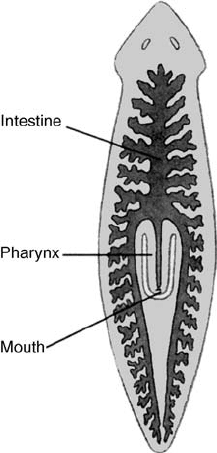
worm Planaria (Figure 8.1), found on the bottom of rocks in streams. The trematodes
include the blood fluke Schistosomona (also called Bilharzia), which causes the important
waterborne parasitic infection schistosomiasis (or bilharziasis). This disease is common
in warm climates. Th e schistosomes are discharged from the intestines of infected people
in their feces. If the fecal contamination reaches a stream, the fluke can infect a specific
kind of snail, where it develops. Released back to the water, the schistosomes can reinfect
humans through the bare skin. It then travels via the bloodstream to infection sites in the
liver and digestive system. Symptoms in humans include extreme diarrhea and blood y
stool or urine. It can be controlled by proper sanitation and by control of conditions favor-
able to the snail host.
Tapeworms are in another class, the cestodes. Tapeworms are long (up to 10 m), very
flat worms that infect vertebrate digestive tracts. Humans can contract them from impro-
perly cooked meats. When ingested, they attach inside the intestines and grow to great
Figure 8.1 Planarian, showing internal structure. (From Hickman et al., 1997. # The McGraw-
Hill Companies. Used with permission.)
158
THE ANIMALS
lengths. They have no digestive system, but absorb food from the host gut through tiny
projections similar to the villi of the intestines themselves. They shed reproductive organs
from their end, which leave with the feces or crawl out the anus, spreading larvae for sub-
sequent infections. Pork tapeworm can migrate to the eye or brain of humans, causing
blindness or death. About 1% of American cattle are infected, and 20% of slaughtered
cattle are not federally inspected. Furthermore, inspections miss 25% of infections.
These facts point up the importance of cooking meat thoroughly, which kills tapeworms.
The nine phyla of the vermiform (worm-shaped) group have a complete mouth-
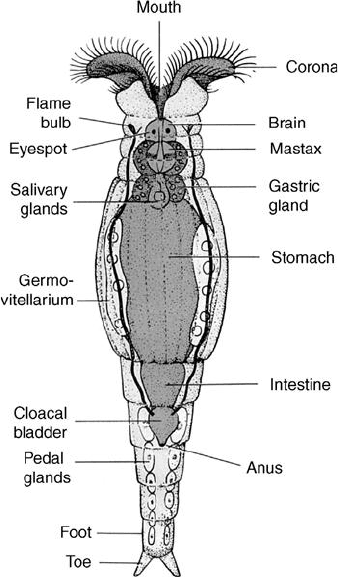
to-anus digestive system. Phylum rotifera (the rotifers, Figure 8.2) have one or more
rings of cilia at the head to draw food toward the mouth. When the cilia are beating,
they give the impression of a rotating wheel. The foot has one to four toes that it uses
for attachment. There are about 1800 species, all of which are dioecious. Most live in
benthic aquatic habitats. They can withstand desiccation for long periods.
The phylum nematoda contains the nematodes, or roundworms. Nematodes are among
the most abundant animals on Earth. There can be 3 billion per cubic meter of soil, where
they help to recycle organic matter. They are common parasites in pets and other animals.
Ascaris lumbricoides is a large roundworm that commonly infects huma ns. A female may
lay 200,000 eggs a day, which pass in the feces. Trichinella spiralis causes the disease
trichinosis. In the past this disease was contracted by eating poorly cooked pork, but it
has been virtually eliminated in the United States. T. spiralis is actually an intracellular
parasite that can control the gene expression of its host cell. Eight species of filarial
Figure 8.2 The rotifer Philodina, showing internal structure. (From Hickman et al., 1997. # The
McGraw-Hill Companies. Used with permission.)
INVERTEBRATE PHYLA OTHER THAN ARTHROPODS 159
worms infect humans, including one that causes the disease called river blindness, which
is carried by black flies and is common in hot climates.
8.3 MOLLUSKS, SEGMENTED WORMS, ARTHROPODS
This group is distinguished as having the simplest phyla with a ‘‘true coelum,’’ a body
cavity completely lined with mesoderm tissue.
8.3.1 Mollusks
The mollusks are soft-bodied animals whose unique features include a muscular foot
for motility and a radula (except in bivalves), a rasplike tongue for scraping food off sub-
strates. A skin covering called the mantle protects the body and, in most species, secretes
the shell. Mollusks are the first phylum with a specialized respiratory system, consisting
of lungs or gills. Most have an open circulatory system, in which blood flows not only in
vessels but also outside the vessels, where it can bathe the tissues directly. There are about
50,000 known living mollusk species.
There are eight classes of mollusks, of which we discuss three. The largest and most
diverse class is the gastropods, which includes snails, slugs, conches, and limpets. If there
is a shell, it is a univalve (one piece). Gastropods show a wide range of feeding behaviors.
Most are herbivores that rasp algae off surfaces. Others are scavengers or carnivores. The
oyster borer urosalpinx cinerea uses its radula to drill through the shell of the oyster.
Members of the genus Conus can eat fish, harpooning them with their radula at the tip
of a proboscis and using a poison to stun the fish.
The class bivalvia contains all the mollusks with two-part shells, including mussels,
clams, scallops, and oysters. Most bivalves are marine and most are filter feeders.
Their gills are specialized for both oxygen transfer and feeding. Cilia are used to draw
water through pores in the gills. The pores trap the particles and ensnare them in
mucus secretions. The mucus is then transported to the mouth by ciliary action. This feed-
ing behavior causes them to concentrate pathogens from wastewater pollution, making
them a possible source of infection for humans who feed on them.
A third class of mollusks is composed the cephalopods. This class contains marine
predators, including octopuses, squi d, nautiluses, devilfish, and cuttlefish. The foot, as
the name implies, has become part of the head and is modified for expelling water
from the mantle to provide locomotion. The edge of the head forms a circle of arms or
tentacles. Squids and cuttlefish have a small internal shell, and octopuses do not have
shells at all. Cephal opods have the largest brains of any invertebrates. Octopuses can
even be trained. Cephalopods have well-developed eyes. The eyes of the giant squid
can be up to 25 cm in diameter, the largest in the animal kingdom.
8.3.2 Annelids
The annelids are the segmented worms, which include the common earthworm. Segmen-
tation facilitates the formation of larger organisms and the motility of those organisms.
Annelids have a completely closed circulatory system, which allows higher blood pres-
sures and the consequent control over blood flow. They lack specialized respiratory
organs. Their digestive system is more developed than that of other phyla we have
160 THE ANIMALS
discussed, containing two specialized areas: The crop stores food; the gizzard grinds it.
Annelids are usually divided into three classes: polychaetes, oligochaetes, and hirudinea.
Polychaetes (many bristles ) include 10,000 species, mostly of marine worms.They are
usually 5 to 10 cm long, and many are brightly colored. They are distinguished from
the other annelids by the presence of a pair of appendages on each segment. They are
commonly found burrowed in the sediments of estuaries. They may achieve densities
of thousands per square meter in mud flats. Others move about, and these are usually
predatory.
Oligochaetes (few bristles) are the class that includes the common earthworm Lumbri-
cus terrestris. Most are scavengers, feeding on decayed plant and animal matter. Earth-
worms are hermaphroditic but must copulate with another individual. Eggs and sperm are
then deposited in a mucus and chitin pouch, or cocoon. Earthworms play an important
role in the ecology of the soil. Their burrows improve soil drainage and aeration. They
mix the soil by ingesting it at depth and depositing it at the surface, and they bring organic
matter from the surface down into the burrows, where the nutrients released by their decay
can become available to plant roots. Freshwater oligochaetes are smaller but more mobile
than their terrestrial cousins. They can be an important source of food for fish. One is
Tubifex, a small reddish worm that forms tubes in the sediment in which it lives head
down, with tails waving in the water. Tubifex can form carpets on the bottoms of heavily
polluted streams.
The class hirudinea are the leeches, most of which live by sucking blood from other
organisms. They have specialized sucker organs to attach themselves to prey. Some aqua-
tic leeches prey on fish, cattle, horses, and humans. Some terrestrial leeches prey on insect
larvae, earthworms, and slugs, or may climb bushes and trees to reach birds.
8.3.3 Arthropods
Arthropods (jointed legs) include the spiders, centipedes, millipedes, insects, and crus-
taceans. They represent an evolutionary advance that allowed them to form the greatest
diversity and number of species of all the phyla, about 1 million species known. The
advance was the development of a jointed exoskeleton made of chitin, a nitrogenous poly-
saccharide, bound with protein. In crustaceans the exoskeleton also contains calcium salts
for added strength. Other innovations with this phylum are increased specialization of the
body segments; locomotion via mus cles in external appendages; improved sensory cap-
abilities; more efficient respiratory organs, which enables high activity rates and even
flight; and even the development of social organization.
Because the rigid exoskeleton places limits on the organism’s growth, it must shed its
covering periodically in a process called molting. It then secretes a new cuticle, which
hardens into a new shell. Each stage in the life of an arthropod between molts is called
an instar.
Besides taking on virtually all the kinds of ecological roles there are, arthropods are
essential to the survival of many other species, from the many flowering plants that
depend on insects to pollinate them, to the many larger animals that depend on them
for food. In aquatic ecosystems, for example, microscopic crustaceans form much of
the zooplankton, which forms the first animal level of the food chain, and insect larvae
are the food source for many fish species.
There are numerous arthropod classes (see Table 8.2). We focus on several of the most
familiar and ecologically important. The diversity of this group is so great that we will
MOLLUSKS, SEG MENTED WORMS, ARTHROPODS 161

TABLE 8.2 Classification of Familiar Arthropods
Phylum Subphylum Class Order
Arthropoda
Trilobites (extinct)
Chelicerata
Merostoma [includes horseshoe crabs (Limulus)]
Pycnogonida (sea spiders)
Arachnida
Araneae (spiders)
Scorpionida (scorpions)
Opiliones (harvestmen, or ‘‘daddy longlegs’’)
Acari (ticks and mites)
Uniramia (two classes not shown)
Chilopoda (centipedes)
Diplopoda (millipedes)
Insecta (the terrestrial mandibulates; 16 of 27 orders shown)
Anoplura (lice)
Coleoptera (beetles, fireflies, weevils)
Dermaptera (earwig)
Diptera (true flies, mosquitoes)
Ephemeroptera (mayfly)
Isoptera (termites)
Lepidoptera (moths, butterflies)
Hemiptera (true bugs, bedbugs, water striders)
Homoptera (aphids, cicadas)
Hymenoptera (bees, wasps, ants)
Neuroptera (lacewing, dobsonflies)
Odonata (dragonfly)
Orthoptera (roaches, grasshoppers, locusts, crickets,
mantids)
Plecoptera (stoneflies)
Siphonaptera (fleas)
Trichoptera (caddis flies)
Crustaceans (the aquatic mandibulates; two minor classes not shown)
Branchiopods (several other classes not shown)
Anostraca (brine shrimp)
Cladocera (water fleas, or Daphnia)
Maxillopoda
Subclass Ostracoda
Subclass Copepoda (e.g., Cyclops)
Subclass Cirripedia (includes barnacles)
Malacostraca (14 orders, not all shown)
Isopoda (pill bugs or sow bugs)
Amphipoda (scuds, sideswimmers)
Euphausiacea (krill)
Decapoda (crayfish, lobsters, crabs, ‘‘true’’ shrimp)
162
THE ANIMALS
find numerous familiar species to be in surprising relationships. For example, horseshoe
crabs are more closely related to spiders than to crustaceans, and the ‘‘daddy longlegs’’ is
not really a spider. The ‘‘pill bugs’’ often found upon overturning a rock in the garden are
not insects, but one of the few terrestrial crustaceans.
Arthropods share the segmentation of the annelids; however, the segments are fused
into functional parts. For example, the insects have three such parts: the head, thorax,
and abdomen. In spiders and crustaceans the head and thorax are further fused into a
cephalothorax.
Arachnids include the spiders and several other orders. There are about 35,000 species
of spiders. All are venomous predators. However, few are dangerous to humans, not even
the tarantula, Rhechostica hentzi. Among the few that are dangerous are the black widow
spider, Latrodectus mactans, and the brown recluse, Loxosceles reclusa. These can be
recognized by a red ‘‘hourglass’’ shape on the bottom of the abdomen and a ‘‘violin-
shaped’’ mark on the cephalothorax, respectively. Even most scorpions are not very
dangerous, except, again, for certain species in Africa and Mexico. Arachnids have six
appendages, but only four are used as legs. The other two are modified into poison
fangs. The protinaceous web is spun from an organ on the abdomen, producing silk
that is stronger than steel of the same thickness.
Ticks and mites are the most abundant arachids and the most important from an eco-
nomic and medical viewpoint. They attach to plants and animals, puncturing their surface
to suck out fluids or blood. Besides the direct harm this causes, they are the most impor-
tant insect disease vector after mosquitoes. They spread Lyme disease and Rocky Moun-
tain spotted fever in humans, as well as many cattle diseases.
Crustaceans and insects make up some 80% of all the named species of animals.
Whereas insects dominate the land, crustaceans rule the waters. In fact, it may be that the
most abundant animals in the world belong to the copepod genus Calanus, a zooplankter.
Crustaceans are distinguished from other arthrop ods in that they always have two
pairs of antennas, and their chitin exoskeleton is harde ned with calcium salts. The head
and thorax is fused into a cephalothorax, as with spiders. Each of the typically 16 to 20
body segments has a pair of appendages, adapted for various uses, such as grasping, walk-
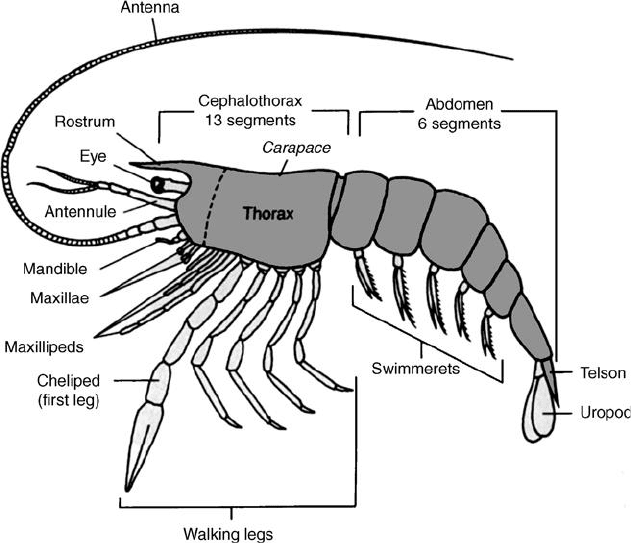
ing, and swimming. They have gills for respiration. An example is the lobster, a decapod
(Figure 8.3).
Hold a glass of pond water up to the light and you will see ‘‘specks’’ swimming or
darting about. Most likely, you will be seeing one of the planktonic crustaceans: cladocer-
ans, ostracods, or copepods (see Figure 15.10). The cladoceran Daphnia spp. are also
called water fleas. They feed on algae. Daphnia, along with the brine shrimp, are impor-
tant in the laboratory for their use in toxicity testing. Ostracods resemble the cladocerans,
except that they are enclosed by a two-piece carapace that makes them look like a very
small clam. As mentioned above, copepods are extremely common. In the oceans the
copepod Calanus and the euphasid krill form the major food source for herring, menha-
den, sard ines, and some whales and shar ks. The copepod Cyclops is very common in
freshwater systems.
Barnacles start their lives as planktonic forms resembling copepods. Eventually, most
attach to a solid surface and form the familiar shell of calcareous plates that we see on
rocks exposed by low tide. When covered with water, they open the slitlike apertures and
wave their fanlike legs to filter food particles from the water.
The class Malacostraca is the most diverse. It contains the most familiar crustaceans
of all, the decapods, which include crabs, lobsters, and shrim p. As the name implies,
MOLLUSKS, SEG MENTED WORMS, ARTHROPODS 163
decapods have five pairs of walking legs, the first of which may be modified into a claw.
The euphasids have only about 90 species but form the important marine food source
called krill. Most of them are bioluminescent. The amphipods have a laterally flattened
form with immobile compound eyes and two types of legs. For example, one set of legs
may be for swimming, the other for jumping. An example is Orchestia, the beach hopper.
Isopods are the only crustacean group to include terrestrial species, such as the familiar
pill bug. They have a flattened form and compound eyes. Although adapted for land, they
are not efficient at conserving water and require moist conditions to survive. Some are
parasites of fish or other crustaceans.
Around 1 million species of insects have been named, and this is thought to be only a
fraction of the number that exist. There are more species of insects than of all other ani-
mals combined. They dominate the land and fresh water, although few marine insects
exist. Their success is attributed to the arthropod char acteristics, plus their small size
and their development of flight. Table 8.2 shows some of the variety in the insect class.
In all there are 27 orders. The word ‘‘bug’’ is popularly used to denote any insect, or
sometimes any small organism. Environmental engineers often refer to the organisms
populating biological wastewater treatment plants, including bacteria and protozoans,
as bugs. To an entomologist (a scientist who studies insects), however, a ‘‘bug’’ is an
insect of a single order only, the Hemiptera.
An insect is an arthropod with three pairs of legs and (usually) two pairs of wings on
the thorax. Some insects have only one pair of wings or none at all. For example, the true
Figure 8.3 Typical body plan of the lobster, order Decapoda, class Malacostraca, subphylum
crustacean. (From Hickman et al., 1997. # The McGraw-Hill Companies, Inc. Used with
permission.)
164
THE ANIMALS
flies (order Diptera) have only one pair, and femal e ants and termites have wings only at
certain times. Lice and fleas have no wings. The head of an insect usually has two large
compound eyes and one pair of antennas. Most insects eat plants, although parasitic
insects are common. Some are predators on other insects or animals. Fleas feed on the
blood of mammals. Many wasps lay their eggs in or on spiders, centipedes, or other
insects, on which the larvae feed after hatching. Many predatory insect s benefit humans
by attacking crop pests. Many larvae and beetles eat dead animals.
To accommodate the high oxygen consumption rate necessary for flight, insects have
evolved an efficient tracheal system, consisting of tubes to transport air directly to the
tissues. Insects, along with arachnids, have evolved an efficient water-conserving excre-
tion mechanism that eliminates nitrogen waste in the form of insoluble uric acid.
Insects are dioecious with internal fertilization. Most female insects lay a large number
of eggs. The eggs must be laid in highly specific settings. For example, the monarch but-
terfly must lay its eggs on milkweed plants, which its caterpillar stage needs to eat. Some
insects lay their eggs on water, and their juvenile stages are aquatic.
About 88% of insects go through complete metamorphosis, in which the juvenile
form is radically different from the adult insect. The hatchling of an insect that undergoes
this process is wormlike and is called a larva, also known as a caterpillar, maggot, grub,
and so on, depending on the species. The larva grows through a series of molts and even-
tually surrounds itself with a cocoon, transforming into a transitional nonfe eding stage
called a pupa or chrysalis. When it molts out of this stage, the result is an adult, a
form that no longer molts. Other insects undergo gradual metamorphosis, in which
the juvenile somewhat resembles the adult and becomes an adult by gradual change.
The juvenile forms are cal led nymphs. Examples of species that have nymphs are grass-
hoppers, cicadas, mantids, and terrestrial bugs. Both larvae and nymphs pass through
several instars before going on to the next stage.
Besides those that attack crops, many insects harm humans directly. Mosquitoes trans-
mit malaria, encephalitis, yellow fever, and filariasis. Fleas transmit plague; the housefly,
typhoid; and the louse, typhus fever. Our battle with insects has had signal success—only
for us to have found that in some cases, the cure is worse than the disease . Unrestricted
use of pesticides starting after World War II had become a crisis by the 1960s, giving rise
to the modern environmental movement. Elimination of the more persistent pesticides and
more careful use of others has greatly reduced environmental and health risks today. How-
ever, alternative approaches are being developed. Parasitic wasps are sometimes cultured
to fight crop pests. Viral, bacterial, and fungal insect pathogens are being recruited. For
example, the bacteria Bacillus thuringiensis has been found to be effective against lepi-
dopterans (moths and caterpillars). A strategy called integrated pest manage ment (IPM)
combines plant culturing techniqu es such as crop rotation and selection of resistant vari-
eties with minimum timed use of pesticides to control insects without the heavier pesti-
cide dose that would otherwise be needed.
8.3.4 LESSER PROTOSTOMES
The lesser protostomes are a group of phyla whose species have mostly minor ecological
significance today. Most of them are worms or wormlike. One phylum that may be fami-
liar is the tardigrades, the water bears, which are common in aquatic habitats. Phylum
pogonophora live mostly below 200 m in the ocean in tubes made of chitin. This phylum
LESSER PROTOSTOMES 165
includes one of the most interesting of the recently discovered animals: the tube worms of
the deep-sea vent community (see Section 15.4.3).
8.4 DEUTEROSTOMES (STARFISH, VERTEBRATES, ETC.)
The deuterostomes constitute a group of phyla distinguished by the apparently arcane
distinction that the gut forms from the blastula, starting at the anus rather than the
mouth, as in protostomes. There are seven phyla in this group. The six that are exclusively
invertebrate can be clustered into a group called the lesser deuterostomes. Only one of
these, the echinoderms, includes familiar organisms, the sea stars and the anemones.
8.4.1 Echinoderms
The phylum echinodermata includes sea stars, sea urchins, brittle stars, sea lilies, and sea
cucumbers. They are among the most fascinating of marine organisms for the beach com-
ber. Th e name means ‘‘spiny skinned,’’ a reference to the spikes, bumps, or other projec-
tions all echinoderms have to protect them from predators. Curiously, although they are
among the higher phyla, they have primitive features, such as radial or biradial symmetry.
This characteristic is usually associated with sessile animals, but echinoderms are motile.
Their larvae are, however, bilateral. They also lack a brain and excretory and respiratory
systems. However, they do have one evolutionary advance: an endoskeleton consisting of
calcareous plates. Echinoderms cannot osmoregulate and thus are not found in brackish
waters, where the salinity may vary with tidal changes. Movement, excretion, and respira-
tion are performed by means of a unique water-vascular system, which uses canals
connected to the environment by pores. By pressurizing parts of the canal system, the
echinoderm can slowly move part of its body.
Sea stars, or starfish, are mostly predators feeding on other invertebrates and small fish.
Strong suckers on the legs enable movement and gripping prey. Some can force open a
clamshell, and then discharge their stomach through their mouth to digest the clam. Sea
urchins have their mouths on the bottom, where they graze algae and detritus from the
substrate.
8.4.2 Chordates, Including the Vertebrates
Finally, we come to the phylum that includes ourse lves. The chordates incorporated
evolutionary innovations that made it possible for them to grow to great size, forming
the largest animals on land (dinosau rs and elephants) and in the water (whales). The
four unique characteristics of the phylum Chordata are:
1. They have the presence of a notocord at some point in their development. The
notocord is a flexible skeletal rod that runs the length of the organism. It remains in
adult lampreys and hagfish, but in other chordates it is mostly replaced by vertebrae.
2. They have a single, hollow tubular nerve cord, located dorsal to the notocord,
usually enlarged at the anterior end to form a brain.
3. They have paired openings in the anteri or digestive tract called gill slits at some
point in their development. In humans these are present in the embryonic stage.
166 THE ANIMALS
One pair remains after this stage and forms the Eustachian tubes, which connect
the throat to the middle ear. It is the Eustachian tube that allows you to equalize the
pressure in your ear by swallowing.
4. The notocord, nerve cord, and segmented muscles continue into a tail that extends
beyond the anus. In humans the tail is present only briefly in the embryo.
Other important, although less uniqu e characteristics are: They have segmented
muscles in an otherwise unsegmented body. In humans these muscles lie along the spinal
column. Chordates have a closed blood system with a ventrally located heart, and they
have a complete digestive system.
Not all chordates are easily recognizable as being closer relatives to us than, say,
echinoderms. Two subphyla within the Chordates are marine invertebrates (Table 8.3).
The subphy lum Urochordata constitutes the tunicates. These include about 2000 species
of filter feeders. Many, called sea squirts, are sessile. One group, calle d the salps, form
meters-long colonies of transparent lemon- shaped bodies. Salps are brightly biolumines-
cent. The phylum Cephalochordata includes the 25 or 30 species of lancelets. Also
called amphioxus, they resemble a small, translucent fish without fins or mouth or eyes
to mark the head. They are common in sandy coastal waters around the world. Four
species are found off the coast of North America.
If you ask someone to name any animal that comes to mind, they will probably think of
a member of the third chordate subphylum: the vertebrates. The unique characteristic of
the subphyl um Vertebrata (also called Craniata) is that they possess a cartilaginous or
boney endoskeleton with a cranium, or brain case. Bone is a living tissue, not just calcar-
eous deposits. As the name implies, almost all vertebrates have a spine made of a series of
bones called vertebrae. The segmented muscles attach to the vertebrae. The only excep-
tion is the cartilaginous fishes (such as sharks). The subphylum Vertebrata includes eight
classes that are placed in five groups, each of which contributes new adaptations:
1. The fishes comprise four classes with about 30,000 species. They are the oldest
vertebrates and represent the development of the skull, bones, jaws, fins, and
vertebrae.
2. The class of amphibians has about 3000 species. They innovated with legs, fully
functioning lungs, a chambered heart, and separate circulation systems for the lungs
and the rest of the body.
3. The class of reptiles has 6500 species. Their innovations include dry, scaly skin, an
expandable rib cage, and the transfer of legs to beneath the body.
4. The birds (class Aves) include 9600 species. They represent the development of
warm-bloodedness, although many now believe this first occurred among the
dinosaurs. They also uniquely have feathers, air sacs, and hard-shelled eggs.
5. The class of mammals has about 5000 members. They independently developed
warm blood, plus their unique characteristics of body hair, a placenta for nurturing
embryos (in most orders), and mammary glands with milk production for nurturing
juveniles.
Hagfish and lampreys are in two classes that together make a superclass called the
jawless fish. Hagfish are blind scavengers that find prey by smell and attach themselves
by the mouth. They are the only vertebrates that keep their osmotic equilibrium with the
DEUTEROSTOMES (STARFISH, VERTEBRATES, ETC.) 167