
Vaccari D.A., Strom P.F., Alleman J.E. Environmental Biology for Engineers and Scientists
Подождите немного. Документ загружается.


TABLE 8.3 Classification of Living Members of Phylum Chordates
Subphylum Class Order Family Genus Species
Urochordata (tunicates; sea squirts and salps)
Cephalochordata (lancelets)
Vertebrata
Myxini (hagfish (43 spp.)
Cephalaspidomorphi (jawless fish, e.g., lamprey)
Chondrichthyes (cartilagenous fish: sharks and rays, 850 spp.)
Bony fish (45 living orders, about 30,000 spp.)
Amphibia (3900 spp.)
Caudata (salamanders, 360 spp.)
Anura (frogs and toads, 21 families, 3450 spp.)
Reptilia (13 orders, including the extinct dinosaurs)
Testudines (turtles)
Squamata (lizards and snakes)
Crocodilia (crocodiles and alligators)
Aves (birds) (27 living orders)
Mammalia
Nonplacental mammals:
Monotremes (only 3 spp., including duck-billed platypus);
Marsupials (kangaroos, opossums, koalas, 260 spp.)
Placental mammals:
Insectivora (shrews, hedgehogs, moles, 390 spp.)
Macroscelidea (elephant shrews, 15 spp.)
Dermoptera (flying lemurs, 2 spp.)
Chiroptera (bats, 986 spp.)
Scandentia (tree shrews, 16 spp.)
Xenarthra (anteaters, armadillos, sloths, 30 spp.)
Pholodota (pangolins, 7 spp.)
Lagomorpha (rabbits, hares, pikas, 69 spp.)
Rodentia (gnawing mammals: squirrels, rats, 1814 spp.)
Cetacea (whales, dolphins, porpoises, 79 spp.)
Carnivora (dogs, wolves, cats, bears, weasels, 240 spp.)
Pinnipedia (sea lions, seals, walruses, 34 spp.)
Tubulidentata (aardvark, 1 spp.)
Proboscidea (elephants, 2 spp.)
Hyracoidea (coneys, 7 spp.)
Sirenia (sea cows and manatees, 4 spp.)
Perissodactyla (odd-toed hoofed mammals:
horses, asses, zebras, tapirs, rhinoceroses, 17 spp.)
Artiodactyla (even-toed hoofed mammals: swine, camels, deer,
hippopotamuses, antelopes, cattle, sheep, goats, 211 spp.)
(Perissodactyla and Artiodactyla are called ungulates)
Primates (233 spp.):
prosimians (lemurs, tarsiers), monkeys, apes, humans
Great Apes
Homo
Homo sapiens
Homo habilis (extinct)
Pan (chimpanzees)
Gorilla
Lesser Apes
168
THE ANIMALS
surrounding seawater instead of controlling their internal condition. The lamprey is a
destructive eel-like parasite. It attaches itself to live fish by a suckerlike mouth and
uses sharp teeth to rasp at the flesh of the victim. Accidental introduction of the sea
lamprey Petromyzon marinus to the Great Lakes in the nineteenth century led to devas-
tation of one commercial species of fish after another. Larvicides are applied to streams
where they breed. This, combined with fish stocking programs, are producing a recovery
of the fisheries.
The cartilaginous fish, which include sharks and rays, surprisingly evolved from
boney ancestors. They track prey by smell and use an interesting lateral line system
of sensors along the side that detect vibrations and bioelectrical fields produced by all
animals. The electric ray can produce a low-voltage but high-current field from large
organs alongside its head. The power output can be several kilowatts and can stun prey
or repel predators.
The boney fish include most of the familiar fresh- and saltwater fish. They have
developed ray fins and a swim bladder, a gas-filled chamber below the spine that the
fish uses to control buoyancy. The importance of this can be seen by considering
the sharks, which lack a swim blad der and therefore must swim continuously to keep
from sinking to the bottom of the sea.
Among amphibians, the life cycle of frogs comes close to proving a famous biological
principle proposed in the nineteenth century which states that ontogeny (the development
of an individual from embryo to adult) recapitulates (repeats) phylogeny (the evolution-
ary development of a species). This principle, termed recapitulation, is invoked to
explain embryonic features that disappear in the adult, such as gill slits in human
embryos. As new features evolve, they are added to the embryonic development. But
the principle turns out to have too many exceptions to be generally valid. Evolution some-
times deletes characteristics, as well as adding them, so the ontogeny is not an accurate
record of the organism’sevolution. What we observe in frogs is the development of an
aquatic species into a terrestrial species. For example, all frogs hatch from the egg resem-
bling fish, having gills, a tail, and no limbs. This early stage is called the tadpole.
Gradually, the tadpoles sprout limbs, grow lungs and eyelids, and the tail shortens,
until the adult frog is finished.
The most abundant frog genus is probably Rana. All frogs, and most adult amphibians,
are carnivores. They feed on anything that moves and that is small enough to swallow
whole. Some amp hibians, such as some salamanders, remain aquatic; others do not
have an aquatic stage. However, all have thin water-permeable skins that require moist
conditions. This may make them among the terrestrial animals that are most vulnerable
to environmental problems. There is considerable anecdotal evidence today that frog
populations in many areas are in serious decline. The cause is a mystery, but some of
the factors that have been blamed include habitat destruction, acid rain, pesticides, and
damage from increased ultraviolet radiation due to destruction of stratospheric ozone.
Reptiles show numerous evolutionary developments. Many of these developments
freed reptiles from dependence on moist conditions. Their dry skin limits evaporative
loss. Internal fertilization and shelled, waterproof eggs eliminates the need for water for
reproduction. In turtles and crocodilians the temperature of incubation of the eggs deter-
mines the sex ratio. More efficient respiration allows greater size, up to the 115-kg
Komodo dragon. Reptile jaws are capable of applying crushing force. They have higher
blood pressure and more efficient circulation. Their lungs are more efficient. Whereas
amphibians force air into their lungs with mouth muscles, reptiles developed the ability
DEUTEROSTOMES (STARFISH, VERTEBRATES, ETC.) 169
to suck air in by expanding the rib cage. They excrete nitrogen as insoluble uric acid,
further conserving water. The nervous system of reptiles is much more complex than
that of amphibians . Crocodilians developed a true cerebral cortex. Plac ement of the
legs below the body instead of at the sides allows better support and motion.
Birds (class Aves) have many distinguishing characteristics other than the obvious ones
of having feathers and forelimbs developed into wings. Their necks are disp roportionately
long. Their skeleton contains air cavities, making them strong, yet light. Their beaks lack
teeth. They have a four-chambered heart and are warm-blooded. They excrete nitrogenous
wastes as uric acid. Fertilization is internal and they produce eggs with a large amount of
yolk. Some birds feed on insects; other invertebrates, such as worms, mollusks, and
crustaceans; and vertebrates. About one-fifth feed on nectar. Many eat seeds. The beak
is specialized for the type of feeding behavior. Bird behavior is highly developed, includ-
ing complex activities such as nest building and social activity. The farther from the
equator one gets, the higher the percentage of birds that migrate for the winter. The
Arctic tern breeds above the Arctic Circle and then migrates to the Antarctic region!
Day length seems to be the factor that stimulates migration. Birds can navigate using
the sun and stars as cues. Amazingly, it has been proven that they can also detect Earth’s
magnetic field.
Birds are very sensitive to the use of pesticides in the environment. Some pesticides
tend to biomagnify, increasing in concentr ation as they are passed up the food chain.
This has had the greatest impact on birds of prey, such as eagles and osprey. Other
contaminants that affect birds include lead shot discharged by hunters in wetlands. Water-
fowl ingest them, resulting in lead poisoning. The loss of wintering lands in tropical
regions may be a cause of the reduced songbird populations that have occurred in the
last 40 years.
The classification of birds and reptiles may soon change. This is because the common
ancestor of all reptiles is also the ancestor of the birds. Thus, they should be classified
together, or perhaps distinguished as feathered or featherless reptiles. Birds developed
from certain dinosaurs. Their closest relatives today are the crocodilians. For the present,
however, the traditional classification is retained.
The main distinguishing characteristic of mammals is the presence of hair or fur and
the production of milk. Hair or fur provides insu lation, giving greater advantage to the
warm-blooded metabolism. It has other functions as well, such as camouflage, water-
proofing, and sensing (as by whiskers). Hair is produced from dead cells that leave a
fibrous protein called keratin, the same substance that forms nails, claws, hooves, and
feathers. Mammalian skin contain s a variety of glands, including sweat , scent, and mam-
mary glands. The latter produce the milk to nurture the young. Herbivorous animals
harbor anaerobic bacteria and protozoans in a stomach chamber to ferment cellulose
into sugars, fatty acids, and starches. No vertebrates are able to use cellulose on their
own. Carnivores feed mostly on herbivores. The need for hunting behavior has selected
for intelligence in these animals. The herbivores, on the other hand, have developed keen
senses as protection against predators.
Most mammals have mating seasons, timed to produce young at a favorable season for
rearing. Mating is limited by the female, who is receptive to mating only during a brief
period in the mating season known as estrus. Old World monkeys and humans have a
different cycle, the menstrual cycle. Mammals exhibit three ways of giving birth. Mono-
tremes, such as the duck-billed platypus, is a mammal that lays eggs. Animals that lay
170 THE ANIMALS
eggs are called oviparous. The platypus still nurses its young with milk, however.
Marsupials are viviparous; that is, they give live birth. However, the newborns are
essentially still embryos. For example, the red kangaroo spends about a month in the
uterus. When it is born, it climbs by itself through the mother’s fur to a pouch, where it
attaches itself to a teat to suckle for 235 days until it is capable of living independently.
The third way to give birth is that of the placental mammals, which comprise 94% of
all mammals. Gestation in utero is prolonged. The embryo is nourished by a placenta,a
membrane structure produced by and surrounding the embryo. The placenta grows thou-
sands of tiny fingerlike projections called villi into the lining of the mother’s uterus to
absorb nutrients and oxygen from the maternal blood supply without there being an actual
exchange of maternal and fetal blood. The fetus is connected to the placenta by the umbi-
lical cord. Once born, the mammal may be more or less dependent on parents for a time.
Humans are members of the primate order. The first prima te fossils date back about
40 million years. About 8 million years ago, forests in eastern Africa gave way to savan-
nas, giving an advantage to apes that could stand upright. But it was 4 million years ago
that the first foss ils that could be called hominids (humanlike) appeared. This species has
been named Australopithecus afarensis. One of the best such fossils, discovered in 1974,
is of a female that has been named ‘‘Lucy.’’ It had a brain the size of a chimpanzee’s,
about 450 mL. The first species of our genus was Homo habilis, which lived from 2 million
years ago until about 1.5 million years ago. This species used stone and bone tools and had
a brain size of about 640 mL. This was followed by Homo erectus, which had a brain size
about 1000 mL and lived in social groups. Homo erectus disappeared about 300,000 years
ago and was replaced by our species, Homo sapiens. About 130,000 years ago a subspe-
cies of Homo sapiens appeared, called the Neanderthals. They had a brain size within the
range of modern humans, about 1100 to 1700 mL.
About 30,000 years ago Neanderthal man was replaced by a new subspecies, Homo
sapiens sapiens—us! These ancestors of ours were distinct from the Neanderthals in a
number of ways. Although Neanderthals made stone blades, those of sapiens were of
much higher quality. Sapiens buried their dead with ritual objects, suggesting a belief
in an afterlife. Finally, their vocal apparatus and related portions of the brain show
increased development. This suggests that early humans may have been capable of
language. Language capability confers the ability to do abstract reasoning. Thus, language
is the basis of intellect, the one thing that most decisively distinguishes us from the other
animals. It is interesting to realize that modern humans coexisted with a distinct sub-
species not long before the beginning of recorded history. Many suspect that Neanderthal
man was wiped out in conflicts with our ancestors. Others think that the two groups
merged by interbreeding.
Some interesting information on our more recent origins has been obtained from
studies of mitochondrial DNA. Although we inherit the DNA in our cells’ nuclei from
both parents, there is also DNA in our mitochondria that we inherit from our mother
alone. Mitochondrial DNA can be used to trace genetic heritage because it is not
confounded by recombination and the mixing due to sexual reproduction. The diversity
in mitochondrial DNA from different ethnic populations has been compared with the
divergence that would have occurred due to the rate of mutation from natural effects.
From this it has been possible to establish that if the assumptions used in the analysis
are reasonable, all humans in the world today are descendents of a single individual
that lived in Africa 200,000 years ago.
DEUTEROSTOMES (STARFISH, VERTEBRATES, ETC.) 171
PROBLEMS
8.1. Which phyla consist of organisms with no specialized excretory organs and therefore
would be most susceptible to toxic water pollutants? What other mechanisms would
these organisms have for excreting toxins?
8.2. The most common type of organism on land is virtually absent from the sea, and vice
versa. What are these two groups, and what do they have in common?
8.3. What class of vertebrates, other than the fish, are most susceptible to water pollution,
and why?
REFERENCE
Hickman, C. P., Jr., L. S. Roberts, and Allan Larson, 1997. Integrated Principles of Zoology, Wm. C.
Brown, Dubuque, IA.
172
THE ANIMALS

9
THE HUMAN ANIMAL
Now we begin a detailed examination of the physiology and anatomy of the human ani-
mal. Homo sapiens has adapted itself for life under the widest conditions of any animal
species, from the equator to the poles, from the bottom of the ocean to the top of the atmo-
sphere and beyond. The phenomenal success of this animal has not been without negative
effects on other organisms. Its activities have resulted in extinction of other species and
loss of habitat for many more. It may be the only species that by itself is responsible for
global changes in the environment. It produces chemicals that deplete stratospheric ozone,
with effects that are yet to be well understood. Its activities produce CO
2
fast enough to
result in a doubling of the atmospheric concentration by the mid-twenty-first century, and
which is expected to alter Earth’s climate. Homo sapiens has turned a good portion of the
world’s biological productivity toward its own use, but it is at risk of depleting its own
resources. It has the greatest ability to plan of any species by far, including the capability
of controlling its own resource consumption to prevent the risk of depletion. However, it
remains to be seen whether it will actually do so to prevent catastrophe in the future.
We will study the biological functioning of the human body, stopping short of human
behavior, which is beyond the scope of this book. We focus in turn on each of the 11 major
organ systems. An understanding of the structure and function of the human body will
help in understanding the effect of toxins.
The cells in the body are differentiated into about 200 different kinds. These are
classed into four basic types, which also correspond to the four basic types of tissues:
1. Muscle cells and tissues generate mechanical force and movement. They are
derived from the mesoderm. There are only three types of muscle tissue: smooth, skeletal,
and cardiac.
Environmental Biology for Engineers and Scientists, by David A. Vaccari, Peter F. Strom, and James E. Alleman
Copyright # 2006 John Wiley & Sons, Inc.
173
2. Nerve cells and tissues produce and conduct electri cal signals over large distances
within the organism and at great speed. They can stimulate response from other cells, such
as in muscles or glands. They are derived from the ectoderm.
3. Epithelial cells and tissues, or epithelium, form a lining over the organs, line body
cavities such as the inside of the intestines or the lungs, and cover the organism as a
whole, as the outer part of the skin. Thus, almost all absorption of pollutants must first
pass through the epithelium. In keeping with this role, its cells are specialized to be
selective in their absorption and secretion of ions and organic compounds, enabling them
to act as a barrier to the passage of chemicals into and within the body. Epit helium is
formed from ectoderm, mesoderm, and endoderm. Epithelial tissue never has its own
blood supply; instead, it receives nutrients by diffusion from the underlying connective
tissue. Cells that secrete subst ances such as hormones or digestive enzymes are epithelial
cells called gland cells.
4. Connective cells and tissues connect and support parts of the body. Examples
include bones, cartilage, fat storage cel ls, blood cells, and lymph fluid. Connective tissue
includes a number of cells that respond to tissue injury. These include a variety of
leukocytes, or white blood cells, which prot ect against infection, and mast cells, which
release the compounds histamine and heparin, which are responsible for the inflammation
response. Connective tissue underlies most epithelial layers. Connective cells are often
embedded in a large amount of extracellular material. For example, bone cells are
surrounded by a crystalline matrix. Tendons and ligaments consist almost completely of
collagen, a tough, ropelike fibrous protein that resists stretching. Some ligaments have a
stretchy fiber called elastic fiber, which is made up of the protein elastin.
The organs themselves are made of combinations of different kinds of the four basic
types of tissues. In a typical example, blood vessels have an inner lining of epithelium,
surrounded by a layer of connective tissue, and then by another layer of muscle tissue. The
muscle layer controls the movement of blood by constricting or dilating. For example,
when the body is cold, the muscle layer surrounding the blood vessels near the skin con-
stricts, reducing the transport of heat to the skin surface. Blushing occurs when the oppo-
site happens: The capillary muscles of facial skin dilate (open wi der), bringing more
blood to the surface. Adipose tissues are the fatty deposits below the skin. They can be
an important storage site for toxins.
9.1 SKIN
The integumentary system consists of the skin and associated structures, such as hair,
nails, and glands. The skin is one of the body’s main protections against toxins in the
environment. Looking at this from a different point of view, the skin is also an important
route of exposure for many toxins. The skin consists of two main layers, the dermis and
the epidermis (Figure 9.1). The dermis, the inner layer, is made up primarily of connec-
tive tissue, plus sweat glands, hair follicles, nerve endings, blood vessels, and the small
muscles that make your hair ‘‘stand up on end.’’ The dermis contains a large amount of
intracellular collagen fibers and elastic fibers. The elastic fibers give the skin the ability to
stretch. The collagen fibers limit the stretching and give skin strengt h.
The epidermis, the outer layer, is about 1 mm thick. The epidermis does not have its
own blood supply; it is supplied from capillaries in the dermis. The inne rmost part of the
epidermis is the basal cell layer, a single layer of cells that replicate to replace lost
174 THE HUMAN ANIMAL
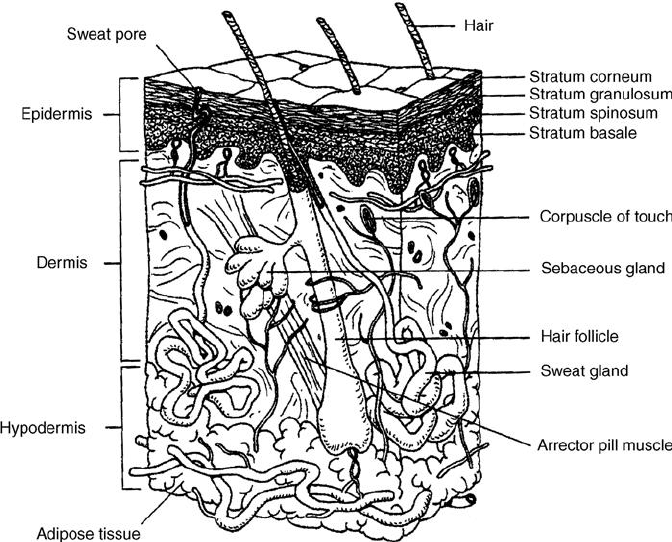
epidermal cells. These new cells push up as other new cells are produced below. Once
they are several cells away from the basal cell layer, they start producing large amounts
of keratin, a tough fibrous protein, and the cells gradually die off and dehydrate. This
process produces the outermost layer of the epidermis, called the stratum corneum.
This layer consists of dead epidermis cel ls filled with keratin and sandwiched between
phospholipid membranes. These cells are sloughed off continuously and regenerated by
the epidermis. It takes about 15 to 30 days for a cell to go from the basal layer to the
stratum corneum, and another 14 before it is shed.
The stratum corneum is resistant to water and other substances, although pores in the
skin provide a route for substanc es such as drugs or toxins to enter. The solvent dimethyl
sulfoxide (DMSO) easily crosses the skin and enters the circulation. Substances that other-
wise do not easily cross the skin may do so if dissolved in DMSO. Melanin is the dark
pigment in the skin of black people and of Caucasians with substantial exposure to sun-
light (a tan). It is produced by cells in the basal layer called melanocytes. The melanin
protects skin by absorbing ultraviolet light from the sun. Ultraviolet radiation from sun-
light is a common cause of skin cancer.
9.2 SKELETAL SYSTEM
The skeletal system consists of the bones, cartilage, and joints. Its functions are to pro-
vide support, protection, movement, mineral storage, and the production of red and white
Figure 9.1 Layers of the skin. (From Van de Graaff and Rhees, 1997. # The McGraw-Hill
Companies, Inc. Used with permission.)
SKELETAL SYSTEM 175
blood cells. Of environmental interest, the bones may be a significant storage site for toxic
divalent heavy metals such as lead, radium, or strontium.
Bone is a living tissue, although most of its mass consists of calcium salt crystals
and collagen fibers. Almost two-thirds of the mass of the bone is hydroxyapatite,
Ca
10
(PO
4
)
6
(OH)
2
, plus sodium, magnesium, and fluoride salts. About one-third of bone
mass is made up of collagen fibers. Living cells make up only 2% of the bone’s mass.
The cells include blood vessels and bone cells, called osteocytes. The combination of
crystalline hardness and collagen toughness give bone structural properties comparable
to high-quality steel-reinforced concrete. Bone structure often consists of a solid compact
bone exterior, with a strong, yet light spongy bone layer inside. Many bones have an
internal cavity containing marrow, which is the bone tissue that produces red and
white blood cells and that stores fat reserves.
Bones are dynamic tissues. Some osteocytes, called osteoblasts, produce new bone;
others, called osteoclasts, dissolve bone material. For example, when a long bone
grows in diameter, the osteoblasts produce bone on the outside while osteoclasts dissolve
bone on the intererior to enlarge the marrow cavity. Physical stress, such as from exercise,
causes bones to grow at the point of attachment of the muscle tendons. (Exception: In
children, excessive strenuous activity can damage sites of bone lengthening and result
in shortened stature.) Baseball pitchers and tennis play ers have 35 to 5 0% more bone
in their playing arm than in the other arm. Inactivity, on the other hand, can cause a
loss of bone mass. Weightlessness causes astronauts to lose significant bone mass even
if they exercise regularly. Older women are vulnerable to bone loss due to hormonal
changes, a condition called osteoporosis. However, this problem can be at least partially
forestalled by physical activity and/or hormonal therapy.
Humans have about 206 bones. The exact number varies because a variable number
fuse together during development. The head contains 29 bones: 22 facial bones, 8 cranial
bones, 6 bones in the ears, plus the hyoid bone. The latter is the only bone in the body not
connected to the skeleton. It is located just under and behind the tongue, and is involved in
swallowing. The spine consists of 26 bones: 24 are vertebrae, divided into the cervical,
thoracic, and lumbar regions. At the bottom of the spine are the sacrum, which connects to
the pelvis and is formed from five fused bones, and the coccyx, a vestigial tail formed
from three to five fused bones. The rib cage plus the sternum makes another 25 bones.
The upper and lower extremities plus the pelvic and pectoral girdles makes up another
126.
Cartilage is a clear, glassy mater ial composed of cartilage cells surrounde d by a mesh
of collagen fibers. It lines the moving surfaces of the skeletal joints. Cartilage has few
blood vessels, a reason that injury to it is slow to heal. Tendons are bands of dense tissues
containing parallel fibers of collagen that connect muscles to bones. Ligaments are like
tendons, but form connections from one bone to another. Some ligaments, such as those in
the spine, contain more elastic fibers than collagen, making them springy.
9.3 MUSCULAR SYSTEM
Muscles are organs containing cells, called muscle fibers, which are specialized to con-
tract. There are three types of muscle tissue. Cardiac muscle is present only in the heart.
Smooth muscle is responsible for involuntary actions, such as the contractions that move
food through the digestive system. It is also the type of muscle that surrounds the blood
176 THE HUMAN ANIMAL
vessels, controlling their contraction and dilation. Both of these types of muscle make up
about 3% of the body. However, the great majority of the body’s muscle is of the third
type: skeletal muscle, which makes up about 40% of the body’s weight. We focus on this
type of muscle.
Each skeletal muscle is made up of muscle fibers, each one a single cell that can
extend the length of the muscle (up to 20 cm) and 10 to 100 mm in diameter. Each of
these giant cells has hundreds of nuclei. Within each muscle fiber are many parallel bun-
dles called myofibrils, which run the length of the cell. Finally, within each myofibril are
numerous thick filaments composed of bundles of the protein myosin, and thin filaments
made of actin and other proteins. Muscle contraction is caused by the sliding filament
mechanism, in which the myosin filaments pull on the actin filaments like a person pull-
ing on a rope.
The ATP for muscle contractions can come from four sources: aerobic oxidation, or
glycolysis with fermentation to lactic acid, creatine phosphorylation, and free ATP.
Under resting conditions, muscle cells produce ATP from the oxidation of fatty acids
via aerobic respiration. Because it requires oxygen, this mechanism can provide energy
only as fast as the required amount of oxygen can be provided to the muscle by the blood-
stream. Although this is most efficient, aerobic respiration does not provide ATP fast
enough for continuous contractions such as those during athletic performances. It can, how-
ever, support moderate continuous activity such as hiking or, literally, ‘‘aerobic’’ exercise.
Recall from Section 5.4.1 that glycolysis, which occurs in the cytoplasm, can produce a
few ATPs from a partial oxidation of glucose to pyruvate. A fermentation step then con-
verts the pyruvate to lactic acid. The glucose itself is stored in the muscle in the form of
glycogen. Glycolysis provides enough energy for vigorous activity lasting 1 to 3 minutes,
such as an 800-m run. It has the advantage that it does not require oxygen. However, the
lactic acid accumulates in the muscle fiber, reducing the pH and disrupting the cell’s activ-
ity. This is the ‘‘burn’’ felt after heavy exercise that forces us to rest to recover from the
exertion. Muscle cells cannot oxidize the lactic acid. They must release it to the blood-
stream, where it will reach the liver. Only the liver can eliminate lactic acid. The liver will
gradually oxidize about 30% via respiration and use the resulting ATP to convert the rest
of the lactic acid back to glucose. Thus, the rate of oxygen utilization is elevated for a time
after the exertion stops, to repay the accumulated oxygen debt .
For very brief, explosive activity, such as a single leap or a throw, the muscle cell has
two immediate sources of ATP. One is the small amount of free ATP always p resent in
cells. This can support about 2 seconds of contractions. The second immediate source is a
high-energy compound called creatine phosphate (CP). The muscle fibers store about five
times as much CP as they do ATP.
An analogy for these sources of energy is in sources of money. Free ATP is like change
in the pocket. It’s ready in an instant, but it doesn’t last long. If you take a moment more,
you can fish for paper money in your wallet or purse. This is like the creatine phosphate.
Glycolysis is like using a credit card. It lasts longer but produces uncomfortable side
effects (financial debt, in this case), which must be paid back. Finally, the reactions of
respiration are like getting a job to obtain money. It comes in slow and steady, although
not fast enough to sustain a marathon shopping spree. To extend the analogy, fats can be
compared to ownership of stocks. Although they can be a significant reserve, they must be
converted to cash (liquidated, in the financial parlance) in order to be useful.
The muscles contain sensors that provide information to the central nervous system
about the state of contraction of the muscles. This gives us a sense of body position and
MUSCULAR SYSTEM 177