
Vaccari D.A., Strom P.F., Alleman J.E. Environmental Biology for Engineers and Scientists
Подождите немного. Документ загружается.


The molecules that the hormones interact with are calle d receptors. The effect of a
hormone depends not only on how much hormone is in circulation but how many recep-
tors are present and on which cells. This is an important aspect of hormone control. Dif-
ferent tissues may vary in their numbers of receptors for a particular hormone. This
enables the action of hormones to be selective. Change in receptors is also a mechanism
for the control of hormone response. For example, thyroid hormone stimulates adipose
cells to produce receptors for epinephrine, increasing their sensitivity to epinephrine’s
causing the release of fatty acids. The interaction of a hormone with a cell-surface recep-
tor ultimately results in the activation or inhibition of an enzyme within the cell. Many
drugs are designed to either stimulate or interfere with recepto rs.
The lipid hormones enter the cell and complex with the DNA in the nucleus. They then
either stimulate or inhibit gene expression, and ultimately, the cell function. For example,
testosterone stimulates production of structural proteins in skeletal muscles, increasing
muscle size and strength. Thyroid hormones, in addition to complexing with DNA,
may bind to mitochondria, causing an increase in ATP production.
Hormones are also controlled by changes in the composition of intercellular fluids, by
other hormones, or by neural stimulation. Th e hypothalamus and the adrenal medulla are
TABLE 9.2 Amino–Acid–Derived Hormones
Gland Hormone Target and Function
Pineal gland Melatonin Pineal gland receives stimuli from visual
neurons that reduce melatonin production
during the day and increase it at night.-
Thought to be involved in circadian (daily)
rhythms of the body. Increases during dark
winters thought to cause seasonal affective
disorder (SAD), a disorder that affects
mood, sleeping, and eating.
Thyroid Thyroxine (T
4
) and
triiodothyronine (T
3
)
Synthesis of thyroxine and triiodothyronine
requires iodide. Synthesis and release is
stimulated by hypothalamic regulatory
enzymes. Produces a rapid, short-term
increase in metabolic rate by binding to
mitochondria, and by activated genes that
code for glycolysis enzymes.
Catecholamines
Adrenal medulla Epinephrine (adrenaline)
and norepinephrine
Epinephrine makes up about 75% of the
release of the adrenal medulla; the rest is
norepinephrine. Release is stimulated by
the sympathetic division of the autonomic
nervous system as part of the fight or flight
response. Causes skeletal muscles to break
down glycogen to glucose as a ready source
of energy, adipose tissue to break fats
down to fatty acids for other tissues to use,
the liver to break down glycogen for use by
the neurons that cannot use fatty acids.
Hypothalamus Dopamine Controls release of prolactin.
188
THE HUMAN ANIMAL

stimulated directly by nervous activity. The hypothalamus controls the release of many
hormones from the anterior pituitary, which in turn affects numerous other hormones
and tissues. It also controls the release of vasopressin and oxytocin, which it produces,
but which are stored in the posterior pituitary. This arrangement mak es it possible to
have a rapid response for urgent needs such as blood pressure control.
TABLE 9.3 Lipid-Derived Hormones
Gland Hormone Target and Function
Eicosanoids
Many tissues Leukotrienes Released by white blood cells, they coordinate tissue
responses to injury and disease.
Prostaglandins Generated by most tissues of the body, converted by
platelets in the blood to thromboxanes.
Thromboxanes Causes platelets to aggregate and the smooth
muscles of the blood vessel walls to contract.
Steroids
Reproductive
organs
Androgens (testosterone
and others)
Testosterone Produced by testes, it promotes sperm
growth, stimulates overall growth, especially
of the skeletal muscles, and produces
aggressive behavior.
Follicles of
ovaries
Estrogens (e.g.,
estradiol)
Stimulates maturation of egg cells and growth
of the lining of the uterus.
Corpus luteum
of ovaries
Progestins (e.g.,
progesterone)
Prepares uterus for embryo, stimulates
movement of egg or embryo, stimulates
enlargement of mammary glands.
Adrenal cortex Several dozen
hormones, e.g.:
Aldosterone In response to drop in blood sodium, volume, or
pressure, stimulates retention of sodium by
kidneys, sweat glands, salivary glands, and
pancreas; increases sensitivity of salt-sensing
taste buds in tongue; also stimulated by angio-
tensin II.
Glucocorticoids (e.g.,
cortisol, hydrocortisone,
corticosterone)
Accelerates glucose synthesis and glycogen forma-
tion, especially in the liver; stimulates tissues to
use fatty acids for energy instead of glucose,
reduce inflammation by inhibiting white blood
cells and mast cells. Cortisol inhibits its own
production by a negative feedback loop involving
the hypothalamus and ACTH.
Androgens The ‘‘sex’’ hormones, including testosterone. Some
are converted to estrogen.
Kidneys Calcitriol One of the D vitamins, released in response to PTH.
Stimulates absorption of calcium and phosphate
by the digestive tract, stimulates differentiation
and behavior of bone cells, and inhibits PTH
production.
ENDOCRINE SYSTEM AND H OMEOSTASIS 189
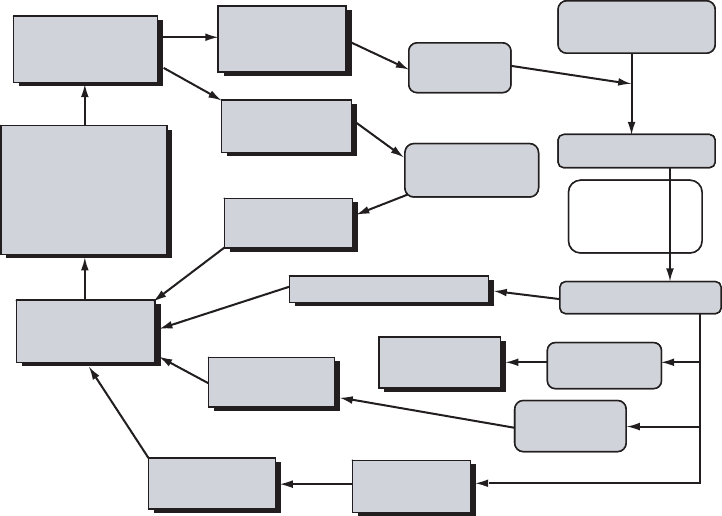
Hormones, endocrine organs, and the nervous system interact in complex ways.
Figure 9.6 shows one case that illustrates this complexity schematically. That this system
is much more complex than portrayed in the figure is appar ent when one considers that
each box represents a complex stimulus–response process in itself.
One of the most common diseases of the endocrine system is diabetes mellitus, which
results in unstable blood glucose levels. Diabetes is the result of either inadequate insulin
production, production of abnormal insulin, or production of defective receptors. These,
in turn, may be determin ed genetically. Without effective levels of insulin, cells cannot
remove glucose from the bloodstream. As a result, the liver, brain, and other tissues
‘‘starve’’ despite the ready supply. The kidneys work to remove the excess glucose, result-
ing in the loss of large amounts of water. This produces the symptoms of copious produc-
tion of sweet urine, thirst, and dehydration.
Hydrocortisone creams are used in the treatment of rashes or excessive itching. These
symptoms are overreactions of the immune or nervous systems. However, these medicines
should never be applied to wounds, because they inhibit the inflammation response that
would otherwise speed healing.
9.6 CARDIOVASCULAR SYSTEM
The cardiovascular system includes the blood, heart, and blood vessels. The heart and
blood vessels serve to transport the blood throughout the body. The blood, in turn, has the
following functions: (1) transport of gases, nutrients, hormones, and wastes; (2) regulation
of pH and electrolyte concentration of intercellular fluids; (3) control of heat transport;
HOMEOSTASIS
Normal blood presure
and volume
HOMEOSTASIS
Normal blood presure
and volume
Low blood
pressure and
volume
Low blood
pressure and
volume
Restored blood
pressure and
volume
Restored blood
pressure and
volume
Reduced kidney
blood flow
Reduced kidney
blood flow
Reduced O
2
to
the kidneys
Reduced O
2
to
the kidneys
Red blood cell
production
Red blood cell
production
Fluid retention
Fluid retention
Fluid absorption
Fluid absorption
Vasoconstriction
Vasoconstriction
Thirst
stimulation
Thirst
stimulation
Renin
release
Erythropoietin
released
Angiotensinogen
from the liver
ADH
secretion
Enzyme
in
Lungs
Angiotensin II
Aldosterone
secretion
Sodium
retention
Sodium
retention
Angiotensin I
HOMEOSTASIS
Normal blood presure
and volume
HOMEOSTASIS
Normal blood presure
and volume
Low blood
pressure and
volume
Low blood
pressure and
volume
Restored blood
pressure and
volume
Restored blood
pressure and
volume
Reduced kidney
blood flow
Reduced kidney
blood flow
Reduced O
2
to
the kidneys
Reduced O
2
to
the kidneys
Red blood cell
production
Red blood cell
production
Fluid retention
Fluid retention
Fluid absorption
Fluid absorption
Vasoconstriction
Vasoconstriction
Thirst
stimulation
Thirst
stimulation
Renin
release
Erythropoietin
released
Angiotensinogen
from the liver
ADH
secretion
Enzyme
in
Lungs
Angiotensin II
Aldosterone
secretion
Sodium
retention
Sodium
retention
Angiotensin I
Figure 9.6 Control of blood pressure and volume. (Based on Martini, 1998.)
190
THE HUMAN ANIMAL
(4) removal of pathogens and cell debris; and (5) restriction of fluid loss from injury, by
clotting. The blood is the mechanism by which systemic toxins are carried around the body
to the tissues they injure. Each of its parts may also be attacked by various toxins.
Blood makes up about 7% of human body weight. In females this averages about 4.5 L
of blood; males about 5.5 L. When a tube of blood is centrifuged, the upper 55% of the
volume will be a pale yellow liquid called plasma. Plasma is 90% water, with 10% solutes
including proteins and electrolytes; nutrients such as glucose, amino acids, and lipids; and
waste products such as urea and bilirubin, a waste product that gives plasma, as well as
urine and feces, their color. About 96% of the plasma proteins consist of albumins and
globulins. These have overlapping functions, including control of osmolarity and the
transport of insoluble lipids, vitamins, metals, hormones, and so on. Globulins are an
important component of the immune system, discussed in Section 9.7. The rest of the pro-
tein is fibrinogen, involved in blood clotting. The dominant electrolytes are sodium and
chloride. Intercellular fluid is similar in composition to plasma.
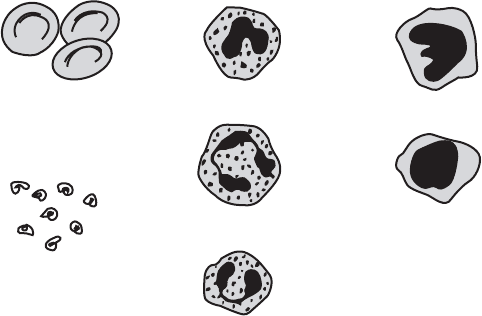
The other 45% of blood volume consists of the blood cells and platelets (Figure 9.7).
The great majority of these, about 5,000,000 per cubic millimeter, are the red blood cells,
or erythrocytes. These are produced in the bone marrow under stimulation by erythro-
poetin from the kidney. When mature, they lose their ribosomes, mitochondr ia, nucleus,
and so on, giving them the appearance of a small (about 7 mm) disk indented in the center.
Without their organelles, erythrocytes cannot long maintain their structure. They are
replaced continuously, at the rate of a little less than 1% per day. Old red blood cells
are destroyed and recycled by the spleen and liver.
The function of erythrocytes is to carry oxygen from the lungs to the other tissues
and to carry carbon dioxide on the reverse path. These compounds are carried by the
red pigment hemoglobin (Figure 9.8), which constitutes one-third of the mass of the
erythrocyte. Hemoglobin is composed of four polypeptide chains complexed with four
heme groups, each containing a ferrous iron ion at its center. Note the similarity between
Erythrocytes
(red blood cells)
Platelets
(thrombocytes)
Leukocytes
(white blood cells)
Granular Nongranula
r
Basophil
Neutrophil
Eosinophil
Lymphocyte
Monocyte
Figure 9.7 The formed elements of the blood. (From Van De Graaff and Rhees, 1997. # The
McGraw-Hill Companies, Inc. Used with permission.)
CARDIOVASCULAR SYSTEM 191
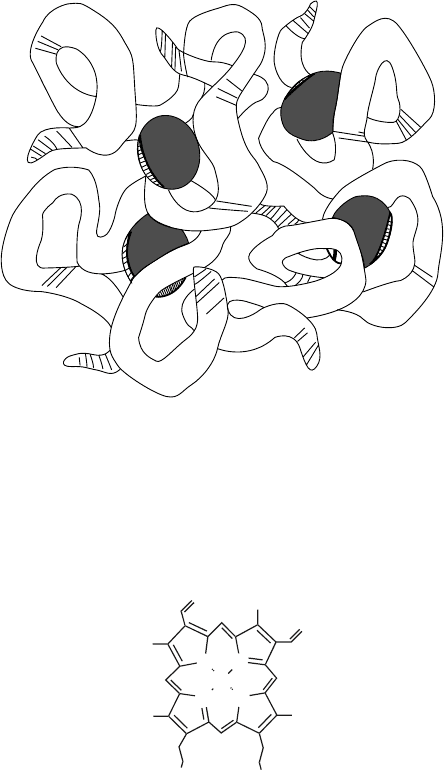
the heme molecule and chlorophyll shown in Figure 5.10. Each of the four ferrous ions can
complex with one molecule of O
2
. This gives blood an oxygen-carrying capacity of about
74 mg/L, about 10 times the solubility of oxygen in water at physiological temperature.
Fe
N
NN
N
HOOC
COOH
heme subunit
Just 0.1% of the blood volume is composed of white blood cells,orleukocytes, and
platelets. All are descendants of the same cells in the bone marrow that produce erythro-
cytes, although some leukocytes go through additional processing in the thymus and
organs of the lymphatic system. There are four types of leukocytes, of which 60 to
70% are neutrophils and 20 to 25% are lymphocytes. Functionally, leukocytes are part
of the immune system and are discussed in Section 9.7. Although transported by blood,
they usually leave the blood vessels for sites of infection or damage to do their work.
Blood platelets are cytoplasmic cell fragments that are much smaller than erythro-
cytes. They are involved in the formation of blood clots to prevent blood loss and promote
tissue healing after a physical injury. Such injury disrupts the endothelial lining of the blood
vessels, exposing underlying connective tissue. Platelets adhere to collagen, and a plug of
platelets is formed rapidly. Simultaneously, a complex series of reactions, some of which
involve platelets, results in the conversion of fibrinogen into a form that aggregates to form
Figure 9.8 Hemoglobin. (From Van De Graaff and Rhees, 1997. # The McGraw-Hill Companies,
Inc. Used with permission.)
192
THE HUMAN ANIMAL
a mesh of interlocking strands called fibrin that forms the clot. Several factors limit clotting
to the area of the wound, including prostaglandins produced by normal tissue. Hemophilia
is a gender-linked genetic disease in which the victim cannot produce one of the factors
involved in fibrin formation. It has been mentioned that aspirin inhibits prostaglandins.
However, at low doses it inhibits thromboxane more. Thus, it has been found that men
with no previous history of heart disease who take one aspirin every other day reduce
their chance of heart attack (caused by clotting of the coronary arteries) by 50%.
The blood vessels are the tubes that conduct blood around the body. They are lined
with a type of epithelial cells, which in this case are called endothelium. Arteries
carry blood away from the heart toward the tissues. They contain muscles that help main-
tain blood pressure. Arteries branch successively into arterioles, which by their contrac-
tion and dilation control blood flow to various tissues. These divide further until they form
a weblike network of tiny thin-walled vessels called capillaries. These are about 5 to 8 mm
in diameter, just wide enough for erythrocytes to pass in single file. Capillaries permeate
almost all tissues; few cells are more than 1 mm from a capillar y. The capillaries are
responsible for the transfer of heat and substances to and from tissues. Ve ins carry blood
back to the heart. (Note that the definition does not depend on whether or not the blood is
oxygenated. Specifically, the pulmonary arteries are deoxygenated but carry blood from
the heart to the lungs, and the pulmonary veins are oxygenated but carry blood back to the
heart.) Veins are less muscular and under much lower pressure than arteries. Thus, move-
ment is aided by contraction of skeletal muscles surrounding them and by the presence of
one-way check valves to prevent flow reversal.
The heart is actually two connected pumps. The right side pumps deoxygenated blood
through the lungs, the left distributes it through the body. The heart of a resting adult
pumps about 5.0 L/min in 72 beats/min, or about 70 mL/beat. When exercising, a non-
athlete may pump 20 L/min at 192 beats/min. A well-trained athlete may pump up to
35 L/min. Blood is delivered to the right atrium of the heart by the superior and inferior
vena cava. This collects a volume of blood to fill the more muscular right ventricle,
which then provides the pressure to force the blood out through the pulmonary arteries
to the lungs. After CO
2
is exchanged for O
2
, the blood flows back into the left atrium.
The left atrium fills the left ventricle, the most muscular part of the heart, which must
develop enough pressure to circulate the blood throughout the body. The left ventricle
discharges through the main artery, called the aorta. A pair of coronary arteries branch
out from the aorta to provide blood for the heart’s own use.
Although innervated by the autonomic nervous system, the heart can beat indepen-
dently. Nervous stimulation can serve to increase or decrease heart rate as needed. The
contraction phase of the cardiac cycle is called systole; the relaxation phase is called
diastole. Pressure peaks at a normal 120 mmHg (over 2 m of hydraulic head) during systole.
During diastole it drops to about 80 mmHg. These measurements are usually expressed in
the form 120/80. Blood pressure above 140/90 is abnormally high. Surprisingly, the heart
also produces a hormone to regulate blood volume in concert with the kidneys.
9.7 IMMUNITY AND THE LYMPHATIC SYSTEM
The immune system consists of defenses against foreign matter that gains entry to the
body. It consists of the lymphatic system plus components of numerous other systems
of the body. Many toxic pollutants either stimulate or suppress the immune system.
IMMUNITY AND THE LYMPHATIC SY STEM 193
The lymphatic system consists of lymph, lymphatic vessels, lymphocytes, and lym-
phoid tissues and organs. Lymph is a fluid similar to plasma. Lymphatic vessels are
similar in structure to veins. They conduct lymph from peripheral tissues to the veins.
Capillaries deliver more liquid to tissues than they carry away. The rest forms intercellular
fluid that collects as lymph. The most important lymphoid organs are the lymph nodes,
the spleen, and the thymus. The lymph nodes contain immune system cells that remove
pathogens from the lymph before they reach the bloodstream. The tonsils are lymph
nodes positioned to respond to infections arriving by way of the mouth or nose. The
thymus produces T cells (described below). The spleen performs functions for the
blood similar to those the lymph nodes perform for the lymph, such as removal of cellular
debris and responding to pathogens in the blood. It also stores iron from recycled erythro-
cytes.
The defenses of the body are classified into two forms: specific and nonspecific.
Nonspecific defenses protect without discriminating the exact type of threat, and act rela-
tively rapidly. There are seven kinds of nonspecific defenses:
1. Barrier defenses include the skin, mucous membranes, and hair, which act to
prevent physical access to the interior by disease agents.
2. Phagocytes are cells that engulf pathogens (the process of phagocytosis) and debris.
Several of the white blood cells serve this function. In addition, the white blood cells
known as monocytes are converted into phagocytes called macrophages, which
perform this function in tissues and the lymphatic system.
3. Immunological surveillance involves a kind of lymphocyte called natural killer
(NK) cells that can recognize and kill virus-infected and cancerous cells. They are
also recruited by the specific defense immune system.
4. Interferons are small proteins released by lymphocytes and macrophages that
stimulate virus-infected cells to produce antiviral proteins.
5. Complement consists of 11 special proteins in plasma that work either alone,
forming pores in the membrane of foreign cells, killing them, or in conjunction with
the specific defenses to have the same effect. They can als o attack virus structure,
attract phagocytes, and stimulate inflammation.
6. Inflammation results when damage stimulates the release of histamines, heparin,
prostaglandins, potassium, and other substances which produce dilation and
increased permeability of capillaries. These produce pain, swelling, warmth, and
redness of the injured area. Clots isolate the area, and macrophages are attracted.
The increased temperature can reduce pathogen growth.
7. Fever is the increase of body temperature above 37.2
C (99
F). Fever is caused by
proteins in the blood called pyrogens, Some pyrogens are produced by macro-
phages, which affect the temperature set point. High body temperature may be a
strategy to inhibit growth of pathogens while enhancing the body’s own metabolism.
Metabolism increases about 10% for each 1
C increase in temperature.
Specific defenses are highly selective: for example, recognizing a particular strain of
bacteria but ignoring all others. However, they take longer to get int o action. The protec-
tion of specific defenses is called immunity. Immune responses are stimulated by foreign
substances called antigens. Specific defenses refer to immune responses that recognize
particular antigens. Immunity is mediated by cells that differentiate from lymphocytes
194 THE HUMAN ANIMAL
that have left the bloodstream. These can form three basic types: NK cells, mentioned
above; B cells; and T cells. Both B and T cells are produc ed in the lymphoid organs.
There are several basic forms of T cells. The most important are the cytotoxic T cells
(T
C
cells, also called killer T cells). T
C
cells recognize antigens bound in the membranes
of other cells. These other cells can be any cell in the body. All our cells constantly take
protein fragments from the cytoplasm and place them on their membranes complexed
with a glycoprotein called the major histocompatibility complex (MHC). If a cell is
damaged or contains infectious material such as proteins, some of the antigens presented
on the surface will be abnormal. The deranged cell will also produce other membrane
proteins that signal, in effect, ‘‘I am deranged.’’ A T
C
cell can bind to the MHC and
the second signal protein. The presence of both binding sites stimulates the T
C
cell to
kill the deranged cell either by producing toxins or by stimulating the cell to kill itself
(a process called apoptosis). The now-activated T
C
cell can then reproduce many
times, generating an army of cells to attack other cel ls carrying the same antigen. The
reproduction process will also generate memory T
C
cells, which remain in reserve in
case of future reinfections by the same antigen-bearing pathogen.
B cells act to eliminate the source of antigens directly instead of killing infected cells.
The lymph nodes store millions of different populations of B cells, each capable of react-
ing to a different antigen. Almost any biological substance, whether from a fungus or a
transplanted organ, can find a B cell that can react to it. Each population of B cells has a
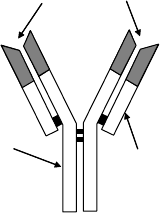
specific type of globulin protein studding its surface. These are Y-shaped molecules called
antibodies,orimmunoglobulins (Figure 9.9). Antibodies are produced by B cells. Once
an antigen complexes with the antibodies on the surface of a B cell, the B cell becomes
sensitized. It then reacts with a helper T cell and becomes activated. The activated B
cell then starts reproducing rapidly. Some of the offspring become plasma cells, which
produce antibodies that circulate in the blood. Others become memory B cells, which
remain in storage in case of a repeat infection.
The attack is now carried on by the circulating antibodies. The top of the Y can com-
plex with antigens. When macrophages encounter a substance covered with antibodies, it
is stimulated to phagocytize it, destroying it. Complement also reacts with the antibodies,
and if they are attached to a cell or a virus, the com plement will destroy them.
Several varieties of polysaccharides on the surface of red blood cells differ between
persons to give them their characteristic blood type. These sugars are natural antigens
that act when blood from one person is given to another in a transfusion. The genetic
Binding sites
Heavy
chain
Light
chain
Figure 9.9 Basic structure of an immunoglobulin protein. (Based on Van de Graaff and Rhees,
1997.)
IMMUNITY AND THE LYMPHATIC SY STEM 195
basis of blood type was described in Section 6.1.1. The gene for blood type has three
alleles: A, B, or O. Alleles A and B code for the production of a corresponding surface
sugar. The allele for O does not produce a surface sugar. Thus, a person with alleles AA or
AO have only type A sugars on the surface of their RBCs, and those people have type A
blood. Unlike standard antibody response, people with type A blood always have anti-B
antibodies even if they have never been exposed to the type B antigen. Thus, if blood of
types B or AB is transfused into type A persons, their antibodies will produce a reaction
that involves hemolysis (RBC rupture) or clumping of RBCs. Table 9.4 shows the similar
relationships for other blood types. Note that type AB persons can accept transfusions of
any blood type. Thus, they are called universal recipients. Type O persons can donate
blood to anyone and are called universal donors.
Another type of T cell, the helper T (T
H
) cell, is produced by a mechanism similar to
the production of cytotoxic T cells. The T
H
cell produces cytokines that stimulate the
maturation of cytotoxic T cells and the B cells. The human immunodeficiency virus (HIV),
which causes the disease known as acquired immune deficiency syndrome (AIDS) infects
and kills a type of T
H
cell. These T cells slowly disappear over a period of years in infec-
ted individual, eventually disabling the entire specific defense system.
Vaccines consist of inactivated antigens, such as killed infectious bacteria or virus.
When injected into a human, the person develops antibodies for that bacteria or virus
just as if it were faced with a real infection. If a real infection occurs subsequently,
circulating antibodies and memory T cells and B cells will be ready to respond more
quickly to stop the infection.
There are several types of diseases of the immune system. AIDS is a type of immuno-
deficiency disease. Besides the infectious type, this problem can be caused by radiation or
congenital problems. Autoimmune disorders occur when the immune system treats part
of the body as if it were a foreign substance. Examples are rheumatoid arthritis, lupus
erythematosis, psoriasis, and diabetes mellitus. Allergies are excessive or inappropriate
immune responses. A first exposure to an antigen stimulates the production of antibodies,
which mediate an exaggerated response on subsequent exposures.
As described earlier, stress produces the release of glucocorticoids, which inhibit
inflammation responses and ultimately, the healing of wounds. This makes the stressed
person more susceptible to disease.
9.8 RESPIRATORY SYSTE M
The respiratory system has the primary function of exchanging the gases O
2
and CO
2
between the blood and the atmosphere. Along with the integument and the digestive
tract, it is a major area of contact between the body and the environment. In fact, it is
TABLE 9.4 Human ABO Blood Types and Their Compatibilities
Blood Percent of U.S. Antigen on Genetic Antibodies Compatible Blood
Type Population RBC Makeup in Blood Types
A 42 A AA or AO Anti-B A or O
B 10 B BB or BO Anti-A B or O
AB 3 A and B AB None Any
O 45 None OO Anti-A and anti-B A, B, or AB
196
THE HUMAN ANIMAL
the major area of exposure, in terms of the volume of environmental material contacted.
Besides infectious illness, the respiratory system is susceptible to gaseous and particulate
pollutants, ranging from irritants to carcinogens.
The upper respiratory system includes the nose and nasal cavity, the nasal sinuses,
and the pharynx. The sinuses are open chambers in the face, connected to the nasal cavity
by passages. Their function is to lighten the head, add timbre to the voice, and to produce
mucus to moisten and lubricate the surfaces of the nasal cavity. Air passing through the
nasal cavity is warmed, humidified, and filtered of large particles. The pharynx is the part
of the respiratory system shared with the digestive system, extending from the back of the
mouth down to the larynx.
The lower respiratory system includes the larynx (voice box), trachea (windpipe),
and the bronchi, bronchioles, and alveoli of the lungs. The glottis is a narrow passageway
between the phary nx and the trachea. It can open and close much like a pair of sliding
doors. In speech, air passing through the glottis vibrates ligaments at the inner edge of
the glottis, the vocal cords. The larynx is a group of cartilaginous structures that surround
and protect the glottis. At the top is a spoon-shaped cartilage called the epiglottis. When
you swallow, the larynx is pushed up, forcing the epiglottis to fold down and seal off the
trachea. At the same time, the glottis closes. If particles get past the epiglottis, they fall on
the glottis and stimulate the coughing reflex. In a cough, the glottis is held closed against
air pressure from the lungs and then is opened abruptly to eject any material.
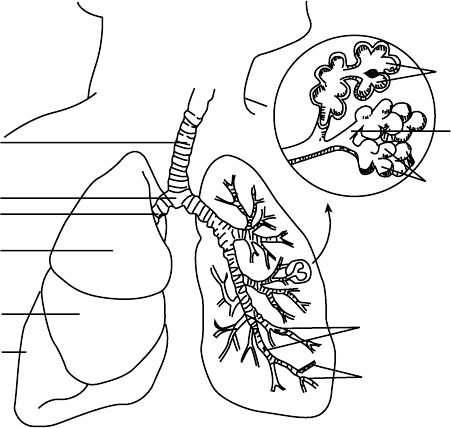
Air is then conducted down through the trachea, which then branches into two
bronchi and enters each of the lungs (Figure 9.10). The trachea and each bronchus has
a similar tubelike structure surrounded by C-shaped cartilage rings. These branch succes-
sively into smaller and smaller bronchi. At the smallest level they form bronchioles, with
an inside diameter of 0.3 to 0.5 mm. Bronchioles lack cartilage. Like arterioles, they can
expand and contract under the influence of the autonomic nervous system to control flow.
Right middle lobe
Right inferior lobe
Right superior lobe
Right primary bronchus
Carina
Trachea
Tertiary bronchioies
Secondary bronchi
Pulmonary alveoli
Alveolar duct
Alveolar sacs
Figure 9.10 Trachea, bronchi, and lungs. (From Van De Graaff and Rhees, 1997. # The McGraw-
Hill Companies, Inc. Used with permission.)
RESPIRATORY SYSTEM 197