
Vaccari D.A., Strom P.F., Alleman J.E. Environmental Biology for Engineers and Scientists
Подождите немного. Документ загружается.

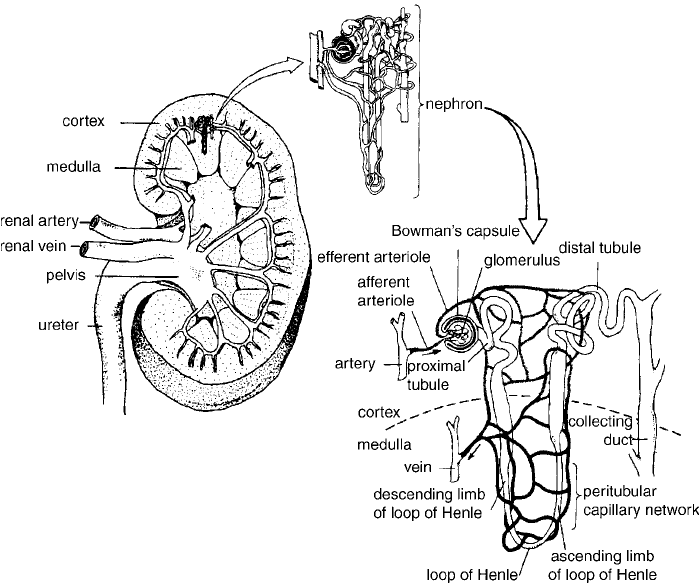
The nephron is about 50 mm long, 15 to 60 mm in diameter, and has four main parts.
The ball-shaped glomerular capsule in the cortex contains a tuft of about 50 capillaries
called the glomerulus. This connects to the proximal tubule, which, in turn, is connected
to the loop of Henle, with a descending limb that passes down into the renal medulla and
an ascending limb that goes back into the cortex. Finally, the distal tubule passes through
more of the cortex before emptying into a collecting duct. Each of these four sections of
the nephron play a role in forming urine using three distinct processes: (1) glomerular
filtration, (2) tubular resorption, and (3) tubular secretion.
The capillaries of the glomerulus have pores with a diameter between 50 and 100 nm.
In glomerular filtration, blood pressure forces plasma through these pores into the
nephron. Blood cells and most blood proteins are retained, but the liquid, salts, and small
organic molecules pass through to form a filtrate. The kidneys receive about 20 to 25% of
the blood flow from the left ventricle of the heart. Of this, some 10%, about 125 mL/min,
passes into the nephrons. This filtrate has a composition similar to plasma, except without
the large proteins. The filtration rate is maintained at a fairly constant rate within the
kidney but can be modified by hormones or by the autonomic nervous system. A disorder
called glomerulonephritis can follow a severe infection of bacteria or viruses. The infec-
tion can produce a high concentration of antibody–antigen complex to circulate in the
blood. Th e complexes plug the pores of the glomerulus, reducing the filtration rate and
producing an inflammation of the renal cortex.
Figure 9.13 Human kidney with details of the nephron. (From Fried, 1990. # The McGraw-Hill
Companies, Inc. Used with permission.)
208
THE HUMAN ANIMAL
As the filtrate passes alon g the nephron, various materials are removed or added by
diffusion, osmosis, or carrier-mediated transport such as facilitated transport active trans-
port, cotransport, or countercurrent transport. Carrier-mediated transport has a limited
capacity, and if the blood concentration of the transported compound exceeds a threshold,
the excess will be lost in the urine. This is the fate of much of the water-soluble vitamins
taken in high concentrations in pill form. After a high-sugar meal, your blood sugar may
briefly exceed the threshold of 180 mg/dL, and some sugar will be lost. This is a chronic
problem with diabetics.
Using facilitated transport and cotransport, the proximal tubule removes 99% of
organic nutrients such as sugars, amino acids, and vitamins, as well as drugs and toxins,
from the urine. It is an important site for the removal of peptide hormones, such as insulin,
from the blood. Many ions, such as sodium, potassium, magnesium , bica rbonate, phos-
phate, and sulfate, are actively transported out of the urine. Water follows the solutes
by osmosis. Overall, the proximal tubule reduces the volume of the filtrate by 60 to
70%. Some secretion also occurs, as described below. The proximal tubule and the loop
of Henle remove most of the calcium filtered by the glomerulus.
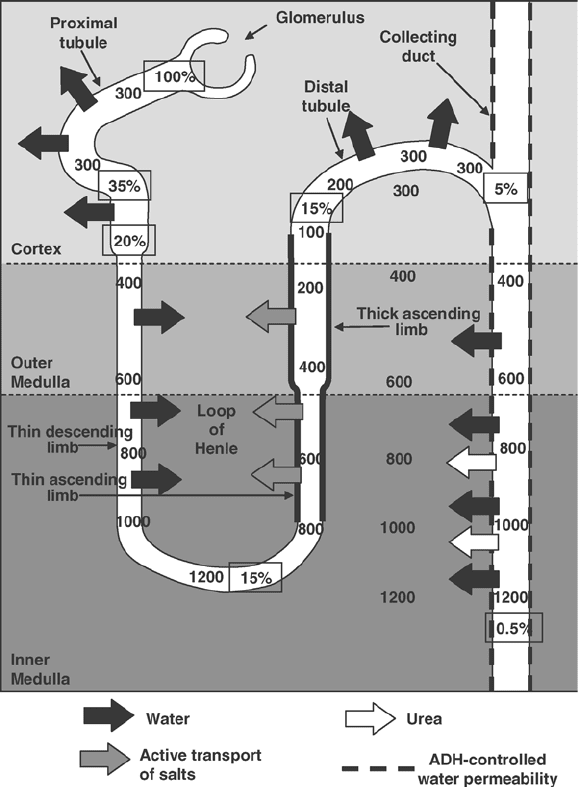
The osmolarity of the urine is still at the level of plasma, about 300 mOsmol/L.The
urine now passes to the loop of Henle, where half the remaining water and two-thirds
of the sodium and chloride ions are removed. The descending loop runs parallel to the
ascending loop through the medulla. The thin descending loop is permea ble to water
but not to solutes. The thick ascending section is impermeable to both, but has active
transport mechanisms that pump sodium and chloride out of the tubule and into the
medulla. The collecting duct also passes through the medulla, and urea diffuses from
the urine in the duct into the medulla. The sodium chloride and the urea increase the
osmolarity of the medulla near the turn in the loop to about 1200 mOsmol/L. As a result,
water passively diffuses out of the descending loop by osmosis. As the urine passes up the
ascending loop, the removal of sodium chloride reduces the osmolarity to levels below
that of plasma, as low as 100 mOsmol/L. This mechanism for the removal of water
and salts involving opposite flow directions of the descending and ascending loops is
called the countercurrent multiplier effect (Figure 9.14).
The total flow is now about 15 to 20% of the original filtrate, and continues on to the
distal tubule. Both the proximal and distal tubules are active in tubular secr etion. Drugs
such as penicillin and phenolbarbitol are removed from the blood in this way. The urinary
drug testing of athletes is possible because of tubular secretion. Sodium and chloride is
removed from urine by active transport, but at the expense of two potassium ions for each
three sodi um ions. This is stimulated by the hormone aldosterone, which, as was noted
above, conserves water in response to stress, but produces potassium loss. The distal
tubule also secretes hydrogen ions and exchanges them for bicarbonate. This gives the
kidneys some control over blood pH. Both the proximal and distal tubules produce and
secrete ammonia as a way to remove hydrogen ions from the blood without decreasing
urine pH excessively.
Contrary to what the name implies, the collecting ducts do more than just act as pipe-
lines. They are critical for the final processi ng of urine and in the kidney’s role in con-
trolling blood pressure and volume. The walls of the ducts are permeable to water. As the
duct passes into the high-salinity medulla, water is removed by osmosis until it is in equi-
librium with the medulla at an osmolarity approaching 1200 mOsmol/L. At this point, its
volume has been reduced to about 1% of the amount filtered in the glomerulus. The per-
meability of the distal tubule and the collecting ducts is controlled by the hormone ADH
EXCRETORY SYSTEM 209
(vasopressin). In the absense of the hormone, the ducts become impermeable to water. No
water is absorbed from the distal tubule on, and the person secretes large amounts of
dilute urine. This is what occurs in the disease diabetes insipidus (not to be confused
with the insulin production disorder diabetes mellitus). Normal persons secrete ADH
continuously to closely control water recovery. ADH is opposed by the hormone ANP
that is produced by the heart (Section 9.5.2). ANP increases glomerular filtration, sup-
presses sodium absorption by the distal tubule, blocks release of ADH and aldosterone,
and inhibits the response of the distal tubule and collecting ducts to ADH and aldosterone.
The water and solutes removed from the filtrate reenter blood vessels that are inti-
mately associated with the nephron. These blood vessels, not shown in Figure 9.14,
Figure 9.14 Countercurrent multiplier effect in the nephron. Percentages refer to fraction of
glomerular flow remaining. The other numbers inside the nephron are the milliosmolarity. (Based on
Smith et al., 1983.)
210
THE HUMAN ANIMAL
form a loop parallel to the loop of Henle after passing through the glomerulus. The blood
picks up solutes as it passes down into the medulla, increas ing its osmolarity to about
1200 mOsmol/L. It then loops back up to the cortex, absorbing water as it goes, until
its osmolarity returns to a normal 300 mOsmol/L.
The pH of urine is normally between 5.5 and 6.5, but may range from 4.6 to 8.0. The
value is influenced by diet. Drinking milk can produce acidic urine with a pH about 6.0. A
diet high in fruits and vegetables produces alkaline urine. The concentration of urea varies
directly with nitrogen in the diet, particularly protein. Creatinine is excreted in proportion
to a pers on’s muscle mass.
Some of the normal constituents of urine may precipitate in the ureter or urethra,
forming kidney stones. One-third of these are associated with alkaline urine or calcium
problems and include Ca
3
(PO
4
)
2
, MgHN
4
PO
4
, CaCO
3
, or a mixture of these. About half
of all kidney stones are calcium oxalate, caused by eating large amounts of spinach or
rhubarb, which have high levels of oxalic acid. Stones may also be formed from organics
such as uric acid.
9.12 REPRODUCTION AND DEVELOPMENT
The reproductive system is the only system that is not essential to a person’s survival. It
is, however, essential to the survival of the species. Because cells replicate continually,
they are subject to errors of replication, either due to the inborn rate of error or because
of environmental agents such as chemic al pollutants or radiation. This makes the repro-
ductive organs susceptible to diseases associated with genetic damage. These range from
cancer, which affects the individual, to birth defects and mutat ions, which affect a per-
son’s offspring. Some pollutants are thought to mimic the sex hormones, affecting repro-
duction and development.
The main reproductive organs are the gonads: the testes in the male and the ovaries
in the female. The gonads have two functions: production of haploid gametes by meiosis
and the production of the steroidal sex hormones. The male gametes are sperm and the
female gametes are ova (singular, ovum). In addition, there are a number of accessory
reproductive organs. These include the ducts that transport sperm and ova, and asso-
ciated glands.
Each ejaculation releases 2 to 5 mL of semen, the fluid containing the sperm. Semen
normally contains between 20 and 100 million sperm per milliliter. The sperm consists of
a5-mm head containing the nucleus, a midpiece containing mitochondria, and a 55-mm-
long flagellum, or tail, which can propel the sperm at a speed of 1 to 4 mm/min. The semi-
nal vesicles and the prostate gland produce much of the liquid that makes up semen,
which includes fructose to provide energy for the sperm, and alkalinity to counter the
acidity of the vagina. When the male becomes sexually excited, nerves of the autonomic
nervous system produce dilation of arterioles in the penis, causing blood to enter that
organ faster than it can leave. This causes the erectile tissue to become engorged, causing
an erection. The male then inserts the penis into the female’s vagina in the act of copu-
lation, injecting the semen by rhythmic contractions called ejaculations.
The ovaries contain about 400,000 ova arrested in prophase of meiosis I since birth.
Some 400 of these will eventually develop completely, one per menstrual period. Cilia
along the fallopian tubes transport the ova to the uterus. Fertilization may occur in either
of these organs, and development takes place mostly in the latter.
REPRODUCTION AND DEVELOPMENT 211
The main sex hormone in the male is testosterone. It is produced mainly by the testes.
It is part of a group of hormones produced by both males and females in the adrenal cortex
that have a masculinizing effect. Thus, they are collectively called androgens (‘‘man-
maker’’). The androgens other than testosterone are relatively low in potency. The
main sex hormones in the female are progesterone and a group of hormones called
the estrogens. The most important estrogen is calle d estradiol.
Production of sex hormones is controlled by a series of hormones originating with the
brain stimulating the hypothalamus to release gonadotropin-releasing hormone (GnRH).
GnRH is released in pulses and stimulates the anterior pituitary to release follicle-
stimulating hormone (FSH) and luteinizing hormone (LH). Although these names are
based on their functions in females, they are produced in both sexes.
In males, FSH stimulates the testes to produce sperm and another hormone called
inhibin. The inhibin inhibits FSH production, thus forming a negative feedback loop to
control sperm production. LH stimulates the testes to produce testosterone. The testoster-
one inhibits GnRH and LH secretion, forming a negative feedback control loop.
Testosterone has many funct ions, including (1) combining with FSH to stimulate sperm
production, (2) affecting aggressive behavior and sexual desire through the CNS function,
(3) stimulation of protein synthesis and muscle growth, (4) stimulation of secondary
sex characteristics such as facial hair, (5) maintaining accessory organs, and (6) in fetuses
it stimulates the formation of male reproductive system. In contrast to females, GnRH
production in males is relatively constant from hour to hour or day to day, thus keeping
its effects also at a constant level.
The hormone levels in females, on the other hand, varies in a cycle with a period of
22 to 35 (average 28) days. This cycle, together with associated physiological changes,
is called the menstrual cycle. The menstrual cycle is unique to humans, monkeys, and
apes. Females who menstruate may be receptive to males at any part of the cycle,
although they can only conceive at certain points. Other mammals follow a simpler
estrous cycle, in which the female will only copulate at certain times, called estrus or
heat. Some animals, such as dogs and foxes, enter estrus only once per breeding season.
Others, especially the mammals in tropic al regions, have repeated estrus during the breed-
ing season. The estrous cycle provides control over the season in which young are born.
The menstrual cycle consists of two ovarian phases or three uterine phases. In the fol-
licular phase the structure containing the ovum develops into a follicle, and the ovum
continues its meiosis to produce a mature ovum, or egg cell. The follicular phase ends
with ovulation, when the ovum erupts from the surface of the ovary and enters the fal-
lopian tube. Th is event marks the beginning of the second, luteal phase of menstruation,
in which the remains of the follicle, now called the corpus luteum (yellow body), pro-
duces hormones that prepare the uterus for pregnancy. If pregnancy does not occur, the
corpus luteum degenerates after about 12 days and the luteal phase ends.
Simultaneous with the ovarian phases, the uterus goes through its own cycle
(Figure 9.15). The uterus is a muscular organ that supports and nourishes the fetus. It
is lined with a glandular mucosa called the endometrium, which performs the nourishing
function. The first phase of the uterine cycle is menses, in which the thicken ed endome-
trium from the previous cycle deteriorates. Over a period of 3 to 5 days it is slou ghed off
and discharged along with 35 to 50 mL of blood. This endometrial sloughin g is called
menstruation. Menses is followed by the proliferative phase, in which the endometrium
regenerates inside the uterus and produces a glycogen-rich mucus. Menses and the pro-
liferative phase coincide with the follicular phase of the ovarian cycle. After ovulation, the
uterus enters the secretory phase (simultaneous with the ovarian luteal phase), in which
212 THE HUMAN ANIMAL
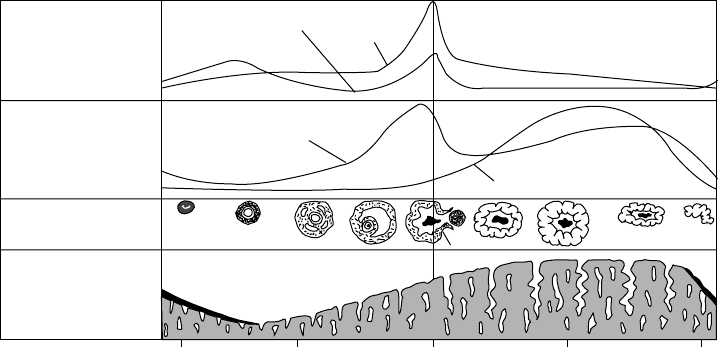
further secretions occur and the endometrium is ready to receive the conce ptus. (The con-
ceptus is a name for the products of conception, such as zygote, embryo, fetus, and so on,
including the placenta, at any stage of pregnancy.) If pregnancy does not occur, the cycle
ends and menses begins.
The menstrual cycle is controlled by an intri cately choreographed sequence of hor-
monal secretions. In males the director of the choreography is GnRH. GnRH is secreted
in pulses from the hypo thalamus and stimulates the anterior pituitary to produce FSH and
LH. Unlike males, in females these secretions vary considerably from day to day, and the
timing is controlled by feedback mechanisms involving ovarian hormones. At the begin-
ning of the menstrual cycle an increase in GnRH produces a broad peak a few days later in
FSH and a gradual increase in LH production. As its name implies, FSH stimulates devel-
opment of the follicles. The follicles secrete inhibin, which exerts a negative feedback
effect on FSH production, and estrogen, which exerts positive feedback on GnRH pulses
and negative feedback on LH. Estrogen also stimulates the uterine endometrium to
thicken. When estrogen levels exceed a threshold level for more than about 36 hours ,
estrogen’s effect on LH switches from negative to positive feedback. This causes a
massive release of LH by the pituitary, triggering the completion of meiosis I by the
ovum and ovulation.
LH also stimulates formation of the corpeus luteum, which produces estrogen plus
large amounts of progesterone, which inhibits GnRH pulse production and stimulates
the endometrium further. If pregnancy does not occur, the corpus luteum degenerates,
and estrogen and progesterone levels fall sharply. Without the inhibition from the proges-
terone, GnRH pulses increase again, to initiate another menstrual cycle. The drop in estro-
gen and progesterone also results in the degeneration of the endometrium in the uterus,
leading to menses.
During the follicular phase the basal body temperature (the resting body temperature
measured upon waking in the morning) is about 0.3
C below the temperature during the
17 14
Days
21 28
Levels of follicle-stimulating
hormone (FSH) and
luteinizing hormone (LH) in
blood plasma.
Levels of estrogen and
progesterone in blood
plasma
Ovarian cycle
Menstruation cycle
depicted by the thiclness
of the endometrium
Follicular phase
Estrogen
Progesterone
Luteal phase
Ovulation
FSH
LH
Figure 9.15 Menstrual and ovarian cycle. (From Van De Graaff and Rhees, 1997. # The
McGraw-Hill Companies, Inc. Used with permission.)
REPRODUCTION AND DEVELOPMENT 213
luteal phase. In addition, the temperature dips measurably at the time of ovulation. Thus,
the sudden increase in temperature can be used to determine when ovulation occurs. This
is used for birth control (either to prevent or increase the likelihood of conception), since
fertilization is most likely to occur within 1 day of ovulation. Oral contraceptives (the
birth control pill) come in several forms. The combination pill contains both progesterone
and estrogen. They are taken starting about 5 days after the start of menses and continued
for 3 weeks. They act by inhibiting GnRH production, and therefore FSH release, and
ultimately preventing follicle development and ovulation.
9.12.1 Prenatal Development
Development begins when the haploid sperm and ovum unite in the process of fertiliza-
tion (or conception), to form a diploid zygote. After ovulation, a layer of cells surrounds
the ovum. At least 100 sperm are needed to release an enzyme that creates gaps in this
layer. Then one of the sperm may penetrate the cytoplasm of the ovum. This triggers reac-
tions that render the ovum impermeable to additional sperm. In addition, the ovum com-
pletes meiosis II. The zygote then divides by mitotic division without an increase in the
size of the conceptus. This division is called cleavage. After one or more cleavages, or
even in the blastocyst stage, the cells may separate and develop independently, resulting in
genetically identical twins. Fraternal twins result when two ovulations occur and are fer-
tilized by different sperm. In the United States about one pregnancy in 90 produces twins,
and 70% of twins born are fraternal.
From fertilization until all of the organs are formed, the developing individual is
called an embryo. In humans this stage lasts two months. For the rest of the prenatal
(before birth) development the individual is called a fetus. Table 9.8 lists the events of
this development.
The amnion is a membrane that grows to completely enclose the fetus, which floats in
the amniotic fluid to protect it from shock. Surrounding the amnion is another membrane
called the chorion. Eventually, as the fetus and amn ion grow, the amnion fuses with the
chorion, forming the single membrane whose rupture discharges the amniotic fluid,
signaling the start of labor. The portion of the chorion that is in contact with the endome-
trium is called the placenta. The fetus is connected to the placenta by the umbilical cord.
The placenta has fingerlike projectio ns into the endometrium called chorionic villi. These
provide surface area for the exchange of nutrients and waste products between the fetus
and the mother.
The placenta also has important endocrine functions. Soon after implantation, chorionic
gonadotropin (CG) is produced. This maintains the corpus luteum so that progesterone
production is continued. Progesterone maintains the thick endometrium. After month
three or four of the pregnancy, CG drops sharply and the placenta produces progesterone
itself; the corpus luteum is allowed to degrade. The placenta also produces large amo unts
of estrogens, especially estriol, from testosterone produced by the fetal adrenal glands.
The high levels of progesterone and estrogen are thought to contribute to the ‘‘morning
sickness’’ experienced by some pregnant women. The hormone human placental
lactogen, placental prolactin, plus maternal hormones prolactin and thyroid hormones
prepare the mammary glands for milk production and has other effects similar to growth
hormone. The peptide hormone relaxin prepares for birth by causing dilation of the cervix
and suppressing oxytocin production by the hypothalamus.
214 THE HUMAN ANIMAL

By the end of the first trimester, all the major organ systems have become initiated. It is
during this time that the fetus is most sensitive to agents, such as drugs or other toxins,
that can cause birth defects (teratogens). Development of sex organs is quite interesting.
At the end of the first trimester the embryo possesses gonads and external genitals, but the
genitals have not differentiated into male or female. Furthermore, the embryo possesses
two sets of ducts. One is destined to become the vas deferens of males, the other the
uterus, etc., of females. Which one developes is determined by a single gene on the
Y chromosome that stimulates formation of the testes. The testes then produce testosterone,
which stimulates development of the male ducts and external genitalia. The testes also
produce a hormone that blocks development of the female ducts. The absense of testos-
terone results in development of female characteristics. Occasionally, hormonal disorders
result in individuals who are genetically of one sex developing external genitalia of the
other sex. These individuals may grow, apparently normal, to adulthood without knowing
that they are genetically of the opposite sex, until they find out that they are unable to have
children.
In the second trimester, development continues. In the third trimester most organ sys-
tems becom e ready to perform their normal functions. A number of changes occur in
the mother to support the pregnancy: Respiration rate and tidal volume increase, blood
volume increases, nutrient and vitamin requirement increases 10 to 30%, causing
increased hunger, glomerular filtration in the kidney increases 50% along with urine pro-
duction; the uterus increases in size; and mammary glands increase in size and begin
secretory activity.
After 280 days (40 weeks) the fetus is said to be full term and is ready for birth.
Medical technology makes it possible to deliver premature babies safely as early as the
twenty-seventh week. The entire process of birth is called parturition.
TABLE 9.8 Events of First-Trimester Development in the Human
Time Since
Fertilization Events
1 day First cleavage produces two-cell stage.
4 days The embryo has developed into a solid ball of cells, called a morula.
5 days The ball becomes hollow, and is called a blastocyst. The outer layer is the
trophoblast, the smaller inner cells will form the embryo.
7–10 days The embryo implants itself into the uterine endometrium.
10–16 days By process of gastrulation the embryo forms first two, then three distinct germ
layers: ectoderm ultimately gives rise to the skin, epithelium of mouth, nose, and
anus, the nervous system, pituitary gland, and adrenal medullae; mesoderm,
produces muscle, cardiovascular system, lymphatic system, kidneys, adrenal
cortex, gonads and ducts, bone, linings of body cavities, all connective tissues;
endoderm forms the lungs, thymus, thyroid, pancreas, most of the digestive tract
including the liver, and stem cells that produce gametes.
Week 2–3 Formation of extraembryonic membranes from germ layers and the trophoblast:
yolk sac, amnion, allantois, and chorion. The part of the chorion that connects
with the endometrium is called the placenta.
Week 3 Neural tube forms, distinguishing dorsal, ventral, right and left sides.
Week 6 Fetal heart begins to pump.
Week 13 End of first trimester, in which organogenesis (organ formation) is begun. External
genitalia become distinctive of their sex.
REPRODUCTION AND DEVELOPMENT 215
Estrogen levels increase throughout the pregnancy, making the uterine muscle increas-
ingly sensitive and likely to start contractions. Progesterone has an inhibiting effect, but
estrogen production increases faster just before birth. Estrogen also increases the sensitiv-
ity of uterine muscle to oxytocin. Oxytocin is produced by the hypothalamus but released
by the posterior pituitary. Its release is stimulated by increasing estrogen levels and by
distortion of the uterine cervix by the weight of the fetus. Estrogen and oxytocin stimulate
production of prostaglandins in the endometrium that also stimulates muscle contractions.
Once these factors reach a critical level, parturition begins and is maintained by a positive
feedback loop. Parturition occurs in three stages. (1) In the dilation stage the cervix
dilates completely, contractions occur at increasing frequency, and the amniochorionic
membrane ruptures, releasing the amniotic fluid (the ‘‘water break’’). This stage usually
lasts 8 hours or more. (2) In the expulsion stage, which lasts less than 2 hours, contrac-
tions occur at maximum intensity, and the newborn infant, or neonate, is delivered
through the vagina. (3) In the placental stage the uterus contracts to a much smaller
size, tearing the placenta from the endometrium. Within an hour of delivery the placenta
is delivered in what is called the afterbirth.
PROBLEMS
9.1. Which organ systems are most susceptible to oxygen deprivation, and why?
9.2. Nerve transmission is often described as an electrical transmission. In what sense is
this true? Is there any transport of electrons, as in elect rical current in wires?
9.3. Which will cross the blood–brain barrier more easily: ethanol or chloroform? Which
class of hormones will cross most easily?
9.4. How would hydrophobic toxins such as chloroform be carried by the blood?
9.5. Name two organs that both remove and are affected by toxins.
REFERENCES
Fried, G., 1990. Schaum’s Outline: Theory and Problems of Biology, McGraw-Hill, New York.
Hickman, C. P., Jr., L. S. Roberts, and Allan Larson, 1996. Integrated Principles of Zoology, Wm. C.
Brown, Dubuque, IA.
Hirschhorn, N., and W. B. Greenough III, 1991. Progress in oral rehydration therapy, Scientific
American, Vol. 264, No. 2, pp. 50–56.
Martini, F. H., 1998. Fundamentals of Anatomy and Physiology, Prentice Hall, Upper Saddle River,
NJ.
Needham, J. G., and P. R. Needham, 1962. A Guide to the Study of Freshwater Biology, Holden-Day,
San Francisco.
Smith, E. L., et al., 1983. Principles of Biochemistry: Mammalian Biochemistry, 7th ed., McGraw-
Hill, New York.
Van de Graaff, K. M., and R. W. Rhees, 1997. Schaum’s Outline: Theory and Problems of Human
Anatomy and Physiology, McGraw-Hill, New York.
Vander, A. J., J. H. Sherman, and D. S. Luciano, 1994. Human Physiology: The Mechanisms of Body
Function, McGraw-Hill, New York.
216
THE HUMAN ANIMAL

10
MICROBIAL GROUPS
Some organisms are too small to be seen with the naked eye. Such organisms are referred
to as microorganisms,ormicrobes, from the Greek word mikros (small), and their study
is referred to as mi crobiology. This is not a tru e taxonomic grouping since not only is
there tremendous diversity among microbes (including all three domains), but some spe-
cies may be microscopic whereas their close relatives are readily visible (macroscopic).
Although individual microorganisms are small, their collective impact is not. Their
activities led to the development of Earth’s present aerobic atmosphere, are a major factor
in biogeochemical cycling of elements, and have a substantial impact on every ecosystem.
Their numbers are staggering, typically ranging from a million to a billion (10
6
to 10
9
)per
gram of soil, biofilm, or sludge. They have also been widely used by humans to make
products ranging from foods and medicines to industrial chemicals. On the other hand,
they may cause food to spoil and materials to corrode or degrade.
To the environmental engineer and scientist, microbial activity can be both a blessing
and a curse. On the posi tive side, microbes often afford the most efficient and cost-effec-
tive means of treating many of society’s wastes. Thus, they are used routinely in engi-
neered waste treatment systems such as sewage treatment plants. They are also of
critical importance in the recovery processe s of natural environments degraded by
human activities, such as in the self-purification of streams receiving sewage and runoff,
and the natural attenuation of industrial contaminants leaked or spilled onto soil.
On the other hand, microorganisms have the potential to create substantial environ-
mental problems. For example, they may deplete oxygen, generate unpleasant tastes
and odors, clog equipment, and corrode pipes. Perhaps of greatest concern, however, is
that some microorganisms are capable of producing disease in plants and animals, includ-
ing, of course, humans.
In this chapter we consider the prokaryotic groups, Bacteria (including blue-green
algae) and Archaea. We also examine the eukaryotic groups containing single-celled
organisms: protozoans, algae, fungi, and slime molds, even though they (except protozo-
ans) also include many multicellular, macroscopic species. The metazoans, microscopic
Environmental Biology for Engineers and Scientists, by David A. Vaccari, Peter F. Strom, and James E. Alleman
Copyright # 2006 John Wiley & Sons, Inc.
217