
Vaccari D.A., Strom P.F., Alleman J.E. Environmental Biology for Engineers and Scientists
Подождите немного. Документ загружается.


Acidification, Including Acid Mine Dra inage Oxidation of soluble ferrous iron appears
to consume acidity:
Fe
2þ
þ
1
4
O
2
þ H
þ
! Fe
3þ
þ
1
2
H
2
O
However, the subsequent precipitation of ferric hydroxide has the effect of producing
3 mol of acid, so that the overall reaction can be written as
Fe
2þ
þ
1
4
O
2
þ 2:5H
2
O ! FeðOHÞ
3
þ 2H
þ
ð13:21Þ
During mining of coal and other minerals, anaerobic deposits containing pyrites
(FeS
2
) are commonly exposed to the air. This begins a complex process involving both
abiotic and biochemical mechanisms that leads eventually to oxidation of both the iron
and sulfur. Acidification initially results from the oxida tion of reduced sulfur to sulfate
(sulfuric acid), which then makes oxidation of the iron favorable. The first step, or initia-
tor reaction, is typically abiotic at the starting neutral pH:
FeS
2
þ 3:5O
2
þ H
2
O ! Fe
2þ
þ 2SO
4
2
þ 2H
þ
ð13:22Þ
The production of acid leads to a drop in pH and the development of favorable con-
ditions for bacteria such as Thiobacillus ferrooxidans. The overall reaction can be
written as
FeS
2
þ 3:75O
2
þ 3:5H
2
O ! FeðOHÞ
3
þ 2SO
4
2
þ 4H
þ
ð13:23Þ
Drainage from such areas can thus be highly acidic, with a pH of 2 not uncommon. This
may have a drastic effect on the ecosystem of any nearby streams. An iron sulfate mineral
known as yellow boy may also precipitate and color a stream bed dramatically.
Pyrites are also found in some clay minerals. This has been found to be a problem with
the clay caps that are sometimes put over landfills—acid formation inhibits establishment
of cover vegetation. Leachate from landfills containing reduced iron and/or sulfides may
also become acidified through similar processes.
Drinking Water With certain groundwater supplies, iron-oxidizing bacteria such as
Gallionella in wells can cause clogging of the screens, resulting in a decrease in pumping
capacity. Beyond the growth itself, the large amounts of precipitated iron they produce
may be responsible for much of the problem. A similar effect can occur with the oxidation
of reduced manganese (Section 13.5.3), but iron concentrations are typically much
(1000) higher. Clogging of sand filters is also possible if the feed water contain s suffi-
cient reduced iron.
High iron concentrations can provoke consumer complaints about the aesthetic quality
of drinking water. Dissolved iron can create taste problems, particularly with hot bev-
erages such as coffee or tea. Also, the oxidation of reduced iron over time may produce
a noticeable brownish discolo ration (mainly from ferric hydroxide) on porcelain surfaces
such as kitchen sinks, toilet bowls, and bathtubs, and even in clothes during washing.
Additionally, there may be concern among customers over the safety of the ‘‘rusty’’
water itself. For these reasons, the secondary standard for iron in drinking water is
0.3 mg/L.
438 MICROBIAL TRANSFORMATIONS
13.5 MANGANESE
Manganese can have an oxidation state as high as þ7 in the form of permanganate
(KMnO
4
), which has some use in the environmental field as an oxidizing agent. However,
within the biological realm, the natural states are þ2toþ4, called, respectively, the
‘‘mangan ous’’ and ‘‘manganic’’ forms. Soluble Mn
2þ
and insoluble MnO
2
represent
the principal forms that are found.
The dominant reservoir for manganese is the lithosphere; it forms 0.1% of Earth’s
crust. Waters, both fresh and marine, rarely contain manganese concentrations above
a few tenths of a part per million, and often far less. Like iron, manganese can also
be chemically oxidized by atmospheric oxygen, but in this case pH levels of 8 or higher
(as opposed to pH 4 to 5 for iron) are necess ary to promote this spontaneous reac-
tion. (This fact is used in the Winkler test, the standard ch emical method of measur-
ing dissolved oxygen; a solution of Mn
2þ
is added to the sample, followed by alkali,
leading to formation of a stoichiometric amount of MnO
2
that is then analyzed
iodometrically.)
13.5.1 Manganese Reduction
Manganese in the þ4 state (i.e., MnO
2
) can be reductively converted to Mn(II) by micro-
bial activity under anoxic conditions. At least in some cases it appears that it is being used
as an alternative electron acceptor for anaerobic respiration.
13.5.2 Manganese Oxidation
There is a relatively small group of bacteria capable of directly using manganese as an
oxidative energy source, including some strains of Arthrobacter, Bacillus manganicus,
Corynebacterium, Flavobacterium, Gallionella, Hyphomicrobium, Pseudomonas, and
Vibrio. Several strains of iron-oxidizing bacteria, such as Leptothrix and Sphaerotilus,
are also believed to be capable of cooxidizing manganese, precipitating it within their
sheaths and metallic coatings.
13.5.3 Manganese in Environmental Engineering and Science
The cycling of manganese is not often regarded as a major environmental engineering and
science concern, particularly since it is usually present only in the low parts per billion
range. However, as with iron, higher levels of manganese may cause aesthetic problems in
waters, or even difficulties with groundwater pumping. These issues tend to develop in
relation to site-specific conditions.
Like iron, manganese can impose objectionable tastes in waters at quite low concen-
trations, particularly with hot coffee and tea. Discoloration with manganese generates a
pinkish color. To address these concerns, the secondary standard for drinking water has
been set at 50 parts per billion.
Typically, the problem is seen in communities using a lake or reservoir as their pot-
able water source. Such water bodies tend to stratify (Section 15.2.1), with an aerobic
zone (epilimnion) above an anaerobic one (hypolimnion). Seasonally, as the depths of
these layers vary, the point of withdrawal for these waters (Figure 13.29) may extend
MANGANESE 439
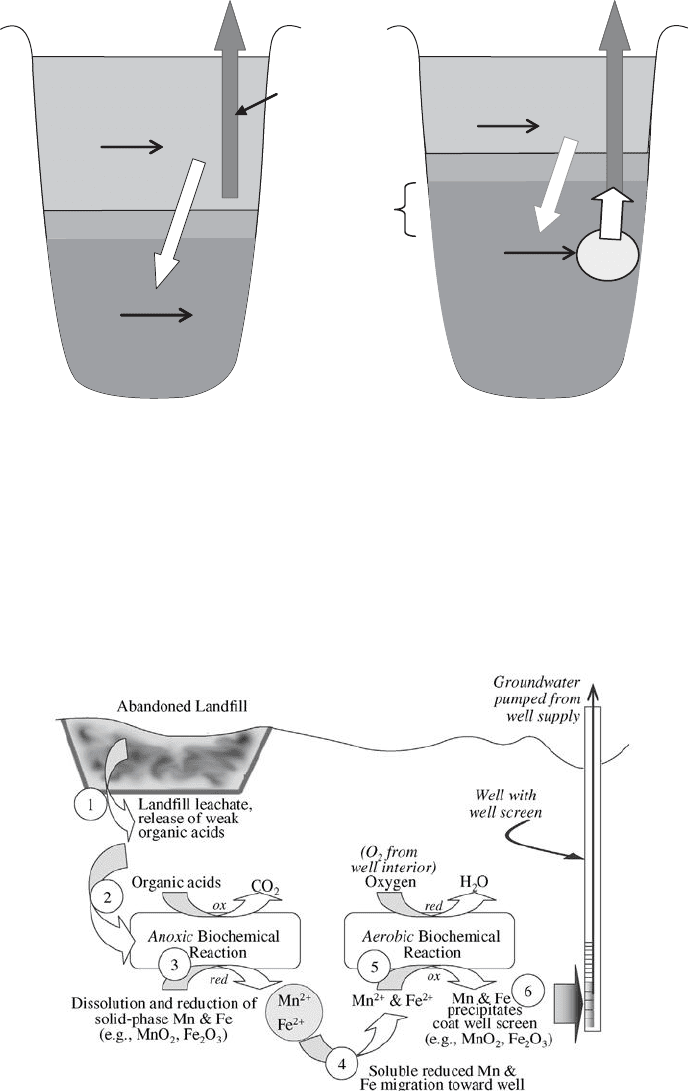
into the anaerobic zone. This can draw reduced manganese into the system, where it may
later be oxidized.
Another potential problem occurs when groundwater is contaminated by landfill lea-
chate or other degradable organic compounds, leading to anaerobic conditions. This can
lead to mobilization of manganese and iron, potentially causing clogging of nearby wells
(Figure 13.30).
Nominal Mn
2+
at water intake point
Fixed
elevation
intake pipe
Seasonal
upward shift
in hypolimnion
(typically ‘‘peaks’’
during Fall)
settling
MnO
2
Thermocline
Hypolimnion
MnO
2
reduced
Mn
2+
Epilimnion
Mn
2+
MnO
2
oxidation
Thermocline
Hypolimnion
Epilimnion
MnO
2
reduced
Mn
2+
MnO
2
oxidation
Elevated Mn
2+
at water intake point
Mn
+2
Mn
2+
Figure 13.29 Seasonal shifts in lake stratification leading to increased presence of soluble reduced
manganese (Mn
2þ
) in potable waters.
Figure 13.30 Mobilization of reduced manganese and iron by groundwater contamination.
440
MICROBIAL TRANSFORMATIONS
PROBLEMS
13.1. What is the theoretical oxygen demand of a 20-mg/L solution of (a) pentane,
C
5
H
12
; (b) ribose, C
5
H
10
O
5
?
13.2. What are the total organic carbon concentrations of the solutions in Problem 13.1?
13.3. How much oxygen is utilized to nitrify 25 mg=LNH
4
þ
-N to nitrate? How much
CaCO
3
alkalinity?
13.4. In a particular wastewater treat ment plant, 200 mg/L of C-BOD and 20 mg/L of
ammonium-N are oxidized using oxygen. Suppose that anoxic zones could be
introduced so that all the nitrate produced was consumed by denitrification while
oxidizing some of the wastewater C-BOD. By what percentage could the oxygen
requirement potentially be reduced in this way?
13.5. A water quality limit of 0.04 mg/L NH
3
is placed on a stream receiving the effluent
from a wastewater treatment plant. (a) How much total ammonia-N can be present
in the water if the final pH of the stream is 7.3? (b) If the stream above the discharge
point contains 0.2 mg/L total ammonia, and if the plant discharge is 20% of the total
flow, how much total ammonia can the effluent contain without resulting in a
violation of the limit?
13.6. In mg/L, how much methanol would be needed to denitrify 20 mg/L of nitrate-N
stoichiometrically in an anoxic wastewater?
13.7. Suppose that a finished drinking water contains 0.5 mg/L ammonium nitrogen that
becomes nitrified by biofilms in the water distribution system. How much chlorine
residual will this nitrite consume?
REFERENCES
Atlas, R. M., 1997. Principles of Microbiology, 2nd ed., Wm. C. Brown, Dubuque, IA.
Atlas, R. M., and Richard Bartha, 1993. Microbial Ecology: Fundamentals and Applications, 3rd ed.,
Benjamin/Cummings, Redwood City, CA.
Madigan, M. T., J. M. Martinko, and J. Parker, 2000. Brock Biology of Microorganisms, 9th ed.,
Prentice Hall, Upper Saddle River, NJ.
Rittmann, B. E., and P. L. McCarty 2001. Environmental Biotechnology: Principles and Applications,
McGraw-Hill, New York.
University of Minnesota Biocatalysis/Biodegradation Database, 2004. http://umbbd.ahc.umn.edu/.
Updated regularly.
U.S. EPA, 1993. Process Design Manual: Nitrogen Control, EPA/625/R-93/010, U.S. Environmental
Protection Agency, Office of Research and Development, Washington, DC.
Wackett, L. P., and C. D. Hershberger 2001, Biocatalysis and Biodegradation: Microbial Transfor-
mation of Organic Compounds, ASM Press, Washington, DC.
Young, L. Y., and C. Cerniglia (Eds.), 1995. Microbial Transformation and Degradation of Toxic
Organic Chemicals, Wiley-Liss, New York.
REFERENCES 441

14
ECOLOGY: THE GLOBAL VIEW OF LIFE
‘‘Ecology is the scientific study of the interactions that determine the distribution and
abundance of organisms’’ (Krebs, 1994). The effects of pollutants can be detected at
all levels of the biological hierarchy. Our concern about these impacts falls mainly into
two groups of organisms: humans and everything else. We are concerned directly with all
types of impacts on humans. However, in nonhuman populations our primary conce rn is
about loss of desirable species and the proliferation of undesirable ones resulting from our
activities. Th erefore, ecology provides an appropriate framework for examining our
impact on the natural world.
The word ecology has as its root oikos, the Greek word for ‘‘house.’’ The word
economy is based on the same root. Thus, one can be thoug ht of as the study of where
we live; the other is its management. It is intere sting that these two disciplines are com-
monly considered to conflict with each other. However, economics is now being brought
to bear on environmental problems. Some think that if the true value of unspoiled ecosys-
tems were taken into account, much destructive human activity would actually be seen not
to be econom ically beneficial. In this view, the apparent economic advantages of polluting
or destroying ecosystems comes from the costs being borne by others than those who
receive the profits (the ‘‘tragedy of the commons’’).
Recall the following definitions from Section 2.2:
Population A group of individuals of the same species living in the same environment
and are actively interbreeding.
Community A group of interacting populations occupying the same environment.
Environment The physical and chemical surroundings in which individuals live.
Ecosystem The combination of a community and its environment.
Environmental Biology for Engineers and Scientists, by David A. Vaccari, Peter F. Strom, and James E. Alleman
Copyright # 2006 John Wiley & Sons, Inc.
442

These are the entities with which we are concerned directly in the study of ecology. A
biome is a major type of ecosystem. Table 14.1 lists the most important biomes. The indi-
vidual biomes are discussed in more detail in Chapter 15.
The range of environments in which a species lives is called its habitat. Each type of
organism is thought to occupy a unique functional position, called its niche, in an ecosystem.
The idea of a niche can be defined as a subset of the environmental and ecological variables
that are favorable to a species. For example, two aquatic insects, the backswimmer (Noto-
necta) and the water-boatman (Corixa), occupy the same habitat among aquatic plants at
the edge of a pond. But they have different niches because the former is a predator and the
latter feeds on dead plant matter. Niche may be characterized by many variables, such as
food source or tolerated physical conditions. The niches of two species may overlap but
not coincide. It is said that two organisms in a particular ecosystem cannot occupy the
same niche. However, they can coexist if there are even slight differences in their behavior.
Let us now systematize and categorize the ecological roles taken by organisms. Much
of this is in terms that engineers will find familiar. For example, one important way to
look at ecosystems is to examine their energy and material balances. Changes in sizes
of populations are modeled in a way not very different from chemic al or microbial
kinetics. Most unique, perhaps, are the types of interactions between species such as com-
petition or symbiosis. However, even these are studied in part using the mathematics of
population dynamics. As you learn the ways in which we describe ecological roles and
phenomena, think about how pollution could affect each.
14.1 FLOW OF ENERGY IN THE ECOSYSTEM
With minor exceptions, the biosphere is powered by the sun. The average amount of solar
energy reaching Earth’s surface (the insolation) in the United States ranges from 1250 to
TABLE 14.1 Biomes of the Biosphere
Terrestrial biomes
Tundra: arctic and alpine
Boreal coniferous forests
Temperate deciduous forests
Temperate grassland
Tropical grassland and savanna
Chaparral: winter rain / summer drought
Desert: herbaceous and shrub
Semievergreen tropical forest: pronounced wet and dry seasons
Evergreen tropical rain forest
Freshwater ecosystems
Lentic (standing water): lakes, ponds, etc.
Lotic (running water): rivers and streams
Wetlands: marshes and swamp forests
Marine ecosystems
Pelagic (open ocean)
Continental shelf (inshore waters)
Upwelling regions
Estuaries (coastal bays, sounds, river mouths, salt marshes, etc.)
Source: Odum (1987).
FLOW OF ENERGY IN THE ECOSYSTEM
443
2750 kcal/m
2
day in January to 5250 to 7000 kcal/m
2
day in July. For the entire year,
averaged over all regions of the country, the input is about 3940 kcal/m
2
day. Much smal-
ler quantities originate from nonthermal sources. Geothermal energy derives from radio-
active decay in the Earth and contributes about 0.5% of the solar input. Tidal friction
extracts energy from the kinetic energy of the Earth–sun–moon system and is about
0.0017% of solar. A portion of the wind’s energy comes from the kinetic energy of Earth’s
rotation. Oxidation of reduced inorganic minerals transported to the biosphere from deep
in Earth’s crust by hot springs and deep ocean vents provide energy for unique ecosystems
adjacent to them. (However, this source is not completely independent of solar input, as it
relies on oxygen produced mostly in the photosphere by solar energy.) These are the ulti-
mate sources of energy for the biosphere. However, sensible heat and mechanical forms of
energy cannot be used to form carbohydrates from CO
2
. Organisms require high-quality
energy in the form of photons or chemical bond energy in order to drive the reactions that
produce biomass from inorganic precursors.
14.1.1 Primary Productivity
Most of the solar energy arriving at Earth’s surface is converted to sensible heat or drives
the processes of evaporation, wind, and waves. About 0.8%, however, is captured by
photosynthetic conversion to organics. This autotrophic activity supplies practically all
of the energy for the biosphere. The autotrophs responsible for the initial generation of
fixed carbon from CO
2
are called producers in ecological terminology. The rate at
which carbon is fixed in an environment is called its primary productivity. It can be mea-
sured either in energy terms (kcal/m
2
day), or equivalently, in terms of biomass produc-
tion rate (e.g., g/m
2
yr). The basis area (m
2
) refers to the area of the land. Biomass is
usually measured as the total dry weight of the organisms under consideration. Carbohy-
drates have about 4.1 kcal/g (17.2 kJ/g).
Note that much of the activity of chemoautotrophs is not ‘‘primary’’ in the sense that
the reduced minerals they are oxidizing were produced by other organisms. For example,
hydrogen sulfide and ammonia are produced by anaerobi c bacteria in marsh sediments.
These can then be used by chemoautotrophic bacteria to fix CO
2
. The energy for the anae-
robes comes from organics that probably originated from plants. Other sources of these
minerals, such as deep ocean vents or volcanoes, are abiotic in origin.
Primary productivity has two main com ponents. Gross primary productivity (GPP) is
the total amount of carbon fixed by the autotrophs. GPP may also be called the rate of
assimilation. Only part of the gross productivity is available to other components of the
ecosystem because the autotrophs themselves respire, consuming some of the fruits of
their own labor. Net primary productivity (NPP) is the rate at which biomass or energy
is accumulated by the autotrophs. It is equal to the difference between gross productivity
and respiration. In practice, the net productivity is measured by harvesting and respiration
measured by CO
2
production.
Gross primary productivity can be computed from measurements of net primary pro-
ductivity and respiration. In some systems, such as the ocean , GPP is strongly correlated
to the chlorophyll content. Chlorophyll can be measured by solvent extraction followed
by spectrophotometry. Then one can apply a factor known as the assimilation ratio,
which is the ratio of carbon fixation rate to chlorophyll concentration. For the ocean
the assimilation ratio is fairly constant at 3.7 g of carbon fixed per hour per gram of chlor-
ophyll. However, this ratio can vary widely for other ecosystems. Plants that are adapted
444 ECOLOGY: THE GLOBAL VIEW OF LIFE

to grow in shade usually have much higher chlorophyll concentrations in order to capture
more effectively the energy available to them. This results in a lower assimilation ratio.
Forests typically have about 0.4 to 3.0 g of chlorophyll per square meter, and an assim-
ilation ratio that varies from about 0.4 to 4.0. Thinly vegetated areas such as new crops in
the field, on the other hand, may have only 0.01 to 0.60 g of chlorophyll per square meter
but fix from 8 to 40 g of carbon per gram of chlorophyll.
It is important to understand the relationship between the gross and net productivity,
which are rates, and the biomass, or standing crop. Keep in mind that the amount of bio-
mass present is not a measure of the gross or net productivity. As an analogy, consider a
tank with water being pumped in, and with some flowing out through a hole in the bottom.
The inflow is like the gross primary productivity, and the outflow is like respiration. If
more is entering the tank than is draining out the hole, the difference accumulates. The
rate of accumulation is like the net primary productivity. If the amount entering and
leaving are equal, the amount in the tank stays the same and the system is at steady
state. This would be equivalent to having zero net productivity and could occur with
the tank full or almost empty. Consider a mature tropical rain forest (Table 14.2). The
gross primary productivity is of such a forest is about 45,000 kcal/m
2
yr. However,
most of that is taken up by respiration to maintain the large biomass. Thus, the net primary
productivity is essentially zero.
On the other hand, an alfalfa field is adding considerably to its biomass during the
growing season. Its gross primary productivity is 24,400 kcal/m
2
yr. Respiration accounts
for 9200 kcal/m
2
yr, leaving a net primary productivity of 15,200 kcal/m
2
yr. However,
the actual yield that farmers can obtain from the field will be lower because other hetero-
trophs (such as field mice) consume part of the crop. This leads to a third type of produc-
tivity, net community productivity (NCP), which is the gross primary productivity minus
plant (autotrophic) respiration and minus the amount consumed by other organisms in the
ecosystem (heterotrop hic respiration). In the case of the alfalfa field, 800 kcal/m
2
yr is
consumed by heterotrophic respiration. This yields a net community productivity of
14,400 kcal/m
2
yr, for an efficiency of 59%.
Primary productivity (GPP) can be limited by numerous factors, such as the amount of
sunlight, availability of moisture and nutrients, soil properties, and so on. On land, moist-
ure is the most serious limiting factor. In the open ocean, productivity is limited by
nutrient availability and the ability of sunlight to penetrate the water. Ideal conditions
can result in productivities that are as much as double the ‘‘typical’’ values (e.g., see
Table 15.1); 50,000 kcal/m
2
yr is thought to be the practical upper limit for any natural
ecosystem. Changes in primary productivity, or comparisons to similar ecosystems, can be
TABLE 14.2 Forms of Annual Primary Productivity for Several Ecosystems (kcal/m
2
)
Medium Age Mature
Alfalfa Field Oak/Pine Forest Rain Forest
Gross primary productivity 24,400 11,500 45,000
Net primary productivity 15,200 5,000 13,000
Net community productivity 14,400 2,000 Negligible
NPP/GPP 62% 43% 29%
NCP/GPP 59% 17% 0%
Source: Odum (1987).
FLOW OF ENERGY IN THE ECOSYSTEM
445
used as indicators of the health of an ecosystem. Worldwide, the total GPP is estimated to
be about 10
18
kcal/yr.
The primary productivity of the world’s agriculture has only been keeping pace with
increases in human population. Humans greatly increas e the productivity of cultivated
land by energy subsidies. This energy originates mostly from fossil fuels and takes the
form of synthetic nitrogen fertilizer, pesticides, and mechanized agriculture (tilling, har-
vesting, etc.). Productivity of crops has also been increased by breeding new varieties. The
greatly increased food production has resulted in an increase in the carrying capacity of
the Earth for humans, and has been called the green revolution. However, it must be noted
that the new crops are more dependent on energy subsidies than are traditional cultivars.
Although the improved productivity has been important, underdeveloped countries have
increased their food production as much by increasing the amount of land under cultiva-
tion. This results in destruction of forests and resulting loss in habitat for other species.
Humans have other uses for primary productivity besides as food. Cotton and flax
fibers are used for clothing and wood for structures, paper, and fuel. Overharvesting of
wood in poor regions of the world has led to deforestation and erosion.
14.1.2 Trophic Levels, and Food Chains and Webs
One of the most important relationships among organisms in an ecosystem is, of course,
who eats whom. Ecologists discover these relationships by direct observation as well as
by examining the stomach contents of animals captured from the wild. One species of bird
may eat seeds, another might only eat certain types of insects, whereas a third may prey
mostly on small mammals.
The energy and fixed carbon from the autotrophic producers are available to hetero-
trophs in the ecosystem, and these are called the consumers. Consumers that feed directly
on the producers are called primary consumers, also called herbivores (plant eat ers).
Those that feed on herbivores are called secondary consumers,or carnivores (meat
eaters). Next may come tertiary consumers,ortop carnivores, which feed on carni-
vores.
This structure describes the food chain, the seque ntial feeding rel ationship from pri-
mary producers to higher consumers. The feeding levels in the food chain are collectively
called trophic levels. The organisms in a particular trophic level have the same number of
steps in their food chain between themselves and the primary producers.
The portion of each trophic level that is not used as food by a higher level will even-
tually die. A parallel food chain is based on this dead material. The organisms that rely on
this are called detritivores, decomposers, saprobes,orsaprotrophs, and a food chain
based on them is called a detritus food chain . (In contrast, a food chain based on living
biomass is called a grazing food chain.) The detritus food chain starts with organisms
that feed directly on dead material, including bacteria, fungus, earthworms and other
soil invertebrates, and some marine crustaceans, such as lobsters and crabs. These may,
themselves, be fed upon. In fact, the grazing and detritus food chains are linked at all
levels. For example, an owl may eat an insectivorous (insect-eating) shrew, which in
turn has fed on saprobic soil invertebrates, and the same owl may also eat an herbivorous
mouse (a grazer).
Ultimately, all the dead organic material is mineralized, that is, converted back to inor-
ganic minerals such as CO
2
, water , ammonia or nitrates, and salts. Along the way, the partially
biodegraded biomass forms an important part of the soil and aquatic environments. The
446 ECOLOGY: THE GLOBAL VIEW OF LIFE

decomposers are the ultimate recyclers, making the material available for reuse by the
primary producers. By releasing the minerals close to the roots of plants where they
can be rapidly taken up again, they reduce the rate at which scarce minerals leach out
of the ecosystem.
The energy for each trophic level is obtained from the level below. Some of the energy
in a trophic level will be unavailable because it might be indigestible material, such as
cellulose, lignin, chitin, or bone, or may be protected by defensive measures. Biomass
may be stored, as in the case of peat formation in marshes, o r it may be exported from
the ecosystem, as in the case of migratory animals or tidal estuaries.
The energy input to a trophic level is the gross energy intake. Part of this is unused
and is eliminated in the feces where it enters the detritus food chain. The remainder is the
assimilated energy. Part of the assimilated energy is excreted with urine. A large part is
used in respiration for maintenance and activity. The remainder is available for growth
and reproduction, forming the net productivity of that trophic level. The production effi-
ciency (also called transfer efficiency) of a species or of a trophic level as a whole can be
defined as:
Production efficiency ¼
net productivity
assimilation
ð14:1Þ
Typical values for production efficiency are:
Birds 1.3%
Small mammals 1.5%
Other mammals 3.1%
Fish and social insects 9.8%
Other invertebrates 21–56%
Warm-blooded animals seem to pay a penalty in efficiency. The rate of respiration in
animals can be related to body mass empirically by a log-log relationship. For example,
for herbivorous mammals:
log R ¼ 0:774 þ 0:727 log M ð14:2Þ
where R is the respiration rate in kJ/day per individual and M is the body mass in grams
(1 kJ ¼ 0.239 kcal). Cold-blooded animals may use more than an order of magnitude less
energy, but the value will be strongl y dependent on ambient temperature.
Although they vary widely, a rule of thumb is that the production efficiency of trophic
levels is typically about 10%. Thus, if the gross prima ry productivity is 60 kcal/m
2
day,
the net primary productivity would be estimated at 6 kcal/m
2
day, and the herbivores
would have a net productivity of about 0.6 kcal/m
2
day. Carnivores typically have a
20% efficiency, so net tertiary productivity would be estimated at 0.12 kcal/m
2
day.
As just described, the trophic structure of an ecosystem is commonly represented as an
energy pyramid, which shows the relative proportions of energy or production in the var-
ious trophic levels. As Figure 14.1 shows, the pyramid can also be used to compare gra-
phically quantities other than energy, such as population or standing crop. Note that the
food chain is rarely longer than four trophic levels. Although this was originally thought
to be due to low production efficiency, it now seems that the reason is due to the greater
sensitivity of top carnivores to fluctuations in environmental conditions.
FLOW OF ENERGY IN THE ECOSYSTEM 447