
Vaccari D.A., Strom P.F., Alleman J.E. Environmental Biology for Engineers and Scientists
Подождите немного. Документ загружается.


Using equation (14.10), the sensitivity would be expressed as
s
cp
¼
dC
a
dP
w
¼ 0:3367P
0:09
¼ 0:264 mg=mg
This indicates that a 1- mg/L increase in phosphorus would be expected to produce a
0.264-mg/L increase in chlorophyll a.
14.3.2 Resources and Environmental Conditions
The chemical resources include oxygen, CO
2
and water as well as other macronutrients
and micronutrients. Ot her resources are light and habitat. The latter includes substrate,
shade or sun, shelter, territory and space. Resources can also interact with environmental
conditions. Some of the most important environmental conditions are temperature, humid-
ity, pH, soil, salinity, fire, wind, and photoperiod.
The nutrients most often limiting are nitrogen and phosphorus. The ratio N/P in most
biomass is about 16 : 1. In aquatic systems it is about 28 : 1. If phosphorus is supplemen-
ted, cyanobacter will fix nitrogen to bring the ratio back to nominal values. Therefore,
phosphorus is the usual limiting nutrient. Cyanobacter are not abundant in marine envir-
onments. Thus, nitrogen may become limiting in saline systems. In the open ocean the
micronutrient iron has been shown to be a limiting nutrient. Other micronutrient limita-
tions may be significant in algal succession in lakes (see below).
The highest temperature that any organisms are known to tolerate is microorganisms at
88
C. Among animals, some fish and insects can go up to 50
C. Some organisms are
known to perform better under temperature variations than at any particular constant tem-
perature. Plants that use the C
4
photosynthesis outproduce the C
3
plants at high tempera-
tures and light intensities. Th ey also conserve water better. Conversely, the C
3
plants are
more competitive under cooler, low-light conditions. The fraction of wild grasses that use
the C
4
pathway varies along the Atla ntic coast of North America, starting from 80% in
Florida, 48% in the Carolinas, 34% in the mid-Atlantic region, 23% in New England, to
12% in the northern Maritime Provinces of Canada.
Water is, of course, one of the key determinants of the type of ecosystem that will exist
in a terrestrial environment. A rough classification based on amount of precipitation can
be made as follows:
0 to 25 cm/yr Desert
25 to 75 cm/yr Grassland or open woodland
75 to 125 cm/yr Dry forest
125 cm/yr or more Rain forest
Humidity affects water balance and cooling in p lants and animals. As humidity falls
below saturation, water is lost by evapotranspiration. Evapotranspiration is needed by
plants to help them transport nutrients from the roots to the leaves. Too-low humidity
can cause plant stomates to close to limit water loss. This prevents oxygen from diffusing
out and CO
2
in, favoring photorespiration in C
3
plants. High humidity, on the other hand,
both limits nutrient transport and encourages growth of plant diseases.
Many terrestrial ecosy stems are adapted to peri odic fires. Foresters have learned that
too aggressive suppression of fires has resu lted in shifts in population as less fire-resistant
468 ECOLOGY: THE GLOBAL VIEW OF LIFE
species outcompete the adapted natives. Wind can be a factor in dispersal of seeds, pollen,
and insects. As a climatic factor it can affect survival of a species in harsh conditions.
Pressure may be a factor only in the ocean, where it can reach 1000 atm. Pressure of
that magnitude can affect the conformation and function of enzymes; organisms adapted
to the deep ocean have evolved unique enzymes for that condition.
Photoperiod has a significant effect on the behavior of plants and animals. The best
known example is that the flowering of many plants is controlled by the length of the
day. Many physiological responses of animals are also tied to day length. Birds molt,
migrate, and breed in response to day length. Insect eggs are stimulated to go into a rest-
ing stage by long days, so they will not hatch until the following spring, even if tempera-
ture and other factors are favorable.
14.3.3 Tolerated Range of Factors
Each species can tolerate a range within each factor. More precisely, their favorable range
of factors can be defined as a region of the vector space defined by all the factors. Deter-
mining this space is very difficult. Laboratory tests can be misleading. The marine hydra
Cordylophora caspa was found in the laboratory to have an optimal growth rate at 16
parts per thousand salinity. However, the species is never found at that salinity in nature,
only at much lower levels. Evidently, some other factor in nature is limiting its distribu-
tion to only a part of the salinity range that it tolerates. Field and laboratory experiments
are both needed to understand a species’ range.
(
a
)
10
20
30
40
50
60
70
80
012345
Rainfall (inches)
Temperature (deg F)
1
2
6
8
7
6
5
9
7
8
9
10
5
4
11
3
10
4
11
2
12
3
12
1
European
Optimum
Missouri
Montana
(
b
)
10
15
20
25
30
35
55 65 75 85 95
Relative Humidity (%)
Temperature (deg C)
Optimum
1932
1927
1
2
3
4
5
6
7
8
9
11
12
1
2
3
4
5
6
7
8
9
10
11
12
10
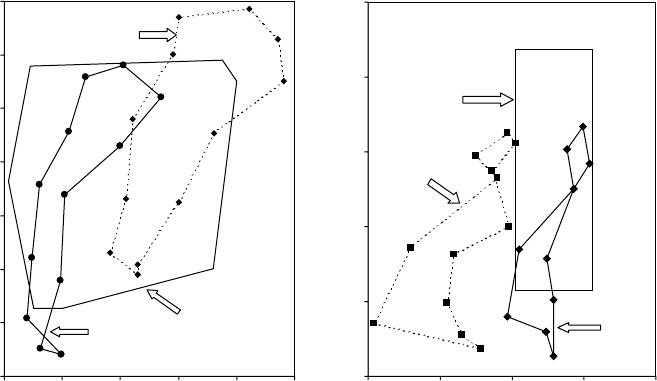
Figure 14.12 Temperature-moisture climograph. (a) The successful introduction of the Hungarian
partridge to Montana, the unsuccessful introduction to Missouri, compared to average conditions in
its native breeding range in Europe. (b) Conditions in Tel Aviv, Israel showing conditions favoring
an outbreak of the Mediterranean fruit fly in 1927. (Redrawn from Odum, 1983; original from
Twomey, 1936.)
FACTORS THAT CONTROL POPULATIONS 469
An example of the combined effect of variables can be seen in Figure 14.12. The plot
shows a temperature–moisture climographs, a phase-plane plot of temperature and
rainfall. The numbers around each polyg on indicate month of the year. The plot shows
three climographs. One represents average conditions in the region of Europe where
the Hungarian partridge naturally breeds. The other two are for the states of Montana
and Missouri, where attempts were made to introduce the partridge. The introduction
was successful in Montana but failed in Missouri.
The natural range of an organism can be examined to determine which levels of which
factors are associated with the boundaries of the range. However, it is thought that differ-
ent factors may operate within a range. In fact, it h as been demonst rated that individuals
near the edge of a geographic range may differ genetically from those in the center. The
genetic variation may be due to natural selection, which in this context is called factor
compensation. Thus, organisms living in the warm er region of a species range might no t
be able to tolerate the colder climate that other more adapted individuals of the same spe-
cies can. The locally adapted populations are called ecotypes. For example, the jellyfish
Aurelia aurita has a southern population that cannot swim outside the temperature range
11 to 36
C. A northern population is sharply limited to between 0 and 28
C. Altho ugh
they are the same species, subpopulations have evolved to flourish over different tempera-
ture ranges.
A species is often limited by geographic factors such as mountain ranges or oceans,
which in turn limit their dispersal. If transplanted outside their normal range, they repro-
duce and spread. This is seen most clearly in the many cases where humans introduced
foreign species to an area, sometimes deliberately and sometimes inadvertently. Often,
these species become nuisances and displace native species. Examples include the
gypsy fly, the chestnut blight, and the starling in the United States, and the rabbit and
the cane toad in Australia.
14.3.4 Species Interactions
Finally, a major factor that can limit the spread of a species is their interactions with other
species. Within the ranges favorable to an organism, it is the interactions with other spe-
cies that seem to dominate its distribution and abundance. Species interactions can be
classified as beneficial, detrimental, or neutral in their effects on each of the interacting
species. Note that a species that benefits from anot her may also become dependent on it.
Thus, its range may be limited by the range of the species it depend s on. A variety of
major interaction types and subtypes have been identified (Table 14.5). We will give
examples of several.
Competition arises when two species attempt to exploit the same resources. When the
negative effect is due to the fact that one species’ use of the resource reduces its avail-
ability to the other, it is called resource competition.Ininterference competition, one
species has a more direct effect on the other’s ability to compete for a resource. It may do
so by chasing it away or by producing a chemical that inhibits competing species. Che-
mical inhibition of competitors is also called allelopathy. For example, sage plants (Sal-
via leucophylla) produce gaseous terpenes, which adsorb onto the soil near the plant and
inhibit germination of seedlings. Some species of sponge produce a toxin that acts on
other sponge species.
470 ECOLOGY: THE GLOBAL VIEW OF LIFE

Predator–prey relationships result in the death of the prey. Most carnivorous organ-
isms are predators (can you think of exceptions?). We usually think of this category in
terms of animals that chase, catch, and eat other animals, but animals such as the blue
whale simply seine the water for shrimp, small fish, and so on. In the microbial world,
rotifers and stalked ciliates filter smaller organisms from the water. Populations of preda-
tor and prey oft en exhibit an out-of-phase oscillation. When the prey population increases,
the predator population follows as its resource increases. This results in a drop in the prey
population, followed a short time later by a drop in the predator population. This relation-
ship is explored mathematically in Section 10.4.1.
Parasitism is distinguished from predation because the parasite is usually much smal-
ler than its host, and the host will usually survive the interaction, although it may be
harmed. Infectious disease falls into this category, although it is sometimes classified
separately. Herbivores may are also be classified as separate þ/ categories. Here we con-
sider them to be predators if they kill the plant, or as parasites if they eat only part and the
plant survives.
An example of predation involves the prickly pear cactus, which overran pastures and
rangelands after it was introduced to Australia. The cactus moth was brought in from
South America. Its caterpillar feeds on the cactus’s new shoots, literally ‘‘nipping it in
the bud’’. In a few years the cactus was no longer a problem. It wasn’t eradicated, though,
because the cactus could spread faster than the moth, although it would be followed soon
after. It is interesting that it is difficult to find the moth in cactus stands either in Australia
or its native South America. Its significant role might never have been discovered if not
for the Australian experiment.
Predator–prey and parasitic relationships have resulted in what’s been called an evolu-
tionary ‘‘arms race’’ as hosts evolve ever better defenses and predators and parasites
evolve to overcome them. Defensive tactics include escape, camouflage, body armor,
and chemical defenses. Poisonous animals often have conspicuous coloration to warn
potential predators away. Other species may mimic poisonous ones. Plants have been par-
ticularly adept at developing chemical defenses. They may be toxic or just noxious. Oaks
and many other plants produce tannins, which complex with digestive enzymes of insects,
TABLE 14.5 Types of Two-Population Interactions
a
Interaction Type Species 1 Species 2
Neutralism 0 0 No effect of either population on the other
Interference competition Each species inhibits the other directly
Resource competition Inhibition only when a resource is in short supply
Amensalism 0 One species is at disadvantage, other not affected
Commensalism þ 0 One species benefits, other not affected
Parasitism þA parasite is usually smaller than the host, and the
host usually survives
Predation þA predator is usually larger than the prey, and the
prey does not survive
Protocooperation þþFavorable to both, but not obligatory
Mutualism þþFavorable to both, and is obligatory
a
0, no significant effect on that species; , a detrimental effect; þ, a beneficial effect.
Source: Odum (1987).
FACTORS THAT CONTROL POPULATIONS
471
rendering oak leaves nonnutritious. Nicotine from tobacco plants is a nerve toxin. Pyre-
thrum is an insecticide that is extracted from the chrysanthemum plant.
Insects obtain food from flowers while pollinating them. Lichens are an association
between a fungus and a flower; neither can live without the other. Bacteria in mammalian
intestinal tracts are beneficial to the host. This is especially true for ruminants, animals
such as cows who depend on bacteria to digest cellulose in their feed. Seed-eating birds
help disperse seeds while obtaining food. Another term for mutualism is symbiosis or
synergy. An example of mutualism that we have already met is the mycorrhyzal fungus
(described in Section 10.7.4). This is a form of mutualism called syntrophy, in which two
species provide some nutritional requirement for each other. Syntrophy is common among
bacteria.
Pioneer communities such as are found in newly cleared areas tend to have more nega-
tive interactions. Negative interactions tend to be less common in well-developed commu-
nities. Even in laboratory predator–prey experiments, the population oscillations dampen
as time goes on. Three-way interactions may also occur. An example is the scavenger–
predator–prey relationship. The scavenger is a carnivore that eats remains of food killed
by other animals.
14.4 POPULATION S AND COMMUNITIES
Now we focus on the aggregate behavior of groups of individuals of one kind—species
and groups of species—communities. The discussion here will emphasize animal popula-
tions, although much of this applies to other kingdoms as well. The questions we address
include: How will a given population change? Will it increase or stay the same? How high
can it go? How can we compare the number of species in one ecosystem with those of
similar ecosystems? How can we measure the effect of pollution on species distribution
and abundance? How does the abundance of organisms of a species depend on such fac-
tors as the geographical extent of its range, its trophic level, or its physical size? How does
a community change in response to environmental influences such as seasonal changes or
natural disasters?
14.4.1 Growth Models: Temporal Structure of Populations
Here we look with some depth at the methods that have been developed to predict changes
in populations as they grow, use resources, compete, and feed on each other. This is one of
the most active areas of ecology and is a prime example of the importance of mathematics
to biol ogy. For the most part, we deal with population as a continuous variable. The result-
ing models are in the form of differential equations. Similar models can be developed for
populations that change in discrete steps, such as annually. This would result in difference
equations instead.
Vital Statistics and the Life Table The size of a population will increase if the natality
(rate of production of new organisms by birth, hatching, division, etc.) plus immigration
(rate at which individuals join the population from outside) exceeds the sum of mortality
(rate of death) and emigration (rate at which individuals leave the population). These four
parameters determine the rate of change of a population. We focus on natality and mor-
tality as the intrinsic determinants of growth.
472 ECOLOGY: THE GLOBAL VIEW OF LIFE

For a given environmental situation, the average natality and mortality both depend on
the age of the organism. Natality is usually zero for an initial period. Some organisms may
then produce young at a fixed rate for their entire lives. Others, such as humans, are cap-
able of bearing young only during a range of ages of the females. Some organisms, such
as salmon, produce young only once in their lives, just before dying. The rate at which
individuals in a given age group, x, produce young is called the fecundity or fertility, and
is denoted b
x
.
Mortality also depends on age. The age-specific rate is denoted q
x
. Although each
population is unique, three basic types of mortality vs. age relationships are noted:
Type I: fairly low and constant mortality over most of the life span, followed by
increasing mortality with age. Humans follow this pattern.
Type II: constant mortality regardless of age. This is typical of birds.
Type III: high mortality among juveniles, followed by fairly low and constant mortality
for the rest of the life span. This is typical of fishes and many lower animals such as
zooplankton, which produce huge numbers of young, few of which survive to
adulthood.
Species that go through several discrete stages, such as insects, may exhibit multiple pla-
teaus of mortality in their lifetimes.
Mortality can be measured by following a group of individuals born in the same age
group through their life span, until all have died. The life span is divided into age groups.
The number that survive to enter each age group x, denoted n
x
. A table of the values of n
x
,
called a life table, shows the age structure of the population. Table 14.6 is a life table for a
population with a five-year life span. (Immigration and emigration are neglected.) The
mortality is denoted q
x
. Note that the midpoint of the age groups is used for calculations,
so calculations for all organisms of age 0 to 1 are based on age 0.5.
This is called a cohort life table. It is based on a single group that goes through the age
groups together. It is often difficult to follow a cohort for life. Instead, it is approximated
by a synoptic, or static, life table. If the population is at steady state, the two will be iden-
tical. A steady-state condition means that natality equals total mortality and that none of
the age groups is changing in size. A cohort life table can be used to compute the mor-
tality as the fraction that die in each age group:
q
i
¼
n
i
n
iþ1
n
i
ð14:11Þ
The information n
i
, q
i
, and b
i
from the life table can be used to compute several things
of interest, such as the steady-state age distribution changes in population and age
TABLE 14.6 Life Table for a Hypothetical Type I Population
i Midpoint Age, x
i
Number, n
i
Natality, b
i
Mortality, q
i
0 0.5 1000 0.000 0.200
1 1.5 800 0.450 0.100
2 2.5 720 0.500 0.100
3 3.5 648 0.500 0.300
4 4.5 454 0.000 1.000
POPULATIONS AND COMMUNITIES 473

distribution when given a starting distribution and the intrinsic rate of increase of the
population.
The steady-state age distribution is easily computed from mortality. A basis population
must be assumed for the first age group, such as the number 1000 used for n
0
in Table 14.6.
Then successive age group populations are computed by rearranging equation (14.11):
n
iþ1
¼ n
i
ð1 q
i
Þð14:12Þ
The age distribution is often presented as a histogram, as in Figure 14.13. This can be
compared to a steady-state life table histogram. Populations with relatively large numbers
of young and of individuals of offspring-producing age will tend to be increasing.
To compute unsteady-state changes, the mortality is simply applied to each age group
at time step j to find the population entering the next age group:
n
iþ1; j þ1
¼ n
i; j
ð1 q
i
Þð14:13Þ
The population of the first age group is obtained from the nata lity of each population, b
i
:
n
0; jþ1
¼
X
1
i¼0
n
i; j
b
i
ð14:14Þ
Table 14.7 shows several generations that result based on the given starting population
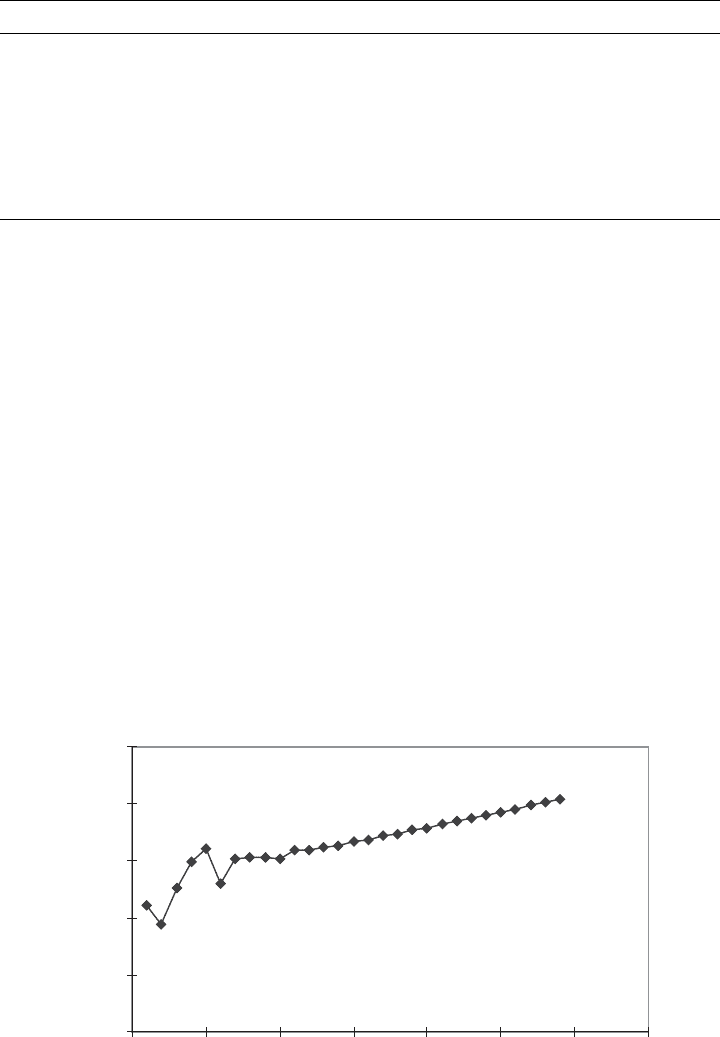
distribution and the life table in Table 14.6. Figure 14.14 is a plot of the total population
over 45 generations of the organism.
Note the ‘‘baby boom’’ caused by the large number of young in the starting population.
Eventually, the oscillations die out as the population assumes a stable age distribution.
This approximates the steady state because natality exceeds mortality and the population
is growing. Note that the population distribution at 45 days is still not at steady state. In
fact, steady state is never reached. This population is growing exponentially, because birth
exceeds mortality.
When the oscillations die out, the total population, N, increases in a constant propor-
tion, l, or geometrical ly, with each gener ation:
l ¼
N
tþ1
N
t
ð14:15Þ
N
t
¼ N
0
l
t
ð14:16Þ
where N
t
is the total population at time t and N
0
is the initial population. If population
growth can be assumed to be continuous, growth can be described by the familiar first-
order growth equation giving the rate of increase as being proportional to the current
population:
dN
dt
¼ rN ð14:17Þ
where r is called the intrinsic rate of increase. This is a the rate of increase normalized
by the population (dN/dt)/N. The case of equation (14.17) in which r has a constant value
is the exponential growth rate model.
474 ECOLOGY: THE GLOBAL VIEW OF LIFE
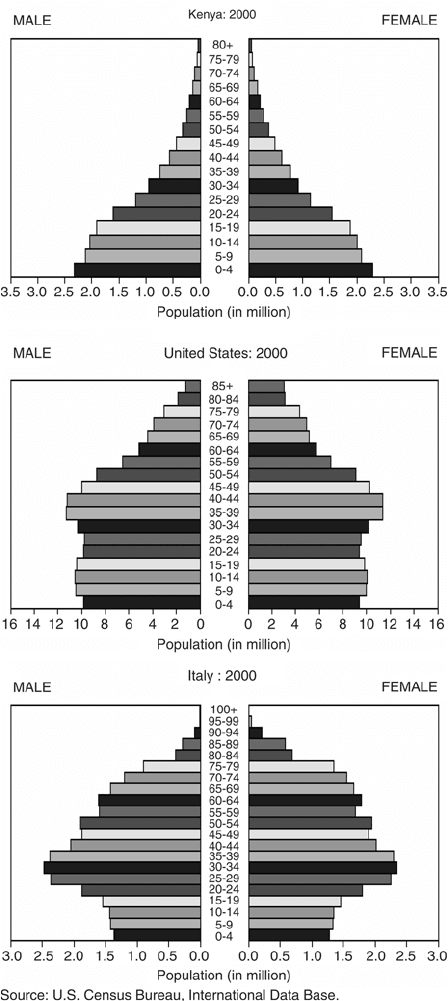
Figure 14.13 Population histogram for three different growth scenarios. Kenya represents a
country with a high growth rate, 2.5% per year. The U.S. growth rate is moderate, 1.0% per year.
Italy is a country with a low growth rate, 0.3% per year, which is expected to begin to decline over
the next several decades. Each bar represents a cohort of five years of age. (From U.S. Census
Bureau, 2004.)
POPULATIONS AND COMMUNITIES 475
Models based on differential equations such as this one are more appropriate to popu-
lations that breed continuously, with overlapping generations. On the other hand, equatio n
(14.16) is better suited to species that breed at fixed intervals, once per season. The solu-
tion to equation (14.17), given an initial total population of N
0
, is the exponential relation-
ship
N
t
¼ N
0
e
rt
ð14:18Þ
and by comparing (14.16) and (14.18), we obtain
r ¼ ln l ð14:19Þ
The values of l and r computed by equations (14.15) and (14.19) do not require age
distribution information to predict growth—only data on total population and the assump-
tion that the population distribution is stable. Examples of these calculations are given in
Table 14.7. Notice that they vary widely until stability emerges.
TABLE 14.7 Population Distribution Changes Based on Life Table from Table 14.6
a
i 1 2345 44 45
0 1000 51 410 419 490 719 729
1 100 800 40 328 335 567 575
2 10 90 720 36 295 503 510
3 1 9 81 648 33 446 452
4 0 1 6 57 454 308 312
Total 1111 950 1257 1487 1606 2541 2578
l 0.855 1.323 1.183 1.080 0.807 1.015
rðtÞ0.156 0.280 0.168 0.077 0.214 0.015
a
Each column represents one generation; each of rows 2 through 6 represents an age group.
0
500
1000
1500
2000
2500
0 5 10 15 20 25 30 35
Generation
Population
Figure 14.14 Predicted total population changes based on life table in Table 14.6.
476
ECOLOGY: THE GLOBAL VIEW OF LIFE

An interesting parameter that can be computed from r is the doubling time, t
2
:
t
2
¼
ln 2
r
¼
0:693
r
ð14:20Þ
The values of r and l could also be estimated directly from mortality and natality with-
out having to simulate the population changes. Two intermediate values must first be com-
puted: the net reproductive rate, R
0
, which is the average number of offspring produced
per individual over a generation; and the mean length of a generation, G, which is the
average time between the birth of an offspring and that of its parents:
R
0
¼
X
1
i ¼0
l
i
b
i
ð14:21Þ
where l
i
¼ n
i
=n
0
is the age distribution norm alized to the first age group:
G ¼
P
1
i ¼0
l
i
b
i
x
i
R
0
ð14:22Þ
r ¼
ln R
0
G
ð14:23Þ
For the data from Table 14.6, we have R
0
¼ 1:044, G ¼ 2:47, and r ¼ 0:0175 per unit
time, for a doubling time t
2
¼ 39:6 time units.
All populations are capable of exponential or geometric growth if favorable environ-
mental conditions are maintained. However, this kind of growth is truly ‘‘explosive.’’ Dar-
win gave an example of the elephant, which he predicted could grow from two individuals
to 19 million over 750 years. This corresponds to a mere r ¼ 0:021 per year, or a doubling
time of 33 years. He also pointed out that although many parasites have a high intrinsic
rate of increase, they are nevertheless rare. Clearly, the growth models described earlier
need to take into account factors that limit growth, such as limiting factors, competition,
and predation. These are the subjects of the next sections.
Single Species: The Logistic Equation A simpl e strategy to place a limit on the expo-
nential growth of equation (14.17) is to have r decrease as N increases. A simple way to
do this is to have it decrease linearly from a maximum specific growth rate , r
0
, when N
is zero, down to zero when N increases to a particular level, K:
r ¼ r
0
K N
K
ð14:24Þ
Since the rate goes to zero as N goes to K, the population cannot increase beyond K
(except by immigration). Thus, K, called the carrying capacity, reflects the inherent abil-
ity of the ecosystem to support the population. Both K and r
0
can vary with environmental
conditions; for example, they might decrease in time of drought. When the rate equation
(14.24) is substituted into the growth equation (14.17), we get the important model of
population growth in the presence of a limiting factor, called the logistic equation:
dN
dt
¼ r
0
N
K N
K
ð14:25Þ
POPULATIONS AND COMMUNITIES 477