
Vaccari D.A., Strom P.F., Alleman J.E. Environmental Biology for Engineers and Scientists
Подождите немного. Документ загружается.

The concluding step in this three-step sequence is methanogenesis, by which methane
is produced. Methanogenesis converts low-molecular-weight organic precursor species
into gaseous end products at both ends of the carbon oxidation state range, including
fully reduced methane and fully oxidized carbon dioxide. At this point, therefore, the
overall process of anaerobic digestion will have biochemically converted a sizable frac-
tion of an initial sludge residua l into a far more benign, possibly even energetically useful
gaseous product.
Whereas the hydrolytic and acidogenic participants in this process are all members
of the eubacteria domain, methanogens are classified as archaea. Methanogens include
17 genus membe rs, typically subdivided into seven different groups based on their
gramstain reaction status, morphology, DNA makeup, and methanogenic substrate form.
On the one hand, these methanogens exhibit considerable variety in terms of their genetic
structure (with C þ G% values ranging from 26 to 62%), shape (short and long rods,
plate-shaped cells, various cocci arrays, and filamentous forms), and temperature toler-
ances (including both mesophilic and thermophilic preferences).
Contrasted with their apparent physiological diversity, though, methanogens rely
on three fairly narrow metabolic options for usable substrate forms, as depicted in
Figure 16.41. The dominant substrate option, which includes a large number of methano-
genic genus members, involves CO
2
-type substrates where carbon dioxide serves as an
acceptor for electrons donated by H
2
, carbon monoxide, or formate. The second option,
which includes only two genuses (Methanosarcina and Met hanothrix) uses acetate in a
metabolic process known as acetoclastis, a form of fermentation whereby this singular
substrate (i.e., acetate) serves as both an electron acceptor and an electron donor. The
third, methylotrophic, substrate option generally follows an electron flow scheme similar
to that of the acetoclastic group, with substrates such as methan ol or methylamine both
CO
2
–Type Options
(includes many
methanogengenus)
H
2
, CO, or formate
1
Oxidation
Reduction
CO
2
CH
4
H
+
or CO
2
Acetate
(CH
3
COO
-
)
Acetoclastic Option
(includes only 2 genus:
Methanosarcina and
Methanothrix)
2
Oxidation
Reduction
CO
2
CH
4
Methanol (CH
3
OH)
Amines
methylamine,
dimethylamine,
trimethylamine,
methyl mercaptan,
dimethyl sulfide
Methylotrophic Options
(includes several
methanogengenus)
3
Oxidation
Reduction
CO
2
CH
4
CO
2
–Type Options
(includes many
methanogen genus)
1
Oxidation
Reduction
Acetoclastic Option
(includes only 2 genus:
Methanosarcina and
Methanothrix)
2
Oxidation
Reduction
Methylotrophic Options
(includes several
methanogen genus)
3
Oxidation
Reduction
Figure 16.41 Methanogenic substrate options.
638
BIOLOGICAL APPLICATIONS FOR ENVIRONMENTAL CONTROL
supplying and scavenging electrons. However, there are several more methanogenic
genuses capable of pursuing this third ‘‘methyl’’ substrate option than are involved
with acetoclastis, and in some cases they may also use hydrogen gas as a source of redu-
cing power. Spread among these three catabolic options, most methanogens are only able
to use one or two substrate forms, although Methanosarcina is far more facile given its
ability to metabolize seven different substrates. In addition, there are methanogens whose
usable substrate options lie outside the standard norm, including those able to subsist with
various alcohol forms, including ethanol, 1- and 2-proponal, and 1-butanol.
Methanogenic metabolism naturally requires a highly reduced environment and is sus-
tained only by microbes whose life-style is strictly anaerobic. Although the reductive
metabolism of carbon dioxide practiced by most methanogens can be viewed as an anae-
robic respiration pathway (using CO
2
as an electron acceptor in lieu of O
2
), methanogens
do not employ the same sort of cytochromes, quinones, and flavoproteins as are involved
in a normal respiratory electron transport chain. Instead, methanogens use a number of
highly specialized reducing enzym es and coenzymes for their reductive metabolism,
sequentially including coenzyme factor F
420
, methanopterin, methanofuran, coenzyme
M (2-mercap toethanesulfonic acid), coenzyme factor F
430
, and a terminal coenzyme
HS-HTP (7-mercaptoheptanoyl threonine phosphate).
Aside from the important biochemical roles played by these metabolic compounds,
two of these enzymatic forms also provide a unique means of selectively identifying
the presence of methanogen cells. Methanopterin, which resembles folic acid structurally,
exhibits a bright blue fluorescence when illuminat ed with light at 342 nm, and coenzyme
F
420
projects a similarly distinct fluorescent blue-green hue when exposed to 420-nm
epifluorescent illumination. Coenzyme factor F
430
also absorbs light when irradiated at
430 nm, but unlike F
420
, this coenzyme does not fluoresce. An environmentally important
aspect of F
430
activity, though, is that this coenzyme requires nickel at a level that gives
methanogens a distinct anabolic requirement for this trace element.
The multistep and metabolically complex nature of these anaerobic mechanisms, there-
fore, introduces a set of concerns when applied to the pragmatic business of sludge diges-
tion, particularly those systems designed for single-stage processing. Indeed, there is an
extremely delicate balance that must be achieved in these single-stage anaerobic reactors
between the involved acidogenic and methanogenic sequences in terms of their respective
production and use of the acidogenic fermentation intermediates. Specifically, two differ-
ent forms of key intermediates are involved, including both the low-molecular-weight
volatile fatty acids (e.g., acetic, butyric, proprionic, etc.) and hydrogen gas.
The first issue with fatty acid intermediates revolves around system pH and the
negative impact that acidic pH levels have on these anaerobic reactions. Methanog ens
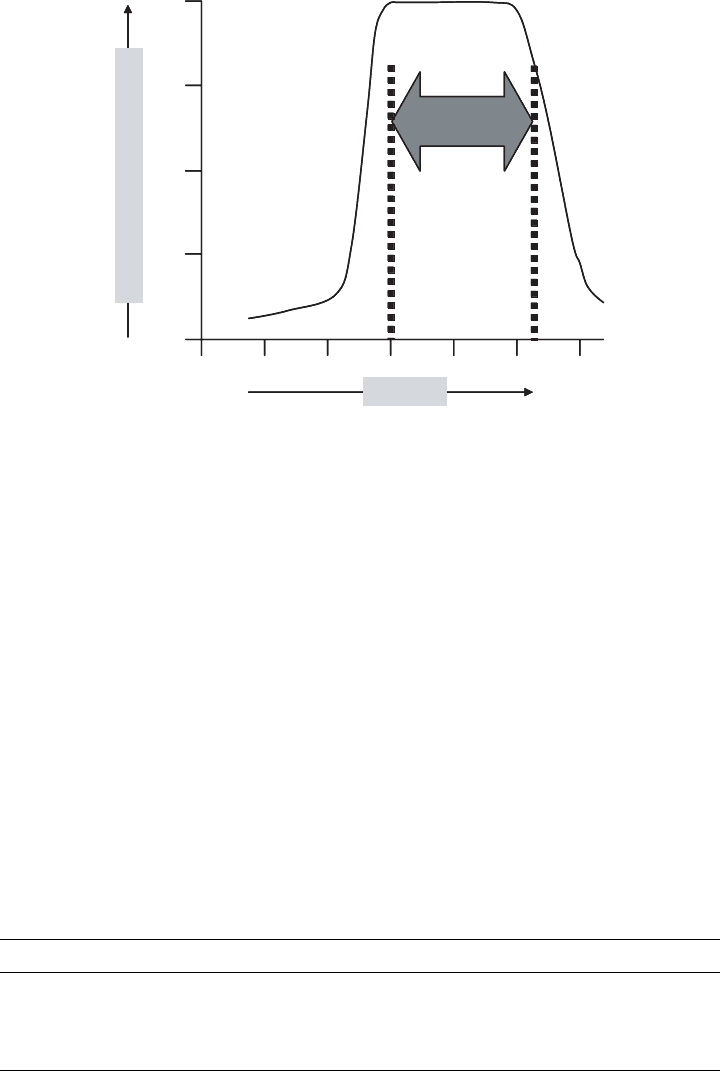
are sensitive to pH outside the range 6 to 8 (Figure 16.42). A decrease in pH below 6
reduces the activity of the methanogens more than that of the acidogens. This causes a
buildup of organic acids, further reducing pH. Thus, anaerobic digestion is unstabl e
when confronted with pH disturbances. An important part of the inhe rent instability of
the acidogenic-to-methanogenic linkage, therefore, stems from the fact that short-term
lags in methanogenic activity (e.g., perhaps triggered by other environmental stress fac-
tors) can lead to upset pH transients from which the methanogens cannot readily recover.
The second crucial aspect with the metabolism of an anaerobic digester is that the
reductive intermediate production of reduced hydrogen gas via the fermentative acidogens
must be simi larly balanced by its consumption during methanogenic metabolism. Should
hydrogen gas levels rise within the digester much above trace values (i.e., above
SLUDGE TREATMENT 639
10
3
atm), the metabolic harmony between acidogenic and methanogenic metabolism
will again be disrupted, although in this case the negative impact is on the acidogenic cells.
This phenomenon reflects yet another delicate thermodynamic circumstance with the
second set of fatty acid fermentation reactions, where the ambient hydrogen gas level
must be kept sufficiently low to effect a net release of free energy. The free-energy values
given in le 16.12 aptly qualify this dependence. In the absence of a sink (i.e., methano-
genic consumption) for hydrogen gas during anaero bic digestion, the free-energy release
for the fermentation of either proprionate or butyrate would be positive in value (with
standard values of þ76.2 and þ48.2 kJ for these respective conversions), at which
point these reactions would simply not occur.
Here again, a successfully maintained anaerobic digester system must achieve a bal-
ance between fermentative and methanogenic reactions. By holding the intermediate
hydrogen gas levels at an acceptably low level (just as the fatty acid buildup had to be
0.25
0. 50
0.75
1.00
0.00
45
6789
pH Preference from
pH→ 6 to 8+
Reactor pH
Methanogenic Activity (in relative %)
pH Preference from
pH → 6 to 8+
Figure 16.42 Approximate pH response by anaerobic methanogens. (Adapted from Speece,
1996.)
TABLE 16.12 Fermentation Free-Energy Changes for Standard vs. Typical Reactor Values
(kJ/Reaction)
Fermentation Type Reaction G
a
G
b
Proprionate fermentation
to acetate, CO
2
, and H
2
Proprionate þ 3H
2
O ! acetate þ H
þ
þH
2
þHCO
3
þ76.2 5.5
Butyrate fermentation to
acetate, CO
2
, and H
2
Butyrate þ 2H
2
O ! 2 acetate þ H
þ
þH
2
þ48.2 17.6
a
G
0
, Standard free-energy release with 1 M fatty acid and H
2
at 1 atm.
b
G, free-energy release with typical reactor conditions (1 mM fatty acid and H
2
at 10
3
atm).
640 BIOLOGICAL APPLICATIONS FOR ENVIRONMENTAL CO NTROL
kept in check) the acidogenic conversions will realize energetically favorable (i.e., nega-
tive free-energy release) conditions during fatty acid fermentation.
This interplay between H
2
-producing and H
2
-consuming anaerobes, known as inter-
species hydrogen transfer, represents an exceedingly vital biochemical alliance, without
which the overall process of anaerobic digestion would not be feasible. In this context, the
bacteria responsible for fatty acid fermentations and preparative H
2
production are also
referred to as syntrophs (literally translated as ‘‘eating together’’), whereby their coopera-
tive life-style synergistically supports the necessary metabolic exchange of this key elec-
tron donor.
Sulfur metabolism, particularly that of sulfide release and transformation, also repre-
sents an important biochemical aspect with the fermentation reactions found in anaerobic
digesters. These systems have three possible sulfur sources, including that of incoming
soluble sulfates being converted directly to sulfides, due to the highly reducing conditions
within the digester. Sulfides may also be introduced to these digesters via the sludge
streams, either as constitutive cellular elements (e.g., present within sulfur-bearing
amino acids, etc .) released directly from lysed microbial cells found in the secondary
sludge or as reduced metallic-sulfide (e.g., FeS) precipitates found within reduced primary
sludges. Whatever their source, sulfides within anaerobic digestors may then undergo a
variety of important transformations. Sulfide-based precipitation may occur to an extent
that could reduce the net solubility of many metal species (e.g., iron, copper, nickel, zinc),
possibly even to a degree that would reduce their availability as metabolically necessary
trace elements. Hydrolysis of the sulfide may also take place given the slightly acidic con-
ditions found in most anaerobic digestors (i.e., due to the low, 10
7:25
, acid ionization con-
stant for sulfide hydrolysis, H
2
S ! HS
þ H
þ
), thereby leading to gas exchange (i.e., via
stripping) into the headspace and contamination of the predominant methane product to
an extent that could neces sitate subsequent removal prior to using the methane as an
energy-rich feed gas. The highly reduced environment of an anaerobic digester may
also transform inorganic sulfides into various malodor ous organic sulfides collectively
known as mercaptans. le 16.13 provides a general synopsis of these various biochemical
products and their associated chemical structures, ranging from simply methyl mercaptan
to dimethyldisulfide. These chemical composites of reductively generated organic methyl
groups and inorganic sulfide collectively bear an intensely malodorous nature whose
repugnant smell, especially when blended with that of classic ‘‘rotten egg’’ smell of
hydrogen sulfide, is well known to anyone who has ever dealt with any of these anaerobic
materials.
Perhaps in part due to the latter complexity of these metabolic pathways and transfor-
mations, anaerobic digestion systems are designed and operated in a wide range of phy-
sical configurations. These variations can be subdivided into one of three generic options:
conventional high-rate, phase-separated, and anaerobic contact reactors. Even then, there
may be further refinements with regard to mesophilic (20 to 35
C) and thermophilic
(45
C and higher) operating temperatures.
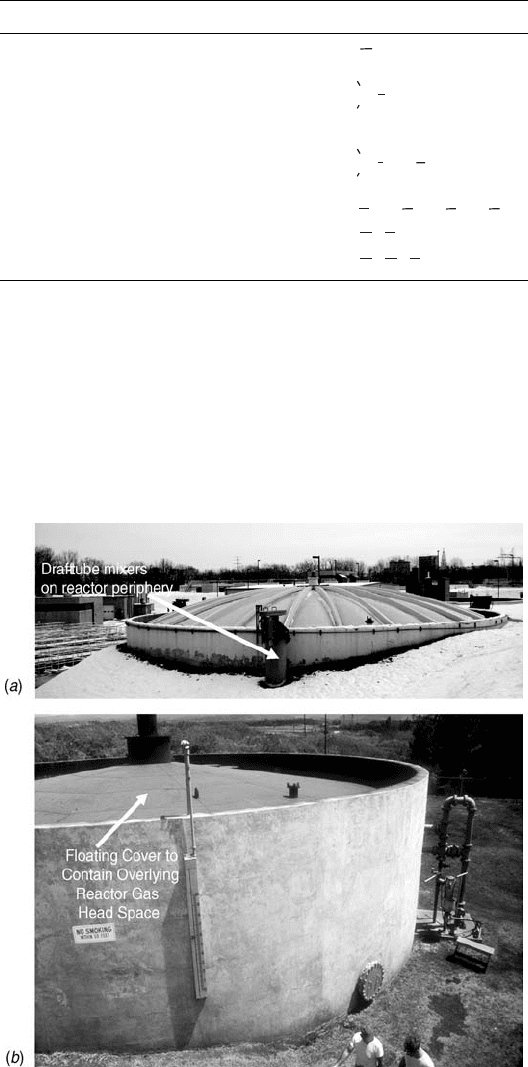
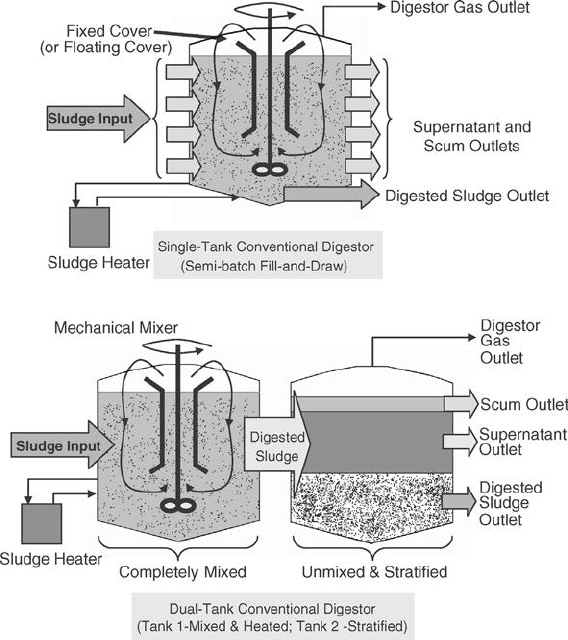
Conventional high-rate anaerobic digesters are typically built in either single- or dual-
tank (i.e., a mixed first tank and stratified second tank) forms, which provide mixing, and
possibly heating, to improve their overall effectiveness (Figures 16.43 and 16.44). These
operations receive smaller, sem icontinuous loads of incoming sludge rather than larger
batch-type loadings spaced farther over a longer period, with the overall intent of fostering
a more stable balance with the acidogenic and methanogenic reactions. The latter
SLUDGE TREATMENT 641
approach toward infrequent, intermittent loadings might impose a ‘‘feast-to-famine’’
regime that would then tend to disturb the desired metabolic harmony considered optimal
for anaerobic digestion.
Taking into account the intermittent nature of these incremental inputs, the recom-
mended loading rates [in terms of the daily applied volatile suspended solids (VSS)
load per unit tank volume] range from 1.6 to 4.8 kg VSS/m
3
day. Ba sed on the typical
TABLE 16.13 Mercaptan Species Generated by Anaerobic Sludge
Metabolism
Chemical Name Chemical Structure
Methyl mercaptan
H
3
CSH
Isopropyl mercaptan
CH SH
H
3
C
H
3
C
Isobutyl mercaptan
CH CH
2
H
3
C
H
3
C
SH
N-Butyl mercaptan
H
3
CCH
2
CH
2
CH
2
SH
Dimethyl sulfide
H
3
CSCH
3
Dimethyl disulfide
H
3
CSSCH
3
Figure 16.43 Conventional anaerobic sludge digestor: (a) with internal mixing; (b) without mixing.
642
BIOLOGICAL APPLICATIONS FOR ENVIRONMENTAL CONTROL
characteristics of municipal wastewater sludge, these loading rates correspo nd directly
to hydraulic retent ion times of 15 to 45 days, at which point these systems should be
able to maintain volatile solids reductions on the order of 45 to 50% while producing
0.75 to 1.2 m
3
of methane-rich gas per kilogram of volatile solids removed. Federal
stipulations for the operation of these systems in a fashion to reduce their pathogen con-
tent significantly mandates minimal solids residence times of 15 days at a temperature of
35 to 55
C, and 60 days for sludge digested at 20
C.
Example 16.5: Preliminary Anaerobic Digester Design After completing the preced-
ing series of four optional wastewater treatment designs, the Deer Creek, Illinois , consult-
ing engineer is then asked for another set of preliminary design estimates relative to
sludge processing. In this example, a preliminary design is developed for an anaerobic
digester as might be used in conjunction with a conventional activated sludge system. Com-
pletion of this preliminary design involves four basic assumptions regarding sludge produc-
tion and character. First, conventional wastewater treatment facilities typically generate
Figure 16.44 Conventional anaerobic sludge digestion process schematics.
SLUDGE TREATMENT 643
about 0.25 kg total dry suspended solids per cubic meter of processed wastewater. Second,
in its original wet state, raw primary plus secondary sludge generally contains a rather small
solids fraction, approximately 1.2% by weight, or 12 kg/m
3
. Third, raw sludge is commonly
prethickened prior to digestion, and for this example a reasonable value of 6% (60 kg/m
3
)
will be assumed. Fourth, blended primary plus secondary wastewater sludge typically has
a volatile solids fraction of 70%, the remaining 30% being inert solids.
Preliminary Design Details
Sludge solids mass
and volume,
reactor sizing,
and retention
time
Design average wastewater flow: 605.7 m
3
/day
Estimated daily total sludge solids mass: 151.43 kg TSS/day
ð605:7m
3
=dayÞð0:25 kg=m
3
Þ
Estimated raw wet sludge volume: 2.5 m
3
/day
ð151:43 kg=dayÞ=ð60 kg=m
3
Þ
Estimated daily volatile sludge solids mass: 106 kg VSS/day
ð151:43 kg=dayÞð0:7Þ
Design anaerobic digester solids loading rate: 1 kg VSS /m
3
day
Design anaerobic digester volume: 106 m
3
ð106 kg=dayÞ=ð1kg=m
3
dayÞ
Design anaerobic digester HRT: 42 days
ð106 kg=dayÞ=ð2:5m
3
dayÞ
Related notes 1. The estimated raw wet sludge volume represents more than a
200-fold concentration of contaminants from the original was-
tewater flow into this residual sludge stream (i.e., 2.5 vs. 605.7
m
3
/day, or a ratio of 1:242).
2. The design solids loading rate represents a typical norm for
conventional low-rate anaerobic digesters.
3. Here again, this single reactor design does not afford the
desired system redundancy associated with multiple units.
Digester off-gas generated by these conventional high-rate operations typically con-
tains about two-thirds methane and one-third CO
2
, with a net heating value of approxi-
mately 22,400 kJ/m
3
. By comparison, natural gas (i.e., a mixture of butane, methane, and
propane) has an energetic value roughly 50% higher. Moderate-to-large wastewater treat-
ment operations will, therefore, typically collect and use this gas to run boilers and inter-
nal combustion engines that then supply heat and power, although many smaller plants
just burn their gas in a flare as a waste product. Prior to using this gas within a boiler
or diesel engine, though, low-level gas contaminants such as water vapor and H
2
S will
routinely be removed to minimize their corrosive impact.
Although the vast majority of anaerobic systems currently in use for sludge digestion
qualify as high- rate operations, experimental study and limited full-scale evaluation have
644 BIOLOGICAL APPLICATIONS FOR ENVIRONMENTAL CO NTROL
demonstrated that further improvements in process efficiency and reliability can be
obtained with appropriate revisions in the reactor staging, temperature and/or solids
contact scheme. For example, even as early as the 1930s, it was noticed that thermophilic
reactor temperatures from 50 to 55
C might provide distinctly higher metabo lic
rates for anaerobic fermentation, thereby resulting in significant reductions with
necessary detention time s. Unfortunately, though, these early thermophilic studies also
revealed corresponding problems with process instabilities (e.g., higher levels of off-
gas odor, as well as elevated foaming tendencies) that would largely negate any metabolic
gains.
Recognizing these relative trade-offs (i.e., benefits vs. shortcomings) with mesophilic
and thermophilic systems, several new schemes have been developed in recent years to
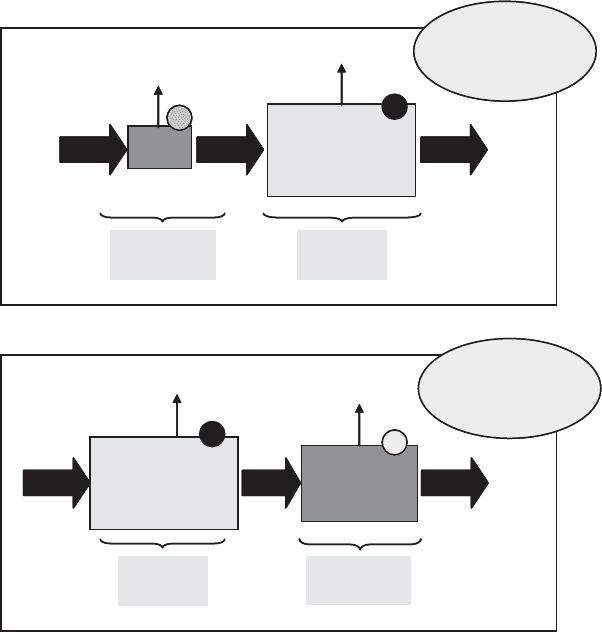
combine the advantages of both. Two such temperature-phased processing options are
shown in Figures 16.45 and 16.46, with one using a thermophilic-to-mesophilic sequence
and the other using a mesophilic-to-thermophilic arrangement. In either case, the opera-
tional premise is that the first phase serves as a solids preprocessor, which then expedites
the efficiency of the trailing, second phase. The resulting improvement in processing
efficiency achieved with these temperature-phased designs is reflected in their reduced
HRT requirements, which on average (at approximately 15 days) are both comparable
to the lowest permissible values with standard high-rate designs.
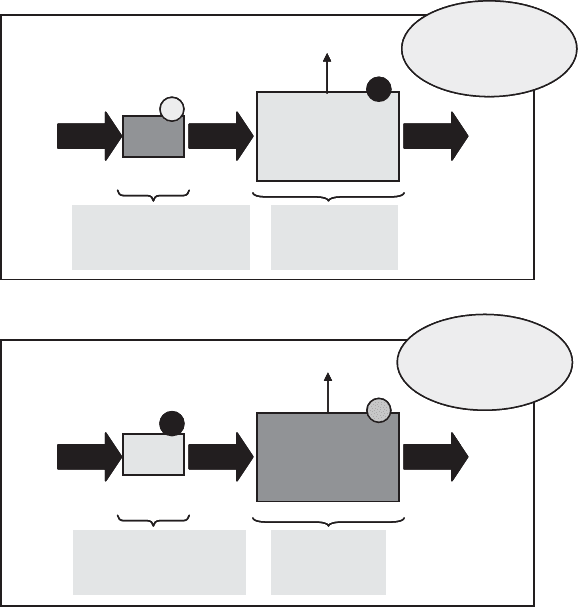
Yet another version of these phase-separated design schemes was developed not only to
provide different sequential reactor temperatures but also to secure a beneficial separation
of the acidogenic and methanogenic reactions. These types of acid-to-gas phased proces-
sing options (Figure 16.45), are designed with even smaller hydraulic retention times
(e.g., 1 to 3 days) for the initial, ‘‘acid’’ phase, such that the slower-growing methano-
gens simply cannot be retained within the first reactor. At that point, therefore, the first
reactor’s hydrolytic and acidogenic roles are uncoupled from that of the concluding,
second-phase methanogenic transformation, thereby promoting optimal conditions for
each of these subdivided reactions.
This type of mesophilic-to-thermophilic acid-gas scheme has been used with consider-
able success on a full-scale level (i.e., at the Woodridge facility in DuPage County,
Illinois) with less than a two-week total retention time. Such acid-gas-phased anaerobic
digestion processes typically carry a far higher level of volatile acids (i.e., commonly ran-
ging from 6000 to 8000 mg/L, and sometimes as high as 18,000 mg/L) within the first
tank, and as a result the average pH in this reactor (5.6) is considerably below the
desired, let alone tolerable level for the methanogenic conversion desired. Another telltale
indicator to the success of this two-phase digestion scheme is that the vast majority (typi-
cally, 95%) of the system’s overall gas production takes place within the concluding
thermophilic reactor. Conversely, gas production, particularly that of hydrogen, takes
place at only a nominal level within the first reactor, such that the acidogens are not con-
strained by the thermodynamic difficulties (i.e., at higher hydrogen levels) that might
otherwise be imposed.
Further efforts to secure better, or more stable, performance with anaerobic digestion
systems have also been made using changes in the mode of initial contact (e.g., with
upflow passage through a fluidized bed of anaerobic granules) and/or final separation
of the solid–liquid matrix (e.g., using mechanically induced separation as opposed to nat-
ural settling and flotation). In whatever fashion these systems might be constructed,
energy savings represent a significant benefit with anaerobic dige stion, including the
SLUDGE TREATMENT 645
twin economic advantages of eliminating the aeration energy cost of aerobic processes
and of recovering a good fraction of the energy content of the organic waste as gas-
phase methane fuel.
16.2.2 Aerobic Digestion
Whether collected within wastewater treatment plants, solid waste landfills, or simply on a
forest floor, organic solids will naturally degrade and decay under aerobic conditions
through the natural process of oxidative breakdown. The microbial cells found in raw
sludge will therefore undergo much the same progressive sequence of cell lysis, release
of cytoplasmic mater ials, and final oxidative conversion within an aerobic digester,
whereby the organics released from lysed cells serve as a source of substrates for other
living aerobic cells. The metabolic conversion of wastewater sludge through aerobic
digestion, such as the unit depicted in Figure 16.47, subsequently converts an initially
organic-rich sludge matrix into carbon dioxide and residual solids that include not only
both inorganic and recalcitrant organic forms but also the remaining complement of meta-
bolically active aerobic oxidizers. The resulting product has the advantage not only of
7-15 day
HRT
(~35
o
C)
3-5 day
HRT
(~55-60
o
C)
1
2
>5-7 day
HRT
(~35
o
C)
1
2
gas
gas
gas
gas
Raw
sludge
Digested
sludge
Raw
sludge
Digested
sludge
>7-10 day
HRT
(~55-60
o
C)
Temperature-Phased
‘ → ’
Total HRT
~10-20 days
Temperature-Phased
‘’
Total HRT
~ 12-17 days
7-15 day
HRT
Mesophilic
(~35
o
C)
3-5 day
HRT
3-5 day
HRT
Thermophilic
(~55-60
o
C)
1
2
>5-7 day
HRT
Mesophilic
(~35
ο
C)
1
2
gas
gas
>7-10 day
HRT
Thermophilic
(~55-60
ο
C)
Temperature-Phased
‘‘Thermo→Meso’’
Total HRT
~10-20 days
Temperature-Phased
‘‘Meso→Thermo’’
Total HRT
~ 12-17 days
Figure 16.45 Temperature-phased anaerobic sludge digestion process schematics.
646
BIOLOGICAL APPLICATIONS FOR ENVIRONMENTAL CONTROL
being well stabilized, but produces much less of an odor problem than that of anaerobi-
cally digested sludge. The main disadvantages of aerobic digestion is the significant
energy cost of operation; the loss, compared to anaearobic digestion, of the energy
value of the waste; and the production of high levels of oxidize d nitrate–nitrogen,
which may complicate subsequent land application options.
Compared to the complicated process of anaerobic digestion, aerobic sludge digestion
represents a far more simplistic and in large measure a single-step process. However, there
are still several important biological issues with aerobic digester operations that must be
considered and accommodated. The level of oxygen uptake maintained within these reac-
tors provides a useful indication of the level of organic solids stability and digestion effi-
cacy. This parameter is quantified as a specific oxygen utilization rate (SOUR) by which
the measured oxygen uptake rate is divided by the existing volatile suspended solids con-
centration to derive the specific (i.e., per mass of solids) value. The generally accepted
benchmark for suitably stabilized biosolids is a SOUR value of no more than 1.5 mg
of oxygen consumed per gram of total solids per hour.
The pH levels with standard, mesophilic aerobic sludge digestion operations can typi-
cally be expected to drop with time given the fact that the organic nitrogen released from
1-3 d ay
HRT
>10 day
HRT
‘Gas Phase’
Mesophilic
‘Acid Phase’
2
1
gas
Raw
sludge
Digested
sludge
Acid-Gas Phased
‘Meso→ Thermo’
Total HRT
~12+ days
Thermophilic
‘Acid-Phase’
Mesophilic
‘Gas-Phase’
Acid-Gas Phased
‘ →Meso’
Total HRT
~12+ days
>10 day
HRT
1-2 d ay
HRT
Raw
sludge
Digested
sludge
1
2
gas
1-3 day
HRT
>10 day
HRT
Thermophilic
‘Gas Phase’
(Methanogenesis)
Mesophilic
‘‘Acid Phase’’
(Hydrolysis & Acidogenesis)
2
1
gas
Acid-Gas Phased
‘‘Meso→Thermo’’
Total HRT
~12+ days
Thermophilic
‘‘Acid-Phase’’
(Hydrolysis & Acidogenesis)
Mesophilic
‘Gas-Phase’
(Methanogenesis)
Acid-Gas Phased
‘
Total HRT
~12+ days
>10 day
HRT
1-2 day
HRT
1
2
gas
‘Thermo→Meso’’
Figure 16.46 Acid-gas phased anaerobic sludge digestion process schematics.
SLUDGE TREATMENT 647