
Zhang K., Li D. Electromagnetic Theory for Microwaves and Optoelectronics
Подождите немного. Документ загружается.

2.2 Polarization of Plane Waves 71
The coefficients of sin τ in the two sides of each equation must be equal, and
so must be the coefficients of cos τ . We have
a cos θ = E
xm
cos δ
x
cos ψ + E
y m
cos δ
y
sin ψ, (2.80)
a sin θ = E
xm
sin δ
x
cos ψ + E
y m
sin δ
y
sin ψ, (2.81)
±b cos θ = −E
xm
sin δ
x
sin ψ + E
y m
sin δ
y
cos ψ, (2.82)
±b sin θ = E
xm
cos δ
x
sin ψ − E
y m
cos δ
y
cos ψ. (2.83)
The sum of the squares of the four equations gives
a
2
+ b
2
= E
2
xm
+ E
2
y m
. (2.84)
The sum of the product of (2.80) and (2.82) and the product of (2.81) and
(2.83) gives
±ab = E
xm
E
y m
sin ∆. (2.85)
The quotient of (2.82) to (2.80) and the quotient of (2.83) to (2.81) are both
equal to ±b/a and must be equal to each other. Thus
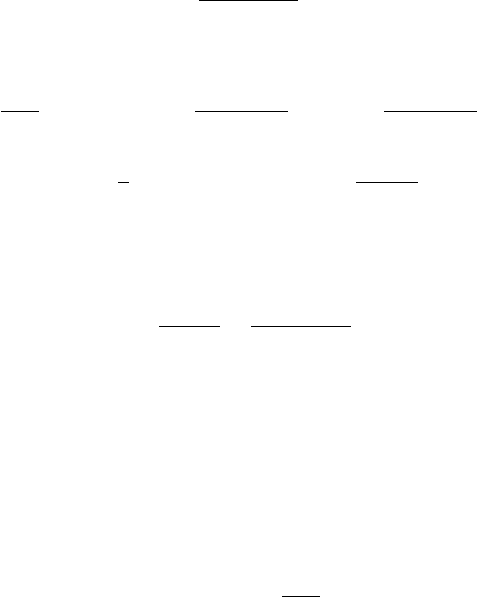
tan 2ψ =
2E
xm
E
y m
E
2
xm
− E
2
y m
cos ∆. (2.86)
It is convenient to introduce the ratios of E
y m
to E
xm
and b to a. Let
tan φ =
E
xm
E
y m
, then tan 2φ=
2E
xm
E
y m
E
2
xm
−E
2
y m
, sin 2φ =
2E
xm
E
y m
E
2
xm
+E
2
y m
; (2.87)
tan χ =
b
a
, then sin 2χ = ±
2ab
a
2
+ b
2
, (2.88)
where χ denotes the elliptic angle and φ denotes the orientation angle of a
linear polarized wave composed by E
xm
and E
y m
.
Dividing twice (2.85) by (2.84) gives
sin 2χ = ±
2ab
a
2
+ b
2
=
2E
xm
E
y m
E
2
xm
+ E
2
y m
sin ∆. (2.89)
Then we have the relations between χ and ψ and φ and ∆:
sin 2χ = sin 2φ sin ∆, and tan 2ψ = tan 2φ cos ∆. (2.90)
(3) Special Cases
(1) ∆ = 0. E
x
and E
y
are in phase. From (2.90) we note that χ = 0, the
minor-axis of the ellipse is zero, and the wave is linearly polarized with the
orientation angle ψ:
ψ = φ = arctan
E
y m
E
xm
.
72 2. Introduction to Waves
The field expressions of an arbitrary oriented linearly polarized wave are given
by
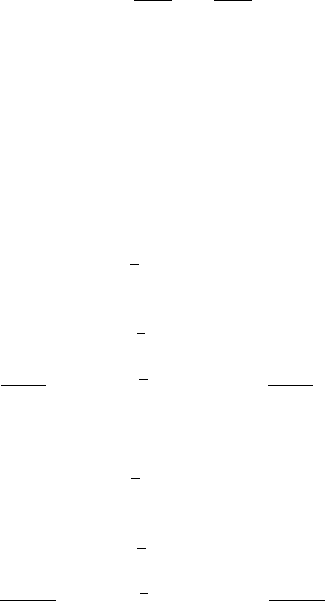
E = (
ˆ
xE
xm
+
ˆ
yE
y m
)e
j(ωt−kz+θ)
, (2.91)
H = (
ˆ
yH
y m
+
ˆ
xH
xm
) e
j(ωt−kz+θ)
=
µ
ˆ
y
E
xm
η
−
ˆ
x
E
y m
η

e
j(ωt−kz+θ)
. (2.92)
(2)∆ = ±π/2. From (2.90) we note that ψ = 0 and χ = φ. The wave becomes
an ortho-elliptically polarized wave, the major and minor axes coincide with
x, y axes.
(3) ∆ = ±π/2 and E
xm
= E
y m
. Thus χ = φ = π/4, a = b, and the major
and minor axes are equal. The wave b ecomes circularly polarized. ∆ = −π/2
represents the clockwise (CW) or right-handed circularly polarized wave and
∆ = π/2 represents the counterclockwise (CCW) or left-handed wave.
The fields of a clockwise circularly polarized wave are given by
E
CW
= E
CW
¡
ˆ
x +
ˆ
ye
−j
π
2
¢
e
j(ωt−kz)
= E
CW
(
ˆ
x − j
ˆ
y)e
j(ωt−kz)
, (2.93)
H
CW
= H
CW
¡
ˆ
y −
ˆ
xe
−j
π
2
¢
e
j(ωt−kz)
= H
CW
(
ˆ
y + j
ˆ
x)e
j(ωt−kz)
=
E
CW
η
¡
ˆ
y −
ˆ
xe
−j
π
2
¢
e
j(ωt−kz)
=
E
CW
η
(
ˆ
y + j
ˆ
x)e
j(ωt−kz)
. (2.94)
The fields of a counterclockwise circularly polarized wave are given by
E
CCW
= E
CCW
¡
ˆ
x +
ˆ
ye
j
π
2
¢
e
j(ωt−kz)
= E
CCW
(
ˆ
x + j
ˆ
y)e
j(ωt−kz)
, (2.95)
H
CCW
= H
CCW
¡
ˆ
y −
ˆ
xe
j
π
2
¢
e
j(ωt−kz)
= H
CCW
(
ˆ
y − j
ˆ
x)e
j(ωt−kz)
=
E
CCW
η
¡
ˆ
y −
ˆ
xe
j
π
2
¢
e
j(ωt−kz)
=
E
CCW
η
(
ˆ
y − j
ˆ
x)e
j(ωt−kz)
. (2.96)
It can be shown that, for a circularly polarized wave, both the average
Poynting vector and the instantaneous Poynting vector are independent of
distance of propagation, refer to Problem 2.1.
2.2.2 Combination of Two Opposite Circularly
Polarized Waves
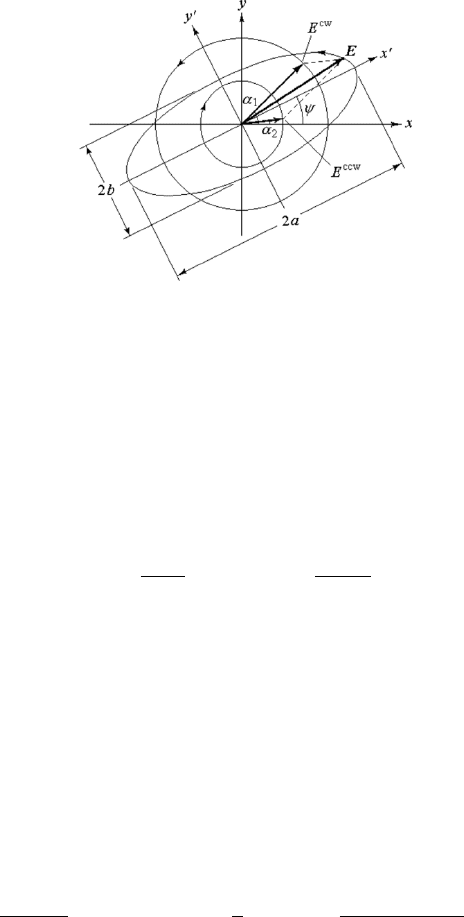
An arbitrary polarized electromagnetic wave may also be explained by the
sum of two circular polarized waves rotating in opposite directions with the
same frequency and the same propagation coefficient but different amplitudes
and different phase angles.
2.2 Polarization of Plane Waves 73
Figure 2.7: Combination of two opposite circularly polarized waves.
(1) General Formulation
The composed electric and magnetic fields for CW and CCW circularly po-
larized waves are written as
E = E
CW
+ E
CCW
=
£
E
CW
(
ˆ
x−j
ˆ
y) e
jα
1
+ E
CCW
(
ˆ
x + j
ˆ
y) e
jα
2
¤
e
j(ωt−kz)
,
(2.97)
H = H
CW
+ H
CCW
=
·
E
CW
η
(
ˆ
y+j
ˆ
x) e
jα
1
+
E
CCW
η
(
ˆ
y − j
ˆ
x) e
jα
2
¸
e
j(ωt−kz)
,
(2.98)
where α
1
and α
2
denote the phase angles of the CW and CCW waves, re-
spectively. The phase difference is
∆α = α
2
− α
1
. (2.99)
Expressions (2.97) and (2.98) represent the field of an arbitrary elliptically
polarized wave, see Fig. 2.7. The principle semi-axes a and b are given by
a = E
CW
+ E
CCW
, b =
¯
¯
E
CW
− E
CCW
¯
¯
. (2.100)
The orientation angle ψ and the elliptic angle χ are given by
ψ =
α
1
+ α
2
2
, χ = arctan
b
a
= arctan
¯
¯
¯
¯
E
CW
− E
CCW
E
CW
+ E
CCW
¯
¯
¯
¯
. (2.101)
(2) Special Cases
(1) E
CW
= E
CCW
, then b = 0 and χ = 0 and the wave is linearly polarized.
(2) E
CCW
= 0, then a = b, E = E
CW
, and a clockwise circularly polarized

74 2. Introduction to Waves
wave results.
(3) E
CW
= 0, then a = b, E = E
CCW
, and a counterclockwise circularly
polarized wave results.
(4) α
2
= −α
1
, then ψ = 0, to give an ortho-elliptically polarized wave.
In conclusion, we have three sets of parameters for describing the state of
polarization of a wave:
(1) The amplitudes of two mutually perpendicular linearly polarized waves
E
xm
, E
y m
, and their phase difference ∆;
(2) The amplitudes of two opposite circularly polarized waves E
CW
, E
CCW
,
and their phases α
1
, α
2
;
(3) Two principle semi-axes a, b, and the orientation angle ψ.
The first and the second sets of parameters include phases, which are diffi-
cult to measure experimentally. On the contrary, the third set of parameters
is easy to measure. A rotary polarization analyzer and a detector can detect
the maximum and the minimum of the wave intensity, a
2
and b
2
, and the
orientation angle of the maximum intensity, ψ.
2.2.3 Stokes Parameters and the Poincar´e Sphere
Define four parameters S
1
, S
2
, S
3
, and S
0
as follows
S
1
= E
2
xm
− E
2
y m
= 4E
CW
E
CCW
cos ∆α, (2.102)
S
2
= 2E
xm
E
y m
cos ∆ = 4E
CW
E
CCW
sin ∆α, (2.103)
S
3
= 2E
xm
E
y m
sin ∆ = 2
h
¡
E
CW
¢
2
−
¡
E
CCW
¢
2
i
, (2.104)
S
0
= E
2
xm
+ E
2
y m
= 2
h
¡
E
CW
¢
2
+
¡
E
CCW
¢
2
i
=
q
S
2
1
+ S
2
2
+ S
2
3
. (2.105)
These parameters are known as the Stokes parameters, and only three
of them are independent. The relations between the Stokes parameters and
parameters a, b, ψ, and χ are given by
S
1
= S
0
cos 2χ cos 2ψ, (2.106)
S
2
= S
0
cos 2χ sin 2ψ, (2.107)
S
3
= S
0
sin 2χ, (2.108)
S
0
= a
2
+ b
2
, (2.109)
where χ is the elliptic angle given in (2.101).
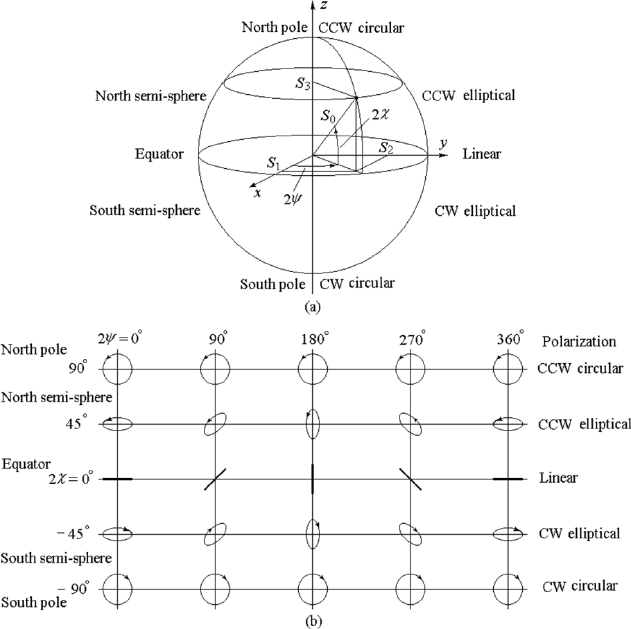
It can be seen from the above relations that S
1
, S
2
and S
3
are the Carte-
sian coordinates of a point on the spherical surface of radius S
0
. This sphere
is known as the Poincar´e sphere. The radius of the sphere represents the
intensity of the wave, i.e., the square of the field strength, and each point
on the sphere surface corresponds to a state of polarization. The polar axis
of the sphere is in the direction of S
3
, and the equatorial plane is the S
1
-S
2
plane, see Fig. 2.8(a).
2.2 Polarization of Plane Waves 75
Figure 2.8: (a) Poincar´e sphere and (b) its expanded view.
The points on the equator of the Poincar´e sphere, where S
3
= 0, i.e., χ = 0
and b = 0, represent linearly polarized waves. The north and south poles,
S
1
= S
2
= 0, i.e., 2χ = ±π/2, b = a, represent circularly polarized waves.
The north pole, where S
3
is positive, 2χ = +π/2, ∆ = +π/2, represents a
CCW or left-handed circularly polarized wave, and the south pole, where S
3
is
negative, 2χ = −π/2, ∆ = −π/2, represents a CW or right-handed circularly
polarized wave. Points on the north semi-sphere, except at the equator and
north pole, represent a CCW elliptically polarized wave and points on the
south semi-sphere, except at the equator and south pole, represent a CW
elliptically polarized wave. The latitude represents the ratio of the major to
minor axes and the longitude represents the orientation, see Fig. 2.8(b).
As we already know, the parameters a, b, and ψ are easy to measure, so
the Stokes parameters and the coordinates on the Poincar´e sphere can be
determined experimentally by means of (2.106)–(2.109) [11, 58].
76 2. Introduction to Waves
2.2.4 The Degree of Polarization
A steady-state sinusoidal traveling wave with a certain frequency is called a
monochromatic wave. Monochromatic waves are necessarily polarized waves.
An arbitrary time-dependent field in a linear system can be treated
by a superposition of sinusoidal fields with different frequencies. This is
done by means of the Fourier transform. Thus an arbitrary wave can be
composed of mono chromatic waves with different frequencies, so-called non-
monochromatic waves. The frequency distribution of a non-monochromatic
wave is known as the spectrum of the wave. For periodic waves, the spec-
trum is discrete and for the aperiodic waves, the spectrum is continuous. It is
usual to speak of a wave that includes a range of frequencies of the spectrum
which is very small compared with the center frequency of the spectrum as
a quasi-monochromatic wave.
The monochromatic wave and the combination of monochromatic waves
with finite spectrum are polarized waves.
The non-monochromatic waves are not necessarily polarized waves.
(1) Non-polarized wave. The amplitude, frequency, phase, and the orienta-
tion of the field vectors of a non-p olarized wave are random. Natural light
including solar light is an example of a non-polarized wave.
(2) Quasi-polarized wave. The field vector of a quasi-polarized wave is po-
larized, but its amplitude, frequency, and phase are random. Natural light
passing through a polarizer becomes quasi-polarized.
(3) Partially polarized wave. The parameter to evaluate the partially polar-
ized wave is the degree of polarization, which denotes the ratio of the wave
intensities of the polarized and non-polarized components, i.e., the square of
the ratio of the fields.
2.3 Normal Reflection and Transmission of
Plane Waves
An incident electromagnetic wave passing through an boundary surface of
different media usually gives rise to both a reflected wave and a transmitted
wave. The reason is that the boundary conditions cannot be satisfied by the
fields of a single traveling wave. The composed fields of the incident, reflected
and transmitted waves have to satisfy the boundary conditions.
Firstly, we begin with the simplest example, a uniform plane wave nor-
mally incident to a metal surface, i.e., approximately a perfect-conductor
surface or so called short-circuit surface from a nonconducting medium.
2.3 Normal Reflection and Transmission of Plane Waves 77
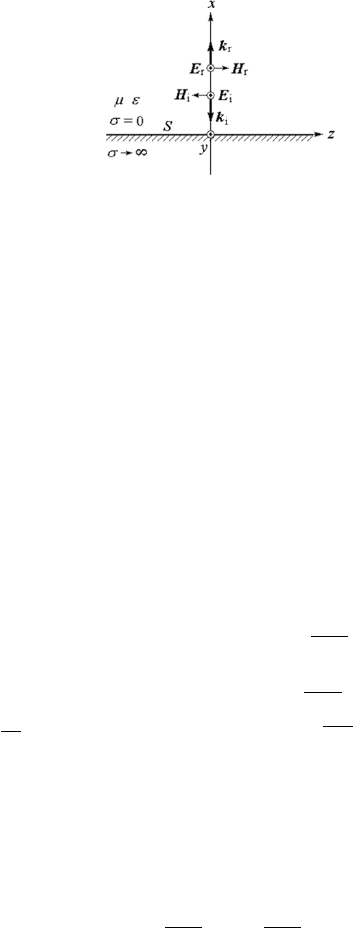
Figure 2.9: Normal incidence and reflection of uniform plane wave at a
perfect-conductor surface.
2.3.1 Normal Incidence and Reflection at a
Perfect-Conductor Surface, Standing Waves
Suppose there is a uniform plane wave incident from medium 1 through a
plane boundary into medium 2. When medium 2 is a perfect conductor, there
is no transmitted wave in it, because both the electric field and the magnetic
field must vanish in a perfect conductor.
The fields of the linearly polarized incident plane wave propagating along
−x and the reflected wave along +x, refer to Fig. 2.9, are given by
E
i
=
ˆ
yE
i
y
=
ˆ
yE
i
y m
e
jkx
e
jωt
, (2.110)
E
r
=
ˆ
yE
r
y
=
ˆ
yE
r
y m
e
−jkx
e
jωt
, (2.111)
H
i
=
ˆ
yH
i
z
=
ˆ
zH
i
zm
e
jkx
e
jωt
= −
ˆ
z
E
i
y m
η
e
jkx
e
jωt
, (2.112)
H
r
=
ˆ
yH
r
z
=
ˆ
zH
r
zm
e
−jkx
e
jωt
=
ˆ
z
E
r
y m
η
e
−jkx
e
jωt
, (2.113)
where k =
√
µ² is the phase coefficient and η =
p
µ/² is the wave impedance
of plane waves in the nonconducting medium 1.
The composed fields can be obtained by adding the incident and the
reflected fields:
E
y
= E
i
y
+ E
r
y
= (E
i
y m
e
jkx
+ E
r
y m
e
−jkx
)e
jωt
, (2.114)
H
z
= H
i
z
+ H
r
z
=
Ã
−
E
i
y m
η
e
jkx
+
E
r
y m
η
e
−jkx
!
e
jωt
. (2.115)
The tangential component of the composed electric field must be zero on
the plane x = 0 to satisfy the boundary condition of the perfect-conductor
surface.
E
y
|
x=0
= 0, E
i
y m
+ E
r
y m
= 0.
78 2. Introduction to Waves
The reflection coefficients of electric field and magnetic field are given by
Γ
E
=
E
r
y m
E
i
y m
= −1, (2.116)
Γ
H
=
H
r
zm
H
i
zm
= −
E
r
y m
E
i
y m
= +1. (2.117)
This means that total reflection occurs on the surface of a perfect-conductor
or short-circuit surface.
The composed fields (2.114) and (2.115) become
E
y
= E
i
y m
(e
jkx
+ e
−jkx
)e
jωt
= 2jE
i
y m
sin kxe
jωt
,
H
z
= −
E
i
y m
η
¡
e
jkx
+ e
−jkx
¢
e
jωt
= −2
E
i
y m
η
cos kxe
jωt
.
Let
E
m
= 2jE
i
y m
,
the composed fields can be rewritten as
E
y
= E
m
sin kxe
jωt
, (2.118)
H
z
= j
E
m
η
cos kxe
jωt
. (2.119)
The corresponding instantaneous values of the fields are
E
y
= =E
y
= =(E
m
sin kxe
jωt
) = E
m
sin kx sin ωt, (2.120)
H
z
= =H
z
= =
µ
j
E
m
η
cos kxe
jωt

=
E
m
η
cos kx cos ωt. (2.121)
Electric and magnetic fields in the form of (2.118) and (2.119) or (2.120)
and (2.121) are standing waves, resulting from the combination of incident
and reflected waves with the same amplitudes. The standing wave does not
travel in any direction, it is just an oscillation with a sinusoidal amplitude
distribution shown in Fig. 2.10.
Define the ratio of the complex amplitude of the electric field and that of
the magnetic field at an arbitrary cross-section x as the input impedance, or
simply, impedance Z(x). From (2.118) and (2.119), we have
Z(x) =
E
y
(x)
H
z
(x)
= jη tan kx = jX(x). (2.122)
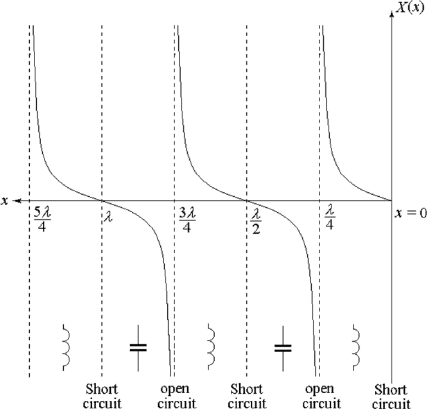
The impedance of a standing wave is reactance, see Fig. 2.11.
We can see from Fig. 2.10 and Fig. 2.11 that when kx = nπ, n = 0, 1, 2, ···
or x = n(λ/2), the amplitude of the electric field is zero and the amplitude
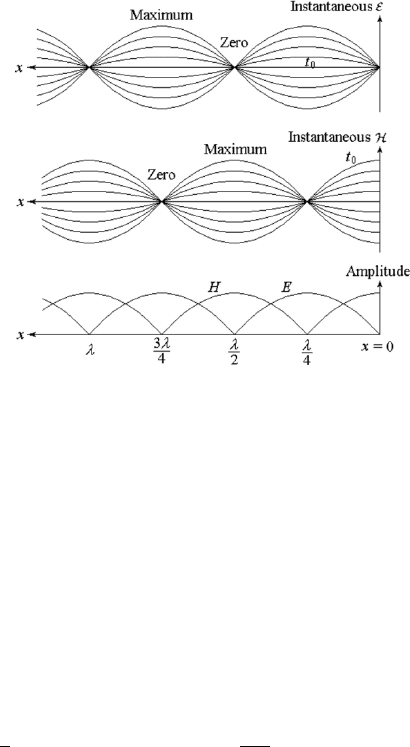
2.3 Normal Reflection and Transmission of Plane Waves 79
Figure 2.10: Electric and magnetic fields of a standing wave.
of magnetic field reaches its maximum, consequently, the input impedance
is zero, i.e., the effective short-circuit. When kx = (n + 1/2)π or x = (n +
1/2)(λ/2), the amplitude of the electric field reaches its maximum and the
amplitude of magnetic field is zero, and the input impedance reaches infinity,
i.e., the effective open-circuit. The distance between the short-circuit and
the open-circuit is λ/4, while the distance between two neighboring short-
circuit or two neighboring open-circuit is λ/2. The impedance between the
short-circuit and the open-circuit is an inductance or a capacitance.
The complex Poynting vector of the standing wave is imaginary,
˙
S =
1
2
E × H
∗
=
ˆ
xE
y
H
z
=
ˆ
x
µ
j
E
2
m
2η
sin kx cos kx

. (2.123)
It means that there is only reactive power flow oscillation and no active power
transmission in the standing wave.
For a clockwise (CW) circularly polarized incident wave along −x, the
incident electric field and the reflected electric field (Γ
E
= −1) are
E
i
= (
ˆ
y + j
ˆ
z)E
i
m
e
jkx
e
jωt
,
E
r
= −(
ˆ
y + j
ˆ
z)E
i
m
e
−jkx
e
jωt
,
The reflected wave is a counterclockwise (CCW) circular polarized wave along
+x.
80 2. Introduction to Waves
Figure 2.11: The input reactance of a standing wave.
The composed field is
E = E
i
+ E
r
= (
ˆ
y + j
ˆ
z)E
i
m
(e
jkx
− e
−jkx
)e
jωt
= (
ˆ
y + j
ˆ
z)2jE
i
m
sin kx e
jωt
= (
ˆ
y + j
ˆ
z)E
m
sin kx e
jωt
. (2.124)
The composed electric field is a rotation vector with its amplitude sinusoidally
distributed along x, i.e., a circularly polarized standing wave. If the incident
wave is elliptically polarized, the composed field will be an elliptically polar-
ized standing wave.
2.3.2 Normal Incidence, Reflection and Transmission at
Nonconducting Dielectric boundary,
Traveling-Standing Waves
Consider a uniform plane wave normally incident from medium 1 through a
plane boundary into medium 2 and the two media are nonconductive with
different constitutional parameters. There are incident wave, reflected wave
in medium 1 and refracted wave in medium 2, see Fig. 2.12.
The fields of incident and reflected waves in medium 1 are given by
E
i
=
ˆ
yE
i
y
=
ˆ
yE
i
y m
e
jk
1
x
e
jωt
, (2.125)
E
r
=
ˆ
yE
r
y
=
ˆ
yE
r
y m
e
−jk
1
x
e
jωt
, (2.126)