
Zhang K., Li D. Electromagnetic Theory for Microwaves and Optoelectronics
Подождите немного. Документ загружается.

2.4 Oblique Reflection and Refraction of Plane Waves 101
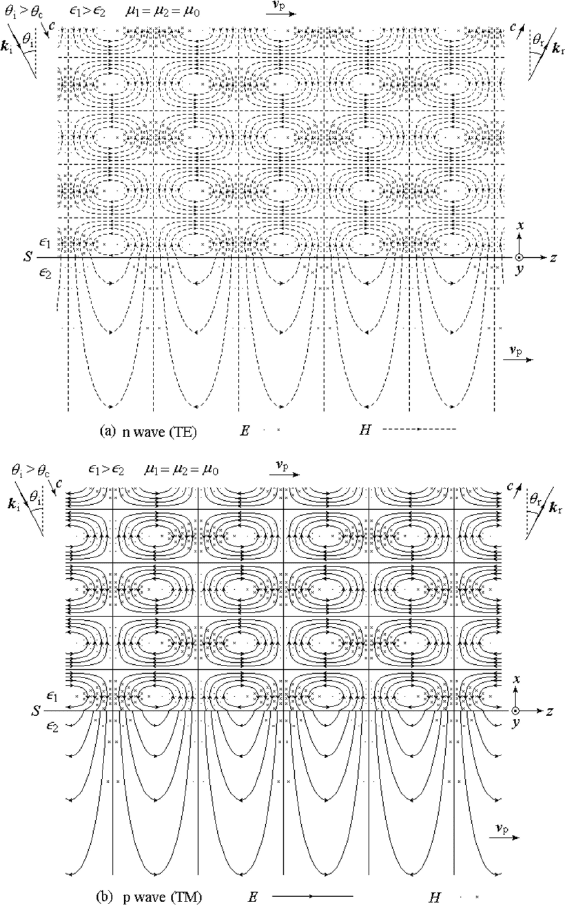
Figure 2.20: Field maps of (a) n wave (TE) and (b) p wave (TM) for total
internal reflection.
102 2. Introduction to Waves
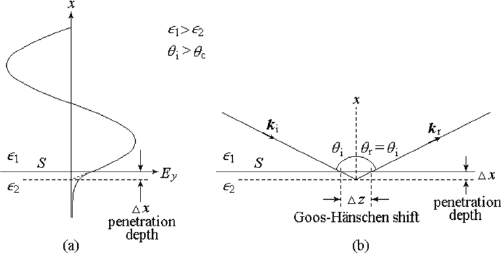
Figure 2.21: The phase shift of the field in total internal reflection at the
dielectric boundary.
2.4.7 The Goos–H¨anchen Shift
Comparing the field expressions in medium 1 for total internal reflection of a
n wave (TE) at the dielectric boundary, (2.231)–(2.233), with those of total
reflection at the perfect conductor surface, (2.165)–(2.167), we can see that
both of them are standing waves in the direction normal to the boundary
and traveling waves in the direction parallel to the boundary. In the case of
total reflection at the perfectly conductor surface, the null of the standing
wave of E is just on the boundary, but in the case of total internal reflection
at the dielectric boundary, the null of the standing wave of E extends into
the region of medium 2, see Fig. 2.21(a).
Kapany and Burke [48] propose that total reflection does not occur at the
material boundary but takes place slightly inside the lower-index medium as
shown in Fig. 2.21(b). This model is consistent with the result of experimen-
tal observation that a thin light beam is shifted laterally on total reflection.
This shift is known as the Goos–H¨anchen shift, after its first observers [48, 69].
2.4.8 Reflection Coefficients at Dielectric Boundary
As a conclusion, we will investigate the reflection coefficients at dielectric
boundary with respect to the angle of incidence.
(1) Medium 2 is Optically Denser than Medium 1, n
2
> n
1
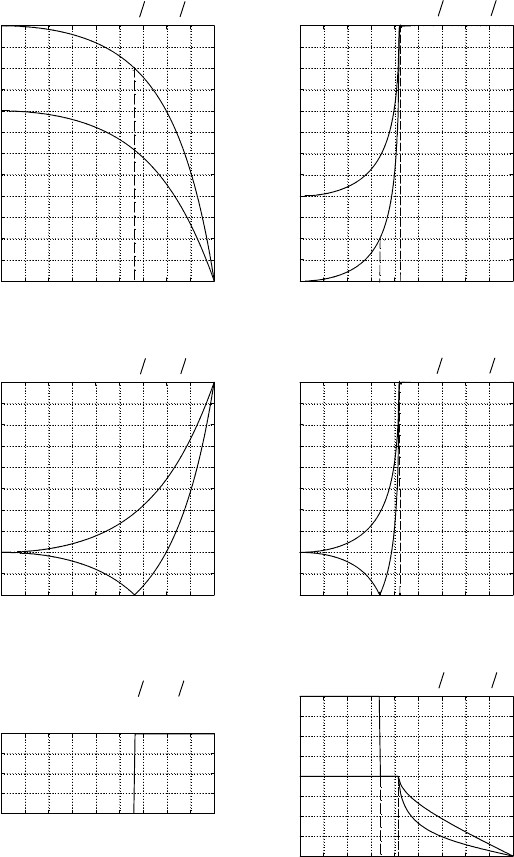
The magnitude and the phase angle of the reflection coefficients with respect
to the angle of incidence for n
2
> n
1
are shown in Fig. 2.22(a).
The phase angle of the reflection coefficient for the n wave (TE) is always
π. On the other hand, the phase angle of the reflection coefficient for the p
wave (TM) is zero when the angle of incidence is less than the Brewster angle,
2.4 Oblique Reflection and Refraction of Plane Waves 103
*
0 10 20 30 40 50 60 70 80 90
-1.0
-.9
-.8
-.7
-.6
-.5
-.4
-.3
-.2
-.1
0.0
.1
.2
T
%
*
p(TM)
n(TE)
0 10 20 30 40 50 60 70 80 90
-.2
-.1
0.0
.1
.2
.3
.4
.5
.6
.7
.8
.9
1.0
p(TM)
n(TE)
0 10 20 30 40 50 60 70 80 90
0
45
90
135
180
0 10 20 30 40 50 60 70 80 90
0.0
.1
.2
.3
.4
.5
.6
.7
.8
.9
1.0
0 10 20 30 40 50 60 70 80 90
-180
-135
-90
-45
0
45
90
135
180
arg(
*
)
o
0 10 20 30 40 50 60 70 80 90
0.0
.1
.2
.3
.4
.5
.6
.7
.8
.9
1.0
T
c
n(TE)
p(TM)
T
%
|
*
|
n(TE)
p(TM)
n(TE)
T
c
T
%
|
*
|
n(TE)
p(TM)
p(TM)
n
1
/n
2
=1.5/1
p(TM)
p(TM)
n(TE)
n(TE)
T
c
T
%
n(TE)
n(TE)
p(TM)
p(TM)
T
%
arg(
*
)
o
(a) n
2
> n
1
(b) n
2
< n
1
p(TM)
$
i
T
$
i
T
$
i
T
$
i
T
$
i
T
$
i
T
5.11
21
nn
5.11
21
nn
5.11
21
nn
15.1
21
nn
15.1
21
nn
15.1
21
nn
T
%
Figure 2.22: Magnitude and phase angle of the reflection coefficients at a
dielectric boundary for n
2
> n
1
(a) and n
2
< n
1
(b).

104 2. Introduction to Waves
θ
i
< θ
B
, and π when the angle of incidence is larger than the Brewster angle,
θ
i
> θ
B
. At the Brewster angle, the magnitude of the reflection coefficient
for the p wave (TM) is zero and the phase angle changes from 0 to π.
The reflection coefficients at θ
i
= 90
◦
for both modes are unity, because
no wave is transmitted into medium 2. The reflection coefficients at θ
i
= 0
for the n wave (TE) and p wave (TM) are equal to each other and equal to
the reflection coefficient of normal incidence.
(2) Medium 2 is Optically Rarer than Medium 1, n
2
< n
1
The magnitude and the phase angle of the reflection coefficients with respect
to the angle of incidence for n
2
< n
1
are shown in Fig. 2.22(b). As θ
i
may
be larger than θ
c
for n
2
< n
1
, the curves shown on the left-hand side of
this figure are different from those shown on the left. The magnitudes of the
reflection coefficients for both modes are unity when the angle of incidence is
larger than the critical angle, and the phase angle change from 0 to −π; the
corresponding φ and ψ change from 0 to π/2.
In general, when a plane wave is obliquely incident upon a boundary, the
polarization states of the reflected and the refracted waves will be different
from that of the incident wave, because the reflection co efficient and the
refraction co efficient are different in magnitude or in phase for n wave (TE)
and p wave (TM).
2.4.9 Reflection and Transmission of Plane Waves at
the Boundary Between Lossless and Lossy Media
In a lossy medium, the permittivity and the angular wave number of the
plane wave become complex:
˙² = ²
0
− j
³
²
00
+
σ
ω
´
,
˙
k = ω
r
µ
h
²
0
− j
³
²
00
+
σ
ω
´i
= β − jα,
where the expressions of β and α are found in (2.54) and (2.55), respectively.
The phase velocity of the plane wave and the index of refraction for the
lossy medium are also complex and can be given by
˙v
p
=
ω
˙
k
=
ω
β − jα
=
1
p
µ [²
0
− j (²
00
+ σ/ω)]
, (2.234)
˙n =
c
˙v
p
=
c
ω
˙
k =
c
ω
(β − jα) = n
0
− jn
00
, (2.235)
where n
0
denotes the refractive index and n
00
denotes the absorption index of
the medium. Using (2.60) and (2.61), we have
n
0
= c
√
µ²
(
1
2
"
r
1 +
(²
00
+ σ/ω)
2
²
02
+ 1
#)
1/2
, (2.236)

2.4 Oblique Reflection and Refraction of Plane Waves 105
n
00
= c
√
µ²
(
1
2
"
r
1 +
(²
00
+ σ/ω)
2
²
02
− 1
#)
1/2
. (2.237)
The wave impedance of the lossy medium also becomes complex, see (2.56).
Substituting the above complex index and complex wave impedance into
the expressions for Snell’s law and Fersnel’s formulas, we have the relation
for the directions for wave vectors and the relation of the amplitudes of the
reflected, refracted, and incident waves when a plane wave is incident on the
surface of lossy media or on the boundary between lossy media [11, 96].
For the reflection and refraction of plane wave on the boundary between
two lossy media, please refer to [11].
(1) Boundary Between a Lossless and a Lossy Media
We are investigating the oblique incidence of a plane wave passing from a
lossless medium, through the boundary, into a lossy medium [5, 11]. The
index of medium 1 is real, n
1
, whereas the index of medium 2 is complex, ˙n
2
.
According to Snell’s law (2.158), we have the sine of the refraction angle,
sin θ
t
=
n
1
˙n
2
sin θ
i
=
n
1
n
0
2
− jn
00
2
sin θ
i
=
k
1
β
2
− jα
2
sin θ
i
. (2.238)
Hence sin θ
t
and θ
t
become complex. Then cos θ
t
becomes
cos θ
t
=
q
1 − sin
2
θ
t
=
s
1 −
µ
n
1
n
0
2
− jn
00
2

2
sin
2
θ
i
=
v
u
u
t
1 −
n
2
1
¡
n
0
2
2
− n
00
2
2
¢
¡
n
0
2
2
+ n
00
2
2
¢
2
sin
2
θ
i
− j
2n
2
1
n
0
2
n
00
2
¡
n
0
2
2
+ n
00
2
2
¢
2
sin
2
θ
i
. (2.239)
So cos θ
t
is also complex and can be written as
cos θ
t
= se
−jξ
= s(cos ξ − j sin ξ). (2.240)
The relation between (2.239) and (2.240) gives
s
2
cos 2ξ =1−
n
2
1
¡
n
0
2
2
− n
00
2
2
¢
¡
n
0
2
2
+ n
00
2
2
¢
2
sin
2
θ
i
, s
2
sin 2ξ =
2n
2
1
n
0
2
n
00
2
¡
n
0
2
2
+ n
00
2
2
¢
2
sin
2
θ
i
. (2.241)
Applying the above results to (2.181) or (2.199), we have the expression
for the refracted electric field:
E
t
(x, t) = E
t
exp{j[ωt −
˙
k
2
(−x cos θ
t
+ z sin θ
t
)]}
= E
t
exp(−jk
1
sin θ
i
z) exp[j(β
2
− jα
2
)s(cos ξ − j sin ξ)z]e
jωt
= E
t
exp[s(α
2
cos ξ + β
2
sin ξ)x]
×exp{j[ωt + s(β
2
cos ξ − α
2
sin ξ)x − k
1
sin θ
i
z]}
= E
t
e
px
exp[j(ωt + q
x
x − q
z
z)], (2.242)
106 2. Introduction to Waves
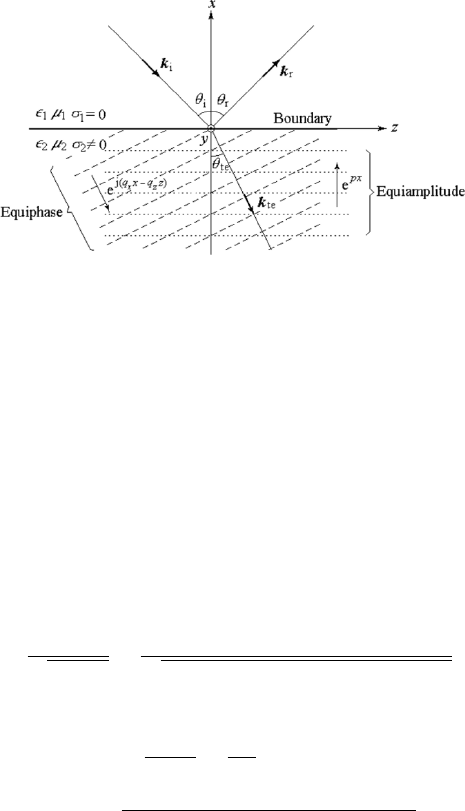
Figure 2.23: Reflection and refraction of a plane wave at the boundary be-
tween a lossless and a lossy medium.
where
p = s(α
2
cos ξ + β
2
sin ξ), q
x
= s(β
2
cos ξ − α
2
sin ξ), q
z
= k
1
sin θ
i
.
The refracted wave becomes a nonuniform plane wave, refer to Fig. 2.23.
The amplitude of the wave attenuates along the −x direction, due to the
conductive and polarization loss, so the equiamplitude is the plane x = const,
but the equiphase is the plane with q
x
x + q
z
z = const. The direction of
the wave vector is normal to the equiphase, so the true angle of refraction,
denoted by θ
te
, becomes
sin θ
te
=
q
z
p
q
2
z
+ q
2
x
=
k
1
sin θ
i
q
k
2
1
sin
2
θ
i
+ s
2
(β
2
cos ξ − α
2
sin ξ)
2
. (2.243)
Snell’s law becomes
sin θ
i
sin θ
te
=
n
2e
n
1
= n
21e
,
where
n
2e
=
q
n
2
1
sin
2
θ
i
+ s
2
(n
0
2
cos ξ − n
00
2
sin ξ)
2
. (2.244)
The effective refractive index n
2e
is not equal to n
0
2
, the real part of the
complex refractive index of medium 2.
(2) Boundary Between a Lossless Medium and a Good Conductor
If medium 2 is a good conductor, σ
2
À ω²
2
, from (2.66), we have, β
2
≈ α
2
À
k
1
. According to (2.238) and (2.243), we have, sin θ
t
≈ 0, and sin θ
te
≈ 0.
This means that the wave transmitted into the good conductor is always
approximately along the direction normal to the surface of the conductor,

2.5 Transformation of Impedance for Electromagnetic Waves 107
regardless of the angle of incidence, and is damped rapidly. So, for electro-
magnetic devices enclosed by good conductors with any geometry, the fields
inside the conductor can always be considered as damped plane waves normal
to the surface of the conductor, and the surface impedance (2.68) and power
loss (2.70) in good conductors for plane waves can be used in most of such
problems.
2.5 Transformation of Impedance for
Electromagnetic Waves
We are interested in the fields in medium 1 for an arbitrary incidence and re-
flection of uniform plan wave on the boundary of the two media, see Fig. 2.24.
Generally, the wave in medium 1 is a traveling-standing wave in the direc-
tion normal to the boundary. The composed tangential electric and magnetic
fields in medium 1 for the n wave (TE mode) can be found by substituting
Γ E
i
y m
for E
r
y m
in (2.179), (2.180), (2.182), and (2.183):
E
y
= E
i
y m
e
−jk
i
·x
+ E
r
y m
e
−jk
r
·x
= E
i
y m
¡
e
jk
x
x
+ Γ
n
e
−jk
x
x
¢
e
−jk
z
z
, (2.245)
H
z
=−
1
Z
TE
1
³
E
i
y m
e
−jk
i
·x
−E
r
y m
e
−jk
r
·x
´
=−
E
i
y m
Z
TE
1
¡
e
jk
x
x
−Γ
n
e
−jk
x
x
¢
e
−jk
z
z
.
(2.246)
Similarly, for the p wave (TM mode), from (2.194), (2.195), (2.197) and
(2.198):
H
y
= H
i
y m
e
−jk
i
·x
+ H
r
y m
e
−jk
r
·x
= H
i
y m
¡
e
jk
x
x
− Γ
p
e
−jk
x
x
¢
e
−jk
z
z
, (2.247)
E
z
=Z
TM
1
³
H
i
y m
e
−jk
i
·x
−H
r
y m
e
−jk
r
·x
´
=Z
TM
1
H
i
y m
¡
e
jk
x
x
+Γ
p
e
−jk
x
x
¢
e
−jk
z
z
,
(2.248)
where k
x
= k
ix
= k
rx
, k
z
= k
iz
= k
rz
. It can be seen that the composed
field is a traveling wave in the direction z, tangential to the boundary, and a
traveling-standing wave in x, the normal direction.
Similar to what we did in Section 2.3.2 for normal incidence, it is conve-
nient to use the concept of impedance at an arbitrary cross section to describe
the relation between incident and reflected waves. Define
Z(x) =
E
⊥
(x)
H
⊥
(x)
, (2.249)
where E
⊥
and H
⊥
denote the field components normal to the direction of
propagation of the traveling-standing wave. For the wave in the −x direction,
they are the field components tangential to the boundary between the media,
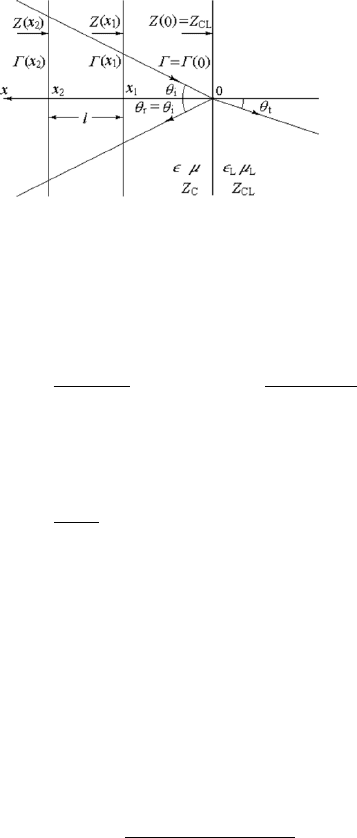
108 2. Introduction to Waves
Figure 2.24: Impedance transformation for electromagnetic waves.
i.e., E
⊥
= E
y
, H
⊥
= −H
z
for the n wave (TE), and E
⊥
= E
z
, H
⊥
= H
y
for
the p wave (TM). Then, from (2.245)–(2.248) we have
Z(x) = Z
C
1 + Γ (x)
1 − Γ (x)
, Γ(x) =
Z(x) − Z
C
Z(x) + Z
C
, (2.250)
where Z
C
is the normal wave impedance, i.e., wave impedance or character-
istic impedance for the n wave (TE) or p wave (TM) for oblique incidence
in medium 1, (2.190),
Z
C
= Z
TE
1
=
η
1
cos θ
i
, or Z
C
= Z
TM
1
= η
1
cos θ
i
,
and Γ (x) is the reflection coefficient in the section x,
Γ (x) = Γ e
−j2k
x
x
and Γ = |Γ |e
−jφ
, (2.251)
where Γ = Γ (0) is the complex reflection coefficient at the boundary, Γ = Γ
n
,
or Γ = Γ
p
, and k
x
= k
1
cos θ
i
= k
1
cos θ
r
.
The relation between the reflection coefficients at two sections x
1
and x
2
is
Γ (x
2
) = Γ (x
1
)e
−j2k
x
(x
2
−x
1
)
= Γ (x
1
)e
−j2k
x
l
, (2.252)
where l = x
2
− x
1
, refer to Fig. 2.24. The transformation relation for the
impedances with two sections x
1
and x
2
becomes
Z(x
2
) = Z
C
Z(x
1
) + jZ
C
tan k
x
l
Z
C
+ jZ(x
1
) tan k
x
l
. (2.253)
This is just the impedance transformation formula in transmission-line the-
ory.
The composed tangential electric and magnetic fields for n wave (2.245),
(2.246) and those for p wave (2.247), (2.248) can be rewrite as the general
form of traveling-standing waves in the direction x,
E
⊥
= E
m
¡
e
jk
x
x
+ Γ e
−jk
x
x
¢
e
jωt
= E
m
h
1 + |Γ |e
j(φ−2k
x
x)
i
e
j(ωt+k
x
x)
,
(2.254)

2.6 Dielectric Layers and Impedance Transducers 109
H
⊥
=
E
m
η
¡
e
jk
x
x
− Γ e
−jk
x
x
¢
e
jωt
=
E
m
η
h
1 − |Γ |e
j(φ−2k
x
x)
i
e
j(ωt+k
x
x)
.
(2.255)
The amplitudes of the electric and magnetic fields are:
|E
⊥
| = E
m
p
1 + |Γ |
2
+ 2|Γ |cos(φ − 2k
x
x), (2.256)
|H
⊥
| =
E
m
η
p
1 + |Γ |
2
− 2|Γ |cos(φ − 2k
x
x). (2.257)
In general, the fields are traveling-standing waves. If Γ = 0, they become
traveling waves and if Γ = ±1, they become standing waves.
For θ
i
= 0, the relations (2.250)–(2.257) reduce the corresponding formu-
las (2.135)–(2.139) in Section 2.3.2 for plane waves normally incident at the
boundary.
The transformation relations for the impedance and reflection coefficients
of plane waves are totally consistent with those in transmission-line theory,
see Section 3.2.1.
2.6 Dielectric Layers and
Impedance Transducers
The characteristics of the reflection and transmission of electromagnetic
waves at the surface of multi-layer media are important in many applica-
tions, such as the anti-reflecting and highly reflecting coatings in optics and
the concealment of targets in radar technology. From the view of networks,
the multi-layer coating is equivalent to the impedance transducer consists of
multi-section transmission lines or waveguides with different characteristic
impedances.
2.6.1 Single Dielectric Layer,
The λ/4 Impedance Transducer
The reflection of a plane wave from a boundary of two media with different
wave impedance η
1
and η
2
may be eliminated by coating the b oundary with
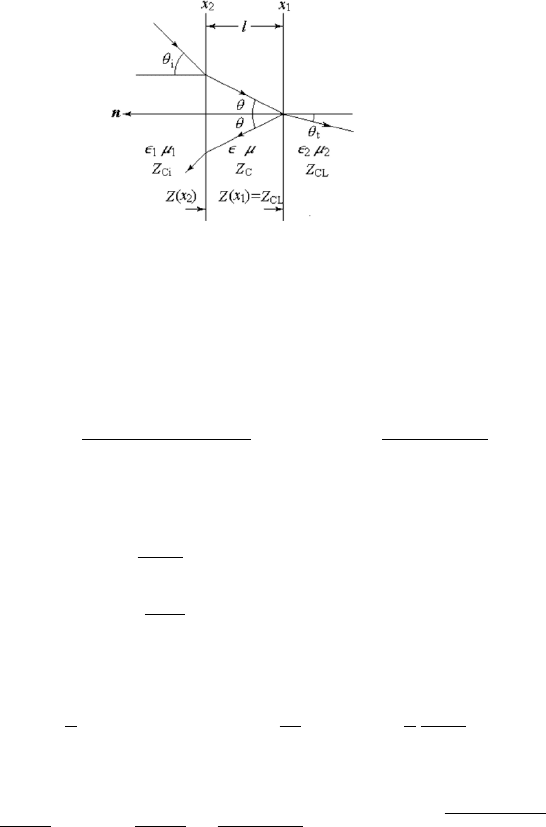
a intermediate layer with wave impedance η and thickness l. The incident
plane wave from the input medium, with the angle of incidence θ
i
produces
transmitted waves in the intermediate medium and the output medium with
the angles of refraction θ and θ
t
, respectively, and produces reflection waves
at the boundaries, as illustrated in Fig. 2.25.
The input impedance at the surface of the output medium Z(x
1
) is the
normal wave impedance of the output medium, given by (2.190) for n wave
(TE) or (2.205) for p wave (TM):
Z(x
1
) = Z
CL
=
η
2
cos θ
t
, or Z(x
1
) = Z
CL
= η
2
cos θ
i
.
110 2. Introduction to Waves
Figure 2.25: Single dielectric layer.
The input impedance and the reflection coefficient at the surface of the
intermediate medium Z(x
2
) and Γ (x
2
) is given by the impedance transfor-
mation relation (2.253) and (2.250)
Z(x
2
) = Z
C
Z(x
1
) + jZ
C
tan k
x
l
Z
C
+ jZ(x
1
) tan k
x
l
, Γ (x
2
) =
Z(x
2
) − Z
Ci
Z(x
2
) + Z
Ci
,
where Z
Ci
denotes the normal wave impedance of the input medium and Z
C
denotes the normal wave impedance of the intermediate medium.
Z
Ci
= Z
TE
1
=
η
1
cos θ
i
, or Z
Ci
= Z
TM
1
= η
1
cos θ
t
Z
C
= Z
TE
=
η
cos θ
, or Z
C
= Z
TM
= η cos θ,
If we make the thickness of the intermediate medium equal to an odd
number of quarter normal wavelengths, so that
k
x
l = (2n + 1)
π
2
, i.e., l = (2n + 1)
λ
x
4
= (2n + 1)
λ
4
1
cos θ
i
, (2.258)
then the impedance transformation relation becomes
Z(x
2
) =
Z
2
C
Z(x
1
)
, i.e.,
Z(x
2
)
Z
C
=
1
Z(x
1
)/Z
C
, or Z
C
=
p
Z(x
2
)Z(x
1
).
(2.259)
The normalized impedance at x
1
, Z(x
1
)/Z
C
, and at x
2
, Z(x
2
)/Z
C
, are re-
ciprocal with each other, We come to the conclusion that the characteristic
impedance of a quarter wavelength intermediate layer is equal to the geomet-
rical mean of its input impedance and output impedance.
If we make the normal wave impedance of the intermediate medium equal
to the geometrical mean of the normal wave impedance of the input and
output media
Z
2
C
= Z
Ci
Z
CL
, (2.260)