
Zhang K., Li D. Electromagnetic Theory for Microwaves and Optoelectronics
Подождите немного. Документ загружается.

2.1 Sinusoidal Uniform Plane Waves 61
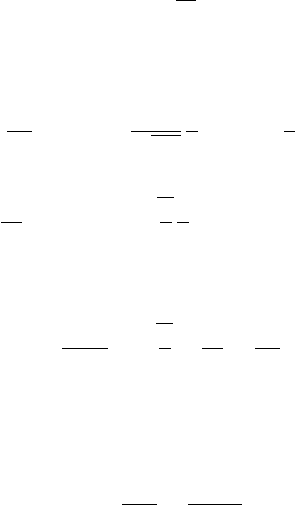
Maxwell’s equations (2.3) – (2.6) for uniform plane waves become
jk × E
+
= j ωµH
+
, (2.31)
jk × H
+
= −j ω²E
+
, (2.32)
jk · E
+
= 0, (2.33)
jk · H
+
= 0. (2.34)
It can be seen that in a uniform plane wave with an arbitrary direction of
propagation, E and H are both perpendicular to the direction of propagation
k, and E and H are perpendicular to each other. So a uniform plane wave
is a kind of transverse electric-magnetic wave, or simply a TEM wave.
multiplying (2.31) by −jk, substituting (2.32) in the right-hand side and
applying (B.30), (2.33), yields
k
2
E
+
= ω
2
µ²E
+
, (2.35)
k
2
H
+
= ω
2
µ²H
+
. (2.36)
These are Helmholtz’s equations for uniform plane waves, which can also be
obtained by applying (2.30) to general vector Helmholtz’s equations (2.1) and
(2.2).
The magnitude of the wave vector k is given by
k = ω
√
µ², (2.37)
which is just the angular wave number of the unbounded medium.
From equation (2.31) and (2.32) we have
H
+
=
1
ωµ
k × E
+
=
1
p
µ/²
k
k
× E
+
=
1
η
n × E
+
(2.38)
and
E
+
= −
1
ω²
k × H
+
= −
r
µ
²
k
k
× H
+
= −η n × H
+
. (2.39)
The ratio of the complex amplitude of the electric field to that of the magnetic
field is equal to the wave impedance:
η =
|E
+
|
|H
+
|
=
r
µ
²
=
k
ω²
=
ωµ
k
. (2.40)
Note that for a plane wave in a lossless simple medium, the wave impedance
is a real constant: the electric field and the magnetic field are in phase.
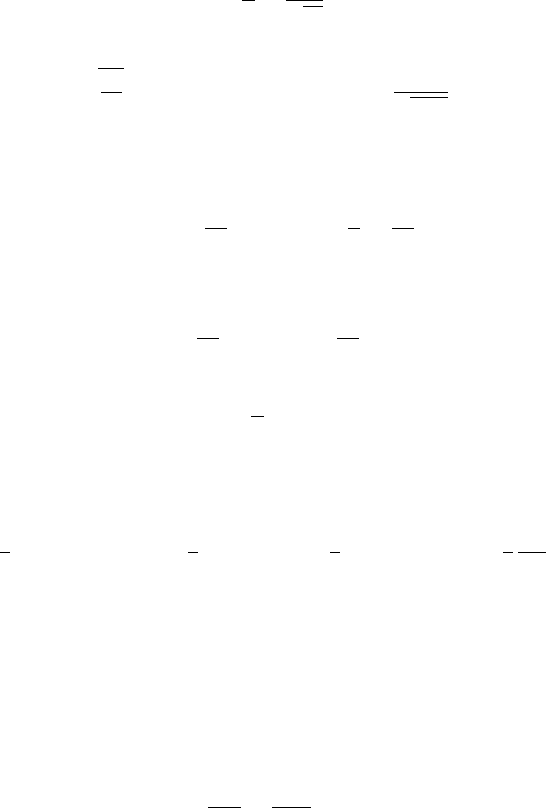
From (2.22), we have the phase velocity of a plane wave in an arbitrary
direction x:
v
px
=
d|x|
dt
=
ω
k cos θ
, (2.41)
62 2. Introduction to Waves
where θ denotes the angle between x and the wave vector k. Let θ = 0, we
then have the phase velocity in the direction of wave vector:
v
p
=
ω
k
=
1
√
µ²
. (2.42)
In vacuum,
η
0
=
r
µ
0
²
0
≈ 120π ≈ 377 Ω, v
p
=
1
√
µ
0
²
0
= c, (2.43)
where η
0
and c are two universal physical constants.
The time parameters of a wave are the circular or angular frequency ω,
the time period T , and the frequency f, and the relations among them are
ω = 2πf =
2π
T
, T =
1
f
=
2π
ω
. (2.44)
The space parameters of a wave are the angular wave number k, the
wavelength λ, and the wave number 1/λ, and the relations among them are
k =
2π
λ
, λ =
2π
k
. (2.45)
The connection between time and space is the phase velocity:
v
p
=
ω
k
= λf. (2.46)
Substituting (2.24) and (2.38) into the definition of the Poynting vector,
and applying the formula for a triple vector product (B.30) and equation
(2.33), we have the complex power flow density in the plane wave:
˙
S =
1
2
E
+
(x) × H
∗
+
(x) =
1
2
E
+
e
−jk·x
×
µ
1
η
n × E
+
e
jk·x

=
1
2
E
2
+
η
n.
(2.47)
This shows that in a simple medium the direction of power flow is the same
as the direction of the wave vector. In a lossless medium, the Poynting vector
is real and the time-average power flow density is independent of time and
the distance of propagation, which means that
∇ ·
˙
S = 0.
From the complex Poynting theorem (and note that σ = 0, J = 0) we
have
²E
2
2
=
µH
2
2
. (2.48)
For a uniform plane wave in a lossless simple medium, the time-average elec-
tric energy density is equal to the time-average magnetic energy density.
They are both independent of time and the coordinates. The wave propa-
gates without damping, i.e., persistent wave.
The instantaneous power flow density and the instantaneous energy den-
sities for a linear polarized uniform plane wave are alternate with frequency
2ω with respect to time and distance of propagation, refer to Problem 2.1.

2.1 Sinusoidal Uniform Plane Waves 63
2.1.3 Plane Waves in Lossy Media, Damped Waves
Except for a vacuum, all media have losses, including conductive loss or Joule
loss and dielectric loss or polarization loss. The complex permittivity of a
lossy medium was given in (1.96) as follows:
˙²(ω) = ²
0
(ω) − j
h
²
00
(ω) +
σ
ω
i
. (2.49)
When σ/ω ¿ ²
0
and ²
00
¿ ²
0
, the losses can be neglected and the medium is
identified as a lossless medium. The magnetization loss is not considered in
this section, but it can be added in if necessary.
In lossy media, the complex wave equations (1.156) and (1.157) become
∇
2
E + ω
2
µ
n
²
0
(ω) − j
h
²
00
(ω) +
σ
ω
io
E = 0, (2.50)
∇
2
H + ω
2
µ
n
²
0
(ω) − j
h
²
00
(ω) +
σ
ω
io
H = 0. (2.51)
These are also Helmholtz’s equations and the solutions for uniform plane
waves are similar to those for lossless media (2.18) and (2.19), but the phase
coefficient becomes complex,
˙
k = ω
r
µ
³
˙² − j
σ
ω
´
= ω
r
µ
h
²
0
− j
³
²
00
+
σ
ω
´i
. (2.52)
Let
˙
k = β − jα , or ˙γ = j
˙
k = α + jβ, (2.53)
where γ denotes the propagation coefficient, α denotes the attenuation co-
efficient in nepers per meter (Np/m) and β denotes the phase coefficient in
radians per meter (rad/m). The relation between neper (Np) and decibel
(dB) is 1 Np = 8.686 dB.
From (2.53) and (2.52), we have
k
2
= (β
2
− α
2
) − j2αβ = ω
2
µ²
0
− jω
2
µ
³
²
00
+
σ
ω
´
.
The real parts and the imaginary parts must be equal separately,
β
2
− α
2
= ω
2
µ²
0
, 2αβ = ω
2
µ
³
²
00
+
σ
ω
´
,
and we have
β = ω
p
µ²
0
(
1
2
"
r
1 +
(²
00
+ σ/ω)
2
²
02
+ 1
#)
1/2
, (2.54)
α = ω
p
µ²
0
(
1
2
"
r
1 +
(²
00
+ σ/ω)
2
²
02
− 1
#)
1/2
. (2.55)
64 2. Introduction to Waves
This shows that the polarization loss and conductive loss not only introduce
attenuation but also change the phase coefficient of the wave.
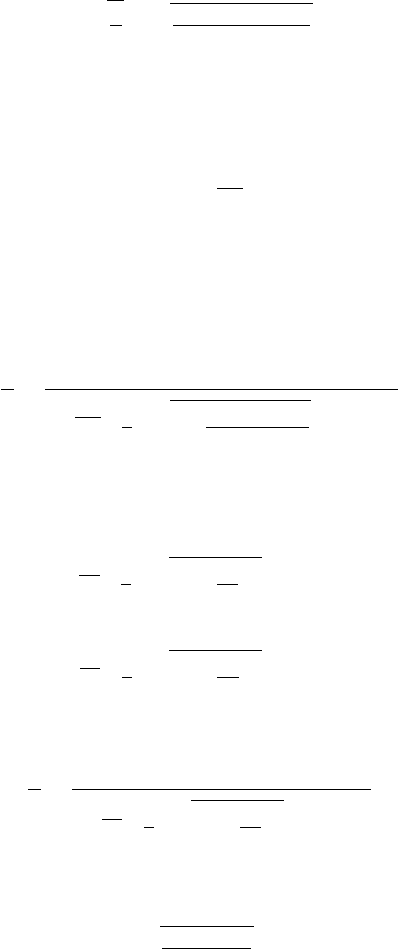
In lossy media, the wave impedance becomes complex as well,
˙η =
r
µ
˙²
=
r
µ
²
0
− j(²
00
+ σ/ω)
. (2.56)
The fields of a wave traveling in the +z direction become
E
+
(z) = E
0
e
− ˙γz
= E
0
e
−αz
e
−jβz
, (2.57)
H
+
(z) = H
0
e
− ˙γz
=
E
0
˙η
e
−αz
e
−jβz
. (2.58)
Thus the losses in a medium give rise to exponential decaying of the fields in
the direction of wave propagation, and the electric and magnetic fields are
no longer in phase. This kind of wave is called a damped wave.
The quantity δ = 1/α is the penetration depth or the skin depth over
which the amplitude of the field decreases by a factor of 1/e ≈ 0.369,
δ =
1
α
=
1
ω
√
µ²
0
(
1
2
"
r
1 +
(²
00
+ σ/ω)
2
²
02
− 1
#)
1/2
. (2.59)
If the medium is conductive and the polarization loss is negligibly small,
σ/ω À ²
00
, ˙² ≈ ²
0
= ², (2.54) and (2.55) become
β = ω
√
µ²
(
1
2
"
r
1 +
³
σ
ω²
´
2
+ 1
#)
1/2
, (2.60)
α = ω
√
µ²
(
1
2
"
r
1 +
³
σ
ω²
´
2
− 1
#)
1/2
. (2.61)
The skin depth (2.59) becomes
δ =
1
α
=
1
ω
√
µ²
(
1
2
"
r
1 +
³
σ
ω²
´
2
− 1
#)
1/2
. (2.62)
The wave impedance (2.56) becomes
˙η =
r
µ
² − j(σ/ω)
. (2.63)
2.1 Sinusoidal Uniform Plane Waves 65
(1) Low-Loss Conductive Media
For the medium with low conductivity, and in a relatively high frequency
range, the conductive current is much less than the displacement current,
σ/ω² ¿ 1, so (2.60), (2.61), (2.62) and (2.63) reduce to
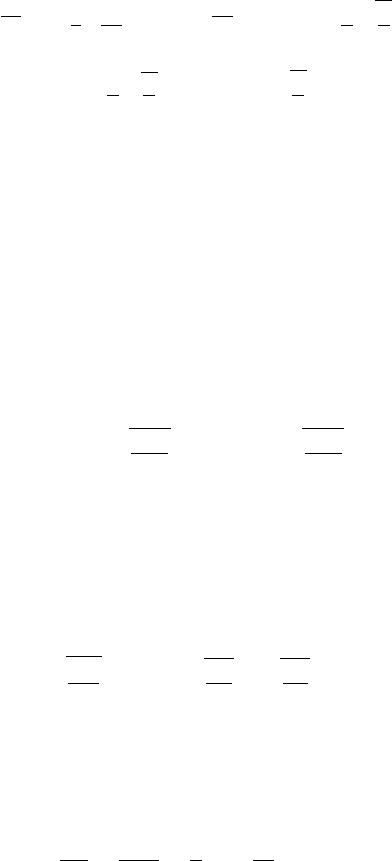
β ≈ ω
√
µ²
·
1 +
1
8
³
σ
ω²
´
2
¸
≈ ω
√
µ² α ≈
σ
2
r
µ
²
, (2.64)
δ ≈
2
σ
r
²
µ
, η ≈
r
µ
²
. (2.65)
In such media the conductivity hardly affects the phase coefficient and wave
impedance, but it gives rise to an attenuation that is independent of frequency
and α ¿ β.
(2) Good Conductors
When the conductivity of a medium is rather high and the frequency is
relatively low, the conductive current is much larger than the displacement
current. Such a medium is identified as a good conductor and gives σ/ω² À 1.
In good conductors, equations (2.50) and (2.51) become diffusion equations,
the phase and attenuation coefficients (2.60) and (2.61) and the skin depth
(2.62) reduce to
β ≈ α ≈
r
ωµσ
2
, δ ≈
r
2
ωµσ
. (2.66)
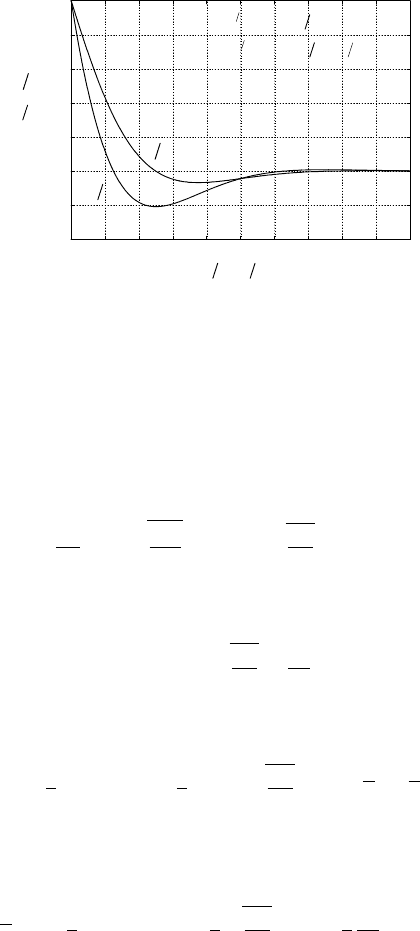
The attenuation coefficient in good conductors is very large and equals the
phase coefficient. At a distance of about λ/6, i.e., the phase shift of 1 rad, the
amplitude of the field is attenuated to 1/e of the original value, or attenuated
to 1/e
2π
≈ 1/534 in one wavelength, see Fig. 2.4. For example, the skin depth
of copper is about 8.5 mm at 60 Hz and 1 µm at 3 GHz.
The wave impedance (2.63) reduces to
˙η =
r
jωµ
σ
= (1 + j)
r
ωµ
2σ
=
r
ωµ
σ
e
j(π/ 4)
. (2.67)
In good conductors, the phase difference between the electric and magnetic
fields is π/4.
In conductors, the electric energy density is no longer equal to the mag-
netic energy density; the ratio of w
e
to w
m
is given by
w
e
w
m
=
²E
2
µH
2
=
²
µ
η
2
=
ω²
σ
¿ 1,
which means that in good conductors, the magnetic field is dominant in the
wave.
66 2. Introduction to Waves
0.0 .1 .2 .3 .4 .5 .6 .7 .8 .9 1.0
-.4
-.2
0.0
.2
.4
.6
.8
1.0
GO
±2zz
m
EE
m
HH
GZ
G
ztEE cose
z-
m
4±cose
z-
m
GZ
G
ztHH
m
EE
m
HH
Figure 2.4: Fields of a damped plane wave in a good conductor.
The tangential components of the electric and magnetic fields are contin-
uous across the boundary of a conductor, because there is no surface current.
The ratio of the tangential component of the electric field to that of the mag-
netic field just outside a conductor is still equal to the wave impedance of
the conductor (2.67):
Z
s
=
E
t
H
t
¯
¯
¯
¯
S
=
r
jωµ
σ
= (1 + j)
r
ωµ
2σ
= R
s
+ jX
s
, (2.68)
where Z
s
denotes the surface impedance of the good conductor, and
R
s
= X
s
=
r
ωµ
2σ
=
1
σδ
.
The complex Poynting vector of the wave in a good conductor is given by
˙
S =
1
2
E
+
× H
∗
+
=
1
2
(1 + j)
r
ωµ
2σ
H
2
t
n = p + j q, (2.69)
where n is the unit vector of the wave vector k. The real part represents the
average power-flow density entering into the conductor:
p = <
³
1
2
E
+
× H
∗
+
´
=
1
2
r
ωµ
2σ
H
2
t
n =
1
2
1
σδ
H
2
t
n. (2.70)
This is the power dissipation in a unit area on the surface of a good conductor.
It can be shown that it is equal to the Joule loss in a semi-infinite conducting
cylinder of unit cross section. We leave the proof of this relation as an
exercise, see Problem 2.6.
2.2 Polarization of Plane Waves 67
(3) Perfect Conductors
In the electrostatic equilibrium state the electric field inside a conductor
is always zero. In a time-varying state, the electric and magnetic fields in
a conductor are not zero but are damped waves. The exceptional case is
that in which the conductivity approaches infinity, σ → ∞, such that the
skin depth approaches zero, δ → 0, i.e., the field and current concentrate in a
infinitesimal depth on the surface of the conductor and cannot penetrate into
the conductor. The above approximation is said to be a perfect conductor.
The surface impedance (2.68) of a perfect conductor approaches zero,
as does the tangential component of the electric field at the surface. The
tangential component of the magnetic field at the surface is equal to the
surface current density. This conclusion is just the boundary condition of the
short-circuit surface, given in Section 1.2.2:
n × E|
S
= 0, n × H|
S
= J
s
.
At the surface of a perfect conductor, the normal component of the Poynting
vector is zero, so there is no power loss in the perfect conductor.
Note that the perfect conductor is not identical to a superconductor, the
superconductor is a kind of specific material but the perfect conductor is only
an approximation of good conductors for simplifying the analysis in certain
conditions. However, the sup er conductor is the b est perfect conductor.
The concept of perfect conductors is successfully used in the analysis of
electromagnetic waves with conducting boundaries when the power loss on
the conductor surface is allowed to be negligible.
2.2 Polarization of Plane Waves
In the above section, the plane wave with a specific fixed orientation of the
field vector was presented. Since the wave equation is a linear equation, the
sum of solutions is also a solution to it. Many complex electromagnetic waves
may be considered as made up of a large number of simple plane waves with
different magnitudes, frequencies, phases, orientations of the field vector, and
directions of propagation.
In this section, we will discuss the combination of plane waves with the
same direction of propagation. The orientation of the field vector of the
combined wave is not necessarily fixed. The states of the field vectors of these
waves are described by the polarization of the wave, which is designated as
the projection of the locus of the terminus of the instantaneous field vector
on the wave front, i.e., the plane normal to the direction of propagation.
For the plane wave presented in the above section, the electric field vec-
tor always lies in a given direction; it is said to be a linearly polarized or,
sometimes, plane polarized wave. The general form of the polarized wave is

68 2. Introduction to Waves
elliptic polarization; in special cases, it becomes linear polarization or circular
polarization.
For radio waves, including microwaves, it is common to describe the po-
larization by the orientations of the electric field vector, but in optics, people
usually utilizes the magnetic field vector to define the plane of polarization.
In this text, we use the former description.
2.2.1 Combination of Two Mutually Perpendicular
Linearly Polarized Waves
An arbitrary polarized electromagnetic wave can be explained by the sum of
two mutually p erpendicular linearly polarized waves with the same frequency
and the same propagation coefficient but different amplitudes and different
phase angles.
(1) General Formulation
Suppose that the electric field of a plane wave is the sum of vectors E
x
and
E
y
:
E =
ˆ
xE
x
+
ˆ
yE
y
=
¡
ˆ
xE
xm
e
jδ
x
+
ˆ
yE
y m
e
jδ
y
¢
e
j(ωt−kz)
, (2.71)
where δ
x
and δ
y
are the phase angels of E
x
and E
y
, respectively, and the
phase difference is
∆ = δ
y
− δ
x
. (2.72)
The combined magnetic field becomes
H =
ˆ
yH
y
+
ˆ
xH
x
=
ˆ
y
E
x
η
−
ˆ
x
E
y
η
=
µ
ˆ
y
E
xm
η
e
jδ
x
−
ˆ
x
E
y m
η
e
jδ
y

e
j(ωt−kz)
.
(2.73)
Let τ = ωt − kz and rewrite the two components of the electric field in
instantaneous form:
E
x
= E
xm
sin(τ + δ
x
), E
y
= E
y m
sin(τ + δ
y
). (2.74)
These are the parametric equations for an ellipse. It means that the combined
electric field vector rotates and the terminus of it traces an elliptic path in a
plane normal to the direction of propagation.
The field vector of a elliptically polarized wave rotates during the propa-
gation. The direction of the rotation depends upon the phase relation of the
two field components. When an observer who transmits the wave, i.e., who
looks in the direction of propagation, the field vector rotates in a clockwise
sense if δ
y
< δ
x
and ∆ is negative, and the field vector rotates in a coun-
terclockwise sense if δ
y
> δ
x
and ∆ is positive. These are a clockwise (CW)
polarized wave and a counterclockwise (CCW) polarized wave, respectively.
Sometimes, they are called right-handed and left-handed waves instead. Most
2.2 Polarization of Plane Waves 69
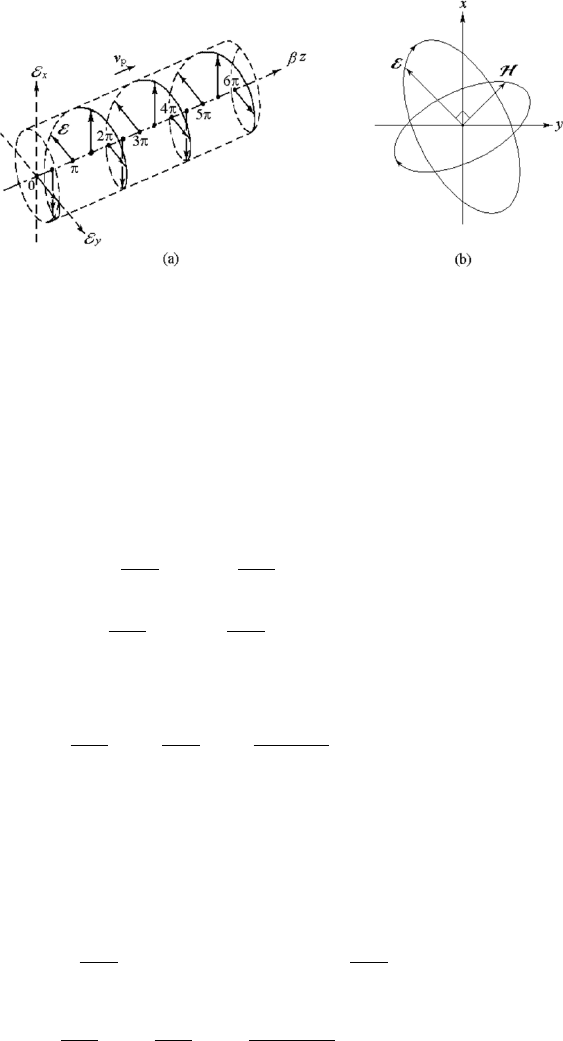
Figure 2.5: An elliptically polarized plane wave.
literatures on electromagnetic waves or so called radio waves describe the di-
rection of the rotation in such a way.
In some literatures, especially in texts and papers on optics, the direction
of the rotation is determined by an observer who receives the wave, i.e., one
who looks in a direction opposite to the direction of propagation, and the
CW and CCW are exchanged.
From equations (2.74), and applying (2.72), yields
E
x
E
xm
sin δ
y
−
E
y
E
y m
sin δ
x
= sin τ sin ∆,
E
x
E
xm
cos δ
y
−
E
y
E
y m
cos δ
x
= −cos τ sin ∆.
Taking the sum of the square of the above two expressions, canceling τ
in it, gives
1
E
2
xm
E
2
x
+
1
E
2
y m
E
2
y
−
2 cos ∆
E
xm
E
y m
E
x
E
y
− sin
2
∆ = 0. (2.75)
This is the equation of an ellipse. The ellipse is internally tangential to a
rectangle with sides 2E
xm
and 2E
y m
. The locus of the terminus of the electric
field with respect to time and space is an elliptic helix, see Fig. 2.5(a). This
is the reason for the name elliptic polarization. Elliptical polarization is the
general form of polarized waves.
For the magnetic field we have the similar expressions
H
y
=
E
xm
η
sin(τ + δ
x
), H
x
= −
E
y m
η
sin(τ + δ
y
), (2.76)
and
η
2
E
2
y m
H
2
x
+
η
2
E
2
xm
H
2
y
+
2 η
2
cos ∆
E
xm
E
y m
H
x
H
y
− sin
2
∆ = 0. (2.77)
70 2. Introduction to Waves
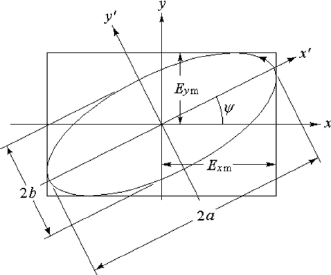
Figure 2.6: Combination of two mutually perpendicular linearly polarized
waves.
The terminus of the magnetic field vector traces an elliptical path perpen-
dicular to the ellipse traced by the terminus of the electric field vector in the
same plane and rotates in the same sense, see Fig. 2.5(b).
In general, the trace is an inclined ellipse with respect to the x,y coordi-
nates. The semi-major axis and semi-minor axis and the orientation of the
ellipse are given as follows.
Suppose that the two principle axes of the ellipse are 2a and 2b. Place
new coordinates x
0
,y
0
, such that x
0
is in the direction of 2a and y
0
is in the
direction of 2b. The angle between x
0
and x is denoted as ψ and is called
the orientation angle of the ellipse, see Fig. 2.6. The two components of the
electric field in the new x
0
,y
0
coordinates are E
x
0
and E
y
0
:
E
x
0
= E
x
cos ψ + E
y
sin ψ, E
y
0
= −E
x
sin ψ + E
y
cos ψ. (2.78)
In x
0
,y
0
coordinates, the parametric equations of the ellipse are
E
x
0
= a sin(τ + θ), E
y
0
= ±b cos(τ + θ), (2.79)
where θ is an arbitrary phase angle of the fields and the signs + and −
correspond to CCW and CW, respectively.
(2) Relations Between E
xm
, E
y m
, ∆ and a, b, ψ
Substituting (2.74) and (2.79) into (2.78) yields
a (sin τ cos θ + cos τ sin θ) = E
xm
(sin τ cos δ
x
+ cos τ sin δ
x
) cos ψ
+ E
y m
(sin τ cos δ
y
+ cos τ sin δ
y
) sin ψ,
±b (cos τ cos θ + sin τ sin θ) = − E
xm
(sin τ cos δ
x
+ cos τ sin δ
x
) sin ψ
+ E
y m
(sin τ cos δ
y
+ cos τ sin δ
y
) cos ψ.