
Zhang K., Li D. Electromagnetic Theory for Microwaves and Optoelectronics
Подождите немного. Документ загружается.

2.4 Oblique Reflection and Refraction of Plane Waves 91
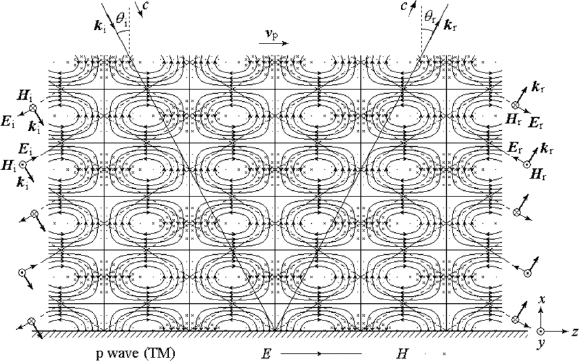
Figure 2.17: Field maps of the p wave (TM mode) for the total reflection
from the surface of a perfect conductor.
But we cannot put two parallel perfect-conductor planes perpendicular
to y without influence on the wave propagation, because the electric field is
parallel to those planes, i.e., the boundary conditions for a perfect-conductor
surface is not satisfied at such planes. This means that the TM
n0
modes
cannot exist in the rectangular waveguide.
2.4.3 Fresnel’s Law, Reflection and Refraction
Coefficients
A uniform plane wave obliquely incident at a nonconducting dielectric bound-
ary gives rise to both a reflected wave and a refracted wave. The relations
among the directions of propagation of the three waves are given by the
Snell’s law. Now we are going to give the relations among the amplitudes
and phases of the three waves, i.e., the Fresenel’s law. The n wave and the
p wave will be investigated separately.
(1) The n Wave or TE Mode
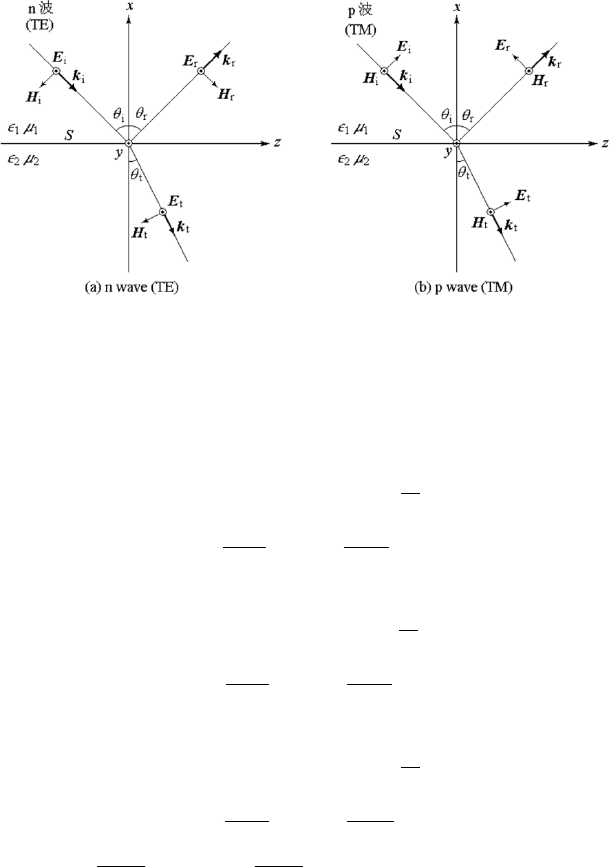
The electric field of the n wave (TE mode) has only y component, normal
to the x,z plane, see Fig. 2.18(a). The field components of the incident, the
reflected and the refracted waves can be given by (2.24) as follows,
E
i
(x) =
ˆ
yE
i
y
(x) =
ˆ
yE
i
y m
e
−jk
i
·x
, (2.179)
E
r
(x) =
ˆ
yE
r
y
(x) =
ˆ
yE
r
y m
e
−jk
r
·x
, (2.180)
92 2. Introduction to Waves
Figure 2.18: Fields of incident, reflected, and refracted waves.
E
t
(x) =
ˆ
yE
t
y
(x) =
ˆ
yE
t
y m
e
−jk
t
·x
. (2.181)
The Magnetic fields can be given by (2.38):
H
i
(x) =
¡
ˆ
xH
i
xm
+
ˆ
zH
i
zm
¢
e
−jk
i
·x
=
1
η
1
ˆ
k
i
×E
i
(x)
=
µ
−
ˆ
x
sin θ
i
η
1
E
i
y m
−
ˆ
z
cos θ
i
η
1
E
i
y m

e
−jk
i
·x
, (2.182)
H
r
(x) = (
ˆ
xH
r
xm
+
ˆ
zH
r
zm
)e
−jk
r
·x
=
1
η
1
ˆ
k
r
×E
r
(x)
=
µ
−
ˆ
x
sin θ
i
η
1
E
r
y m
+
ˆ
z
cos θ
i
η
1
E
r
y m

e
−jk
r
·x
, (2.183)
H
t
(x) =
¡
ˆ
xH
t
xm
+
ˆ
zH
t
zm
¢
e
−jk
t
·x
=
1
η
2
ˆ
k
r
×E
t
(x)
=
µ
−
ˆ
x
sin θ
t
η
2
E
t
y m
−
ˆ
z
cos θ
t
η
2
E
t
y m

e
−jk
t
·x
, (2.184)
where η
1
=
p
µ
1
/²
1
and η
2
=
p
µ
2
/²
2
denote the wave impedances of media
1 and 2, respectively.
On the boundary of the two media, the tangential comp onents of the
composed electric and magnetic fields of the incident and reflected waves
in medium 1 and the tangential components of the electric and magnetic
fields of the refracted wave in medium 2 must be continuous. The boundary
equations are given by
n ×
¡
E
i
+ E
r
¢
¯
¯
x=0
= n × E
t
, (2.185)

2.4 Oblique Reflection and Refraction of Plane Waves 93
n ×
¡
H
i
+ H
r
¢
¯
¯
x=0
= n × H
t
, (2.186)
which gives
E
i
y m
+ E
r
y m
= E
t
y m
, (2.187)
H
i
zm
+ H
r
zm
= H
t
zm
, i.e.,
cos θ
i
η
1
E
i
y m
−
cos θ
i
η
1
E
r
y m
=
cos θ
t
η
2
E
t
y m
. (2.188)
Substituting (2.187) into (2.188), we have the coefficient of reflection for
n wave (TE).
Γ
n
=
η
2
cos θ
i
− η
1
cos θ
t
η
2
cos θ
i
+ η
1
cos θ
t
. (2.189)
Let
Z
TE
1
=
1
Y
TE
1
=
η
1
cos θ
i
, Z
TE
2
=
1
Y
TE
2
=
η
2
cos θ
t
, (2.190)
denote the normal wave impedances, i.e., the wave impedances of obliquely
propagated n wave (TE) with respect to the axis x in medium 1 and medium
2, respectively. They are larger than the wave imp edance of a uniform plane
wave in unbounded medium η
1
and η
2
, respectively. Y
TE
1
and Y
TE
2
are the
corresponding wave admittances.
The coefficient of reflection (2.189) becomes
Γ
n
=
E
r
y m
E
i
y m
=
Z
TE
2
− Z
TE
1
Z
TE
2
+ Z
TE
1
=
Y
TE
1
− Y
TE
2
Y
TE
1
+ Y
TE
2
. (2.191)
This formula is similar to that for normal reflection (2.135).
Substituting Snell’s formula (2.155) into (2.189) to cancel θ
t
gives
Γ
n
=
cos θ
i
−
q
²
2
µ
1
²
1
µ
2
q
1 −
²
1
µ
1
²
2
µ
2
sin
2
θ
i
cos θ
i
+
q
²
2
µ
1
²
1
µ
2
q
1 −
²
1
µ
1
²
2
µ
2
sin
2
θ
i
=
cos θ
i
−
η
1
η
2
n
1
n
2
q
n
2
21
− sin
2
θ
i
cos θ
i
+
η
1
η
2
n
1
n
2
q
n
2
21
− sin
2
θ
i
.
(2.192)
Define T
n
= E
t
y m
/E
i
y m
as the transmission coefficient for the n wave (TE).
Applying the boundary equation (2.187) we have
T
n
= 1 + Γ
n
. (2.193)
(2) The p Wave or TM Mode
The magnetic fields of the p (TM mode) incident, reflected, and refracted
waves have only a y component, and can be given by (2.25) as follows, refer
to Fig. 2.18(b):
H
i
(x) =
ˆ
yH
i
y
(x) =
ˆ
yH
i
y m
e
−jk
i
·x
, (2.194)
H
r
(x) =
ˆ
yH
r
y
(x) =
ˆ
yH
r
y m
e
−jk
r
·x
, (2.195)

94 2. Introduction to Waves
H
t
(x) =
ˆ
yH
t
y
(x) =
ˆ
yH
t
y m
e
−jk
t
·x
. (2.196)
The electric fields can be given by (2.39):
E
i
(x) =
¡
ˆ
xE
i
xm
+
ˆ
zE
i
zm
¢
e
−jk
i
·x
=−η
1
ˆ
k
i
×H
i
(x)
=
¡
ˆ
xη
1
sin θ
i
H
i
y m
+
ˆ
zη
1
cos θ
i
H
i
y m
¢
e
−jk
i
·x
, (2.197)
E
r
(x) = (
ˆ
xE
r
xm
+
ˆ
zE
r
zm
) e
−jk
r
·x
=−η
1
ˆ
k
r
×H
r
(x)
=
¡
ˆ
xη
1
sin θ
i
H
r
y m
−
ˆ
zη
1
cos θ
i
H
r
y m
¢
e
−jk
r
·x
, (2.198)
E
t
(x) =
¡
ˆ
xE
t
xm
+
ˆ
zE
t
zm
¢
e
−jk
t
·x
=−η
2
ˆ
k
t
×H
t
(x)
=
¡
ˆ
xη
2
sin θ
t
H
t
y m
+
ˆ
zη
2
cos θ
t
H
t
y m
¢
e
−jk
t
·x
. (2.199)
The boundary equations are given by
n ×
¡
H
i
+ H
r
¢
¯
¯
x=0
= n × H
t
, (2.200)
n ×
¡
E
i
+ E
r
¢
¯
¯
x=0
= n × E
t
, (2.201)
which gives
H
i
y m
+ H
r
y m
= H
t
y m
, (2.202)
E
i
zm
+E
r
zm
=E
t
zm
, i.e., η
1
cos θ
i
H
i
y m
−η
1
cos θ
i
H
r
y m
=η
2
cos θ
t
E
t
y m
. (2.203)
Substituting (2.202) into (2.203), we have the coefficient of reflection for
p wave (TM).
Γ
p
=
η
1
cos θ
i
− η
2
cos θ
t
η
1
cos θ
i
+ η
2
cos θ
t
. (2.204)
The formulas (2.189) for n wave and (2.204) for p wave (TM) are known as
Fressnel’s formulas.
Let
Z
TM
1
=
1
Y
TM
1
= η
1
cos θ
i
, Z
TM
2
=
1
Y
TM
2
= η
2
cos θ
t
. (2.205)
The normal wave impedance, i.e., the wave impedance of obliquely propa-
gated p wave (TM) with respect to the axis x in medium 1 and medium 2
are smaller than that of the TEM wave in unbounded medium.
The coefficient of reflection (2.204) becomes
Γ
p
= −
H
r
y m
H
i
y m
=
Z
TM
2
− Z
TM
1
Z
TM
2
+ Z
TM
1
=
Y
TM
1
− Y
TM
2
Y
TM
1
+ Y
TM
2
, (2.206)
This formula is similar to that for normal reflection (2.135) and for n wave
(2.191).

2.4 Oblique Reflection and Refraction of Plane Waves 95
Substituting Snell’s formula (2.155) into (2.204) to cancel θ
t
, gives
Γ
p
=
cos θ
i
−
q
²
1
µ
2
²
2
µ
1
q
1 −
²
1
µ
1
²
2
µ
2
sin
2
θ
i
cos θ
i
+
q
²
1
µ
2
²
2
µ
1
q
1 −
²
1
µ
1
²
2
µ
2
sin
2
θ
i
=
cos θ
i
−
η
2
η
1
n
1
n
2
q
n
2
21
− sin
2
θ
i
cos θ
i
+
η
2
η
1
n
1
n
2
q
n
2
21
− sin
2
θ
i
.
(2.207)
The transmission coefficient of the magnetic field for the p wave (TM) is
given by
T
p
= 1 + Γ
p
. (2.208)
(3) Dielectric and Magnetic Boundaries
For the boundary between nonmagnetic dielectric media, µ
1
= µ
2
, n
21
=
p
²
2
/²
1
, the reflection coefficients of the n wave (TE) (2.189) and p wave
(TM) (2.204) become
Γ
n
=
n
1
cos θ
i
− n
2
cos θ
t
n
1
cos θ
i
+ n
2
cos θ
t
=
cos θ
i
−
q
n
2
21
− sin
2
θ
i
cos θ
i
+
q
n
2
21
− sin
2
θ
i
, (2.209)
Γ
p
=
n
2
cos θ
i
− n
1
cos θ
t
n
2
cos θ
i
+ n
1
cos θ
t
=
n
2
21
cos θ
i
−
q
n
2
21
− sin
2
θ
i
n
2
21
cos θ
i
+
q
n
2
21
− sin
2
θ
i
. (2.210)
For the boundary between magnetic media with the same permittivity,
²
1
= ²
2
, n
21
=
p
µ
2
/µ
1
, the reflection coefficients of the n wave (TE) (2.189)
and p wave (TM) (2.204) become
Γ
n
=
n
2
cos θ
i
− n
1
cos θ
t
n
2
cos θ
i
+ n
1
cos θ
t
=
n
2
21
cos θ
i
−
q
n
2
21
− sin
2
θ
i
n
2
21
cos θ
i
+
q
n
2
21
− sin
2
θ
i
, (2.211)
Γ
p
=
n
1
cos θ
i
− n
2
cos θ
t
n
1
cos θ
i
+ n
2
cos θ
t
=
cos θ
i
−
q
n
2
21
− sin
2
θ
i
cos θ
i
+
q
n
2
21
− sin
2
θ
i
. (2.212)
Essentially, the reflection coefficients are related to the ratio of the wave
impedances, not the indices of the media. But in the nonmagnetic dielectrics
and magnetic media with the same permittivity, the wave impedance is in-
versely proportional to the index, so the indices appear in the expressions for
the reflection coefficient.
It can be shown that, in nonmagnetic dielectrics, Fressnel’s formulas
(2.189) for n wave (TE) and (2.204) for p wave (TM) can be reformulated
as follows:
Γ
n
= −
sin(θ
i
− θ
t
)
sin(θ
i
+ θ
t
)
, Γ
p
=
tan(θ
i
− θ
t
)
tan(θ
i
+ θ
t
)
. (2.213)

96 2. Introduction to Waves
We leave the proof of these relations as an exercise, refer to Problem 2.15.
On the contrary, in magnetic media with the same permittivity, Fress-
nel’s formulas (2.189) for n wave (TE) and (2.204) for p wave (TM) can be
reformulated as follows:
Γ
n
=
tan(θ
i
− θ
t
)
tan(θ
i
+ θ
t
)
, Γ
p
= −
sin(θ
i
− θ
t
)
sin(θ
i
+ θ
t
)
. (2.214)
2.4.4 The Brewster Angle
In the formula for the reflection coefficient at a nonmagnetic dielectric bound-
ary, (2.213), we can see that for the p wave (TM mode), when the sum of
the angle of incidence and the angle of refraction is equal to π/2,
θ
i
+ θ
t
=
π
2
, (2.215)
the reflection coefficient of the p wave (TM) is equal to zero, Γ
p
= 0, and the
reflected wave of the p (TM) mode vanishes. This special angle of incidence
is known as the Brewster angle and is denoted by θ
B
. The condition (2.215)
gives
cos θ
B
= cos
³
π
2
− θ
t
´
= sin θ
t
=
sin θ
B
n
21
.
So we have
tan θ
B
= n
21
or θ
B
= arctan n
21
. (2.216)
If a plane wave of an arbitrary polarization is incident upon a plane bound-
ary between dielectrics at the Brewster angle, the reflected wave is completely
linearly polarized with a polarization vector normal to the plane of incidence,
i.e., the n wave (TE). All the energy of the p wave (TM) is transmitted to
the second medium. In gas lasers, windows placed at the Brewster angle
are used to generate oscillation for only one of the two possible polarization
states, since for only the p wave (TM) will there be low reflection from the
windows, and the external optical resonator will govern the behavior of the
laser.
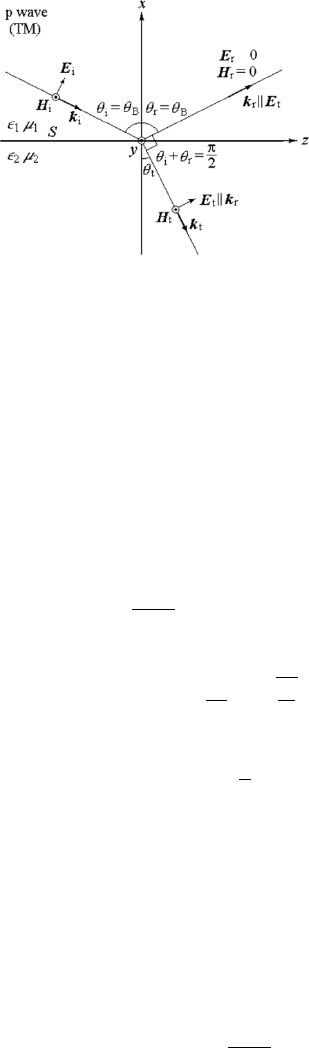
The incident, reflected, and refracted wave vectors at the Brewster an-
gle are shown in Fig. 2.19. We can see that the refracted wave vector k
t
is
perpendicular to the reflected wave vector k
r
and the refracted electric field
vector E
t
is parallel to the reflected wave vector k
r
. The tangential compo-
nents of the incident and the transmitted electric fields satisfy the boundary
condition without the reflected field.
At the boundary between nonmagnetic dielectrics, the Brewster angle
exists for only the p wave (TM), and the incident angle of zero reflection for
the n wave (TE) does not exist. In the formula for the reflection coefficient
for the boundary between magnetic media with ²
1
= ²
2
, (2.204), we can see
that the Brewster angle exists for only the n wave (TE).
2.4 Oblique Reflection and Refraction of Plane Waves 97
Figure 2.19: The reflected wave of the p (TM) mo de vanishes at the Brewster
angle.
2.4.5 Total Reflection and the Critical Angle
When an incident plane wave passes from an optically dense medium into an
optically rarer medium,
n
1
> n
2
, n
21
< 1,
we have from Snell’s law that
sin θ
t
=
sin θ
i
n
21
> sin θ
i
.
If
sin θ
i
= sin θ
c
= n
21
=
n
2
n
1
=
r
²
2
²
1
,
then
sin θ
t
= 1, θ
t
=
π
2
.
For an incident wave with θ
i
= θ
c
, the refracted wave is propagated parallel
to the boundary. There can be no power flow across the boundary. Hence
at that special angle of incidence there must be total reflection. This special
angle of incidence is known as the critical angle,
θ
c
= arcsin n
21
. (2.217)
If the angle of incidence is larger than the critical angle, θ
i
> θ
c
, then
sin θ
i
> n
21
, sin θ
t
=
sin θ
i
n
21
> 1. (2.218)

98 2. Introduction to Waves
This means that θ
t
is complex and cos θ
t
becomes
cos θ
t
=
q
1 − sin
2
θ
t
=
q
n
2
21
− sin
2
θ
i
n
21
, (2.219)
and cos θ
t
must be purely imaginary,
cos θ
t
= j
q
sin
2
θ
t
− 1 = j
q
sin
2
θ
i
− n
2
21
n
21
. (2.220)
The reflection coefficients for the TE and TM modes, (2.192) and (2.207)
then become
Γ
TE
=
cos θ
i
− j
n
1
η
1
n
2
η
2
q
sin
2
θ
i
− n
2
21
cos θ
i
+ j
n
1
η
1
n
2
η
2
q
sin
2
θ
i
− n
2
21
, (2.221)
and
Γ
TM
=
cos θ
i
− j
n
1
η
2
n
2
η
1
q
sin
2
θ
i
− n
2
21
cos θ
i
+ j
n
1
η
2
n
2
η
1
q
sin
2
θ
i
− n
2
21
, (2.222)
respectively. The magnitudes of these reflection coefficients are both unity,
and the amplitude of the reflected wave is equal to the amplitude of the
incident wave. A standing wave in the x direction is set up in medium 1 with
no net power flow in this direction. The complex reflection coefficients can
be expressed as follows:
Γ
TE
= e
−j2φ
, φ = arctan
n
1
η
1
n
2
η
2
q
sin
2
θ
i
− n
2
21
cos θ
i
(2.223)
and
Γ
TM
= e
−j2ψ
, ψ = arctan
n
1
η
2
n
2
η
1
q
sin
2
θ
i
− n
2
21
cos θ
i
. (2.224)
For a nonmagnetic dielectric boundary, η
2
/η
1
= n
1
/n
2
, the complex re-
flection coefficients become
Γ
TE
=
cos θ
i
− j
q
sin
2
θ
i
− n
2
21
cos θ
i
+ j
q
sin
2
θ
i
− n
2
21
= e
−j2φ
, φ = arctan
q
sin
2
θ
i
− n
2
21
cos θ
i
,
(2.225)
and
Γ
TM
=
n
2
21
cos θ
i
− j
q
sin
2
θ
i
− n
2
21
n
2
21
cos θ
i
+ j
q
sin
2
θ
i
− n
2
21
= e
−j2ψ
, ψ = arctan
q
sin
2
θ
i
− n
2
21
n
2
21
cos θ
i
.
(2.226)

2.4 Oblique Reflection and Refraction of Plane Waves 99
Similar formulas for the complex reflection coefficients for a magnetic
boundary with the same permittivity can also be obtained.
The total reflection at the boundary of two nonconducting media is also
known as total internal reflection. The word internal implies that the incident
and reflected waves are in the medium with the larger index.
The magnitude of the reflection coefficient for the total reflection at
perfect-conductor boundary and the total reflection at dielectric boundary
are both unity, But the angle of the reflection coefficient are different.
2.4.6 Decaying Fields and Slow Waves
When the plane wave is totally reflected from a perfect-conductor surface,
neither fields nor power flow exists in the perfect conductor. If the total
internal reflection occurs at the boundary of two nonconductive media, the
electric and magnetic fields exist in the medium 2, although there is no av-
erage (active) power flow passing through the boundary to the medium 2.
Rewrite the expression for the refracted wave vector k
t
,
k
t
= −
ˆ
xk
tx
+
ˆ
zk
tz
, k
2
t
= k
2
tx
+ k
2
tz
,
where k
t
= |k
t
| = k
2
= ω
√
µ
2
²
2
= k
1
n
21
, k
1
= ω
√
µ
1
²
1
. Using (2.152) and
(2.219), we have
k
tz
=k
2
sin θ
t
=k
1
sin θ
i
, k
tx
=k
2
cos θ
t
=k
1
n
21
cos θ
t
=k
1
q
n
2
21
− sin
2
θ
i
.
When θ
i
> θ
c
, sin θ
i
> n
21
, k
tx
becomes imaginary,
k
tx
= jk
1
q
sin
2
θ
i
− n
2
21
= jK
x
, (2.227)
but k
tz
is still real.
The transmitted or refracted fields of the n wave (TE mode) in medium
2, (2.181) and (2.184), in the case of total reflection become
E
y 2
= E
m2
e
K
x
x
e
j(ωt−k
z
z)
, (2.228)
H
x2
= −
sin θ
t
η
2
E
m2
e
K
x
x
e
j(ωt−k
z
z)
, (2.229)
H
z2
= −
cos θ
t
η
2
E
m2
e
K
x
x
e
j(ωt−k
z
z)
, (2.230)
where E
m2
= E
t
y m
. Thus for θ
i
> θ
c
, the refracted wave propagates along
z, parallel to the boundary, and the fields decay exponentially along −x in
medium 2, beyond and perpendicular to the boundary. The fields E
y 2
and
H
x2
are in phase, so there is real power flow in the direction parallel to the
boundary. The phase difference between E
y 2
and H
z2
is π/2 when cos θ
t
is imaginary, so there is no real power flow in the direction normal to the

100 2. Introduction to Waves
boundary. The nonuniform plane traveling wave with a decaying field in the
transverse direction is known as a surface wave.
The phase velocity of the surface traveling wave along z in medium 2 is
v
pz
=
ω
k
z
=
ω
k
2
sin θ
t
< v
p2
=
ω
k
2
.
The phase velocity of the surface wave is less than the phase velocity of a
uniform plane wave in the same medium. It is a slow wave.
Rewrite the reflection coefficient for the n wave (TE) in the case of total
internal reflection:
Γ
n
=
E
r
y m
E
i
y m
= e
−j2φ
= −e
−j2(φ−π/ 2)
.
The composed fields of the incident and the reflected waves for the n wave
(TE) in medium 1 in the case of total internal reflection can be derived from
(2.179), (2.180), (2.182), and (2.183) as follows:
E
y 1
= E
i
y
+ E
r
y
= E
m1
sin
h
k
x
x +
³
φ −
π
2
´i
e
j(ωt−k
z
z)
, (2.231)
H
x1
=H
i
x
+H
r
x
=−
sin θ
i
η
1
¡
E
i
y
+E
r
y
¢
=−
sin θ
i
η
1
E
m1
sin
h
k
x
x+
³
φ−
π
2
´i
e
j(ωt−k
z
z)
,
(2.232)
H
z1
=H
i
z
+ H
r
z
=−
cos θ
i
η
1
¡
E
i
y
−E
r
y
¢
=j
cos θ
i
η
1
E
m1
cos
h
k
x
x+
³
φ−
π
2
´i
e
j(ωt−k
z
z)
,
(2.233)
where E
m1
= 2jE
i
y m
.
We leave the composed fields for the p wave (TM) in the case of total
internal reflection as an exercise, refer to Problem 2.17.
The field maps of the n wave (TE) and p wave (TM) in the case of total
internal reflection are shown in Fig. 2.20.
The phase velocity in medium 1 must be equal to that in medium 2,
v
pz
=
ω
k
z
=
ω
k
1
sin θ
i
> v
p1
=
ω
k
1
.
The phase velocity is larger than the phase velocity of a plane wave in the
same medium. It is a fast wave. So we have, v
p1
< v
pz
< v
p2
. The phase
velocity is just between the phase velocities of the plane waves in the two
media.
Until now we have three types of wave modes:
(1)TEM mode including uniform plane waves: the phase velocity is equal to
the velocity of light in the unbounded medium.
(2)A fast wave mode: the phase velocity is larger than the velocity of light
in the unbounded medium, and the transverse distribution of fields must be
standing waves.
(3)A slow wave mode: the phase velocity is less than the velocity of light
in the unbounded medium, and the transverse distribution of fields must be
decaying fields.