
Zhang K., Li D. Electromagnetic Theory for Microwaves and Optoelectronics
Подождите немного. Документ загружается.

2.3 Normal Reflection and Transmission of Plane Waves 81
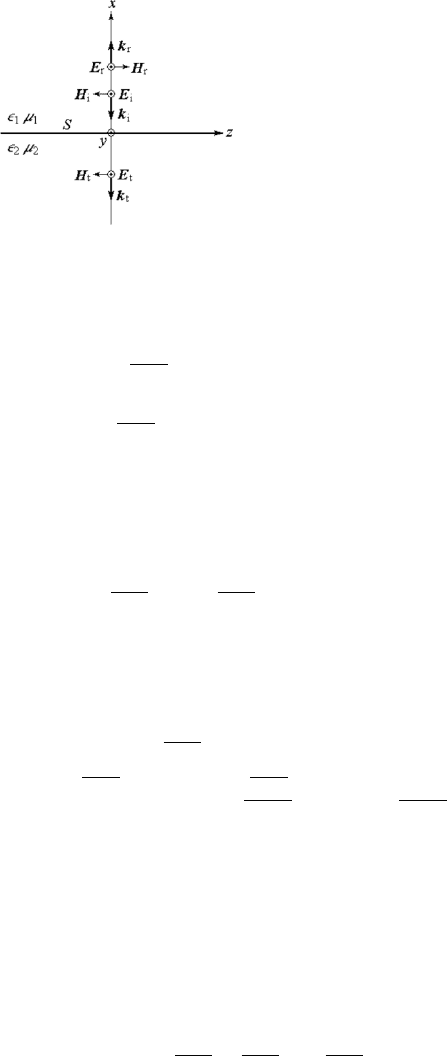
Figure 2.12: Normal incidence, reflection and transmission of uniform plane
wave at a nonconducting media boundary.
H
i
=
ˆ
zH
i
z
= −
ˆ
z
E
i
y m
η
1
e
jk
1
x
e
jωt
, (2.127)
H
r
=
ˆ
zH
r
z
=
ˆ
z
E
r
y m
η
1
e
−jk
1
x
e
jωt
. (2.128)
The composed fields in medium 1 are given by the combination of the incident
and the reflected files,
E
1
=
ˆ
yE
y 1
=
ˆ
y(E
i
y
+ E
r
y
) =
ˆ
y
¡
E
i
y m
e
jk
1
x
+ E
r
y m
e
−jk
1
x
¢
e
jωt
, (2.129)
H
1
=
ˆ
zH
z1
=
ˆ
z(H
i
z
+ H
r
z
) =
ˆ
z
Ã
−
E
i
y m
η
1
e
jk
1
x
+
E
r
y m
η
1
e
−jk
1
x
!
e
jωt
. (2.130)
The fields in medium 2 are transmitted fields only,
E
2
=
ˆ
yE
y 2
= E
t
=
ˆ
yE
t
y m
e
jk
2
x
e
jωt
, (2.131)
H
2
=
ˆ
zH
z2
= H
t
= −
ˆ
z
E
t
y m
η
2
e
jk
2
x
e
jωt
. (2.132)
In the above equations, k
1
= ω
√
µ
1
²
1
and k
2
= ω
√
µ
2
²
2
denote the phase
coefficient of plane wave in media 1 and 2, and η
1
=
p
µ
1
/²
1
and η
2
=
p
µ
2
/²
2
denote the wave impedances of media 1 and 2, respectively.
On the boundary of the two media, there is no surface current, which
means that neither of the two media is a perfect conductor. Both the tangen-
tial component of the composed electric field and the tangential component
of the composed magnetic fields must be continuous at the boundary between
medium 1 and medium 2. The boundary equations are given by
n × E
1
|
x=0
= n × E
2
|
x=0
, i.e., E
i
y m
+ E
r
y m
= E
t
y m
, (2.133)
n × H
1
|
x=0
= n × H
2
|
x=0
, i.e., −
E
i
y m
η
1
+
E
r
y m
η
1
= −
E
t
y m
η
2
. (2.134)

82 2. Introduction to Waves
Define a reflection coefficient of electric field that E
r
y m
= Γ E
i
y m
, from
(2.133) and (2.134), we have
Γ = |Γ |e
jφ
=
E
r
y m
E
i
y m
=
η
2
− η
1
η
2
+ η
1
. (2.135)
The reflection coefficient Γ is real when medium 1 and medium 2 are b oth
lossless media, while it become imaginary when medium 2 is lossy medium
and medium 1 is still lossless.
The composed fields in medium 1 become
E
y 1
=E
i
y m
¡
e
jk
1
x
+Γ e
−jk
1
x
¢
e
jωt
=E
i
y m
h
1+|Γ |e
−j(φ−2k
1
x)
i
e
jk
1
x
e
jωt
, (2.136)
H
z1
=−
E
i
y m
η
1
¡
e
jk
1
x
−Γ e
−jk
1
x
¢
e
jωt
=−
E
i
y m
η
1
h
1−|Γ |e
−j(φ−2k
1
x)
i
e
jk
1
x
e
jωt
. (2.137)
The amplitudes of the fields are
|E
y 1
| = E
i
y m
p
1 + |Γ |
2
+ 2|Γ |cos(φ − 2k
1
x) , (2.138)
|H
z1
| =
E
i
y m
η
1
p
1 + |Γ |
2
− 2|Γ |cos(φ − 2k
1
x) . (2.139)
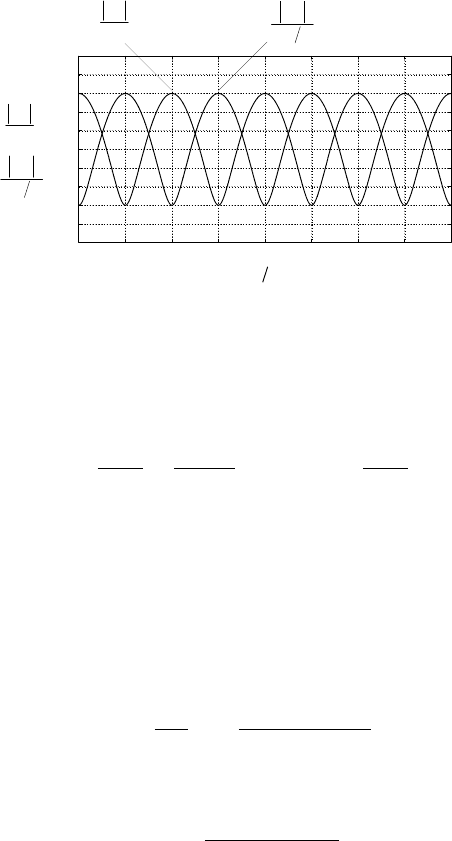
The field amplitude distribution along x is shown in Fig. 2.13.
We can see from equations (2.138), (2.139) and Fig. 2.13 that, the field
maximum and field minimum appear alternatively. The distance between the
maximum and the minimum is λ/4, while the distance between two neigh-
boring maximum or two neighboring minimum is λ/2. The field minimum
is no longer zero as it is for the standing wave. This kind of wave is called
traveling-standing wave.
The field maximum and minimum are
E
max
= E
i
y m
(1 + |Γ |), E
min
= E
i
y m
(1 − |Γ |).
Equations (2.138), (2.139) can be rewritten as follows,
E
y 1
= E
i
y m
¡
e
jk
1
x
+ Γ e
−jk
1
x
¢
e
jωt
= 2Γ E
i
y m
cos k
1
x e
jωt
+ (1 − Γ )E
i
y m
e
j(ωt+k
1
x)
, (2.140)
H
z1
= −
E
i
y m
η
1
¡
e
jk
1
x
− Γ e
−jk
1
x
¢
e
jωt
= −j
2Γ E
i
y m
η
1
sin k
1
x e
jωt
− (1 − Γ )
E
i
y m
η
1
e
j(ωt+k
1
x)
. (2.141)
It shows that a traveling-standing wave is the combination of a traveling wave
and a standing wave.
2.3 Normal Reflection and Transmission of Plane Waves 83
0.00 .25 .50 .75 1.00 1.25 1.50 1.75 2.00
0.0
.2
.4
.6
.8
1.0
1.2
1.4
1.6
1.8
2.0
*
= 0.6
i
m
1
z
z
E
E
1
i
m
1
K
z
y
E
H
O
x
i
m
1
z
z
E
E
1
i
m
1
K
z
y
E
H
Figure 2.13: Field amplitude distribution of a traveling-standing wave.
Define the ratio of E
max
to E
min
as the standing-wave ratio, or SWR for
short, denoted by
ρ = SWR =
E
max
E
min
=
1 + |Γ |
1 − |Γ |
or |Γ | =
ρ − 1
ρ + 1
. (2.142)
The state of |Γ | = 0 and ρ = 1 corresponds to non-reflection or matching i.e.,
a traveling wave, and the state of |Γ | = 1 and ρ → ∞ corresponds to total
reflection, i.e., standing wave.
Usually the standing wave and the traveling-standing wave are together
denoted as the standing wave with specific standing-wave ratio.
The input impedance for a traveling-standing wave is given by the ratio
of (2.136) to (2.137),
Z(x) =
E
y 1
H
z1
= η
1
e
jk
1
x
+ Γ e
−jk
1
x
e
jk
1
x
− Γ e
−jk
1
x
. (2.143)
Using (2.135), yields
Z(x) = η
1
η
2
+ jη
1
tan k
1
x
η
1
+ jη
2
tan k
1
x
. (2.144)
We can see from (2.135), (2.136), (2.137) and (2.144) that, for a plane
wave incident from a rare medium into a dense medium with permittivity
much larger then that of the rare medium, ²
2
À ²
1
, η
2
¿ η
1
, it leads to
Γ ≈ −1, E
y 1
≈ 0, and Z(0) ≈ 0, i.e., the tangential component of electric
field is vanished. the boundary corresponds to a short-circuit boundary. On
the contrary, when ²
2
¿ ²
1
, η
2
À η
1
, it leads to Γ ≈ +1, H
z1
≈ 0 and
Z(0) ≈ ∞, the boundary corresponds to an open-circuit boundary. Generally,
it corresponds to an impedance boundary.
84 2. Introduction to Waves
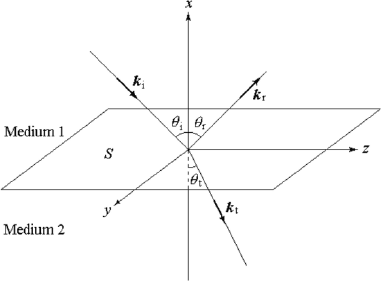
Figure 2.14: Incident, reflected, and refracted wave vectors.
2.4 Oblique Reflection and Refraction of
Plane Waves
A uniform plans wave incident obliquely into the boundary between two
media usually gives rise to both a reflected wave and a transmitted wave.
Generally, the transmitted wave does not propagate in the same direction as
that of the incident wave, and is called the refracted wave. The laws governing
the reflection and refraction of plane waves are Snell’s law for the directions
of propagation and the Fresenel’s law for the amplitudes and phases of the
waves.
2.4.1 Snell’s Law
Consider an incident uniform plane wave obliquely passing through a plane
boundary between two media. According to the formulation of a plane wave
propagating in an arbitrary direction, (2.24), the electric field vectors of the
incident, reflected, and transmitted waves are
E
i
(x, t) = E
im
e
j(ω
i
t−k
i
·x)
, (2.145)
E
r
(x, t) = E
rm
e
j(ω
r
t−k
r
·x)
, (2.146)
E
t
(x, t) = E
tm
e
j(ω
t
t−k
t
·x)
, (2.147)
where the subscripts i, r, and t denote the quantities of the incident, reflected,
and transmitted waves, respectively, refer to Fig. 2.14.
Suppose the boundary between medium 1 and medium 2 is placed on the
plane x = 0, and the unit normal directed from 2 to 1 is n. The boundary
condition for the tangential components of the electric fields is given by
n ×
h
E
im
e
j(ω
i
t−k
i
·x)
+ E
rm
e
j(ω
r
t−k
r
·x)
i
¯
¯
¯
x=0
= n × E
tm
e
j(ω
t
t−k
t
·x)
¯
¯
¯
x=0
.

2.4 Oblique Reflection and Refraction of Plane Waves 85
This boundary condition must be satisfied at all points on the boundary
plane at all time. It implies that the time and spatial variations of all fields
must be the same at x = 0:
ω
i
= ω
r
= ω
t
= ω and k
i
· x|
x=0
= k
r
· x|
x=0
= k
t
· x|
x=0
,
i.e.,
k
iy
y + k
iz
z = k
ry
y + k
rz
z = k
ty
y + k
tz
z, at x = 0. (2.148)
Place the coordinates such that the incident wave vector is on the x,z
plane. Then we have
k
iy
= 0.
The equation (2.148) must be satisfied at all y and z, which yields
k
ry
= 0, k
ty
= 0.
The incident, reflected, and refracted wave vectors are coplanar vectors, laid
on the plane of incidence defined by the boundary normal n and the incident
wave vector k
i
, i.e., the x,z plane. Then the equation (2.148) becomes
k
iz
= k
rz
= k
tz
. (2.149)
The three wave vectors can then be written in component forms:
k
i
= −
ˆ
xk
ix
+
ˆ
zk
iz
= −
ˆ
xk
i
sin θ
i
+
ˆ
zk
i
cos θ
i
, (2.150)
k
r
=
ˆ
xk
rx
+
ˆ
zk
rz
=
ˆ
xk
r
sin θ
r
+
ˆ
zk
r
cos θ
r
, (2.151)
k
t
= −
ˆ
xk
tx
+
ˆ
zk
tz
= −
ˆ
xk
t
sin θ
t
+
ˆ
zk
t
cos θ
t
. (2.152)
where θ
i
, θ
r
, and θ
t
denote the angles of incidence, reflection, and refraction,
respectively, see Fig. 2.14.
The incident and reflected waves propagate in medium 1 and the refracted
wave propagates in medium 2. The phase coefficients of the plane waves are
k
i
= k
r
= k
1
= ω
√
µ
1
²
1
=
ω
v
p1
, k
t
= k
2
= ω
√
µ
2
²
2
=
ω
v
p2
. (2.153)
Substituting (2.150)–(2.153) into (2.149) yields
θ
i
= θ
r
, (2.154)
i.e., the angle of reflection is equal to the angle of incidence, known as the
law of reflection, and
sin θ
i
sin θ
t
=
k
2
k
1
=
√
µ
2
²
2
√
µ
1
²
1
=
v
p1
v
p2
, (2.155)

86 2. Introduction to Waves
i.e., the sine of the angle of refraction and the sine of the angle of incidence
is proportional to the phase velocity of plane wave in the media, known as
the law of refraction.
Define the index of refraction or simply the index of a medium as the
ratio of the phase velocity of plane wave in vacuum to the phase velocity in
the medium:
n =
c
v
p
=
√
µ
r
²
r
. (2.156)
The indices of medium 1 and medium 2 are
n
1
=
c
v
p1
=
√
µ
r1
²
r1
and n
2
=
c
v
p2
=
√
µ
r2
²
r2
,
respectively. The relative index of medium 2 to medium 1 is
n
21
=
n
2
n
1
=
v
p1
v
p2
=
r
µ
r2
²
r2
µ
r1
²
r1
. (2.157)
Then (2.155) becomes
sin θ
i
sin θ
t
=
n
2
n
1
= n
21
. (2.158)
In conclusion, for a uniform plane wave incident obliquely from medium 1
into medium 2, the incident, reflected, and refracted wave vectors are copla-
nar, the angle of reflection is equal to the angle of incidence, and the ratio
of the sine of the angle of incidence to the sine of the angle of refraction is
equal to the ratio of the phase velocities of uniform plane waves in the two
media, or the inverse ratio of the indices of the two media. This is known as
Snell’s law.
2.4.2 Oblique Incidence and Reflection at a
Perfect-Conductor Surface
For the reflection and refraction of waves, the relations among the directions
of propagation, on the one hand, follow from the wave nature of the phenom-
ena but do not depend on the detailed nature of the fields and their boundary
conditions. On the other hand, the relations among the intensities and phases
of the waves depend entirely on the specific nature of electromagnetic fields
and their boundary conditions.
For a plane wave obliquely incident upon a plane boundary, the boundary
conditions for waves with different polarization states are different. In section
2.2.1, we have shown that a plane wave with an arbitrary polarization state
can be decomposed into two mutually perpendicular line polarized waves. It
is convenient to separate a wave into two modes, the mode with its electric
field normal to the plane of incidence, called n wave, and the one with its
electric field parallel to the plane of incidence, called p wave. For the n wave,
the electric field vector has only the component parallel to the boundary
2.4 Oblique Reflection and Refraction of Plane Waves 87
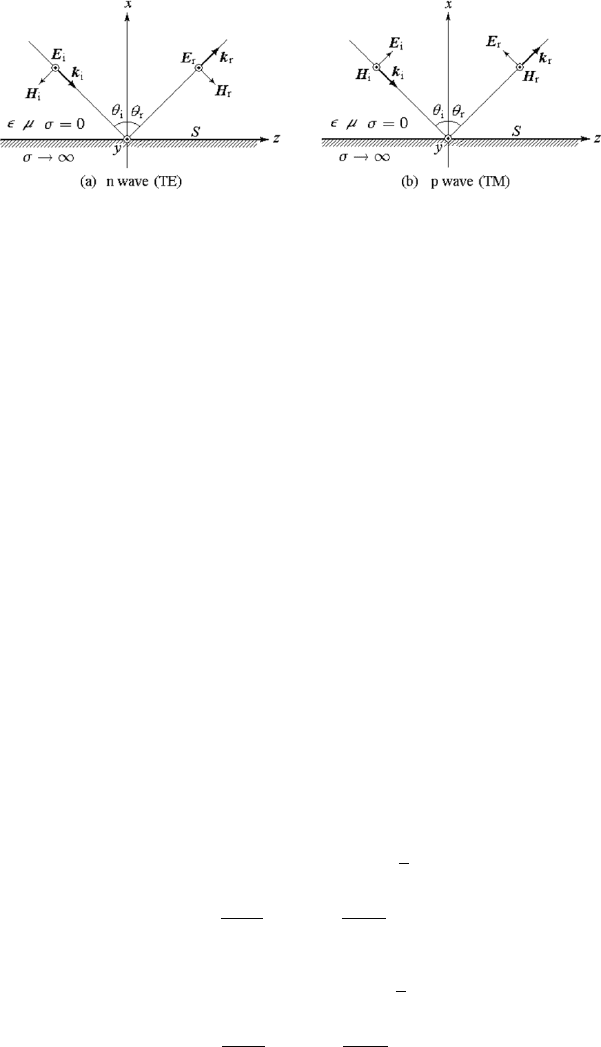
Figure 2.15: Oblique incidence and reflection at a p erfect-conductor surface,
(a) n wave and (b) p wave.
plane, which is the transverse component with respect to the wave vectors k
x
and k
z
, and is denoted as the TE mode. For the p wave, the magnetic field
vector has only the transverse component, and is denoted as the TM mode
[38].
In this section, we suppose that the medium 2 is metal, and can be seen
as a perfect conductor, there is no refracted wave in it. The fields of the
incident wave and the reflected wave must satisfy the short-circuit bound-
ary conditions on the metal surface. The n wave and p wave incident and
reflected at the perfect-conductor surface are shown in Fig. 2.15(a) and (b),
respectively.
(1) The n Wave or TE Mode
The electric field of the incident n wave has only a y component, normal to
the x-z plane, the plane of incidence. To satisfy the boundary condition, the
electric fields of the reflected waves must also have only y components, refer
to Fig. 2.15(a). They can be given by (2.24) as follows,
E
i
(x) =
ˆ
yE
i
y
(x) =
ˆ
yE
i
y m
e
−jk
i
·x
, (2.159)
E
r
(x) =
ˆ
yE
r
y
(x) =
ˆ
yE
r
y m
e
−jk
r
·x
. (2.160)
The magnetic fields can be derived by (2.38):
H
i
(x) =
¡
ˆ
xH
i
xm
+
ˆ
zH
i
zm
¢
e
−jk
i
·x
=
1
η
ˆ
k
i
×E
i
(x)
=
µ
−
ˆ
x
sin θ
i
η
E
i
y m
−
ˆ
z
cos θ
i
η
E
i
y m

e
−jk
i
·x
, (2.161)
H
r
(x) = (
ˆ
xH
r
xm
+
ˆ
zH
r
zm
)e
−jk
r
·x
=
1
η
ˆ
k
r
×E
r
(x)
=
µ
−
ˆ
x
sin θ
i
η
E
r
y m
+
ˆ
z
cos θ
i
η
E
r
y m

e
−jk
r
·x
, (2.162)

88 2. Introduction to Waves
where η =
p
µ/² denotes the wave impedances of the nonconducting medium,
in which the incident wave propagates.
The boundary equation on the plane surface of a perfect conductor at
x = 0 is given by
n ×
¡
E
i
+ E
r
¢
¯
¯
x=0
= 0, i.e., E
i
y m
+ E
r
y m
= 0. (2.163)
We then have the coefficient of reflection for the electric field of the n wave:
Γ
n
=
E
r
y m
E
i
y m
= −1. (2.164)
Total reflection occurs on the surface of a perfect conductor for oblique inci-
dence and reflection of a n wave.
Applying the above relations (2.164) in the electric field expressions
(2.159) and (2.160) we have the composed electric field:
E
y
= E
i
y
+ E
r
y
= E
i
y m
¡
e
jk
x
x
− e
−jk
x
x
¢
e
j(ωt−k
z
z)
= 2jE
i
y m
sin k
x
xe
j(ωt−k
z
z)
.
Let
E
m
= 2jE
i
y m
,
yields
E
y
= E
m
sin k
x
xe
j(ωt−k
z
z)
, (2.165)
The composed magnetic field components are derived from (2.161),
(2.162), and (2.164) as follows:
H
x
= −
sin θ
i
η
1
E
m
sin k
x
xe
j(ωt−k
z
z)
, (2.166)
H
z
= j
cos θ
i
η
1
E
m
cos k
x
xe
j(ωt−k
z
z)
. (2.167)
We can see from (2.165)–(2.167) that the composed field of the incident
and the reflected waves outside the perfect conductor forms a traveling wave
in the z direction and a standing wave in the x direction. The equiphase
is a plane perpendicular to z, i.e., the x-y plane, but the amplitude in this
plane is not uniform, so it is a nonuniform plane wave in the z direction.
The electric field of the wave has only a transverse (y) component and is
normal to the direction of propagation z, but the magnetic field has both a
transverse (x) and a longitudinal (z) component. This type of traveling-wave
mode (n wave) is called the transverse electric mo de and is denoted by TE
mode. The electric and magnetic field lines of the n wave (TE mode) are
shown in Fig. 2.16.
The phase velocity and the wavelength in longitudinal (z) direction are
v
pz
=
ω
k
z
=
ω
k sin θ
i
=
c
sin θ
i
, λ
z
=
2π
k
z
=
2π
k sin θ
i
=
λ
0
sin θ
i
, (2.168)
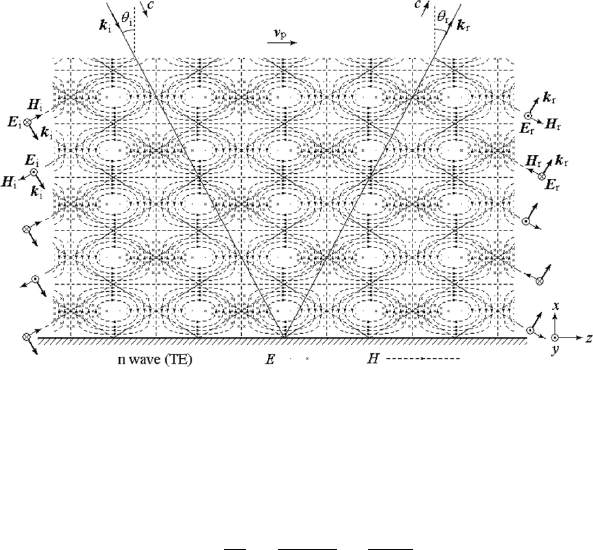
2.4 Oblique Reflection and Refraction of Plane Waves 89
Figure 2.16: Field maps of the n wave (TE mode) for the total reflection
from the surface of a perfect conductor.
and the wavelength in transverse (x) direction is
λ
x
=
2π
k
x
=
2π
k cos θ
i
=
λ
0
cos θ
i
, (2.169)
where λ
0
denotes the wavelength in free space.
We can see that, λ
z
> λ
0
and v
pz
> c. The phase velocity is larger than
the velocity of light in free space, so it is a fast wave. For a fast wave, the
distribution of fields in the transverse direction must be a standing wave.
The planes at x = nλ
x
/2, n = 1, 2, 3, ···, are equivalent short-circuit
planes, and the planes at x = (n + 1/2)λ
x
/2 are equivalent open-circuit
planes. If we put a perfect-conductor plane at x = nλ
x
/2, it has no influence
on the wave propagation, because the tangential electric field component is
zero at those planes. It forms the TE
n0
modes in a parallel-plate transmission
line.
We can also put two parallel p erfect-conductor planes perpendicular to
y, and they have no influence on the wave propagation, because the electric
field is normal to those planes. It forms the TE
n0
modes in a rectangular
waveguide.
(2) The p Wave or TM Mode
The magnetic fields of the incident and reflected p waves have only a y
component, refer to Fig. 2.15(b), and can be given by
H
i
(x) =
ˆ
yH
i
y
(x) =
ˆ
yH
i
y m
e
−jk
i
·x
, (2.170)

90 2. Introduction to Waves
H
r
(x) =
ˆ
yH
r
y
(x) =
ˆ
yH
r
y m
e
−jk
r
·x
, (2.171)
The electric fields can be given by (2.39):
E
i
(x) =
¡
ˆ
xE
i
xm
+
ˆ
zE
i
zm
¢
e
−jk
i
·x
=−η
ˆ
k
i
×H
i
(x)
=
¡
ˆ
xη sin θ
i
H
i
y m
+
ˆ
zη cos θ
i
H
i
y m
¢
e
−jk
i
·x
, (2.172)
E
r
(x) = (
ˆ
xE
r
xm
+
ˆ
zE
r
zm
) e
−jk
r
·x
=−η
ˆ
k
r
×H
r
(x)
=
¡
−
ˆ
xη sin θ
i
H
r
y m
+
ˆ
zη cos θ
i
H
r
y m
¢
e
−jk
r
·x
, (2.173)
The boundary equation on the plane surface of a perfect conductor at
x = 0 becomes
n ×
¡
E
i
+ E
r
¢
¯
¯
x=0
= 0, i.e., E
i
zm
− E
r
zm
= 0. (2.174)
We then have the coefficient of reflection for electric field of the p wave:
Γ
p
=
E
r
zm
E
i
zm
= +1. (2.175)
Total reflection occurs on the surface of a perfect conductor for a p wave
also, but the reflection coefficient is +1 for p wave instead of −1 for n wave.
Then we have the composed magnetic field:
H
y
= H
i
y
+H
r
y
= H
i
y m
¡
e
jk
x
x
+e
−jk
x
x
¢
e
j(ωt−k
z
z)
= 2H
i
y m
cos k
x
xe
j(ωt−k
z
z)
.
Let
H
m
= 2H
i
y m
,
yields
H
y
= H
m
cos k
x
xe
j(ωt−k
z
z)
, (2.176)
E
x
= η
1
sin θ
i
H
m
cos k
x
xe
j(ωt−k
z
z)
, (2.177)
E
z
= jη
1
cos θ
i
H
m
sin k
x
xe
j(ωt−k
z
z)
. (2.178)
The composed field of the incident and the reflected waves outside the
perfect conductor is also a nonuniform plane wave in the z direction. The
magnetic field of the wave has only a transverse (y) component and is normal
to the direction of propagation z. The electric field has transverse (x) and
longitudinal (z) components. This type of traveling-wave mode (p wave) is
called the transverse magnetic mode, denoted by TM mode. The electric and
magnetic field lines of the p wave (TM mode) are shown in Fig. 2.17.
The planes at x = nλ
x
/2, n integer, are equivalent short-circuit planes,
and the planes at x = (n +1/2)λ
x
/2 are equivalent open-circuit planes. If we
put a perfect-conductor plane at x = nλ
x
/2, it has no influence on the wave
propagation, because the tangential electric field component is zero at those
planes. It forms the TM
n0
modes in a parallel-plate transmission line.