
Zhang K., Li D. Electromagnetic Theory for Microwaves and Optoelectronics
Подождите немного. Документ загружается.


4.10 Vector Eigenfunctions and Normal Modes 221
Theorem 2 All eigenvalues are nonnegative for q ≤ 0, and with the con-
stant boundary conditions (4.240),
λ
i
≥ 0.
Theorem 3. Orthogonality Theorem The eigenfunction set is a com-
plete orthogonal set. The eigenfunctions y
n
(x) and y
m
(x) corresponding to
eigenvalues λ
n
and λ
m
, respectively, are orthogonal with weight ρ(x).
Z
b
a
ρ(x)y
∗
n
(x)y
m
(x)dx = 0, m 6= n. (4.241)
Theorem 4. Expansion Theorem Every continuous function f(x) which
has piecewise continuous first and second derivatives and satisfies the bound-
ary conditions of the eigenvalue problem can be expanded in an absolutely
and uniformly convergent series in terms of the eigenfunctions
f(x) =
∞
X
n=1
a
n
y
n
(x). (4.242)
The coefficients a
n
can be obtained by using the orthogonality property of
the eigenfunctions:
a
n
=
R
b
a
ρ(x
0
)f(x
0
)y
∗
n
(x
0
)dx
0
R
b
a
ρ(x
0
)|y
n
(x
0
)|
2
dx
0
. (4.243)
The proofs of the above theorems can be found in texts on mathematical
physics, for example [26, 35, 72].
(2) Orthonormal Eigenfunction Set
Define a set of normalized orthogonal eigenfunctions, namely orthonormal
eigenfunctions as follows:
U
n
(x) =
y
n
(x)
q
R
b
a
ρ(x)|y
n
(x)|
2
dx
0
. (4.244)
The orthogonal relation of the orthonormal eigenfunctions becomes
Z
b
a
ρ(x)U
∗
n
(x)U
m
(x)dx = δ
nm
, δ
nm
=
½
0, n 6= m,
1, n = m.
(4.245)
The expansion of the function f(x) in terms of the orthonormal eigenfunctions
U
n
(x) is
f(x) =
∞
X
n=1
a
n
U
n
(x). (4.246)
222 4. Time-Varying Boundary Value Problems
The coefficients a
n
become
a
n
=
Z
b
a
ρ(x
0
)f(x
0
)U
∗
n
(x
0
)dx
0
. (4.247)
(3) Completeness Relation
Substituting the coefficient a
n
(4.247) into the series (4.246), we have
f(x) =
∞
X
n=1
"
Z
b
a
ρ(x
0
)f(x
0
)U
∗
n
(x
0
)dx
0
#
U
n
(x)
=
Z
b
a
"
∞
X
n=1
ρ(x
0
)U
∗
n
(x
0
)U
n
(x)
#
f(x
0
)dx
0
, (4.248)
where x is a specific point and x
0
is the integration variable. The point x lies
within the range a–b, applying the functional property of the δ function,
Z
b
a
δ(x
0
− x)f(x
0
)dx
0
= f(x),
we have the completeness relation:
∞
X
n=1
ρ(x
0
)U
∗
n
(x
0
)U
n
(x) = δ(x
0
− x). (4.249)
If ρ(x) = 1, the orthonormality condition and the completeness condition
become
Z
b
a
U
∗
n
(x)U
m
(x)dx = δ
nm
,
∞
X
n=1
U
∗
n
(x
0
)U
n
(x) = δ(x
0
− x), (4.250)
and the coefficient a
n
of the series (4.246) becomes
a
n
=
Z
b
a
f(x
0
)U
∗
n
(x
0
)dx
0
. (4.251)
4.10.2 Eigenvalues for the Boundary-Value Problems
of the Vector Helmholtz Equations
The general solutions of the Helmholtz’s equations in the commonly used
coordinate systems obtained in the previous sections are the vector eigen-
functions. The eigenvalues of the boundary value problems of the vector
Helmholtz equations are given by
k
2
= k
2
x
+ k
2
y
+ k
2
z
, for rectangular coordinates, (4.252)

4.10 Vector Eigenfunctions and Normal Modes 223
k
2
= β
2
+ T
2
with ν or n, for cylindrical coordinates, (4.253)
k
2
, with n, m, for spherical coordinates, (4.254)
where k
2
x
, k
2
y
, k
2
z
, T
2
, ν, n, and m are the eigenvalues of the corresponding
ordinary differential equations. Each of them is an infinite set of discrete
values. The eigenvalue of the vector Helmholtz equations, k
2
, is then an
infinite set of discrete values too, denoted by k
2
m
.
Each of the eigenvalues corresponds to a specific set of vector eigenfunc-
tions E
m
(x) and H
m
(x), which is known as a normal mode. The vector
eigenfunctions satisfy the vector Helmholtz equations in a volume V and
given boundary conditions of the first or the second kind, including the short-
circuit or the open-circuit boundary conditions on the boundary S enclosing
V .
For source-free problems, ∇ · E
m
= 0, the vector Helmholtz equation for
E
m
(4.21) can be written as
∇ × ∇ × E
m
− k
2
m
E
m
= 0. (4.255)
Taking the scalar product of (4.255) with E
∗
m
, then integrating over V , gives
k
2
m
Z
V
E
2
m
dV =
Z
V
E
∗
m
· (∇ × ∇ × E
m
) dV. (4.256)
Applying the vector identity (B.38) for ∇ · (A × B), we have
E
∗
m
· (∇ × ∇ × E
m
) = |∇ × E
m
|
2
− ∇ · (E
∗
m
× ∇ × E
m
).
Substituting this into (4.256) and using the Gauss’ formula yields
k
2
m
Z
V
E
2
m
dV =
Z
V
|∇ × E
m
|
2
dV −
Z
S
(E
∗
m
× ∇ × E
m
) · n dS. (4.257)
Applying the triple scalar product formula (B.29), we may write the integrand
of the second term on the right-hand side of (4.257) as
n · (E
∗
m
× ∇ × E
m
) = ∇ × E
m
· (n × E
∗
m
),
or
n · (E
∗
m
× ∇ × E
m
) = −E
∗
m
· (n × ∇ × E
m
) = E
∗
m
· j ω ˙µ(n × H
m
).
Nevertheless the fields satisfying the short-circuit boundary condition, ∇ ×
E
m
|
S
= 0, or the open-circuit boundary condition, ∇ × H
m
|
S
= 0, means
that the second term of the right-hand side of (4.257) is equal to zero, so that
k
2
m
=
R
V
|∇ × E
m
|
2
dV
R
V
E
2
m
dV
. (4.258)
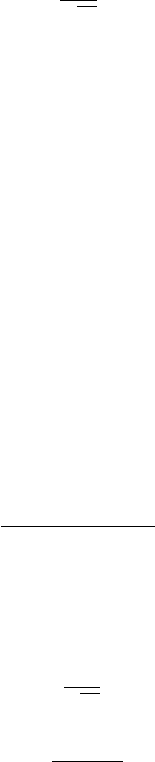
224 4. Time-Varying Boundary Value Problems
This is the expression of the eigenvalue of the boundary value problem for
the vector Helmholtz equation.
The integrands in the numerator and the denominator on the right-hand
side of (4.258) cannot be negative. So we have
k
2
m
≥ 0. (4.259)
So k
m
is a set of infinite discrete real numbers. This is the basic property
of the eigenvalues of the Strum–Liouville problems. The physical meaning of
k
m
is the natural angular wave number of the mth mo de in a closed system.
The corresponding natural angular frequency is
ω
m
=
k
m
√
µ²
, (4.260)
which is also a set of infinite discrete values. In a lossless closed system,
the electromagnetic fields can exist only when the frequency of the sinu-
soidal fields equals one of the natural frequencies, and the field distribution
is described by the vector eigenfunctions of the corresponding mode. So any
closed system is a resonant system.
4.10.3 Two-Dimensional Eigenvalues in Cylindrical
Systems
If there are no boundaries in the longitudinal direction z, a cylindrical system
becomes a uniform transmission system or guided-wave system. The problem
reduces to a two-dimensional boundary value problem. For a source-free
system, the two-dimensional Helmholtz equation (4.96) becomes
∇
T
× ∇
T
× E
m
+ T
2
m
E
m
= 0. (4.261)
E
m
satisfies the short-circuit or open-circuit boundary conditions at the
closed curve l surrounding the cross section S of the system. T
2
m
is the
two-dimensional eigenvalue of the problem. Similarly, we have
T
2
m
=
R
S
|∇
T
× E
m
|
2
dS
R
S
E
2
m
dS
. (4.262)
T
2
m
is also a set of infinite discrete positive values, T
2
m
≥ 0, and T
m
is real or
zero. The physical meaning of T
m
= k
cm
is the cutoff angular wave number
of the mth mode in the transmission system, and the critical or the cutoff
angular frequency is
ω
cm
=
T
m
√
µ²
, (4.263)
The longitudinal phase constant β = k
z
becomes continuous:
β
m
=
p
k
2
− T
2
m
, (4.264)

4.10 Vector Eigenfunctions and Normal Modes 225
and
β
m
≤ k, v
pm
= ω/β
m
≥ 1/
√
µ².
So a uniform cylindrical system enclosed by smooth short-circuit or open-
circuit boundaries is always a fast wave system or a system with a phase
velocity equal to the unbounded speed of light, and can never be a slow wave
system. A slow wave system must be enclosed by a boundary of impedance
surfaces.
4.10.4 Vector Eigenfunctions and Normal Mode
Expansion
The vector eigenfunction set of the time-varying boundary-value problems
forms a complete orthogonal set.
In a cylindrical system, (u
1
, u
2
, z), suppose that the two-dimensional vec-
tor eigenfunctions of two arbitrary modes are E
n
(u
1
, u
2
), H
n
(u
1
, u
2
) and
E
m
(u
1
, u
2
), H
m
(u
1
, u
2
), the transverse two-dimensional eigenvalues are T
n
,
T
m
and the longitudinal phase constants are β
n
, β
m
, respectively. The or-
thogonality of these two sets of vector eigenfunctions is given as
Z
S
0
[E
n
(u
1
, u
2
) × H
∗
m
(u
1
, u
2
)] · ˆzdS = 0, n 6= m, (4.265)
where S
0
denotes an arbitrary cross section of the system. Note that E
n
,
H
n
, E
m
, and H
m
here are functions of the the two-dimensional coordinates
on the cross section (u
1
, u
2
). The physical meaning of this expression is that
the electric field and magnetic field of two different modes do not carry any
power flow. So the total power flow of a multi-mode system is equal to the
sum of the power flows of all modes. These modes are known as normal
modes.
According to the Lorentz’s reciprocal theorem in the source-free region
(1.289)
I
S
(E
n
× H
∗
m
− E
∗
m
× H
n
) · ndS = 0, (4.266)
where S is the closed surface surrounding the volume to be investigated.
Note that E
n
, H
n
, E
m
, and H
m
here are functions of the three-dimensional
coordinates (u
1
, u
2
, z) or (x).
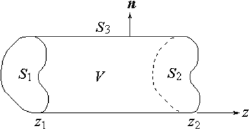
The region to be investigated is a segment of a source-free cylindrical
system. The surface S consists of two parts, i.e., the two arbitrary cross-
section surfaces S
1
and S
2
at z
1
and z
2
, and the cylindrical surface S
3
between
z
1
and z
2
, see Fig. 4.8. Then (4.266) becomes
Z
S
1
(E
n
× H
∗
m
− E
∗
m
× H
n
) · ˆzdS −
Z
S
2
(E
n
× H
∗
m
− E
∗
m
× H
n
) · ˆzdS
+
Z
S
3
(E
n
× H
∗
m
− E
∗
m
× H
n
) · ndS = 0. (4.267)
226 4. Time-Varying Boundary Value Problems
Figure 4.8: A segment of a source-free cylindrical system.
For metallic waveguides, the cylindrical surface S
3
is the conducting wall,
and for the dielectric waveguide, S
3
is the cylindrical surface between S
1
and
S
2
at infinity or far enough away so that the fields vanish. So the tangential
components of the field are zero on the cylindrical surface S
3
, and the third
integral of (4.267) is zero. The equation becomes
Z
S
1
(E
n
×H
∗
m
−E
∗
m
×H
n
)·ˆzdS−
Z
S
2
(E
n
×H
∗
m
−E
∗
m
×H
n
)·ˆzdS = 0. (4.268)
The two cross sections S
1
and S
2
are arbitrary chosen. To satisfy the above
equation, we must have
Z
S
0
(E
n
× H
∗
m
− E
∗
m
× H
n
) · ˆzdS = 0, (4.269)
where S
0
is a cross section at an arbitrary z.
If the two modes are both traveling waves in the +z direction,
E
n
(x) = E
n
(u
1
, u
2
)e
−jβ
n
z
, H
n
(x) = H
n
(u
1
, u
2
)e
−jβ
n
z
,
E
m
(x) = E
m
(u
1
, u
2
)e
−jβ
m
z
, H
m
(x) = H
m
(u
1
, u
2
)e
−jβ
m
z
,
then (4.269) becomes
e
−j(β
n
−β
m
)z
Z
S
0
[E
n
(u
1
, u
2
)×H
∗
m
(u
1
, u
2
)−E
∗
m
(u
1
, u
2
)×H
n
(u
1
, u
2
)] · ˆzdS =0.
For non-degenerate modes, β
n
6= β
m
, we have
Z
S
0
[E
n
(u
1
, u
2
)×H
∗
m
(u
1
, u
2
)−E
∗
m
(u
1
, u
2
)×H
n
(u
1
, u
2
)] · ˆzdS = 0. (4.270)
If the nth mode is a traveling wave in the +z direction, and the mth mode
is a traveling wave in the −z direction,
E
n
(x) = E
n
(u
1
, u
2
)e
−jβ
n
z
, H
n
(x) = H
n
(u
1
, u
2
)e
−jβ
n
z
,
E
m
(x) = E
m
(u
1
, u
2
)e
jβ
m
z
, H
m
(x) = −H
m
(u
1
, u
2
)e
jβ
m
z
,

4.10 Vector Eigenfunctions and Normal Modes 227
then (4.269) becomes
e
−j(β
n
+β
m
)z
Z
S
0
[−E
n
(u
1
, u
2
)×H
∗
m
(u
1
, u
2
)−E
∗
m
(u
1
, u
2
)×H
n
(u
1
, u
2
)]·ˆzdS = 0,
and we have
Z
S
0
[−E
n
(u
1
, u
2
)×H
∗
m
(u
1
, u
2
)−E
∗
m
(u
1
, u
2
)×H
n
(u
1
, u
2
)]·ˆzdS =0. (4.271)
Taking the sum and the difference of (4.270) and (4.271), gives
Z
S
0
[E
∗
m
(u
1
, u
2
) × H
n
(u
1
, u
2
)] · ˆzdS = 0, (4.272)
Z
S
0
[E
n
(u
1
, u
2
) × H
∗
m
(u
1
, u
2
)] · ˆzdS = 0. (4.273)
The orthogonality of normal modes is proven.
Any fields over the cross section of a cylindrical system can thus be ex-
panded into a series of vector eigenfunctions or normal modes:
E =
∞
X
n=1
A
n
E
n
, H =
∞
X
n=1
B
n
H
n
. (4.274)
The coefficients of the series may be obtained by the orthogonality principle:
A
n
=
R
S
0
(E × H
∗
n
) · ˆzdS
R
S
0
(E
n
× H
∗
n
) · ˆzdS
, B
n
=
R
S
0
(E
∗
n
× H) · ˆzdS
R
S
0
(E
∗
n
× H
n
) · ˆzdS
. (4.275)
Define the orthonormal vector eigenfunctions as
e
n
=
E
n
R
S
0
(E
n
× H
∗
n
) · ˆzdS
, h
n
=
H
n
R
S
0
(E
∗
n
× H
n
) · ˆzdS
. (4.276)
Then the orthonormal mode expansions of the fields become
E =
∞
X
n=1
a
n
e
n
, H =
∞
X
n=1
b
n
h
n
, (4.277)
and the coefficients become
a
n
=
Z
S
0
(E × h
∗
n
) · ˆzdS, b
n
=
Z
S
0
(e
∗
n
× H) · ˆzdS. (4.278)
We come to the conclusion that the solutions of the Helmholtz’s equations
that satisfy specific boundary conditions is a complete set of infinite number
of normal modes. A finite number of modes are propagation modes or guided
modes and the rests are cutoff modes or evanescent modes.
The orthogonality of the three-dimensional vector eigenfunctions can also
be proven and any fields in a closed region can also be expanded into a series
of the three-dimensional orthonormal vector eigenfunctions. [91]

228 4. Time-Varying Boundary Value Problems
4.11 Approximate Solution of
Helmholtz’s Equations
If the boundaries of the region coincide with the surfaces of a coordinate
system and are uniform along the three axes, the problem is known as a
simple boundary problem. Otherwise, it is a complicated boundary problem.
The exact solution of a simple boundary problem can be easily obtained
by means of separation of variables. For the complicated boundary problem,
the exact solution is usually difficult to obtain, and we have to find the
approximate solution under certain conditions. The approximate solution
includes approximate eigenvalues and approximate eigenfunctions.
4.11.1 Variational Principle of Eigenvalues
Suppose E is a field satisfying Helmoltz’s equation,
∇ × ∇ × E − k
2
E = 0, (4.279)
but not totally satisfying the boundary conditions.
Taking the scalar product of (4.279) with E
∗
, and integrating over V , we
have
k
2
Z
V
E · E
∗
dV =
Z
V
E
∗
· ∇ × ∇ × E dV, (4.280)
which gives
k
2
=
R
V
E
∗
· ∇ × ∇ × E dV
R
V
E · E
∗
dV
= X(E). (4.281)
This shows that the eigenvalue k
2
is a functional in terms of the vector
function E. When the boundary conditions are totally satisfied, E becomes
the true eigenfunction or true field and k
2
becomes the true eigenvalue of the
problem shown in (4.258).
We are now going to show the stationary character of the eigenvalue k
2
.
Supposing E is the true field, and E
T
is the approximate solution, which is
called trial function and δE denotes the deviation between E
T
and E:
E
T
= E + δE. (4.282)
Taking the variation of (4.280), we have
δ
µ
k
2
Z
V
E · E
∗
dV

= δ
µ
Z
V
E
∗
· ∇ × ∇ × E dV

. (4.283)
Note that the regulations of the variation of a functional are similar to those
of the differentiation of a function. Then the variational equation (4.283)
4.11 Approximate Solution of Helmholtz’s Equations 229
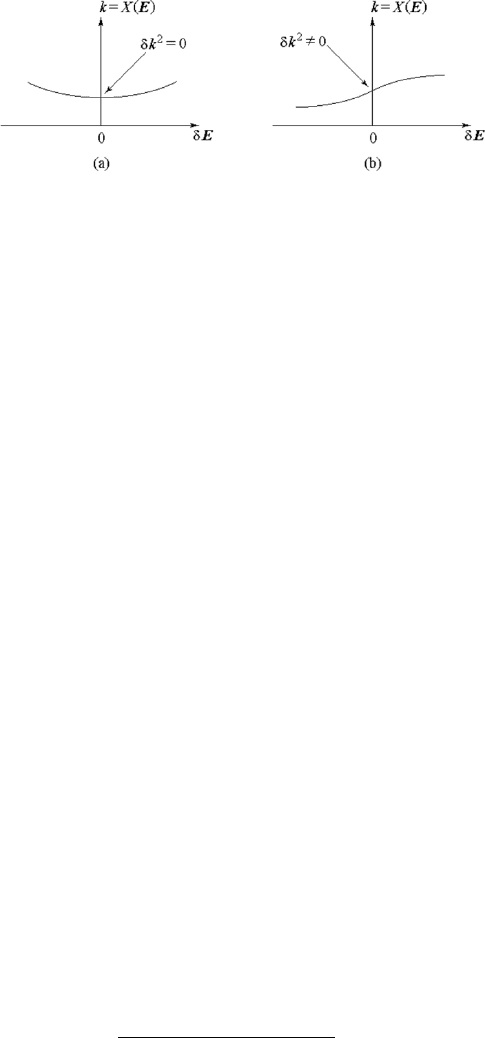
Figure 4.9: Stationary formula (a), and non-stationary formula (b).
becomes
µ
Z
V
E · E
∗
dV

δk
2
=
Z
V
δE
∗
·
¡
∇ × ∇ × E − k
2
E
¢
dV
+
Z
V
E
∗
·
¡
∇ × ∇ × δE − k
2
δE
¢
dV. (4.284)
The first term on the right-hand side of the above equation must be zero,
because the true field satisfies Helmholtz’s equation (4.279). Suppose that
the trial field E
T
also satisfies Helmholtz’s equation, then the second term is
also zero
∇ × ∇ × δE − k
2
δE = 0.
The integral on the left-hand side,
R
V
E ·E
∗
dV =
R
V
E
2
dV , cannot be zero,
so we have
δk
2
= 0. (4.285)
The first-order variation of the functional k
2
is equal to zero at δE = 0. This
means that k
2
will have a minimum or maximum at δE = 0, and the formula
(4.281) is known as the stationary formula of the eigenvalue k
2
. See Fig. 4.9.
It is evident that for small δE the stationary formula gives a smaller error
in k
2
than does the non-stationary formula. This property is summarized as
follows: A parameter determined by a stationary formula is insensitive to
small variations of the field about the true field. In this case the error in
the parameter is smaller then that in the field in one order. An error of the
order of 10% in the trial field E
T
gives an error of the order of only 1% in
the eigenvalue k
2
when the trial field satisfies Helmholtz’s equation but does
not totally satisfy the boundary conditions.
A stationary formula for the trial field, which satisfies the boundary con-
ditions but does not satisfy Helmholtz’s equation, can also be derived [37].
The two-dimensional eigenvalue T
2
in the cylindrical system is given by
T
2
=
R
S
E
∗
· ∇
T
× ∇
T
× E dS
R
S
E · E
∗
dS
= X(E), (4.286)
230 4. Time-Varying Boundary Value Problems
which is also a stationary formula, and
δT
2
= 0. (4.287)
In the analysis of the resonant system or transmission system, the value
of the nature frequency, which is determined by k
2
, or the cutoff frequency,
which is determined by T
2
, must be more accurate than the distribution of
the fields. This requirement is consistent with the variational principle of the
eigenvalues.
4.11.2 Approximate Field-Matching Conditions
For some problems with complicated boundaries, the whole region can be di-
vided into a number of subregions, and the problem becomes a simple bound-
ary condition problem in each subregion. The uniqueness theorem of such
problems is given in Section 4.1.2. The appropriate boundary conditions, or
so called field matching conditions, over the boundaries for the accurate so-
lution are given in (4.5). Sometimes the exact field expressions and the exact
equation for the eigenvalues, which is known as the characteristic equation,
are extremely complicated. So we want to find out the approximate boundary
conditions for the best approximate solution.
Consider a complicated region of volume V enclosed by a short-circuit or
open-circuit boundary S. The whole region is divided into n subregions with
simple boundaries V
i
, i = 1 to n. The subregion V
i
is enclosed by S
i
, which
consists of two sorts of surfaces, the outer boundary of the whole region V
denoted by S
i0
, which is a part of S, and the inner boundary or interface
between subregion V
i
and the adjacent subregion V
j
, denoted by S
ij
. See
Fig. 4.1b.
According to the uniqueness theorem given in Section 4.1.2, the true fields
E
i
(x), H
i
(x) must satisfy the following Helmholtz equations and boundary
conditions on the outer boundaries S
i0
as well as the matching conditions on
the inner boundaries S
ij
:
∇ × ∇ × E
i
− k
2
E
i
= 0, ∇ × ∇ × H
i
− k
2
H
i
= 0,
n × E
i
|
S
i0
= 0 or n × H
i
|
S
i0
= 0,
n × E
i
|
S
ij
= n × E
j
|
S
ij
and n × H
i
|
S
ij
= n × H
j
|
S
ij
.
According to the variational principle given in the above subsection, we
can find a set of approximate solutions as the trial fields E
iT
(x), H
iT
(x),
which satisfy Helmholtz’s equations and the boundary conditions on the outer
boundaries,
∇ × ∇ × E
iT
− k
2
E
iT
= 0, (4.288)
∇ × ∇ × H
iT
− k
2
H
iT
= 0, (4.289)
n × E
iT
|
S
i0
= 0 or n × H
iT
|
S
i0
= 0. (4.290)