
Zhang K., Li D. Electromagnetic Theory for Microwaves and Optoelectronics
Подождите немного. Документ загружается.


4.11 Approximate Solution of Helmholtz’s Equations 231
But the trial fields do not satisfy the field-matching conditions (4.5) on the
inner boundaries S
ij
. Now, the question is: for the trial functions in the
ith and jth subregions E
iT
, H
iT
and E
jT
, H
jT
, what conditions must be
satisfied on the boundary S
ij
so that the errors in the approximate eigenvalue
and the approximate eigenfunction become minimum.
The true eigenvalue and the true eigenfunction satisfy (4.258), but the
trial function E
iT
does not satisfy it. We try to make the trial function E
iT
satisfy the following equation as the basis of the approximate solution,
k
2
=
P
n
i=1
R
V
i
|∇ × E
iT
|
2
dV
P
n
i=1
R
V
i
|E
iT
|
2
dV
, (4.291)
and to find the proper boundary conditions that satisfy the above equation.
Taking the scalar product of E
∗
iT
with the equation for E
iT
(4.288), and
integrating it over the volume V
i
gives
k
2
Z
V
i
E
∗
iT
· E
iT
dV =
Z
V
i
E
∗
iT
· ∇ × ∇ × E
iT
dV. (4.292)
Using the vector identity (B.38) yields
E
∗
iT
· ∇ × ∇ × E
iT
= |∇ × E
iT
|
2
− ∇ · (E
∗
iT
× ∇ × E
iT
),
and (4.292) becomes
k
2
Z
V
i
|E
iT
|
2
dV =
Z
V
i
|∇×E
iT
|
2
dV −
I
S
i
(E
∗
iT
×∇× E
iT
) ·n
i
dS. (4.293)
Taking the sum of (4.293) over all V
i
yields
k
2
n
X
i=1
Z
V
i
|E
iT
|
2
dV =
n
X
i=1
Z
V
i
|∇ × E
iT
|
2
dV −
n
X
i=1
I
S
i
(E
∗
iT
× ∇ × E
iT
) · n
i
dS,
(4.294)
where n
i
denotes the outward normal unit vector of S
i
, the boundary of V
i
.
By using the formula of the triple scalar product (B.29), we have the second
term of the right-hand side in (4.293):
n
i
· (E
∗
iT
× ∇ × E
iT
) = ∇ × E
iT
· (n
i
× E
∗
iT
)
or
n
i
· (E
∗
iT
× ∇ × E
iT
) = −E
∗
iT
· (n
i
× ∇ × E
iT
) = jωµE
∗
iT
· (n
i
× H
iT
).
Since the trial fields E
iT
(x) or H
iT
(x) satisfy the zero boundary conditions
on the outer boundaries S
i0
(4.290), the surface integral of the second term
on the right-hand side of (4.293) and (4.294) on S
i0
is zero and the rest is
the surface integral on the boundaries S
ij
,
I
S
i
(E
∗
iT
× ∇ × E
iT
) · n
i
dS =
Z
S
ij
(E
∗
iT
× ∇ × E
iT
) · n
ij
dS, (4.295)

232 4. Time-Varying Boundary Value Problems
where n
ij
denotes the normal unit vector of S
ij
in the direction from V
i
to
V
j
.
The boundary S
ij
is shared by both V
i
and V
j
and is included in both
S
i
and S
j
. The sum for all S
i
must include two surfaces over S
ij
, one for V
i
and the other for V
j
, and the directions of n
ij
and n
ji
are opposite to each
other. As a result, we have
n
X
i=1
I
S
i
(E
∗
iT
× ∇ × E
iT
) · n
i
dS
=
n
X
i=1
n
X
j=1
Z
S
ij
[(E
∗
iT
× ∇ × E
iT
) − (E
∗
jT
× ∇ × E
jT
)] · n
ij
dS.
Substituting it into (4.294) yields
k
2
=
P
n
i=1
R
V
i
|∇×E
iT
|
2
dV
P
n
i=1
R
V
i
|E
iT
|
2
dV
−
P
n
i=1
P
n
j=1
R
S
ij
[(E
∗
iT
×∇×E
iT
) − (E
∗
jT
×∇×E
jT
)] · n
ij
dS
P
n
i=1
R
V
i
|E
iT
|
2
dV
. (4.296)
If k
2
and E
iT
satisfy the basis of the approximate solution (4.291), the second
term on the right-hand side of the above expression must be zero, so that
n
X
i=1
n
X
j=1
Z
S
ij
[(E
∗
iT
× ∇ × E
iT
) − (E
∗
jT
× ∇ × E
jT
)] · n
ij
dS = 0.
The trial fields E
iT
, E
jT
satisfy Helmholtz’s and Maxwell’s equations, so we
have
n
X
i=1
n
X
j=1
Z
S
ij
[(E
∗
iT
× H
iT
) − (E
∗
jT
× H
jT
)] · n
ij
dS = 0. (4.297)
This condition means that the total power flowing through all the inner
boundaries must be continuous.
The above condition must be satisfied if the power flows through each
inner boundary are continuous:
Z
S
ij
(E
∗
iT
× H
iT
) · n
ij
dS =
Z
S
ij
(E
∗
jT
× H
jT
) · n
ij
dS. (4.298)
This is known as the power-flow matching condition and can be used as the
matching condition for the optimum approximate solution. By using the
triple scaler product formula (B.29), the condition (4.298) becomes
Z
S
ij
H
iT
· (n × E
∗
iT
)dS =
Z
S
ij
H
jT
· (n × E
∗
jT
)dS,
4.11 Approximate Solution of Helmholtz’s Equations 233
i.e.,
Z
S
ij
H
t
iT
E
t
iT
dS =
Z
S
ij
H
t
jT
E
t
jT
dS,
where E
t
iT
and H
t
iT
denote the tangential components of the fields.
In most cases, one of the tangential components of electric and magnetic
trial fields can be continuous everywhere on the boundary, for example, the
tangential components of electric trial field is continuous everywhere on the
boundary,
n × E
iT
|
S
ij
= n × E
jT
|
S
ij
, i.e., E
t
iT
|
S
ij
= E
t
jT
|
S
ij
. (4.299)
If the electric field is uniform on the boundary, then the matching condi-
tion of the magnetic field becomes
Z
S
ij
H
t
iT
dS =
Z
S
ij
H
t
jT
dS. (4.300)
This means that the surface integral of the tangential component of the mag-
netic trial field on S
ij
or the average value of H
t
iT
on S
ij
must be continuous.
This is known as the integral matching or the average matching condition.
If we take H
t
iT
be matched everywhere on S
ij
, then E
t
iT
must satisfy the
average matching condition.
The other approximate matching condition is the specific-point matching
condition in which trial field at a specific point on S
ij
, instead of the average
value, is continuous. It gives satisfactory approximate solutions too.

234 4. Time-Varying Boundary Value Problems
Problems
4.1 Give the boundary conditions of the Borgnis’ potentials U
(x)
, V
(x)
, and
U
(y )
, V
(y )
on perfect conducting boundaries in transverse and longitu-
dinal directions.
4.2 Plot the dispersion curves (ω–β diagram) of the uniform plane-wave and
the TEM wave in a transmission line and the fast wave in a metallic
waveguide. Point out the phase velocity and the group velocity of the
wave corresponding to a specific point on the curves.
4.3 Derive the expressions for transverse field components (4.100) to (4.103)
by using the component form of complex Maxwell’s equations.
4.3 In spherical coordinates, neglect the condition ϕ = −∇ · Π
e
given in
Section 1.6 and re-define the Hertzian vectors as follows
Π
e
= ˆrΠ
e
, φ
e
= −
∂Π
e
∂r
,
E = k
2
Π
e
− ∇φ
e
, H = jω² ∇ × Π
e
,
and
Π
m
= ˆrΠ
m
, φ
m
= −
∂Π
m
∂r
,
E = −jω²∇ × Π
m
, H = k
2
Π
m
− ∇φ
m
.
Prove that the above Π
e
and Π
m
are equivalent to the Borgnis’ poten-
tials U and V . Refer to [106].
4.4 Prove the variational principle (stationary formula) for the trial field
that satisfies the boundary conditions but does not satisfy Helmholtz’s
equation.
4.5 Prove the variational principle for the two-dimensional boundary-value
problems of Helmholtz’s equation.
Chapter 5
Metallic Waveguides and
Resonant Cavities
There are two sorts of electromagnetic waves, the wave in unbounded media
and the wave confined by material boundaries, which is known as a guided-
wave. In Chapter 2, the uniform plane wave in unbounded simple medium
was given as the simplest example of the electromagnetic waves. In this
and the next two chapters, guided waves confined in metallic boundaries,
dielectric boundaries, and periodic boundaries will be introduced.
During the early years, the open two-wire line was the only guided-wave
system, which is adequate for low frequencies when the wire spacing is very
much less than the wavelength. At higher frequencies, when the wavelength
approaches the cross-sectional dimensions of the open line, the phase dif-
ference between the currents flowing through the two wires are no longer
negligibly small, the open line becomes a radiator and give rise to radiation
loss. A coaxial line or coaxial waveguide is suitable for high-frequency ap-
plications, since it is a completely enclosed system and the radiation loss is
avoided. It has been mentioned in Chapter 4 that the dominant mode of all
transmission lines with two or more insulated conductors is the TEM mode,
which has zero cut-off frequency and can be analyzed by means of either
circuit theory, given in Chapter 2 or field theory, to be given in this chapter.
Guided-wave system widely used at high frequencies, especially in the
microwave band, is a hollow metallic tube and is known as the metallic
waveguide. The metallic waveguide is also a completely enclosed system,
so radiation loss is prevented. Furthermore, the resistive loss of the inner
conductor and the dielectric loss of the insulator supporting the inner con-
ductor for the coaxial line are eliminated. In hollow metallic waveguides with
only one conductor, however, the TEM mode with zero cutoff frequency does
not exist and only TE and TM modes with nonzero cutoff frequency exist.
The cutoff frequency for TE and TM modes are decided by the transverse
236 5. Metallic Waveguides and Resonant Cavities
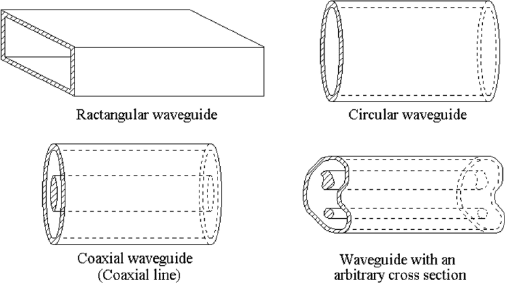
Figure 5.1: Examples of metallic waveguides.
dimensions of the waveguide, and single-mode transmission can be realized
only for frequencies higher than the cutoff frequency of the dominant mode
and lower than that of the next higher mode. This means that, in practice,
metallic waveguides are suitable for centimeter and millimeter wave bands,
i.e., the microwave band. The two-conductor transmission lines including
coaxial lines are also considered as waveguides in which the lowest mode, i.e.,
TEM mode with zero cutoff frequency can be supported as well as TE and
TM modes.
For high frequencies, the dimensions of ordinary lumped-circuit elements
are comparable to wavelengths, and energy will be lost by radiation. In
addition, the resistance of ordinary wire circuits may become high because
of the skin effect. Hence L-C resonant circuits with lumped elements are
no longer suitable for the microwave band. It is suggested that the circuit
should be completely enclosed by a good conductor to prevent radiation, and
the current paths should be made with as large an area as possible to reduce
the resistive loss. The resulting resonant elements for the microwave band is
known as the resonant cavity, which is simply a hollow metallic box with the
electromagnetic energy confined within the box.
5.1 General Characteristics of Metallic
Waveguides
The metallic waveguide discussed in this chapter includes all infinitely-long
cylindrical systems bounded by one or several insulated good conductors.
Some examples of metallic waveguides are given in Fig. 5.1.

5.1 General Characteristics of Metallic Waveguides 237
5.1.1 Ideal-Waveguide Model
Waveguides constructed with good conductor boundaries and filled with low-
loss medium can be approximately analyzed as an ideal waveguide in which
the waveguide walls are considered to be perfect conductors or short-circuit
surfaces and the medium inside the waveguide is considered to be uniform
lossless perfect dielectric material.
According to the general principle given in Section 4.6, the electromag-
netic problem of an infinitely long cylindrical system enclosed by short-circuit
boundaries is a two-dimensional eigenvalue problem. The transverse eigen-
value T
2
of such a problem must be zero or p ositive and the possible modes
in the system are TEM modes and fast-wave modes. In a hollow metallic
waveguide, the only possible modes are fast-wave modes. It will be seen that
the boundary conditions of uniform metallic waveguides can be satisfied by
any one of the TE or TM modes, which means that the TE or TM modes
can exist in the metallic waveguide independently.
TE mode or H mode: U = 0, V 6= 0, or E
z
= 0, H
z
6= 0.
TM mode or E mode: U 6= 0, V = 0, or E
z
6= 0, H
z
= 0.
In the waveguide, some modes are degenerate. The combination of two or
more degenerate modes forms a hybrid mode denoted by HEM mode. Some
hybrid modes have their electric or magnetic fields laid on a longitudinal
section called Longitudinal-section modes denoted by LSE or LSM modes.
5.1.2 Propagation Characteristics
According to the general description of the guided waves in cylindrical sys-
tems given in Section 4.6, the cutoff angular wave number k
c
of a specific
mode is equal to the transverse angular wave number T , which is the eigen-
value of the two-dimensional boundary-value problem and is determined by
the shape and the dimension of the waveguide cross section. The correspond-
ing cutoff angular frequency is ω
c
and the cutoff frequency is f
c
, so we have
k
c
= T, ω
c
=
T
√
µ²
=
cT
√
µ
r
²
r
, f
c
=
T
2π
√
µ²
=
cT
2π
√
µ
r
²
r
. (5.1)
When the frequency is higher than the cutoff frequency of a metallic
waveguide mode, there are standing waves along the transverse coordinates
and traveling waves along the longitudinal coordinate, which is the transmis-
sion state of the mode or guided mode. When the frequency is lower than the
cutoff frequency, there are standing waves along the transverse coordinates
and decaying fields along the longitudinal coordinate, which is the cutoff state
of the mode or cutoff mode. The transverse wavelength in the waveguide is
equal to the wavelength in the dielectric at the cutoff frequency:
λ
T
=
2π
T
=
1
f
c
√
µ²
=
c
f
c
1
√
µ
r
²
r
, (5.2)

238 5. Metallic Waveguides and Resonant Cavities
and the corresponding wavelength in vacuum is known as the cutoff wave-
length or critical wavelength,
λ
c
=
c
f
c
=
2π
T
√
µ
r
²
r
. (5.3)
The waveguide mode is in the propagation state when ω > ω
c
, k > T ,
and the longitudinal propagation constant β = k
z
and the longitudinal phase
velocity v
p
are determined by (4.112) and (4.121), respectively,
β = k
z
= k
r
1 −
T
2
k
2
, v
p
=
ω
β
=
c
√
µ
r
²
r
1
p
1 − T
2
/k
2
. (5.4)
The longitudinal wavelength λ
z
or guided wavelength λ
g
is given by
λ
g
= λ
z
=
2π
β
= λ
1
p
1 − T
2
/k
2
=
λ
0
√
µ
r
²
r
1
p
1 − T
2
/k
2
, (5.5)
where λ is the wavelength of a plane wave in the medium with ² and µ and
λ
0
is that in vacuum. The group velocity in the metallic waveguide in a
propagation state is given by (4.122):
v
g
=
dω
dβ
=
1
√
µ²
r
1 −
T
2
k
2
, (5.6)
and we have
v
p
v
g
=
1
µ²
; in vacuum v
p
v
g
= c
2
. (5.7)
The waveguide mode is in the cutoff state when ω < ω
c
, k < T , and the
longitudinal propagation constant β becomes imaginary. Let jβ = α, then
we have
α = k
r
T
2
k
2
− 1, (5.8)
and the field in the waveguide becomes a decaying field along z. These modes
are known as cutoff modes or evanescent modes.
We have mentioned in Section 4.10.4 that the solutions of Helmholtz’s
equations that satisfy specific boundary conditions in a cylindrical coordinate
system is a complete set of infinite number of normal modes. When the
electromagnetic field with certain frequency exists in the uniform waveguide,
A finite number of modes are guided modes and the rests of them are cutoff
modes or evanescent modes. When a waveguide is excited by a source, or
a imperfection or discontinuity is located in the guide, all guided modes
and evanescent modes are excited to satisfy the boundary conditions of the
waveguide and the source or discontinuity. Guided modes propagate along
the guide to the remote distance while evanescent modes damp out in a short
distance and are localized fields that store reactive energy. These give the
5.1 General Characteristics of Metallic Waveguides 239
0 1 2 3 4
0
1
2
3
4
0 1 2 3 4
0
1
2
3
4
-4 -3 -2 -1 0 1 2 3 4
0
1
2
3
4
v
p
= c
E
= k
(a) v
p
-
Z
, v
g
-
Z
(b) k -
E
k -
D
E
= k
(c) k -
E
diagram
c
ZZ
cv
p
cv
g
cv
cv
g
p
T
D
T
E
TT
DE
Tk
T
E
Tk
E
d
d
g
k
c
v
E
k
c
v
p
Figure 5.2: Dispersion characteristics of a metallic waveguide.
discontinuity its reactive properties, because the characteristic impedance of
cutoff mode is reactive, see Section 5.1.4. If the waveguide is uniform and
infinitely long and the source is located far enough, then only the fields of
the guided modes exist in the guide.
5.1.3 Dispersion Relations
The relation of the phase velocity v
p
versus the frequency f is known as
the dispersion characteristics or dispersion curves of the modes in transmis-
sion system. The normalized dispersion curve of a specific mode in metallic
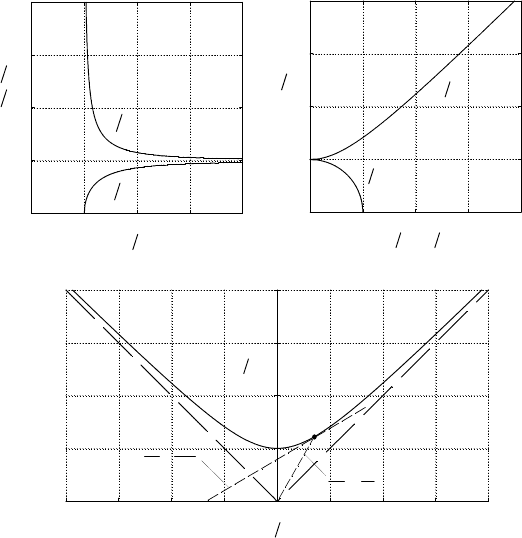
waveguide is shown in Fig. 5.2(a), where the curve of group velocity v
g
is also
given.
The other useful expression for the dispersion characteristics is the ω–β
diagram or the k–β diagram. The normalized k–β diagram for a metallic
waveguides is shown in Fig. 5.2(b), in which, the curve of α versus k below
cutoff is also given.
Phase velocity and group velocity are shown in the ω–β curve simulta-

240 5. Metallic Waveguides and Resonant Cavities
neously. According to the definition of the phase velocity and the group
velocity, the slope of the straight line connected from the origin to a p oint
on the ω–β curve represents the phase velocity v
p
and the slope of the tan-
gential line at that point represents the group velocity v
g
. The slope of the
asymptote of the dispersion curve is the velocity of light in unbounded space
c. The corresponding slopes on the k–β diagram represent v
p
/c and v
g
/c,
respectively, see Fig. 5.2(c). It can be seen from Fig. 5.2(c) that in metallic
waveguides, the phase velocity is always larger than, and group velocity is
always less than the velocity of light c, whereas the directions of the phase
velocity and the group velocity are always the same.
5.1.4 Wave Impedance
The field components of a wave propagating along the +z direction in a
cylindrical waveguide are given by (4.63)–(4.68).
For a uniform plane wave or TEM wave, the ratio of the electric field to the
magnetic field, which are both transverse, is defined as the wave impedance or
characteristic impedance of the transmission system. Similarly, for non-TEM
waves, the wave impedance or characteristic impedance is defined by the ratio
of the transverse component of the electric field to the transverse component
of the magnetic field. The sign of the wave impedance is determined by the
right-hand screw rule in the sequence of E–H–k.
In accordance with (4.65) and (4.68), for a TE mode, U = 0, V 6= 0,
yields
η
TE
=
E
1
H
2
=
ωµ
β
= η
k
β
= η
1
p
1 − T
2
/k
2
, (5.9)
and for a TM mode, U 6= 0, V = 0, yields
η
TM
=
E
1
H
2
=
β
ω²
= η
β
k
= η
r
1 −
T
2
k
2
. (5.10)
According to the right-hand screw rule, from (4.66) and (4.67), we see
that the ratio of E
2
to H
1
becomes a negative wave impedance.
For a guided mode, T
2
< k
2
, β is real and the characteristic impedance
is real or resistive; whereas for a cutoff mode, the characteristic impedance
is imaginary or reactive, since T
2
> k
2
and β becomes imaginary.
5.1.5 Power Flow
The power flow along a metallic waveguide is the surface integral of the
Poynting vector over the cross section of the waveguide:
P =
Z
S
<
1
2
(E × H
∗
) · dS =
1
2
Z
S
(E
1
H
∗
2
− E
2
H
∗
1
) dS.