
Zhang K., Li D. Electromagnetic Theory for Microwaves and Optoelectronics
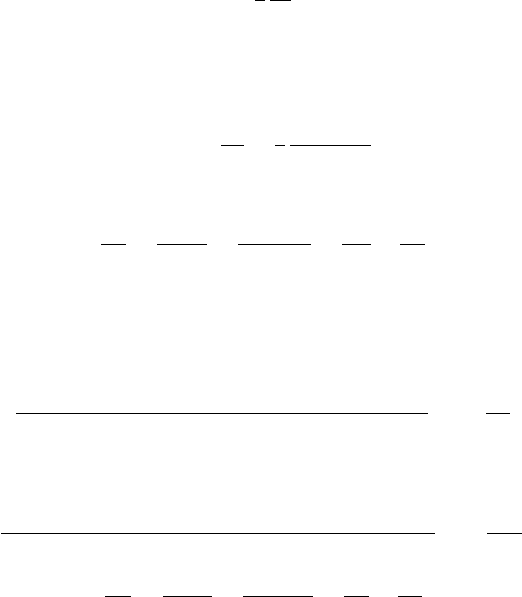
Подождите немного. Документ загружается.

5.1 General Characteristics of Metallic Waveguides 241
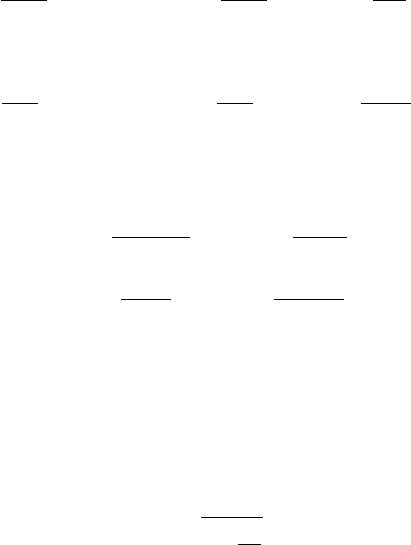
For TE modes, it becomes
P
TE
=
1
2 η
TE
Z
S
¡
E
2
1
+ E
2
2
¢
dS =
1
2 η
TE
Z
S
E
2
T
dS =
η
TE
2
Z
S
H
2
T
dS, (5.11)
and for TM modes
P
TM
=
η
TM
2
Z
S
¡
H
2
1
+ H
2
2
¢
dS =
η
TM
2
Z
S
H
2
T
dS =
1
2 η
TM
Z
S
E
2
T
dS. (5.12)
If we use (4.63)–(4.68), applying Helmholtz’s equations and boundary
conditions, the above expressions, (5.11) and (5.12), become functions of U
and V :
P
TE
=
T
2
β
2
η
TE
2
Z
S
V
2
dS =
β
2
η
TE
2T
2
Z
S
H
2
z
dS, (5.13)
P
TM
=
T
2
β
2
2 η
TM
Z
S
U
2
dS =
β
2
2T
2
η
TM
Z
S
E
2
z
dS. (5.14)
5.1.6 Attenuation
(1) Volume Loss
If the volume loss of the material filling the metallic waveguide is considered,
the angular wave number of the medium becomes complex and the phase
coefficient of the waveguide is also complex. It becomes
˙
β =
˙
k
r
1 −
T
2
k
2
= β − jα, (5.15)
where
˙
k denotes the complex angular wave number of the lossy medium,
given in Section 2.1.3. The imaginary part α is the attenuation coefficient.
The wave will attenuate exponentially along the waveguide.
(2) Surface Loss
The wall of a practical waveguide is made of high-conductivity metal instead
of a perfect conductor. There are power losses on the surface of the wall
and the wave in the waveguide will be attenuated along the direction of
propagation.
The attenuation of the waveguide due to surface loss can be obtained by
solving Helmholtz’s equations with non-perfect conductor boundary condi-
tions, which gives the accurate field solution of the problem, but it is an
onerous task. In practice, for low-loss waveguides made with good conductor
walls, the perturbation technique given as follows is suitable.
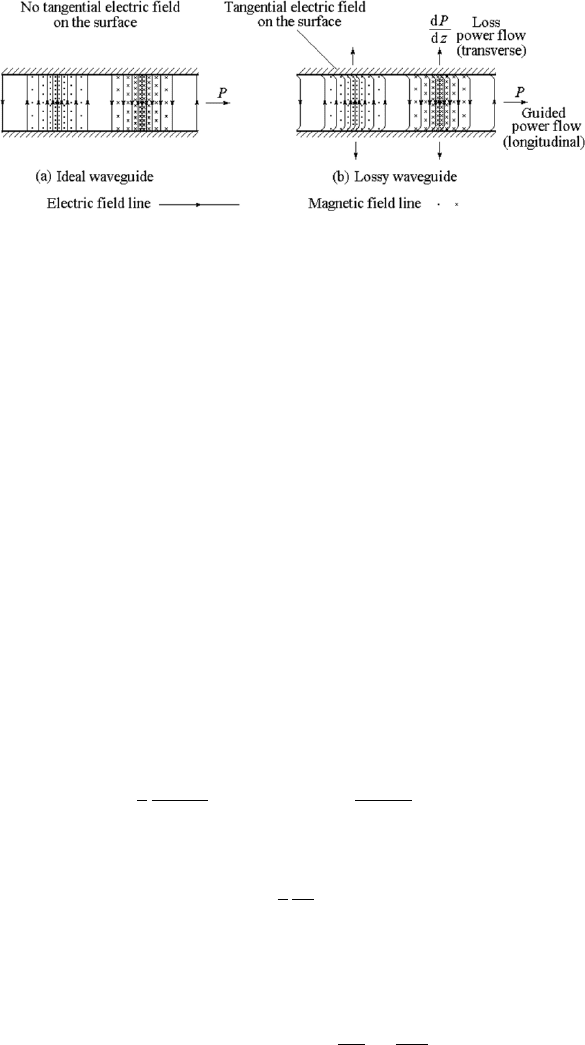
In practical lossy waveguides, the tangential comp onent of the electric
field at the boundary becomes nonzero. The tangential electric field accom-
panied by the tangential magnetic field forms the Poynting vector pointing
242 5. Metallic Waveguides and Resonant Cavities
Figure 5.3: Fields and power flows in an ideal waveguide and a lossy waveg-
uide.
normally into the wall and gives rise to the attenuation. But in ideal waveg-
uides, the tangential component of the electric field at the boundary is always
zero. We recognize that this is the only difference that must be considered,
because it is the difference of a finite value from zero. However, the other
components of the fields in most regions of a lossy waveguide are also differ-
ent from those in an ideal waveguide, but the differences are small enough
for a low-loss waveguide and can be neglected. See Fig. 5.3. Therefore, the
tangential component of the electric field at the boundary of a low-loss waveg-
uide can be obtained by means of the expression for the surface impedance
of a good conductor given in Section 2.1.3 and the value obtained in the
perfect waveguide for the tangential component of the magnetic field. Here,
the plane-wave approximation is used because the penetration depth for a
good conductor is very small compared with the radius of curvature of the
wall, and the Poynting vector is always approximately normal to the good
conductor surface, refer to Section 2.4.9.
The z dependence of the fields in a lossy waveguide with propagation
coefficient γ = α + jβ is e
−jβz
e
−αz
, and the power flow along z is P (z) =
P e
−2αz
. Then we have
α =
1
2
dP/dz
P
[Np/m] = 4.343
dP/dz
P
[dB/m]. (5.16)
The average power flow density normal to the conducting wall is obtained in
Section 2.1.3 as
¯
S =
1
2
1
σδ
H
2
t
, (5.17)
where H
t
denotes the tangential component of the magnetic field at the
surface of the wall, which is obtained approximately by the solution for a
perfect waveguide. The average power flow entering a wall of length dz is
given by
dP = dz
I
l
¯
Sdl, and
dP
dz
=
1
2σδ
I
l
H
2
t
dl
5.2 General Characteristics of Resonant Cavities 243
Substituting it into (5.16) yields
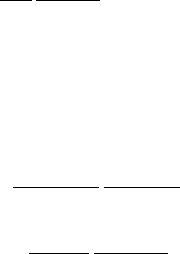
α =
1
4σδ
H
l
H
2
t
dl
P
[Np/m], (5.18)
where l denotes the enclosed boundary curve of the cross section of the inner
wall of the waveguide, P denotes the average power flow along the waveguide
given in the last subsection, σ denotes the conductivity of the wall material,
and δ denotes the skin depth.
Finally, considering (5.11) and (5.12), we have
α
TE
=
T
2
2σδβ
2
η
TE
H
l
H
2
t
dl
R
S
H
2
z
dS
, (5.19)
α
TM
=
T
2
η
TM
2σδβ
2
H
l
H
2
t
dl
R
S
E
2
z
dS
. (5.20)
5.2 General Characteristics of Resonant
Cavities
A lossless electromagnetic system completely enclosed by a short-circuit or
open-circuit surface forms an adiabatic system, which is known as an ideal
resonant cavity or ideal resonator. Practically, a resonant cavity can be a
metallic box with an arbitrary geometry in which the short-circuit boundary
is approximately realized by means of a high-conductivity metal wall.
The electromagnetic problem of an ideal resonant cavity is a typical 3-
dimensional eigenvalue problem. The electromagnetic fields can exist in an
ideal cavity only when the frequency is equal to one of the discrete natural
frequencies or resonant frequencies, which is known as the oscillation mode
of the cavity. In the resonant state, in an ideal resonator, the maximum
electric energy is equal to the maximum magnetic energy stored in the res-
onator. They convert to each other periodically and become electromagnetic
oscillations. No energy is needed to sustain the oscillation because an ideal
resonator is a lossless system.
If the cavity is filled with lossy dielectric material or the loss on the
metallic wall of the cavity is no longer negligible, the oscillation in a source-
free resonator will damp out with respect to time. A source must exist to
compensate the power loss and sustain oscillations, and the discrete natural
frequencies will expand into frequency bands. The frequency response of a
mode of a resonant cavity is the same as that of an L-C resonant circuit.
5.2.1 Modes and Natural Frequencies of the Resonant
Cavity
The natural angular wave number of the mth mode of an ideal resonant
cavity is equal to the mth eigenvalue of the enclosed electromagnetic system
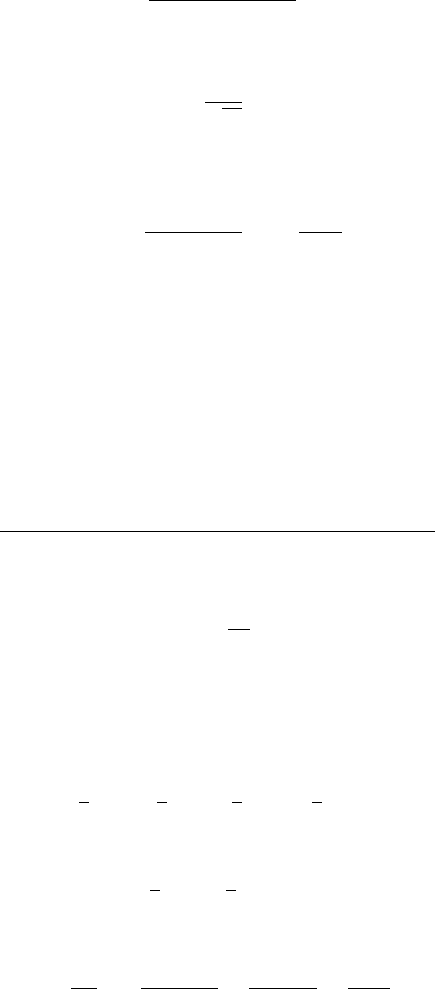
244 5. Metallic Waveguides and Resonant Cavities
given in Section 4.10.2:
k
2
m
=
R
V
|∇ × E
m
|
2
dV
R
V
E
2
m
dV
. (5.21)
The corresponding natural angular frequency is
ω
m
=
k
m
√
µ²
. (5.22)
The fields E
m
and H
m
are the eigenfunctions of the boundary value problem
and satisfy the Maxwell equations. So, (5.21) becomes
k
2
m
= ω
2
µ²
R
V
µH
2
m
dV
R
V
²E
2
m
dV
= k
2
m
W
hm
W
em
.
We have
W
em
= W
hm
.
This is consistent with the result of Poynting’s theorem given in Section 1.4.2.
5.2.2 Losses in a Resonant Cavity, the Q Factor
An important parameter specifying the performances of a resonant circuit is
the quality factor or Q. The general definition of Q that is applicable to all
resonant systems is
Q =
time−average energy stored in the system
energy loss per radian of oscillation in the system
.
For the mth mode of a resonant cavity,
Q
m
= ω
m
W
P
, (5.23)
where ω
m
denotes the natural angular frequency of the mth mode, W denotes
the time-average energy stored in the cavity, and P denotes the power loss,
i.e., the energy loss per unit time interval in the cavity.
The time-average energy density stored in the cavity at the mth mode,
w, is
w =
1
4
µH
2
+
1
4
²E
2
=
1
2
µH
2
=
1
2
²E
2
.
The Joule-loss and polarization-loss densities inside the cavity give
p
V
=
1
2
σE
2
+
1
2
ω²
00
E
2
.
The Q of a cavity due to the volume loss is then given by
Q
V
= ω
W
P
V
= ω
R
V
wdV
R
V
p
V
dV
=
ω²
σ + ω²
00
=
1
tan δ
. (5.24)
5.3 Waveguides and Cavities in Rectangular Coordinates 245
Applying the perturbational technique, we find that the average power
flow density normal to the cavity wall is given in (5.17) as
p
S
=
1
2
1
σδ
H
2
t
,
where H
t
denotes the tangential component of the magnetic field at the
surface of the cavity wall, which is obtained approximately by the solution
for an ideal cavity. The Q of a cavity due to the surface loss is then given by
Q
S
= ω
W
P
S
=
2
δ
R
V
H
2
dV
H
S
H
2
t
dS
. (5.25)
The Q of a cavity due to the total loss becomes
1
Q
0
=
P
0
ω
m
W
=
P
V
+ P
S
ω
m
W
=
1
Q
V
+
1
Q
S
, (5.26)
where Q
0
denotes the Q of an unloaded cavity and is known as the unloaded
quality factor.
When a cavity is coupled to an external load, we define the external
quality factor Q
e
as follows
Q
e
=
time−average energy stored in the cavity
energy loss per radian of oscillation in the load
= ω
m
W
P
L
. (5.27)
The Q factor of the system is known as the loaded quality factor, denoted by
Q
L
, and is given by
Q
L
=
time−average energy stored in the cavity
energy loss per radian of oscillation in the system
=ω
m
W
P
sys
. (5.28)
1
Q
L
=
P
sys
ω
m
W
=
P
0
+ P
L
ω
m
W
=
1
Q
0
+
1
Q
e
. (5.29)
5.3 Waveguides and Cavities in Rectangular
Coordinates
The waveguides and cavities in rectangular coordinates include the rectangu-
lar waveguide, parallel plate transmission line, and rectangular cavity. Their
boundaries coincide with the coordinate planes of the rectangular coordinate
system.
5.3.1 Rectangular Waveguides
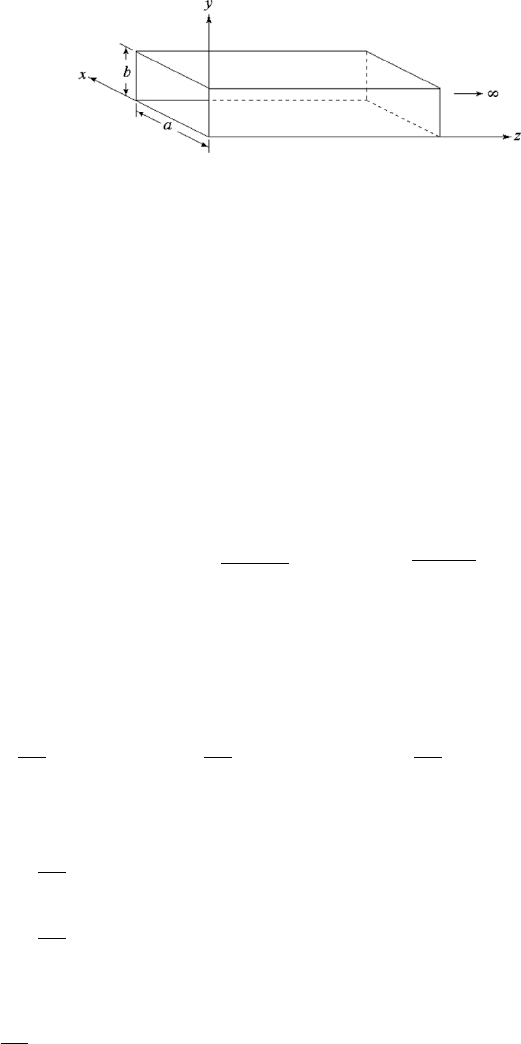
The rectangular waveguide is a metallic pipe with a rectangular cross section.
See Fig. 5.4. The transverse dimensions of the waveguide are a and b in the
x and y directions, respectively. It is uniform and infinitely long in the
longitudinal direction z.
246 5. Metallic Waveguides and Resonant Cavities
Figure 5.4: Rectangular waveguide.
(1) TE Modes
For the TE mode, U = 0. The function V (x, y, z) was given in (4.132)–
(4.134) or (4.138)–(4.140). As the fields in the waveguide are standing waves
along x, y and traveling waves along +z, the functions X(x) and Y (y) must be
sinusoidal functions and Z(z) must be an exponential function with imaginary
argument.
V (x, y, z) = X(x)Y (y)Z(z)
= (A sin k
x
x + B cos k
x
x)(C sin k
y
y + D cos k
y
y)e
−jβz
, (5.30)
where β = k
z
denotes the longitudinal phase coefficient, and
β = k
z
=
p
k
2
− T
2
, T =
q
k
2
x
+ k
2
y
. (5.31)
The above V (x, y, z) satisfies Helmholtz’s equation, and the next step is to
satisfy the boundary conditions.
The boundary conditions of function V on the boundary of the waveguide
is given from Section 4.4 as
∂V
∂n
¯
¯
¯
¯
S
= 0, i.e.,
∂V
∂x
¯
¯
¯
¯
x=0,a
= 0 and
∂V
∂y
¯
¯
¯
¯
y =0,b
= 0. (5.32)
Taking the derivatives of (5.30), we have
∂V
∂x
= k
x
(A cos k
x
x − B sin k
x
x)(C sin k
y
y + D cos k
y
y)e
−jβz
,
∂V
∂y
= k
y
(A sin k
x
x + B cos k
x
x)(C cos k
y
y − D sin k
y
y)e
−jβz
.
Substituting them into the boundary equations (5.32) yields
∂V
∂x
¯
¯
¯
¯
x=0
= 0 −→ A = 0, (5.33)
5.3 Waveguides and Cavities in Rectangular Coordinates 247
∂V
∂x
¯
¯
¯
¯
x=a
= 0 −→ sin k
x
a = 0, k
x
=
mπ
a
, m is an integer, (5.34)
∂V
∂y
¯
¯
¯
¯
y =0
= 0 −→ C = 0, (5.35)
∂V
∂y
¯
¯
¯
¯
y =b
= 0 −→ sin k
y
b = 0, k
y
=
nπ
b
, n is an integer. (5.36)
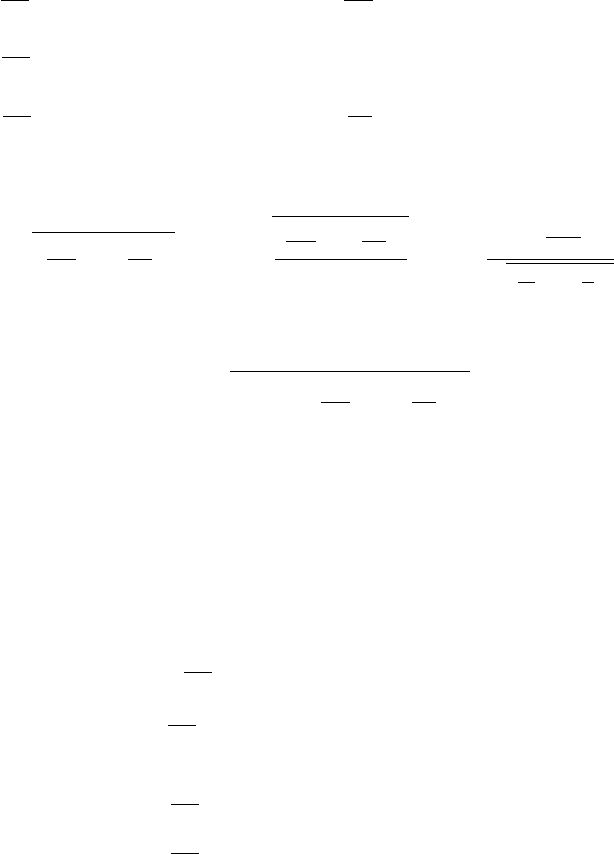
The expressions for T , ω
c
, and λ
c
become
T =
r
³
mπ
a
´
2
+
³
nπ
b
´
2
, ω
c
=
v
u
u
t
¡
mπ
a
¢
2
+
¡
nπ
b
¢
2
µ²
, λ
c
=
2
√
µ
r
²
r
q
¡
m
a
¢
2
+
¡
n
b
¢
2
.
(5.37)
The expression for β becomes
β = k
z
=
s
ω
2
µ² −
·
³
mπ
a
´
2
+
³
nπ
b
´
2
¸
. (5.38)
Substituting (5.33)–(5.36) into (5.30) gives
V (x, y, z) = V
0
cos(k
x
x) cos(k
y
y)e
−jβz
, (5.39)
where V
0
= BD.
Substituting (5.39) into the expressions for the transverse field compo-
nents, (4.147)–(4.152), and considering U = 0 yields
E
x
= −jωµ
∂V
∂y
= jωµk
y
V
0
cos(k
x
x) sin(k
y
y) e
−jβz
, (5.40)
E
y
= jωµ
∂V
∂x
= −jωµk
x
V
0
sin(k
x
x) cos(k
y
y) e
−jβz
, (5.41)
E
z
= T
2
U = 0, (5.42)
H
x
= −jβ
∂V
∂x
= jβk
x
V
0
sin(k
x
x) cos(k
y
y) e
−jβz
, (5.43)
H
y
= −jβ
∂V
∂y
= jβk
y
V
0
cos(k
x
x) sin(k
y
y) e
−jβz
, (5.44)
H
z
= T
2
V =
¡
k
2
x
+ k
2
y
¢
V
0
cos(k
x
x) cos(k
y
y) e
−jβz
. (5.45)
In the above expressions, m and n are arbitrary integers. A set of specific m
and n represents a mode denoted by TE
mn
. It can be seen from (5.40)–(5.45)
that one of m or n can be zero, to form the TE
m0
and TE
0n
modes, but m
and n cannot both be zero, if so, all field comp onents would be zero.
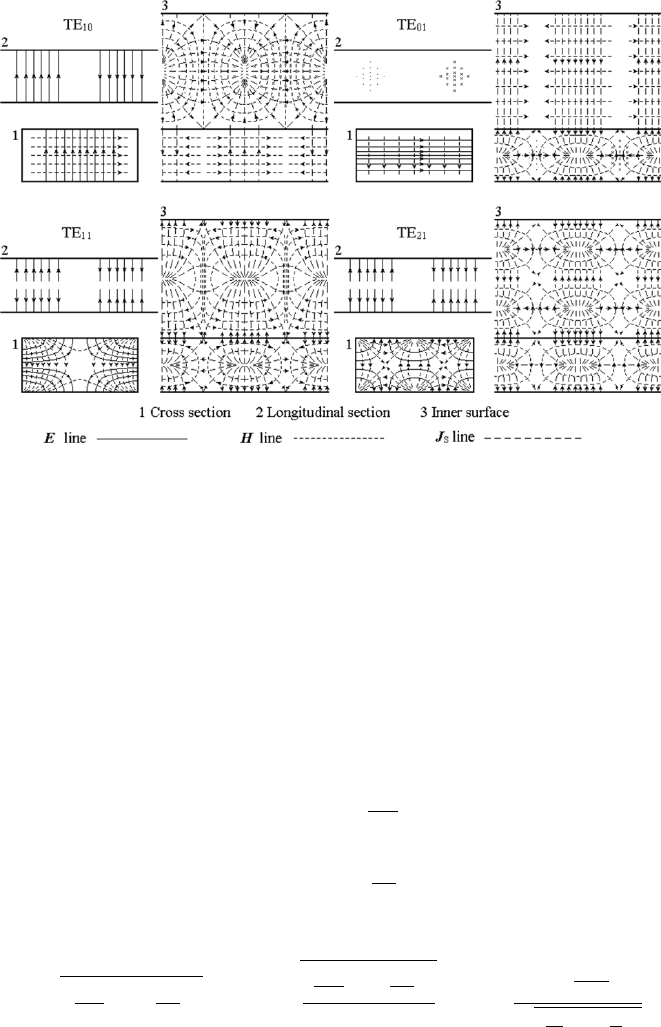
Field maps of some low-order TE modes are given in Figure 5.5.
248 5. Metallic Waveguides and Resonant Cavities
Figure 5.5: Field maps of TE modes in a rectangular waveguide.
(2) TM Modes
For the TM mode, V = 0. The function U (x, y, z) is given by
U(x, y, z) = X(x)Y (y)Z(z)
= (A sin k
x
x + B cos k
x
x)(C sin k
y
y + D cos k
y
y)e
−jβz
. (5.46)
The boundary conditions for function U on the boundary of the transverse
cross section are given from Section 4.4 as follows:
U|
x=0
= 0 −→ B = 0, (5.47)
U|
x=a
= 0 −→ sin k
x
a = 0, k
x
=
mπ
a
, m is an integer, (5.48)
U|
y =0
= 0 −→ D = 0, (5.49)
U|
y =b
= 0 −→ sin k
y
b = 0, k
y
=
nπ
b
, n is an integer. (5.50)
The expressions for T , ω
c
, λ
c
and β become
T =
r
³
mπ
a
´
2
+
³
nπ
b
´
2
, ω
c
=
v
u
u
t
¡
mπ
a
¢
2
+
¡
nπ
b
¢
2
µ²
, λ
c
=
2
√
µ
r
²
r
q
¡
m
a
¢
2
+
¡
n
b
¢
2
.
(5.51)
5.3 Waveguides and Cavities in Rectangular Coordinates 249
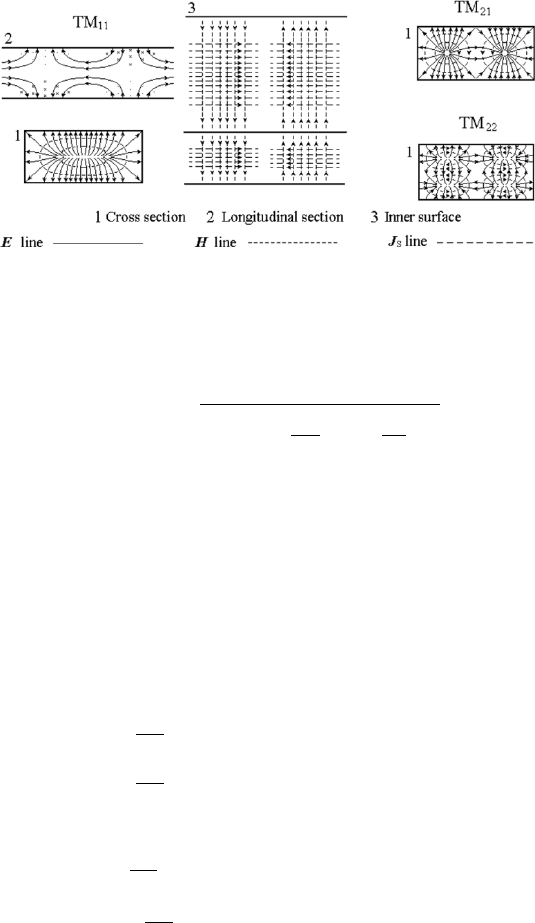
Figure 5.6: Field maps of TM modes in a rectangular waveguide.
The expression for β becomes
β = k
z
=
s
ω
2
µ² −
·
³
mπ
a
´
2
+
³
nπ
b
´
2
¸
. (5.52)
The above expressions for cutoff condition and dispersion are the same as
those for TE modes given in (5.37) and (5.38).
Substituting (5.47)–(5.50) into (5.46) gives
U(x, y, z) = U
0
sin(k
x
x) sin(k
y
y)e
−jβz
, (5.53)
where U
0
= AC.
Substituting (5.53) into the expressions for the transverse field compo-
nents, (4.147)–(4.152), and considering V = 0 yields
E
x
= −jβ
∂U
∂x
= −jβk
x
U
0
cos(k
x
x) sin(k
y
y) e
−jβz
, (5.54)
E
y
= −jβ
∂U
∂y
= −jβk
y
U
0
sin(k
x
x) cos(k
y
y) e
−jβz
, (5.55)
E
z
= T
2
U =
¡
k
2
x
+ k
2
y
¢
U
0
sin(k
x
x) sin(k
y
y) e
−jβz
, (5.56)
H
x
= jω²
∂U
∂y
= jω²k
y
U
0
sin(k
x
x) cos(k
y
y) e
−jβz
, (5.57)
H
y
= −jω²
∂U
∂x
= −jω²k
x
U
0
cos(k
x
x) sin(k
y
y) e
−jβz
, (5.58)
H
z
= T
2
V = 0. (5.59)
The field maps of some low-order TM modes are given in Fig. 5.6.
A set of sp ecific m and n represents a TM
mn
mode. It can be seen from
(5.54)–(5.59) that all field components will be zero when m or n is zero. So m
250 5. Metallic Waveguides and Resonant Cavities
0.0 .5 1.0 1.5 2.0 2.5 3.0
0.0
.5
1.0
1.5
2.0
2.5
3.0
TE10
TE01
TE20
TE02
TE30
TE03
TE11 TM11
TE21
TM21
TE12 TM12
TE31
TM31
TE13 TM13
22
32
23
TE33
TM33
a
O
b
O
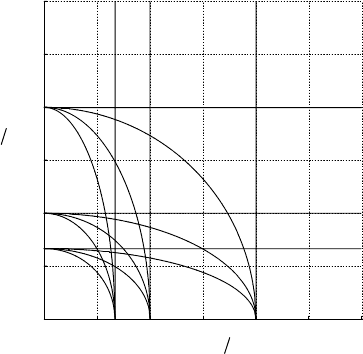
Figure 5.7: Mode distribution in a rectangular waveguide.
and n are both nonzero integers for TM modes, and TM
m0
and TM
0n
modes
cannot exist in rectangular waveguides. The cutoff angular wave number
k
c
= T and the phase coefficient β are the same for TE
mn
modes and TM
mn
modes, so the TE and TM modes with the same m, n are degenerate modes.
(3) Propagation Characteristics
Substituting the formula of T in (5.37) or (5.51) into (5.1), (5.3), (5.4), (5.5),
(5.6), and (5.8), we have the cutoff angular frequency ω
c
, cutoff wavelength
λ
c
, phase velocity v
p
, guided wavelength λ
g
, group velocity v
g
, and the cutoff
attenuation coefficient α of a sp ecific mode in the rectangular waveguide.
The distribution of the cutoff wavelengths of some lower-order modes in
rectangular waveguides is given in Fig. 5.7, and the dispersion curves (f - β
diagram) are given in Fig. 5.8.
If the width in the x direction is larger than the height in the y direction of
a rectangular waveguide, a > b, the cutoff frequency of the TE
10
mode is the
lowest one, namely the lowest-order mode. When the height in the y direction
is less than the half-width in the x direction, b < a/2, the TE
20
mode is the
next lower-order mode, and when the height in the y direction is larger than
the half-width in the x direction, b > a/2, the TE
01
mode becomes the next
lower-order mode. When the frequency is higher than the cutoff frequency of
the lowest-order mode, and lower than the cutoff frequency of the next lower-
order mode, the lowest-order mode becomes the only propagating mode. This
is known as the single-mode state of a transmission system. In a rectangular
waveguide, single mode propagation can be realized only with the TE
10
mode,
which is known as the dominant mode or principal mode.