
Zhang K., Li D. Electromagnetic Theory for Microwaves and Optoelectronics
Подождите немного. Документ загружается.

5.3 Waveguides and Cavities in Rectangular Coordinates 261
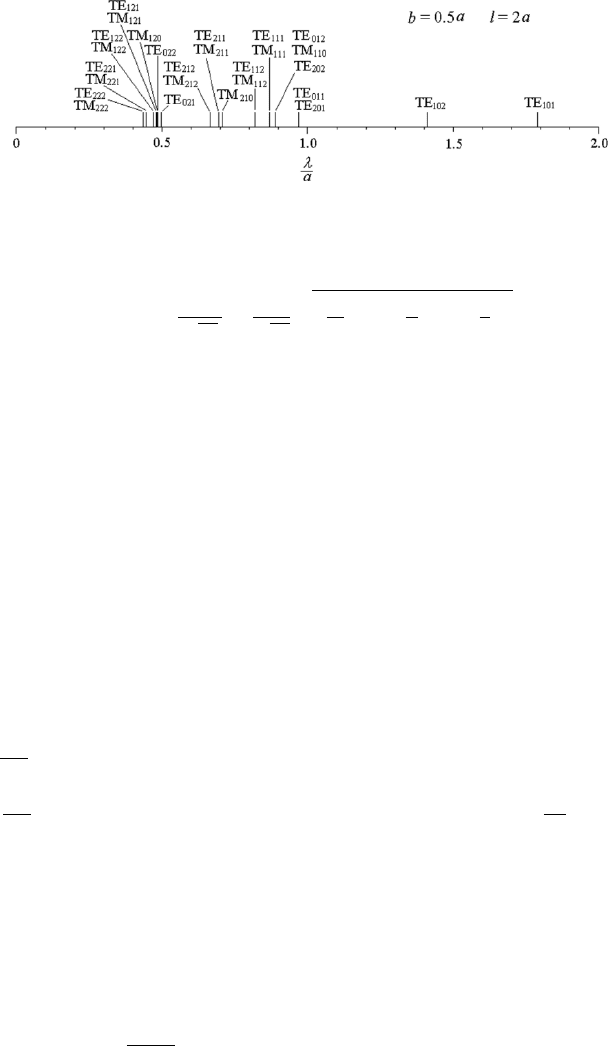
Figure 5.17: Mode spectrum of a rectangular resonant cavity.
ω
mnp
=
k
mnp
√
µ²
=
π
√
µ²
r
³
m
a
´
2
+
³
n
b
´
2
+
³
p
l
´
2
. (5.109)
It can be seen from (5.102)–(5.107) that one of m and n is allowed to be
zero but p is not allowed to be zero. So the TE
101
mode is the lowest TE
mode when a > b. The distribution of the natural wavelength is shown in
Figure 5.17.
(2) TM Modes
The function V is zero and
U(x, y, z) = X(x)Y (y)Z(z)
= (A sin k
x
x + B cos k
x
x)(C sin k
y
y + D cos k
y
y)
¡
F e
jk
z
z
+ Ge
−jk
z
z
¢
.(5.110)
The boundary conditions on the walls at x = 0, x = a, y = 0, and y = b
are given in (5.47)–(5.50). The boundary conditions of function U on the
short-circuit surface at z = 0 and z = l are given by
∂U
∂z
¯
¯
¯
¯
z=0
= 0 −→ jk
z
F − jk
z
G = 0, G = F, (5.111)
∂U
∂z
¯
¯
¯
¯
z=l
= 0 −→ jk
z
¡
e
jk
z
l
− e
−jk
z
l
¢
= −2k
z
sin k
z
l = 0, k
z
=
pπ
l
, (5.112)
where p is an integer. Substituting (5.47)–(5.50) and (5.111) and (5.112) into
(5.110), let U
0
= 2ACF , gives
U(x, y, z) = U
0
sin(k
x
x) sin(k
y
y) cos(k
z
z), (5.113)
The field components are given by (4.141)–(4.146):
E
x
=
∂
2
U
∂x ∂z
= −k
x
k
z
U
0
cos(k
x
x) sin(k
y
y) sin(k
z
z), (5.114)
262 5. Metallic Waveguides and Resonant Cavities
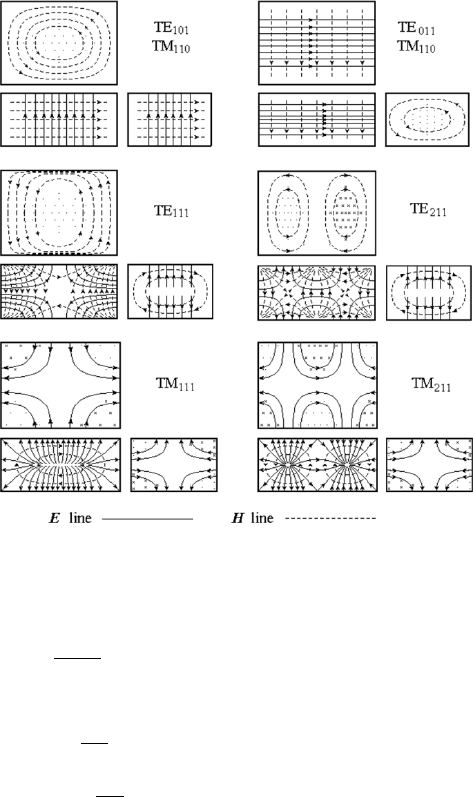
Figure 5.18: Field maps in a rectangular resonant cavity.
E
y
=
∂
2
U
∂y ∂z
= −k
y
k
z
U
0
sin(k
x
x) cos(k
y
y) sin(k
z
z), (5.115)
E
z
= T
2
U =
¡
k
2
x
+ k
2
y
¢
U
0
sin(k
x
x) sin(k
y
y) cos(k
z
z), (5.116)
H
x
= jω²
∂U
∂y
= jω²k
y
U
0
sin(k
x
x) cos(k
y
y) cos(k
z
z), (5.117)
H
y
= −jω²
∂U
∂x
= −jω²k
x
U
0
cos(k
x
x) sin(k
y
y) cos(k
z
z), (5.118)
H
z
= T
2
V = 0, (5.119)
where k
x
= mπ/a, k
y
= nπ/b and k
z
= pπ/l. They are the same as those for
TE modes. Then the natural angular wave number and the natural angular
frequency are also the same as those for TE modes given in (5.108) and
(5.109). So the TE
mnp
and TM
mnp
modes are degenerate modes. It can be
seen from (5.114)–(5.119) that neither m nor n is allowed to be zero but p is
allowed to be zero. So the TM
110
mode is the lowest TM mode.
A typical mode spectrum of a rectangular cavity is shown in Figure 5.17.
The field maps of some low-order modes are given in Fig. 5.18.
5.3 Waveguides and Cavities in Rectangular Coordinates 263
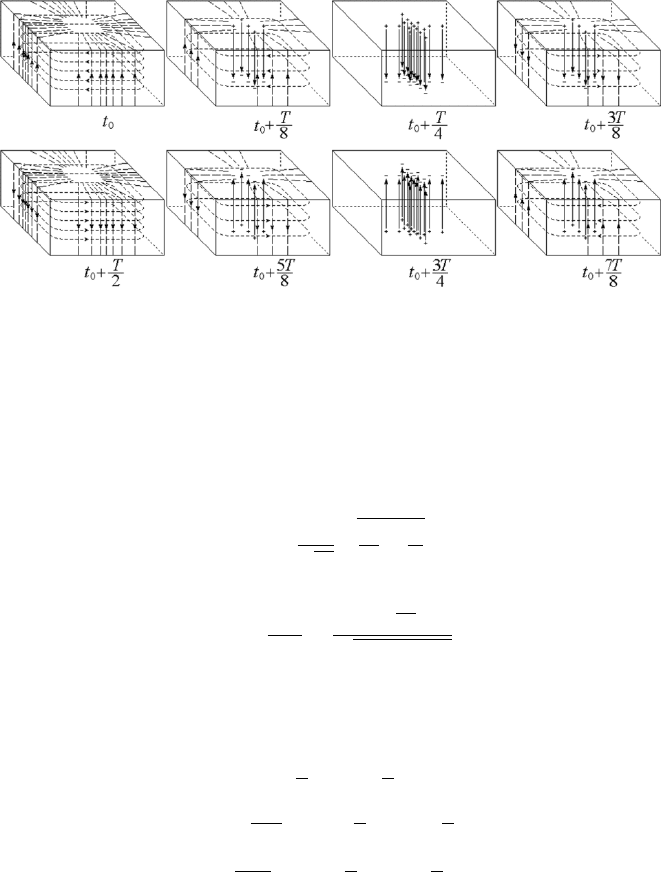
Figure 5.19: Instantaneous fields of the TE
101
mode in a rectangular cavity.
(3) The Dominant Mode
For a cavity with a > b and l > b, the TE
101
is the lowest mo de or dominant
mode, and the natural frequency and the natural wavelength are
ω
101
=
π
√
µ²
r
1
a
2
+
1
l
2
, (5.120)
λ
101
=
c
f
101
=
2
√
µ²
p
1/a
2
+ 1/l
2
. (5.121)
Putting m = 1, n = 0, p = 1 into (5.102)–(5.107), we have the field compo-
nents of the TE
101
mode
E
y
= E
0
sin
³
π
a
x
´
sin
³
π
l
z
´
, (5.122)
H
x
= −j
π
ωµl
E
0
sin
³
π
a
x
´
cos
³
π
l
z
´
, (5.123)
H
z
= j
π
ωµa
E
0
cos
³
π
a
x
´
sin
³
π
l
z
´
. (5.124)
The instantaneous fields of the TE
101
mode in a rectangular cavity with
respect to time are shown in Figure 5.19. It can be seen that the difference
between the phases of the electric and magnetic fields is π/2. The energy is
stored in the electric field and the magnetic field alternatively.
If we consider y as the longitudinal axis, the dominant mode becomes
TM
110
.
264 5. Metallic Waveguides and Resonant Cavities
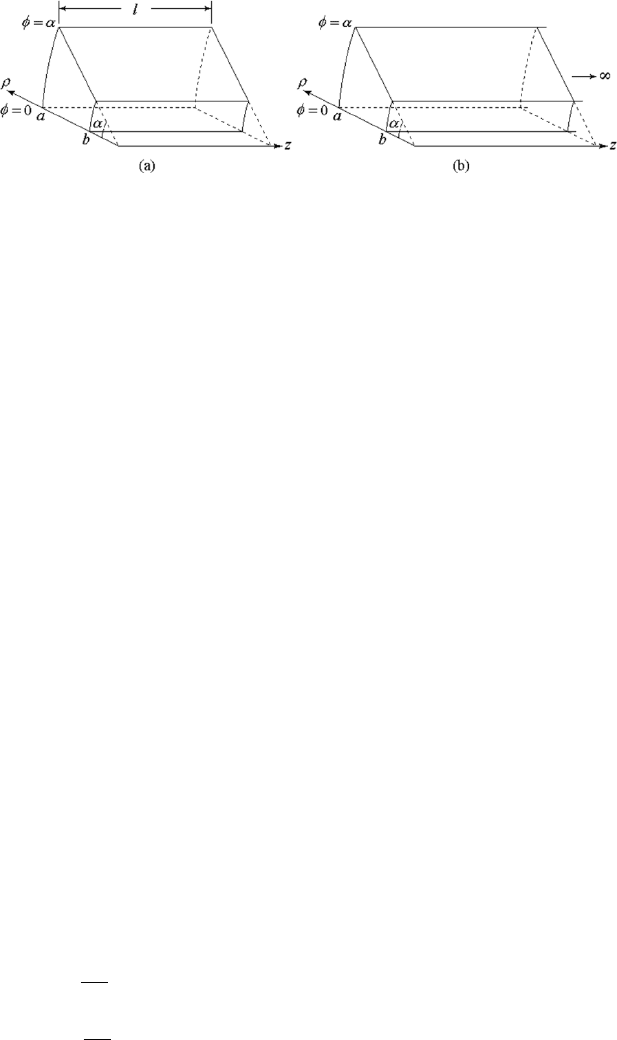
Figure 5.20: (a) Sectorial cavity and (b) sectorial waveguide.
5.4 Waveguides and Cavities in Circular
Cylindrical Coordinates
The waveguides and cavities in the circular cylindrical coordinates include
the circular waveguide and circular cylindrical cavity, coaxial line and coaxial
cavity, sectorial waveguide and sectorial cavity, radial transmission line, and
cylindrical horn waveguide.
5.4.1 Sectorial Cavities
The most general metallic electromagnetic structure in circular cylindrical
system is the sectorial cross-sectional cylindrical cavity, shown in Fig. 5.20(a).
(1) TM Modes or E Modes
In circular cylindrical coordinates, for TM modes, V (ρ, φ, z) = 0, and
U (ρ, φ, z) = R(ρ)Φ(φ)Z(z)
= [AJ
ν
(T ρ) + BN
ν
(T ρ)]
¡
Ce
jνφ
+ De
−jνφ
¢¡
F e
jβz
+ Ge
−jβz
¢
, (5.125)
where
β = k
z
, β
2
+ T
2
= k
2
= ω
2
µ². (5.126)
The boundary condition for function U on the short-circuit surfaces are
U|
ρ=a
= 0 −→ R(a) = AJ
ν
(T a) + BN
ν
(T a) = 0, (5.127)
U|
ρ=b
= 0 −→ R(b) = AJ
ν
(T b) + BN
ν
(T b) = 0, (5.128)
U|
φ=0
= 0 −→ Φ(0) = C + D = 0, D = −C, (5.129)
U|
φ=α
= 0 −→ Φ(α) = Ce
jνα
+ De
−jνα
= 0, (5.130)
∂U
∂z
¯
¯
¯
¯
z=0
= 0 −→ Z
0
(0) = jβ(F − G) = 0, G = F, (5.131)
∂U
∂z
¯
¯
¯
¯
z=l
= 0 −→ Z
0
(l) = jβ
¡
F e
jβl
− Ge
−jβl
¢
= 0. (5.132)

5.4 Waveguides and Cavities in Circular Cylindrical Coordinates 265
From (5.129) and (5.130), we have
C
¡
e
jνα
− e
−jνα
¢
= 0, sin να = 0, ν =
nπ
α
, n is an integer. (5.133)
From (5.131) and (5.132), we have
F
¡
e
jβl
− e
−jβl
¢
= 0, sin βl = 0, β =
pπ
l
, p is an integer. (5.134)
Finally, from (5.127) and (5.128), we have
B = −A
J
ν
(T a)
N
ν
(T a)
, (5.135)
and
J
ν
(T b)N
ν
(T a) − J
ν
(T a)N
ν
(T b) = 0. (5.136)
This is the eigenvalue equation or characteristic equation of the TM mode in
a sectorial cavity, which is a transcendental equation of the Bessel functions
of the νth order and has infinite discrete roots. The mth root of the equation
of the νth order is denoted by T
TM
νm
.
The natural angular wave numbers and the natural angular frequencies
can then be found from the resonant conditions (5.133), (5.134), and (5.136)
as follows:
k
TM
νmp
=
q
β
2
p
+ T
2
TM
νm
, ω
TM
νmp
=
1
√
µ²
q
β
2
p
+ T
2
TM
νm
. (5.137)
Applying the above results into (5.125) gives
U(ρ, φ, z) = U
0
[N
ν
(T a)J
ν
(T ρ) − J
ν
(T a)N
ν
(T ρ)] sin(νφ) cos(βz), (5.138)
where U
0
= 4jACF/N
ν
(T a).
Substituting (5.138) into the expressions for the field components in cir-
cular cylindrical coordinates in terms of Borgnis’ potentials, (4.190)–(4.195),
we have
E
ρ
= −βT U
0
[N
ν
(T a)J
0
ν
(T ρ)−J
ν
(T a)N
0
ν
(T ρ)] sin(νφ) sin(βz), (5.139)
E
φ
= −
βν
ρ
U
0
[N
ν
(T a)J
ν
(T ρ)−J
ν
(T a)N
ν
(T ρ)] cos(νφ) sin(βz), (5.140)
E
z
= T
2
U
0
[N
ν
(T a)J
ν
(T ρ)−J
ν
(T a)N
ν
(T ρ)] sin(νφ) cos(βz), (5.141)
H
ρ
=
jω²ν
ρ
U
0
[N
ν
(T a)J
ν
(T ρ)−J
ν
(T a)N
ν
(T ρ)] cos(νφ) cos(βz), (5.142)
H
φ
= −jω²T U
0
[N
ν
(T a)J
0
ν
(T ρ)−J
ν
(T a)N
0
ν
(T ρ)] sin(νφ) cos(βz),(5.143)
H
z
= 0. (5.144)
It can be seen from (5.133) that ν is not necessarily an integer, so the
Bessel functions in the field expressions are not necessarily with integer order.
The TM
νm
modes are also denoted by E
νm
modes, because only electric
fields have longitudinal components in the waneguide.

266 5. Metallic Waveguides and Resonant Cavities
(2) TE Modes or H Modes
For TE modes, U(ρ, φ, z) = 0, and
V (ρ, φ, z) = R(ρ)Φ(φ)Z(z)
= [AJ
ν
(T ρ) + BN
ν
(T ρ)]
¡
Ce
jνφ
+ De
−jνφ
¢¡
F e
jβz
+ Ge
−jβz
¢
, (5.145)
where
β = k
z
, β
2
+ T
2
= k
2
= ω
2
µ². (5.146)
The boundary conditions for function V on the short-circuit surfaces are
as follows:
∂V
∂ρ
¯
¯
¯
¯
ρ=a
= 0 −→ R
0
(a) = AJ
0
ν
(T a) + BN
0
ν
(T a) = 0, (5.147)
∂V
∂ρ
¯
¯
¯
¯
ρ=b
= 0 −→ R
0
(b) = AJ
0
ν
(T b) + BN
0
ν
(T b) = 0, (5.148)
∂V
∂φ
¯
¯
¯
¯
φ=0
= 0 −→ Φ
0
(0) = C − D = 0, D = C, (5.149)
∂V
∂φ
¯
¯
¯
¯
φ=α
= 0 −→ Φ
0
(α) = Ce
jνα
− De
−jνα
= 0, (5.150)
V |
z=0
= 0 −→ Z(0) = F + G = 0, G = −F, (5.151)
V |
z=l
= 0 −→ Z(l) = F e
jβl
+ Ge
−jβl
= 0. (5.152)
From the above boundary equations, we have
ν =
nπ
α
, n is an integer, β =
pπ
l
, p is an integer, (5.153)
B = −A
J
0
ν
(T a)
N
0
ν
(T a)
, (5.154)
and
J
0
ν
(T b)N
0
ν
(T a) − J
0
ν
(T a)N
0
ν
(T b) = 0. (5.155)
This is the eigenvalue equation of the TE modes in a sectorial cavity; The
mth root of the equation of νth order is denoted by T
TE
νm
.
The natural angular wave numbers and the natural angular frequencies
can then be found from the resonant conditions (5.153) and (5.155) as follows
k
TE
νmp
=
q
β
2
p
+ T
2
TE
νm
, ω
TE
νmp
=
1
√
µ²
q
β
2
p
+ T
2
TE
νm
. (5.156)
Substituting the above results into (5.145) gives
V (ρ, φ, z) = V
0
[N
0
ν
(T a)J
ν
(T ρ) − J
0
ν
(T a)N
ν
(T ρ)] cos(νφ) sin(βz), (5.157)
where U
0
= 4jACF/N
ν
(T a).

5.4 Waveguides and Cavities in Circular Cylindrical Coordinates 267
Substituting (5.157) into the expressions for the field components in cir-
cular cylindrical coordinates (4.190)–(4.195), we have
E
ρ
=
jωµν
ρ
V
0
[N
0
ν
(T a)J
ν
(T ρ)−J
0
ν
(T a)N
ν
(T ρ)] sin(νφ) cos(βz), (5.158)
E
φ
= jωµT V
0
[N
0
ν
(T a)J
0
ν
(T ρ)−J
0
ν
(T a)N
0
ν
(T ρ)] cos(νφ) sin(βz), (5.159)
E
z
= 0, (5.160)
H
ρ
= βT V
0
[N
0
ν
(T a)J
0
ν
(T ρ)−J
0
ν
(T a)N
0
ν
(T ρ)] cos(νφ) cos(βz), (5.161)
H
φ
= −
βν
ρ
V
0
[N
0
ν
(T a)J
ν
(T ρ)−J
0
ν
(T a)N
ν
(T ρ)] sin(νφ) cos(βz), (5.162)
H
z
= T
2
V
0
[N
0
ν
(T a)J
ν
(T ρ)−J
0
ν
(T a)N
ν
(T ρ)] cos(νφ) sin(βz). (5.163)
The TE
νm
modes are also denoted by H
νm
modes, because only magnetic
fields have longitudinal components in the waneguide.
The fields in a sectorial cavity are standing waves in three directions, the
ρ dependence is a cylindrical standing wave represented by Bessel functions.
The sectorial cavity is the general electromagnetic structure in circular
cylindrical coordinates. The other waveguides and cavities of cylindrical ge-
ometry can be developed from it by giving special dimensions and angles.
5.4.2 Sectorial Waveguides
If the system is unbounded in the longitudinal direction, z, it becomes a sec-
torial waveguide, see Fig. 5.20(b). The boundary equations (5.131), (5.132),
(5.151), and (5.152) at z = 0 and z = l are no longer valid, β becomes a
continuous value. Considering the traveling wave along +z in an infinitely
long waveguide; we have the function U of the TM modes,
U(ρ, φ, z) = U
0
[N
ν
(T a)J
ν
(T ρ) − J
ν
(T a)N
ν
(T ρ)] sin(νφ)e
−jβz
, (5.164)
and the function V of the TE modes,
V (ρ, φ, z) = V
0
[N
0
ν
(T a)J
ν
(T ρ) − J
0
ν
(T a)N
ν
(T ρ)] cos(νφ)e
−jβz
. (5.165)
The field components can then be obtained by substituting one of the above
two expressions into (4.196)–(4.201).
The eigenvalue equations for sectorial waveguides are the same as those
for sectorial cavities, (5.136) for TM modes and (5.155) for TE modes. The
eigenvalue equation or characteristic equation is also known as the dispersion
equation for the transmission system. The mth root of (5.136) for the νth
order is the cutoff angular wave number for the TM
νm
mode, denoted by
T
TM
νm
, and the mth root of (5.155) for the νth order is the cutoff angular
wave number for the TE
νm
mode, denoted by T
TE
νm
. The longitudinal phase
coefficient is then given by
β
2
TM
νm
=k
2
−T
2
TM
νm
= ω
2
µ² −T
2
TM
νm
, (5.166)
268 5. Metallic Waveguides and Resonant Cavities
Figure 5.21: Field maps in a sectorial waveguide.
β
2
TE
νm
=k
2
−T
2
TE
νm
= ω
2
µ² −T
2
TE
νm
. (5.167)
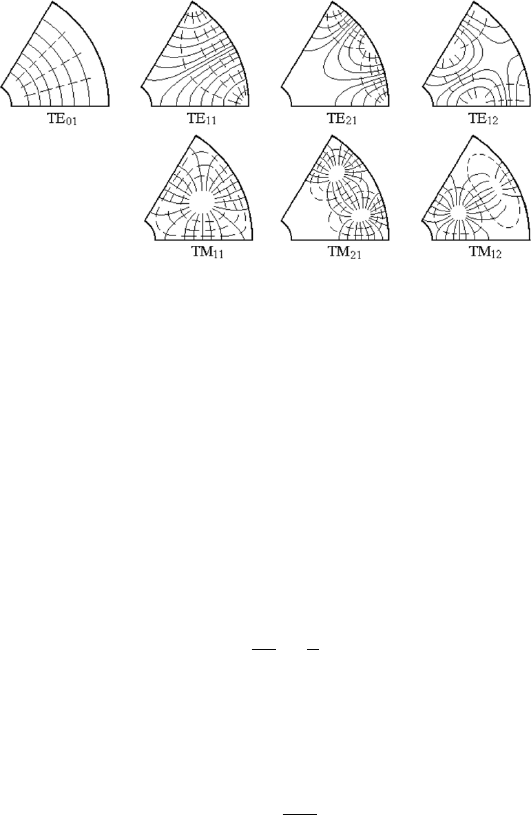
The field maps for some lower-order modes in the cross section of the
sectorial waveguide are shown in Fig. 5.21. The field distributions are similar
to those for rectangular waveguides, especially when a − b ¿ a and α ¿ 2π.
The lowest mode is TE
01
when α is small and a − b is large, on the
contrary, the lowest mode becomes TE
11
when α is large and a − b is small.
5.4.3 Coaxial Lines and Coaxial Cavities
If the sectorial angle of the sectorial waveguide is enlarged to α = 2π, then ν
becomes
ν =
nπ
α
=
n
2
.
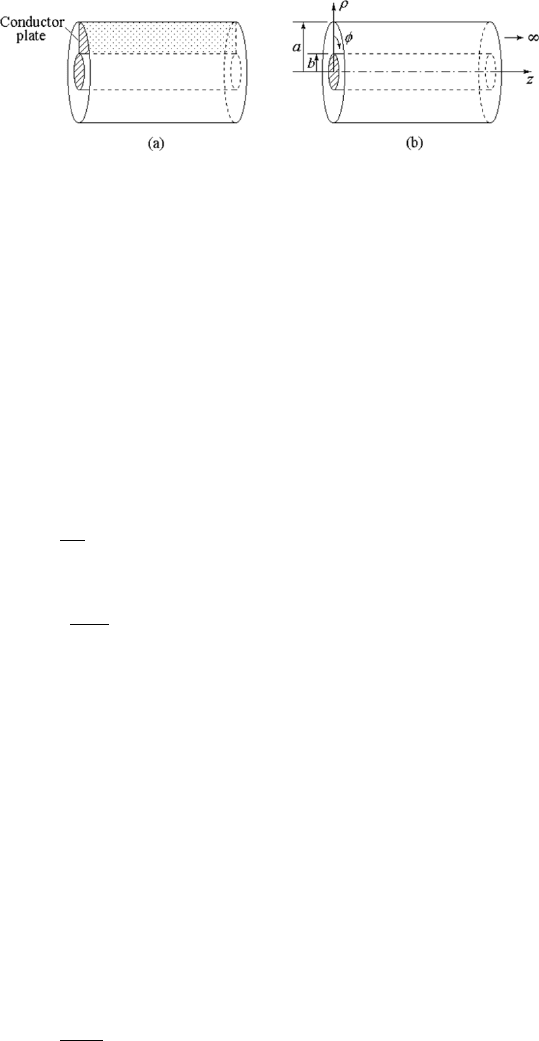
This is not a coaxial line but a coaxial line with a conducting plate in a plane
of equal φ, as shown in Fig. 5.22(a).
In a coaxial line shown in Fig. 5.22(b), the field must be continuous around
the whole circle, and ν must satisfy
ν(φ + α) = νφ + 2nπ, ν =
2nπ
α
= n, n = 0, 1, 2 ···.
The radial functions of the fields become Bessel functions with integer order.
and the angular functions of the fields become cos nφ or sin nφ or the linear
combination of them, which depends upon the choice of the initial orientation
of the coordinate φ.
(1) TM and TE Modes in Coaxial Lines
In problems including the whole circumference, the orientation of φ = 0 can
be chosen arbitrarily. Here, the orientation of φ = 0 is chosen so that the
5.4 Waveguides and Cavities in Circular Cylindrical Coordinates 269
Figure 5.22: (a) Sectorial waveguide with α = 2π, and (b) a coaxial line.
Borgnis’ function becomes an even function with respect to φ. Considering
ν becomes integer n, and the short-circuit boundary condition on ρ = a, the
expression for U function (5.164) for TM modes becomes
U(ρ, φ, z) = U
0
[N
n
(T a)J
n
(T ρ) − J
n
(T a)N
n
(T ρ)] cos(nφ)e
−jβz
. (5.168)
Substituting (5.168) into the expressions for the field components of the
traveling-wave solution in circular cylindrical coordinates (4.196)–(4.201), we
have the field-component expressions for the TM modes:
E
ρ
= −jβT U
0
[N
n
(T a)J
0
n
(T ρ)−J
n
(T a)N
0
ν
(T ρ)] cos(nφ)e
−jβz
, (5.169)
E
φ
= j
βn
ρ
U
0
[N
n
(T a)J
n
(T ρ)−J
n
(T a)N
ν
(T ρ)] sin(nφ)e
−jβz
, (5.170)
E
z
= T
2
U
0
[N
ν
(T a)J
n
(T ρ)−J
n
(T a)N
n
(T ρ)] cos(nφ)e
−jβz
, (5.171)
H
ρ
= −
jω²n
ρ
U
0
[N
n
(T a)J
n
(T ρ)−J
n
(T a)N
ν
(T ρ)] sin(nφ)e
−jβz
, (5.172)
H
φ
= −jω²T U
0
[N
n
(T a)J
0
n
(T ρ)−J
n
(T a)N
0
n
(T ρ)] cos(nφ)e
−jβz
, (5.173)
H
z
= 0. (5.174)
The dispersion equation for the TM mode in a coaxial line is just that for
a sectorial waveguide and sectorial cavity (5.136) but the order of the Bessel
functions becomes an integer,
J
n
(T b)N
n
(T a) − J
n
(T a)N
n
(T b) = 0. (5.175)
Similarly, the function V for TE mode is given by
V (ρ, φ, z) = V
0
[N
0
n
(T a)J
n
(T ρ) − J
0
n
(T a)N
n
(T ρ)] cos(nφ)e
−jβz
. (5.176)
Substituting (5.176) into (4.196)–(4.201), we have the field-component ex-
pressions of the TE modes:
E
ρ
=
jωµn
ρ
V
0
[N
0
n
(T a)J
n
(T ρ)−J
0
n
(T a)N
n
(T ρ)] sin(nφ)e
−jβz
, (5.177)

270 5. Metallic Waveguides and Resonant Cavities
E
φ
= jωµT V
0
[N
0
n
(T a)J
0
n
(T ρ)−J
0
n
(T a)N
0
n
(T ρ)] cos(nφ)e
−jβz
, (5.178)
E
z
= 0, (5.179)
H
ρ
= −jβT V
0
[N
0
n
(T a)J
0
n
(T ρ)−J
0
n
(T a)N
0
n
(T ρ)] cos(nφ)e
−jβz
, (5.180)
H
φ
=
jβn
ρ
V
0
[N
0
n
(T a)J
n
(T ρ)−J
0
n
(T a)N
n
(T ρ)] sin(nφ)e
−jβz
, (5.181)
H
z
= T
2
V
0
[N
0
n
(T a)J
n
(T ρ)−J
0
n
(T a)N
n
(T ρ)] cos(nφ)e
−jβz
. (5.182)
The dispersion equation for the TE mode in a coaxial line is also similar
to that for sectorial waveguide and is given by
J
0
n
(T b)N
0
n
(T a) − J
0
n
(T a)N
0
n
(T b) = 0. (5.183)
Dispersion equations (5.175) and (5.183) are two transcendental equations
of the Bessel functions of the nth order and both have infinite discrete roots.
Let
x = T a, or y = T a, c =
a
b
.
Equations (5.175) and (5.183) become
J
n
(x)N
n
(cx) − J
n
(cx)N
n
(x) = 0, (5.184)
J
0
n
(y)N
0
n
(cy) − J
0
n
(cy)N
0
n
(y) = 0. (5.185)
The mth root of (5.184) for the nth order is denoted by x
nm
and the mth root
of (5.185) for the nth order is denoted by y
nm
. They are given in Table 5.1
[49, 67].
Table 5.1
The roots of J
n
(x)N
n
(cx) − J
n
(cx)N
n
(x) = 0
(c − 1)x
nm
c nm = 01 11 21 02 12 22
1.2 3.140 3.146 3.161 6.282 6.285 6.293
1.5
3.135 3.161 3.237 6.280 6.293 6.332
2.0
3.123 3.197 3.400 6.273 6.312 6.430
3.0
3.097 3.271 6.258 6.357
4.0 3.073 3.336 6.243 6.403
The roots of J
0
n
(y)N
0
n
(cy) − J
0
n
(cy)N
0
n
(y) = 0
(c + 1)y
nm
(c − 1)y
nm
c nm = 11 21 01 12 22 02
1.2 2.002 4.006 3.145 3.151 3.167 6.285
1.5 2.013 4.020 3.161 3.188 3.270 6.293
2.0 2.031 4.023 3.197 3.282 3.500 6.312
3.0
2.056 3.908 3.271 3.516 6.357
4.0
2.055 3.760 3.336 3.753 6.403