
Zhang K., Li D. Electromagnetic Theory for Microwaves and Optoelectronics
Подождите немного. Документ загружается.

5.4 Waveguides and Cavities in Circular Cylindrical Coordinates 281
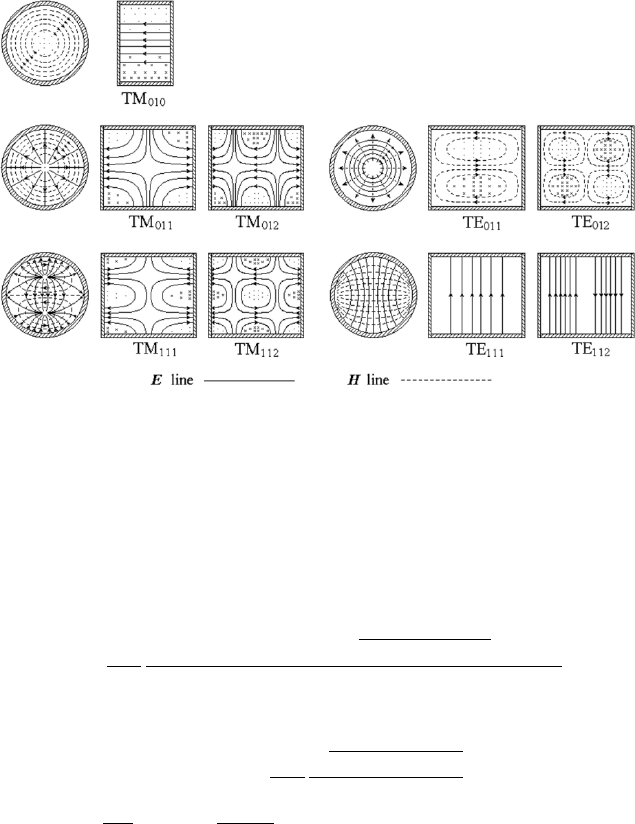
Figure 5.31: Field patterns of some modes in a circular cylindrical cavity.
The field patterns of some low-order modes in a circular cylindrical cavity
are given in Fig. 5.31.
The Q factor of the TM and TE modes in a circular cylindrical cavity
due to surface loss may be evaluated by substituting the field-component
expressions into (5.25). The final result for the Q of TE modes is
Q
TE
nmp
=
η
2R
S
¡
1 − n
2
/y
2
nm
¢
p
y
2
nm
+ (pπa/l)
2
y
2
nm
+ (2a/l)(pπa/l)
2
+ (1 − 2a/l)(npπa/y
nm
l)
2
, (5.223)
and the Q of TM modes can be evaluated to give
Q
TM
nmp
=
η
2R
S
p
x
2
nm
+ (pπa/l)
2
1 + δ
p
a/l
, (5.224)
where η =
p
µ/², R
S
=
p
ωµ/2σ = 1/σδ, η/2R
S
= λ/2πδ, and
δ
p
=
½
1 p = 0,
2 p 6= 0.
An interesting mode in circular cylindrical cavity is the TE
0mp
mode. It
has only circumferential currents in both the cylindrical wall and the end
plates. Thus, if a cavity for such a mode is tuned by moving the end plate,
a good contact between the end plate and the cylindrical wall is not needed
since no current flows across the boundary line. Furthermore, the Q factor
282 5. Metallic Waveguides and Resonant Cavities
of TE
0mp
mode is considerably higher than that of the other modes. So
the TE
0mp
modes, especially the lowest-order one, TE
011
mode, are widely
used as wave meter, echo box, frequency standard and other high-Q resonant
devices.
The other interesting mode in a circular cylindrical cavity is the TM
010
mode. It is the simplest mode, analogous to the TE
011
or TM
110
mode in
a rectangular cavity. We can see from Fig. 5.31 that the longitudinal elec-
tric field has a maximum at the center of the cavity and a circumferential
magnetic field surrounds the electric field. Neither field varies in the ax-
ial or circumferential direction. This mode may be considered as a TM
01
mode in a circular waveguide operating at cutoff, or it may be thought of
as the standing wave produced by inward and outward radial propagating
waves of the cylindrical TEM mo de in the radial transmission line, refer to
Section 5.4.6. This cavity and its deformation, the reentrant or small-gap
cavity, are usually used in electron devices in which the carriers, i.e., charges
or holes interact with the longitudinal electric field at the center of the cavity,
refer to Section 5.6.
5.4.5 Cylindrical Horn Waveguides and
Inclined-Plate Lines
(1) Cylindrical Waves in Cylindrical Horn Waveguides
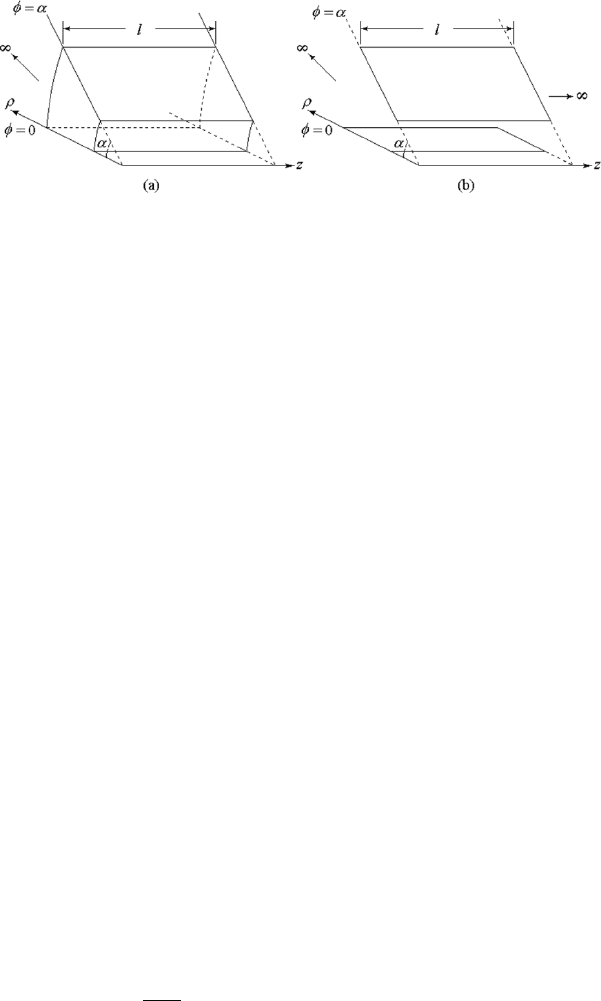
If there is no boundary along the ρ direction in the sectorial structure de-
scribed in Section 5.4.1, it becomes a cylindrical horn waveguide, shown in
Fig. 5.32(a). The expressions for U of TM modes and V of TE modes are
the same as those for sectorial cavities, (5.125) and (5.145), respectively. The
boundary conditions in the φ and z directions, (5.129)–(5.132) and (5.149)–
(5.152) are still valid but the boundary conditions in the ρ direction, (5.127)
and (5.128), are no longer valid, and the transverse angular wave number T
becomes continuous. The functions U and V become
U(ρ, φ, z) = [AJ
ν
(T ρ) + BN
ν
(T ρ)] sin(νφ) cos(βz), (5.225)
V (ρ, φ, z) = [AJ
ν
(T ρ) + BN
ν
(T ρ)] cos(νφ) sin(βz), (5.226)
where
ν = nπ/α, β = k
z
= pπ/l , T
2
= k
2
− β
2
.
This two expressions may also be written in terms of Hankel functions
U(ρ, φ, z) =
£
U
−
H
(1)
ν
(T ρ) + U
+
H
(2)
ν
(T ρ)
¤
sin(νφ) cos(βz), (5.227)
V (ρ, φ, z) =
£
V
−
H
(1)
ν
(T ρ) + V
+
H
(2)
ν
(T ρ)
¤
cos(νφ) sin(βz), (5.228)
where
U
+
= (A+jB)/2, U
−
= (A−jB)/2, V
+
= (A+jB)/2, V
+
= (A−jB)/2.
5.4 Waveguides and Cavities in Circular Cylindrical Coordinates 283
Figure 5.32: (a) Cylindrical horn waveguide and (b) an inclined-plate line.
In the above expressions, the function H
(1)
ν
(T ρ) represents the cylindrical
wave along the −ρ direction and the function H
(2)
ν
(T ρ) represents the cylin-
drical wave along the +ρ direction.
Substituting (5.227) or (5.228) into the field-component expressions in
terms of Borgnis’ functions, (4.190)–(4.195), we may have the fields of the
TM and TE modes in a cylindrical horn waveguide.
In a cylindrical horn waveguide, the cylindrical traveling wave propagates
along the ±ρ direction with angular wave numb er T , and β becomes the
cutoff angular wave number. When k > β, T is real and the dependence of
the field along ρ becomes a Hankel function. This is the wave-propagation
state. When k < β, T is imaginary and the dependence of the field along ρ
becomes a modified Bessel function. This is the cutoff state.
(2) Cylindrical Waves in Inclined-Plate Lines
If there is no boundary along both the ρ and the z direction in the sectorial
structure, it becomes an inclined-plate line, shown in Fig. 5.32(b). We are
interested in the waves with a uniform field in the z direction, in which
β = 0, T = k.
The expressions for U and V , (5.227) and (5.228), become
U(ρ, φ, z) =
£
U
−
H
(1)
ν
(kρ) + U
+
H
(2)
ν
(kρ)
¤
sin(νφ), (5.229)
V (ρ, φ, z) =
£
V
−
H
(1)
ν
(kρ) + V
+
H
(2)
ν
(kρ)
¤
cos(νφ). (5.230)
The field components of the wave with V = 0 become
E
z
= k
2
£
U
−
H
(1)
ν
(kρ) + U
+
H
(2)
ν
(kρ)
¤
sin(νφ), (5.231)
H
ρ
=
jω²ν
ρ
£
U
−
H
(1)
ν
(kρ) + U
+
H
(2)
ν
(kρ)
¤
cos(νφ), (5.232)
H
φ
= −jω²k
£
U
−
H
(1)
ν
0
(kρ) + U
+
H
(2)
ν
0
(kρ)
¤
sin(νφ), (5.233)
284 5. Metallic Waveguides and Resonant Cavities
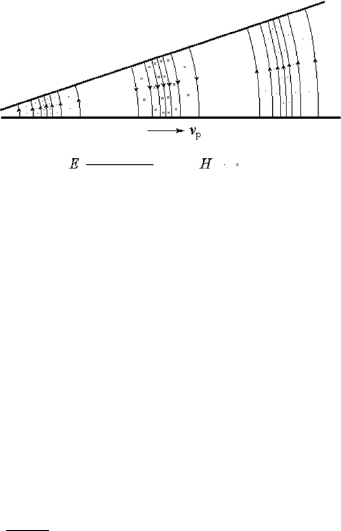
Figure 5.33: The fields of the TEM
(ρ)
mode in an inclined-plate line.
E
ρ
= 0, E
φ
= 0, H
z
= 0.
The modes of this class are known as TM or E modes with respect to z as
the propagation direction. Now, the propagation direction, i.e., longitudinal
direction becomes ρ. The modes of this class with E
ρ
= 0 and H
ρ
6= 0 become
TE or H modes with respect to ρ as the propagation direction, denoted by
TE
(ρ)
or H
(ρ)
modes. With this point of view, the TM or E modes with
respect to z as the propagation direction are denoted by TM
(z)
or E
(z)
modes.
The field components of the wave with U = 0 become
E
ρ
=
jωµν
ρ
£
V
−
H
(1)
ν
(kρ) + UV + H
(2)
ν
(kρ)
¤
sin(νφ), (5.234)
E
φ
= jωµk
£
V
−
H
(1)
ν
0
(kρ) + V
+
H
(2)
ν
0
(kρ)
¤
cos(νφ), (5.235)
H
z
= k
2
£
V
−
H
(1)
ν
(kρ) + V
+
H
(2)
ν
(kρ)
¤
cos(νφ), (5.236)
E
z
= 0, H
ρ
= 0, H
φ
= 0.
The mo des of this class are known as the TE or H modes with respect to z,
but they become TM or E modes with respect to ρ, denoted by TM
(ρ)
or E
(ρ)
modes. The TE or H modes with respect to z as the propagation direction
are denoted by TE
(z)
or H
(z)
modes.
If ν = 0, all field components of the TE
(ρ)
mode become zero, but the
field components of the TM
(ρ)
mode exist
E
φ
= −jk
2
η
£
V
−
H
(1)
1
(kρ) + V
+
H
(2)
1
(kρ)
¤
, (5.237)
H
z
= k
2
£
V
−
H
(1)
0
(kρ) + V
+
H
(2)
0
(kρ)
¤
. (5.238)
This is the φ-polarized uniform cylindrical TEM wave or TEM
(ρ)
mode. The
field map of this mode is shown in Fig. 5.33.
The theory for cylindrical horn waveguides and inclined-plate lines can be
used in the analysis of the transition between two waveguides with different
cross-sections.
5.4 Waveguides and Cavities in Circular Cylindrical Coordinates 285
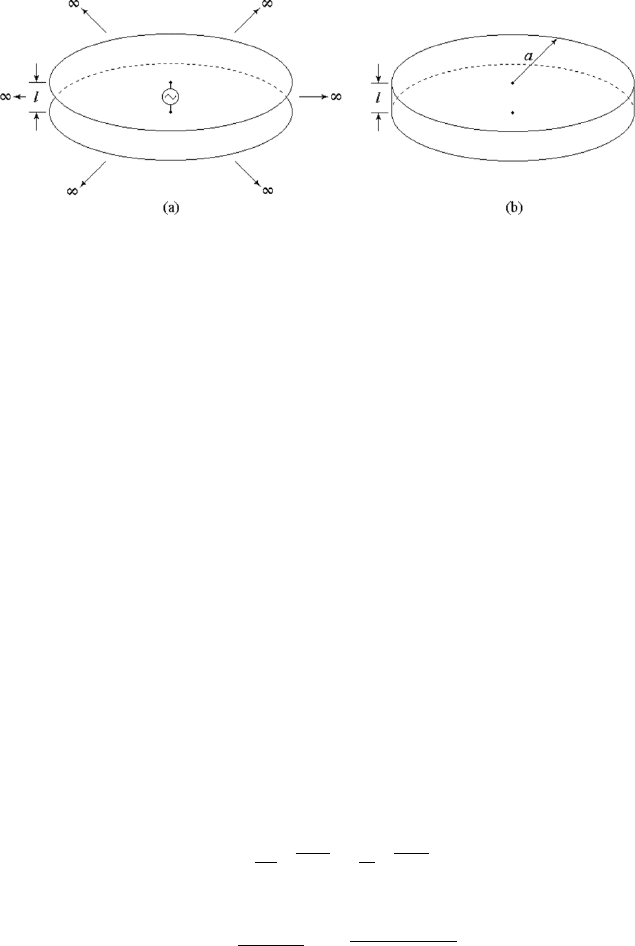
Figure 5.34: (a) Radial line and (b) radial line cavity.
5.4.6 Radial Transmission Lines and Radial-Line
Cavities
If in the cylindrical horn waveguide, α = 2π and the conducting plate at the
constant-φ plane is removed, one has a pair of circular parallel plates with
a separation l, which is known as the radial transmission line or simply the
radial line as shown in Fig. 5.34(a). There are cylindrical traveling waves in
the +ρ and −ρ directions in the radial line. If the radial line is shorted at a
constant-ρ surface, it becomes a radial line cavity, shown in Fig. 5.34(b).
(1) TE and TM Modes in Radial Lines
In the expressions for U and V of the cylindrical horn waveguide, (5.227) and
(5.228), if ν is an integer, ν = n, we have the expressions for U and V of the
radial line in the form of traveling-waves as follows:
U(ρ, φ, z) =
£
U
−
H
(1)
n
(T ρ) + U
+
H
(2)
n
(T ρ)
¤
cos(nφ) cos(β
p
z), (5.239)
V (ρ, φ, z) =
£
V
−
H
(1)
n
(T ρ) + V
+
H
(2)
n
(T ρ)
¤
cos(nφ) sin(β
p
z), (5.240)
where β
p
= pπ/l becomes the two-dimensional eigenvalue or cutoff angular
wave number of the radial guided wave. The cutoff wavelength of the radial
line becomes
λ
c
=
2π
β
p
√
µ
r
²
r
=
2l
p
√
µ
r
²
r
. (5.241)
The phase coefficient of the cylindrical traveling wave becomes
T =
q
k
2
− β
2
p
=
q
k
2
− (pπ/l)
2
. (5.242)
Function H
(1)
n
(T ρ) represents the inward cylindrical wave in the −ρ direction
and H
(2)
n
(T ρ) represents the outward cylindrical wave in the +ρ direction.

286 5. Metallic Waveguides and Resonant Cavities
Substituting (5.239) or (5.240) into the expressions (4.190)–(4.195), we
have the field components of the modes of V = 0 or modes of U = 0 in the
radial line. For example, the field components of the circumference uniform
modes of V = 0, n = 0, are given by
U =
£
U
−
H
(1)
0
(T ρ) + U
+
H
(2)
0
(T ρ)
¤
cos(βz), (5.243)
E
z
= T
2
£
U
−
H
(1)
0
(T ρ) + U
+
H
(2)
0
(T ρ)
¤
cos(βz), (5.244)
E
ρ
= T β
£
U
−
H
(1)
1
(T ρ) + U
+
H
(2)
1
(T ρ)
¤
sin(βz), (5.245)
H
φ
= jω²T
£
U
−
H
(1)
1
(T ρ) + U
+
H
(2)
1
(T ρ)
¤
cos(βz). (5.246)
The functions U and V in the radial line may also be written in the form
of standing wave as
U(ρ, φ, z) = [AJ
n
(T ρ) + BN
n
(T ρ)] cos(nφ) cos(βz), (5.247)
V (ρ, φ, z) = [AJ
n
(T ρ) + BN
n
(T ρ)] cos(nφ) sin(βz). (5.248)
The field components of the circumference uniform modes of V = 0 in the
form of standing waves become
U = [AJ
0
(T ρ) + BN
0
(T ρ)] cos(βz), (5.249)
E
z
= T
2
[AJ
0
(T ρ) + BN
0
(T ρ)] cos(βz), (5.250)
E
ρ
= T β[AJ
1
(T ρ) + BN
1
(T ρ)] sin(βz), (5.251)
H
φ
= jω²T [AJ
1
(T ρ) + BN
1
(T ρ)] cos(βz), (5.252)
E
φ
= 0, H
ρ
= 0, H
z
= 0.
These modes of V = 0 are TM modes with respect to both z and ρ since
H
z
= 0 and H
ρ
= 0.
The modes of U = 0 can also derived by the similar procedure.
(2) Cylindrical TEM Mode in Radial Lines
In the expressions for the modes of V = 0 in radial lines, if n = 0 and p = 0,
i.e., β = 0, T = k, expressions (5.243)–(5.252) become
U = AJ
0
(kρ) + BN
0
(kρ) = U
−
H
(1)
0
(kρ) + U
+
H
(2)
0
(kρ), (5.253)
E
z
= k
2
[AJ
0
(kρ) + BN
0
(kρ)] = k
2
£
U
−
H
(1)
0
(kρ) + U
+
H
(2)
0
(kρ)
¤
, (5.254)
H
φ
=
jk
2
η
[AJ
1
(kρ) + BN
1
(kρ)] =
jk
2
η
£
U
−
H
(1)
1
(kρ) + U
+
H
(2)
1
(kρ)
¤
. (5.255)
E
ρ
= 0, E
φ
= 0, H
ρ
= 0, H
z
= 0.
This mode is the TM or H mode with respect to z but the TEM mode with
respect to ρ, denoted by TEM
(ρ)
mode. There is no longitudinal electric field
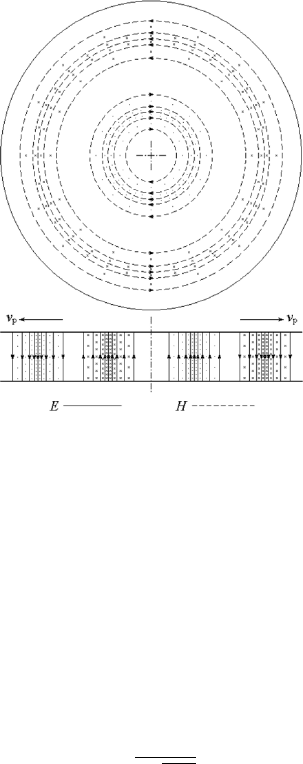
5.4 Waveguides and Cavities in Circular Cylindrical Coordinates 287
Figure 5.35: Fields of the TEM mode in a radial line.
component nor longitudinal magnetic field component, i.e., no fields in the ρ
direction. It is a cylindrical TEM mode.
The other cylindrical TEM mode is the TEM
(ρ)
mode in an inclined-plate
line, given in (5.237) and (5.238). The TEM
(ρ)
mode in a radial line, (5.254)
and (5.254), and the TEM
(ρ)
mode in an inclined-plate line, (5.237) and
(5.238), are dual modes. The field map of the TEM
(ρ)
mode in a radial line
is given in Fig. 5.35.
The condition for single-TEM-mode transmission in a radial line can be
found from (5.241):
l <
λ
2
√
µ
r
²
r
. (5.256)
(3) Radial Line Cavities
A section of a radial line closed by short-circuit surfaces at ρ = b and ρ = a,
b < a, becomes a radial line cavity or toroidal cavity. In fact, it is the same
as a coaxial cavity with short-circuit end plates.
The radial line cavity with b = 0 becomes a circular cylindrical cavity,
in which the axis ρ = 0 is included in the field region and the coefficients
of N
n
(T ρ) become zero. For example, according to (5.254) and (5.255), the
fields of the TEM
m
mode in a radial line cavity are given by
E
z
= k
2
AJ
0
(kρ) = E
0
J
0
(kρ), (5.257)

288 5. Metallic Waveguides and Resonant Cavities
H
φ
=
jk
2
η
AJ
1
(kρ) =
jE
0
η
J
1
(kρ). (5.258)
Applying the boundary condition at ρ = a, we have
J
0
(ka) = 0, k =
x
0m
a
, (5.259)
where x
0m
is the mth root of the Bessel function of the zeroth order.
We can have the same result from the expression for the circular cylin-
drical cavity (5.217) of Section 5.4.4 by letting n = 0 and β = 0. So the
TEM
m
mode in a radial line cavity is just the same as the TM
0m0
or E
0m0
mode in a circular cylindrical cavity. The field pattern of the TM
010
mode
in a circular cylindrical cavity, i.e., the TEM
1
mode in a radial line cavity is
given in Fig. 5.31.
5.5 Waveguides and Cavities in Spherical
Coordinates
The waveguides and cavities in spherical coordinates include the spherical
cavity and spherical radial waveguides such as the biconical line, coaxial
biconical line, wedge line, and spherical horn. Their boundary coincide with
the coordinate surfaces of the spherical coordinate system.
The solutions of the Helmholtz equations in spherical coordinates were
given by (4.231) and (4.232). The fields in spherical coordinates may be
classified into TM and TE modes according to the following criterion.
TM or E mode: H
r
= 0, E
r
6= 0, i.e., V = 0, U 6= 0.
TE or H mode: E
r
= 0, H
r
6= 0, i.e., U = 0, V 6= 0.
In spherical coordinates, r becomes the longitudinal direction, θ and φ
become the transverse directions.
5.5.1 Spherical Cavities
The field region of a spherical cavity includes the polar axes, θ = 0 and θ = π,
so the co efficient of the function Q
n
(cos θ) in the solution must be zero. It
also includes the origin, r = 0, so the coefficient of the function N
n+1/2
(kr)
must also be zero. The field region of a spherical cavity includes the whole
circumference in φ, so the orientation of φ = 0 may be chosen arbitrarily,
and m must be an integer. Here, the orientation of φ = 0 is chosen such
that Borgnis’ function becomes an even function respect to φ. The resulting
solutions U and V , (4.231) and (4.232), for a spherical cavity become
U =a
n
ˆ
J
n
(kr)P
m
n
(cos θ) cos(mφ) = A
n
√
rJ
n+1/2
(kr)P
m
n
(cos θ) cos(mφ),
(5.260)
V = b
n
ˆ
J
n
(kr)P
m
n
(cos θ) cos(mφ) = B
n
√
rJ
n+1/2
(kr)P
m
n
(cos θ) cos(mφ).
(5.261)

5.5 Waveguides and Cavities in Spherical Coordinates 289
Substituting (5.260) or (5.261) into (4.233)–(4.238), we have the field com-
ponents of TM or TE modes in the spherical cavity.
For a spherical cavity enclosed by short-circuit surface at r = a, the
boundary conditions are
E
θ
|
r=a
= 0 and E
φ
|
r=a
= 0. (5.262)
For TE or H modes, the above b oundary conditions are satisfied when
V |
r=a
= 0, i.e.,
ˆ
J
n
(ka) = 0, k
TE
np
=
x
np
a
, (5.263)
where x
np
is the pth root of the eigenvalue equation
ˆ
J
n
(x) = 0, refer to the
upper half of Table 5.3. [37]
Table 5.3
The roots of
ˆ
J
n
(x) = 0
x
np
n = 1 n = 2 n = 3 n = 4 n = 5 n = 6
p = 1 4.493 5.763 6.988 8.183 9.356 10.513
p = 2
7.725 9.095 10.417 11.705 12.967 14.207
p = 3
10.904 12.323 13.698 15.040 16.355 17.648
p = 4 14.066 15.515 16.924 18.301 19.653 20.983
The roots of
ˆ
J
0
n
(y) = 0
y
np
n = 1 n = 2 n = 3 n = 4 n = 5 n = 6
p = 1 2.744 3.870 4.973 6.062 7.140 8.211
p = 2
6.117 7.443 8.722 9.968 11.189 12.391
p = 3
9.317 10.713 12.064 13.380 14.670 15.939
p = 4 12.486 13.921 15.314 16.674 18.009 19.321
The natural angular frequency and the natural wavelength of TE
nmp
modes are
ω
TE
nmp
=
k
TE
np
√
µ²
=
x
np
a
√
µ²
, λ
TE
nmp
=
2πc
ω
TE
nmp
=
2πa
x
np
√
µ
r
²
r
. (5.264)
For TM or E modes, the boundary conditions are
∂U
∂r
¯
¯
¯
¯
r=a
= 0, i.e.,
ˆ
J
0
n
(ka) = 0, k
TM
np
=
y
np
a
, (5.265)
where y
np
is the pth root of the eigenvalue equation
ˆ
J
0
n
(y) = 0, refer to the
lower half of Table 4.3.
The natural angular frequency and the natural wavelength of TM
nmp
modes are
ω
TM
nmp
=
k
TM
np
√
µ²
=
y
np
a
√
µ²
, λ
TM
nmp
=
2πc
ω
TM
nmp
=
2πa
y
np
√
µ
r
²
r
. (5.266)

290 5. Metallic Waveguides and Resonant Cavities
The natural frequency of the TE
nmp
and TM
nmp
modes are independent
of m, the azimuthal variation of the fields, so the modes in a spherical cavity
are always nth-order degenerate, since m ≤ n. On the other hand, there are
even and odd degenerate modes when m 6= 0. Furthermore, the orientation
of the polar axis is arbitrary settled, so the modes of different orientations
of polarization are also degenerate. In conclusion, the mo des in a spherical
cavity are highly degenerate, because of the highly symmetrical configuration
of the cavity.
The lowest TM mode in a spherical cavity is the TM
101
mode, in which
n = 1, m = 0 and p = 1, and the function U becomes
U = A
√
rJ
3/2
(kr)P
1
(cos θ).
Since
J
3/2
(kr) =
r
2
πkr
µ
sin kr
kr
− cos kr

,
and
P
1
(cos θ) = cos θ,
we have
U = U
0
µ
sin kr
kr
− cos kr

cos θ, (5.267)
where U
0
= A
p
2/πk. Substituting (5.267) into (4.233)–(4.238), we have the
field components
E
r
=
∂
2
U
∂r
2
+ k
2
U = 2k
2
U
0
µ
sin kr
k
3
r
3
−
cos kr
k
2
r
2

cos θ, (5.268)
E
θ
=
1
r
∂
2
U
∂θ ∂r
= k
2
U
0
µ
sin kr
k
3
r
3
−
cos kr
k
2
r
2
−
sin kr
kr

sin θ, (5.269)
H
φ
= −
jω²
r
∂U
∂θ
=
jk
2
U
0
η
µ
sin kr
k
2
r
2
−
cos kr
kr

sin θ, (5.270)
where
k =
y
11
a
=
2.744
a
. (5.271)
The lowest TE mode in a spherical cavity is the TE
101
mode, in which
n = 1, m = 0 and p = 1, and the function V becomes
V = B
√
rJ
3/2
(kr)P
1
(cos θ) = V
0
µ
sin kr
kr
− cos kr

cos θ, (5.272)
where V
0
= B
p
2/πk. Substituting (5.272) into (4.233)–(4.238), we have the
field components
H
r
=
∂
2
V
∂r
2
+ k
2
V = 2k
2
V
0
µ
sin kr
k
3
r
3
−
cos kr
k
2
r
2

cos θ, (5.273)