
Zhang K., Li D. Electromagnetic Theory for Microwaves and Optoelectronics
Подождите немного. Документ загружается.


7.4 Periodic Systems 411
In region 2, ρ ≤ b, the space between the disks can be viewed as a radial
line with a load at ρ = b. The coefficient of function N
0
(kρ) must be zero
because the axis ρ = 0 is included in the region. Hence we have the solution
with the standing wave in ρ as follows
U
2
= BJ
0
(kρ)e
−jβz
, (7.34)
E
z2
= k
2
BJ
0
(kρ)e
−jβz
, (7.35)
H
φ2
= jω²
0
kBJ
1
(kρ)e
−jβz
. (7.36)
The boundary conditions on the boundary ρ = b are given by E
z1
(b) =
E
z2
(b) and H
φ1
(b) = H
φ2
(b) as follows,
−τ
2
A[K
0
(τa)I
0
(τb) − I
0
(τa)K
0
(τb)] = k
2
BJ
0
(kb), (7.37)
−jω²
0
τA[K
0
(τa)I
1
(τb) + I
0
(τa)K
1
(τb)] = jω²
0
kBJ
1
(kb). (7.38)
We obtain the eigenvalue equation
1
τb
K
0
(τa)I
1
(τb) + I
0
(τa)K
1
(τb)
K
0
(τa)I
0
(τb) − I
0
(τa)K
0
(τb)
=
J
1
(kb)
kbJ
0
(kb)
. (7.39)
The dispersion relation is determined by this equation and the equation
of β and τ , (7.22). The k–β diagram of the dominant TM mode in a disk-
loaded waveguide with coupling holes at the edge is given in Fig. 7.5(b).
The dominant TM mode in a disk-loaded waveguide with coupling holes at
the edge is a backward wave, for which the phase velocity is in the opposite
direction of the group velocity.
The disk-loaded waveguide can also be considered as a coupled-cavity
chain. The center-holed coupling disk-loaded waveguide is a electric field
(or capacitance) coupled-cavity chain, whereas the edge-holed coupling disk-
loaded waveguide is a magnetic field (or inductance) coupled-cavity chain.
We will see later that in periodic system, the fundamental harmonic in a
capacitance-coupled-cavity chain is a forward wave, whereas the fundamental
harmonic in a inductance-coupled-cavity chain is a backward wave.
The dispersion curves given in Fig. 7.3 and Fig. 7.5 are obtained by the
uniform system approach. They are good approximations only in the region
of small β. When β is large, we must consider the effect of the periodic
boundaries.
7.4 Periodic Systems
In the previous sections, a periodic structure is analyzed approximately by the
approach of the uniform-system model. When the spatial period is much less
than the longitudinal guided wavelength, this model is a good approximation.
If, however, the spatial period is not small enough so that the phase shift along
z is no longer continuous, we must develop the theory for periodic structures
or periodic transmission systems [10, 107].
412 7. Periodic Structures and the Coupling of Modes
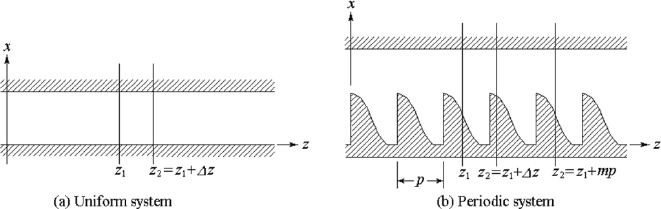
Figure 7.6: Uniform system (a) and periodic system (b).
7.4.1 Floquet’s Theorem and Space Harmonics
(1) Uniform System
A uniform transmission system has its shape, size, and material kept uniform
along the longitudinal direction z, as shown in Fig. 7.6(a). The principle
feature of a uniform system can be described as follows.
For a given mode of propagation at a given steady-state frequency the
fields at one cross section differ from those an arbitrary distance away merely
by a complex constant which depends upon the distance only.
The proof lies on the fact that when a uniform system of infinite length
is displaced along its z axis by an arbitrary distance, it is indistinguishable
from the original one.
Suppose that the complex constant can be written as
e
−γ(z
2
−z
1
)
= e
−γ∆z
, where z
2
= z
1
+ ∆z, γ = α + jβ.
Then the relation between fields distributed on the two cross sections at
points z
1
and z
2
is given by
E (x, y, z
2
, t) = E (x, y, z
1
, t) e
−γ∆z
. (7.40)
For satisfying the above relation, the harmonic field at a given steady-state
frequency distributed on an arbitrary cross section at point z is given by
E (x, y, z, t) = F (x, y) e
−γz
e
jωt
, (7.41)
and the complex amplitude of the field is
E (x, y, z) = F (x, y) e
−γz
, (7.42)
where F (x, y) is the distribution function of the field on the transverse cross
section which is independent of z.
7.4 Periodic Systems 413
For lossless uniform systems, γ = jβ, and
E (x, y, z) = F (x, y) e
−jβz
. (7.43)
Therefore, we conclude that the field of a guided mode in a uniform system
is a single spatial harmonic wave, i.e., a sinusoidal wave that satisfies the
uniform boundary condition.
(2) Periodic System
In a periodic transmission system, the shape, size, and constitutive material
vary periodically along its z axis, see Fig. 7.6(b). The basis for the study of
periodic systems is a theorem ascribed to the French mathematician Floquet,
which may be stated as follows.
In a periodic system, for a given mode of propagation at a given steady-
state frequency, the fields at one cross section differ from those one period
(or an integer multiple of periods) away by only a complex constant.
This theorem is true whether or not the structure has losses so long as it
is p eriodic. The proof of the theorem lies in the fact that when a periodic
system having infinite length is displaced along its axis by one period or an
integer multiple of periods, it cannot be distinguishable from its original self.
Suppose that the spatial period of the system is p, and the distance be-
tween the two cross sections is mp, m is an integer, then the complex constant
can be written as
e
−γ(z
2
−z
1
)
= e
−γ
0
mp
, where z
2
− z
1
= ∆z = mp, γ
0
= α
0
+ jβ
0
.
The relation between the complex amplitudes of the fields on the two cross
sections at z
1
and z
2
= z
1
+ mp are given by
E (x, y, z + mp) = E (x, y, z) e
−γ
0
mp
. (7.44)
This is the mathematical formulation of Floquet’s theorem.
In a periodic system, the distribution function of the field on the trans-
verse cross section is dependent on z, so the time-harmonic field at a given
steady-state frequency on an arbitrary cross section at z must be
E (x, y, z, t) = F (x, y, z) e
−γ
0
z
e
jωt
, (7.45)
and the complex amplitude of the field at z is
E (x, y, z) = F (x, y, z) e
−γ
0
z
. (7.46)
We can readily prove that if the function F (x, y, z) is a periodic function of
z with period p, then the Floquet’s theorem (7.44) is followed.
The complex amplitudes of the fields on the cross sections at z + mp is
E (x, y, z + mp) = F (x, y, z + mp) e
−γ
0
(z+mp)
. (7.47)

414 7. Periodic Structures and the Coupling of Modes
If F (x, y, z) is a periodic function in z, we must have
F (x, y, z + mp) = F (x, y, z). (7.48)
Then (7.47) becomes
E (x, y, z + mp) = F (x, y, z) e
−γ
0
z
e
−γ
0
mp
= E (x, y, z) e
−γ
0
mp
, (7.49)
so we see that the Floquet’s theorem (7.44) is obeyed.
For lossless systems, γ
0
= jβ
0
, and (7.46) becomes
E (x, y, z) = F (x, y, z) e
−jβ
0
z
. (7.50)
(3) Space Harmonics
The periodic function F (x, y, z) can be expanded into a Fourier series of the
form
F (x, y, z) =
∞
X
n=−∞
E
n
(x, y) exp
³
− jn
2π
p
z
´
, (7.51)
and the field expression (7.50) becomes
E (x, y, z) =
∞
X
n=−∞
E
n
(x, y) exp
h
− j
³
β
0
+
2πn
p
´
z
i
. (7.52)
To find E
n
(x, y), multiply (7.51) by exp
¡
jm
2π
p
z
¢
and then integrate both
sides from z
0
− p/2 to z
0
+ p/2:
Z
z
0
+p/2
z
0
−p/2
F (x, y, z) exp
³
jm
2π
p
z
´
dz =
∞
X
n=−∞
Z
z
0
+p/2
z
0
−p/2
E
n
(x, y) exp
h
j(m−n)
2π
p
z
i
dz.
By orthogonality of the functions exp
¡
jn
2π
p
z
¢
,
Z
z
0
+p/2
z
0
−p/2
exp
h
j(m − n)
2π
p
z
i
dz =
½
0 m 6= n,
p m = n,
the above integration becomes
E
n
(x, y) =
1
p
Z
z
0
+p/2
z
0
−p/2
F (x, y, z) exp
³
jn
2π
p
z
´
dz
=
1
p
Z
z
0
+p/2
z
0
−p/2
£
F (x, y, z) e
−jβ
0
z
¤
exp
h
j
³
β
0
+
2πn
p
´
z
i
dz.
Using (7.50), we obtain
E
n
(x, y) =
1
p
Z
z
0
+p/2
z
0
−p/2
E (x, y, z) e
jβ
n
z
dz, (7.53)

7.4 Periodic Systems 415
where
β
n
= β
0
+
2πn
p
, (7.54)
and the field expression (7.52) becomes
E (x, y, z) =
∞
X
n=−∞
E
n
(x, y) e
−jβ
n
z
. (7.55)
The nth term of the above series is called the nth space harmonic or Hartree
harmonic which is associated to a phase constant β
n
. Some of the phase
constants are positive and some of them are negative. The space harmonic
with n = 0 is called the fundamental harmonic.
The corresponding phase velocity of the nth space harmonic is
v
pn
=
ω
β
n
=
ω
β
0
+ 2πn/p
=
1
1/v
p0
+ 2πn/ωp
, (7.56)
which is different for different n and will b e negative whenever β
n
is negative.
The group velocity of the nth space harmonic is
v
gn
=
dω
dβ
n
=
dω
d(β
0
+ 2πn/p)
=
dω
dβ
0
= v
g0
, (7.57)
and is the same for all space harmonics.
As mentioned before, the wave with phase and group velocities in the
same direction is called a forward wave, denoted by FW, and the wave with
phase and group velocities in opposite directions is called a backward wave,
denoted by BW. The k–β diagrams with unique features for forward waves
and for backward waves are shown in Fig. 7.1.
We come to the conclusion that the field of a single spatial harmonic
wave mode cannot adjust to the boundary condition of a periodic system.
The field which does satisfy the periodic boundary condition has to be a
spatial anharmonic wave mode which can b e expanded into an infinite series
of space harmonics with phase velocities different but group velocities the
same. In a propagation mode, all the space harmonics with the same group
velocity must be present simultaneously in order for the total field to satisfy
the boundary conditions. For a given periodic boundary, the proportions of
space harmonics of a mode remain constant. If there are energy exchanges
between the wave and certain outside source or load, e.g., a charged particle
beam, the amplitudes of all space harmonics will scale by a common factor.
This means that in a periodic structure, for a given mode of propagation at
any frequency there is no one common phase velocity but it is found to be an
infinite number of individual phase velocities characterizing the mode. The
difference in the concepts mode and space harmonic is that the former can
match the boundary conditions alone but the later cannot.
Because the phase velocities for different space harmonics are different,
the phase relations of different harmonics, hence the composed wave form,
will vary during propagation.
416 7. Periodic Structures and the Coupling of Modes
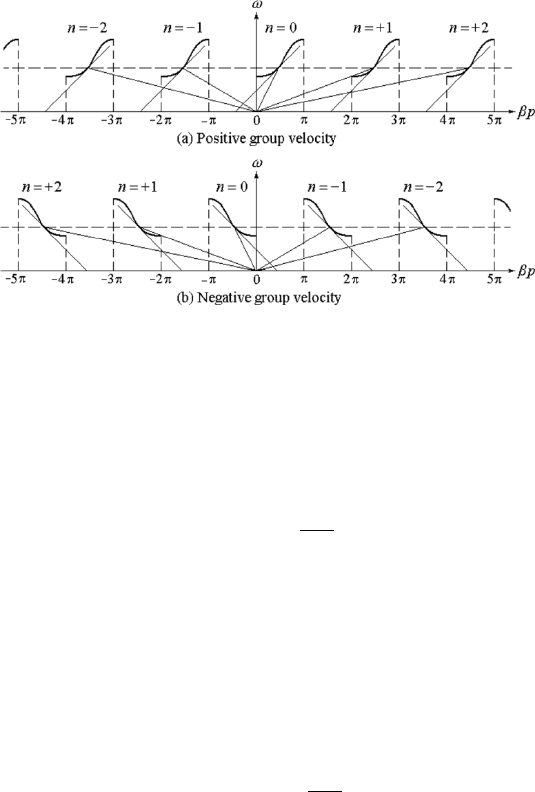
Figure 7.7: The ω–β diagram of a periodic system.
7.4.2 The ω–β Diagram of Periodic Systems
The relation between the phase constant of the nth space harmonic and that
of the fundamental harmonic is given by
β
n
= β
0
+
2πn
p
.
For a system with given β
0
, β
n
can be obtained by adding 2πn/p to it, this
is to say that the ω–β
n
curve is simply the ω–β
0
curve shifted along the β
axis by 2πn/p; see Fig. 7.7(a). Therefore ω is a periodic function of β
n
.
It is apparent that ω is an even function of β
n
, since for a reciprocal
system, reversing the structure in z cannot change the physical situation.
The ω–β diagram of a periodic system for the wave with group velocity in
−z direction is shown in Fig. 7.7(b). For the wave with negative group
velocity, the phase coefficients of the space harmonics become
β
n
= −
µ
β
0
+
2πn
p

.
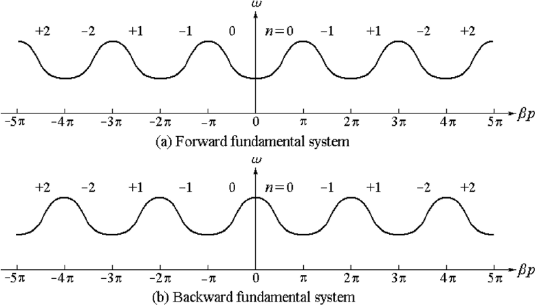
The complete ω–β diagram of a typical periodic system is shown in
Fig. 7.8(a). In this diagram, the phase velocity of the fundamental harmonic
and the group velocity are in the same direction. The diagram represents a
system in which the fundamental harmonic is a forward wave. In such sys-
tems, all the space harmonics with positive n are forward waves and all the
space harmonics with negative n are backward waves.
The ω–β diagram of a system with a fundamental harmonic that is a
backward wave is shown in Fig. 7.8(b). In such systems, all the space har-
monics with positive n are backward waves and all the space harmonics with
negative n are forward waves.
7.4 Periodic Systems 417
Figure 7.8: The ω–β diagram of a periodic system with a forward fundamental
(a) and with a backward fundamental (b).
In practice, there is a complete set of modes in a periodic system. Each
mode corresponds to a pass band, some of the pass bands have a forward
fundamental and some of them have a backward fundamental. Pass bands
are separated by stop bands.
The ω–β diagram of a periodic system is also known as a Brillouin dia-
gram.
7.4.3 The Band-Pass Character of Periodic Systems
To understand the pass bands and stop bands in the ω–β diagram of a peri-
odic system, we investigate, for example, the disk-loaded waveguide that is a
circular waveguide with thin obstacles lined up periodically inside, as shown
in Fig. 7.4.
We are interested in a specific mode, for which the first cutoff frequency
is equal to the cutoff frequency of the waveguide without obstacles. This
first cutoff frequency is obtained when the phase shift along the waveguide
is set to be zero, βp = 0, and is denoted by ω
0
. For example, the cutoff
condition for the TM
01
mode is k
c
a = x
01
= 2.405, λ
c
= 2.6a. The first
cutoff frequency ω
0
is also called the transverse resonant frequency. When
the wave of this specific mode propagates in the disk-loaded waveguide, at
each obstacle there will be transmission and reflection. There will be a certain
frequency for which the reflections from the successive obstacles returning to
a specific point in the waveguide will add in phase and the wave of that mode
in the guide will be cut off again. This second cutoff frequency will be equal
to the frequency for which the one-way phase shift between obstacles is nπ,
where n is any integer and is denoted by ω
π
. The second cutoff frequency ω
π
418 7. Periodic Structures and the Coupling of Modes
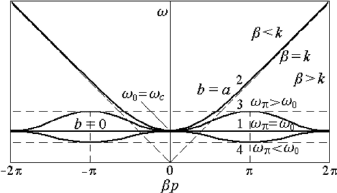
Figure 7.9: ω–β diagrams of coupled-cavity chain or disk-loaded waveguide.
is also called the longitudinal resonant frequency.
The disk-loaded waveguide and other periodic loaded transmission sys-
tems can also be viewed as a coupled-cavity chain. The disk-loaded waveguide
with coupling holes at the center is an electric-field or capacitance-coupled-
cavity chain and the disk-loaded waveguide with coupling holes at the edge
is a magnetic-field or inductance-coupled-cavity chain. When the size of the
coupling hole is reduced to zero, this becomes a chain of uncoupled cavities
for which the ω–β diagram is a horizontal straight line, meaning that any
phase shift between sections is possible at the natural frequency of the cav-
ity; see curve 1 in Fig. 7.9. When the coupling hole is enlarged to the size
of the waveguide, this becomes an unloaded waveguide and the second cutoff
frequency tends to infinity; see curve 2 in Fig. 7.9.
The patterns of the fields in a circular waveguide, disk-loaded waveguide,
and uncoupled cavity chain at ω
0
(βp = 0) and ω
π
(βp = π) are shown in
Fig. 7.10.
From the field pattern at ω
0
, we observe that the introduction of obstacles
does not disturb the field at ω
0
, and hence, by no means changes the first
cutoff frequency ω
0
.
In the case of a center-hole coupled-cavity chain, the coupling from section
to section is predominately capacitive, since the coupling holes are located in
a region in which the electric field is stronger than the magnetic field. From
Fig. 7.10 we easily see that the electric field strength near the coupling hole
at βp = π is smaller than that at βp = 0 and the magnetic field remains
almost the same. To see that the effective capacitance becomes smaller and
the natural frequency is higher at βp = π than at βp = 0, i.e., ω
π
> ω
0
;
see curve 3 in Fig. 7.9. In this case, the slope of the dispersion curve must
be positive, the group velocity and the phase velocity must be in the same
direction, and the fundamental harmonic must be a forward wave. So the
center-hole coupled-cavity chain is a forward fundamental system.
In the case of an edge-hole coupled-cavity chain the coupling from section
to section is predominately inductive, since the coupling holes are located in
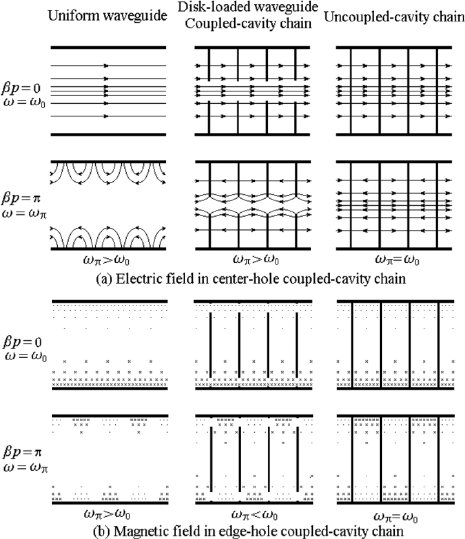
7.4 Periodic Systems 419
Figure 7.10: Electric and magnetic fields in a disk-loaded waveguide.
a region in which the magnetic field is stronger than the electric field. From
Fig. 7.10 we easily see that the magnetic field strength near the coupling
hole at βp = π is smaller than that at βp = 0 and the electric field remains
almost the same. This tells us that the effective inductance becomes larger
and the natural frequency is lower at βp = π than at βp = 0, i.e., ω
π
< ω
0
;
see curve 4 in Fig. 7.9. In this case, the slope of the dispersion curve must
be negative, the group velocity and the phase velocity must be in opposite
directions, and the fundamental harmonic must be a backward wave. So the
edge-hole coupled-cavity chain is a backward fundamental system.
In fact, the coupling holes are also resonant elements, so the character-
istics of the coupled-cavity chain is determined not only by the resonant
characteristics of the cavities but also by the resonant characteristics of the
coupling elements. For example, the cavity mode of an edge-hole coupled-
cavity chain is a backward fundamental mode when the resonant frequency
of the hole is higher than that of the cavity, i.e., the hole should be viewed
as an inductance; however, the mode becomes a forward fundamental mode
when the resonant frequency of the hole is lower than that of the cavity, i.e.,
420 7. Periodic Structures and the Coupling of Modes
the hole should b e viewed as a capacitance. In the former case, there is a
higher hole mode with a forward fundamental and in the latter case, there
is a lower hole mode with a backward fundamental. In the considerations of
the hole mode, the cylindrical cavity plays the part of a resonant coupling
element.
Various modified disk-loaded waveguides are developed for high-power
traveling-wave amplifiers, they are Hughes structure with inductive (edge)
coupling, i.e., a backward fundamental structure; clover-leaf structure and
centipede structure with negative inductive coupling, i.e., forward fundamen-
tal structures; and long-slot structure with resonant coupling, also a forward
fundamental structure.
The basic center-hole disk-loaded waveguide is a narrow-band structure,
which is usually used in linear accelerators. Various kinds of modified disk-
loaded waveguides are used in medium-power and high-power broad-band
traveling amplifiers.
7.4.4 Fields in Periodic Systems
The boundary condition of a periodic system cannot be satisfied by fields de-
scribed by any single space harmonic. In order to satisfy the periodic bound-
ary condition one must have a spatial non-simple-sinusoidal field which can
be expanded into an infinite series of space harmonics with different phase
velocities but with the same group velocity. Because the phase velocities
for different space harmonics are different, the phase relations among differ-
ent harmonics will change during the propagation, thus the composed wave
form will change during propagation. The field patterns of the lowest TM
mode in the drift region of a periodic disk-loaded waveguide are illustrated
in Figure 7.11.
From Fig. 7.11, we notice the following
1. The waveform of the composed field is anharmonic and changes during
propagation.
2. The waveform of the composed field is very sharp near the periodic
surface of the structure, ρ = b, so it must be composed of high order
space harmonics of larger amplitudes. But the waveform is much more
smooth near the axis, i.e., away from the periodic surface, so it must be
composed of space harmonics of smaller amplitudes especially higher
order ones. The reason for this phenomenon is that the higher the order
of space harmonic the larger the transverse decaying factor.
3. The electric field on the axis has a non-zero longitudinal component, but
its transverse component there vanishes. This field structure is suitable
for the interaction between the field and a longitudinal charged-particle
beam.