
Zhang K., Li D. Electromagnetic Theory for Microwaves and Optoelectronics
Подождите немного. Документ загружается.

7.4 Periodic Systems 421
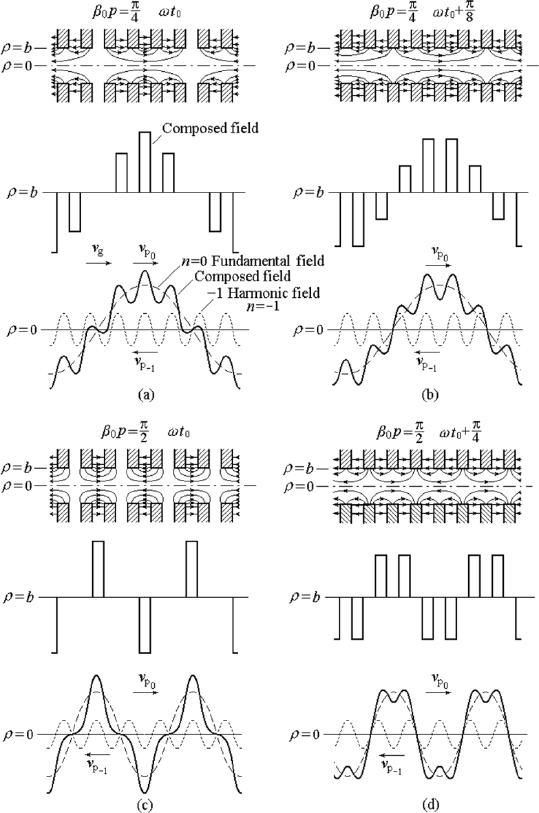
Figure 7.11: Field patterns in a periodic disk-loaded waveguide.

422 7. Periodic Structures and the Coupling of Modes
7.4.5 Two Theorems on Lossless Periodic Systems
There are two important theorems on lossless periodic transmission systems.
Their statements are as follows [107].
Theorem 1
The time-averaged electric stored energy per period is equal to the time-
averaged magnetic stored energy per period in the pass bands of a lossless
periodic transmission system.
The mathematical expression of Theorem 1 is
Z
V
1
4
µH · H
∗
dV −
Z
V
1
4
²E · E
∗
dV = 0, (7.58)
where V represents the volume of the periodic structure of one spatial period.
Notice that the time-averaged electric stored energy in an arbitrary length
is equal to the time-averaged magnetic stored energy in the same length in a
lossless uniform transmission system. In this case, V in (7.58) represents the
volume of the system of an arbitrary length.
Theorem 2
The time-averaged power flow in the pass band of a lossless periodic trans-
mission system is equal to the group velocity times the time-averaged electric
and magnetic stored energy per period divided by the length of the period
The mathematical expression of Theorem 2 is given by
<
µ
Z
S
1
2
E × H
∗
· dS

= v
g
1
p
Z
V
µ
1
4
²E · E
∗
+
1
4
µH · H
∗

dV, (7.59)
where S represents the area of an arbitrary cross section of the system, V
represents the volume of the structure of one spatial period and p is the
spatial period of the system.
Notice that the time-averaged power flow in a lossless uniform transmis-
sion system is equal to the group velocity times the time-averaged electric
and magnetic stored energy in an arbitrary length divided by the length.
The proofs of these two theorems are left to the reader as an exercise,
refer to Problem 7.11.
7.4.6 The Interaction Impedance for Periodic Systems
For a given mode in a periodic system, the phase velocities ascribed to dif-
ferent space harmonics are different, so the charged particles with certain
velocity can interact with only that particular space harmonic with phase
velocity close to the velocity of the particles. The effectiveness of the interac-
tion is determined by the interaction impedance of a specific space harmonic,

7.5 Corrugated Conducting Plane as a Periodic System 423
i.e., the strength of the electric field of the specific space harmonic of the
given mode referred to the total power flow carried by the mode:
K
n
=
E
2
znm
2β
2
n
P
=
E
2
znm
2β
2
n
v
g
W
, (7.60)
where E
znm
denotes the amplitude of the z component of the electric field
specified by the nth space harmonic, P denotes the total power flow carried
by the mode, and W denotes the energy of the given mo de stored in the
system of unit length.
7.5 Corrugated Conducting Plane
as a Periodic System
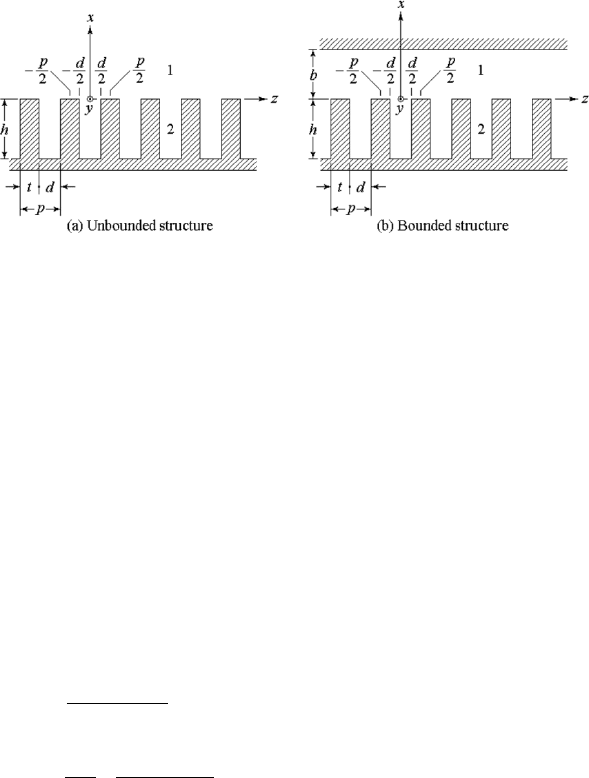
Consider the two-dimensional corrugated conducting plane shown in
Fig. 7.12(a) as a periodic system. The spatial period of the structure is
no longer much less than the longitudinal wavelength, so the phase shift in
one period cannot be made infinitesimally small. In this case, the system
must be analyzed by means of the periodic system model [107]. We are again
interested in TM modes with no y-dependence, V = 0, U(x, z) 6= 0, and
∂/∂y = 0.
For the unbounded structure of Fig. 7.12(a), the field extends to infinity in
the +x direction. In region 1, 0 ≤ x ≤ ∞, the U function must be composed
of the complete set of space harmonics shown in (7.55) and each term of the
series must assume the form of (7.2), i.e., an exponential decaying function
in the x direction, e
−τ
n
x
, and a traveling wave in the z direction, e
−jβ
n
z
.
U =
∞
X
n=−∞
A
n
e
−τ
n
x
e
−jβ
n
z
, (7.61)
and
E
z1
=
∞
X
n=−∞
−τ
2
n
A
n
e
−τ
n
x
e
−jβ
n
z
, (7.62)
E
x1
=
∞
X
n=−∞
jβ
n
τ
n
A
n
e
−τ
n
x
e
−jβ
n
z
, (7.63)
H
y 1
=
∞
X
n=−∞
jω²
0
τ
n
A
n
e
−τ
n
x
e
−jβ
n
z
, (7.64)
where
β
2
n
− τ
2
n
= k
2
= ω
2
µ
0
²
0
, (7.65)
and
β
n
= β
0
+
2πn
p
. (7.66)
424 7. Periodic Structures and the Coupling of Modes
Figure 7.12: Corrugated conducting surface as a periodic system, (a) un-
bounded structure, (b) bounded structure.
In region 2, −h ≤ x ≤ 0, the gap may as well be viewed as a parallel-plate
transmission line with a short-circuit plane at x = −h. For an exact solution,
each of the field components in region 2 is also a complete set or infinite series
consisting of all eigenfunctions that satisfy the boundary conditions. The
eigenvalue equation will include an infinite-dimensional determinant and all
the coefficients make up an infinite series similar to those for the reentrant
cavity given in Section 5.6.1. We would rather find the approximate solution
according to the method given in Section 4.11 than bother with the exact
solution. Although the spatial period of the structure is no longer much
less than the longitudinal wavelength p 6¿ λ
z
, it is still much less than the
wavelength in space, p ¿ λ, and the only mode we need to consider is the
TEM mode propagating in the ±x directions. Since p 6¿ λ
z
, the phase shift
along z must be considered as a discontinuous function e
−jβ
0
mp
. We have
E
z2
=
(
B
sin k(x + h)
sin kh
e
−jβ
0
mp
, mp−d/2 <z < mp+d/2,
0 mp+d/2 < z <(m + 1)p−d/2,
(7.67)
H
y 2
=
(
−j
ω²
0
k
B
cos k(x+h)
sin kh
e
−jβ
0
mp
, mp−d/2<z <mp+d/2,
0 mp+d/2<z <(m+1)p−d/2.
(7.68)
The electric field in region 1 at the boundary x = 0 is given by
E
z1
(0) =
∞
X
n=−∞
−τ
2
n
A
n
e
−jβ
n
(mp+z
0
)
=
∞
X
n=−∞
−τ
2
n
A
n
e
−jβ
0
mp
e
−jβ
n
z
0
, (7.69)
where z
0
denotes the z coordinate with respect to the center of the mth gap,
z
0
= z − mp. Note that both n and m are integers so that e
−j2πnm
= 1.
The electric field in region 2 at the boundary x = 0 is given by
E
z2
(0) =
½
Be
−jβ
0
mp
, −d/2 < z
0
< +d/2,
0 +d/2 < z
0
< p − d/2.
(7.70)

7.5 Corrugated Conducting Plane as a Periodic System 425
The field-matching condition of the electric field E
z
at the boundary be-
tween region 1 and region 2, x = 0, is then given by E
z1
(0) = E
z2
(0), i.e.,
∞
X
n=−∞
−τ
2
n
A
n
e
−jβ
n
z
0
=
½
B, −d/2 < z
0
< +d/2,
0 +d/2 < z
0
< p − d/2.
(7.71)
The coefficient −τ
2
n
A
n
of the Fourier series is
−τ
2
n
A
n
=
1
p
Z
d/2
−d/2
Be
jβ
n
z
0
dz
0
, (7.72)
The above integral is calculated as
Z
d/2
−d/2
e
jβ
n
z
0
dz
0
= d
sin(β
n
d/2)
β
n
d/2
= d sinc
β
n
d
2
. (7.73)
Then we have the final expression of the coefficient −τ
2
n
A
n
−τ
2
n
A
n
= B
d
p
sinc
β
n
d
2
. (7.74)
Substituting this into the field-component expressions (7.62) and (7.64), we
have
E
z1
=
∞
X
n=−∞
B
d
p
sinc
β
n
d
2
e
−τ
n
x
e
−jβ
n
z
, (7.75)
H
y 1
=
∞
X
n=−∞
−
jω²
0
τ
n
B
d
p
sinc
β
n
d
2
e
−τ
n
x
e
−jβ
n
z
. (7.76)
The exact matching conditions for the electric field E
z
and the magnetic
field H
y
at the boundary x = 0 cannot be satisfied simultaneously, for they
are both trial functions but not actual fields in the gap region. Once the
electric field E
z
is matched exactly at x = 0, the magnetic field H
y
can only
be matched approximately by applying the average matching condition given
in Section 4.11, which is
Z
d/2
−d/2
H
y 1
(0) dz
0
= H
y 2
(0) d. (7.77)
Hence we have
d
p
∞
X
n=−∞
1
τ
n
sinc
β
n
d
2
Z
d/2
−d/2
e
jβ
n
z
0
dz
0
=
d
k
cot kh. (7.78)
Using the integral formula (7.73), we have the eigenvalue equation
d
p
∞
X
n=−∞
1
τ
n
h
µ
sinc
β
n
d
2

2
=
1
kh tan kh
. (7.79)
426 7. Periodic Structures and the Coupling of Modes
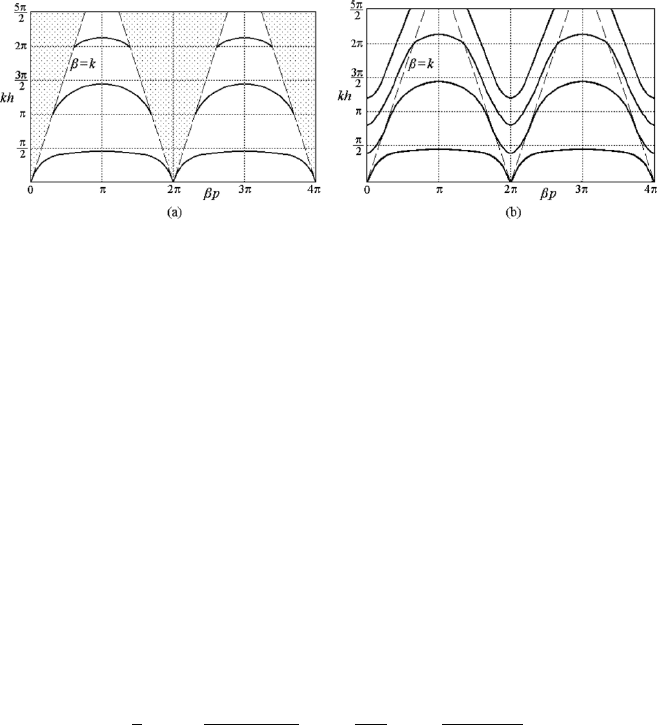
Figure 7.13: The k–β diagram of the open corrugated conducting surface
structure (a) and the closed structure (b) as periodic systems.
The difference between this equation and the eigenvalue equation of the same
structure based on a uniform system approach (7.11) is that the left-hand
side of the equation becomes a series. Furthermore, the factors p/d and
sinc(β
n
d/2) pertaining to details of the structure app ear in the eigenvalue
equation obtained by the periodic system approach.
Following this dispersion equation, we have the k–β curves plotted in
Fig. 7.13(a). It is shown by the dispersion curves in Fig. 7.13(a) and
Fig. 7.3(a) that when βp is small the two curves are close to each other
and when βp is large the periodic character of the system is obvious. The
dispersion curve becomes periodic and the forbidden regions appear periodi-
cally. This fact shows that as a guided wave system, for any space harmonic,
transverse radiation is never allowed.
The eigenvalue equation for the bounded structure shown in Fig. 7.12(b)
is obtained in a similar manner:
d
p
∞
X
n=−∞
1
τ
n
h tan τ
n
b
µ
sinc
β
n
d
2

2
=
1
kh tan kh
. (7.80)
The k–β curves are plotted in Fig. 7.13(b). Note that there is no forbidden
region in the k–β diagram for the bounded system, because the fast wave with
transverse standing-wave fields can be supported by an unbounded structure.
7.6 Disk-Loaded Waveguide as a Periodic
System
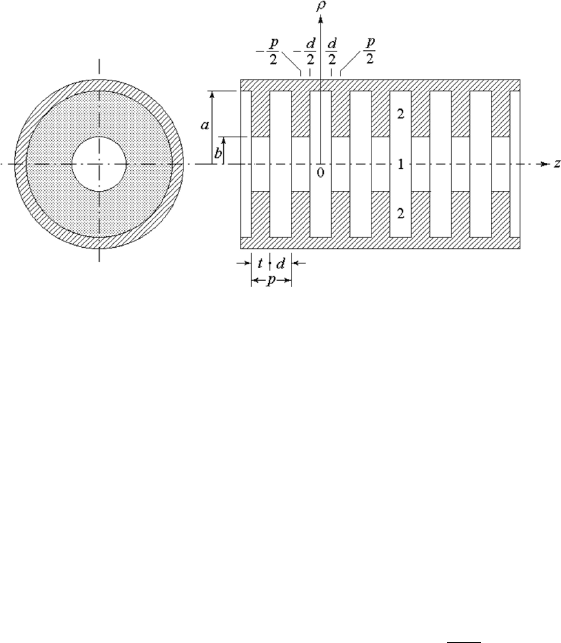
The disk-loaded waveguide with coupling holes at the center as a periodic
system is shown in Fig. 7.14. The thickness of the disk is t, the spacing
between disks is d, and the period of the system is p = t+d. We are interested
in the azimuthal invariant TM modes for which n = 0. The spatial period is
7.6 Disk Loaded Waveguide as a Periodic System 427
Figure 7.14: Disk-loaded waveguide as a p eriodic system.
no longer much less than the longitudinal wavelength and the structure must
be analyzed as a periodic system.
In region 1, ρ ≤ b, according to (7.55) and (7.18), the U function can be
expressed as the following series:
U
1
=
∞
X
n=−∞
A
n
I
0
(τ
n
ρ)e
−jβ
n
z
, (7.81)
where
β
2
n
− τ
2
n
= k
2
= ω
2
µ
0
²
0
, β
n
= β
0
+
2πn
p
. (7.82)
The field components become
E
ρ1
=
∞
X
n=−∞
−jβ
n
τ
n
A
n
I
1
(τ
n
ρ)e
−jβ
n
z
, (7.83)
E
z1
=
∞
X
n=−∞
−τ
2
n
A
n
I
0
(τ
n
ρ)e
−jβ
n
z
, (7.84)
H
φ1
=
∞
X
n=−∞
−jω²
0
τ
n
A
n
I
1
(τ
n
ρ)e
−jβ
n
z
. (7.85)
In region 2, b ≤ ρ ≤ a, the region between two disks is a radial line
with short-circuit surface at ρ = a. The exact solution must be the following
series:
U
2
=
(
∞
X
l=0
[B
l
J
0
(T
l
ρ) + C
l
N
0
(T
l
ρ)] cos β
l
z
)
e
−jβ
0
mp
, (7.86)

428 7. Periodic Structures and the Coupling of Modes
where β
l
is the phase coefficient inside the radial line, readers should distin-
guish it from the phase coefficient of the system β
0
and β
n
. Since p 6¿ λ
z
,
the phase shift along z is considered as a discontinuous function e
−jβ
0
mp
.
Although the spatial period of the structure is no longer much less than the
longitudinal wavelength, it is still much less than the wavelength in space,
p ¿ λ, and the only mode we need to consider is the TEM
(ρ)
mode propa-
gating in the ±ρ directions, i.e., β
l
= 0 and T = k. Hence we have
U
2
= [B
1
J
0
(kρ) + B
2
N
0
(kρ)] e
−jβ
0
mp
. (7.87)
In satisfying the short-circuit boundary condition at ρ = a, we have
B
1
N
0
(ka)
= −
B
2
J
0
(ka)
= B.
Then the U
2
function and the field components become
U
2
= B [N
0
(ka)J
0
(kρ) − J
0
(ka)N
0
(kρ)] e
−jβ
0
mp
, (7.88)
E
z2
= k
2
B [N
0
(ka)J
0
(kρ) − J
0
(ka)N
0
(kρ)] e
−jβ
0
mp
, (7.89)
H
φ2
= jω²
0
kB [N
0
(ka)J
1
(kρ) − J
0
(ka)N
1
(kρ)] e
−jβ
0
mp
. (7.90)
Suppose that the electric field at the gap is uniform, i.e., on the boundary,
ρ = b, the electric field is of the form
E
z
(b) =
½
E
0
, −d/2 < z
0
< +d/2,
0 +d/2 < z
0
< p − d/2.
(7.91)
where z
0
denotes the z coordinate with respect to the center of the mth gap,
z
0
= z − mp.
Let E
z1
(b) = E
z
(b). We get
∞
X
n=−∞
−τ
2
n
A
n
I
0
(τ
n
b)e
−jβ
n
z
0
=
½
E
0
, −d/2 < z
0
< +d/2,
0 +d/2 < z
0
< p − d/2.
The nth coefficient of the Fourier series is evaluated by
−τ
2
n
A
n
I
0
(τ
n
b) =
1
p
Z
d/2
−d/2
E
0
e
jβ
n
z
0
dz
0
= E
0
d
p
sinc
β
n
d
2
and
A
n
= −
E
0
τ
2
n
I
0
(τ
n
b)
d
p
sinc
β
n
d
2
. (7.92)
Let E
z2
(b) = E
z
(b). We get
k
2
B [N
0
(ka)J
0
(kb) − J
0
(ka)N
0
(kb)] = E
0
,

7.6 Disk Loaded Waveguide as a Periodic System 429
and
B =
E
0
k
2
[N
0
(ka)J
0
(kb) − J
0
(ka)N
0
(kb)]
. (7.93)
The magnetic field H
φ
can be matched approximately on the cylindri-
cal boundary ρ = b by applying the average matching condition given in
Section 3.10, which is
Z
d/2
−d/2
H
φ1
(b) dz
0
=
Z
d/2
−d/2
H
φ2
(b) dz
0
. (7.94)
Substituting (7.85) and (7.90) into this and applying the integral formula
(7.73), we have
∞
X
n=−∞
−τ
n
A
n
I
1
(τ
n
b) sinc
β
n
d
2
= kB[N
0
(ka)J
1
(kb) − J
0
(ka)N
1
(kb)]. (7.95)
Substituting the expressions for A
n
and B into this equation, we have the
eigenvalue equation as follows:
d
p
∞
X
n=−∞
I
1
(τ
n
b)
τ
n
bI
0
(τ
n
b)
µ
sinc
β
n
d
2

2
=
1
kb
N
0
(ka)J
1
(kb) − J
0
(ka)N
1
(kb)
N
0
(ka)J
0
(kb) − J
0
(ka)N
0
(kb)
. (7.96)
If we use the specific point matching condition instead of the average match-
ing condition for the magnetic field, then the eigenvalue equation becomes
d
p
∞
X
n=−∞
I
1
(τ
n
b)
τ
n
bI
0
(τ
n
b)
sinc
β
n
d
2
=
1
kb
N
0
(ka)J
1
(kb) − J
0
(ka)N
1
(kb)
N
0
(ka)J
0
(kb) − J
0
(ka)N
0
(kb)
. (7.97)
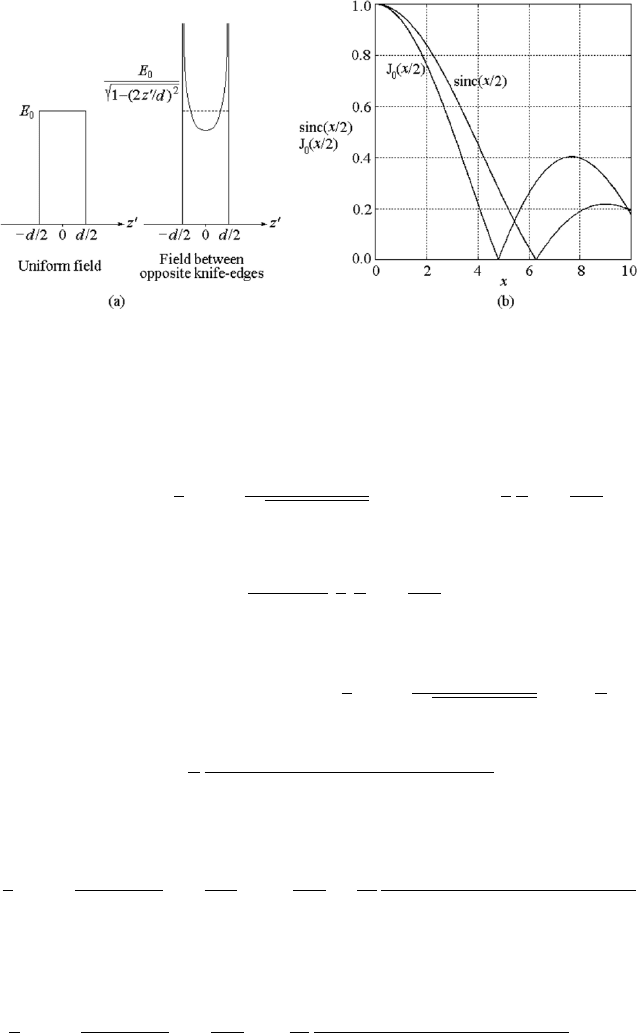
In fact, the fields in the gap are not uniform. The field at the center of
the gap must be weaker than that at the edge. The alternative approach is
that the electric field at the gap is assumed to be a quasi-static field between
opposite knife-edges, refer to Fig 7.15(a). According to the result of conformal
mapping, the potential between the edges is given by
ϕ(z
0
) =
V
π
arcsin
2z
0
d
and the electric field is derived to be
E
z
(b) = −
dϕ
dz
0
=
E
0
p
1 − (2z
0
/d)
2
, (7.98)
where E
0
= 2V/πd. Let E
z1
(b) = E
z
(b). We get
∞
X
n=−∞
−τ
2
n
A
n
I
0
(τ
n
b)e
−jβ
n
z
0
=
E
0
p
1 − (2z
0
/d)
2
, −d/2 < z
0
< +d/2,
0 +d/2 < z
0
< p − d/2.
430 7. Periodic Structures and the Coupling of Modes
Figure 7.15: (a) Uniform field between parallel plates and quasi-static field
between opposite knife edges. (b) Functions J
0
(x/2) and sinc(x/2).
The nth coefficient of the Fourier series satisfies the relation
−τ
2
n
A
n
I
0
(τ
n
b) =
1
p
Z
d/2
−d/2
E
0
p
1 − (2z
0
/d)
2
e
jβ
n
z
0
dz
0
= E
0
d
p
π
2
J
0
µ
β
n
d
2

and the expression for A
n
takes the form
A
n
= −
E
0
τ
2
n
I
0
(τ
n
b)
d
p
π
2
J
0
µ
β
n
d
2

. (7.99)
Let E
z2
(b) = E
z
(b). We get
k
2
B[N
0
(ka)J
0
(kb) − J
0
(ka)N
0
(kb)] =
1
d
Z
d/2
−d/2
E
0
p
1 − (2z
0
/d)
2
dz
0
=
π
2
E
0
and
B =
π
2
E
0
k
2
[N
0
(ka)J
0
(kb) − J
0
(ka)N
0
(kb)]
. (7.100)
Substituting these expressions for A
n
and B into (7.95), we have the eigen-
value equation
d
p
∞
X
n=−∞
I
1
(τ
n
b)
τ
n
bI
0
(τ
n
b)
J
0
µ
β
n
d
2

sinc
β
n
d
2
=
1
kb
N
0
(ka)J
1
(kb) − J
0
(ka)N
1
(kb)
N
0
(ka)J
0
(kb) − J
0
(ka)N
0
(kb)
.
(7.101)
If we use the specific point matching condition for a magnetic field, then
the eigenvalue equation takes another form:
d
p
∞
X
n=−∞
I
1
(τ
n
b)
τ
n
bI
0
(τ
n
b)
J
0
µ
β
n
d
2

=
1
kb
N
0
(ka)J
1
(kb) − J
0
(ka)N
1
(kb)
N
0
(ka)J
0
(kb) − J
0
(ka)N
0
(kb)
. (7.102)