
Zhang K., Li D. Electromagnetic Theory for Microwaves and Optoelectronics
Подождите немного. Документ загружается.

7.7 The Helix 441
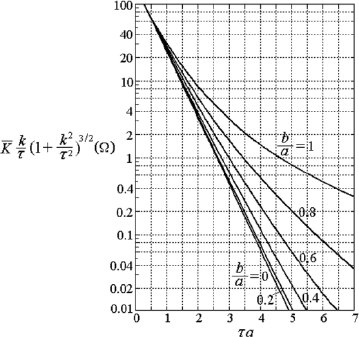
Figure 7.24: The average interaction impedance of the dominant mode on a
sheath helix.
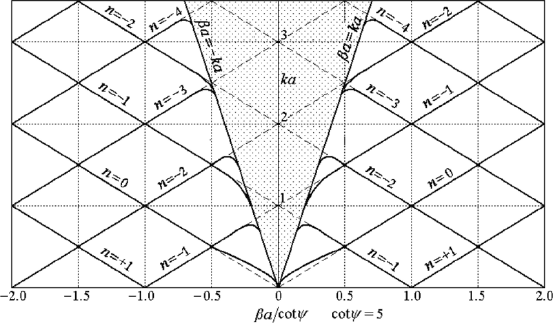
of n = 0 is shown in the diagram as a forward-wave mode, so the helix is a
forward fundamental system. It is also indicated in the diagram that only for
n = 0 mode and for τ a À 1, is the phase velocity nearly constant and nearly
equal to the group velocity. The modes for which n 6= 0 are forward-wave
modes in a certain frequency range and are backward-wave modes for rest of
the frequency range.
From the eigenvalue equation (7.129) and the k −β diagram Fig 7.25 we
see that, other from metallic waveguide, dielectric waveguide and disk-loaded
waveguide, for helix, the cutoff conditions and the dispersion relations are dif-
ferent for +n and −n, i.e., τ
−n
6= τ
+n
and β
−n
6= β
+n
. So the clockwise and
the counterclockwise skew waves with functions e
−jnφ
e
−jβ
−n
z
and e
jnφ
e
−jβ
n
z
propagate with different longitudinal phase coefficients and cannot be com-
posed into standing wave fields with stationary polarization direction. This
is because of the skew and anisotropic nature of the boundary.
A right-handed helix is not fundamentally different from a left-handed
helix. If we have the solution for a right-handed helix of the form
F
n
(ρ)e
jnφ
e
−jβz
, then a solution F
−n
(ρ)e
−jnφ
e
−jβz
exists for the left-handed
helix. This is so because n occurs only in conjunction with cot ψ and func-
tions I
n
and K
n
are even functions of n. Thus, if we change the sign of n and
the sign of cot ψ, we get the same propagation constant β.
The dominant mode with n = 0 of a helix is a forward-wave mode, which
is usually used as slow-wave structure for traveling wave amplifier. The
backward-wave mode with n = −1 is used as the slow-wave structure for
backward-wave oscillator, which is a wide-band electronic-tuned oscillator.
442 7. Periodic Structures and the Coupling of Modes
Figure 7.25: k–β diagram of the sheath helix.
7.7.2 The Tape Helix
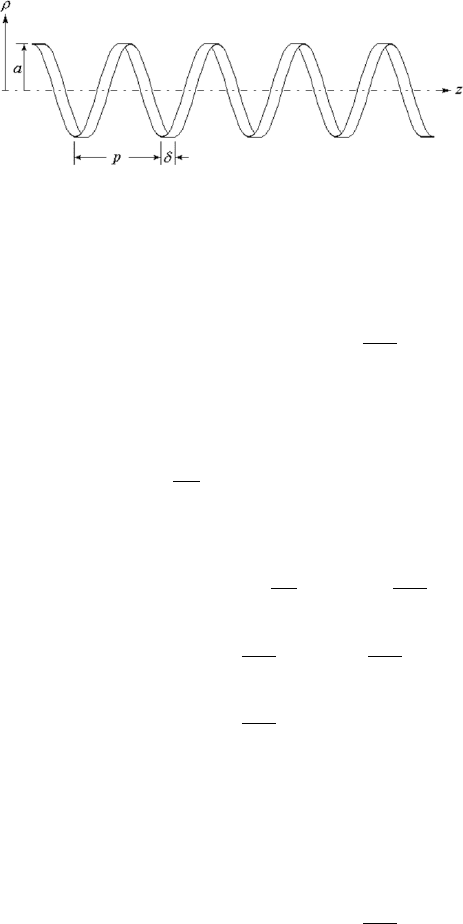
A more representative physical model of the wire helix is the tape helix [87]
shown in Fig. 7.26. The tape is of width δ and of zero thickness and considered
to be perfectly conducting. The radius of the helix is a, the pitch is p and
cot ψ = 2πa/p.
We have seen in the last subsection that the sheath helix is a uniform
helical structure. When a sheath helix of infinite length is displaced along
its z axis by an arbitrary distance, it remains invariant and when the sheath
helix is rotated in φ by an arbitrary angle it again remains invariant.
Both the wire helix and the tape helix are periodic helical structures
rather than uniform-helical structures. The features of a periodic helical
structure are as follows:
(1) When the helix is moved a distance p in the z direction it remains
invariant. This is the feature of a p eriodic structure and according to (7.50)
and (7.48) we have
E (ρ, φ, z) = F (ρ, φ, z) e
−jβ
0
z
, (7.154)
F (ρ, φ, z + mp) = F (ρ, φ, z). (7.155)
(2) When the single-wire helix is rotated in φ by 2π it also remains in-
variant. This gives
F (ρ, φ + 2π, z) = F (ρ, φ, z). (7.156)
In satisfying the two conditions above, the function F (ρ, φ, z) must be of the
7.7 The Helix 443
Figure 7.26: The tape helix.
following form
F (ρ, φ, z) =
∞
X
ν=−∞
∞
X
n=−∞
F
νn
(ρ)e
jνφ
exp
³
− j
2πn
p
z
´
. (7.157)
(3) When the helix is moved an arbitrary distance ∆z and rotated in φ
by ∆φ = 2π∆z/p it again remains invariant. This gives
F
µ
ρ, φ + 2π
∆z
p
, z + ∆z

= F (ρ, φ, z), (7.158)
i.e.,
∞
X
ν=−∞
∞
X
n=−∞
F
νn
(ρ) exp
·
jν
µ
φ + 2π
∆z
p
¶¸
exp
·
−j
2πn
p
(z + ∆z)
¸
=
∞
X
ν=−∞
∞
X
n=−∞
F
νn
(ρ)e
jνφ
exp
³
− j
2πn
p
z
´
exp
·
−j
2πn
p
(n − ν)∆z
¸
=
∞
X
ν=−∞
∞
X
n=−∞
F
νn
(ρ)e
jνφ
exp
³
− j
2πn
p
z
´
. (7.159)
To ensure this, it is necessary to demand ν = n, i.e.,
F
νn
(ρ) 6= 0, for ν = n, and F
νn
(ρ) = 0, for ν 6= n.
So F (ρ, φ, z) must be in the following expanded series
F (ρ, φ, z) =
∞
X
n=−∞
F
n
(ρ)e
jnφ
exp
³
− j
2πn
p
z
´
, (7.160)
and the field components must be the form
E (ρ, φ, z) = F (ρ, φ, z) e
−jβ
0
z
=
∞
X
n=−∞
F
n
(ρ)e
jnφ
e
−jβ
n
z
, (7.161)

444 7. Periodic Structures and the Coupling of Modes
where
β
n
= β
0
+
2πn
p
. (7.162)
Each term in the above series must satisfy Helmholtz’s equation in cylin-
drical co ordinates. Hence the wave functions for slow-wave solutions must be
series of I
n
(τρ) in region 1 (ρ ≤ a) and series of K
n
(τρ) in region 2 (ρ ≥ a):
U
1
=
∞
X
n=−∞
A
n
I
n
(τ
n
ρ)e
jnφ
e
−jβ
n
z
, V
1
=
∞
X
n=−∞
B
n
I
n
(τ
n
ρ)e
jnφ
e
−jβ
n
z
, (7.163)
U
2
=
∞
X
n=−∞
C
n
K
n
(τ
n
ρ)e
jnφ
e
−jβ
n
z
, V
2
=
∞
X
n=−∞
D
n
K
n
(τ
n
ρ)e
jnφ
e
−jβ
n
z
, (7.164)
where
β
2
n
− τ
2
n
= k
2
= ω
2
µ². (7.165)
It should be noted that, for sheath helix, n is the angular order of the mode.
Each mode represents a space-sinusoidal wave which alone can satisfy the
uniform-system boundary condition of the sheath helix. Here, for tape helix,
n is the longitudinal order as well as the angular order of the space harmonic.
The non-sinusoidal wave composed by all the space harmonics can satisfy the
periodic-system b oundary condition of the tap e helix.
The field components in the two regions are given by
E
z1
=
∞
X
n=−∞
−τ
2
n
A
n
I
n
(τ
n
ρ)e
jnφ
e
−jβ
n
z
, (7.166)
E
ρ1
=
∞
X
n=−∞
·
−jβ
n
τ
n
A
n
I
0
n
(τ
n
ρ) +
ωµn
ρ
B
n
I
n
(τ
n
ρ)
¸
e
jnφ
e
−jβ
n
z
, (7.167)
E
φ1
=
∞
X
n=−∞
·
nβ
n
ρ
A
n
I
n
(τ
n
ρ) + jωµτ
n
B
n
I
0
n
(τ
n
ρ)
¸
e
jnφ
e
−jβ
n
z
, (7.168)
H
z1
=
∞
X
n=−∞
−τ
2
n
B
n
I
n
(τ
n
ρ)e
jnφ
e
−jβ
n
z
, (7.169)
H
ρ1
=
∞
X
n=−∞
·
−
ω²n
ρ
A
n
I
n
(τ
n
ρ) − jβ
n
τ
n
B
n
I
0
n
(τ
n
ρ)
¸
e
jnφ
e
−jβ
n
z
, (7.170)
H
φ1
=
∞
X
n=−∞
·
−jω²τ
n
A
n
I
0
n
(τ
n
ρ) +
nβ
n
ρ
B
n
I
n
(τ
n
ρ)
¸
e
jnφ
e
−jβ
n
z
. (7.171)
E
z2
=
∞
X
n=−∞
−τ
2
n
C
n
K
n
(τ
n
ρ)e
jnφ
e
−jβ
n
z
, (7.172)
E
ρ2
=
∞
X
n=−∞
·
−jβ
n
τ
n
C
n
K
0
n
(τ
n
ρ) +
ωµn
ρ
D
n
K
n
(τ
n
ρ)
¸
e
jnφ
e
−jβ
n
z
, (7.173)

7.7 The Helix 445
E
φ2
=
∞
X
n=−∞
·
nβ
n
ρ
C
n
K
n
(τ
n
ρ) + jωµτ
n
D
n
K
0
n
(τ
n
ρ)
¸
e
jnφ
e
−jβ
n
z
, (7.174)
H
z2
=
∞
X
n=−∞
−τ
2
n
D
n
K
n
(τ
n
ρ)e
jnφ
e
−jβ
n
z
, (7.175)
H
ρ2
=
∞
X
n=−∞
·
−
ω²n
ρ
C
n
K
n
(τ
n
ρ) − jβ
n
τ
n
D
n
K
0
n
(τ
n
ρ)
¸
e
jnφ
e
−jβ
n
z
, (7.176)
H
φ2
=
∞
X
n=−∞
·
−jω²τ
n
C
n
K
0
n
(τ
n
ρ) +
nβ
n
ρ
D
n
K
n
(τ
n
ρ)
¸
e
jnφ
e
−jβ
n
z
. (7.177)
The boundary conditions at ρ = a for the perfect conducting tape helix
are as follows.
1. The tangential electric field is continuous for all φ and z.
2. The discontinuity in a tangential magnetic field is equal to the surface
current density perpendicular to the magnetic field.
3. The tangential electric field is equal to zero on the tape surface.
The mathematical expressions of the above conditions are as follows.
E
z1
(a) = E
z2
(a), (7.178)
E
φ1
(a) = E
φ2
(a), (7.179)
H
z2
(a) − H
z1
(a) = −J
sφ
(a), (7.180)
H
φ2
(a) − H
φ1
(a) = J
sz
(a) (7.181)
and
E
t
(a) = 0, for
pφ
2π
−
δ
2
< z <
pφ
2π
+
δ
2
, (7.182)
where E
t
(a) denotes the tangential electric field on the surface ρ = a, J
sφ
(a)
and J
sz
(a) are the surface current densities on ρ = a in the φ and z directions,
respectively. They are also in series of space harmonics
J
sφ
(a) =
∞
X
n=−∞
j
φn
e
jnφ
e
−jβ
n
z
, (7.183)
J
sz
(a) =
∞
X
n=−∞
j
zn
e
jnφ
e
−jβ
n
z
, (7.184)
where j
φn
and j
zn
are the complex Fourier amplitudes of the current densities
associated with the nth space harmonic.
An exact solution should be obtained in principle if one tries to insert the
appropriate field component quantities in the boundary equations (7.178) to
446 7. Periodic Structures and the Coupling of Modes
Figure 7.27: The expanded view of a tape helix.
(7.181). This results in a set of infinite-by-infinite simultaneous equations
which can be solved for the unknown propagation constant β
0
and the co-
efficients A
n
to D
n
in expressions of field components. This procedure is
similar to that used for the reentrant cavity given in Section 5.6.1 and adds
little physical insight to the problem. Therefore, only approximate methods
are considered here in which a reasonable current distribution in the tape is
assumed.
For slow waves and for regions smaller than the wavelength in space, the
r.f. field solutions are like static field solutions. We assume, therefore, that
the current in a thin, narrow tape flows only in the tape direction, i.e.,
J
⊥
= 0, (7.185)
J
k
=
∞
X
n=−∞
j
kn
e
jnφ
e
−jβ
n
z
for
pφ
2π
−
δ
2
< z <
pφ
2π
+
δ
2
, (7.186)
and
J
k
= 0, elsewhere.
The relations for j
φn
, j
zn
, and j
kn
are
j
φn
= j
kn
cos ψ, j
zn
= j
kn
sin ψ. (7.187)
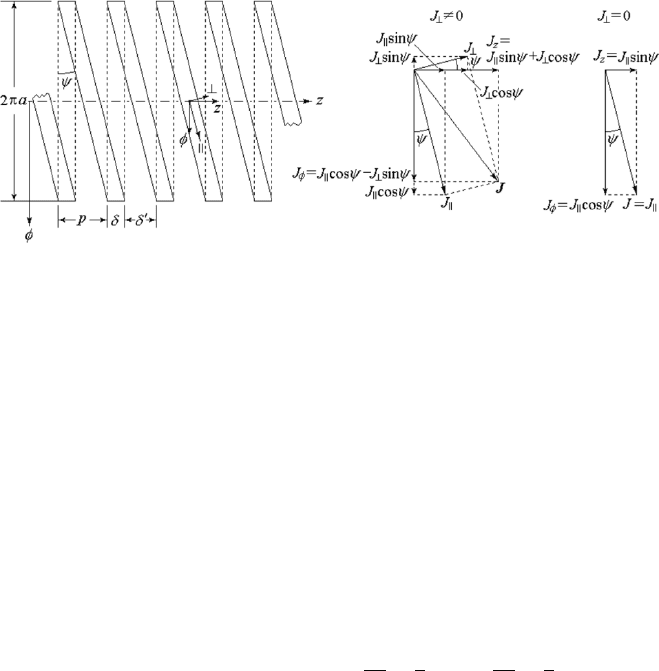
See the figure of the expanded view of a tape helix, Fig. 7.27.
For the amplitude variation on the tape, there are two possible assump-
tions.
1. The current density is constant over the width of the tape.
2. The quasi-static current density distribution in an isolated infinitesi-
mally thin conducting tape, which can be obtained by means of con-
formal mapping is similar to the distribution of electric field between
opposite knife-edges (7.98).

7.7 The Helix 447
For the phase variation on the tape, there are three possible assumptions.
1. The phase varies in the z direction.
2. The phase varies in the φ direction.
3. The phase varies in the helical direction of the tape.
Finally, the current density J
k
is expressed as follows:
J
k
=
p
δ
J
s
1 − ξ
·
2(z + pφ/2π)
δ
¸
2
exp
½
−j
·
β
0
pφ
2π
+ β
k
µ
z −
pφ
2π
¶¸¾
, (7.188)
for
pφ
2π
−
δ
2
< z <
pφ
2π
+
δ
2
,
and
J
k
= 0, elsewhere,
where
ξ = 0 means constant current density over the width of the tape;
ξ = 1 indicates the quasi-static current density in an isolated thin tape;
β
k
= β
0
means the phase varies in z, the phase factor becomes e
−jβ
0
z
;
β
k
= 0 means the phase varies in φ, the phase factor becomes
exp
³
−jβ
0
pφ
2π
´
;
β
k
= β
0
sin
2
ψ means the phase varies in the helical direction and the
phase factor becomes exp
n
−jβ
0
h
z sin
2
ψ +
pφ
2π
¡
1 − sin
2
ψ
¢
io
.
The Fourier coefficients of (7.186), j
kn
, are then obtained by equating it
to the given function (7.188) and performing proper integration:
j
kn
=
1
p
Z
pφ
2π
+
δ
2
pφ
2π
−
δ
2
p
δ
J
r
1−ξ
h
2(z+pφ/2π)
δ
i
2
exp
½
−j
·
β
0
pφ
2π
+β
k
µ
z−
pφ
2π
¶¸¾
e
jβ
n
z
e
−jnφ
dz.
(7.189)
The result of the integration is
j
kn
= JR
n
, (7.190)
where
R
n
=
sinc(nπδ/p), for ξ = 0, β
k
= β
0
;
J
0
(nπδ/p), for ξ = 1, β
k
= β
0
;
sinc(β
n
δ/2), for ξ = 0, β
k
= 0;
J
0
(β
n
δ/2), for ξ = 1, β
k
= 0;
(β
0
/β
n
)sinc(β
n
δ/2), for ξ = 0, β
k
= β
0
sin
2
ψ;
J
0
(β
n
δ/2)/J
0
(β
0
δ/2), for ξ = 1, β
k
= β
0
sin
2
ψ.

448 7. Periodic Structures and the Coupling of Modes
Substituting the field-component expressions (7.166)–(7.177) and the sur-
face current density expressions (7.183), (7.184), (7.187), and (7.190) into the
boundary equations (7.178)–(7.181), we have the following set of simultane-
ous linear equations
−τ
2
n
I
na
A
n
+ τ
2
n
K
na
C
n
= 0, (7.191)
nβ
n
a
I
na
A
n
+jωµτ
n
I
0
na
B
n
−
nβ
n
a
K
na
C
n
−jωµτ
n
K
0
na
D
n
= 0, (7.192)
−τ
2
n
I
na
B
n
+ τ
2
n
K
na
D
n
= JR
n
cos φ, (7.193)
jω²τ
n
I
0
na
A
n
−
nβ
n
a
I
na
B
n
−jω²τ
n
K
0
na
C
n
+
nβ
n
a
K
na
D
n
= JR
n
sin φ, (7.194)
where I
na
, I
0
na
, K
na
, and K
0
na
represent I
n
(τ
n
a), I
0
n
(τ
n
a), K
n
(τ
n
a), and
K
0
n
(τ
n
a), respectively.
The solutions of this set of equations give the following expressions for
the field coefficients
A
n
=
−a sin ψ + (nβ
n
/τ
2
n
) cos ψ
jω²
K
n
(τ
n
a)JR
n
, (7.195)
B
n
=
−a cos ψ
τ
n
K
0
n
(τ
n
a)JR
n
, (7.196)
C
n
=
−a sin ψ + (nβ
n
/τ
2
n
) cos ψ
jω²
I
n
(τ
n
a)JR
n
, (7.197)
D
n
=
−a cos ψ
τ
n
I
0
n
(τ
n
a)JR
n
. (7.198)
Substituting these coefficients into (7.166)–(7.177), we have all the field com-
ponents inside and outside the tape helix. The only unknown quantity is J,
which is determined by the amplitude of traveling wave propagating along
the longitudinal direction z.
The eigenvalue equation is then obtained by applying the condition of
(7.182). Because the current density distribution on the tape is not the true
value, the condition of (7.182) cannot be satisfied strictly everywhere, instead,
the following approximate condition is used:
E
k
³
a, φ,
pφ
2π
´
= 0, (7.199)
which means that the electric field parallel to the helical direction of the tape
is equal to zero on the central line of the tape. The relation of E
k
and E
z
,
E
φ
is given by
E
k
= E
z
sin ψ + E
φ
cos ψ. (7.200)
Substituting the corresponding field-component expressions (7.166), (7.168)
or (7.172), (7.174) and the coefficient expressions (7.195), (7.196) or (7.197),
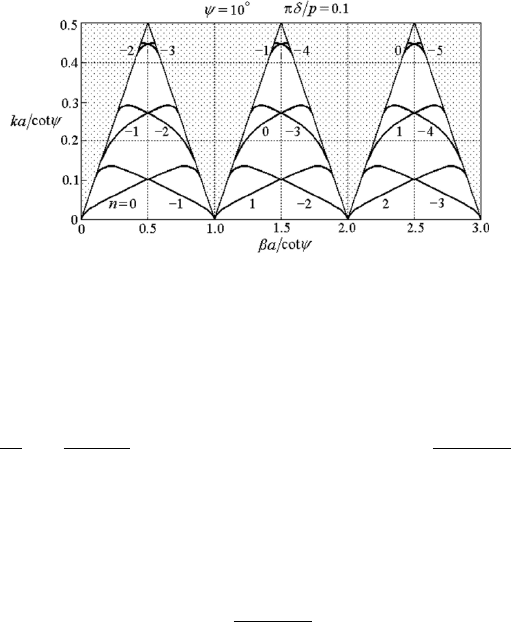
7.7 The Helix 449
Figure 7.28: k–β diagram of the tape helix.
(7.198) into the above equations, we have
E
k
³
a, φ,
pφ
2π
´
= j
J sin
2
ψ
ω²a
e
jβ
0
z
∞
X
n=−∞
nh
(τ
n
a)
2
− 2nβ
n
a cot ψ +
n
2
(β
n
a)
2
(τ
n
a)
2
cot
2
ψ
i
×I
n
(τ
n
a)K
n
(τ
n
a)+(ka)
2
cot
2
ψ I
0
n
(τ
n
a)K
0
n
(τ
n
a)
o
R
n
=0. (7.201)
It gives the approximate eigenvalue equation as follows
∞
X
n=−∞
nh
(τ
n
a)
2
−2nβ
n
a cot ψ +
n
2
(β
n
a)
2
(τ
n
a)
2
cot
2
ψ
i
I
n
(τ
n
a)K
n
(τ
n
a)
+ (ka)
2
cot
2
ψ I
0
n
(τ
n
a)K
0
n
(τ
n
a)
o
R
n
=0. (7.202)
This equation includes a series of modified Bessel functions which converge
slowly. If each term of the series in (7.202) is independently set to zero, it
reduces to the eigenvalue equation for the nth mode in a sheath helix, shown
in (7.129).
Equation (7.202) is solved for a specific value of cot ψ. A complete k–β
diagram of a tape helix is shown in Fig. 7.28 for ψ = 10
◦
and πδ/p = 0.1.
Comparison of Fig. 7.28 with Figure 7.25 shows that the forbidden regions
appear periodically at βp = 2nπ and the k–β curves are consistent with the
regulations for periodic systems. It is remarkable that the space harmonic
components on the tape helix correspond to individual modes on the sheath
helix and that the sheath approach is invalid in forbidden regions.
The interaction impedance of the tape helix can be obtained from its
field components and the calculated value is lower than that of the sheath
approach due to the influences of space harmonics.

450 7. Periodic Structures and the Coupling of Modes
7.8 Coupling of Modes
The guided modes that we studied in the preceding sections propagate along
guided-wave systems undisturbed and free of mutual coupling provided that
the waveguide is uniform and free of irregularities or discontinuities. Some-
times, there are material inhomogeneities or slight changes in the boundaries
on the waveguide. These imperfections cause the modes in the waveguide
to couple among them. If a single mode is excited at the beginning of a
waveguide, some of the power may be transferred to other guided modes,
cutoff modes, or radiation modes by means of the coupling. Furthermore,
the guided mo des in different waveguides may also be coupled with each
other if there are some coupling mechanisms between the waveguides. In pe-
riodic systems the mode coupling can happen to different space harmonics of
different modes. When mode coupling occurs, the propagation constants will
be different from those of the individual modes, which leads to an increase
or decrease of phase velocity or the growth or decay of the wave.
A great many phenomena occurring in physics or engineering can be quite
naturally viewed as coupled-mode processes and studied by the coupled-mode
theory. For example, the directional couplers in microwave and light-wave
technologies, the scattering loss due to waveguide irregularities, the inter-
action between electron beams and slow-wave structures in traveling-wave
amplifiers and backward-wave oscillators, the distributed feedback (DFB)
structures, and the scattering of light by gratings and by acoustic waves,
etc. The coupled-mode formalism is a perturbation analysis developed for
weak coupling, it includes the coupling-in-time formalism and the coupling-
in-space formalism. The former is applied to coupled oscillating modes and
the latter to coupled propagation modes. In this book, we deal with the
coupling-in-space formalism only. The coupling-in-time equations are analo-
gous to the coupling-in-space equations. Time in oscillating elements plays
the role of distance in propagating structures. The frequency plays the role
of the propagation constant, whereas the counterpart of power flow in the
transmission system is energy in the oscillator. [38, 61, 80, 117]
7.8.1 Coupling of Modes in Space
Recall from Section 3.4 that in an arbitrary uniform lossless guided-wave sys-
tem any mode can be simulated by an equivalent ideal transmission line. For
the wave with time dependence e
jωt
, the basic equations for ideal transmis-
sion line are given in Section 3.1.1 as follows:
dU
dz
= jωLI,
dI
dz
= jωCU. (7.203)
The solutions to these equations are in the form e
−jβz
in which β is positive
or negative for the wave with phase velocity in the +z or the −z direction,
respectively, and β =
√
LC.