
Zhang K., Li D. Electromagnetic Theory for Microwaves and Optoelectronics
Подождите немного. Документ загружается.

7.8 Coupling of Modes 451
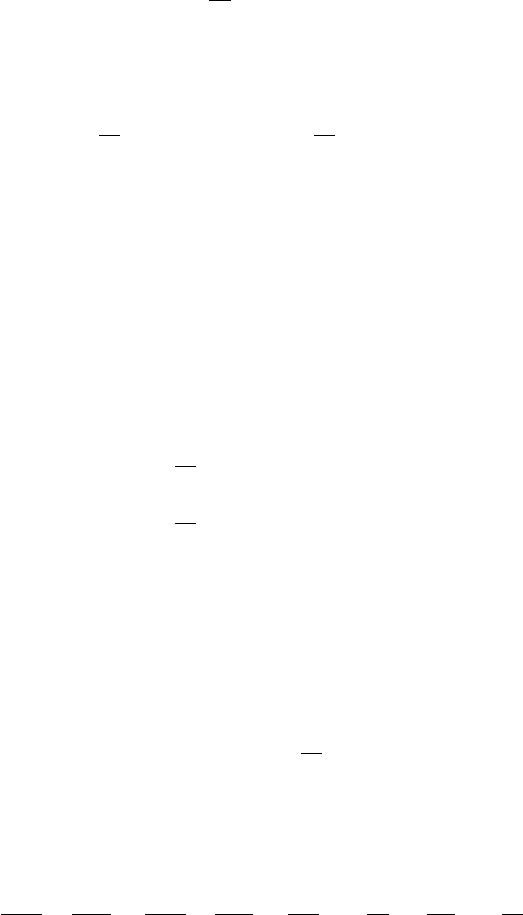
Let a(z) denote the complex quantity of any field component of a desired
mode propagating in the z direction in a guided-wave system with spatial
dependence e
−jβ
0
z
. The normal mode form of the transmission-line equation
is
da
dz
= −jβ
0
a. (7.204)
Consider two modes a(z) and b(z), which, in the absence of coupling, have
natural phase constants β
01
and β
02
, respectively. We have the normal mode
representation of the transmission line equations for the two modes:
da
dz
= −jβ
01
a,
db
dz
= −jβ
02
b. (7.205)
The modes are assumed to be lossless, so that both β
01
and β
02
are real. If
β
01
and β
02
are positive, the phase velocities of both modes are in the +z
direction; if β
01
and β
02
are negative, the phase velocities of both modes
are in the −z direction; and if β
01
and β
02
are of opposite sign, the phase
velocities are in opposite directions.
We will see later that only the modes with analogous phase velocities can
have effective coupling, so we can neglect all other modes and obtain sim-
ple coupled-wave equations that describe the interaction. If the two guided
modes with effective coupling are a and b, some of the energy in mode a is
transferred to mode b and some of the energy in mode b is transferred to
mode a. Then the coupled-mode equations can be written as
da
dz
= −jβ
01
a + κ
12
b, (7.206)
db
dz
= −jβ
02
b + κ
21
a, (7.207)
where κ
12
and κ
21
, in general, are mutual coupling differential operators.
For weak coupling, κ
12
and κ
21
become complex coupling coefficients and
κ
12
and κ
21
are small compared with β
01
and β
02
, so the equations become
linear equations. The coupling is assumed to b e uniform over the length of
the coupling, so that κ
12
and κ
21
are independent of z.
For a source-free and lossless system, power conservation requires that
the total average power of the two modes must be independent of z, i.e.,
|a|
2
± |b|
2
= constant,
d
dz
¡
|a|
2
± |b|
2
¢
= 0. (7.208)
If the waves carrying power travel in the same direction for the two uncoupled
modes, the plus sign is to be taken, whereas if the waves carrying power travel
in opposite directions for the two uncoupled modes, the minus sign is to be
taken. Then we have
d|a|
2
dz
±
d|b|
2
dz
=
daa
∗
dz
±
dbb
∗
dz
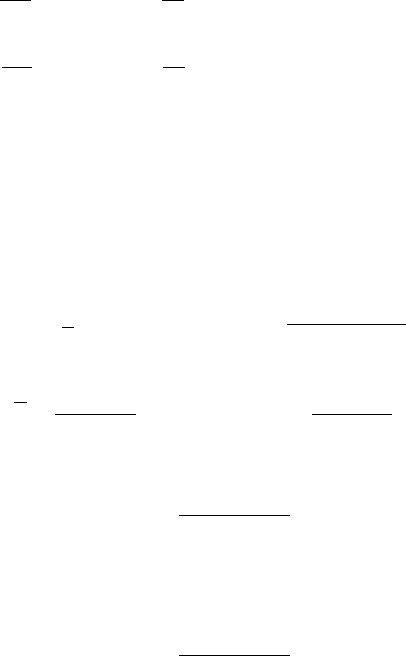
=a
da
∗
dz
+ a
∗
da
dz
± b
db
∗
dz
± b
∗
db
dz
= aκ
∗
12
b
∗
+ a
∗
κ
12
b ± bκ
∗
21
a
∗
± b
∗
κ
21
a = 0.
452 7. Periodic Structures and the Coupling of Modes
For strict energy conservation, this expression must be identically true for all
z. Since a and b are arbitrary complex quantities and the phases of a and b
are then arbitrary, the above equation is true if and only if
κ
21
= ∓κ
∗
12
, (7.209)
where the upper sign, minus, is required for group velocities in the same
direction and the lower sign, plus, is required for group velocities in opposite
directions.
Applying the operator (d/dz + jβ
02
) to (7.206) then substituting (7.207)
into it, and applying the operator (d/dz + jβ
01
) to (7.207) then substituting
(7.206) into it, we have the wave equations in coupled-mode formalism:
d
2
a
dz
2
+ j(β
01
+ β
02
)
da
dz
− (β
01
β
02
+ κ
12
κ
21
)a = 0, (7.210)
d
2
b
dz
2
+ j(β
01
+ β
02
)
db
dz
− (β
01
β
02
+ κ
12
κ
21
)b = 0. (7.211)
These are homogeneous linear differential equations with constant coeffi-
cients. The solutions of the equations are in the form of e
−jβz
, where βs
denote the phase coefficients for the coupled waves, which is different from
those for the uncoupled waves β
01
and β
02
. Substituting the trial solutions
into the coupled-wave equations yields the determinant equation of the cou-
pled modes:
β
2
− (β
01
+ β
02
)β + (β
01
β
02
+ κ
12
κ
21
) = 0. (7.212)
The two solutions of this equation are β
1
and β
2
:
β
1,2
= β ± B, B =
p
∆β
2
− κ
12
κ
21
, (7.213)
where
β =
β
01
+ β
02
2
, ∆β =
β
01
− β
02
2
.
For the two uncoupled modes that have waves carrying power in the same
direction, κ
21
= −κ
∗
12
, κ
12
κ
21
= −|κ
12
|
2
, and
B =
p
∆β
2
+ |κ
12
|
2
. (7.214)
In this case, β
1
and β
2
are always real.
For two uncoupled modes that have waves carrying power in opposite
directions, κ
21
= κ
∗
12
, κ
12
κ
21
= |κ
12
|
2
, and
B =
p
∆β
2
− |κ
12
|
2
. (7.215)
In this case, if |∆β| > |κ
12
|, then β
1
and β
2
are still real, or if |∆β| < |κ
12
|,
then B becomes imaginary and β
1
and β
2
become complex.
7.8 Coupling of Modes 453
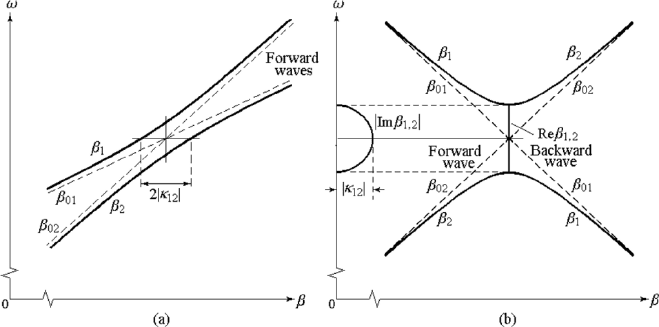
Figure 7.29: Dispersion diagram of coupled modes for the case of power flow
in the same direction (a), and in the opposite directions (b).
If the difference in the phase velocities of the two uncoupled modes is
sufficiently large so that |∆β| À |κ
12
|, then
β
1
or β
2
≈ β
01
or β
02
.
The two modes propagate with their own natural phase velocities and are
free of coupling.
Appreciable coupling can occur only if |β
01
−β
02
| is of the order of |κ
12
|,
which is small compared with β
01
and β
02
under the weak-coupling assump-
tion. Thus the condition for effective coupling is
β
01
≈ β
02
,
i.e., the phase velocities of the two modes must be of the same sign and
approximately equal to each other. In the case of ∆β = 0, β
01
= β
02
we have
B =
½
|κ
12
|, for group velocities in the same direction,
j|κ
12
|, for group velocities in opposite directions.
This is known as the phase synchronous state or phase matching.
The ω–β diagrams for coupled modes are shown in Fig. 7.29. The group
velocities of the two uncoupled modes are different and the unperturbed
dispersion curves of β
01
and β
02
may cross at the point of β
01
= β
02
as
shown by the dashed lines in the figure.
If the two uncoupled modes have group velocities in the same direction
as shown in Fig. 7.29(a), then the phase constants of the coupled waves β
1
and β
2
are always real. This is known as the co-directional mode coupling.
454 7. Periodic Structures and the Coupling of Modes
In this case, the appreciable coupling can occur only if the two modes are
both forward waves or both backward waves and the phase velocities of the
two modes are approximately equal. The coupled waves are two persistent
traveling waves with different phase coefficients. In consequence, the space
beat occurs for the composed wave. The two modes are said to be passively
coupled.
If the two uncoupled modes have group velocities in the opposite direc-
tions as shown in Fig. 7.29(a), this is known as the contra-directional mode
coupling. In this case, B becomes imaginary and β
1
, β
2
become complex
when |∆β| < |κ12|. It follows that a crossing of the β
01
and β
02
curves leads
to exponentially growing and decaying waves. In this case, the two modes
are said to be actively coupled. The condition of active coupling is that the
group velocities are in opposite directions and the phase velocities are in the
same direction and sufficiently closed to each other. Accordingly, if one mode
is a forward-wave mode the other mode must be a backward-wave mode. The
other possibility is that the two modes with opposite group velocities cou-
pling to each other by means of a forward-wave space harmonic of one mode
and a backward-wave space harmonic of the other mode.
7.8.2 General Solutions for the Mode Coupling
The solutions to the coupled-wave equations (7.210) and (7.211) must be
linear combinations of the functions e
−jβ
1
z
and e
−jβ
2
z
:
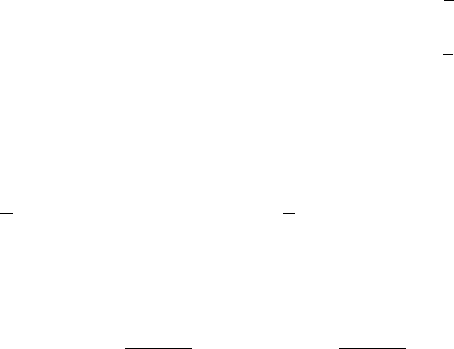
a(z) = A
1
e
−jβ
1
z
+ A
2
e
−jβ
2
z
=
¡
A
1
e
−jBz
+ A
2
e
jBz
¢
e
−jβz
, (7.216)
b(z) = B
1
e
−jβ
1
z
+ B
2
e
−jβ
2
z
=
¡
B
1
e
−jBz
+ B
2
e
jBz
¢
e
−jβz
, (7.217)
where coefficients A
1
, A
2
, B
1
, B
2
are determined by the boundary conditions
at specific z.
Substituting the expressions for a(z) and b(z), (7.216) and (7.217), into
coupled-mode equation (7.206), we have
{j[β
01
−(β+B)]A
1
−κ
12
B
1
}e
−jBz
+{j[β
01
−(β−B)]A
2
−κ
12
B
2
}e
jBz
= 0. (7.218)
The two terms on the left-hand side must be equal to zero independently,
because this equation should be valid for arbitrary z. Hence we have
B
1
= j
∆β − B
κ
12
A
1
, B
2
= j
∆β + B
κ
12
A
2
. (7.219)
If both the uncoupled modes have group velocities in the same direction,
and suppose that the initial values of a and b at z = 0 are a(0) and b(0),
substituting (7.219) into (7.216) and (7.217), we have
A
1
+ A
2
= a(0), (7.220)
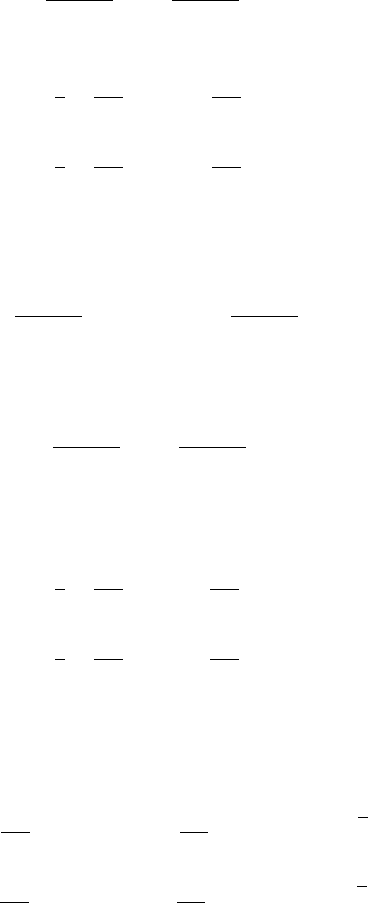
7.8 Coupling of Modes 455
B
1
+ B
2
= j
∆β − B
κ
12
A
1
+ j
∆β + B
κ
12
A
2
= b(0). (7.221)
The solutions of A
1
and A
2
are
A
1
=
µ
1
2
+
∆β
2B

a(0) + j
κ
12
2B
b(0), (7.222)
A
2
=
µ
1
2
−
∆β
2B

a(0) − j
κ
12
2B
b(0). (7.223)
Substituting the expressions for a(z) and b(z), (7.216) and (7.217), into
coupled-mode equation (7.207), by a procedure similar to the one used for
finding (7.219), we have
A
1
= −j
∆β + B
κ
21
B
1
, A
2
= −j
∆β − B
κ
21
B
2
. (7.224)
Suppose again that the initial values of a and b at z = 0 are a(0) and
b(0). By inserting (7.224) into (7.216) and (7.217), we have
A
1
+ A
2
= −j
∆β + B
κ
21
B
1
− j
∆β − B
κ
21
B
2
= a(0). (7.225)
B
1
+ B
2
= b(0). (7.226)
The solutions of B
1
and B
2
are
B
1
=
µ
1
2
−
∆β
2B

b(0) + j
κ
21
2B
a(0), (7.227)
B
2
=
µ
1
2
+
∆β
2B

b(0) − j
κ
21
2B
a(0). (7.228)
Substituting (7.222), (7.223), (7.227), and (7.228) into (7.216) and
(7.217), we have the general solutions of the coupled-wave equations for the
case of both of the uncoupled modes having group velocities in the same
direction, i.e., co-directional coupling:
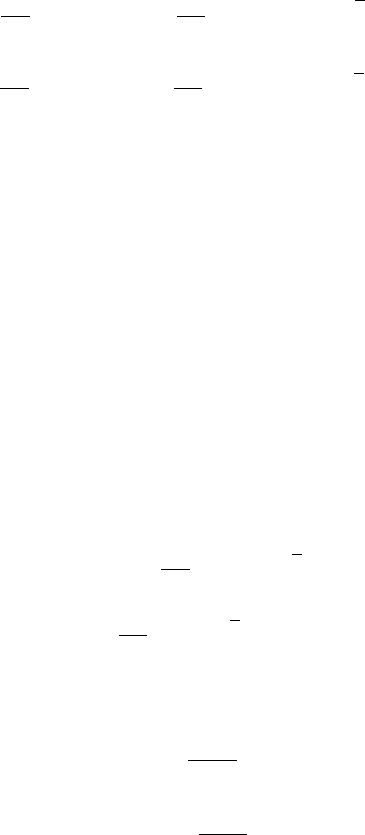
a(z) =
·µ
cos Bz − j
∆β
B
sin Bz

a(0) +
³
κ
12
B
sin Bz
´
b(0)
¸
e
−jβz
, (7.229)
b(z) =
·µ
cos Bz + j
∆β
B
sin Bz

b(0) +
³
κ
21
B
sin Bz
´
a(0)
¸
e
−jβz
. (7.230)
It is remarkable that, in the case of co-directional coupling, each coupled
wave is to make up the beat of two persistent waves with different phase
constants. The coupling waves become sine and cosine modulated traveling
waves. Power transfer takes place between the two modes and the average
power in each mode varies sinusoidally along z.
456 7. Periodic Structures and the Coupling of Modes
In the case of contra-directional coupling, when |∆β| > |κ12|, B is real,
the solutions are still (7.229) and (7.230). When |∆β| < |κ12| then B becomes
imaginary. Let B = jT , the solutions become
a(z) =
·µ
cosh T z−j
∆β
T
sinh T z

a(0)+
³
κ
12
T
sinh T z
´
b(0)
¸
e
−jβz
, (7.231)
b(z) =
·µ
cosh T z+j
∆β
T
sinh T z

b(0)+
³
κ
21
T
sinh T z
´
a(0)
¸
e
−jβz
. (7.232)
The coupling waves become hyperbolic-sine and hyperbolic-cosine modulated
traveling waves, i.e., decaying and growing waves along the directions of the
power flow.
7.8.3 Co-Directional Mode Coupling
For co-directional coupling, the resulted coupled waves are sine and cosine
modulated traveling waves, and power transfer takes place between the two
modes. This is the theoretical basis of the waveguide coupler.
(1) Asynchronous State
If the uncoupled phase constants of the two modes are not equal to each
other, β
01
6= β
02
, this condition is said to be the asynchronous state. We
suppose that all the power is initially introduced to mode 1, i.e., a(0) 6= 0
and b(0) = 0, then according to (7.229) and (7.230), we can describe the
distributions of fields of the two modes as
a(z) = a(0)
µ
cos Bz − j
∆β
B
sin Bz

e
−jβz
, (7.233)
b(z) = a(0)
κ
21
B
sin Bze
−jβz
. (7.234)
The power-flows of the two modes are P
a
and P
b
, which ar proportional to
|a(z)|
2
and |b(z)|
2
, respectively, and are given by
|a(z)|
2
= a(z)a
∗
(z) = |a(0)|
2
·
1 −
|κ
21
|
2
B
2
sin
2
Bz
¸
, (7.235)
|b(z)|
2
= b(z)b
∗
(z) = |a(0)|
2
|κ
21
|
2
B
2
sin
2
Bz, (7.236)
and
|a(z)|
2
+ |b(z)|
2
= |a(0)|
2
.
The power fed in mode 1 at z = 0 will alternate back and forth between the
two modes, and the total power |a(z)|
2
+ |b(z)|
2
remain unchange along z
7.8 Coupling of Modes 457
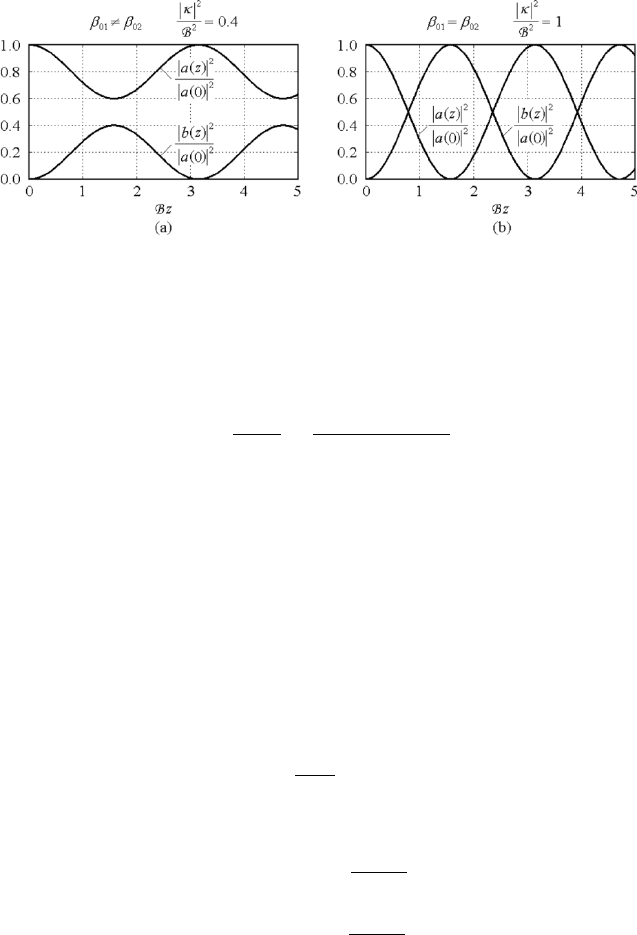
Figure 7.30: Power flow distributions of the co-directional coupled modes for
synchronous state (a) and asynchronous state (b).
and equals the power at the input, |a(0)|
2
. The maximum fraction of power
transfer is
F =
|κ
21
|
2
B
2
=
1
1 + (∆β/|κ
21
|)
2
. (7.237)
This is illustrated in Fig. 7.30(a).
(2) Synchronous State
If both of the modes in the two modes are forward waves and the uncoupled
phase constants of the modes are equal to each other, ∆β = 0, β
01
= β
02
= β
0
and B = |κ
12
| = |κ
21
|, this condition is said to be the synchronous state or
phase-matching state. Suppose again that the initial field introduced to mode
1 at the input port is a(0) and there is no excitation in mode 2, b(0) = 0.
Then (7.233) and (7.234) becomes
a(z) = a(0) cos Bze
−jβ
0
z
, (7.238)
b(z) = a(0)
κ
21
|κ
21
|
sin Bze
−jβ
0
z
. (7.239)
The power-flow distributions along the two modes are
|a(z)|
2
= |a(0)|
2
cos
2
Bz =
|a(0)|
2
2
(1 + cos 2Bz), (7.240)
|b(z)|
2
= |a(0)|
2
sin
2
Bz =
|a(0)|
2
2
(1 − cos 2Bz), (7.241)
and
|a(z)|
2
+ |b(z)|
2
= |a(0)|
2
. (7.242)
Thus the power fed into mode 1 at z = 0 will completely alternate back and
forth between the two modes as long as they continue to be coupled together.
458 7. Periodic Structures and the Coupling of Modes
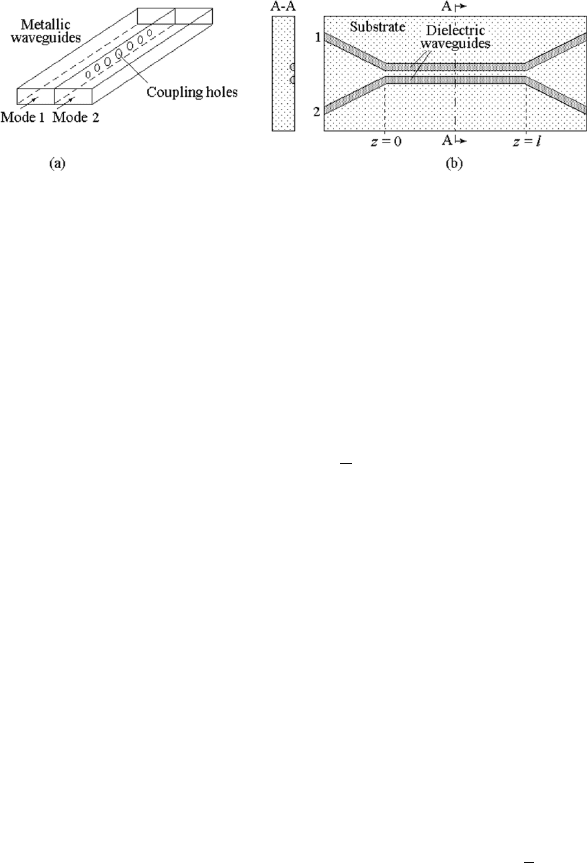
Figure 7.31: (a) Metallic waveguide coupler and (b) dielectric waveguide
coupler.
This is illustrated in Fig. 7.30(b). Furthermore, the transfer takes place in
exactly the same way if power is initially introduced to mode 2 as if p ower
were fed into mode 1.
For a synchronous state, complete power transfer from one mode to an-
other is possible. The minimum length for complete power transfer satisfies
Bl = κ
21
l =
π
2
.
This length is said to be the coupling length and this type of coupler is known
as a directional coupler.
(3) Waveguide Coupler
The waveguide coupler or the so-called directional coupler is made of two
parallel waveguides with a certain coupling mechanism between them [64, 75].
For metallic waveguides, the coupling is provided by means of permeated
fields through the slots or holes on the common wall of the two side-by-
side waveguides, and for dielectric waveguides, the coupling is provided by
means of the decaying fields outside the core, which can be realized simply by
making the two parallel waveguides close together on a common substrate.
See Fig. 7.31. The coupling coefficient for the former can be adjusted by
varying the size and the number of coupling holes, and for the latter by
varying the spacing between the two waveguides. The optimum length of the
coupler is the above indicated coupling length, i.e., Bl = κ
21
l =
π
2
.
(4) Waveguide Switch
For a directional coupler made from material capable of producing a large
electro-optic effect designed so that β
01
= β
02
and Bl = κ
21
l = π/2, and
the power can be transferred completely from one waveguide to another if
oppositely oriented electric fields are applied to the two dielectric waveguides,
then the β of the waveguide can be shifted in opposite directions, so that
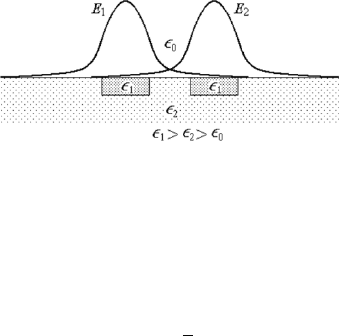
7.8 Coupling of Modes 459
Figure 7.32: Transverse field pattern in two parallel dielectric waveguides.
β
01
6= β
02
. Hence the fraction of power transfer of the coupler can be adjusted
by means of the applied electric field, i.e., the applied voltage on the electrodes
[51, 99]. When
∆β =
√
3|κ
12
|,
we have
B = 2κ
12
, Bl = 2κ
21
l = π.
In this case, from (7.235) and (7.236), we have
|a(l)|
2
= |a(0)|
2
, |b(l)|
2
= 0,
and no power transfer occurs any more between the two waveguides. This is
the principle of the optical waveguide switch.
7.8.4 Coupling Coefficient of Dielectric Waveguides
The coupling between two waveguides is caused by the power transfer from
one waveguide to another by the field of one waveguide penetrating to the
other waveguide. Consider two parallel dielectric waveguides close together
on a common substrate, as shown in Fig. 7.31(b). The electric fields in the
two individual waveguides are
E
1
(x, y, z) = a(z)e
1
(x, y), E
2
(x, y, z) = b(z)e
2
(x, y),
where e
1
(x, y) and e
2
(x, y) are the normalized transverse field patterns of
waveguides 1 and 2, respectively. For the first-order approach, the total field
in both waveguides is the superposition of the two field patterns of waveguides
1 and 2:
E(x, y, z) = E
1
(x, y, z) + E
2
(x, y, z) = a(z)e
1
(x, y) + b(z)e
2
(x, y), (7.243)
where the field a(z)e
1
, by definition, is the field of waveguide 1 in the absence
of waveguide 2, this is to say that the influence of the permittivity increase
in waveguide 2 on the field pattern of waveguide 1 is neglected. See Fig. 7.32.
460 7. Periodic Structures and the Coupling of Modes
The power transferred from waveguide 1 to waveguide 2 is caused by
the additional a.c. polarization current J
p
produced in waveguide 2 by the
electric field of waveguide 1, as a result of the permittivity increment in the
core of waveguide 2:
J
p
=
d P
d t
= jωP
21
, P
21
=²
0
(χ
1
− χ
2
)a(z)e
1
(x, y)=(²
1
− ²
2
)a(z)e
1
(x, y),
J
p
= jω(²
1
− ²
2
)a(z)e
1
(x, y), (7.244)
where ²
1
and ²
2
are the permittivities for the core and the substrate, respec-
tively, and χ
1
and χ
2
are the corresponding susceptibilities.
The power transferred is
P
21
= −
1
4
·
Z
S
2
E
∗
2
· (jωP
21
)dS+
Z
S
2
E
2
· (jωP
21
)
∗
dS
¸
= −
1
4
·
jωab
∗
Z
S
2
(²
1
− ²
2
)e
1
· e
∗
2
dS−jωa
∗
b
Z
S
2
(²
1
− ²
2
)e
∗
1
· e
2
dS
¸
. (7.245)
From the coupled-mode formulation, we know that the power transfer is
P
21
=
d|b|
2
dz
=
dbb
∗
dz
= b
db
∗
dz
+ b
∗
db
dz
= κ
21
ab
∗
+ κ
∗
21
a
∗
b. (7.246)
Comparison of (7.245) and (7.246) gives
κ
21
= −
jω
4
Z
S
2
(²
1
− ²
2
)e
1
· e
∗
2
dS. (7.247)
The same approach for the power transferred from waveguide 2 to waveguide
1 gives
κ
12
= −
jω
4
Z
S
1
(²
1
− ²
2
)e
2
· e
∗
1
dS. (7.248)
7.8.5 Contra-Directional Mode Coupling
For contra-directional coupling, the coupling waves become hyperbolic-sine
and hyperbolic-cosine modulated traveling waves, i.e., decaying or growing
waves along the direction of the power flow. For contra-directional coupling,
when |∆β| < |κ12| then B becomes imaginary. Let B = jT , the solutions
become 7.231 and 7.232. We suppose that all the power is initially introduced
to the input end of mode 1, z = 0, i.e., a(0) 6= 0 and there is no power
introduced to the input end of mo de 2, z = L, i.e., b(L) = 0, then according
to (7.231) and (7.232), we can describe the distributions of fields along the
two modes as
a(z) = a(0)
coshT z−
|κ
12
|
2
T
2
sinhTL sinhT(z−L)−j
∆β
T
sinhTz
1 +
|κ
12
|
2
T
2
sinh
2
T L
e
−jβz
, (7.249)