
Zhang K., Li D. Electromagnetic Theory for Microwaves and Optoelectronics
Подождите немного. Документ загружается.

7.9 Distributed Feedback (DFB) Structures 471
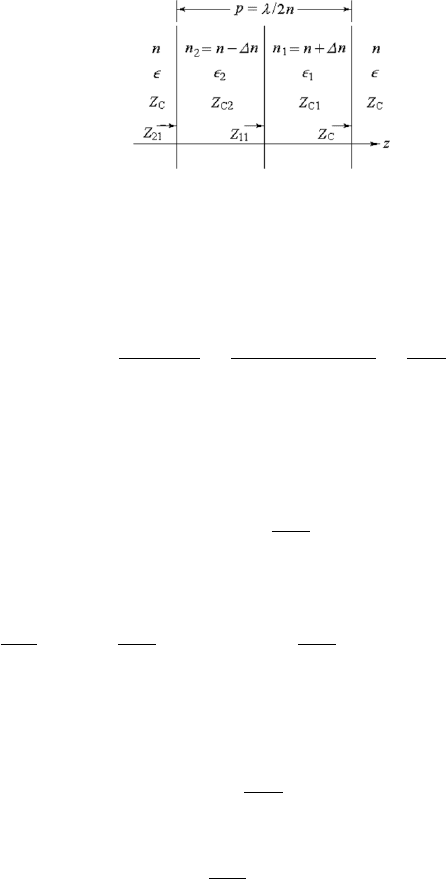
Figure 7.41: A pair of dielectric layers in a uniform medium of index n.
and the reflection coefficient is given by
Γ =
Z
21
− Z
C
Z
21
+ Z
C
=
(1 + 4∆n/n) − 1
(1 + 4∆n/n) + 1
≈
2∆n
n
.
Comparing this approximation for Γ with (7.287), while l = p and |κ|p ¿ 1
for one layer pair,
Γ (p)|
ω
0
= tanh |κ|p ≈ |κ|p,
we have
|κ|p ≈
2∆n
n
. (7.290)
Substituting this relation into (7.289) gives
Z
2m
Z
CL
≈
µ
1 +
4∆n
n

(l/p)
=
"
µ
1 +
4∆n
n

(n/4∆n)
#
2|κ|l
. (7.291)
Utilizing the fact that the term in brackets approaches the numerical constant
e as ∆n/n is made very small, i.e.,
lim
∆n/n→0
µ
1 +
4∆n
n

(n/4∆n)
= e,
we deduce that
Z
2m
Z
CL
= e
2|κ|l
. (7.292)
It is the same result as obtained with the DFB approach (7.288), where Z
C
corresponds to Z
CL
and Z
in
corresponds to Z
2m
. We may conclude that both
approaches give the same result in the limit of small ∆n/n, i.e., the weak
coupling limit. The coupled-mode approach is notably simpler and gives
the frequency dependence of the reflection coefficient as shown in Fig. 7.37.
The structure is no longer a reflector when used outside the stop band, or
472 7. Periodic Structures and the Coupling of Modes
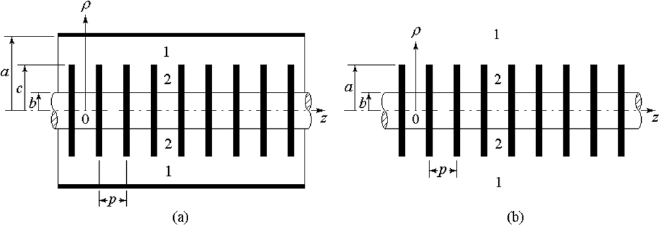
Figure 7.42: (a) Problem 7.1. Disk-loaded coaxial line, (b) Problem 7.2.
Disk-loaded conducting cylinder.
when |δ| > |κ|, because the reflections from individual layers are no longer
interferences.
The multi-layer reflector as a DFB structure is successfully used in the
vertical cavity surface emitting semiconductor lasers (VCSEL), refer to [116].
Problems
7.1 Find the eigenvalue equation of the azimuthal uniform TM modes in the
disk-loaded coaxial line shown in Fig. 7.42a, (1) as a uniform system,
(2) as a periodic system.
7.2 Find the eigenvalue equation of the azimuthal uniform TM modes in the
disk-loaded conducting cylinder shown in Fig. 7.42b, (1) as a uniform
system, (2) as a periodic system.
7.3 Find the eigenvalue equation of the azimuthal uniform TE modes in
the disk-loaded circular waveguide with a center coupling hole, using
uniform system approach.
7.4 Show that the azimuthal nonuniform TE or TM mode by itself cannot
satisfy the boundary conditions of the disk-loaded waveguide with a
center coupling hole, using uniform system approach.
7.5
Show that the azimuthal nonuniform TE or TM mode by itself cannot
satisfy the boundary conditions of the disk-loaded coaxial line and the
disk-loaded conducting cylinder, using uniform system approach.
Problems 473
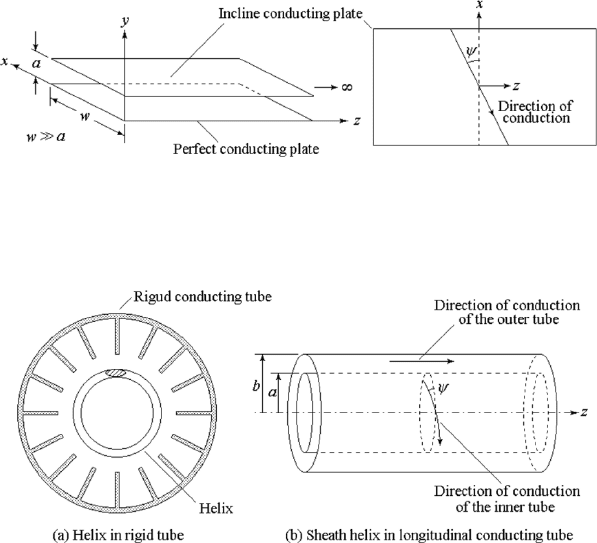
Figure 7.43: Problem 7.6. Parallel-plate transmission line made of a inclined
conducting plate and a common conducting plate.
Figure 7.44: Problem 7.8. Helix enclosed by a rigid conducting tube.
7.6 Find the field components, eigenvalue equation, and the propagation
characteristics of the parallel-plate transmission line shown in Fig. 7.43,
in which the upper plate is an inclined conducting plate and the lower
plate is made of common conducting material. The angle between the
direction of conduction and the direction of the transverse axis x is ψ.
7.7 Find the eigenvalue equation of a sheath helix of radius a enclosed by a
perfect conducting tube of radius b (b > a).
7.8 Find the eigenvalue equation of a sheath helix of radius a enclosed by a
longitudinal conducting tube of radius b (b > a) shown in Fig. 7.44(b),
which is the physical model of a helix enclosed by a longitudinal rigid
conducting tube, shown in Fig. 7.44(a).
7.9 Assume a periodic structure with the spatial period equal to 5 cm; the
frequency at which β
0
p = π/2 is 3 GHz. Find the phase constants, the
phase velocities, and the longitudinal wavelengths of the fundamental
(n = 0) and the n = −1 space harmonics.

474 7. Periodic Structures and the Coupling of Modes
7.10 Find the ratio of β
−1
to β
0
in a periodic structure, when β
0
= 0,
β
0
= π/4, β
0
= π/2, β
0
= 3π/4 and β
0
= π.
7.11 Prove the two theorems given in Section 7.4.5. Refer to [107].
7.12 Find the natural frequencies of coupled resonators. The natural fre-
quencies of the two uncoupled resonators are ω
01
and ω
02
, and the
coupling coefficients are κ
12
and κ
21
.
Hint: The mode-coupling equations of coupled resonators are given by,
da
dt
= −jω
01
a + κ
12
b,
db
dt
= −jω
02
b + κ
21
a.
7.13 Find the general solutions a(t) and b(t) of coupled resonators given in
the last problem. Suppose that the initial value of a and b at t = 0 are
a(0) and b(0), respectively.
7.14 Prove the power conservation for the coupled waves of co-directional
mode coupling and contra-directional mode coupling.
Chapter 8
Electromagnetic Waves
in Dispersive Media and
Anisotropic Media
Up to this point, we have concentrated our attention on issues concerning
the fields and waves in simple media, i.e., linear, non-dispersive, and isotropic
media, For a simple medium, the constitutional parameters are assumed to be
constant scalars and frequency independent. In fact, no medium can always
be a simple medium except vacuum. Most media can only be approximated
as simple media under certain conditions.
Recently, the wave-propagation in dispersive, and anisotropic media be-
came more imp ortant in microwave, THz (tera-hertz) and light-wave tech-
nologies. The effects of dispersion, and anisotropy of the media must be taken
into account in the design of many devices and a number of new devices with
unique characteristics were developed by applying these effects.
The propagation of electromagnetic waves in material media is a micro-
scopic process of the interaction between fields and matter. In principle, it
must be investigated theoretically by means of quantum mechanics and sta-
tistical mechanics rather than macroscopic electrodynamics. In classical elec-
trodynamics, macroscopic constitutional parameters are defined as we have
discussed in Section 1.1.2 and these parameters can be found experimentally.
In addition, classical theories based on macroscopic models for some special
matters, for example, ideal gas, conductors, electron beams, plasmas, and
ferrites, have been developed successfully.
In this chapter, the constitutional relations of dispersive media and
anisotropic media are given and the analysis of wave propagation phenomena
in such media are introduced. The problems of fields and waves in nonlin-
ear media [38, 116] are not included in this book, they belong to the course
“Nonlinear Optics” [6, 16, 89].
475
476 8. Electromagnetic Waves in Dispersive Media and Anisotropic Media
8.1 Classical Theory of Dispersion and
Dissipation in Material Media
The microscopic interaction between electromagnetic waves and particles re-
sults in dispersion and dissipation of waves in material media. All media in
reality show a certain amount of dispersion. However, within a limited fre-
quency range, on the specific kinds of media involved, this dispersion turns
out to be sufficiently small so the permittivity ², the permeability µ of the
medium and the velocity of propagation for a TEM wave can be regarded
as constant and independent of the frequency of the waves. Even when ²
and µ do depend on the frequency, the treatment for time-harmonic fields
given in the previous chapters for a non-dispersive medium remains valid for
each frequency component. However, for electromagnetic wave trains that
are a superposition of sinusoidal waves in a range of frequencies, dispersive
effects can no longer be ignored. In the radio wave and microwave bands, the
dispersion and dissipation in most media are rather weak but in the THz,
infrared, visible light, and ultraviolet bands, the dispersion and dissipation
are usually strong and strongly depend upon the frequency.
In Sections 1.1.2 and 1.1.4, we point out that, in dispersive media, the
response of polarization and magnetization are not instantaneous, and for
sinusoidal time-dependent fields, the permittivity and permeability become
complex and depend upon the frequency. In order to examine these conse-
quences we need a simple model of dispersion [17, 96].
8.1.1 Ideal Gas Model for Dispersion and Dissipation
It is assumed that the material media are composed of small particles which
can be polarized under the influence of an electric field. These particles can
be molecules or atoms. Consider a medium acted on by the time-harmonic
electric field E(x, t) = E
0
e
jωt
of an incident wave. Assume that the wave
has a wavelength much larger than atomic dimensions, which is true even for
ultraviolet radiation, so that the field acting on the electron cloud in a particle
of the medium is independent of its position relative to the nuclear or positive
ion core of the particle. For simplicity, we will neglect the difference between
the applied electric field and the local field, i.e., the field that arises from
other polarized particles acting on the electron cloud will be neglected. The
model is therefore appropriate only for substances of relatively low density
or gasses of low pressure and is known as the ideal gas model.
In the classical model of dispersion, the center of mass of the electron
cloud in a particle is displaced by an amount x as a result of the action of
the electric field. Any displacement of the electron cloud from its central
ion core produces a restoring force −mω
2
0
x, where ω
0
denotes the natural
angular frequency or so called binding frequency of the oscillating electron
and m is its mass. Also a damping force, denoted by −mγ(dx/dt), where

8.1 Classical Theory of Dispersion and Dissipation in Material Media 477
γ denotes the damping factor, is included. This damping force arises from
radiation and interaction with other charges. The interaction of the restoring
force and damping force with the inertia of the moving charge cloud produces
a resonance as in a mechanical spring–mass system or a harmonic oscillator.
The equation of motion of an electron with charge e can be written as
m
·
d
2
x
dt
2
+ γ
dx
dt
+ ω
2
0
x
¸
= eE
0
e
jωt
. (8.1)
Magnetic field effects are neglected in the equation because the velocity of
the electron is much lower than the speed of light.
In the steady state, the displacement is also time harmonic with the same
frequency as that of the field and can be expressed in phasor form x = x
0
e
jωt
.
We obtain the solution of the above equation:
x =
e
m
1
ω
2
0
− ω
2
+ jωγ
E. (8.2)
The dipole moment caused by the displacement of the electron is
p = ex =
e
2
m
1
ω
2
0
− ω
2
+ jωγ
E. (8.3)
Suppose that the medium is consists of molecules of the same type, there
are N molecules per unit volume, with Z electrons per molecule, and that
there are f
i
electrons per molecule with natural circular frequency ω
i
and
damping factor γ
i
. Then the dipole moment of each molecule becomes
p
m
=
e
2
m
X
i
f
i
ω
2
i
− ω
2
+ jωγ
i
E, (8.4)
where f
i
measures the strength of the ith resonance, and
P
i
f
i
= Z. The
polarization vector, i.e., the dipole moment per unit volume is
P = Np
m
=
Ne
2
m
X
i
f
i
ω
2
i
− ω
2
+ jωγ
i
E. (8.5)
From the definition of electric susceptibility given in (1.29), i.e., P =
²
0
χE, we obtain the complex susceptibility
˙χ(ω) =
P
²
0
E
=
Ne
2
²
0
m
X
i
f
i
ω
2
i
− ω
2
+ jωγ
i
= χ
0
(ω) − jχ
00
(ω). (8.6)
χ
0
(ω) =
Ne
2
²
0
m
X
i
f
i
¡
ω
2
i
− ω
2
¢
¡
ω
2
i
− ω
2
¢
2
+ ω
2
γ
2
i
, (8.7)
χ
00
(ω) =
Ne
2
²
0
m
X
i
f
i
ωγ
i
¡
ω
2
i
− ω
2
¢
2
+ ω
2
γ
2
i
. (8.8)
478 8. Electromagnetic Waves in Dispersive Media and Anisotropic Media
.5 .6 .7 .8 .9 1.0 1.1 1.2 1.3 1.4 1.5
-.8
-.6
-.4
-.2
0.0
.2
.4
.6
.8
1.0
1.2
0
ZZ
max
max
"
"
"
'
F
F
F
F
max
"
'
F
F
max
"
"
F
F
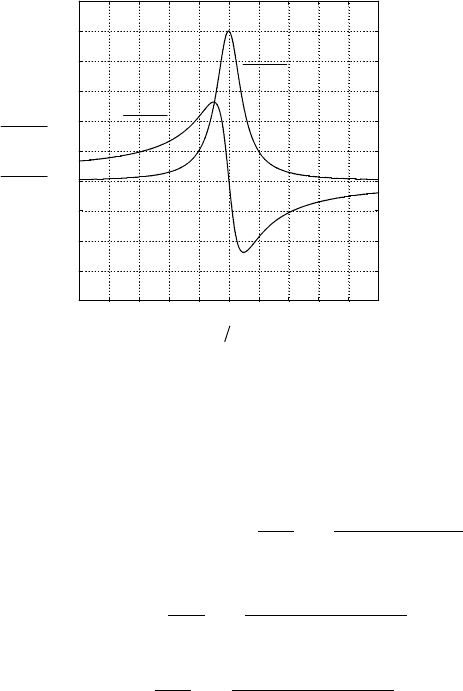
Figure 8.1: Frequency responses of χ
0
(ω) and χ
00
(ω).
The permittivity of the medium is defined in (1.33) and also becomes
complex:
˙²(ω) = ²
0
[1 + ˙χ(ω)] = ²
0
(ω) − j²
00
(ω) = ²
0
+
Ne
2
m
X
i
f
i
ω
2
i
− ω
2
+ jωγ
i
, (8.9)
²
0
(ω) = ²
0
[1 + χ
0
(ω)] = ²
0
+
Ne
2
m
X
i
f
i
¡
ω
2
i
− ω
2
¢
¡
ω
2
i
− ω
2
¢
2
+ ω
2
γ
2
i
, (8.10)
²
00
(ω) = ²
0
χ
00
(ω) =
Ne
2
m
X
i
f
i
ωγ
i
¡
ω
2
i
− ω
2
¢
2
+ ω
2
γ
2
i
. (8.11)
The real part, χ
0
(ω) or ²
0
(ω), describes the dispersion and the imaginary
part, χ
00
(ω) or ²
00
(ω), describes the dissipation of the medium. All of them
are functions of frequency. The parameters f
i
, ω
i
and γ
i
are well defined in
quantum mechanics and when they have appropriate quantum definitions, the
above expressions represent fairly accurate descriptions of the polarization of
the medium. The normalized frequency responses of χ
0
(ω) and χ
00
(ω) for the
ith terms with ω
i
= ω
0
in (8.7) and (8.8) are shown in Fig. 8.1, which is a
typical responses of a damped resonant system.
In practice, there are different molecules and electrons with different ω
i
and γ
i
in the medium. Then a number of discrete resonant peaks appear
on the response curve, which is similar to the resp onse of a resonator with
a number of modes. Similarly, the displacement of one ion from another
produces ionic resonance, but it is much less strong than that for the electron
resonance because of the much larger masses.

8.1 Classical Theory of Dispersion and Dissipation in Material Media 479
If the medium consists of the same type of electrons with resonant fre-
quency ω
0
and damping factor γ, the expressions for the permittivity reduce
to
˙²(ω) = ²
0
+
NZe
2
m
1
ω
2
0
− ω
2
+ jωγ
. (8.12)
²
0
(ω) = ²
0
+
NZe
2
m
ω
2
0
− ω
2
¡
ω
2
0
− ω
2
¢
2
+ ω
2
γ
2
, (8.13)
²
00
(ω) =
NZe
2
m
ωγ
¡
ω
2
0
− ω
2
¢
2
+ ω
2
γ
2
. (8.14)
8.1.2 Kramers–Kronig Relations
The analytic properties of the complex permittivity and the assumption of
the causal connection between the polarization and the electric field provide
interesting and important relationships between the real part and the imagi-
nary part of the complex permittivity, so the frequency behavior of one part
is not independent of that of the other. These relationships are known as
Kramers–Kronig relations as they were first derived by H. A. Kramers and
R. de L. Kronig independently [43].
χ
0
(ω) =
2
π
Z
∞
0
ω
0
χ
00
(ω
0
)
ω
02
− ω
2
dω
0
, χ
00
(ω) =−
2ω
π
Z
∞
0
χ
0
(ω
0
)
ω
02
− ω
2
dω
0
, (8.15)
Experimental values of χ
00
(ω) or ²
00
(ω) from absorption measurement allow
the calculation of χ
0
(ω) or ²
0
(ω) by using the Kramers–Kronig relations.
8.1.3 Complex Index of Refraction
The definition of the refraction index is given in Section 2.4:
n =
√
µ
r
²
r
. (8.16)
For nonmagnetic media, µ
r
= 1, and for dispersive medium, the dielectric
constant ²
r
and the index of refraction n becomes complex,
˙²
r
= ²
0
r
− j²
00
r
, ˙n =
p
˙²
r
=
p
²
0
r
− j²
00
r
= n
0
− jn
00
, (8.17)
where
n
0
=
s
1
2
µ
q
²
0
r
2
+ ²
00
r
2
+ ²
0
r

, n
00
=
s
1
2
µ
q
²
0
r
2
+ ²
00
r
2
− ²
0
r

, (8.18)
n
0
denotes the index of refraction and n
00
denotes the extinction coefficient
for dispersive media. Both of them are functions of frequency.

480 8. Electromagnetic Waves in Dispersive Media and Anisotropic Media
Substituting (8.9) into (8.17), we obtain
˙n =
s
1 +
Ne
2
²
0
m
X
i
f
i
ω
2
i
− ω
2
+ jωγ
i
. (8.19)
Generally ²
00
r
is much less than ²
0
r
, then n
0
and n
00
reduce to
n
0
≈
p
²
0
r
, n
00
≈
²
00
r
2
p
²
0
r
. (8.20)
Substituting (8.10) and (8.11) into (8.20), we obtain the index and the
extinction coefficient for the ideal gas model:
n
0
=
s
1 +
Ne
2
²
0
m
X
i
f
i
(ω
2
i
− ω
2
)
¡
ω
2
i
− ω
2
¢
2
+ ω
2
γ
2
i
, (8.21)
n
00
=
Ne
2
2²
0
m
X
i
f
i
ωγ
i
¡
ω
2
i
− ω
2
¢
2
+ ω
2
γ
2
i
,
s
1 +
Ne
2
²
0
m
X
i
f
i
(ω
2
i
− ω
2
)
¡
ω
2
i
− ω
2
¢
2
+ ω
2
γ
2
i
. (8.22)
For an ideal gas or most optical materials, n
0
is only slightly larger than 1.
Then the above expressions can be simplified as the following approximate
formulas:
n
0
≈ 1 +
Ne
2
2²
0
m
X
i
f
i
¡
ω
2
i
− ω
2
¢
¡
ω
2
i
− ω
2
¢
2
+ ω
2
γ
2
i
, (8.23)
n
00
≈
Ne
2
2²
0
m
X
i
f
i
ωγ
i
¡
ω
2
i
− ω
2
¢
2
+ ω
2
γ
2
i
. (8.24)
If the medium consists of the same type of molecules with resonant frequency
ω
0
and damping factor γ, the above expressions reduce to
n
0
=
s
1 +
NZe
2
²
0
m
ω
2
0
− ω
2
¡
ω
2
0
− ω
2
¢
2
+ω
2
γ
2
, (8.25)
n
00
=
NZe
2
2²
0
m
ωγ
¡
ω
2
0
− ω
2
¢
2
+ ω
2
γ
2
,
s
1+
NZe
2
²
0
m
ω
2
0
− ω
2
¡
ω
2
0
− ω
2
¢
2
+ ω
2
γ
2
, (8.26)
and if n
0
of the medium is only slightly larger than 1, they reduce to
n
0
≈ 1 +
NZe
2
2²
0
m
ω
2
0
− ω
2
¡
ω
2
0
− ω
2
¢
2
+ ω
2
γ
2
, (8.27)
n
00
≈
NZe
2
2²
0
m
ωγ
¡
ω
2
0
− ω
2
¢
2
+ ω
2
γ
2
. (8.28)
The frequency responses of n
0
(ω) and n
00
(ω) are shown in Fig. 8.2.