
Zhang K., Li D. Electromagnetic Theory for Microwaves and Optoelectronics
Подождите немного. Документ загружается.


7.8 Coupling of Modes 461
b(z) = a(0)
κ
21
T
coshTLsinhT(z−L)−j
∆β
T
sinhTL sinhT(z−L)
1 +
|κ
12
|
2
T
2
sinh
2
T L
e
−jβz
. (7.250)
The power-flows of the two modes are P
a
and P
b
, which ar proportional to
|a(z)|
2
and −|b(z)|
2
, respectively, and are given by
|a(z)|
2
= a(z)a
∗
(z) = |a(0)|
2
1 +
|κ
12
|
2
T
2
sinh
2
T (z − L)
1 +
|κ
12
|
2
T
2
sinh
2
T L
, (7.251)
|b(z)|
2
= b(z)b
∗
(z) = |a(0)|
2
|κ
12
|
2
T
2
sinh
2
T (z − L)
1 +
|κ
12
|
2
T
2
sinh
2
T L
, (7.252)
and
|a(z)|
2
− |b(z)|
2
= |a(0)|
2
1
1 +
|κ
12
|
2
T
2
sinh
2
T L
= |a(L)|
2
.
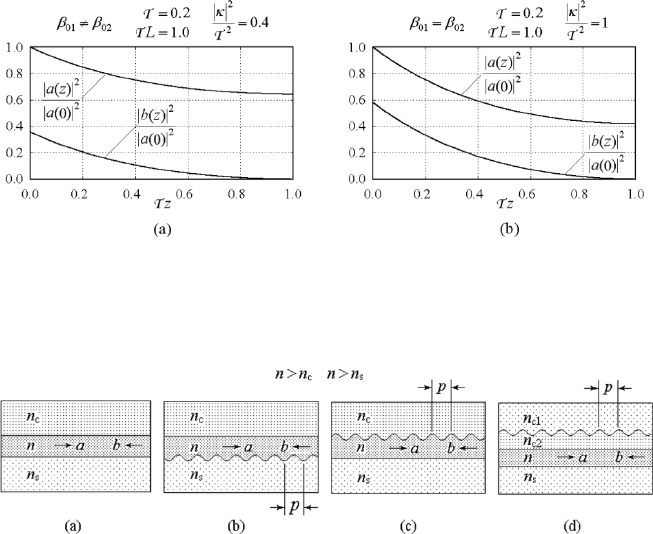
The power fed in mode 1 at z = 0 will monotonously transfer to mode 2
due to the coupling. It leads to the decreasing of power of mode 1 in the
direction of power flow, +z. At the same time, the power transferred to
mode 2 propagates along −z, an monotonously increasing in the direction of
power flow, −z, refer to Fig. 7.33(a). The total power |a(z)|
2
−|b(z)|
2
remain
unchange along z and is equal to the power at the output end of the coupler,
|a(L)|
2
.
For synchronous state, β
01
= β
02
= β
0
, ∆β = 0, T
2
= |κ
12
|
2
. Suppose
a(0) 6= 0, b(L) = 0, (7.249) and (7.250) become
a(z) = a(0)
coshTz−sinhTLsinhT(z−L)
1 + sinh
2
T L
e
−jβz
=a(0)
coshT(z−L)
cosh T L
e
−jβz
, (7.253)
b(z) = a(0)
cosh T L sinh T (z − L)
1 + sinh
2
T L
e
−jβz
= a(0)
sinh T (z − L)
cosh T L
e
−jβz
. (7.254)
The power-flow distributions along the two modes are
|a(z)|
2
= |a(0)|
2
cosh
2
T (z − L)
cosh
2
T L
, (7.255)
|b(z)|
2
= |a(0)|
2
sinh
2
T (z − L)
cosh
2
T L
, (7.256)
refer to Fig. 7.33(b).
An example of contra-directional coupling of two modes is the distributed
feedback (DFB) structure.
462 7. Periodic Structures and the Coupling of Modes
Figure 7.33: Power flow distributions of the contra-directional coupled modes
for asynchronous state (a) and synchronous state (b).
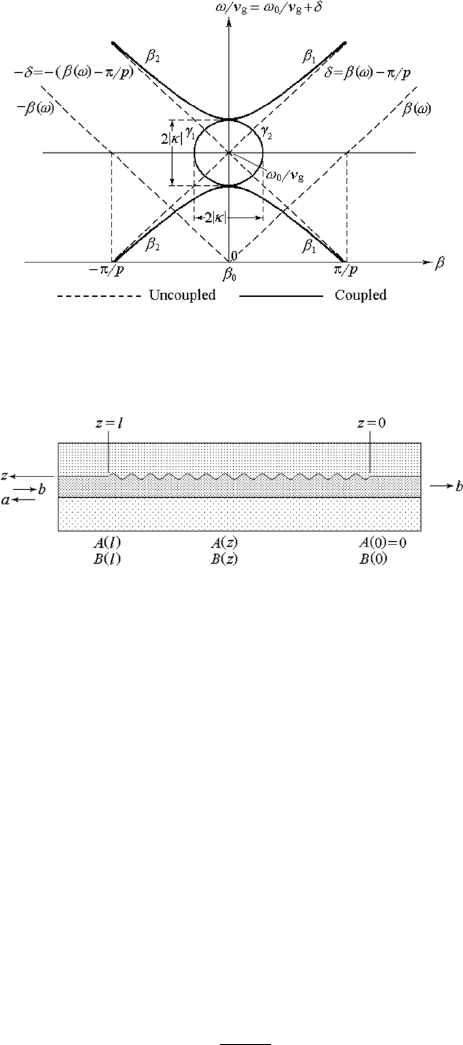
Figure 7.34: Uniform dielectric waveguide (a) and periodic dielectric waveg-
uide (b), (c) and (d).
7.9 Distributed Feedback (DFB) Structures
A distributed feedback (DFB) grating structure is a periodic dielectric waveg-
uide in which the periodicity is due to corrugation of one of the boundaries
shown in Fig. 7.34(b)–(d). Such periodic waveguides are used for a variety of
purposes in optoelectronics, including optical filters, grating couplers, and,
most important, DFB lasers.
Recall from the preceding sections that forward-wave space harmonics and
backward-wave space harmonics are supported in a periodic structure. Hence,
it is possible to realize phase matching between two modes of opposite power
flows if the phase velocity of a forward-wave harmonic in one mode is close
to the phase velocity of a backward-wave harmonic in the other mode with
opposite group velocities. In this case, appreciable mode coupling is realized
through two specific space harmonics and is a contra-directional coupling
which leads to coupled exponentially growing and decaying waves in the
structure.

7.9 Distributed Feedback (DFB) Structures 463
7.9.1 Principle of DFB Structures [23, 38, 52, 116]
In the uniform dielectric waveguide shown in Fig. 7.34(a), there is no ap-
preciable coupling between two guided modes of opposite group velocities,
because both of the two modes are forward waves and their phase velocities
are opposite.
DFB structure is just a section of corrugated p eriodic dielectric waveguide
as shown in Fig. 7.34(b)–(d). In the structure, there exists a set of space
harmonics of which each guided mode is composed, and the phase constants
of space harmonics are given by (7.54) as:
β
n
= β +
2πn
p
, (7.257)
where β = β
0
denotes the phase constant of the fundamental harmonic and
n = 0, ±1, ±2, ±3, ··· denotes the order of the space harmonic. The sum
of the fields of all space harmonics satisfies the boundary conditions of the
periodic structure and constitutes a normal mode.
If the fundamental (n = 0) harmonic of the mo de is a forward wave then
the space harmonics of positive orders must be forward waves too, whereas
the space harmonics of negative orders must be backward waves.
In a periodic waveguide, appreciable coupling between two guided modes
of opposite group velocities is possible if the phase velocity of a forward-
wave harmonic in one mode is approximately equal to that of a backward-
wave harmonic in another mode. We note that the phase velocity of the
n space harmonic with positive group velocity can be close to that of the
−(n + 1) space harmonic with negative group velocity, which is the condition
of synchronous or phase matching,
β
n
≈ −β
−(n+1)
, i.e., β +
2πn
p
≈ −
·
β −
2π(n + 1)
p
¸
,
which gives
βp ≈ π, β
n
p ≈ −β
−(n+1)
p ≈ (2n + 1)π. (7.258)
Generally speaking, the n = 0 space harmonic and n = −1 space harmonic
are the two strongest harmonics in the structure and the other harmonics can
be neglected. We consider mode coupling via the 0 and −1 space harmonics
only. The phase constants of the 0 and −1 space harmonics are related via
β
−1
= β −
2π
p
. (7.259)
Suppose that there are two traveling-wave modes with opposite group
velocities. The fundamental harmonics of these two modes are a and b,
respectively:
a = a
m
e
−jβz
, b = b
m
e
jβz
. (7.260)

464 7. Periodic Structures and the Coupling of Modes
The −1 space harmonics of these two modes are a
−1
and b
−1
, respectively:
a
−1
= a
−1m
exp
·
−j
µ
β −
2π
p

z
¸
, b
−1
= b
−1m
exp
·
j
µ
β −
2π
p

z
¸
. (7.261)
Suppose that the ratios of the −1 harmonic to the fundamental harmonic in
the two modes are s
a
and s
b
, respectively, i.e.,
a
−1m
= s
a
a
m
, b
−1m
= s
b
b
m
, (7.262)
then we have
a
−1
= s
a
a exp
µ
j
2π
p
z

, b
−1
= s
b
b exp
µ
−j
2π
p
z

. (7.263)
The coupled-mode equations associated with these two modes with opposite
group velocities via the 0 and −1 space harmonics are written as
da
dz
= −jβa + χ
ab
b
−1
, (7.264)
db
dz
= jβb + χ
ba
a
−1
, (7.265)
where χ
ab
and χ
ba
are the coupling coefficients connecting the −1 space
harmonic and the fundamental space harmonic of the two guided modes with
opposite group velocities. Substituting (7.263) into the above equations, we
deduce that
da
dz
= −jβa + χ
ab
s
b
b exp
µ
−j
2π
p
z

= −jβa + κ
ab
b exp
µ
−j
2π
p
z

, (7.266)
db
dz
= jβb + χ
ba
s
a
a exp
µ
j
2π
p
z

= jβb + κ
ba
a exp
µ
j
2π
p
z

, (7.267)
where κ
ab
= χ
ab
s
b
and κ
ba
= χ
ba
s
a
are the coupling coefficients of the two
modes with opposite group velocities.
With the following variable substitution,
a = A exp
µ
−j
π
p
z

, b = B exp
µ
j
π
p
z

, (7.268)
where A(z) and B(z) are space envelops of the two modes a and b, the
preceding coupled-mode equations become
dA
dz
= −j
µ
β −
π
p

A + κ
ab
B = −jβ
01
A + κ
ab
B, (7.269)
dB
dz
= j
µ
β −
π
p

B + κ
ba
A = −jβ
02
B + κ
ba
A. (7.270)

7.9 Distributed Feedback (DFB) Structures 465
These two equations are identical with the standard coupled-mode equations
(7.206) and (7.207), in which
β
01
= (β − π/p), β
02
= −(β − π/p).
The phase-matching condition is β
01
≈ β
02
, that is βp ≈ π. Since the group
velocities of the two modes are opposite, the relation between κ
ab
and κ
ba
is
κ
ab
= κ
∗
ba
= κ. (7.271)
Introducing the detuning parameter δ, which is a function of frequency,
δ = β −
π
p
, (7.272)
and supposing β(ω
0
) = π/p, i.e., δ(ω
0
) = 0, we can then expand β(ω) around
ω = ω
0
as follows:
β(ω) ≈ β(ω
0
) +
dβ
dω
(ω − ω
0
) =
π
p
+
ω − ω
0
v
g
. (7.273)
Hence the detuning parameter δ becomes
δ =
ω − ω
0
v
g
. (7.274)
Finally we have the coupled-mode equations for the periodic structure
dA
dz
= −jδA + κ B, (7.275)
dB
dz
= jδB + κ
∗
A. (7.276)
Comparing these equations with the standard coupled-mode equations
(7.206) and (7.207), we have
β
01
= δ, β
02
= −δ, κ
12
= κ, κ
21
= κ
∗
.
Substituting such conditions into the solution of the coupled-mode equations
(7.213), we have the propagation coefficient of the coupled modes in the DFB
structure.
β
1,2
=
β
01
+ β
02
2
±
s
µ
β
01
− β
02
2

2
− κ
12
κ
21
= ±
p
δ
2
− |κ|
2
. (7.277)
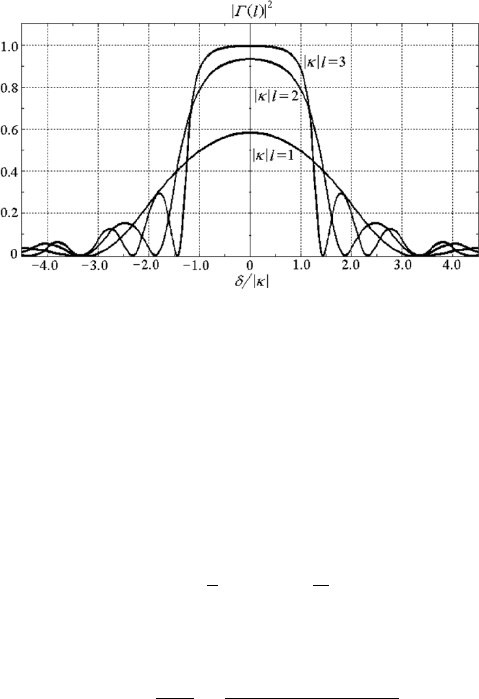
The ω–β diagram of the DFB structure is shown in Fig. 7.35, in which
the frequency ω is represented by the detuning parameter δ. We note from
the figure that when |δ| > |κ|, β is real and the coupled waves are persistent
waves, and when |δ| < |κ|, β becomes imaginary and the coupled waves
degenerate into exponentially growing or decaying waves.
For |δ| < |κ|, β
1,2
are imaginary. Let γ
1,2
= jβ
1,2
, then (7.277) reduces to
γ
1,2
= ∓γ = ∓
p
|κ|
2
− δ
2
. (7.278)
466 7. Periodic Structures and the Coupling of Modes
Figure 7.35: The ω–β diagram of a DFB structure.
Figure 7.36: A segment of a DFB structure.
7.9.2 DFB Transmission Resonator [31, 52]
Consider a segment of DFB structure of length l, as shown in Fig. 7.36. The
load is connected at z = 0 and the input of the DFB is at z = l. The incident
wave with envelope B(z), propagates along −z, whereas the reflected wave
with envelope A(z), propagates along +z.
For |δ| < |κ|, the solutions of the coupled-mode equations must be in the
form of exponentially growing or decaying waves. Try the following form of
superposition of growing and decaying exponential functions
A(z) = A
+
e
γz
+ A
−
e
−γz
, (7.279)
B(z) = B
+
e
γz
+ B
−
e
−γz
, (7.280)
as solutions to (7.275) and (7.276). We obtain
B
±
=
jδ ± γ
κ
A
±
, (7.281)
7.9 Distributed Feedback (DFB) Structures 467
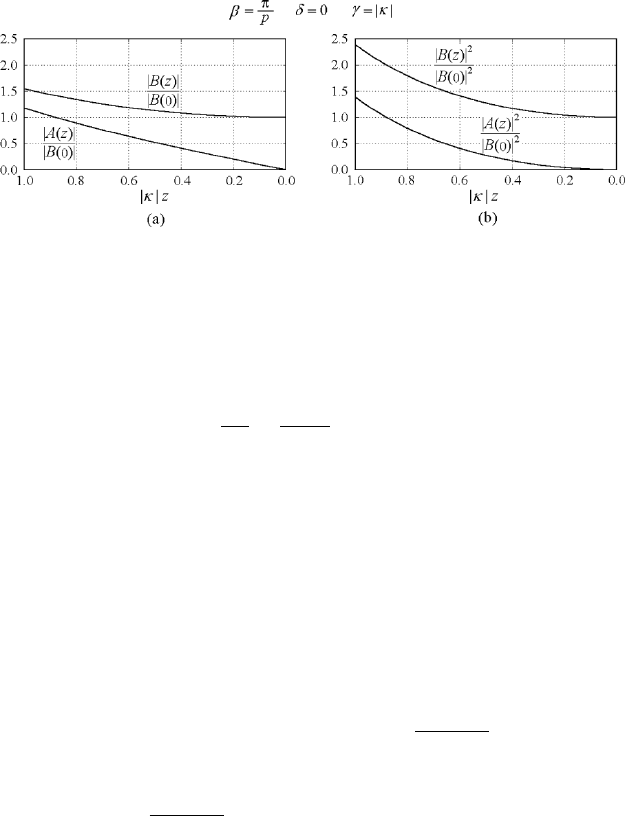
Figure 7.37: Frequency response of a single-segment DFB structure.
which is similar to (7.219).
Suppose that the structure is matched at the terminal z = 0 in such a
way that A(0) = 0, i.e., A
−
= −A
+
. Then, from (7.279), (7.280) and (7.281),
we have the space envelopes of the two mods
A(z) = 2A
+
sinh γz, (7.282)
B(z) = 2A
+
µ
γ
κ
cosh γz +
jδ
κ
sinh γz

. (7.283)
The reflection coefficient at the input port z = l is given by
Γ (l) =
A(l)
B(l)
=
κ sinh γl
γ cosh γl + jδ sinh γl
. (7.284)
The frequency response of the power reflection coefficient |Γ (l )|
2
of a single
segment DFB structure is shown in Fig. 7.37.
At the center frequency, ω = ω
0
, β = π/p, δ = 0, γ = |κ|, the space
envelopes (7.282) and (7.282) become
A(z) = 2A
+
sinh γz = 2A
+
sinh |κ|z, (7.285)
B(z) = 2A
+
cosh γz = 2A
+
cosh |κ|z. (7.286)
The distributions of space envelops A(z), B(z) and power flows A|(z)|
2
,
|B(z)|
2
at the center frequency are shown in Fig 7.38.
The reflection coefficient at the center frequency become
Γ (l)|
ω
0
= tanh |κ|l, (7.287)
468 7. Periodic Structures and the Coupling of Modes
Figure 7.38: The distribution of space envelops A(z), B(z) and A|(z)|
2
,
|B(z)|
2
of coupled waves in a single-segment DFB structure.
and the input impedance of the DFB segment is given by
Z
in
Z
C
=
1 + Γ
1 − Γ
= e
2|κ|l
, (7.288)
where Z
C
is the characteristic impedance of the uniform waveguide without
the grating. When l is sufficiently large,
Γ (l)|
ω
0
= tanh |κ|l → 1,
refer to Fig. 7.37.
Under the condition |δ/κ| < 1, γ is real, so that the fields in the DFB
structure are growing or decaying exponential functions, which corresponds
to a stop band. When |δ/κ| > 1, γ is imaginary, β is real, and the fields in
the DFB structure are persistent waves, which corresponds to a pass band.
In the case of pass band, if the following condition is satisfied,
sinh γl = j sin βl = 0, i.e., sin
p
δ
2
− |κ|
2
l = 0,
we must have
p
δ
2
− |κ|
2
l = nπ, n = 0, 1, 2, 3 ···,
and
Γ (l) = 0.
The reflection coefficient is zero at a series of frequencies within the pass
band, |δ| > |κ|, see Fig. 7.37. At these frequencies, according to (7.282),
with γ purely imaginary, the reflection wave A(z) in the +z direction has a
sinusoidal distribution within the structure and vanishes at the two ends of
the structure. These frequencies are the resonant frequencies of the periodic
DFB structure acting as a distributed Fabry–Perot transmission resonator.
7.9 Distributed Feedback (DFB) Structures 469
Figure 7.39: Quarter-Wave Shifted DFB resonator.
7.9.3 The Quarter-Wave Shifted DFB Resonator
The single-segment periodic DFB structure has a set of transmission reso-
nances in its pass band (|δ| > |κ|), i.e., a pass-band resonance but acts as
a nearly perfect reflector in the stop band (|δ| < |κ|). If we place two seg-
ments of periodic DFB structures on a line and separate them by a quarter
wavelength or an odd multiple of wavelengths, it is possible to achieve trans-
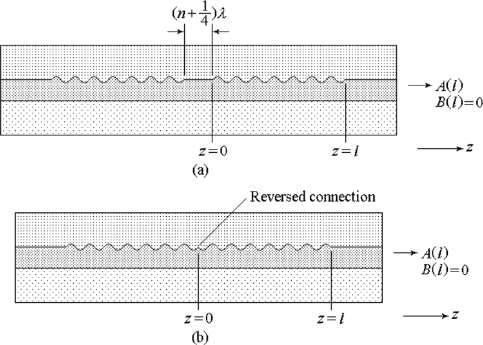
mission at δ = 0 and β = π/2 within the stop band, which is known as a
Quarter-Wave Shifted DFB resonator, see Fig. 7.39(a), and the resonance
becomes a stop-band resonance [38, 40, 116]. At the center frequency, δ = 0,
β = 2π/λ = π/p, i.e., λ/4 = p/2we only have to shift one of the periodic
structures by a distance of half a period or to reverse one of the periodic
structures as shown in Fig. 7.39b.
The Q factor of the Quarter-Wave Shifted DFB resonator can be made
higher than that of the single-segment DFB structure, because as a mirror the
reflection of the DFB structure can be made nearly perfect if the structure
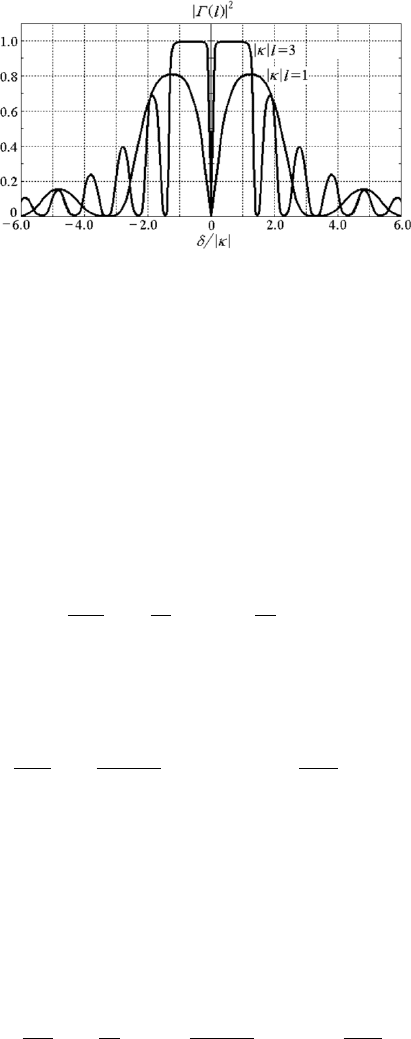
is made sufficiently long. The frequency response of the quarter-wave shifted
DFB resonator is shown in Fig. 7.40. The Q factor of the stop-band resonance
is much higher than that of the pass-band resonance, especially when |κ|l is
sufficiently large.
The DFB laser, i.e., a laser diode using a DFB resonator instead of a
normal F–P resonator is an outstanding dynamic single-mode semiconductor
laser and is an important active device in optoelectronics, especially in optical
fiber communications.
470 7. Periodic Structures and the Coupling of Modes
Figure 7.40: Frequency response of the quarter-wave shifted DFB resonator.
7.9.4 A Multiple-Layer Coating as a DFB Transmission
Resonator
The multi-layer HR or AR coating with alternating refraction index intro-
duced in Section 2.6.3 is a typical DFB structure. Following the DFB ap-
proach, the reflection coefficient and the input impedance of the structure
are given in (7.287) and (7.288). On the other hand, as a multi-layer coating,
from (2.262) in Section 2.6.3, we have
Z
2m
Z
CL
=
µ
n
1
n
2

2m
=
µ
n
1
n
2

2(l/p)
,
where mp = l. Suppose that the indices of the two layers are n
1
= n + ∆n
and n
2
= n − ∆n, with ∆n/n being very small. The ab ove equation thus
reduces to
Z
2m
Z
CL
=
µ
n + ∆n
n − ∆n

2(l/p)
≈
µ
1 +
4∆n
n

(l/p)
. (7.289)
To relate the two equations, (7.288) and (7.289), we have to evaluate the
coupling coefficient κ for a multi-layer structure. Consider a pair of layers of
indices n
1
= n + ∆n and n
2
= n − ∆n forming a segment with a length of
one period of the periodic structure immersed in a medium of index n. The
thickness of each layer is one quarter wavelength at the resonant frequency,
so that p = λ/2n. See Fig. 7.41.
The input impedance of the layer pair is
Z
21
Z
C
=
µ
n
1
n
2

2
=
µ
n + ∆n
n − ∆n

2
≈ 1 +
4∆n
n
,