
Zhang K., Li D. Electromagnetic Theory for Microwaves and Optoelectronics
Подождите немного. Документ загружается.

8.1 Classical Theory of Dispersion and Dissipation in Material Media 481
.5 .6 .7 .8 .9 1.0 1.1 1.2 1.3 1.4 1.5
0.0
.2
.4
.6
.8
1.0
1.2
1.4
1.6
n"
Z
n'
Z
n'
Z
n"
Z
0
ZZ
01
ZZ
02
ZZ
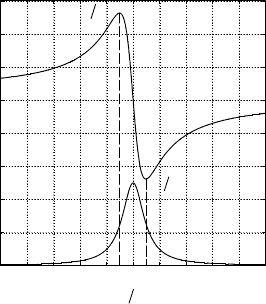
Figure 8.2: Frequency responses of n
0
(ω) and n
00
(ω).
8.1.4 Normal and Anomalous Dispersion
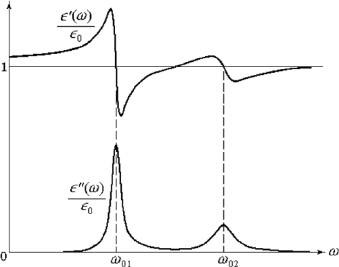
The general features of the real and imaginary parts of complex permittivity
with respect to frequency around two successive resonant frequencies are
shown in Fig. 8.3.
The damping constants γ
i
are generally small compared with the natural
frequencies ω
i
. This means that |ω
2
i
− ω
2
| À ωγ
i
and, as a consequence,
˙²(ω) is approximately real and ²
00
is approximately zero for most frequencies
not too close to ω
i
. The factor
¡
ω
2
i
− ω
2
¢
−1
is positive for ω < ω
i
and
negative for ω > ω
i
. Thus, at low frequencies, below the lowest natural
resonant frequency, ω < min(ω
i
), all the terms in the sum in (8.7) and (8.10)
are positive so that χ
0
must be positive and ²
0
must be larger than ²
0
. If
ω is greater than min(ω
i
) but less than the other ω
i
, the term in the sum
containing min(ω
i
) is negative but the other terms are still positive. As the
frequency is increased so that successive values of ω
i
are passed, more and
more terms in the sum in (8.7) and (8.10) become negative, until finally the
whole sum becomes negative when ω > max(ω
i
), then χ
0
becomes negative
and ²
0
becomes less than ²
0
.
As the frequency approaches any of the ω
i
, refer to Fig. 8.3, both ²
0
and ²
00
increase rapidly. The real part ²
0
reaches a maximum at a value
of ω slightly less than ω
i
, then decreases rather sharply to ²
0
at ω = ω
i
.
Thereafter it reaches a minimum at a value of ω slightly larger than ω
i
and,
finally, increases slowly to ²
0
. The imaginary part ²
00
reaches its maximum
sharply at ω = ω
i
. These frequencies correspond to the absorption lines of
the medium. At low pressure, gases are almost transparent except in narrow
regions close to the absorption lines.
In the regions where the slope of the ²
0
curve is positive, which means that
²
0
(ω) increases with ω, the dispersion is said to be normal dispersion. There
482 8. Electromagnetic Waves in Dispersive Media and Anisotropic Media
Figure 8.3: Frequency responses of ²
0
(ω) and ²
00
(ω) around two successive
resonant frequencies.
exist small ranges of frequency near the resonant frequencies at which the
slope of the ²
0
curve is negative, and the dispersion in this situation is said to
be anomalous dispersion. Normal dispersion occurs everywhere except in the
neighborhood of a resonant frequency. Only if there is anomalous dispersion
does the imaginary part of ˙² become appreciable. A positive imaginary part
to ˙² represents dissipation of energy from the electromagnetic wave to the
medium. The frequency intervals in which ²
00
(ω) > 0 are called regions
of resonant absorption and the medium is known as a passive medium. If
²
00
(ω) < 0, energy is supplied to the wave by the medium and amplification
occurs as in a maser or laser. The medium with ²
00
(ω) < 0 is known as an
active medium.
At the low-frequency end, the lowest resonant frequency for insulators
is different from zero. The electric susceptibility and permittivity given by
(8.6) and (8.9), respectively, tend to their static values in the limit as ω → 0
and no singularity arises. However, for conductors, the behavior of the free
electrons must be considered.
8.1.5 Complex Index for Metals
When particles are packed together at densities of the order of those of liquids
or solids, the influence of the polarization on the local field can no longer be
ignored. The ideal gas model is then no longer valid. As a consequence of
the disturbance to electron behavior by surrounding particles in liquids and
solids, the absorption regions are broader than those predicated by the ideal
gas model.
For conducting materials, we need to include consideration of the free
electrons or conduction electrons. We make two reasonable assumptions: (1)
that free electrons with no restoring force acting on them have zero resonant

8.1 Classical Theory of Dispersion and Dissipation in Material Media 483
frequency i.e., −mω
2
0
x = 0 so that ω
0
= 0, and (2) that the effect of the
ions in a conducting “sea” of electrons removes the need for the local field
correction. Under these assumptions, the expression of the permittivity for
the ideal gas model (8.9) becomes valid again but a singularity arises at
ω = 0.
Assume that a fraction f
0
of the electrons per molecule are free electrons,
and the damping factor which allows for collisions of free electrons with the
lattice ions is denoted by γ
0
. It is convenient to express (8.9) in the following
form:
˙²(ω) =
²
0
+
Ne
2
m
X
i(i6=0)
f
i
ω
2
i
−ω
2
+jωγ
i
− j
Ne
2
mω
f
0
γ
0
+jω
= ²
(0)
(ω)−j
Ne
2
mω
f
0
γ
0
+jω
,
(8.29)
where the contributions of all dipoles are collected together under the square
brackets and are denoted by ²
(0)
(ω),
²
(0)
(ω) = ²
0
+
Ne
2
m
X
i(i6=0)
f
i
ω
2
i
− ω
2
+ jωγ
i
,
and the contribution of the free electrons is given separately in the last term.
In terms of band theory, the terms in the summation correspond to ex-
citation from the valence band to the conduction band whereas the term
including f
0
and γ
0
covers excitation from occupied to unoccupied conduc-
tion band states.
8.1.6 Behavior at Low Frequencies,
Electric Conductivity
Assuming that the conducting medium obeys Ohm’s law, rewriting the ex-
pression of ˙²(ω) (1.96),
˙²(ω) = ²
0
(ω) − j
h
²
00
(ω) +
σ
ω
i
= [²
0
(ω) − j²
00
(ω)] − j
σ
ω
,
then comparing it with (8.29), we obtain
²
0
(ω) − j²
00
(ω) = ²
(0)
(ω), σ =
f
0
Ne
2
m(γ
0
+ jω)
. (8.30)
This is essentially the result obtained from Drude’s model (in 1900) for the
electrical conductivity, with f
0
N being the number of free electrons per unit
volume in the medium.
The damping constant γ
0
/f
0
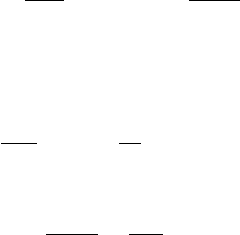
can be determined empirically from experi-
mental data on the low-frequency conductivity of the conductor, which gives
ω ¿ γ
0
and
σ =
f
0
Ne
2
mγ
0
, or
γ
0
f
0
=
Ne
2
mσ
. (8.31)
484 8. Electromagnetic Waves in Dispersive Media and Anisotropic Media
For copper, N = 8 × 10
28
atoms/m
3
and at normal temperatures the low-
frequency conductivity is σ ≈ 5.8×10
7
S/m. This gives γ
0
/f
0
≈ 3×10
13
s
−1
.
If we assume that f
0
≈ 1 and thus γ
0
≈ 3 × 10
13
s
−1
, this shows that up
to frequencies well beyond the microwave region, i.e., up to 10
11
Hz(s
−1
),
conductivity of metals is essentially real, i.e., the current density is in phase
with electric field and independent of frequency.
At higher frequencies in and beyond the infrared region, the conductivity
is complex and depends on the frequency in a way described qualitatively by
(8.30). For a proper understanding of electrical conductivity for a solid in a
high frequency, a quantum approach is necessary, since the Pauli principle
plays an important role.
At low frequencies, a medium containing an appreciable number of free
electronics can be regarded as a conductor, otherwise, even for the medium
containing a large number of free electronics, for example metal, must be
regarded as an insulator, and the dispersive properties of the medium can be
attributed to a complex permittivity or a refractive index and an extinction
coefficient. It should be noted that the meaning of the term “low frequency”
here is different to those in electronic engineering. It covers the entire fre-
quency band from d-c up to sub-millimeter waves. The demarcation between
“low frequency” and “high frequency” is roughly between the sub-millimeter
wave and far-infrared wave, i.e., in THz range. It is just the frequency of
demarcation between electronics and optics.
8.1.7 Behavior at High Frequencies,
Plasma Frequency
At frequencies far above the highest resonant frequency, i.e., ω À max{ω
i
},
ω À γ
i
, the expression for ²(ω) (8.9) reduces to
²(ω) = ²
0
−
Ne
2
ω
2
m
X
i
f
i
= ²
0
−
NZe
2
ω
2
m
,
where NZ denotes the total number of electrons per unit volume. This
expression can also be written in the following form:
²(ω)
²
0
=
Ã
1 −
ω
2
p
ω
2
!
, (8.32)
where
ω
2
p
=
NZe
2
²
0
m
=
ρ
0
e
²
0
m
, (8.33)
where ρ
0
= NZe denotes the volume charge density of electrons and ω
p
is
known as the plasma frequency of the medium. Since each of e, m, and ²
0
is a
universal constant, the plasma frequency ω
p
is determined only by the total
number of electrons per unit volume NZ or the volume charge density of

8.2 Velocities of Waves in Dispersive Media 485
electrons ρ
0
. The physical meaning of ω
p
is the natural oscillating frequency
of electrons in a neutral plasma when the ions remain at rest. The discussion
of the permittivity of plasma and the waves in plasma will be given later in
Sections 8.9 and 8.10.
The permittivity of metal is given by (8.29). At high frequencies, ω À γ
0
,
this takes the following approximate form
˙²(ω)
²
0
=
²
(0)
(ω)
²
0
−
f
0
Ne
2
²
0
m
∗
ω
2
=
²
(0)
(ω)
²
0
−
ω
2
p
ω
2
, where ω
2
p
=
f
0
Ne
2
²
0
m
∗
(8.34)
is the plasma frequency of the conduction electrons, given an effective mass
m
∗
to include partially the effects of binding.
It is clear that the behavior of the interaction of an electromagnetic wave
with any material medium including metal approaches the behavior of the
interaction with a plasma when the frequency of the wave is sufficiently high,
whereas the relative permittivity approaches unity when ω À ω
p
.
For ω ¿ ω
p
, the light penetrates only a very short distance into the metal
and is almost entirely reflected, because the extinction coefficient is large.
But when the frequency is increased to the range ω > ω
p
, the metal becomes
transparent and the reflectivity of the metal surface changes drastically. This
occurs typically in the ultraviolet region and is known as the ultraviolet
transparency of the metal. This is just the frequency of demarcation between
optics and high-energy physics or fundamental-particle physics.
8.2 Velocities of Waves in Dispersive Media
In the previous chapters, the propagation of electromagnetic waves in un-
bounded and bounded systems with non-dispersive filling media is discussed.
Generally, in a guided wave system, all of the waves other than the TEM
mode are dispersive modes. This kind of dispersion is known as waveguide
dispersion. The characteristics of waveguide dispersion are determined by
the propagating mode of interest and the geometry of the guided-wave sys-
tem. In a multi-mode waveguide the phase velocities of different modes are
different. This leads to inter-mode dispersion.
In this section, the dispersion of electromagnetic waves caused by the
medium itself will be discussed. It is known as material dispersion.
For plane waves, in non-dispersive media, the phase velocity is equal to the
group velocity, but in dispersive media, the phase velocity is no longer equal
to the group velocity. In the region of week dispersion, the signal velocity
and energy velocity are both approximately equal to the group velocity, but
in the region of strong disp ersion, the group velocity, energy velocity and
signal velocity are no longer equal to each other [17, 43, 96].
486 8. Electromagnetic Waves in Dispersive Media and Anisotropic Media
8.2.1 Phase Velocity
In dispersive media, the propagation coefficient of a plane wave is complex,
˙
k = ω
p
µ˙² =
ω
c
˙n =
ω
c
(n
0
− jn
00
) = β − jα, (8.35)
where
β = ωn
0
/c, α = ωn
00
/c (8.36)
denote the phase coefficient and the attenuation coefficient, respectively. The
phase velocity of a plane wave in a disp ersive medium becomes
v
p
=
ω
β
=
c
n
0
(ω)
. (8.37)
Generally, in dispersive media, the phase velocity depends on the frequency.
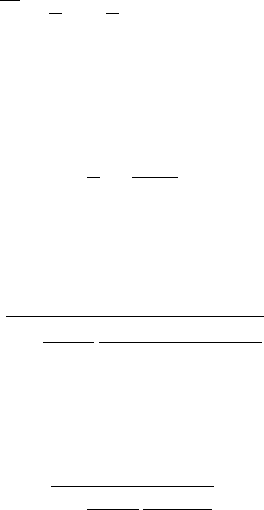
For the medium where ²
00
r
¿ ²
0
r
and if n
0
of the medium is only slightly
larger than 1, substituting (8.27) into the above expression of v
p
, we obtain
v
p
≈
c
1 +
NZe
2
2²
0
m
ω
2
0
− ω
2
¡
ω
2
0
− ω
2
¢
2
+ ω
2
γ
2
(8.38)
It is easily seen that when ω < ω
0
the phase velocity is less than the speed
of light in vacuum, c, whereas when ω > ω
0
, the phase velocity is larger than
c. In the region of normal dispersion, |ω
2
0
− ω
2
| À ωγ, it reduces to
v
p
≈
c
1 +
NZe
2
2²
0
m
1
ω
2
0
− ω
2
. (8.39)
At the high frequency end, the phase velocity approaches c at ω → ∞.
The phase velocity that enters into the wave solution has a steady-state
time dependence of e
jωt
, i.e., a pure monochromatic wave with a definite
frequency and wave number or a wave train of infinite duration which exists
only if the source is turned on at t = −∞ and kept on for all future time
as well. In practice, a steady-state sinusoidal wave will be observed after a
suitable period of time has elapsed and the transient of switching on of the
source has died out. Once steady-state conditions prevail, the phase velocity
can be introduced to describe the velocity at which a constant phase point
appears to move along the medium or the system. However, there is no
information being transmitted along the system once steady-state conditions
have been established. The term signal is used to denote a time function
that can convey information to the observer. Thus any step change of the
wave or a wave train with finite duration is a signal, but once steady-state
conditions are achieved, there is no more signal because the observer does
not receive any more information. Thus the phase velocity is not associated
with any physical entity such as a signal, wavefront, or energy flow. Hence
the fact that in dispersive media, in some frequency bands, the phase velocity
is larger than c does not violate Einstein’s theory of special relativity.

8.2 Velocities of Waves in Dispersive Media 487
8.2.2 Group Velocity
In reality, idealized monochromatic waves do not arise. Even in the most
sharply tuned radio transmitter or most monochromatic light source, waves
with finite frequency ranges are generated and transmitted. Furthermore,
any signal must consist of wave trains of finite extent or waves with finite
frequency spectra. Since the basic equations are linear, any time-dependent
process can be treated by a superposition of sinusoidal waves with different
frequencies and wave numbers.
In a dispersive medium or disp ersive guided wave system, the phase veloc-
ity is not the same for each frequency component of the wave. Consequently
different components of the wave travel with different speeds and tend to
change phase with respect to one another during the propagation and give
rise to phase distortion of the waveform. The velocity of the signal, i.e., the
velocity of the envelope of the wave train, is different from the phase velocity
of the monochromatic wave.
The appropriate tool for the analysis of the propagation of finite wave
trains or wave packets is the Fourier integrals. Suppose that the phase co-
efficient k of the wave is a general smoothly varying function of the angular
frequency ω,
k = k(ω). (8.40)
Then an arbitrary component of the fields in a wave along z can be expressed
as the following Fourier integral:
u(z, t) =
1
√
2π
Z
∞
−∞
A(ω)e
j(ωt−kz)
dω, (8.41)
where A(ω) is the amplitude of the monochromatic wave with frequency
ω, which describes the properties of the linear superposition of the waves
with different frequencies. It is given by the inverse Fourier transform of the
function u(z, t), evaluated at z = 0:
A(ω) =
1
√
2π
Z
∞
−∞
u(0, t)e
−jωt
dt. (8.42)
The above two equations define a Fourier transform pair, see Fig. 8.4(a).
The circular frequency ω can also be expressed as a function of k:
ω = ω(k), (8.43)
and the Fourier integral of u(z, t) becomes
u(z, t) =
1
√
2π
Z
∞
−∞
A(k)e
j(ωt−kz)
dk, (8.44)
see Fig. 8.4(b), where A(k) is the amplitude of the monochromatic wave with
wave number k, which describes the properties of the linear superposition
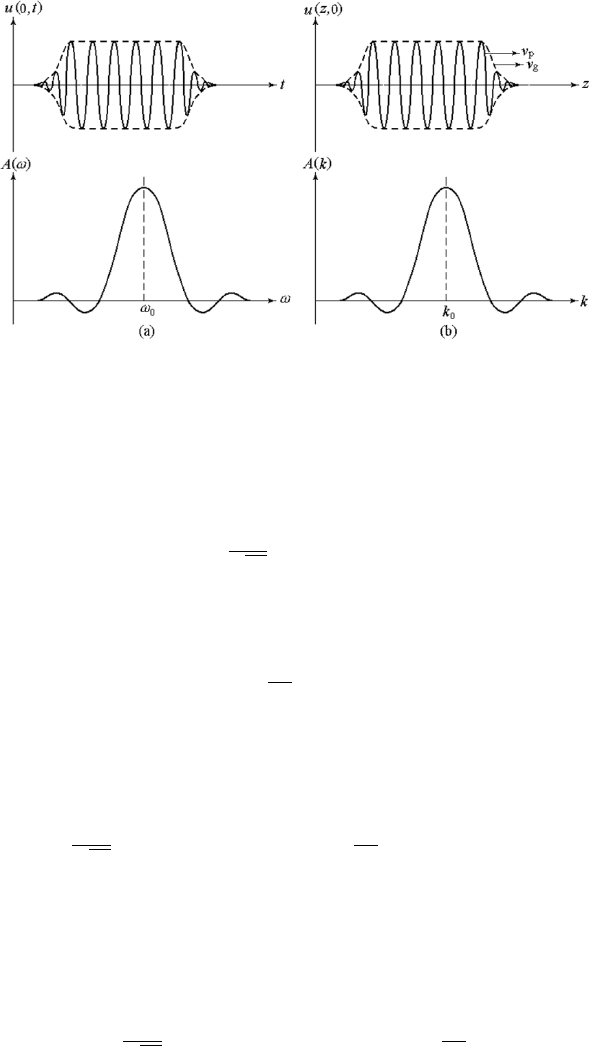
488 8. Electromagnetic Waves in Dispersive Media and Anisotropic Media
Figure 8.4: A finite wave train and its Fourier spectrum in frequency (a) and
in wave number (b).
of the waves with different wave numbers. It is given by the inverse Fourier
transform of the function u(z, t), evaluated at t = 0:
A(k) =
1
√
2π
Z
∞
−∞
u(z, 0)e
jkz
dz. (8.45)
Now we turn to the motion of the wave packet u(z, t). The function of
frequency ω(k) can be expanded around the center value k
0
:
ω(k) = ω
0
+
dω
dk
¯
¯
¯
¯
k
0
(k − k
0
) + ···, (8.46)
where ω
0
= ω(k
0
). If the distribution of amplitude A(k) is fairly sharply
peaked around k
0
, ∆k ¿ k
0
, only two terms in the above series have to be
considered, and (8.44) becomes
u(z, t) =
(
1
√
2π
Z
∞
−∞
A(k) exp
"
−j(k−k
0
)
Ã
z−
dω
dk
¯
¯
¯
¯
k
0
t
!#
dk
)
e
j(ω
0
t−k
0
z)
. (8.47)
Hence the wave packet u(z, t) is explained in the form of a mo dulated
monochromatic wave traveling in the positive z direction and the integral
in the braces represents its envelope U (z, t):
u(z, t) = U(z, t)e
j(ω
0
t−k
0
z)
, (8.48)
U(z, t) =
1
√
2π
Z
∞
−∞
A(k) exp
"
−j(k − k
0
)
Ã
z −
dω
dk
¯
¯
¯
¯
k
0
t
!#
dk. (8.49)
8.2 Velocities of Waves in Dispersive Media 489
The phase factor of the modulated wave is e
j(ω
0
t−k
0
z)
and the phase velo city
is
v
p
=
ω
0
k
0
. (8.50)
The condition for a constant envelope shape is
z −
dω
dk
¯
¯
¯
¯
k
0
t = const,
and the wave packet travels along z with a velocity
v
g
=
dω
dk
¯
¯
¯
¯
k
0
=
1
dk/dω|
k
0
, (8.51)
which is defined as the group velocity. When the wave number is complex,
˙
k = β − jα, the group velocity becomes
v
g
=
dω
dβ
¯
¯
¯
¯
β
0
=
1
dβ/dω|
β
0
, (8.52)
By virtue of (8.36),
β(ω) =
ωn
0
(ω)
c
,
we get
v
p
=
c
n
0
(ω)
, v
g
=
c
n
0
(ω) + ω[dn
0
(ω)/dω]
. (8.53)
The phase velocity and the group velocity in the neighborhood of a reso-
nant peak of a dispersive medium can be obtained by applying the frequency
responses of n
0
(ω) given in Fig. 8.2 in the ab ove expressions. They are plot-
ted, as ratios of c, as the dashed line and the solid line, respectively, in
Figure 8.5.
In the medium where ²
00
r
¿ ²
0
r
and if n
0
of the medium is only slightly
larger than 1, by using (8.27) in (8.53), we obtain
v
g
≈
c
1 +
NZe
2
2²
0
m
(ω
2
0
+ ω
2
)[(ω
2
0
− ω
2
)
2
− ω
2
γ
2
]
[(ω
2
0
− ω
2
)
2
+ ω
2
γ
2
]
2
(8.54)
In the region of normal dispersion, |ω
2
0
− ω
2
| À ωγ, this reduces to
v
g
≈
c
1 +
NZe
2
2²
0
m
ω
2
0
+ ω
2
(ω
2
0
− ω
2
)
2
. (8.55)
Comparing with (8.39), we see that in this region v
g
< v
p
and v
g
< c. The
group velocity also approaches c at ω → ∞ .
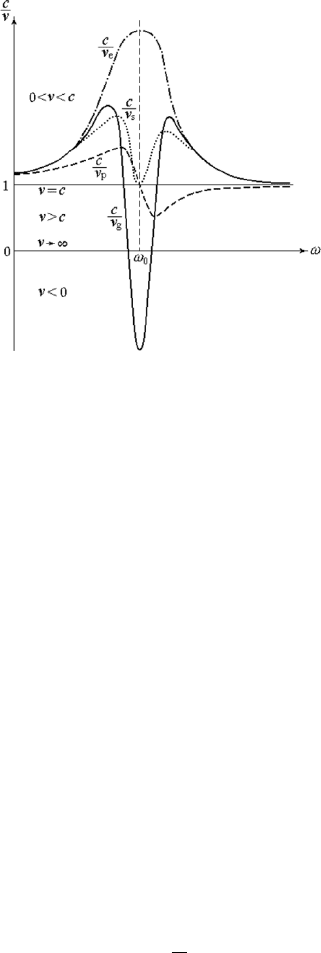
490 8. Electromagnetic Waves in Dispersive Media and Anisotropic Media
Figure 8.5: The plots of v
p
, v
g
, v
s
, and v
e
as ratios of c in the neighborhood
of a resonant peak of a dispersive medium.
In the region of normal dispersion, ω < ω
1
and ω > ω
2
, where (dn
0
/dω) >
0 and n
0
> 1, the group velocity is smaller than the phase velocity and also
smaller than c, i.e., v
g
< v
p
and v
g
< c. In this case, the group velocity
represents the velocity of the signal propagation. In the region of anomalous
dispersion, ω
1
< ω < ω
2
, where (dn
0
/dω) < 0 and |dn
0
/dω| can b ecome large,
then v
g
> v
p
and the group velocity differs greatly from the phase velocity.
When n
0
+dn
0
/dω become less than 1 or even negative then the group velocity
v
g
becomes larger than c or even negative. This result does not mean that the
ideas of special relativity are violated, rather that the group velocity defined
here no longer represents the velocity of a signal which propagates in the
medium with strong anomalous dispersion, because a large value of |dn
0
/dω|
is equivalent to a rapid variation of ω as a function k and consequently the
two term approximation made in (8.47) is no longer valid. Refer to [17, 96].
8.2.3 Velocity of Energy Flow
The definition of the energy flow velocity is
v
e
=
P
w
, (8.56)
where P denotes the density of average power flow and w denotes the average
density of energy stored in the electromagnetic fields. They can be obtained
by means of Poynting’s theorem given in Section 1.4.