
Zhang K., Li D. Electromagnetic Theory for Microwaves and Optoelectronics
Подождите немного. Документ загружается.


8.2 Velocities of Waves in Dispersive Media 491
For a plane wave propagating along z in a dispersive medium,
P =
1
2
<(E × H
∗
) =
1
2
<
³
1
η
∗
E × E
∗
´
, (8.57)
where E = E
0
e
−αz
e
−jβz
, E ×E
∗
= |E|
2
= |E
0
|
2
e
−2αz
,
1
η
∗
=
q
²
0
µ
0
√
²
r
∗
and
√
²
r
∗
= n
∗
= n
0
+ jn
00
. Then we have
P =
1
2
r
²
0
µ
0
n
0
|E
0
|
2
e
−2αz
. (8.58)
The average density of stored energy is given by
w =
1
4
²
0
|E|
2
+
1
4
µ
0
|H|
2
+
1
4
Nmω
2
0
|x|
2
+
1
4
Nmω
2
|x|
2
, (8.59)
where the first and the second terms represent the average density of stored
energy of electromagnetic fields in vacuum;
1
4
Nmω
2
0
|x|
2
is the volume density
of the potential energy of the molecular resonator, where −mω
0
x denotes the
restoring force; and
1
4
Nmω
2
|x|
2
=
1
2
N
¡
1
2
mv
2
¢
denotes the volume density
of the kinetic energy of the molecular resonator.
The ratio of E to H is equal to the wave impedance. Applying (8.13)
and (8.14), we have
|H|
2
=
|E|
2
η
2
=
²
0
µ
0
|²
r
||E|
2
=
²
0
µ
0
|E|
2
¯
¯
¯
¯
1 +
NZe
2
²
0
m
ω
2
0
− ω
2
(ω
2
0
− ω
2
)
2
+ ω
2
γ
2
− j
NZe
2
²
0
m
ωγ
(ω
2
0
− ω
2
)
2
+ ω
2
γ
2
¯
¯
¯
¯
=
²
0
µ
0
|E|
2
v
u
u
t
³
ω
2
0
− ω
2
+
NZe
2
²
0
m
´
2
+ ω
2
γ
2
(ω
2
0
− ω
2
)
2
+ ω
2
γ
2
. (8.60)
Substituting (8.2) and (8.60) into (8.59), we obtain
w =
²
0
4
1+
NZe
2
²
0
m
¡
ω
2
0
+ ω
2
¢
(ω
2
0
− ω
2
)
2
+ ω
2
γ
2
+
v
u
u
t
³
ω
2
0
− ω
2
+
NZe
2
²
0
m
´
2
+ ω
2
γ
2
(ω
2
0
− ω
2
)
2
+ ω
2
γ
2
|E
0
|
2
e
−2αz
.
(8.61)
Substituting (8.58) and (8.61) into (8.56), we obtain the velocity of energy
flow
v
e
=
2n
0
1+
NZe
2
²
0
m
ω
2
0
+ ω
2
(ω
2
0
− ω
2
)
2
+ ω
2
γ
2
+
v
u
u
u
t
³
ω
2
0
− ω
2
+
NZe
2
²
0
m
´
2
+ ω
2
γ
2
(ω
2
0
− ω
2
)
2
+ ω
2
γ
2
c. (8.62)
492 8. Electromagnetic Waves in Dispersive Media and Anisotropic Media
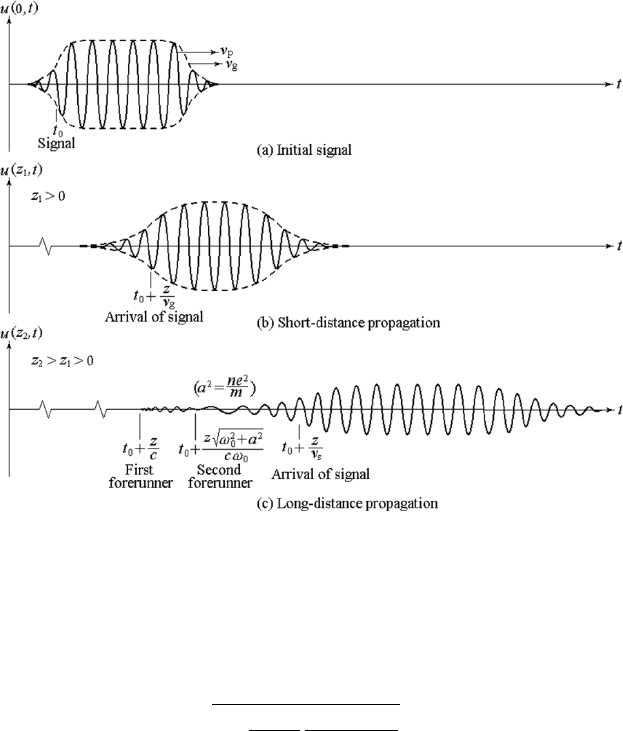
Figure 8.6: The propagation of a signal in disp ersive medium.
In the region of normal dispersion, |ω
2
0
− ω
2
| À ωγ and |ω
2
0
− ω
2
| À
NZe
2
/²
0
m, it reduces to
v
e
≈ n
0
c
1 +
NZe
2
2²
0
m
ω
2
0
+ ω
2
(ω
2
0
− ω
2
)
2
= n
0
v
g
. (8.63)
At the high-frequency range, n
0
< 1, v
e
< v
g
, the velocity of energy flow
and the group velocity approaches c at ω → ∞. At the low-frequency range,
n
0
> 1, v
e
> v
g
and when ω ¿ ω
0
, v
e
≈ v
g
≈ v
p
.
In the region of anomalous dispersion, the velocity of energy flow is much
different from the group velocity and remains less than c. The ratio of c to
v
s
is plotted as the dash-dotted line in Fig. 8.5.
8.2.4 Signal Velocity
In the region of normal dispersion, group velocity represents the velocity of
the signal propagation. But in the region of anomalous dispersion, the group
velocity v
g
will lead to a velocity greater than the velocity of light in vacuum,

8.3 Anisotropic Media and Their Constitutional Relations 493
c, which is relativistically impossible. The above-defined group velocity loses
its meaning as a signal velocity in the region of anomalous dispersion.
The propagation of a signal in a dispersive medium has been carefully
investigated by L. Brillouin [17, 96]. This investigation is of a much more
delicate nature and we would rather give here a statement of the conclusions.
According to Brillouin, a signal is a disturbance in the form of a train of
oscillations starting at a certain instant as shown in Fig. 8.6(a). In the course
of propagation in a dispersive medium, the signal is deformed; see Fig. 8.6(b).
It was found that after p enetrating to a certain depth in the medium, the
main body of the signal is preceded by a forerunner which travels with the
velocity c. The first forerunner arrives with small period and zero amplitude,
and then grows slowly both in period and in amplitude. The amplitude then
decreases while the period approaches the natural period of the electrons.
Then the second forerunner arrives with the velocity c(ω
0
/
p
ω
2
0
+ a
2
) < c,
where a = NZe
2
/m. The period of the second forerunner is at first very large
and then decreases, while the amplitude rises and then falls in a manner
similar to that of the first forerunner. These two forerunners can partly
overlap and their amplitudes are very small but increase rapidly as their
periods approach that of the signal. With a sudden rise of amplitude the
principle part of the disturbance arrives, traveling with a velocity v
s
, which
Brillouin defines as the signal velocity. The time variation of the signal
propagating a certain distance in a dispersive medium is shown in Fig. 8.6(c).
An explicit and simple expression for v
s
cannot be given, but physically its
meaning is quite clear. For a detector with normal sensitivity, a measurement
should, in fact, indicate a velocity of propagation approximately equal to v
s
.
However, as the sensitivity of the detector is increased, the measured velocity
increases, until in the limit of infinite sensitivity we should record the arrival
of the front of the first forerunner, which travels with the velocity c. The
ratio of c to v
s
given by Brillouin is plotted as the dotted line in Fig. 8.5.
8.3 Anisotropic Media and Their
Constitutional Relations
In the previous chapters, we have studied the fields and waves in isotropic
media, in which the orientation of polarization or magnetization is in the
same direction as that of the field vector, and the responses to fields with dif-
ferent orientations are the same. Hence for isotropic media, the permittivity
and permeability are scalars which may be complex and may be frequency
dependent or nonlinear.
In a number of technically important materials, responses of polarization
and magnetization to fields with different orientations may differ, so that the
orientation of p olarization or magnetization can be in the different direction
to that of the field vector. Such media are known as anisotropic media. In
494 8. Electromagnetic Waves in Dispersive Media and Anisotropic Media
these cases the permittivity and/or permeability must be tensors or matrices
[38, 53, 84].
8.3.1 Constitutional Equations for Anisotropic Media
Rewrite the constitutional equations for general anisotropic media given in
Section 1.1.2:
D = ² · E, B = µ · H, (8.64)
where ² is the tensor permittivity and µ is the tensor permeability. For
steady-state sinusoidal time-varying fields, the constitutional tensors are com-
plex tensors, i.e., the elements of the matrices are complex and depend on
frequency. Although a medium can be both electrically and magnetically
anisotropic, but in fact, most anisotropic media are either electric anisotropic
or magnetic anisotropic.
For electric anisotropic or so called ²-anisotropic medium, the permittivity
is a tensor and the permeability is a scalar, so
D = ² · E, B = µH, (8.65)
where
² =
²
xx
²
xy
²
xz
²
yx
²
yy
²
yz
²
zx
²
zy
²
zz
. (8.66)
For magnetic anisotropic or so called µ-anisotropic medium, the perme-
ability is a tensor and the permittivity is a scalar, so
D = ²E, B = µ · H, (8.67)
where
µ =
µ
xx
µ
xy
µ
xz
µ
yx
µ
yy
µ
yz
µ
zx
µ
zy
µ
zz
. (8.68)
The alternative expressions of the constitutional relations for electric
anisotropic media are
E = κ · D , H = νB, (8.69)
and for magnetic anisotropic media are
E = κD, H = ν · B, (8.70)
where κ = ²
−1
is the impermittivity tensor and ν = µ
−1
is the imperme-
ability tensor.

8.3 Anisotropic Media and Their Constitutional Relations 495
8.3.2 Symmetrical Properties of the Constitutional
Tensors
We are now going to explain the properties of the constitutional tensors for
passive and lossless media.
In source-free and nonconducting media, J = 0, J
m
= 0, and σ = 0, the
complex Poynting theorem (1.179) becomes
∇·
˙
S = ∇·
µ
1
2
E × H
∗
¶
= ∇·
¡
S + j q
¢
= j ω
µ
E · D
∗
2
−
B · H
∗
2
¶
. (8.71)
The divergence of the average Poynting vector is
∇ ·
S = ∇ ·
·
1
2
<(E × H
∗
)
¸
=
1
2
<[ j ω (E · D
∗
− B · H
∗
)]. (8.72)
For an arbitrary complex quantity, we have
<z =
1
2
(z + z
∗
).
Then the above equation becomes
∇ ·
S =
1
4
{[j ω(E · D
∗
− B · H
∗
)] + [j ω(E · D
∗
− B · H
∗
)]
∗
}
=
j ω
4
[E · D
∗
− B · H
∗
− E
∗
· D + B
∗
· H]. (8.73)
Substituting (8.64) into it, we obtain
∇ ·
S =
j ω
4
[E · ²
∗
· E
∗
− µ · H · H
∗
− E
∗
· ² · E + µ
∗
· H
∗
· H]. (8.74)
Applying the rule of tensor algebra (E.43),
A · b
∗
· A
∗
= A
∗
· b
†
· A,
where b
∗
is the conjugate tensor of b and b
†
= b
∗T
is the conjugate trans-
posed tensor or associate tenor of b, then (8.74) becomes
∇ ·
S =
j ω
4
[E
∗
· (²
†
− ²) · E + H
∗
· (µ
†
− µ) · H]. (8.75)
In source-free and nonconducting media, ∇ ·
¯
S = 0. This must be true
for an arbitrary choice of E and H, and therefore
²
†
= ², µ
†
= µ, or ²
T
= ²
∗
, µ
T
= µ
∗
. (8.76)
We conclude that the transpose of the constitutional tensor for lossless
anisotropic media is the complex conjugate of the tensor itself, hence both
496 8. Electromagnetic Waves in Dispersive Media and Anisotropic Media
tensors
˙
² and
˙
µ are Hermitian tensors. The relations among the complex
elements of a Hermitian constitutional tensor are given by
²
ii
= ²
∗
ii
, µ
ii
= µ
∗
ii
, (8.77)
and
²
ij
= ²
∗
ji
, µ
ij
= µ
∗
ji
, (8.78)
The diagonal elements have to be real and the non-diagonal elements have
to be conjugate symmetry.
(1) Reciprocal Media
If ²
ij
and µ
ij
are real, (8.78) becomes
²
ij
= ²
ji
, µ
ij
= µ
ji
. (8.79)
The constitutional tensors ² and µ are real and are symmetrical tensors,
²
T
= ², µ
T
= µ, (8.80)
and the media are known as reciprocal media.
Every symmetrical tensor of rank two can be transformed, by rotation
of the coordinate system, to a diagonal tensor. A diagonal tensor is one in
which all of the off-diagonal elements are zero, i.e., ²
ij
= 0, µ
ij
= 0 when
i 6= j. Hence by proper orientation of the coordinate system with respect to a
given reciprocal medium, the tensor permittivity and the tensor permeability
of the reciprocal medium can be expressed in the following form:
² =
²
1
0 0
0 ²
2
0
0 0 ²
3
, µ =
µ
1
0 0
0 µ
2
0
0 0 µ
3
, (8.81)
This special coordinate system, which is chosen to have the constitutional
tensor in the diagonal form, is called the principle coordinate system and the
three coordinate axes of the system are said to be the principle axes.
The reciprocity theorem given in Section 1.8 is suitable for the fields in
reciprocal media. The isotropic media are reciprocal media with ²
1
= ²
2
= ²
3
or µ
1
= µ
2
= µ
3
.
(2) Nonreciprocal Media
If ²
ij
and µ
ij
are imaginary, (8.78) becomes
²
ij
= −²
ji
, µ
ij
= −µ
ji
. (8.82)
The constitutional tensors ² and µ are not symmetrical tensors which cannot
be transformed, by rotation of the coordinate system, to a diagonal tensor.
8.4 Characteristics of Waves in Anisotropic Media 497
Hence the general forms of the constitutional tensors are
² =
²
1
j²
4
j²
5
−j²
4
²
2
j²
6
−j²
5
−j²
6
²
3
, µ =
µ
1
jµ
4
jµ
5
−jµ
4
µ
2
jµ
6
−jµ
5
−jµ
6
µ
3
, (8.83)
and the media are known as nonreciprocal anisotropic media or gyrotropic
media. The reciprocity theorem fails for nonreciprocal media or gyrotropic
media with asymmetrical constitutional tensors. Most nonreciprocal media
must have magnetic properties because of the gyrotropic nature of the mag-
netic force e(v × B) and magnetic torque m ×B.
For some nonreciprocal media, by rotation of the coordinate system, it is
possible to make the constitutional tensor in the following simplest form
² =
²
1
j²
2
0
−j²
2
²
1
0
0 0 ²
3
, µ =
µ
1
jµ
2
0
−jµ
2
µ
1
0
0 0 µ
3
. (8.84)
This special coordinate system can also be called the principle co ordinate
system, and the axis z is known as gyrotropic axis.
8.4 Characteristics of Waves in Anisotropic
Media
In anisotropic media, the effective indices and the propagation coefficients
for waves in different directions may be different. In addition, the electric
induction D and the electric field E in electric anisotropic media or the
magnetic induction B and the magnetic field H in magnetic anisotropic
media may be in the different directions. Consequently, the wave vector and
Poynting’s vector may be in different directions. In this section, the general
equations and rules of wave propagation in anisotropic media will be given
and the behavior of the waves in different kinds of anisotropic media will be
discussed in detail in the next sections.
8.4.1 Maxwell Equations and Wave Equations
in Anisotropic Media
The Maxwell equations for electric anisotropic and magnetic anisotropic me-
dia are
Electric anisotropic media, ², µ Magnetic anisotropic media, ², µ
∇ × E = −jωµH, ∇×E = −jωµ · H,
∇ × H = −jω² · E + J , ∇ × H = −jω²E + J ,
∇ · (² · E) = %, ∇ · (²E) = %,
∇ · (µH) = 0, ∇ · (µ · H) = 0.
498 8. Electromagnetic Waves in Dispersive Media and Anisotropic Media
As an example, we handle the case of the fields and waves in electric
anisotropic media. For source-free and nonconductive media, the Maxwell
equations become
∇ × E = −jωµH, (8.85)
∇ × H = −jω² · E, (8.86)
∇ · (² · E) = 0, (8.87)
∇ · (µH) = 0. (8.88)
Taking the curl of (8.85) and substituting ∇ × H from (8.86), we obtain
∇ × ∇ × E = −jωµ∇ × H = ω
2
µ² · E. (8.89)
The left-hand side may be expanded by using the vector identity for ∇×∇×A
(B.45), as we did to obtain the wave equation for isotropic media, yields
∇
2
E − ∇(∇ · E) + ω
2
µ² · E = 0. (8.90)
This is the governing equation for electromagnetic waves in ²-anisotropic
media.
For plane waves with space factor e
−jk·x
, we have ∇ = −jk, and he
Maxwell equations become
−jk × E = −jωµH, −jk × H = jω² · E, (8.91)
and the wave equation for E becomes
k
2
E − k(k · E) − ω
2
µ² · E = 0. (8.92)
Similarly, for magnetic anisotropic media, the wave equation for H are
∇
2
H − ∇(∇ · H) + ω
2
²µ · H = 0, (8.93)
k
2
H − k(k · H) − ω
2
²µ · H = 0. (8.94)
8.4.2 Wave Vector and Poynting Vector in Anisotropic
Media
In Section 2.1, we showed that, for plane waves with space factor e
−jk·x
, the
nabla operator, ∇, becomes −jk and
∇ · A = −jk ·A, ∇ × A = −jk × A,
Then the Maxwell equations become
k × E = ωB, (8.95)
k × H = −ωD, (8.96)

8.4 Characteristics of Waves in Anisotropic Media 499
k · D = 0, (8.97)
k · B = 0, (8.98)
It is clear from the above equations that the wave vector k is perpendicular
to the plane determined by D and B, which is called the DB plane.
Another important direction of wave propagation is the direction of power
flow, which is defined by the Poynting vector,
˙
S =
1
2
E × H
∗
.
So the direction of power flow is perpendicular to the plane determined by
E and H. In optics the unit vector in the direction of S is called the ray
vector. Finally we have
k ⊥ D, k ⊥ B, S ⊥ E, S ⊥ H.
The plane that contains D and B and is perpendicular to k is the constant-
phase surface or phase front and the plane that contains E and H and is
perpendicular to S is the constant-power or constant-strength surface.
In situations for which D k E and B k H, the ray vector and the wave
vector are in the same direction. This is the same as the behavior of waves
in isotropic media. In anisotropic media, it is possible that D 6kE or B 6kH
and, as a consequence, S is not parallel to k.
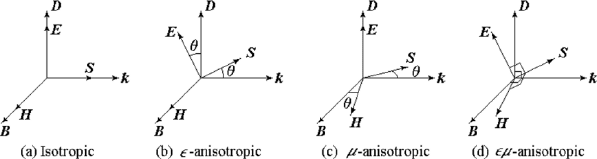
In electric anisotropic media, it is possible that D 6k E, and S is not
parallel to k. The angle between S and k is the same as that between D
and E. In this situation, B k H, so the four vectors D , E, k, and S are
coplanar and normal to both B and H. Similarly, in magnetic anisotropic
media, the four vectors B, H, k, and S are coplanar and normal to both D
and E. The above-mentioned relations are shown in Fig. 8.7.
In conclusion, the Poynting vector S is not necessarily in the same direc-
tion as the wave vector k inside an anisotropic media. The wave with k kS is
called the ordinary wave or, in abbreviation, o wave and the wave with k 6kS
is called the extraordinary wave or e wave.
8.4.3 Eigenwaves in Anisotropic Media
In isotropic media, the indices of refraction and the propagation coefficients of
plane waves in different directions are the same, so, for waves with any state
of polarization and any direction of propagation, the state of polarization of
the wave remains unchanged during the propagation. However, in anisotropic
media, because the constitutional parameters in different directions may be
different, the effective indices and the propagation coefficients in different
directions may be different, so, in general, the state of polarization of the
wave may change during the propagation.
In anisotropic media, only the waves with specific direction of propaga-
tion and with specific polarization state can keep the state of polarization
500 8. Electromagnetic Waves in Dispersive Media and Anisotropic Media
Figure 8.7: The relations among the directions of wave vector, energy flow
and field vectors.
unchanged during the propagation. These specific waves are called eigen-
waves or characteristic waves, and in some literature, natural modes. In a
specific direction of propagation, there are two eigenwaves with different state
of polarization. In reciprocal media, there are two linearly polarized eigen-
waves, and in nonrecipro cal media or so called gyrotropic media, there are
generally two elliptically or circularly polarized eigenwaves.
8.4.4 kDB Coordinate System
For further discussions on the solutions for the fields and waves in anisotropic
media, it is convenient to establish a new orthogonal coordinate system called
the kDB system, which consists of the DB plane and the wave vector k [53].
(1) The Construction of the kDB System and the Relations Between
the kDB System and xyz System
The kDB system (η, ξ, ζ) has unit vectors
ˆ
η,
ˆ
ξ,
ˆ
ζ. Let the unit vector
ˆ
ζ
be in the direction of k in such a way that
k =
ˆ
ζk, (8.99)
and the plane perpendicular to
ˆ
ζ is the DB plane. Let the unit vector
ˆ
η
lie in the x-y plane and be normal to the projection of k on the x-y plane.
Hence
ˆ
η is determined by the intersection of the x-y plane and the DB plane
and perpendicular to k-
ˆ
z plane. Then the unit vector
ˆ
ξ lies in both the DB
plane and the k-
ˆ
z plane and perpendicular to the ζ-η plane. The relation
between coordinates η, ξ, ζ and x, y, z is given in Fig. 8.8.
Suppose that the angle between
ˆ
ζ and
ˆ
z is γ and the angle between the
projection of
ˆ
ζ on the x-y plane and
ˆ
x is φ; see Fig. 8.8. One easily finds
that
ˆ
η =
ˆ
x sin φ −
ˆ
y cos φ, (8.100)
ˆ
ξ =
ˆ
x cos γ cos φ +
ˆ
y cos γ sin φ −
ˆ
z sin γ, (8.101)
ˆ
ζ =
ˆ
x sin γ cos φ +
ˆ
y sin γ sin φ +
ˆ
z cos γ. (8.102)