
Zhang K., Li D. Electromagnetic Theory for Microwaves and Optoelectronics
Подождите немного. Документ загружается.

8.4 Characteristics of Waves in Anisotropic Media 501
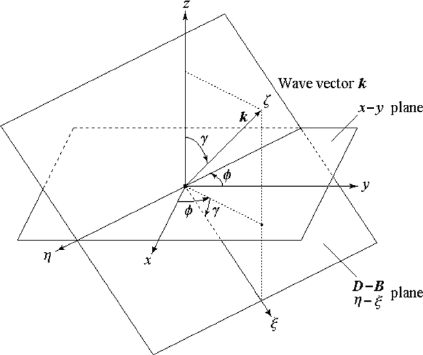
Figure 8.8: The kDB coordinate system.
The transformation relations for the components of an arbitrary field
vector A are to be established. Vector A is represented by components
projected onto the xyz coordinate system and is called A
(xyz)
,
A
(xyz)
=
ˆ
xA
x
+
ˆ
yA
y
+
ˆ
zA
z
=
A
x
A
y
A
z
. (8.103)
The same vector can also be represented by components projected onto the
kDB coordinate system and is called A
(kDB)
,
A
(kDB)
=
ˆ
ηA
η
+
ˆ
ξA
ξ
+
ˆ
ζA
ζ
=
A
η
A
ξ
A
ζ
. (8.104)
The relations between the components of A
(xyz)
and the components of
A
(kDB)
are governed by
A
(kDB)
= T · A
(xyz)
, A
(xyz)
= T
−1
· A
(kDB)
, (8.105)
where T is the transformation matrix and T
−1
is the inverse of T.
Since A
(xyz)
and A
(kDB)
denote the same vector, by using (8.100)–(8.102),
we get
A
η
=
ˆ
η · A =
ˆ
η ·
ˆ
xA
x
+
ˆ
η ·
ˆ
yA
y
+
ˆ
η ·
ˆ
zA
z
= A
x
sin φ −A
y
cos φ, (8.106)
502 8. Electromagnetic Waves in Dispersive Media and Anisotropic Media
A
ξ
=
ˆ
ξ · A =
ˆ
ξ ·
ˆ
xA
x
+
ˆ
ξ ·
ˆ
yA
y
+
ˆ
ξ ·
ˆ
zA
z
= A
x
cos γ cos φ + A
y
cos γ sin φ − A
z
sin γ, (8.107)
A
ζ
=
ˆ
ζ · A =
ˆ
ζ ·
ˆ
xA
x
+
ˆ
ζ ·
ˆ
yA
y
+
ˆ
ζ ·
ˆ
zA
z
= A
x
sin γ cos φ + A
y
sin γ sin φ + A
z
cos γ. (8.108)
Then we obtain the transformation matrix T,
T =
sin φ −cos φ 0
cos γ cos φ cos γ sin φ −sin γ
sin γ cos φ sin γ sin φ cos γ
, (8.109)
and the inverse T
−1
is calculated as
T
−1
=
sin φ cos γ cos φ sin γ cos φ
−cos φ cos γ sin φ sin γ sin φ
0 −sin γ cos γ
, (8.110)
which is seen to be the transpose of T, so that T
−1
= T
T
and hence T is an
orthogonal matrix and the transformation is orthogonal.
(2) Constitutive Equations in the kDB System
The constitutive equations for anisotropic media in the xyz system are
D
(xyz)
= ²
(xyz)
· E
(xyz)
, B
(xyz)
= µ
(xyz)
· H
(xyz)
. (8.111)
According to (8.105) and the above constitutive equations, we obtain
D
(kDB)
= T·D
(xyz)
= T·²
(xyz)
·E
(xyz)
= [T·²
(xyz)
·T
−1
]·E
(kDB)
, (8.112)
B
(kDB)
= T·B
(xyz)
= T·µ
(xyz)
·H
(xyz)
= [T·µ
(xyz)
·T
−1
]·H
(kDB)
. (8.113)
Thus the constitutive equations for anisotropic media in the kDB system
become
D
(kDB)
= ²
(kDB)
· E
(kDB)
, B
(kDB)
= µ
(kDB)
· H
(kDB)
, (8.114)
where
²
(kDB)
= T · ²
(xyz)
· T
−1
=
²
ηη
²
ηξ
²
ηζ
²
ξη
²
ξξ
²
ξζ
²
ζη
²
ζξ
²
ζζ
, (8.115)
µ
(kDB)
= T · µ
(xyz)
· T
−1
=
µ
ηη
µ
ηξ
µ
ηζ
µ
ξη
µ
ξξ
µ
ξζ
µ
ζη
µ
ζξ
µ
ζζ
. (8.116)
Alternative expressions of the constitutional relations for anisotropic me-
dia are
E
(xyz)
= κ
(xyz)
· D
(xyz)
, H
(xyz)
= ν
(xyz)
· B
(xyz)
, (8.117)

8.4 Characteristics of Waves in Anisotropic Media 503
and
E
(kDB)
= κ
(kDB)
· D
(kDB)
, H
(kDB)
= ν
(kDB)
· B
(kDB)
, (8.118)
where
κ
(kDB)
= T · κ
(xyz)
· T
−1
=
κ
ηη
κ
ηξ
κ
ηζ
κ
ξη
κ
ξξ
κ
ξζ
κ
ζη
κ
ζξ
κ
ζζ
, (8.119)
ν
(kDB)
= T · ν
(xyz)
· T
−1
=
ν
ηη
ν
ηξ
ν
ηζ
ν
ξη
ν
ξξ
ν
ξζ
ν
ζη
ν
ζξ
ν
ζζ
. (8.120)
(3) Maxwell Equations in the kDB System
The Maxwell equations remain invariant with respect to the transformation
of coordinate systems, so that the Maxwell equations for plane waves (8.95)–
(8.98) in the kDB system are given by
k × E
(kDB)
= ωB
(kDB)
, (8.121)
k × H
(kDB)
= −ωD
(kDB)
, (8.122)
k · D
(kDB)
= 0, (8.123)
k · B
(kDB)
= 0. (8.124)
In the kDB system,
k =
ˆ
ζk,
and (8.123) and (8.124) become
D
ζ
= 0, B
ζ
= 0.
Applying the constitutional equations and the expressions for κ
(kDB)
,
ν
(kDB)
, (8.118)–(8.120), and considering D
ζ
= 0, B
ζ
= 0, we find that
(8.121) and (8.122) become
ω
k
B
ξ
= E
η
= κ
ηη
D
η
+ κ
ηξ
D
ξ
, (8.125)
ω
k
B
η
= −E
ξ
= −κ
ξη
D
η
− κ
ξξ
D
ξ
, (8.126)
ω
k
D
ξ
= −H
η
= −ν
ηη
B
η
− ν
ηξ
B
ξ
, (8.127)
ω
k
D
η
= H
ξ
= ν
ξη
B
η
+ ν
ξξ
B
ξ
. (8.128)
Written in matrix form, we obtain
·
κ
ηη
κ
ηξ
κ
ξη
κ
ξξ
¸·
D
η
D
ξ
¸
=
·
0 ω/k
−ω/k 0
¸·
B
η
B
ξ
¸
, (8.129)
504 8. Electromagnetic Waves in Dispersive Media and Anisotropic Media
·
ν
ηη
ν
ηξ
ν
ξη
ν
ξξ
¸·
B
η
B
ξ
¸
=
·
0 −ω/k
ω/k 0
¸·
D
η
D
ξ
¸
. (8.130)
These are Maxwell equations for plane waves propagating in anisotropic me-
dia in the kDB coordinate system. They are much simpler than those in the
xyz system.
8.5 Reciprocal Anisotropic Media
As an example of reciprocal anisotropic media, the constitutional character-
istics of reciprocal dielectric crystals and the electromagnetic waves in them
are treated in this section. For a nonmagnetic crystal, the permeability is a
scalar, generally µ
0
, and the permittivity is a symmetrical tensor. The media
are supposed to be lossless. Thus all the permittivity elements are real. In
the principle axes, the permittivity tensor is in the diagonal form.
The eigenwaves in reciprocal crystal are linearly polarized waves but the
wave numb ers in different directions are different and some of the waves may
be extraordinary waves.
The dielectric crystals are classified as the following three kinds with
respect to the symmetry properties of the crystal.
8.5.1 Isotropic Crystals
If three diagonal elements of the permittivity tensor are equal to each other,
the crystal is isotropic and the permittivity becomes a scalar ². Cubic crystals
are isotropic.
8.5.2 Uniaxial Crystals
If two of the three diagonal permittivity elements are equal and the other
one is different, the crystal is known as a uniaxial crystal or the material is
a uniaxial anisotropic medium,
² =
²
1
0 0
0 ²
1
0
0 0 ²
3
= ²
0
n
2
1
0 0
0 n
2
1
0
0 0 n
2
3
, or κ =
κ
1
0 0
0 κ
1
0
0 0 κ
3
. (8.131)
The axis to which the different permittivity element applies is called the
optical axis. Here, like in most of the literature, the z axis is chosen to be
the optical axis. The crystal is said to be positive uniaxial if ²
3
> ²
1
and
it is negative uniaxial if ²
3
< ²
1
. Tetragonal, hexagonal, and rhombohedral
crystals are uniaxial crystals.

8.6 Electromagnetic Waves in Uniaxial Crystals 505
8.5.3 Biaxial Crystals
If all three permittivity elements are unequal, the crystal is known as the
biaxial crystal or biaxial anisotropic medium,
² =
²
1
0 0
0 ²
2
0
0 0 ²
3
= ²
0
n
2
1
0 0
0 n
2
2
0
0 0 n
2
3
, or κ =
κ
1
0 0
0 κ
2
0
0 0 κ
3
. (8.132)
We shall see later that, for biaxial crystals, there are two optical axes in dif-
ferent directions. Orthorhombic, monoclinic, and triclinic crystals are biaxial
crystals.
8.6 Electromagnetic Waves in Uniaxial
Crystals
We now consider the propagation of plane-waves in uniform lossless uniaxial
anisotropic media. For anisotropic media, the propagation characteristics of
waves in different directions may be quite different, it depends on the relation
between the directions of wave vector and optical axis.
8.6.1 General Expressions
Rewrite the constitutional equations for uniaxial crystals (8.69):
E = κ · D , H = νB. (8.133)
In the principle xyz coordinate system with the optical axis in the ˆz direction,
κ
(xyz)
=
κ
1
0 0
0 κ
1
0
0 0 κ
3
, (8.134)
κ = ²
−1
, κ
1
=
1
²
1
, κ
3
=
1
²
3
, ν =
1
µ
0
.
For the discussions of the solutions of waves in uniaxial crystals, it is
convenient to work in the kDB coordinate system
ˆ
η,
ˆ
ξ,
ˆ
ζ, refer to Fig. 8.8.
The unit vector
ˆ
ζ is in the direction of k and the angle between
ˆ
ζ and ˆz is γ.
The plane consists of wave vector k, i.e., axis
ˆ
ζ and optical axis ˆz is known as
the principle section and the plane normal to k is the η-ξ plane, i.e., the DB
plane. The unit vector ˆη lies in the DB plane and is normal to the principle
section and the unit vector
ˆ
ξ lies in both the DB plane and the principle
section. Axis ˆη is the intersection line of DB plane and xy plane and axis
ˆ
ξ
is the intersection line of DB plane and the principle section. In the kDB
system, the constitutional equation for E and D in uniaxial crystals becomes
E
(kDB)
= κ
(kDB)
· D
(kDB)
,

506 8. Electromagnetic Waves in Dispersive Media and Anisotropic Media
i.e.,
E
η
E
ξ
E
ζ
=
κ
ηη
0 0
0 κ
ξξ
κ
ξζ
0 κ
ζξ
κ
ζζ
·
D
η
D
ξ
D
ζ
. (8.135)
The constitutional tensor (8.119) for uniaxial crystals becomes
κ
(kDB)
=
κ
ηη
0 0
0 κ
ξξ
κ
ξζ
0 κ
ζξ
κ
ζζ
= T · κ
(xyz)
· T
−1
=
κ
1
0 0
0 κ
1
cos
2
γ + κ
3
sin
2
γ (κ
1
− κ
3
) sin γ cos γ
0 (κ
1
− κ
3
) sin γ cos γ κ
1
sin
2
γ + κ
3
cos
2
γ
, (8.136)
where
κ
ηη
= κ
1
=
1
²
1
, (8.137)
κ
ξξ
= κ
1
cos
2
γ + κ
3
sin
2
γ =
cos
2
γ
²
1
+
sin
2
γ
²
3
, (8.138)
κ
ξζ
= κ
ζξ
= (κ
1
− κ
3
) sin γ cos γ, = (
1
²
1
−
1
²
3
) sin γ cos γ, (8.139)
κ
ζζ
= κ
1
sin
2
γ + κ
3
cos
2
γ =
sin
2
γ
²
1
+
cos
2
γ
²
3
. (8.140)
For a uniaxial crystal, the Maxwell equations in the kDB system, (8.129)
and (8.130), reduce to
·
κ
ηη
0
0 κ
ξξ
¸·
D
η
D
ξ
¸
=
·
0 ω/k
−ω/k 0
¸·
B
η
B
ξ
¸
, (8.141)
ν
·
B
η
B
ξ
¸
=
·
0 −ω/k
ω/k 0
¸·
D
η
D
ξ
¸
. (8.142)
Note that the field vectors D and B have only η and ξ components. Elimi-
nating B
η
and B
ξ
from the above two equations yields
·
(ω/k)
2
− νκ
ηη
0
0 (ω/k)
2
− νκ
ξξ
¸·
D
η
D
ξ
¸
= 0. (8.143)
Equation (8.143) can be rewritten as the following two component equations:
·
ω
2
k
2
− νκ
ηη
¸
D
η
= 0, or
·
ω
2
k
2
−
1
µ
0
²
1
¸
D
η
= 0, (8.144)
and
·
ω
2
k
2
− νκ
ξξ
¸
D
ξ
= 0, or
·
ω
2
k
2
−
1
µ
0
µ
cos
2
γ
²
1
+
sin
2
γ
²
3
¶¸
D
ξ
= 0. (8.145)

8.6 Electromagnetic Waves in Uniaxial Crystals 507
In order to satisfy the above two equations by nontrivial solutions, there are
three possibilities:
(1) D
η
6= 0 and D
ξ
= 0. The wave corresponds to a linearly polarized
plane wave with electric induction vector D normal to the principle section
called a perpendicularly polarized eigenwave. For this eigenwave, the angular
wave number is denoted by k
⊥
and the phase velocity is denoted by v
p⊥
. From
(8.144), we get
k
2
⊥
=
ω
2
νκ
ηη
= ω
2
µ
0
²
1
= k
2
1
, (8.146)
v
p⊥
=
ω
k
⊥
=
√
νκ
ηη
=
1
√
µ
0
²
1
= v
p1
. (8.147)
The effective refractive index of this eigenwave is given by
n
⊥
=
c
v
p⊥
=
s
1
²
0
κ
ηη
=
√
²
r1
= n
1
. (8.148)
The phase velocity and the effective index are the same as those in an isotropic
medium with permittivity ²
1
.
From the Maxwell equations (8.141) and (8.142), we have
D
ξ
= 0, D =
ˆ
ηD
η
,
B
η
= 0, B =
ˆ
ξB
ξ
=
ˆ
ξ
v
p⊥
ν
D
η
=
ˆ
ξµ
0
v
p⊥
D
η
.
The magnetic induction vector B is parallel to the principle section for the
linearly polarized plane wave with electric induction vector D normal to the
principle section. Then following the constitutional equations (8.133) gives
E =
ˆ
ηE
η
=
ˆ
ηκ
1
D
η
=
ˆ
η
D
η
²
1
, (8.149)
H =
ˆ
ξH
ξ
=
ˆ
ξνB
ξ
=
ˆ
ξ
B
ξ
µ
0
=
ˆ
ξv
p⊥
D
η
. (8.150)
Thus
E kD, H kB, and S kk.
It is clear that E and D are in the same direction as H and B are. As a
consequence, the power flow and the wave vector are in the same direction
too. It means that the perpendicularly linearly polarized eigenwave in a
uniaxial crystal is an ordinary wave. The phase velocity for the ordinary
wave is equal to that for a uniform plane wave in an isotropic medium with
permittivity ²
1
, and is independent of the direction of propagation.
(2) D
ξ
6= 0 and D
η
= 0. It corresponds to a linearly polarized plane
wave with electric induction vector D parallel to the principle section, i.e.,
a parallel polarized eigenwave. For this eigenwave, the angular wave number

508 8. Electromagnetic Waves in Dispersive Media and Anisotropic Media
is denoted by k
k
and the phase velocity is denoted by v
pk
. From (8.145), we
obtain
k
2
k
=
ω
2
νκ
ξξ
=
ω
2
ν
¡
κ
1
cos
2
γ + κ
3
sin
2
γ
¢
=
k
2
1
k
2
3
k
2
1
sin
2
γ + k
2
3
cos
2
γ
, (8.151)
and
v
pk
=
ω
k
k
=
√
νκ
ξξ
=
q
ν
¡
κ
1
cos
2
γ + κ
3
sin
2
γ
¢
=
q
v
2
p1
cos
2
γ + v
2
p3
sin
2
γ,
(8.152)
where k
2
1
= ω
2
µ
0
²
1
, k
2
3
= ω
2
µ
0
²
3
, v
p1
= 1/
√
µ
0
²
1
and v
p3
= 1/
√
µ
0
²
3
. The
effective refractive index of this eigenwave is given by
n
k
=
c
v
pk
=
s
1
²
0
κ
ξξ
=
1
r
cos
2
γ
n
2
1
+
sin
2
γ
n
2
3
, (8.153)
where
n
1
=
c
v
p1
=
√
²
r1
, n
3
=
c
v
p3
=
√
²
r3
.
The magnitude of the phase velocity and the index depend on γ, the angle
between the wave vector and the optical axis.
From the Maxwell equations (8.141) and (8.142) we find that
D
η
= 0, D =
ˆ
ξD
ξ
,
B
ξ
= 0, B =
ˆ
ηB
η
= −
ˆ
η
v
pk
ν
D
ξ
=
ˆ
ηµ
0
v
pk
D
η
.
The magnetic induction vector B is normal to the principle section. Then
following the constitutional equations (8.135) gives
E =
ˆ
ξE
ξ
+
ˆ
ζE
ζ
=
ˆ
ξκ
ξξ
D
ξ
+
ˆ
ζκ
ζξ
D
ξ
, (8.154)
H =
ˆ
ηH
η
=
ˆ
ηνB
η
=
ˆ
η
B
η
µ
0
=
ˆ
ηv
pk
D
ξ
. (8.155)
Thus
E 6kD, H kB, and S 6kk.
We see that E and D both lie in the principle section but no longer in the
same direction and as a consequence, the direction of the Poynting vector
will no longer be in the direction parallel to the wave vector. This is an
extraordinary wave. We conclude that the parallel linearly polarized eigen-
wave in a uniaxial crystal is an extraordinary wave. The phase velocity for
the extraordinary wave is in between that for a uniform plane wave in an
isotropic medium with permittivity ²
1
and that with permittivity ²
3
, and is
dependent on the direction of propagation.

8.6 Electromagnetic Waves in Uniaxial Crystals 509
(3) D
ξ
6= 0 and D
η
6= 0. This is a plane wave with its electric induction
vector in an arbitrary direction other than normal to or parallel to the prin-
ciple section. In this case, (8.144) and (8.145) can be satisfied simultaneously
only when κ
ηη
= κ
ξξ
, which cannot hold unless (i) the medium is isotropic
so that κ
1
= κ
3
or (ii) the direction of the wave vector is along the optical
axis z so that γ = 0, sin
2
γ = 0 and cos
2
γ = 1. Hence a plane wave propa-
gating in an arbitrary direction other than that of the optical axis must be
decomposed into two mutually perpendicular linearly polarized eigenwaves
with different phase velocities. The two eigenwaves may be two e-waves or
an o-wave and an e-wave. As a consequence, the state of polarization of an
arbitrary polarized wave cannot remain unchanged during the propagation
in an anisotropic medium unless the wave propagates along the optical axis.
The result of these two eigenwaves propagating with different phase velocities
in a medium is called double refraction or birefringence and the medium is a
birefringent medium or birefringent crystal.
Now, let us consider some special cases.
8.6.2 Plane Waves Propagating in the Direction of the
Optical Axis
For the plane wave propagating in the direction of optical axis, k k
ˆ
z, γ = 0,
κ
ηη
= κ
ξξ
= κ
1
, κ
ζζ
= κ
3
and κ
ξζ
= κ
ζξ
= 0, the kDB system coincides with
the principle xyz system and the two eigenwaves become ordinary waves with
the same wave number, k
⊥
= k
k
= k. We see from (8.149) and (8.154) that
E
η
= κ
1
D
η
, E
ξ
= κ
ξξ
D
ξ
= κ
1
D
ξ
,
so that
D kE, and S kk,
and
k = ω
√
µ
0
²
1
= k
1
.
The characteristics of a plane-wave propagating in the direction of the optical
axis in a uniaxial crystal are entirely the same as those propagating in an
isotropic medium with permittivity ²
1
. In this case, the propagation char-
acteristics are independent of the state of polarization, so that waves with
arbitrary polarization state can maintain their state of polarization during
the propagation.
8.6.3 Plane Waves Propagating in the Direction
Perpendicular to the Optical Axis
For a plane wave propagating in the direction perpendicular to the optical
axis, k ⊥
ˆ
z, so that
ˆ
ζ ⊥
ˆ
z,
ˆ
ξ k
ˆ
z and γ = π/2, κ
ηη
= κ
ζζ
= κ
1
, κ
ξξ
= κ
3
and
κ
ξζ
= κ
ζξ
= 0, then (8.146) and (8.151) become
k
⊥
= k
1
, k
k
= k
3
.
510 8. Electromagnetic Waves in Dispersive Media and Anisotropic Media
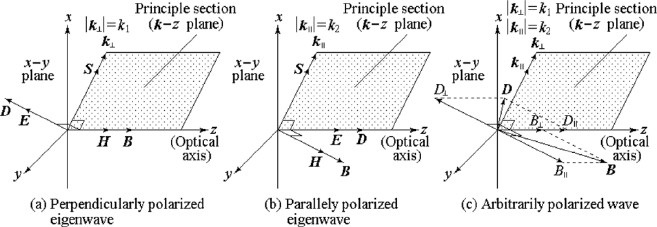
Figure 8.9: Plane waves in uniaxial crystals propagating in the direction
perpendicular to the optical axis.
The angular wave number of the two eigenwaves are different. As a conse-
quence, the two eigenwaves have to have different phase velocities and differ-
ent effective indices.
When γ = π/ 2, κ
ξξ
= κ
3
and κ
ξζ
= κ
ζξ
= 0, We see from (8.149) and
(8.154) that for a perpendicularly polarized eigenwave
E
η
= κ
1
D
η
,
and for a parallel polarized eigenwave
E
ξ
= κ
ξξ
D
ξ
= κ
3
D
ξ
,
where D
ξ
= D
z
and E
ξ
= E
z
.
So that for each eigenwave,
D kE, B kH, S kk
⊥
and both of them are o-waves. See Fig. 8.9(a), (b).
We see that, for the waves propagating in the direction perpendicular
to the optical axis, there are two mutually perpendicular linearly polarized
ordinary eigenwaves with different wave numbers.
If vector D is arbitrary polarized perpendicular to the wave vector, it
can be decomposed into two linearly polarized components, D
⊥
=
ˆ
ηD
η
and
D
k
=
ˆ
ξD
ξ
.
D = D
⊥
+D
k
=
ˆ
ηD
η
+
ˆ
ξD
ξ
, E = E
⊥
+E
k
=
ˆ
ηκ
1
D
η
+
ˆ
ξκ
3
D
ξ
. (8.156)
Hence E is not parallel to D, but both of them lie in the plane normal to k,
i.e., DB plane. So that
D 6kE, D ⊥ k, E ⊥ k, and S kk.