
Foster L.V. A Brief History of Mexico
Подождите немного. Документ загружается.

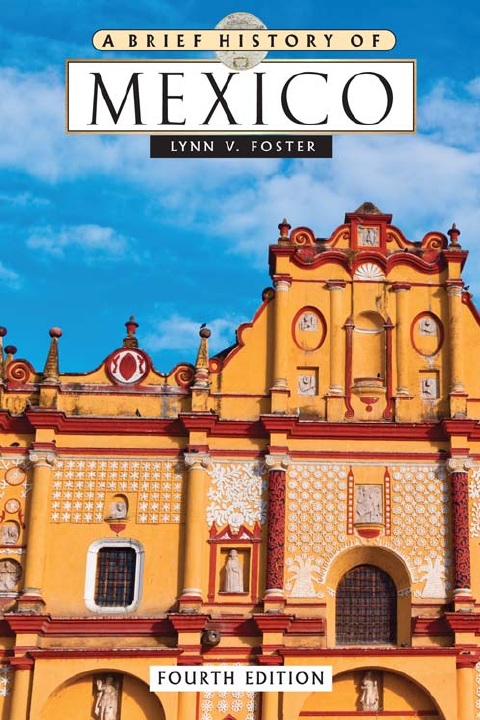

A Brief History
of Mexico
fourtH edition
Lynn V. foster

A Brief History of Mexico, Fourth Edition
Copyright © 2010, 2007, 2004, 1997 by Lynn V. Foster
All rights reserved. No part of this book may be reproduced or utilized in any form
or by any means, electronic or mechanical, including photocopying, recording, or by
any information storage or retrieval systems, without permission in writing from the
publisher. For information contact:
Facts On File
An imprint of Infobase Publishing
132 West 31st Street
New York NY 10001
Library of Congress Cataloging-in-Publication Data
Foster, Lynn V.
A brief history of Mexico / Lynn V. Foster. — 4th ed.
p. cm.
Includes bibliographical references and index.
ISBN 978-0-8160-7405-1
1. Mexico—History. I. Title.
F1226.F67 2009
972—dc22 2009018298
Facts On File books are available at special discounts when purchased in bulk
quantities for businesses, associations, institutions, or sales promotions. Please
call our Special Sales Department in New York at (212) 967-8800 or (800) 322-8755.
You can find Facts On File on the World Wide Web at http://www.factsonfile.com
Cover design by Semadar Megged/Alicia Post
Graphs by Dale Williams
Printed in the United States of America
MP
Hermitage
10 9 8 7 6 5 4 3 2 1
This book is printed on acid-free paper.
To Lawrence Foster,
husband and best friend

Contents
List of Illustrations iv
List of Maps v
List of Tables vi
Acknowledgments vii
Introduction ix
1 The First Peoples: Pre-Columbian Mexico 1
2 Diversity of Mesoamerican Civilization 23
3 The Age of Conquest 45
4 The Founding of an Empire: Sixteenth-Century Mexico 61
5 The Colony of New Spain 81
6 The Bourbon Reforms and Independence (1700–1821) 101
7 Years of Chaos (1823–1876) 117
8 The Porfiriato Dictatorship (1876–1910) 143
9 The Revolution of 1910 (1910–1940) 161
10 The Institutionalized Revolution (1940–1988) 193
11 The March toward Democracy (1988–2000) 223
12 A More Democratic Mexico (2000–2009) 241
Appendixes
1 Basic Facts about Mexico 273
2 Chronology 277
3 Bibliography 285
4 Suggested Reading 291
Index 311

List of illustrations
Diego Rivera’s Mexico before the Conquest 3
Dresden Codex, a
Maya book 12
A Maya scribe 12
Maya sculpture of ballplayers 16
The Great Ball Court, Chichén Itzá 17
Enthroned death god 18
Aztec stone skull rack 21
The Great Goddess, Teotihuacán 25
Olmec stone portrait head 27
Pyramid of the Moon, Teotihuacán 30
Palace, Palenque 34
Palace Tablet, Palenque 35
Monument 122, Toniná 35
Warrior column, Tula 39
Aztec stone sculpture of a jaguar 40
Mixtec gold pendant, Zaachila 42
Hernán Cortés 51
Hernán Cortés as portrayed in Diego Rivera mural 51
Marina (Malinche) as portrayed in D. H. Xochitiotzin mural 53
Aztec Great Temple complex, Mexico City 59
Church of Cuilapán, Oaxaca 67
Diego de Landa 69
Contemporary Lacandón Maya Indian 72
Mixtec ruler 8 Deer, Codex Nuttall 76
Mixtec cacique Don Gabriel, Codex of Yanhuitlán 77
Colonial Mexico
City 82
Colonial building, Pátzcuaro, Michoacán 85
Church in San Juan Chamula, Chiapas 86
Old Basilica of the Virgin of Guadalupe, Mexico City 96
Sor Juana Inés de la Cruz 98
Churrigueresque church facade, Tepotzotlán 105
Miguel Hidalgo as portrayed in José Clemente Orozco mural 111
Antonio López de Santa Anna 121
Benito Juárez 133
iv

José María Velasco’s painting Citlaltépetl 146
Porfirio Díaz and the Científicos by
David Alfaro Siqueiros 150
José Guadalupe Posada’s La catrina 152
Emiliano Zapata
as portrayed in Diego Rivera mural 166
Yaqui Indian soldadera 168
José Clemente Orozco’s mural The Trench 173
Frida
Kahlo
self-portrait 189
Library at the National Autonomous University of Mexico 200
Aztec temple in Mexico City subway station 205
Rufino Tamayo’s mural Man Facing Infinity 218
Opossum family
, wood carving 219
Mexico City skyscraper 229
Mexico City street vendor 229
“Your vote is free and secret” 233
Trash can with effigy of Carlos Salinas de Gortari 237
Vicente Fox Quesada campaigning 242
The Zapatista march to the capital 246
Anti-NAFTA graffito 248
Migrantes 2007 251
Federal Preventive Police in Oaxaca 253
Encampment of López Obrador supporters 257
List of Maps
Mexico 7
Mesoamerica 8
New Spain in the 16th Century 62
Settlement in 17th-Century New Spain 84
Eighteenth-Century Frontier of New Spain 103
Central Mexico and Towns of Independence 113
The 1824 Republic 120
Territory Lost to the United States 126
Rail Lines 148
States and Capitals of Modern Mexico 194
Two Mexicos 256
v

vi
List of Tables
Chronology of Ancient Mexico 24
Depopulation 74
Comparative Chart of Spanish Populations 88
Racial Composition of New Spain, 1810 93
Revenues from New Spain, 1786–1789 104
Import and Export Growth during the Porfiriato 147
Commodity Production, 1910–1920 176
Land Distribution by Administration, 1915–1940 184
Infant Mortality and Average Life Expectancy 190
Agricultural and Industrial Production 197
Urbanization: Percentage of Population in Cities 203
Presidential Election Results in 1970, by Party 207
Maize Cultivation and Population Increases 209
Cities over 500,000 in 1980 210
Oil Production, 1976–1980 212
Presidential Election Results in 1988, by Party 225
1997 Midterm Elections, by Party 233
Wages and Inflation 236
Social and Human Development 239
Presidential Election Results in 2000, by Party 244
Domestic Maize Cultivation v. Imports 249
2006 Congressional Elections, by Party 259
Military Expenditures 260
Exports 262
Economic Indicators 2001–2008 264
Inflation and Wages 265
PRI Domination at the State Level 2006 270
vi

vii
ACKNOWLEDGMENTS
T
he illustrations in this book result from the generous assistance of
many individuals and organizations, acknowledged next to their
corresponding photographs. The majority of photographs, however, are
the works of personal friends who requested no such recognition, fore-
most among them Donnelly Marks, whose contributions to the book
are immeasurable. The new illustrations in the revised editions result
from the persistent efforts of Manuel Ramirez and the generosity and
talents of Erik Boot, Michele Gibbs, Diana Ricci, Barry Scheinberg, and
Cherra Wyllie.
Two editors deserve special thanks: Randy Ladenheim Gil, who
encouraged me to write the book, and Claudia Schaab, who guided the
updated editions into print.

Introduction
“Whatever else Mexico may be, she is never dull.”
Lesley Byrd Simpson (1962)
O
nly five years have passed since the first revised edition of A
Brief History of Mexico was published; however, these few years
have been filled with surprisingly numerous twists and dramatic turns
of events, as Mexico attempts to forge a new political and economic
order. In 2004 it was believed the reforms sweeping over Mexico after
the 2000 presidential election would bring a new era of democracy and
prosperity. With the 70-year-old Partido Revolucinario Institucional
([PRI] Institutional Revolutionary Party) dictatorship removed, cor-
ruption would decrease too, and there would be a “bonus” to help the
nation eliminate poverty. A more open society would see the end of
privileged elites controlling the nation’s resources, and free-trade agree-
ments would modernize the economy.
The optimism wavered during the 2006 presidential election when
two major candidates, neither from the PRI, represented opposite
poles of the political spectrum, giving the voters a real choice and
demonstrating what was best about the new democracy. Many were
convinced, however, that the election, decided by the slimmest fraction
of votes, was fraudulent, leading to two months of protests and delays
before Felipe Calderón Hinojosa of the conservative Partido de Acción
([PAN] National Action Party) was officially declared the winner. The
election crisis was resolved peacefully, but it also left a legacy of politi-
cal polarization and doubt. The new president tried to unite the nation
through a declaration of war against the cartels transshipping drugs
through Mexico into the United States. The war, conducted with U.S.
aid, seems to be failing, as it unleashes levels of violence that have
undermined national morale and worried many across the border in
the United States. Now, in 2009, a more collaborative solution is being
implemented, encouraged by U.S. president Barack Obama and the
Mexican government.
ix