
Foster L.V. A Brief History of Mexico
Подождите немного. Документ загружается.


A BRIEF HISTORY OF MEXICO
78
The new king Philip II reigned in these more severe times (from
1556 to 1598). Philip was more interested in the economy of New
Spain than in the treatment of the native population. He was more sen-
sitive to the jealousy of the settlers when Nahua nobles outdid them in
schools than in attempts to enable the Indians to become fully realized
vassals of Spain. The university was disbanded. Sympathetic to the
colonists and their need for labor, Philip permitted the secular clergy,
less educated and totally dependent on settlers’ tithes, to take over
from the meddlesome mendicant orders. The well-being of the native
population became secondary to the need for a productive economy to
sustain the Spanish empire.
Spain Flourishes
As the first century of European involvement in the New World came to
a close, the potential wealth of the colony had already become apparent
to all. Silver bullion weighted down the Spanish galleons—enough to
pay for the entire cost of administering all the American colonies, with
plenty left over for Spain. The China trade was established in 1564:
silks and spices and porcelains from the Philippines arrived across
the Pacific to Acapulco, and then, after being carried across Mexico to
Veracruz, accompanied the silver in its transatlantic voyage. The gal-
leons carried much of Europe’s wealth. And Spain owned it all.
Piracy occasionally helped England and France to get their share of
American bounty. Sir Francis Drake, for example, looted Spanish ships
from the Pacific to the Caribbean with the full sanction of England.
European powers also tried to colonize other parts of the Americas:
for example, French Huguenots tried, but failed, to settle Florida.
Wishing to protect his very lucrative domains, Philip looked for a port
in California, sent colonizers to New Mexico, and Juan Ponce de Léon
to Florida. He strived not only to secure the passage of his galleons but
to guarantee the continued flow of New World tribute and exports.
New Spain Established
Before the end of the 16th century, a massive change had occurred:
an indigenous civilization had been brought under the control of a
European monarch. The wealth of a population of millions had been
transferred to a few conquerors through encomienda and tribute; there
was not a single aspect of the pre-Columbian culture that had not been
transformed in the process: Indian writing had changed from pictographs

79
to the Roman alphabet; ritual sacrifice had been eradicated, ribbons had
replaced feathers in religious costumes, and once proud Mesoamericans
who had believed their cities were the sacred centers of the universe,
had been taught that the true center was far away in a foreign land. The
very names of people and places had been changed: the sacred city of
Teotihuacán was now San Juan Teotihuacán.
Until recently historians thought the viceregal and ecclesiastic con-
trol of native society obliterated preconquest institutions. Yet archival
studies by historians such as Charles Gibson and James Lockhart have
demonstrated that Spain’s success lay in manipulating the native insti-
tutions to serve its own purposes. Replacing the imperial rulers of the
Aztecs, the viceregal government achieved only an overlay of author-
ity; under it and supporting it through trade and markets, farming and
artisanship, tax collection and tribute, was a “Republic of Indians.”
Even the security of New Spain depended on the peacekeeping efforts
and garrisons of native allies. In many regions, Spaniards relied on the
old Mesoamerican political and social order, with Indian elites acting as
intermediaries between their people and the foreign officials.
In less than 100 years after the conquest, viceregal government was
fully developed, and the Catholic Church had sent its missionaries into
most, if not all, recesses of the country. Spain’s new government branch,
the Council of the Indies, promulgated regulations to New Spain that
affected everything from the location of a town church to the kind of
crops that could be grown. But the forms of government and religion
succeeded only because they took on a distinctly pre-Hispanic cast:
Mexican in nature, the New World’s institutions were as composite as
its people were increasingly racially mixed.
The 16th century witnessed the formation of a new people and new
institutions: a characteristic Mexican fusion. The bureaucracy of New
Spain was in place and, as the century closed, Spain managed to remain
the sole European power in this New World.
THE FOUNDING OF AN EMPIRE: SIXTEENTH-CENTURY MEXICO

81
5
The Colony of New Spain
Without the Indies or its trade, Spain would fall from its great-
ness, because there would be no silver for your majesty, for the
ministers, for private individuals, for those holding . . . inheri-
tances, which all comes from the Indies . . .
Marqués de Varina, 1687 (translated by Stein & Stein)
T
here were two Spanish perspectives in regard to New Spain. Those
living in Europe thought the colony should be exploited to enrich
the home country; and those living in the colony viewed the land as an
opportunity to make money, enough to either recreate a genteel Spanish
lifestyle in the Americas or to return across the Atlantic rich enough to
enjoy the real thing. People of either view saw Mexico as a pot of gold
to be melted and molded into their own treasure.
During three centuries of Spanish domination, the land was trans-
formed by new crops and technologies and trade, new cities and
ports, European art forms and crafts. Policies changed according
to the fashions in Spain, as did the arts and cities and continuously
evolving population. But Spain remained firmly in control of Mexico’s
economic and religious institutions. Its legacy has endured beyond
the colonial centuries, leaving a poorly developed economy, a class
structure based primarily on racism, and a too-common belief among
officials that the governance of Mexico is an opportunity to enhance
personal wealth.
The Capital
Spain’s presence was concentrated in the colonial capital. Even before
the pilgrims landed at Plymouth Rock, the avenues of Mexico City were
broad, parks and plazas were graced by fountains, and stately mansions
A BRIEF HISTORY OF MEXICO
82
were built of stone. Churches were numerous and imposing; the cathe-
dral, magnificent. As one contemporary visitor said, “Besides these
beautiful buildings, the inward riches belonging to the altars are infinite
in price and value” (Gage 1981, 71). There were six hospitals (four for
Europeans, one for Indians, and one for mestizos), even though sur-
geons were in fact no more than barbers and native curers were just as
likely to be relied upon with no known disastrous effects. There were
orphanage-schools for abandoned mestizos, Jesuit and Augustinian col-
leges, and the first university in the Americas, the University of Mexico,
was founded in 1551—although centuries passed before a second one
opened in Guadalajara. The city was abundantly provisioned, with
foodstuffs from the surrounding countryside easily purchased at the
huge outdoor market. Textiles and crafts came from New Spain; ivories
and silks from the China trade, wine and olive oil as well as artists and
paintings arrived from Spain.
Although the poor lived in squalor on the edges of the new city, it is
no wonder that people of privilege found the city the only proper place
to reside. The viceroy and his retinue resided here, creating an elegant
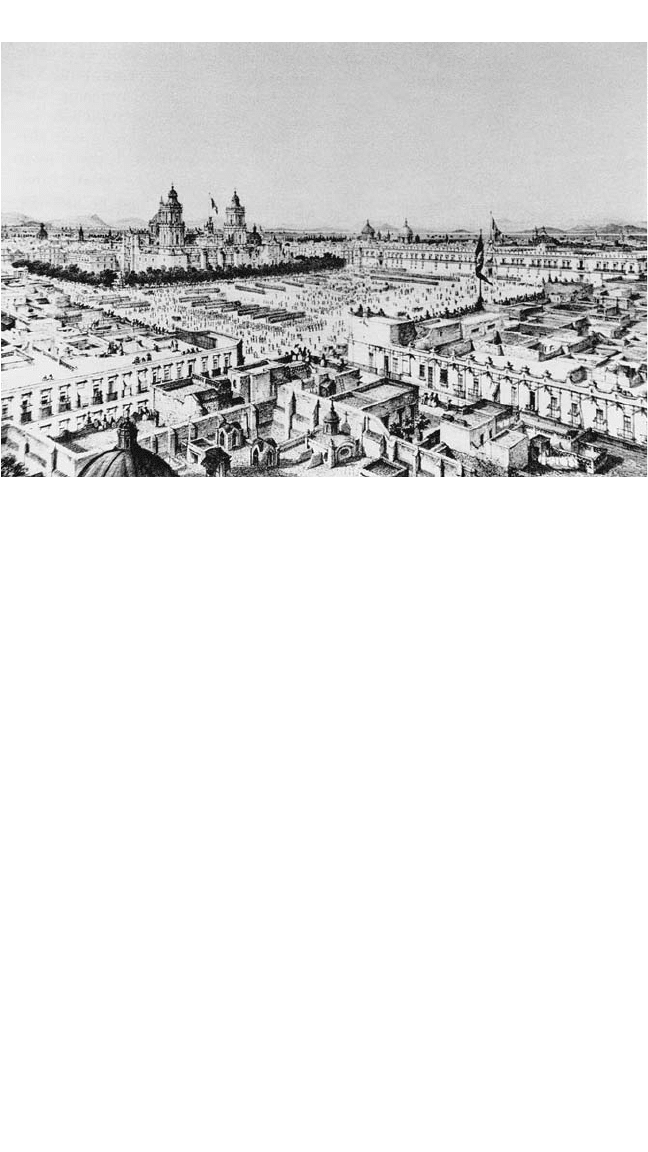
The heart of colonial Mexico City, with its cathedral, viceregal palace, and other administra-
tive buildings, all constructed over the center of the Aztec capital
(Courtesy of the Bancroft
Library)

83
court as the focus for European society. Here, too, resided the judges of
the Audiencia who kept a watchful eye on the viceroy for the king. The
seat of the other powerful authority in the Americas, the archbishop,
was also in the capital along with an inordinate number of ordained
priests. (Twenty-five percent, or 1,500, of the priests, both secular and
mendicant, lived in Mexico City and another 1,400 lived in nearby
Puebla, meaning that about half the priesthood of New Spain lived in
central Mexico in 1650.) The capital and its environs were home to half
the entire European population of the colony “who are so proud and
rich that half the city was judged to keep coaches” (Gage 1981, 67).
By the end of the colonial period, the city had as many racially mixed
residents as Indians.
The capital reflected most of the wealth, power, and Spanish cul-
ture of New Spain. In 1800, with a population of 137,000—half that
estimated for Tenochtitlán—it was the largest city in the Western
Hemisphere and a symbol of European culture in the New World. The
legendary city of Moctezuma had disappeared.
Environmental Change
The city floats in emerald circles,
Radiating splendor like quetzal plumes.
Around it chiefs are carried in canoes,
Veiled by a flowery mist.
Aztec poem (Garibay 1953)
M
exico City was not an island for long. The series of lakes sur-
rounding Tenochtitlán were drained over the centuries. Roads
replaced the dikes; wheeled carts and mule packs, the canoes. Gone were
the waterbirds and fish that thrived in Lake Texcoco, gone the fresh-
water and chinampa agriculture that sustained the populace. Remaking
Mexico City in the image of Spain, the Spaniards wreaked havoc on the
environment. Initially, without the dikes, the city was repeatedly flooded
in the 17th century. As the water levels fell, the central valley became
increasingly infertile. Recently the northern traces of the lake wetlands,
a wildlife refuge, were slated for airport construction.
THE COLONY OF NEW SPAIN
A BRIEF HISTORY OF MEXICO
84
Regional Diversity
Neither God nor his Majesty would have been served by the
people of the provinces, as they are disorganized and have no
head, and the land is sterile and has no products, nor has it
silver or gold whereby his Majesty could be served.
García López de Cárdenas, 1551
Outside the capital, the impact of Spain and its settlers varied with the
region. Viceregal control was as uneven as the distribution of settlements.
Provincial administrators, called corregidores, existed in Spanish towns,
such as Mérida in Yucatán; the corregidores were poorly paid and had lim-
ited authority, but they were notorious for finding ways to supplement
their salaries. They oversaw and reported to the viceroy on the happen-
ings in the municipality as well as in Indian settlements. These towns
also had a local government separate from the royal corregidor. In the best
of times local government officials were elected; when the Crown needed
money, however, officials could buy their positions knowing that prestige
and profiteering would amply reward their investment.

85
Although such provincial towns were few and far between, all were
organized according to royal decree: a main plaza dominated with the
symbols of authority, the church and royal palace and town hall, and
streets laid out perpendicular to the plaza in an orderly fashion. The 10
most important cities, such as Puebla, Oaxaca, and Guadalajara, were
large enough to have cathedrals and grand palaces. Puebla eventually
had a population of 100,000. The location of a town, the building of
a church, and even the founding of a school were all regulated by the
Crown through the Council of the Indies located in Seville, Spain.
Although viceroys often ignored orders, claiming local conditions
did not permit their implementation— “The law is respected but not
obeyed” was the official response—the impact of royal edicts on the
New World is unmistakable in the architecture of both provincial vil-
lages and regional capitals. More than 6,000 decrees governing life in
the colonies were issued.
Hacendados often represented the only Spanish presence in many
rural areas; and the mendicant fathers, though diminishing in num-
ber, continued to create missions in the hinterlands of the empire and
to administer many of the 400 fortress monasteries they had built
among their converts. Well into the 17th century, there were not
enough parish priests to replace them, much less tend to the spiritual
Colonial building in the provincial town of Pátzcuaro, Michoacán (Courtesy of the Mexico
Ministry of Tourism)
THE COLONY OF NEW SPAIN
A BRIEF HISTORY OF MEXICO
86
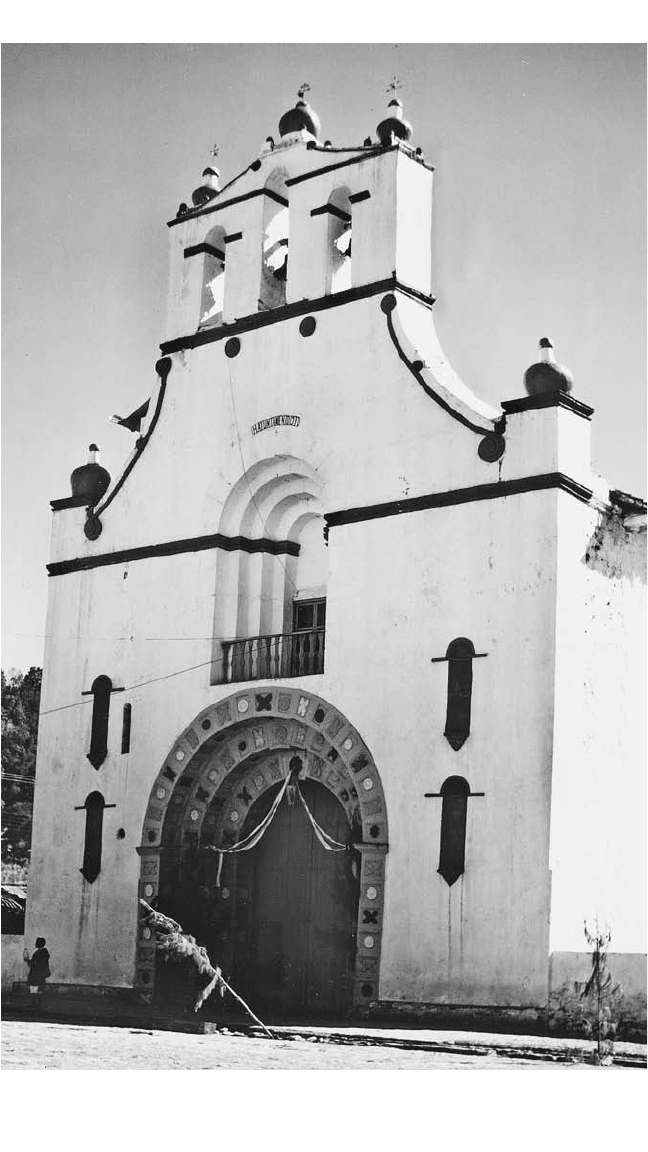
Provincial church in the Maya village of San Juan Chamula, Chiapas

87
needs of the expanding colony. Given the thin layer of Spanish and
church officialdom, an administrative system of caciques (native gov-
ernors) was, of necessity, created to oversee the indigenous peoples
and fulfill Spanish tribute and tax levies. The cacique system paral-
leled the town organization and reinforced the existence of traditional
Indian communities.
The intensity and quality of viceregal control in a given area
depended, at the very least, on the ratio of the density of Spanish set-
tlers to the native populace. The Spaniards preferred to settle near large
populations of Indians who could support them. But they also preferred
the regions that could most easily re-create life in Spain. The central
highlands, with their temperate climate suitable for Old World crops
and livestock, were ideal. Here Spaniards settled in the greatest num-
bers, and most intensely affected the lives of the indigenous peoples as
well as the land.
The tropical lowlands were too hot for the Spaniards, however, the
vegetation unfamiliar, and the malaria too threatening. Sugarcane haci-
endas were quite productive once Spain permitted the use of African
slaves to work them. On the whole, the tropics were so unappealing
that merchants didn’t want to live in the ports of Veracruz or Acapulco;
they simply set up tents on the beaches to await the arrival of the
annual Spanish or Manila galleons. The Yucatán was hot, too, but
unlike Veracruz, it had more than enough Maya Indians for labor. But
it had no silver mines or good soil for growing wheat, so the Spaniards
settled it only sparsely, leaving most of the land to traditional Indian
cornfields. Here Mayas with the desire to live independently could find
refuge. English pirates, too, found good hiding places along the isolated
Caribbean coast.
The discovery of silver and gold could make any region attractive.
The thinly populated northern regions would suddenly burst with
activity when a strike was made. Not only did golddiggers race to the
frontier, but hacendados created ranches to supply them. After its great
silver strikes, Zacatecas became the third-largest city in New Spain early
in the 17th century; only the capital and Puebla were larger. It would
be joined by other silver cities, Guanajuato, Taxco, and San Luis Potosí
among them, changing what had been considered by the Aztecs to be
barbarian deserts into wealthy enclaves.
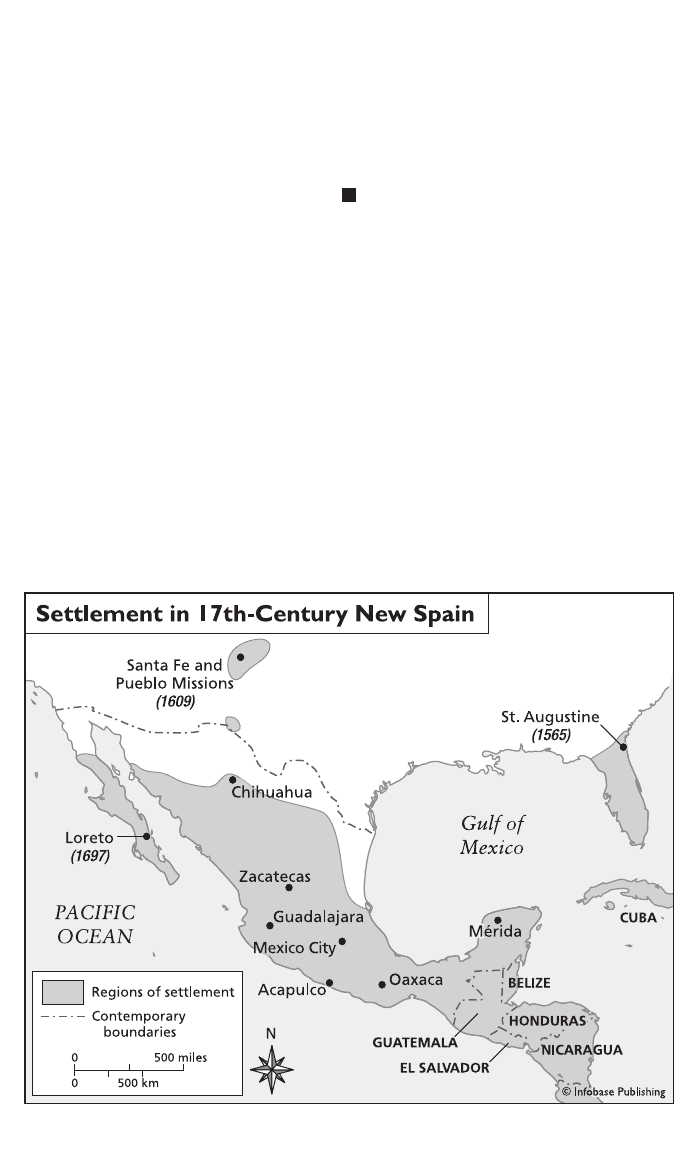
The viceroyalty of New Spain administered a vast territory that
ranged from Panama to California and included some Caribbean islands
as well as the Philippines. A few regions, such as the Philippines, were
independently administered by audiencias. Some regions never were
THE COLONY OF NEW SPAIN