
Foster L.V. A Brief History of Mexico
Подождите немного. Документ загружается.

A BRIEF HISTORY OF MEXICO
98
them from tribute when they participated) and teaching them to make
European instruments. The Indians not only made the instruments and
performed, they also composed church music and recorded it on choir-
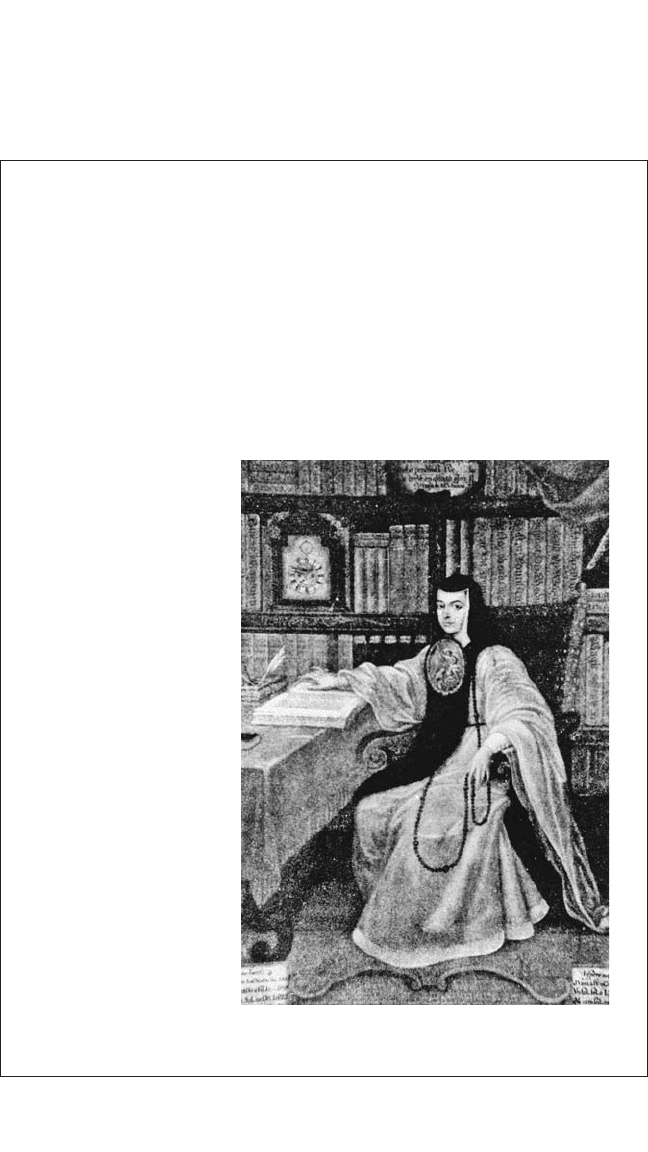
Sor Juana InÉs de la Cruz
B
orn in Mexico and of illegitimate birth, Sor Juana was the first
great poet of the postconquest Americas and one of the most
esteemed baroque poets in the world, as well as an early champion
of women’s rights. Her beauty and genius for learning made her a
favorite of the viceregal court, but instead of marrying she joined
a nunnery—the only institution in that era in which women could
devote themselves to intellectual pursuits: “for it seemed to me no
cause for a head to be adorned with hair and naked of learning,” wrote
Sor Juana in “La Re-
spuesta” (translated
by Margaret Sayera
Peden, 30).
In an age when
most girls were taught
needlepoint and lady-
like deportment, Sor
Juana composed all
kinds of poetry (in-
cluding some in Na-
huatl and others in
the language of nearby
African slaves), wrote
plays (one based on
Greek and Aztec my-
thologies), and essays
(in one, “La Respu-
esta,” she defended
the right of women to
education and cul-
ture). Today she is an
icon of Mexican cul-
ture and an inspira-
tion to contemporary
writers.
Portrait of Sor Juana Inés de la Cruz painted by
Miguel Cabrera in 1750

99
sheets. Later in the colonial period, Creoles composed chamber music
and operas (Manuel Zumaya’s La Partenope, performed in 1711, was the
first). Every element of society enjoyed more popular music, from the
African marimba and Spanish-introduced fandangos and guitar ballads
to Indian festival dances and flute-and-drum music. Wrote Thomas
Gage in 1648, “I dare be bold enough to say the people are drawn to
their churches more for the delight of the music than for any delight in
the service of God.”
The Spanish Legacy
By 1700 New Spain had been transformed from the land of the Aztec
and Maya to that of an exotic European colony. Cochineal dye was
produced near fields of grazing sheep, wheat spread through the
central highlands, and cornfields were everywhere. The people, too,
were increasingly mixed: Africans with Indians and Europeans along
the coasts; Europeans and Indians in every town. Indian myths and
language infused the poetry of even the highest classes. The wheeled
cart slowly replaced human carriers and canoes; the burro took the
burden off native carriers. The Catholic domain was, nonetheless, a
cultural patchwork: at its most rural recesses, indigenous traditions
remained unassimilated, contrasting with the Spanish cattle ranches
and European cities. The Spanish caste system spread illiteracy, rac-
ism, and official corruption through the land, setting one group
against the others.
Although most indigenous peoples were reduced to illiteracy, the
Yucatec Maya scribes continued their pre-Columbian tradition of
recording the events of their people in books of the katuns. The books,
written in Yucatec but no longer in hieroglyphs, were kept secret from
the Spanish world throughout the colonial period. Sometimes the
words are unforgettable reminders of the changed world of the indig-
enous peoples of Mexico:
Then the Indians had no sickness; they had no aching bones;
they had no burning chest. They had no abdominal pain; they
had no consumption; they had no headache. At that time,
the course of humanity was orderly. The foreigners made it
otherwise.
Book of the Chilam Balam of Chumayel, 17th century
(translated by Ralph Roys)
THE COLONY OF NEW SPAIN

101
6
The Bourbon Reforms
and Independence
(1700–1821)
The condition as conquerors of a conquered land, makes them
[the Spaniards] the first inhabitants, the preferred and the
privileged of all America; and woe to us, woe to the peninsula,
and woe to the Indies the day we lose our ascendancy, source
and sole shield of obedience and subordination.
Merchants Guild of Mexico to the Spanish Cortes, 1811
(translated by Stein & Stein)
T
he Enlightenment brought changes to New Spain in the last cen-
tury of colonial rule. A new faith in science and reason led the
Bourbon monarchy to modernize the administration of the colonies
and to squeeze out yet more profits for Spain. As the century progressed
to embrace both the American and French revolutions, increasingly
radical ideas filtered into New Spain—ideas about social equality and
self-governance. After a long and destructive battle for independence,
the Spanish colony would become the free country of Mexico.
The Last of the Spanish Hapsburgs
In 1700, the Hapsburg control of Spain’s monarchy ended. Given the
devastated condition of the empire, the end should have come sooner.
Too many battles—and too many defeats—had bankrupted the country
and resulted in the loss of considerable European territory. The former
war machine had become so pitiful that soldiers ran from battle. The
nation chosen by God to rule the New World, suffered English, French,
and Dutch colonies on American soil.

A BRIEF HISTORY OF MEXICO
102
For all its monopolies and protectionism, Spain was broke. Its pref-
erence for precious metals had led the empire to ignore its industrial
development—a plentiful silver supply had made it too easy to pur-
chase manufactured products from the rest of Europe. War, not invest-
ment in the nation’s economic infrastructure, drained the treasury and
forced Spain to borrow. In the end, two-thirds of its silver bullion went
to pay off debts in foreign European banks. Spain had become a third-
rate economic power.
In an enlightened age, Spain was intellectually stifled by the Holy
Office of the Inquisition. In time of tolerance and scientific understand-
ing, it was ruled by feeble-minded Charles II (1665–1700), called “The
Bewitched.” With his death in 1700, the Spanish Hapsburgs, too, came
to their grueling end.
Bourbon Reforms
Although most courts in Europe could make some claim as to their
right to rule Spain, it was the French dynasty of the Bourbons that
maneuvered Philip V (1701–46) onto the throne and successfully kept
him there through the War of the Spanish Succession (1701–13).
Can Ek, 1697
A
Maya dynasty, said to descend from the ruler of the great Yucatec
city of Chichén Itzá, ended around the same time as the Spanish
Hapsburgs. The Itzá, having fled to the remote Petén jungle, reestablished
themselves on the islands of Lake Petén Itzá, now in Guatemala. Their
numbers swelled to 25,000 with Maya refugees from Spanish rule. These
Maya painted their bodies red and black and tattooed their faces—all
forbidden by the early friars. They built stone temples and colonnaded
palaces, they worshiped the old gods, followed rituals dictated by their
hieroglyphic books, and lived under the rule of the Can Ek dynasty
that demanded, and received, tribute from Maya in Spanish-controlled
areas of the Yucatán peninsula. After 200 years in the New World, the
Spaniards finally forged a trade route through the region. They captured
the last Can Ek and destroyed the Itzá kingdom of Tayasal—their guns
being as effective against feather-decorated spears as they were under
Cortés. The last Mesoamerican ruler became a symbol of resistance, his
name taken by future Maya rebels.
103
To make their trading empire more efficient, the Bourbons streamlined
the viceregal administration of New Spain, replacing 200 provincial cor-
regidores and local mayors with 12 regional intendentes. The intendentes
were well paid and experienced administrators—quite able to collect the
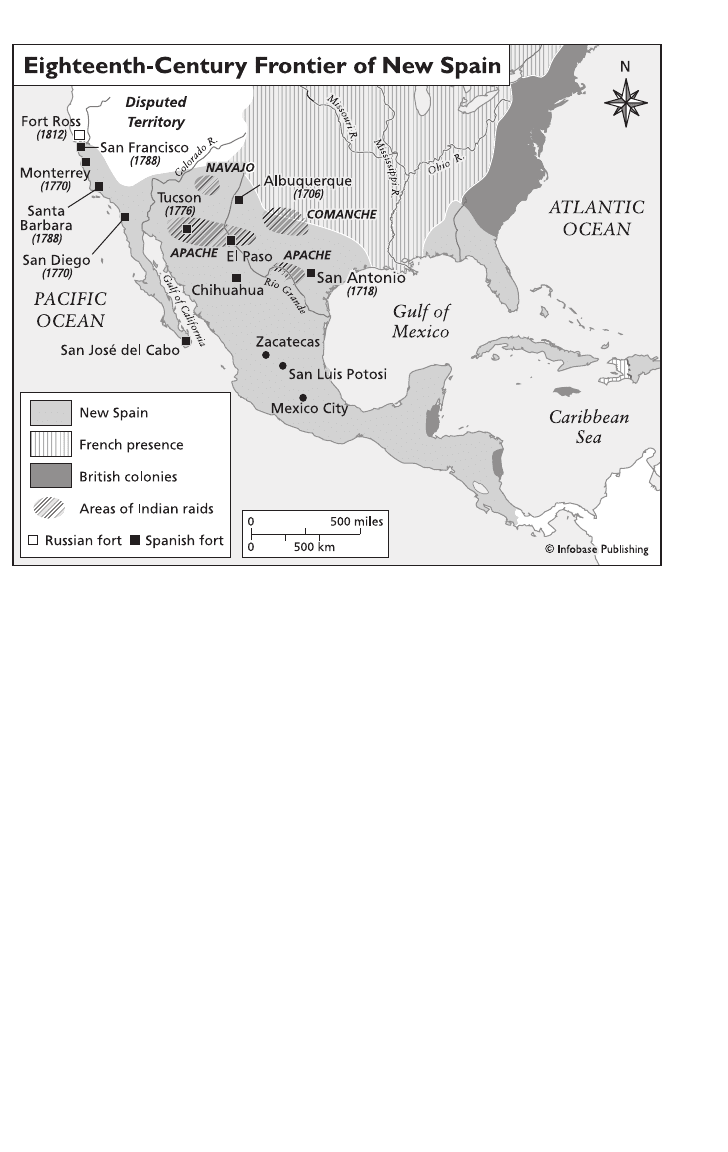
taxes and tribute owed to the Crown. In an effort to preserve the fron-
tier areas of New Spain against additional foreign encroachment—the
Russians had ships in California waters; the French were in Louisiana—
the Crown developed the first professional army of New Spain and estab-
lished a colony in San Francisco and missions in Texas. To increase the
volume of trade, it broke up old monopolies, permitting more ports to
compete with Veracruz and Acapulco (such as Campeche and Progreso
in Yucatán) and allowing direct trade among the various New World
Spanish ports. The number of Manila galleons increased by two annually.
Also some taxes were lowered to encourage silver mining.
Such modernization had its greatest impact under Charles III
(1759–88). Silver production, assisted by new technology as well as
royal incentives, rose from 3.2 million pesos in 1700 to 27 million
pesos in 1804. Gold production tripled. Cochineal production also
increased, becoming the second most valuable export and employing
30,000 Mixtecs. Agricultural products, especially sugarcane, increased
THE BOURBON REFORMS AND INDEPENDENCE

A BRIEF HISTORY OF MEXICO
104
in export value. And royal monopolies on domestic production of
tobacco and pulque, the native alcoholic drink, further increased rev-
enues. Tobacco revenues alone were greater than those from mining;
those from pulque equaled all Indian tribute. At Veracruz, the more
liberal trading policies attracted up to 500 ships in one year.
The reforms worked for Spain because the Bourbons sent able viceroys
to Mexico. The rule of Antonio María de Bucareli (1771–79) was marked
by peace and exceptional prosperity. Another great viceroy, the count of
Revillagigedo (1789–94), created the first public transportation system
and lowered the crime rate in the capital by lighting the streets.
The Impact on New Spain
Spain’s concern was always Spain. . . .
Charles C. Cumberland (1968, 95)
The world’s trade flourishes at the expense of the peoples of
America and their immense labors, but the riches they draw
from the bosom of the fertile earth are not retained.
Memoir to viceroy of Mexico, 1723
(translated by Stein & Stein)
Revenues from New Spain, 1786–1789
Peso Value
Tobacco 16,000,000
Sales tax (includes silver) 15,500,000
Royal grant: silver and gold 9,000,000
Coinage 6,000,000
Pulque 3,500,000
Indian tribute 3,500,000
Customs duty 3,000,000
Source: José Miranda, et al., Historia de México (1971, 263) as presented in Meyer &
Sherman (1983)
105
The reforms made Mexico the most prosperous of all Spain’s colonies.
And they made Spain wealthy. But they also had adverse repercussions
in the colony. Many of the reforms benefited peninsulares and, indeed,
increased emigration from Spain. This class of aristocrats expanded,
at the expense of the Creoles. The regional administrators were all
from Spain, save one, and, worse, they replaced creole local officials.
The pulque and tobacco monopolies increased prices on locally con-
sumed products and displaced those who had haciendas producing
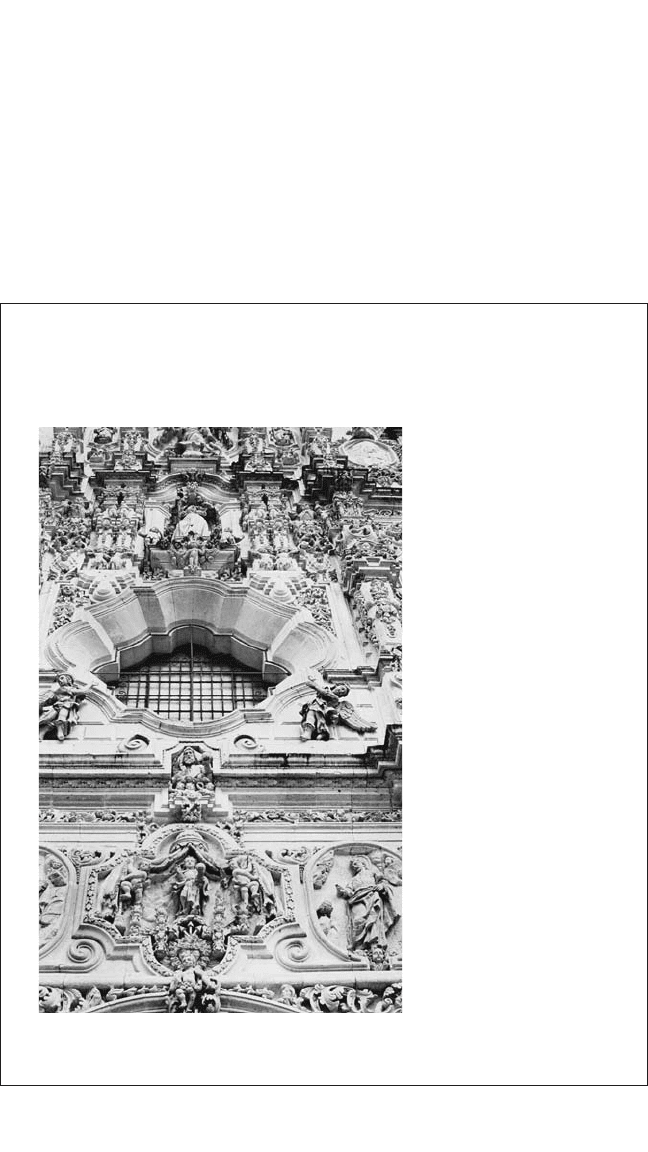
Churrigueresque
Architecture
T
he Mexican ba-
roque style of
the 18th century is the
great cultural legacy of
rich Creoles. The silver
barons could afford to
fund the construction
of entire churches, and
one, José de la Borda of
Taxco, offered to pave
the road from Veracruz
to the capital in silver
coins if the pope would
agree to visit. The cities
they graced with their
mansions, gold altar-
pieces, and churches
are part of-Mexico’s
artistic heritage. Histo-
rically preserved and
protected, the cities—
among them Guanaju-
ato, Querétaro, Puebla,
and Zacatecas —today
attract considerable
tourism.
Churrigueresque church facade in Tepotzotlán
THE BOURBON REFORMS AND INDEPENDENCE

A BRIEF HISTORY OF MEXICO
106
them. The demand for productivity created more hardships for those
who labored, and Indian tribute to the Crown was more vigorously
collected.
In 1810 New Spain produced 75 percent of the profits from all of
Spain’s colonies. Yet Spain reinvested little of the monies, the bulk
of which went to Europe or toward the administrative costs of other
colonies. The end result was an economy as undeveloped as that of
backward Spain. There were few manufactured goods. The roads that
existed were better for pack animals than coaches—and there were
too few of them. Many whites, living like the landed gentry of Europe,
owned vast tracts of land, but too often worked very few acres. The land
of vanilla and chocolate and cotton had to import these items because
their production was so neglected. The country was regulated to an
extreme: a ranchero needed a permit to slaughter his cattle for his own
dinner table. Cattle and sheep roamed everywhere, in countless num-
bers, yet there was not enough wool or fresh beef.
Not only did waste and overregulation and corruption still exist after
the Bourbon reforms, the racist class system remained undisturbed
despite the egalitarianism of the Enlightenment. While the economy
prospered in the Bourbon years, the wealth remained concentrated
among the white population. Yet more than 80 percent of New Spain
was nonwhite by the end of the century, and the squalor that most were
destined to suffer couldn’t have contrasted more sharply with the opu-
lence of the ruling class: In 1784 300,000 Mexicans died from either
famine or diseases related to malnourishment.
The Creoles
Despite problems with the economy, the Creoles were not rebellious.
They were conservative and supported the monarchy. And no won-
der—as dependent as the economy was on Spain, it made most Creoles
fabulously wealthy. Only the galling inequities in their treatment by the
Spanish festered.
Given their number in the colony, the peninsulares were dispropor-
tionately wealthy. Yet the Creoles did very well. Count Regla, a mining
baron and Creole, was the wealthiest man in 18th-century New Spain;
over 30 years, the net profit from his silver mine in Pachuca alone was
15 million dollars. Count Bassoco, like 50 other fabulously rich Creoles,
received his noble title after a generous contribution to the Crown—in
his case, a gift of 200,000 pesos. Count Valenciana, although not the
richest of the rich, earned 1 million pesos each year just from his

107
famous silver mine in Guanajuato. Merchants and ranchers made their
fortunes, too. In the north, hacendados had immense landholdings for
their herds. The Sánchez Navarro family estate—the largest in the New
World—was about the size of Portugal. The Creoles traveled and stud-
ied in Europe and took on the high styles of that continent. They built
ornate palaces for themselves at home and contributed to the building
of entire Churrigueresque churches.
Wealth didn’t entirely satisfy the New World aristocracy: resent-
ment of the privileges of the peninsulares intensified. Phenomenally
rich, many Creoles were like royalty themselves with their own min-
ing and ranching kingdoms. They increasingly took pride in their
Mexican heritage: their Spanish was peppered with Indian words,
their chicken with chile. And they called themselves “americanos.”
The condescension of the Spanish-born toward these provincials
rankled—especially when a peninsular originally came from the lower
classes, as many did.
By mid-century, the Holy Office of the Inquisition could no longer
keep out the pervasive ideas of the European Enlightenment—ideas
about human rights versus the divine rights of kings, about liberty
and social equality. Yet here the Creoles were treated like second-class
citizens in their own country; the highest church and government
positions were not open to them. A Creole village priest, for example,
could make as little as 100 pesos, in contrast to a peninsular bishop’s
100,000. The Bourbon reforms brought no new social and political
opportunities—even at a time in which the United States gained its
independence from Britain (1776) and the French Revolution (1789)
overthrew the Bourbons.
Political Ferment
The Creoles wanted more control over the future of New Spain, but few
had any interest in upsetting the society that had so amply rewarded
them. There were critiques of Spain—of the brutality of the conquest
and centuries of colonial enslavement; there were satires on the more
absurd aspects of Spanish rule. There were even foreign agitators, from
newly independent France and the United States, who tried to bestir
the Mexicans.
Only a few conspired for independence. Military officers, kept out
of the highest ranks, and small merchants and bureaucrats gathered
in “literary” societies that were fronts for their plots. Among the most
radical were some parish priests who, finding themselves in the poorest
THE BOURBON REFORMS AND INDEPENDENCE