
Foster L.V. A Brief History of Mexico
Подождите немного. Документ загружается.


A BRIEF HISTORY OF MEXICO
68
a solution especially amenable to religious practices of Mesoamericans
who had always gathered in large open-air plazas. Over time, open cha-
pels were replaced by enclosed churches and vast monastery complexes
such as the one at Cuilapán. Using Indian labor, the friars built 50 such
establishments by 1540 and, eventually, a total of 400 dotted the land
from Yucatán to Michoacán.
The rapidity of conversion was no less astonishing than the Spanish
conquest itself. Given that Mesoamerican religion profoundly perme-
ated the native view of the world, from the creation of the stars to the
planting of corn, it is hard to understand how it could be so quickly
eradicated. In fact, there is abundant evidence that it was not.
Similarities between the religions facilitated conversion. Both cul-
tures believed in an afterlife and a world created by god(s). The cross
was a symbol for both, being also the symbol for the Mesoamerican
world tree that linked the supernatural and earthly realms; the
Crucifixion of Christ was, for Mesoamericans, another example of
their belief that sacrifice was needed for rebirth. Fasting, sexual
abstinence, and even the ritual use of water, such as in Christian
baptism, also resonated with indigenous practices. And both reli-
gions shared a ritual calendar that dominated the change of seasons
and the march of the days. The Catholics honored their saints and
the Mesoamericans their deities with religious processions, festively
dressed idols, incense burning, music, and dance.
As the friars discovered, conversion often involved only the veneer
of these similarities to Christianity: traditional beliefs and practices
remained intact. It was one thing for the Indians to respect a new god so
powerful as to have led the Europeans to conquer them. It was another
to expect them to reject their own gods and not fear the consequences.
Old ritual practices continued, most often in secret, although some
were overlooked and even exploited by the priests—the dark-skinned
Virgin of Guadalupe, for instance, conveniently made her miraculous
appearance to Juan Diego, a Nahua peasant boy, near the shrine of
Tonantzín, Aztec earth goddess and mother of humankind.
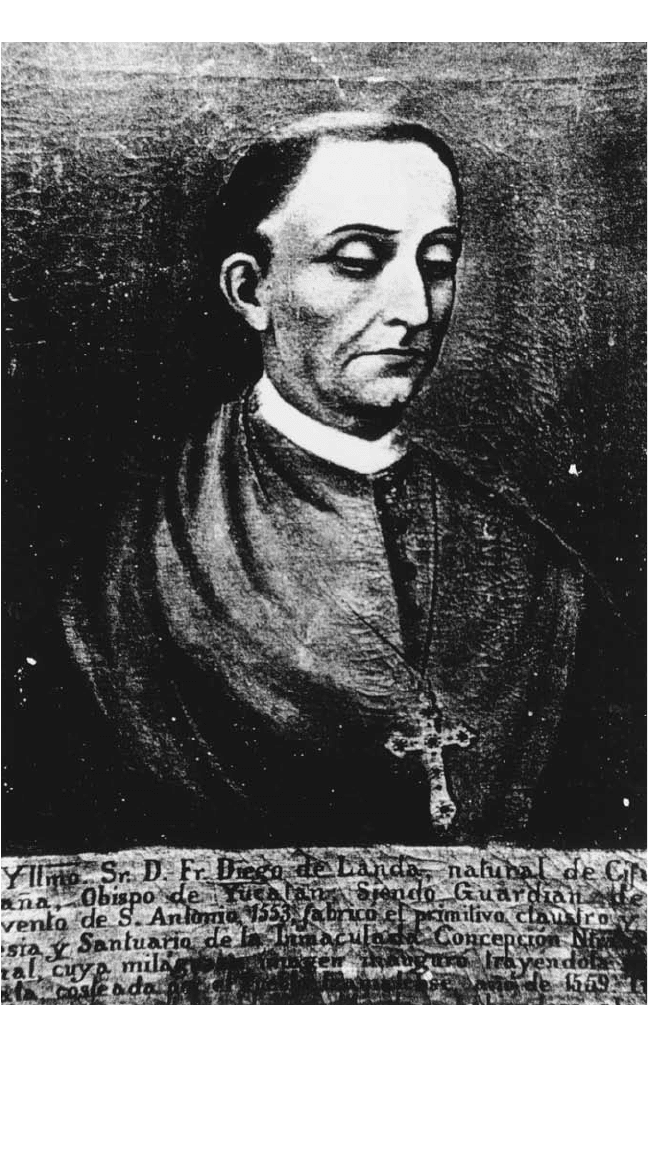
In other instances, the vestiges of paganism proved intolerable: Friar
Diego de Landa, for example, was scandalized by the persistence in the
Yucatán of sacrificial rituals among his most dedicated converts. He
instituted an inquisition into native idolatry in 1562, torturing the her-
etics and burning the Maya hieroglyphic books. He was ordered back
to Spain: the Crown realized the Indians simply did not yet understand
the true faith. The Indians were subsequently exempt from the punitive
powers of the Inquisition.
69
Diego de Landa (1529–79). Although responsible for Indian torture and deaths during an
inquisition, Diego de Landa also wrote the definitive work on Yucatec Maya customs, providing
the key to decipherment of ancient Maya hieroglyphic texts that reveal the very Maya religion
Landa hoped to repress.
THE FOUNDING OF AN EMPIRE: SIXTEENTH-CENTURY MEXICO

A BRIEF HISTORY OF MEXICO
70
Friars as Ethnographers
The priests understood that it was not just the Indians who required
more thorough instruction. The friars needed a greater knowledge of
native beliefs in order to eradicate them. From the beginning the fathers
had been great linguists, learning the native languages and compiling
dictionaries so that the catechism could be taught. Schools were opened
for natives: one was a university for Indian nobles where they learned
Latin so well they became the instructors for the Spanish settlers; oth-
ers included the utopian communities established by Vasco de Quiroga
in Michoacán where the Purépecha learned how to use their craftsmak-
ing skills in order to be self-sustaining.
By the middle of the 16th century, the friars also became the first
ethnographers, working in collaboration with the Indians and encour-
aging them to write about their own history and culture in their native
languages. The most famous, Bernardino de Sahagún, working with
a team of central Mexican nobles, compiled an encyclopedia of pre-
Columbian Aztec life that described everything from sacred rituals to
recipes for preparing hot chocolate. In the process, the nobles learned
to write their own language, Nahuatl, in the Roman alphabet rather
than in pictographs—a skill that greatly facilitated communication. On
Sahagún’s part, he left to posterity its greatest source of information on
Mesoamerican life at the time of the conquest.
Mesoamerican Catholicism
Such collaboration did much to profoundly Hispanicize and Christianize
many Indians. Once the native leaders changed, many of the common-
ers followed suit. The daily relation of the Indians with their land, the
sacred landscape of their ancestors, and with their traditional com-
munities, however, often remained untouched—the church seemed to
think such “household” practices meaningless superstitions. In many
instances, conversion only created what many anthropologists now call
“Mesoamerican Catholicism,” a reworking of Christianity that incorpo-
rated, and partially modified, the Mesoamerican worldview, as can be
seen in the distinctive imagery of this Nahua hymn:
The roses, dark red ones, pale ones
The red feather flowers, the golden flowers
lie there waving like precious bracelets
lie bending with quetzal feather dew.
Indian hymn to St. Clare (Burkhart 1993, 210)

71
Today most native-speaking Mexicans are devout Christians and
many make pilgrimages to the nation’s patron saint, the Virgin of
Guadalupe. But most anthropologists believe the Virgin represents a
powerful synthesis of the Christian and Mesoamerican beliefs: she is
still called Tonantzín by the Nahua. Many such instances of a syncretic
religion have been identified, including the performance of Ch’a-Chak
rituals to the Maya rain god, common in years of drought. Perhaps the
survival of such beliefs would not have been possible if the vibrant
intellectual exchange between native and European had not ended
late in the 16th century when the friars lost much of their power to
the secular clergy. Outside the cities, the Indians, who had often been
officially separated from the colonists to keep them free of Spanish cor-
ruption, lost their only viable link to European ways. Without the friars
and their investment in native education, the traditional communities
themselves provided the daily context for religious observances.
Mid-Century Reforms
The remarkable achievements of Sahagún and other friars, such as Vasco
de Quiroga, occurred during the middle of the 16th century. In what has
been called the “golden age of Christianity,” this was a period of unusual
collaboration between the native population and the foreigners, from
the Aztecs advising the new government on how to control the flood-
ing of Lake Texcoco to programs that taught Indians European skills,
such as blacksmithing and carpentry. There never was similar harmony
among the colonists, the royal functionaries and the religious, however.
The clergy wanted to protect the native population, of course, and pro-
vide them with salvation; the conquistadores wanted to work them like
beasts of burden. But even among these factions, relations improved
after the disputes immediately following the conquest.
The cooperative spirit certainly was promoted by two enlightened
individuals during the founding of New Spain: Mexico’s first viceroy
(1530–50), Antonio de Mendoza, and its first bishop and archbishop
(1528–48), Juan de Zumárraga. These two could not have carried out
the enormous task of institutionalizing the power of the Crown and
church in the conquered land more competently. Mendoza, the count of
Tendilla and related to the royal house, had been a diplomat in Rome;
Zumárraga, a true Franciscan in his poverty vows, was the executor of
many royal commissions and a militant champion of Christian values
(he risked his life challenging the abuses of natives by early officials).
Mendoza was followed by another superb viceroy, Luis de Velasco
THE FOUNDING OF AN EMPIRE: SIXTEENTH-CENTURY MEXICO
A BRIEF HISTORY OF MEXICO
72
Indian Resistance to
Conversion
N
ot all Indians willingly participated in the new societal order.
Armed rebellion did occur sporadically throughout the colo-
nial period. The Mixtón Rebellion in 1541 near Guadalajara was
one of the most threatening: 100,000 native rebels rose against
400 Spaniards. They were defeated by 30,000 Aztecs, for the first
time armed with Spanish guns. Native resistance to the religious
and political conquest more often took the form of escape into
remote regions—especially toward the end of the 16th century.
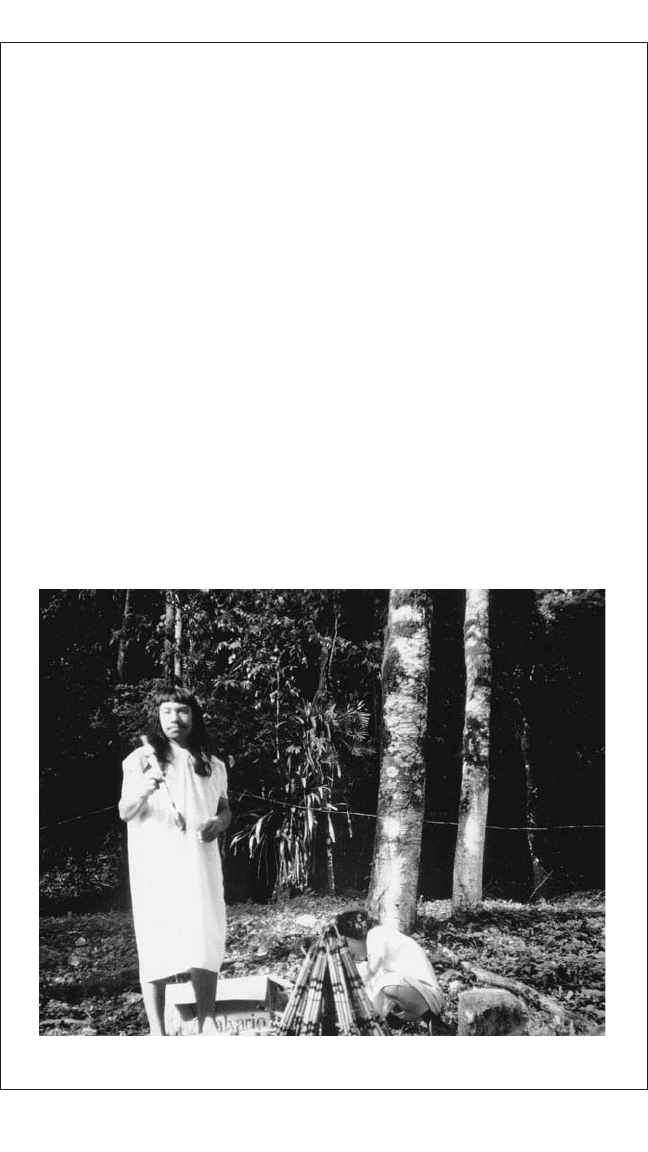
The Lacandón Maya did just that, remaining unconverted and unas-
similated well into the 20th century when logging operations and
population pressures destroyed the Chiapas rain forest that had so
long sustained them. The contemporary Tarahumara Indians of the
Copper Canyon in northern Mexico, known so well by tourists, and
the Huichol of the Colima plateau, famous for their peyote cult, are
other examples. Their cultural survival also is threatened by environ-
mental devastation.
A 20th-century Lacandón Maya Indian selling arrows at Palenque

73
(1550–64), who became known as “Father of the Indians.” These three
shared many Renaissance humanist views and each was scrupulous in
implementing the emperor’s policies. They set the best example for the
future administration of the colony.
Their humanism, as well as that of the religious community, resulted
in the passage of reforms that protected the native population. Both a
papal bull (1537) and a royal edict called the New Laws (1542) settled
the matter once and for all that Indians were human, capable of salva-
tion, and worthy vassals of the Crown—principles that Bartolomé de Las
Casas, bishop of Chiapas, had been lobbying for since he had witnessed
the genocide in the West Indies. Indian slavery finally was outlawed.
The period of relative cooperation that permitted such radical
reforms may have resulted, in part, from the low numbers of Spanish
colonists. By as late as 1560, the Spaniards in New Spain probably
numbered barely more than 20,000. Initially there was plenty of land
and, usually, more than enough Indians to labor on the encomiendas or,
at least, provide tribute to sustain the colonists in an acceptable man-
ner. But as the Indian population declined catastrophically, the settlers’
demands for native labor increasingly clashed with the reforming goals
of the church and government.
The truth was that Indian labor was too much in demand. The church
required, and trained, artisans to build and decorate monasteries and
chapels. The government expected its tequío, or public service, too, for
building town halls or repairing streets. And then there was the enco-
mendero, whose sugar cane and cattle ranches had to be maintained.
Although the Indians had provided tribute and labor to Mesoamerican
rulers, the Spaniards had tripled the levels of Aztec tribute despite the
catastrophic declines in population.
The Crown attempted to protect the Indians from further loss,
swayed by economic reasons as well as arguments from the religious
that the exploitative colonists were at fault. (Friar Bartolomé de Las
Casas claimed that the Spaniards’ abuses made the natives refuse bap-
tism for fear of having to spend eternity in their company.) In addition
to banning Indian enslavement, Mendoza lowered the amount of free
labor and tribute permitted. To boost the economy, more African slaves
were brought to New Spain. (No ban on their enslavement was consid-
ered.) Although these slaves somewhat reduced the settlers’ need for
workers, they also cost money—unlike the Indians. Twenty thousand
had arrived in the colony by 1553, and although their numbers equaled
that of the European community, they hardly made up for the millions
of Indians lost to infectious diseases and abuse.
THE FOUNDING OF AN EMPIRE: SIXTEENTH-CENTURY MEXICO
74
N
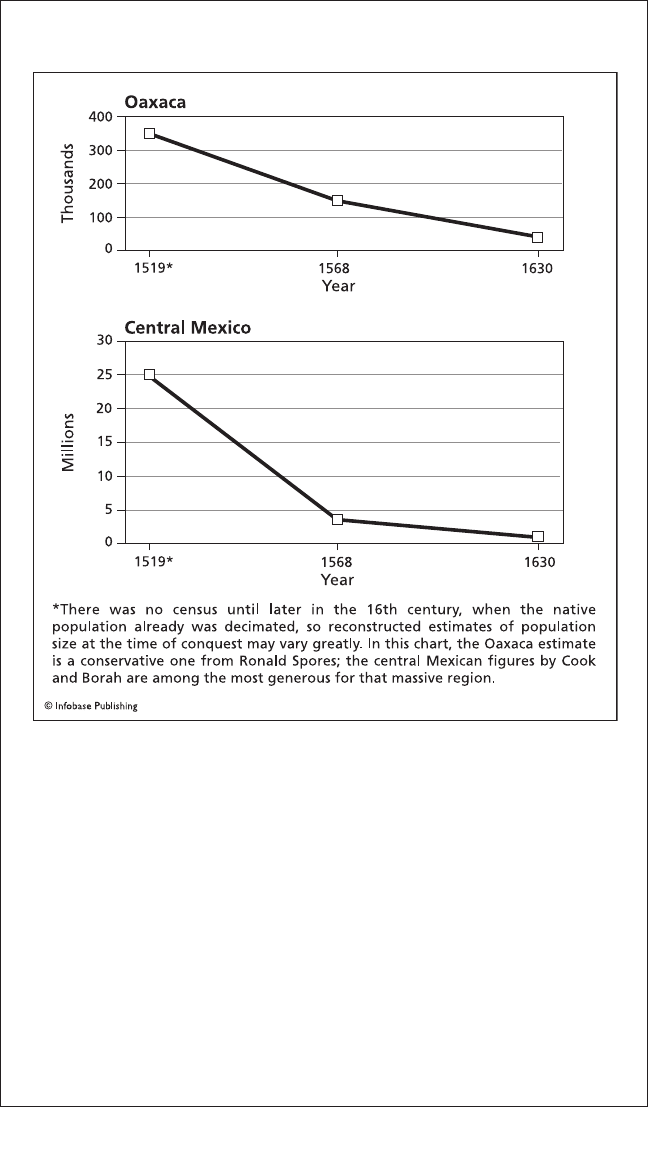
ever having been exposed to European diseases, the Indians had no
natural immunity to smallpox, measles, typhoid, chicken pox, yellow
fever, or mumps. At least seven major waves of these diseases had washed
through the native population by 1600. Famine often followed because so
few individuals were able to work the land. These deaths added to those
caused by abuse, homicide, and cultural dislocation resulted in what some
have called “possibly the greatest demographic disaster in the history of
the world” (Denevan). No one understood the nature of infectious dis-
ease at the time: Friar Bartolomé de Las Casas thought the encomienda
system was the work of the devil to depopulate New Spain; the Mixtecs,
too thought it was due to the supernatural and reverted to traditional
curing rituals—called “witchcraft” by the church. By most estimates, the
population decreased by 70 to 90 percent. Not until 1650 did the size of
the native population begin to increase.
depopulation

75
If restricted labor already was a cause for colonists to complain,
the increased labor needs created by the first major mining strikes
(1545–65) intensified the feeling. When, in 1564, the Crown tried to
implement further reforms, it ignited treasonous ideas, especially since
these reforms attacked the institution most sacred to the conquistadores’
descendants: the encomienda. All encomiendas, it was ordered, would
cease upon the death of the holder. No longer would the privileged
status and wealth of encomenderos be inherited. Outraged, Alonso de
Ávila, son of a conquistador, argued for independence from Spain. He
suggested the new Marqués del Valle, Cortés’s son Martín, should be
made king of the independent nation. And he thought armed resistance
was in order. The talk didn’t get much further before Alonso de Ávila
was arrested and beheaded along with his brother. The more fortunate
Martín Cortés was exiled forever, and his stepbrother, the son of Cortés
and Marina, was tortured. Others of the New World aristocracy were
beheaded. But not only did all talk of rebellion end, so did any serious
effort to eliminate the remaining encomiendas: eventually the practice
would simply fade away.
Utopian Experiments End
As the 16th century came to a close, the conflicts took a different
shape. The Renaissance humanism that had so imbued the mid-century
exchanges between Europeans and the native population with tolerance
(and even a tinge of mutual respect) ended with the more dogmatic prom-
ulgations of the Council of Trent (1563). Following the Council of Trent,
many books, such as those by Erasmus, were banned in Spain, although
they circulated freely in Mexico and were part of the catechism.
Charles V was dead, as were Zumárraga and Mendoza; the native aris-
tocrats who had been educated in Mesoamerican traditions were dying
out. The official onset of the Inquisition in Mexico in 1571 marked
the final demise of this most idealistic religious period. Not only did
the friars no longer attempt to create utopian Indian communities, but
such work bordered on the heretical. Treatises by former archbishop
Zumárraga were banned; Sahagún’s work languished in archives until
the 19th century. The early humanists were too often replaced by more
corrupt individuals who saw the Americas as an opportunity to make a
quick fortune or to hide their vices from European view. Even the clergy
occupied themselves in building ever more ornate churches, replacing
religious zeal with their own material comforts, and advocacy with
authoritarianism.
THE FOUNDING OF AN EMPIRE: SIXTEENTH-CENTURY MEXICO

A BRIEF HISTORY OF MEXICO
76
Mixtec Caciques Thrive
under Spain
T
he Codex Nuttall, a pre-Columbian book, tells the story of the
great Mixtec ruler, 8 Deer “Tiger Claw,” in 1103 c.e. His descen-
dants continued to rule in the Sierra Mixteca of Oaxaca well into the
19th century, whereas Moctezuma’s dynastic line (more threatening to
Spain) had lost the power to hold any office, however low, by 1565.
In Oaxaca, the number of Europeans were fewer than in most parts
of New Spain, never amounting to even 7 percent in contrast to 50
percent around Mexico City. The conquistadores could barely control
Oaxaca City, which they founded; their influence was even less in the
nearby rugged mountains, where they had sadly discovered during the
conquest that “the terrain does not permit the use of horses.” Cacique
rights and territories were recognized in order to gain the Mixtecs’
much-needed cooperation. The indigenous economy, not encomiendas,
became indispensable to Spanish society; the traditional communities
and native political order remained intact, including class distinctions.
In the mid-16th-century Codex of Yanhuitlán, Don Gabriel de Guzmán,
cacique of the Mixtec principality of Yanhuitlán and descendant of the
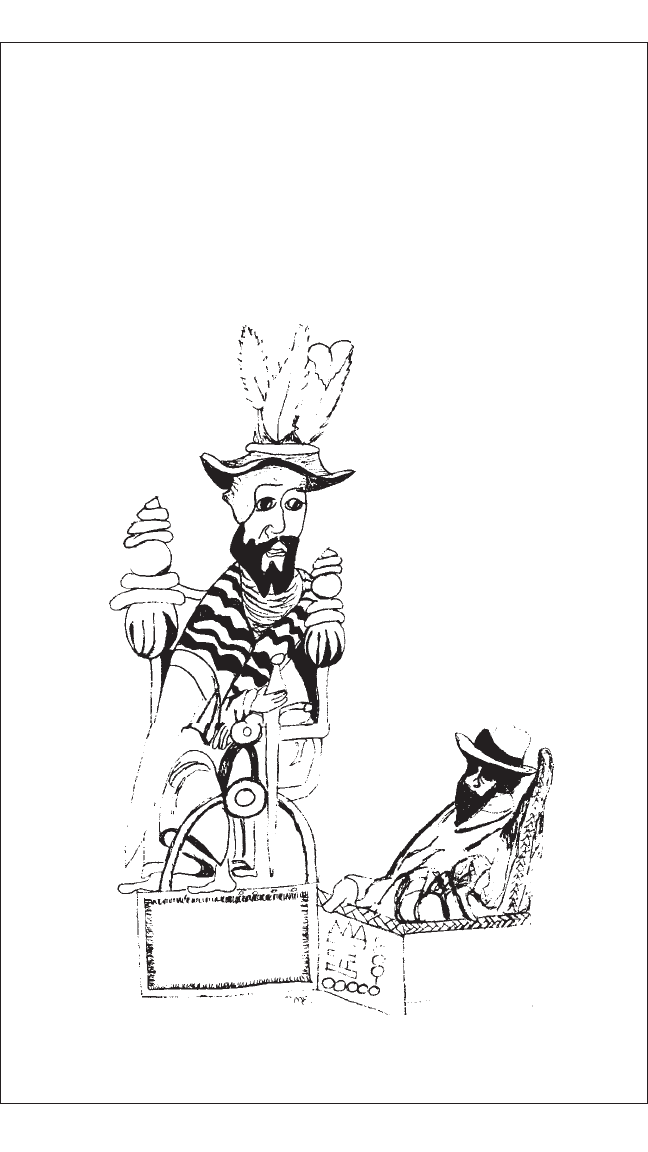
In this section of the pre-Columbian Codex Nuttall, the Mixtec ruler 8 Deer (on
right) undergoes a nose-piercing ceremony.
(Drawing by Shannon Ernst)
77
pre-Columbian ruler 8 Deer “Tiger Claw,” meets with a high-ranking
Spaniard. Below him is his Mixtec name glyph of 9 House. The Mixtec
caciques, such as Don Gabriel, oversaw vast territories and functioned
as they had for many centuries, except tribute was paid to the Spaniards
instead of to the Aztecs. In return, the caciques received Spanish privi-
leges: Don Gabriel was granted the gentleman’s title of don, a coat of
arms, permits to raise livestock and the right to wear Spanish clothes,
ride horseback, and bear arms.
The Mixtec cacique Don Gabriel (on right) confers with a Spaniard, from the
Codex of Yanhuitlán.
(Drawing by Shannon Ernst)
THE FOUNDING OF AN EMPIRE: SIXTEENTH-CENTURY MEXICO