
Foster L.V. A Brief History of Mexico
Подождите немного. Документ загружается.


A BRIEF HISTORY OF MEXICO
108
regions, tended their Indian parishioners with the care of the most
humanistic 16th-century friars.
Most Creoles, however, realized that their privilege and prestige
resulted from the imperial system. They were satisfied to tinker with
the colonial system, maintaining their loyalty to the Spanish monar-
chy but demanding equality with the peninsulares or, better yet, their
replacement by the Creoles themselves.
The nonprivileged classes heard little or nothing about the
Enlightenment. Their own lot was itself enough to foment rebel-
lions—and they did occur, but usually were not organized well enough
to spread beyond a local community. By the 18th century the Indian
population was once again on the increase, intensifying frictions
over land use. On the whole, the native peoples were so downtrod-
den that some Spaniards deluded themselves into thinking they were
naturally servile. Economic growth encouraged some Indians to leave
their traditional communities in order to participate in the broader
society and some managed to do well, taking on Spanish customs and
language. Even the caciques took on more Spanish customs and were
expected to be, at the very least, bilingual. Frequently employed as
mediators or merchants within the traditional communities because
of their bilingualism, these Indians were often the worst oppressors
of their own people.
Many castas, or mixed-race individuals, were able to find more remu-
nerative work and responsibility in the expanding Bourbon economy.
Can Ek Reborn
O
ne Indian rebellion was led by the shaman Jacinto Canek, who
took the name of the legendary Maya leader. He was crowned
king, he said, in order to lead his people out of their servitude through
armed revolt against the Spaniards. His message appealed to many
in the Yucatán and terrified the white population until royal forces
entered Canek’s village in 1761 and killed half of the 1,200 armed Maya
assembled there. Canek escaped, but was later captured, tortured to
death, and cremated. Some rebels were drawn and quartered; others,
after being flogged, had one ear cut off to mark them. Canek’s village
was razed in the hope that, like the leader himself, no trace of the event
would be left.

109
The caste system prevented them from being truly assimilated into
the society, however. At times light-skinned mestizos and mulattoes
“passed” as whites; others successfully bribed priests to register their
children as Creoles; still others maneuvered into the trades, the clergy,
and the burgeoning militia. For most, their color meant a lifetime of
resentment and exploitation.
The increasing numbers of nonwhites living free, out of debt peon-
age and slavery, would have made natural allies for the more liberal
Creoles—if they had so wished. For most Creoles, the entire class
system could be endangered by such alliances, and so there was little
interest in organizing broader protests.
Despite the lack of fervor for independence, political events in
Europe made radical change a necessity. Charles IV (1788–1808), far
from the wise monarch his father had been, permitted the plunder of
the colonies. In 1804 the charitable funds of New Spain, belonging
to the church and used not only to help the poor of Mexico but also
to give credit to Creoles, were taken for the royal treasury to pay off
European war debts. The church had to call in all mortgages, destroying
some Creoles financially; clergy no longer were able to respond to even
the most disastrous circumstances of needy parishioners. The church
was already festering, because Charles III had expelled the Jesuits in
1767 and confiscated all their property, closing schools and frontier
missions.
Charles IV was destructive of Spain, too, where uprisings led him
in 1808 to abdicate in favor of his son, Ferdinand VII. The turmoil
continued when Napoléon I forced both Spanish Bourbons, Charles
and Ferdinand, into exile and placed his brother Joseph Bonaparte on
the throne in 1808. Various rival governments, or juntas, in support
of the Spanish monarchy took charge in areas outside Napoléon’s con-
trol. Without the monarchy, the Mexican Creoles thought they should
rule themselves; the peninsulares believed otherwise. The tug of war
in both Spain and Mexico created instability: Mexico had four vice-
roys in just two years. Worse, the policies of the Spanish juntas were
despotically conservative in regard to the colonies: they ordered the
arrest in the Americas of anyone agitating for reform; the Holy Office
of the Inquisition became a spying arm of the government, rather than
an enforcer of religious standards; and important individuals were
arrested and deported. The Creoles no longer hoped that their politi-
cal fortunes would improve through peaceful means. By mid-1810,
Creoles in every major city had formed secret societies in opposition
to the government.
THE BOURBON REFORMS AND INDEPENDENCE

A BRIEF HISTORY OF MEXICO
110
Miguel Hidalgo
My children . . . will you free yourselves?
Father Miguel Hidalgo y Costilla, 1810
In 1810 when Miguel Hidalgo gave his famous Grito de Dolores, the cry
to action that is reenacted every September 16 in modern Mexico, he
gave Creole leadership to the disorganized stirrings of the mestizos and
other castas, the Indians, and other disenfranchised masses of Mexico.
Considered the father of the Mexican nation, Miguel Hidalgo y
Costilla (1753–1811) was born to a Creole family on an hacienda in
the province of Guanajuato where his father was manager. He was sent
to a Jesuit College in what is now Morelia, but his education was soon
interrupted by the expulsion of the Jesuits. Having learned a lesson in
imperial whimsy, Hidalgo enrolled in another college and received his
degree from the University of Mexico in 1774. He was ordained as a
priest in 1778. Eventually he became rector of the prestigious college of
San Nicolás in Morelia, founded by the 16th-century utopian Vasco de
Quiroga. Like Quiroga, he studied Indian languages, but unlike Quiroga
he soon was investigated by the Inquisition (1800), and although noth-
ing against him could be proved, he lost his position: he was too much
a child of the Enlightenment, reading banned literature, questioning
church dogma—and keeping a mistress. He ended up in the village
of Dolores, where he tried to improve the economic well-being of his
parishioners. It was in Dolores that he met others who would become
the martyrs of independence.
Hidalgo belonged to a secret society in Querétaro that included
Ignacio Allende and Juan de Aldama, both officers in the army; a former
corregidor of Querétaro and his wife, the Mexican patriot Josefa Ortiz de
Domínguez; a postal clerk; and others. Until his famous proclamation
catapulted him into the position of leadership, Hidalgo was a minor
figure in the central Mexican Committee of Correspondence conspiring
for independence. His particular group gathered arms for an insurrec-
tion set for December. But when, on September 13, 1810, Josefa Ortiz
de Domínguez let out the news that royal officials were arresting those
involved, the uprising was prematurely launched.
Receiving the news, Allende, Aldama, and Hidalgo managed to meet
at the small town of Dolores. They decided to go forward with the
insurrection. In the predawn hours of September 16, Hidalgo tolled the
111
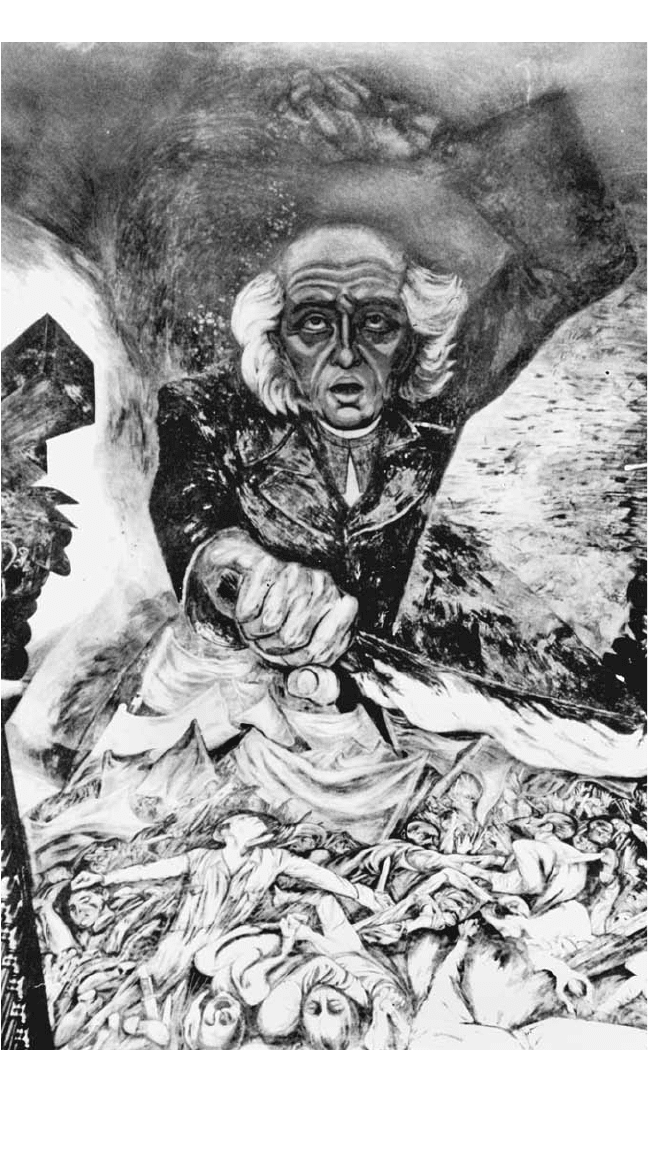
Father Hidalgo with torch of independence in Carnaval de Ideologías (1937–39), a mural in
the Guadalajara Government Palace painted by José Clemente Orozco
THE BOURBON REFORMS AND INDEPENDENCE

A BRIEF HISTORY OF MEXICO
112
bells to call his Indian and mestizo parishioners to church. His cry for
independence went well beyond narrow Creole interests; he attacked
the conquistadores’ confiscation of Indian land and declared an end to
tribute. Later, Hidalgo would also declare an end to slavery. He gave
the rallying cry in the name of the dark-skinned Virgin of Guadalupe.
In response to his “Viva Guadalupe!,” his parishioners are said to have
shouted “Death to the peninsulares!”
The ferocity of the rebellion unleashed in Dolores caught everyone
by surprise—even Hidalgo, who suddenly was swept to the forefront of
the movement. He had naively thought the mere threat of insurrection
would lead everyone to the reasonable position of agreeing to indepen-
dence. Marching under the banner of the Mexican Virgin of Guadalupe,
his forces swelled with the oppressed, armed only with the peasant’s
machete, the miner’s pick, the bow and arrow, and, occasionally, a gun.
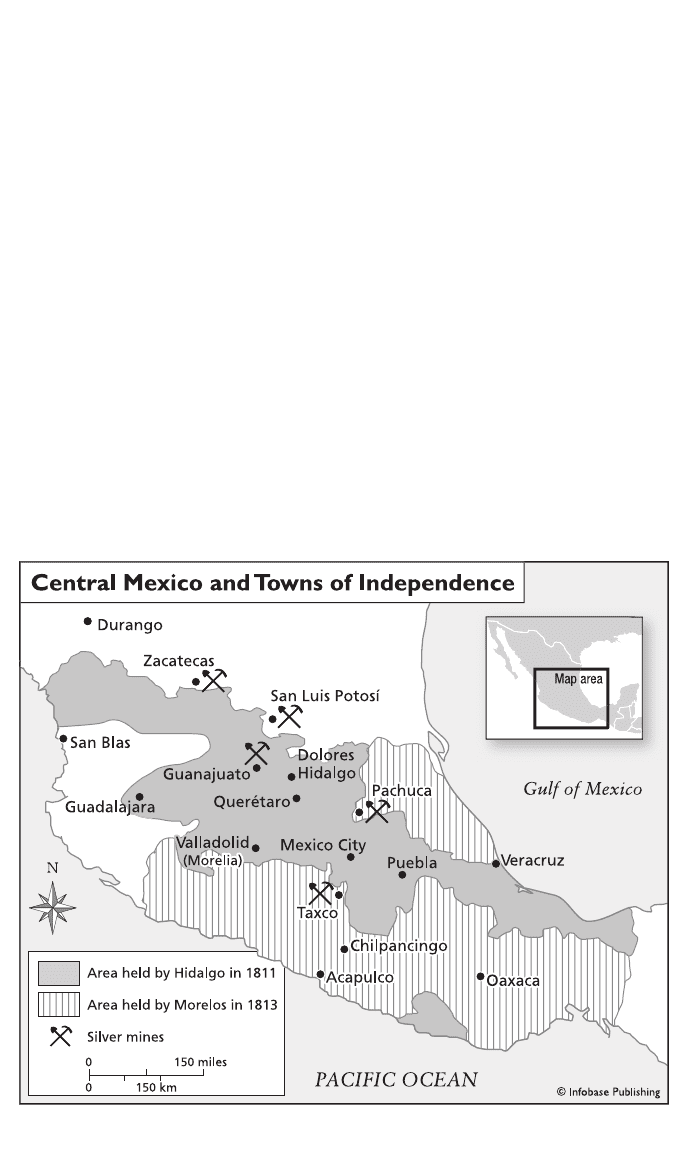
By the time he captured what is now Morelia, his forces numbered
60,000—and thousands more were fighting with Allende farther north.
More poor joined Hidalgo at Morelia, until their numbers swelled to
80,000. Instead of well-disciplined soldiers led by army professionals,
the insurrection was fought by a barely controllable mob and an over-
whelmed priest. Said Lucas Alamán, an eyewitness, “The pillage was
more merciless than if done by a foreign army” (1943: vol 1, 403).
The insurrectionists swept through the countryside, confiscating land
and livestock—some ate the first beef of their lives. Wherever resis-
tance was met, they attacked viciously. In Guanajuato the hundreds of
frightened peninsular families who had gathered together in the granary
were slaughtered. And even though 2,000 rebels were killed by royalist
guns and grenades, they kept fighting. After their victories, towns were
sacked, markets stripped of food, baroque mansions looted of silver.
The capital remained untouched, because Hidalgo, fearing the worst
bloodbath imaginable, didn’t invade despite Allende’s urging; historians
believe such an invasion could have achieved independence early in the
fighting. Yet in just over a month the rebels controlled much of central
Mexico, from Guadalajara and Zacatecas to the Pacific and Gulf coasts.
Despite their stunning victories, the insurgents soon suffered major
setbacks. The royalists, under General Félix Calleja, regrouped and
regained Guanajuato and other cities. Calleja fought mercilessly and
executed innocents as gruesomely as the revolutionaries did. In March
1811, Hidalgo and Allende were captured in Texas and returned to
Calleja. Both were executed, and their decapitated heads were hung
from the granary walls in Guanajuato for 10 years as a macabre warn-
ing to the public.
113
José María Morelos
The popularity of the independence movement diminished. Some poor
were content to work the land they had “liberated.” Creole support
plummeted: fearful of the attacks on personal property and of slogans
promising social change, the privileged shifted their allegiance. They
realized only too well that for the masses, there was little difference in
appearance between the peninsulares and themselves—and little differ-
ence in their exploitation of workers.
Not surprisingly, the movement that continued was under the leader-
ship of a mestizo, the priest José María Morelos y Pavón, who had been
recruited to the cause by Hidalgo. A military genius with clear political
objectives, Morelos brought together a fighter force that included stu-
dents and peasants, military officers, and Indian caciques. Each wore
the badge of the Virgin of Guadalupe who, in addition to being the
protector of the poor, had become the symbol of a free Mexico. Morelos
organized his soldiers into small bands well trained in guerrilla war-
fare. Gradually, they won enough territory, from Oaxaca to Tampico, to
encircle and isolate the capital.
THE BOURBON REFORMS AND INDEPENDENCE

A BRIEF HISTORY OF MEXICO
114
In 1813, Morelos convened a constitutional convention to govern
the liberated territories and alarmed the Creoles and clergy alike with
his politics. He advocated the end of the caste system as well as equal
rights for all regardless of race; he even recommended that church lands
be redistributed among the poor. In independent Mexico, he said, “the
only thing that will distinguish one American from another is vice and
virtue” (Herrejón 1985, 133–134). Spain itself would champion such
liberal ideas in a decade, but the conservative Creoles found them thor-
oughly objectionable. Moreover, Morelos extolled not European culture
but rather the preconquest past, laying the foundation for a unified, and
uniquely Mexican, nation.
Spirits of Moctezuma, Cacamitzin, Cuauhtémoc Xicotencatl,
Calzontzin! Take pride in this august assembly and celebrate
this happy moment in which your sons have congregated to
avenge your insults!
José María Morelos, 1813 (translated by Charles Cumberland)
The royalist forces under the ruthless General Calleja once again
succeeded in winning back cities. To guarantee a firm hand during the
war, a revived Spanish monarchy made Calleja viceroy. Morelos was
captured and executed in 1815, nearly ending the struggle for inde-
pendence. Only a few continued the fight: Guadalupe Victoria (the
nom de guerre of Félix Fernández), hiding out in the mountains above
Veracruz, and Vicente Guerrero on the Pacific slopes. Most defected;
others were pardoned. By 1816 the fighting was so sporadic that Spain
felt safe enough to replace Calleja with a more moderate viceroy, and
by 1819 offered amnesty to the insurgents.
Independence
By 1820 Spain again controlled all the Mexican cities and most of the
territory. Yet in a short time, with barely any bloodshed, Mexico would
be independent. Under threat of a military coup, the restored Spanish
monarchy was forced to function under a liberal constitution, which
recognized the sovereignty of the people. The constitution permitted
free speech and open trade and clipped the powers of the church and its
vast properties—a common anticlerical position of the Enlightenment.
Although Morelos was long dead, his specter seemed to haunt Mexican
conservatives.

115
Finding Spain too liberal, the Creoles, even the most conservative,
opted for independence. They were supported, and partially funded,
by the church. Their modus operandi was a military coup, and their
chosen leader was Agustín de Iturbide, a greedy and vain individual
who had resigned from the royal army when accused of corruption. The
Creoles’ goal was to institute a constitutional monarchy with a member
of Europe’s royalty who would preserve their privileged position in
Mexican society.
The Creoles convinced the viceroy to reinstate Iturbide in order to
defeat Vicente Guerrero once and for all. Iturbide took his army to the
state of what is now Guerrero and, instead of going to war with him,
negotiated with the rightly suspicious Vicente Guerrero to join forces to
fight for independence. On February 24, 1821, they signed the Plan of
Iguala, a platform permitting all of Mexico’s factions to agree. Above all,
it declared independence for all people, whether of Indian, European,
or African descent. In addition, it stated that the nation would be gov-
erned by a constitutional monarchy, headed by either King Ferdinand
of Spain or some European prince. It also declared that the state reli-
gion would be Catholic, and no other, and guaranteed the properties of
the church. Lastly, it stated that all citizens could be employed in any
position without distinction other than merit. Iturbide came away with
the necessary document for independence; he also managed to confis-
cate a silver shipment for Manila into his own safekeeping.
The plan appealed to conservatives and liberals alike. The viceroy,
realizing that the army and most municipal officials supported the
Plan of Iguala, resigned. Spain, forever hopeful, sent as a replacement
Juan O’Donoju, a liberal Spaniard of Irish descent. He quickly realized
that independence was to be a reality and met with Iturbide to ratify
the plan. Iturbide negotiated one modification in what then became
the Plan of Córdoba: in the event that a European prince could not be
found to rule, an appropriate Mexican could be monarch.
On September 27, 1821, Iturbide marched into the capital with
Vicente Guerrero and Guadalupe Victoria at his side. After too many
years of wars and atrocities, Mexico was independent from Spain.
THE BOURBON REFORMS AND INDEPENDENCE

117
7
Years of Chaos
(1823–1876)
Somber events engulf us. Although the revolution is over, its
consequences keep us exposed to grave perils; various parties,
some swollen by triumph, others bitter over defeat, divide our
reborn society . . .
El águila mexicana, 1823 (quoted in Stein & Stein 1970, 130)
M
exican hopes that independence would bring a modernized
economy and more egalitarian society were not realized in the
next century. Instead, the legacy of the battle for independence was
the increased importance of an unscrupulous military and a bankrupt
treasury.
Feuds and class differences that had been matters of life and death
during the fighting—between aristocratic Creoles and mestizos, between
liberal anticlerics and the church, between monarchists and republicans,
and rich and poor—remained unresolved. Worse, none of the social
reforms hoped for by the masses fighting the war were instituted.
In its first 40 years, Mexico had more than 50 governments. Sometimes
two or three different factions claimed the office simultaneously. One year
there were as many as five changes in the presidency. The newly indepen-
dent nation was ruled by military coups d’état, not a constitution; graft,
not government. Taking advantage of the unsettled political situation,
foreign governments intervened.
These disturbing times have left the Mexican consciousness with
one of its greatest heroes, the first Indian president, Benito Juárez, as
well as a fully developed distrust of its northern neighbor, the United
States, to whom half of Mexican territory was lost. It also defined,
though did not fully end, the power struggles between the church and
the modern secular state.