
Foster L.V. A Brief History of Mexico
Подождите немного. Документ загружается.


A BRIEF HISTORY OF MEXICO
88
settled, leaving great territories to be usurped by other European pow-
ers (
see maps on pages 84 and 103). Although some ports in California,
essential stops on the China trade route, were settled in the 18th cen-
tury, Baja California had only a few impoverished Jesuit missions. The
colony in Santa Fe wasn’t supported by any settlement in southern
New Mexico, however, nor did any chain of Spanish villages connect it
with California. Even where there were settlements, communications
among them could be difficult and resources nonexistent. These areas
were barely integrated into New Spain, which administered them. As
Friar Alonso de Benavides (1630) described life in the New Mexican
pueblos, 1,800 very long miles from the capital, “five and six years
were wont to pass without royal officials bethinking themselves about
us
. . . and god only knows what it costs to remind them.”
Spain Regulates the Economy
The colony of New Spain was to be managed for the benefit of Spain.
All traded items had to be approved by Spain and sent on Spanish
ships—a severe burden given that the Spanish galleons sailed in pro-
tected convoy only once a year. Commerce with foreign governments
was prohibited. Protectionism was unquestioned policy, preventing
the free development of industries that competed with those in Spain.
Usually items for domestic consumption were permitted—from wheat
and mutton to handpainted majolica ceramics, while royal monopolies
Comparative Chart of Spanish Populations*
Total Percentage of
Region Year Population Spaniards
Mexico City 1794 104,760 50.3
Puebla 1777 71,366 25.6
Tlaxcala 1794 59,158 13.7
Oaxaca 1794 411,336 6.5
Yucatán 1780 210,472 7.9
New Spain 1810 5,764,731 18.6
*-From Farriss (1984, 65)

89
on gunpowder, silk, mercury for mining, tobacco, and cochineal guar-
anteed considerable income for the Crown and its merchants.
The Hacienda
Initially the Spaniards had taken from the Indians whatever they could
sell abroad and what they needed for their own comfort and suste-
nance, relying on the indigenous patterns of agriculture and industry
to support them. Bishops were happy with mitres made by Aztec feath-
erworkers; settlers found they could convert the native dye, cochineal,
into Europe’s most fashionable red tint—used also to dye the uniforms
of the British redcoats worn against American independence fight-
ers. Other native products made their way around the world: vanilla-
flavor
ed
chocolate became the drink of Spanish royalty; maize found
immediate popularity in Africa and the Middle East. The tomato and
peanut, however, took longer to gain popularity. Tobacco took off more
than any foodstuff: within a century, it was distributed and grown
around the world.
The systems of tribute labor and encomienda that had at first sus-
tained New Spain were inadequate once royal edicts had limited their
scope and once the number of settlers grew. Also, as wealthy as the
encomienda had made some Spaniards, it required great numbers of
Indians to be productive, numbers that epidemics made nonexistent.
Tribute had its limitations as well, if there were not enough Indians
to contribute—and besides, the Crown wanted most of the tribute for
itself. By the end of the 16th century, these early institutions no longer
were adequate to supply the colony with foodstuffs, or support the
more recent settlers.
The Spaniards were forced to become involved in shaping the econ-
omy of New Spain, and they shaped it to their Old World tastes. With
Indian depopulation, there was less resistance to Spanish takeovers of
land. Small estates were sometimes legitimately purchased and some-
times granted by the Crown; they also were seized from the Indians. In
pursuit of the Spanish ideal of gentlemanly land ownership, many small
plots were consolidated into huge estates called haciendas. Instead of
indigenous maize and turkeys, wheat was planted and European live-
stock bred. Friars introduced the first olive groves and vineyards, but
these eventually were prohibited by a monopolistic Spain that exploited
the captive market for its own wines and oils.
At first, the cattle, sheep, and goats grazed primarily in the densely
populated central areas, exhausting formerly rich agricultural lands.
THE COLONY OF NEW SPAIN

A BRIEF HISTORY OF MEXICO
90
The raising of livestock carried such prestige in the home country,
however, that it was a preferred occupation in the New World: not only
was there profit in exporting hides to Spain for leather but considerable
status as well. Because cattle grazing didn’t require a lot of workers, the
hacienda owners with their silver spurs and wide-brimmed hats, and
the chap-protected vaqueros (cowboys) soon found their more proper
niche in the less populated grasslands near the mines of the north,
where “Texas” longhorns thrived. Herds of 150,000 roamed the frontier
regions. One family ranch extended over 11 million acres.
Debt Peonage
Despite the introduction of plows and pack animals into New Spain,
the agricultural haciendas flourished only where there was sufficient
Indian labor. Under the New Laws, the hacendados had to appeal to
Indians to work their land by paying them. Even under the continued
repartimiento system, the “tribute” labor required for public works and
the demonstrated needs of the colony, there was pay involved, if some-
times only a pittance. The natives could be forced into repartimiento for
only a limited number of days each year, and each day was to begin at
dawn and end before dusk so that the work didn’t disrupt the Indians’
own farming in support of their families. Such was the new, more
humanitarian repartimiento system promulgated by Spain.
Practice, however, was another matter. The restraints on exploiting
Indian labor were rarely observed—their lack of implementation pro-
vides, instead, a typical example of the discrepancy between royal word
and colonial deed. The local corregidores made much of their income
through their management of repartimiento labor in favor of the local
hacendados. The abuses became so bad that agriculture was eliminated
from the labor drafts under repartimiento in 1630. The hacendados
learned that few Indians would voluntarily work for scandalously low
wages. A solution was soon found, however, and along with it a new
form of enslavement: debt peonage. Indians, promised generous sums
of money paid in advance, were enticed to work on the estates. Many
found it impossible to work off their debts, especially when they were
forced to buy food and goods at inflated prices at the only nearby store:
the one owned by the hacendado. And it wasn’t unheard of to rig the
accounts in the hacendado’s favor. Not legally permitted to leave the
hacienda with outstanding debts, the Indians were forced to work until
their deaths. Their debts were inherited, unfortunately, bringing other
family members into peonage.

91
Mining
I went to a mine called the Trinity . . . Respecting its wealth,
persons worthy of belief who know the region [of Pachuca] told
me that in ten years this mine has produced forty million pesos,
with nine hundred to a thousand men working daily.
Gemilli Carreri, 1697 (reported in Charles Cumberland 1968, 84)
Agriculture was New Spain’s primary economic endeavor: maize pro-
duction alone often exceeded silver in total value. Yet it was the mines,
not the corn, which preoccupied the Crown. Gold, and especially
silver, were produced in extraordinary quantities. During the colonial
The Mixteca and Cochineal
I
n the Sierra Mixteca change was drastic, but under native control.
Thanks to powerful caciques such as Gabriel de Guzmán (see page
94), the Mixtec never gave up the right to their traditional lands, though
they did use them in ways that were profitable to Spain and its settlers.
Two Spanish enterprises were silk production and sheep grazing—the
Sierra Mixteca was the only region where Indians owned more sheep
than the Spaniards. And even when the silk industry died out at the end
of the 16th century (due to competition from the Far East), the native
red cochineal dye enabled the Mixtecs to flourish for centuries more.
Cochineal, tiny insects that live on prickly pear cactus, were culti-
vated, then dried and crushed to produce the dye. Cochineal had been
traded by the Mixtecs in pre-Hispanic times and paid to the Aztecs in
tribute. Under Spain, production increased dramatically for the bur-
geoning textile industry in Europe, and the dyestuff became the most
valuable export after silver and gold. Some said the Mixtecs—at least
the Mixtec caciques and cacicas (women chiefs, who were among the
wealthiest individuals in all of Oaxaca)—were wealthier under Spain
than their preconquest ancestors had ever been. By controlling their
own lands and the production of major commodities, the Mixtecs were
unusual among indigenous communities in that they never labored
directly for the Spaniards, who were too few to take control beyond
tribute and tax demands. Through the Mixtecs’ participation in the
colonial economy, Oaxaca became one of the most important regions
in New Spain, and by 1797 its capital was the third-largest city.
THE COLONY OF NEW SPAIN

A BRIEF HISTORY OF MEXICO
92
period, the equivalent of $2.25 million worth of silver and gold were
extracted. In the 18th century, Mexico produced as much silver as the
rest of the world combined. Spain gained so much wealth from the
mines—it received approximately 20 percent of the value of all precious
metal production in taxes, fees, the royal quinto (or fifth), etc.—that it
foresook its own moral principles in regard to them. Even after repar-
timiento officially ended for farm labor, it was condoned for the mines
despite the high death rates. For 12 hours a day, workers descended
into the damp and dangerous mine shafts—the one called “the mouth
of hell” in Guanajuato was 2,000 feet deeper than any mine in the
world—returning with 200, even 300, pounds of ore on their backs.
Working conditions led to labor unrest and rebellions, and the mines
had difficulty meeting production schedules. Eventually market forces,
not the Crown, eliminated repartimiento labor in the mines: rising
prices for silver encouraged the mining companies to pay adequately
for much needed skilled labor. Once properly paid, workers were in
plentiful supply.
The Social Classes
A social caste system based primarily on race existed in New Spain
and was reinforced by law. At the pinnacle was the white ruling class,
comprising 1 million of the entire population of 7 million by the end
of the colonial period. Distinctions were made among the whites, how-
ever. Preferences were given to those born on the Iberian peninsula of
Spain (peninsulares), even though the vast majority returned to Spain
after serving their terms of office. In fact, their lack of engagement in
New Spain was the reason for their royal preference. To preserve their
absolute loyalty to the Crown, viceroys and other royal officials usu-
ally served limited terms, often no more than five years, and they were
banned from owning property (though some managed to make a con-
siderable fortune during their terms) or marrying in the colony without
special permission (though fewer than 10 percent were women).
These peninsulares ranked higher than Mexican-born Spaniards
called criollos (Creoles): the pale-skinned children of conquistadores
and permanent settlers found a guaranteed high position in society
regardless of how lowly their ancestors’ status had been in Spain.
However, Creoles could not hold royal office, because the Crown sus-
pected that their place of birth tarnished their loyalty.
Only whites were permitted to wear European silk finery, ride horses,
and be called damas (ladies) and caballeros (gentlemen). So important

93
was it to pretend to be pure white, and so unlikely was that to be the
case in New Spain, that the Crown would certify all Indian or African
blood “extinguished” in a family—for a fee.
Beneath the Spanish upper stratum were the peoples of color. Spain
developed an elaborate terminology for what it perceived as 16 relevant
permutations of European, African, and American peoples—mulattoes
(African and white), and zambos and coyotes (Indian and African),
among them. The African slaves often labored under the worst condi-
tions in the tropics and the mines, but as personal property they seldom
were concentrated together in sufficient numbers to maintain a separate
group identity. One runaway slave, Yanga, established a stronghold of
80 individuals near Veracruz; after defeating royal troops, he forced
the viceroy to recognize their freedom, permitting them to establish
the town of San Lorenzo de los Negros. On the whole, the numbers
of African slaves diminished over the years to 6,000 by 1800, as they
either escaped to remote Indian regions or bought their freedom (per-
missible under Spanish law). The number of individuals with some
African heritage, that is mulatto or zambo, was over 600,000.
And, of course, there were the more numerous mestizos, a group that
would continue to grow throughout the country’s history. Immediately
after the conquest, both church and Crown encouraged intermarriage;
under the more rigid colonial society, they simply looked the other way
in regard to concubinage—mestizos often were the illegitimate children
of Spanish men and Indian women. The mestizos predominated where
Racial Composition of New Spain, 1810
Number Percentage
Indians 3,676,281 60
Whites
Peninsulares 15,000 0.3
Creoles 1,092,367 18
Mestizos 704,245 11
Mulattoes and zambos 624,461 10
Black 10,000 0.2
Total Population 6,122,354
Based on Meyer & Sherman (1983, 218)
THE COLONY OF NEW SPAIN

A BRIEF HISTORY OF MEXICO
94
the Spaniards did: in central Mexico. Although legally lower than the
whites, they were subject to the same taxes and military duties even
if they were not granted the same privileges. Their treatment varied.
Some, born to the famous, such as Cortés’s illegitimate son, were
treated as aristocracy. Others were ranchers and soldiers on the frontier;
and still others, in a social intermediary role, supervised native laborers
for Spanish overlords. Many were simply poor and considered inferior.
Some found their greatest opportunities as vagabonds and thieves who
prowled the countryside.
Below the mestizo but above the slaves and with protections not
granted to the Africans were the Indians, the largest class of all.
Although considered wards of the Crown and church, Indians suffered
abominably whether because of debt peonage or mine labor. At least
one half of Indian children died in their first year; 75 percent died in
early infancy. Excluded from formal education, their lot became that of
illiterate and abjectly poor laborers and peasants. Of course, there were
interesting exceptions, and the harshness of their fate varied according
to region and position in native society. In fact, the pre-Columbian class
structure, divided between a ruling native aristocracy and commoners,
survived the centuries in many traditional villages and was inadver-
tently reinforced by viceregal recognition of local caciques.
Cacique and Commoner in
the Sierra Mixteca
C
aciques, chosen from the Indian nobility, inherited their position.
In the flourishing Oaxaca region of the Sierra Mixteca, they also
inherited wealth. Cacique Guzmán of Yanhuitlán, descendant of the pre-
Columbian leader 8 Deer, had 980 acres of farm and grazing land, and
many houses and animals—more than owned by any Spaniard—and a
salary of 400 pesos plus the tribute due him from his people for the
administrative services he rendered. By contrast, most commoners left
only a shack, a small piece of land, and a few animals to their descen-
dants. Some among the Mixtecs accumulated a bit more: the 1710 will
of Domingo Ramos left farmlands, an adobe house, a storage chest with
key, a bed, a skirt, a quilt, 21 mares, cloth, some silver, and what appears
to be a pre-Columbian preference for green feathers—nearly 1,200 of
them (Spores 1984, 116).

95
The Church and Culture
In Spain, the religious orders were primarily charged with education,
just as they were in the conversion of the peoples of Mexico. Their
responsibilities also included the first generation of Creoles, whose con-
quistador fathers were mostly uneducated. The high status of Creoles in
New Spain required that they be educated, and the religious community
taught them in seminaries and colleges; in Spanish communities of any
size, the Jesuits and Augustinians provided primary school education.
During the colonial period, the University of Mexico granted 4,000
undergraduate degrees and 1,000 postgraduate ones, training the doc-
tors, scientists, priests, and lawyers of New Spain.
Creole education (and primarily that of the males) became the only
educational preoccupation of the established colony. By 1800 there
were only 10 primary schools in New Spain. Indian schools, even the
famous Franciscan college of Santa Cruz de Tlatelolco where Aztec
nobles were taught theology and rhetoric, did not last beyond the 16th
century. Mestizos and Indians were banned from most professions
including the law, although like much else in colonial life, there were
always exceptions.
Even in the trades, there was considerable discrimination. Initially
the friars had taught Indians how to paint Renaissance murals from
copy books and had trained them in European trades: blacksmithing,
tailoring, carpentry. And they had engaged them in constructing the
first church with a true vault. As time went on, the whites took control
of the trades and often permitted only themselves to rise to the rank of
master craftsman.
The skill of the artisans in New Spain, even when they were not
granted master status, can best be judged by the quality of the approx-
imately 12,000 churches built during the colonial period—most of
them finely frescoed or carved, all adorned with elaborate altarpieces
and silver chalices, and fitted with lavishly embroidered vestments.
Their style varied according to the fashions in Spain, beginning with
the Renaissance and Spanish plateresque style of the 16th century
and evolving into 17th-century baroque. Although European artists
provided inspiration for the colony—such as the Spanish painting
tradition of Francisco de Zubarán and Bartolomé Murillo—the pen-
insular styles were often interpreted according to the colony’s own
needs and preferences. The open chapels of the 16th century (
see
page 67), for example, and the exuberant ultrabaroque style, called
Churrigueresque (
see page 105), is another local development that
resulted in some of the finest buildings in 18th-century Mexico. Such
THE COLONY OF NEW SPAIN
A BRIEF HISTORY OF MEXICO
96
artistic bounty, sustained over several centuries, was the work of
thousands of anonymous artists, both Indian and mixed race.
The church was not only the educator of New Spain, but also the great
patron of colonial art. And it had the money to sustain such creative and
lavish outpourings, having been the beneficiary of royal land grants and
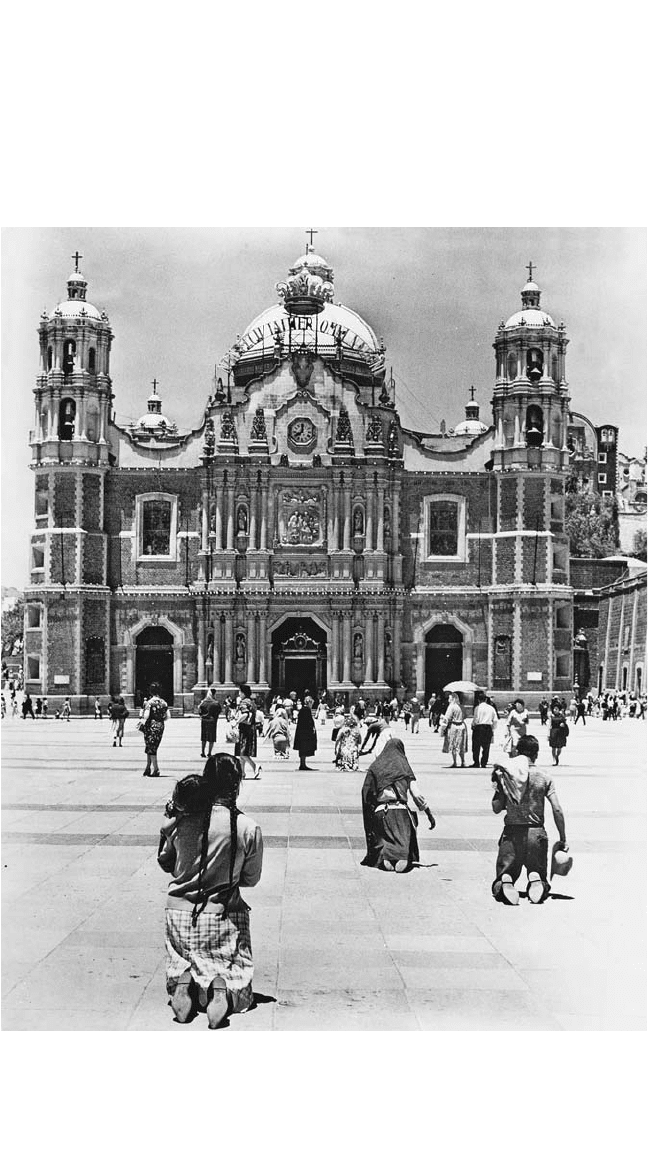
The old Basilica of the Virgin of Guadalupe (ca. 1700). Patron saint of Mexico and the favorite
of the poor, the Virgin’s shrine attracts an estimated 14 million pilgrims annually, more than
either the
Vatican or Lourdes.
(Courtesy of the Mexican Ministry of Tourism)

97
church tithes as well as bequests from everyone from Mixtec caciques to
wealthy Creoles. It would eventually own half the land in Mexico.
There are no more devout people in the world toward the
Church and clergy. In their lifetime they strive to exceed one
another in their gifts to the cloisters of nuns and friars. Some
erect altars . . . worth many thousand ducats . . . others at their
death leave to them two or three thousands ducats for an
annual stipend.
Thomas Gage, 1648 (1981, 70)
Because of the church, Mexico was left the legacy of two of its great-
est colonial painters. Miguel Cabrera (1695–1768), a mestizo born in
Oaxaca and abandoned to an orphanage, became the most popular
baroque painter in Mexico (see portrait on page 98) and a favorite of
the archbishop. His contemporary, Juan Correa (c. 1645–1716), son of
a freed African slave and a mulatto physician from Spain, was one of
the most prolific painters of his age, contributing many works to the
Mexico City cathedral. Given Mexico’s artistic heritage, it was appropri-
ate that when the Academy of San Carlos was established in 1785, it
granted admission to artists of all races.
The introduction of the printing press in 1537 enriched the cultural
life of the colony. Even though there was no newspaper until 1805,
weekly gazettes and literary reviews were published. Fifteen thousand
books (all passing the Inquisition’s censorial review) were printed in
Mexico during the colonial period. The first book published was a
bilingual one in Nahuatl and Spanish by Bishop Zumárraga; others
were written in a total of nine different native languages, and most
books were devoted to religious topics. Books were imported as well,
and Juan de Palafox y Mendoza (1600–59), who served both as bishop
of Puebla and viceroy, collected a personal library of 43,000 volumes,
the largest in the Americas.
The cultural life of Mexico City created two outstanding literary fig-
ures: Sor Juana Inés de la Cruz (1651–95), the great Mexican poet, and
her friend Carlos de Sigüenza y Góngora (1645–1700), a historian, sci-
entist, mathematician, and poet. The latter wrote an ode to the Virgin of
Guadalupe and a history of pre-Columbian civilization, yet, like most
of his class, held the native peoples in contempt.
The friars introduced sacred music into the colony from the earli-
est days, by training the Indians for the church choirs (and exempting
THE COLONY OF NEW SPAIN