
Hunefeldt C., Harris B. A Brief History of Peru
Подождите немного. Документ загружается.


Another important task Cáceres had to face was to end Indian resis-
tance in Peru’s central highlands, a movement he himself had initially
helped organize. By 1888, 45 of the most important haciendas in the
central highlands (about 10 percent) between Cerro de Pasco and the
province of Tayacaja (north of the Department of Huancavelica) were
still held by armed Indians. This occupation had begun in 1882 by a
decree issued by Cáceres, holding that Indian guerrillas were to punish
all those attempting to collaborate with the Chileans by occupying their
properties. Even after the war came to an end Indian guerrillas contin-
ued to take over more and more haciendas. What had begun as a patri-
otic effort had turned into a class confrontation. As president, Cáceres
now sided with landowners. Through negotiation and force the
Peruvian government sought to return these haciendas to their former
owners. It was not until 1902 that the last haciendas were recovered.
The reintroduction of the contribución personal—meant to replenish
empty state cof
fers—was another attempt to strengthen the hand of
landowners. Soon caudillo tactics were back in place. Cáceres had grad-
ually changed from the hero of resistance to an old-fashioned strong-
man. Having defended territorial integrity during the war, afterward he
handed over Peru’s most vital resources to the Peruvian Corporation.
Only 10 years after the Treaty of Ancón had been signed, new dis-
turbances were on Peru’s political horizon. Cáceres’s presidency ended
in 1890, but he had no intention of giving up power. He stage-managed
the selection of General Remigio Morales Bermúdez as his successor.
Shortly after taking office, however, Morales Bermúdez died in 1894. A
provisional junta organized new elections, and Cáceres again won.
Nicolás Piérola, the leader of the Democratic Party and a long-standing
opponent of Cáceres, objected to the results of the 1895 elections, and
after a short civil war, Piérola took power in March 1895. Because of his
measures in the aftermath of the War of the Pacific, Cáceres had lost his
support among peasants in the central highlands. Many earlier tayta
followers now sided with tayta’s enemies. The Partido Civil, which had
earlier supported Cácer
es, now supported Piérola. The old war hero
was on his way into permanent exile.
Modernizing Peru
In the wake of the War of the Pacific, Peru needed economic and polit-
ical uplift, and fortunately, a new generation of positivist thinkers with
much common and practical sense emerged. They added a new dimen-
sion of technical knowledge to politics and the organization of eco-
A BRIEF HISTORY OF PERU
154
155
THE WAR OF THE PACIFIC AND AFTER
nomic life by collecting and evaluating data on economic performance
and, perhaps most important, showing that successful politics need not
follow the whims of unversed individual strongmen. This new group of
technocrats was organized as the Geographical Society of Lima
(Sociedad Geográfica de Lima), founded in 1888 in imitation of similar
organizations in Europe and the United States. Aside from regularly
publishing a journal, the Boletín de la Sociedad Geográfica, the society
had a str
ong influence on natural resources research, evaluation of eco-
nomic feasibility projects, new scientific discoveries, and, last but not
least, the discussions on territorial boundaries. Prominent intellectuals
from the society and from the universities supported and often spear-
headed the government’s efforts to push Peru toward modernity.
The “Indian question” remained high on Peru’s government agenda.
There were two general opinions on this matter. The first was based on
social Darwinism, which held there was a parallel between the biological
process of natural selection and the social process: The “strongest” and
“best” of humans were meant to survive and move forward. Under this
viewpoint the white race and culture were believed to work together to
achieve development, whereas Indians were doomed to cultural—if not
physical—extinction. Therefore, social Darwinists believed that in order
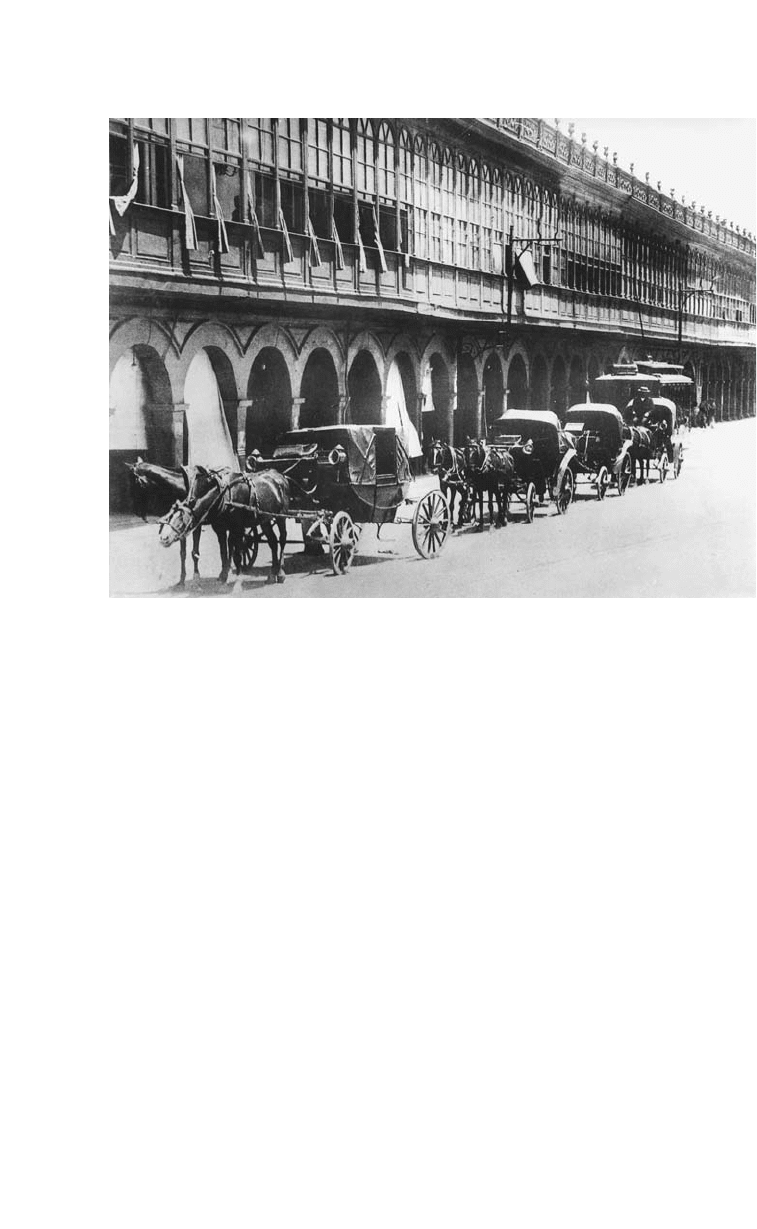
Lima in the late 19th century, following the War of the Pacific (Christine Hunefeldt)

to develop, Peru needed to improve its racial stock by bringing in
European immigrants. In 1894 a law to encourage immigration was
passed, but the results were dismal. Few European immigrants reached
Peruvian shores, and those who did and were settled in the Amazon basin
soon departed when they found themselves cut off from any governmen-
tal help. Although the Peruvian government had promised to build roads
to connect these outlying areas to markets and cities, these promises
never materialized. Europeans wishing to immigrate to the Americas had
better options in the United States, Brazil, Argentina, and Chile.
The second theory concerning Indians aimed to “redeem” the indige-
nous race by teaching Indians to read and write, which would “raise”
them to Western cultural standards. According to this theory, Indians
were behind in their evolution but not unable to learn. The best ways
of making Indians learn, in this view, were obligatory military service,
inclusion into the tax system, and educational reforms.
While grand reforms and intentions regarding Peru’s natives were
laid out, the economy needed cheap labor, and white landowners
wanted to expand current estates and create new ones. Cheap labor
meant Indian peasants, and more land meant Indian land. Indians were
indeed fundamental to the expansion of coastal haciendas and planta-
tions. By the century’s end they would be joined by another cheap labor
force, Japanese immigrants. Still, none of these laborers joined this
labor market of their own free will. Through indebtedness, Indians
from the highlands were dragged to the coastal haciendas, and many
Japanese immigrants did not have the faintest idea of what would
become of them once they left their homeland.
Rebuilding the State
Peru managed to rebuild its finances by resorting to indirect taxation.
Tobacco, opium, matches, and salt were widely consumed, and new
taxes on them, in addition to the existing alcohol tax, provided the
Peruvian state with a substantial portion of its income. The success of
this form of taxation allowed the Peruvian government to reduce taxes
on exports, thus greatly expanding exports. It also allowed the aboli-
tion—once again—of the contribución personal in 1895. By the end of
the 19th centur
y the Peruvian state had doubled its income since the
end of the War of the Pacific, and income would climb further over the
following years. The state no longer depended on private enterprise to
determine its budget, and private enterprise no longer depended on a
single export product such as guano but had diversified its investments
A BRIEF HISTORY OF PERU
156

157
THE WAR OF THE PACIFIC AND AFTER
into sugar, cotton, wool, rubber, copper, silver, and eventually also
petroleum. The Peruvian state had gained a certain level of indepen-
dence in its decision-making processes and could use key institutions
to further sponsor economic development.
During Cáceres’s presidency (1886), organizations such as the
Chamber of Commerce of Lima and the Register for Real Estate (Registro
de la Propiedad Inmueble) came into being and promoted internal credit
transactions. The Lima’s Bolsa de Valores (stock exchange) showed signs
of economic impetus around 1896 and allowed for new patterns of invest-
ment and the creation of new enterprises. Economic progress was further
enhanced by the opening of several banks: the Banco Italiano in 1889, the
Banco Alemán Transatlántico in 1897, the Banco Internacional in 1897,
and the Banco Popular in 1899. Separately, the establishment of civil reg-
isters for baptisms and deaths, which took such functions out of the hands
of the church, completed a century-long secularization process.
When Piérola came to power in 1895, the push toward decentraliza-
tion came to an end, the contribución personal was abolished, and local
administration costs wer
e carried by a Lima-based budget. Only educa-
tion, health, and public works remained under the aegis of local state
dependencies, the departments. Piérola also created a professional army
under the guidance of French advisers.
Piérola’s initiative to create a salt monopoly in 1895 provoked some
Indian upheaval in the highlands. Until then, salt had provided many
peasant communities with a source of supplemental income. It was also
The “Democratic Caudillo”
P
resident Nicolás Piérola was known as the “Democratic Caudillo.”
U.S. historian Peter Klaren has noted that Piérola believed only a
strong hand at the helm of an authoritarian central government (guided
in measure by the tenets of Catholicism) could hold Peruvian society
together in the face of the nation’s geographical diversity and class and
racial divisions.A weak government would be doomed to failure when
confronted with these forces. Piérola was convinced he reflected the
popular will, but he insisted on firm control. Endowed with high energy
and possessed of an engaging personality that allowed him to appeal
successfully to the masses, he was well suited to the task of governing
in such a fashion as a devout Catholic (Klarén 2000, 201).

A BRIEF HISTORY OF PERU
158
tied into Indian religious practices. The most dramatic Indian uprising
occurred in the northern part of the Department of Ayacucho, when
about 1,000 men from Huanta killed their mayor and the subprefecto.
Future president Oscar Benavides—at the time a lieutenant—led the
militar
y expedition against this rebellion and captured its leader, Juan
Sánchez. Other reasons for these scattered rebellions were Piérola’s
monetary reform, which aimed to regularize the money circulating
within the economy; the rejection of governmental bonds to pay taxes;
and the labor drafts imposed on the indigenous population to carry out
governmental tasks (the faenas de república, or “work of the republic”)
without pay—for example, as messengers, police, carriers, and con-
struction workers. Even after Piér
ola’s presidency ended, successive
governments tried to prohibit the free use of Indian labor but failed, in
large measure because the state lacked the financial resources to pay for
these services.
Overall, during 1895–99, Piérola followed in the footsteps of the ear-
lier civilista political and economic program. However
, unlike the
Partido Civil, he could not count on the abundant revenues obtained
from guano and nitrate. As president, Piérola concentrated power in
Peru’s capital city but left the more traditional highland provinces in the
hands of local powerholders known as gamonales; Lima’s government
depended incr
easingly on coastal plantation owners and foreign loans
and investments.
In a sense Peru shared in Europe’s belle epoque, when many Latin
American intellectuals and politicians looked to London and Paris for
examples to follow. For decades many more limeños traveled to London
and Paris than to the imperial capital of the Inca, Cuzco. This orienta-
tion went hand in hand with a neglect of domestic matters and a dis-
dain for the common people, especially Indians.
In 1899 Eduar
do López de Romaña (1847–1918) became president
based on a coalition between pierolistas and civilistas. Election results
in those days wer
e usually decided well before election day. Candidates
and their supporters would rally people, often imposing their candida-
cies by force, blackmail, or outright intimidation. Under the new elec-
toral law passed in 1895, illiterate citizens could not vote. Thus, in
1899, only 108,597 people, or around 2.5 percent of Peru’s population,
were eligible to vote. Only about half of these eligible voters actually
voted, and López de Romaña got the most votes by a very large margin.
López de Romaña’s successor in 1903 was Candamo, also a civilista.
Candamo died eight months after taking over the presidency, and the
Par
tido Civil imposed its chosen candidate, Augusto Bernardino Leguía

(1863–1932) in 1908. Leguía was followed by Guillermo Enrique
Billinghurst (1851–1915) in 1912 as a result of Peru’s first workers’
strike in Lima. It was the first time Peru’s masses had been sufficiently
organized to intervene in Lima’s “aristocratic” politics. Billinghurst was
not part of the oligarchy but a representative of the emerging middle
class. Civilistas, however, did not silently accept this turn of events, and
they or
chestrated a military coup in 1915 that put in power Oscar
Raimundo Benavides (1876–1945), restoring civilista dominance.
Another general strike over incr
eased costs of living in 1919 brought
Augusto B. Leguía back to power, in spite of his failures during his first
presidency. This time he used popular discontent to gain the presiden-
tial chair. Although civilistas had brought him to power in 1908, Leguía
now faced civilista opposition in parliament. Claiming there had been
electoral fraud, he closed down the parliament and governed Peru until
1930 with only a per
functory bow toward democracy. When Leguía
exiled opposition civilistas in 1919, the Partido Civil disappeared from
Peru’
s political map.
Those in power between 1900 and 1919 were inclined toward liber-
alism and modernization. They intended to turn Peru into a more
European-like country, that is, into a better-organized, more prosperous,
159
THE WAR OF THE PACIFIC AND AFTER
Views of Indians
V
entura García Calderón, a son of the former president Francisco
García Calderón, exiled to Chile at the end of the War of the
Pacific, and a candidate for the Nobel Prize in literature, described
Indians in his compilation of tales La venganza del cóndor (1923) as a
species of aliens with prominent cheeks and dark skins, who ate one
another’s fleas and fornicated with white llamas. His work was pub-
lished in several languages around the world.Yet García Calderón had
had little if any contact with Indians during his life.
In the view of Lima’s elites, Peru’s Indians were considered part of
the rich natural resources of the country.At the same time, however,
they were the source of all the country’s woes. In 1901, for example,
Manuel Candamo (1842–1904), president of the Peruvian senate and
future president of Peru, was convinced that Peru’s problems had
nothing to do with legislation but rather with its people, a challenge
that would eventually be resolved through race mixing (Bosadre 1983,
VIII: 102).

and better-educated nation. Several important measures were taken in
order to implement these progressive ideas. In 1900 the Mine Code
replaced the Old Ordinances of 1786. The new code guaranteed secure
investments and promoted more investments and the concentration of
mine ownership as well as the expansion of commercial agriculture.
Also encouraging this process was an 1890 decree that froze taxes on
exports for 25 years. Foreign experts were invited to help improve
Peruvian mines, agrarian technologies, and irrigation projects. In 1902
the Peruvian government established the National School for
Agriculture (Escuela Nacional de Agricultura).
The founding of new governmental agencies to promote progress went
hand in hand with a denationalization of national resources. More enter-
prises became foreign owned. As more regions became specialized in
more export products, the earlier regional division of labor also changed.
Economic Changes
Shifts in Ownership of the Mines
Many smaller Peruvian mines passed into foreign hands, especially the
rich silver and copper mines in the central highlands of Cerro de Pasco,
which became the property of the U.S. Cerro de Pasco Corporation,
founded in New York in 1901 with money from some of the biggest U.S.
fortunes, such as the Vanderbilts, Hearsts, and Morgans. In less than
three months, these interests bought up to 80 percent of the mines.
Other foreign companies followed suit. The Vanadium Company, for
instance, began monopolizing resources around 1907, and the Peruvian
Corporation alone, with a working capital of £19 million, only £2 mil-
lion less than Peru’s national budget, demanded preferential treatment
in the use of railways to lower transportation costs and monopolized
mineral refineries.
By 1920 the Cerro de Pasco Corporation and Northern Peru Mining,
another U.S. company, working in La Libertad, controlled almost all
Peruvian copper, silver, and gold. Through purchase, fraudulent legal
maneuvering, and manipulation of their refining monopoly, U.S. com-
panies gradually became the owners of most mining enterprises.
Moreover these mining companies bought large tracts of land as a way
to solve the labor problem. By depriving peasants of their small plots of
land, the companies gave them no choice but to sell their labor to the
mines. Total copper production rose from 275 tons in 1890 to 12,213
tons in 1905 and to 32,981 in 1920.
A BRIEF HISTORY OF PERU
160

A similar chain of events happened to the oil fields in northern
coastal Peru, where they became the property of British and U.S. com-
panies. The International Petroleum Company, founded in 1913,
bought the oil fields in Brea and Pariñas (Piura), which later came into
the hands of Standard Oil of New Jersey. Between 1905 and 1919 the
labor force working on Peru’s oil fields more than doubled, from 9,651
to 22,000 men, and oil exports came to represent around 10 percent of
Peru’s total exports. These companies worked as enclaves in the
Peruvian economy; that is, they had little effect on Peru’s internal econ-
omy, and technology and engineers came from abroad.
Agrarian Enterprises in the Central Highlands
Economic concentration also occurred with the once highly productive
agrarian enterprises in the central highlands. After the disasters of the
war many hacienda owners looked for support from Lima’s plutocracy
to overcome the nation’s crisis in the countryside. An alliance led to the
formation of large cattle-raising associations (sociedades), but soon the
provincial land and cattle owners found themselves excluded from
t
he boards of these associations, replaced by the most powerful families
in Lima (Prado Ugarteche, Mujica y Cavassa, Gallagher, Gallo Porras,
Barreda y Laos, and Alvarez Calderón, among others). By 1914 the rail
line to Huancayo was complete, and the international demand for wool
was at its peak. Consequently, just when rewards were highest, most if
not all properties had been transferred to outside hands. Gradually
these owners aggressively sought community-owned lands in an effort
to increase revenues still further and to augment the number of avail-
able laborers. In and around the La Oroya refinery toxic fumes and river
contamination poisoned peasant lands and animals. Peasants without
land became peasants who had to sell their labor to survive. Land,
mines, and regional commerce were now in the control of investors in
Lima and New York. Cerro de Pasco, once a part of the Department of
Junín, lost its intraregional links with the Mantaro Valley and in 1931
became administratively a separate department.
Plantations on the Central and Northern Coast
The War of the Pacific had devastated small and medium-size agrarian
enterprises on Peru’s central and northern coast. Chilean troops had
imposed high assessments on these properties, and the Chinese laborers
had fled the countryside. The destruction of agrarian properties in these
regions required high investments to restart production. Domestic capital
161
THE WAR OF THE PACIFIC AND AFTER

was scarce, and the only source left was external credit. So in the aftermath
of this war land became concentrated in few hands, and most landed prop-
erty became foreign owned. Big money came from Germany
(Gildemeister), England (Grace), and Italy (Larco), as well as from com-
mercial enterprises (Duncan & Fox, Graham & Rowe, Prevost, and
Kendall). Foreign owners had the necessary international contacts to
obtain money to rebuild, expand, and modernize their properties. Most of
these huge enterprises encompassed hundreds of square miles, some
extending well into the Peruvian highlands, often for the single reason of
obtaining cheap labor. They expanded irrigation systems and railroads
and used steam engines to transport their sugar and cotton to the Pacific
ports.
Some smaller landowners tenaciously resisted handing over their
properties; however, few could in the long run keep their properties.
Often, larger landowners resorted to violence to convince their smaller
counterparts to sell their land. Cutting off the water supply and harass-
ing the field laborers were common methods to obtain a property trans-
fer. When Peruvian nationals retained ownership, they often depended
on the larger enterprises to process their sugarcane. The results of these
events were the consolidation of large haciendas and the building of
strong agro-industrial enterprises on these haciendas. A new elite
emerged, the so-called sugar and cotton barons. There were also
regional shifts. Whereas during most of the 19th century, Lima had
been the main sugar-producing department, the Department of La
Libertad on the northern coast gained preeminence toward the turn of
the century. Between 1894 and 1912 Lima’s sugar production decreased
from 37.2 percent to 22.3 percent in terms of total national production,
whereas La Libertad increased its share from 30.8 to 43.8 percent.
Cotton production and commerce also depended on foreign capital.
Foreign merchant houses loaned short-term money to producers with
future harvests as the guaranty for repayment. If harvests failed, mer-
chant houses took over the land. It was only in the 1930s that cotton
producers finally gained access to internal financial resources. In
smaller coastal cities, such as Pisco, Chincha, and Cañete, commercial
enterprises processed raw cotton from local haciendas into exportable
cotton fiber and oil. Rice production during this time period was
mainly oriented toward the internal market, and rice became one of the
most important ingredients in Peruvians’ diet.
During World War I (1914–18), sugar and cotton prices rose dra-
matically, as did most other raw materials, providing further incentives
to expand production and production sites, even after prices leveled out
A BRIEF HISTORY OF PERU
162
163
THE WAR OF THE PACIFIC AND AFTER
in the early 1920s. By 1918 Peru had surpassed the productivity levels
of Hawaii, the most advanced sugar-producing site. Expansion contin-
ued well into the 1930s. Gradually some of the revenues obtained from
sugar, rice, and cotton exports was invested in urban financial ventures,
such as banking and insurance companies. The Banco Internacional del
Perú, the Banco Alemán Transatlántico, the Banco Popular, the
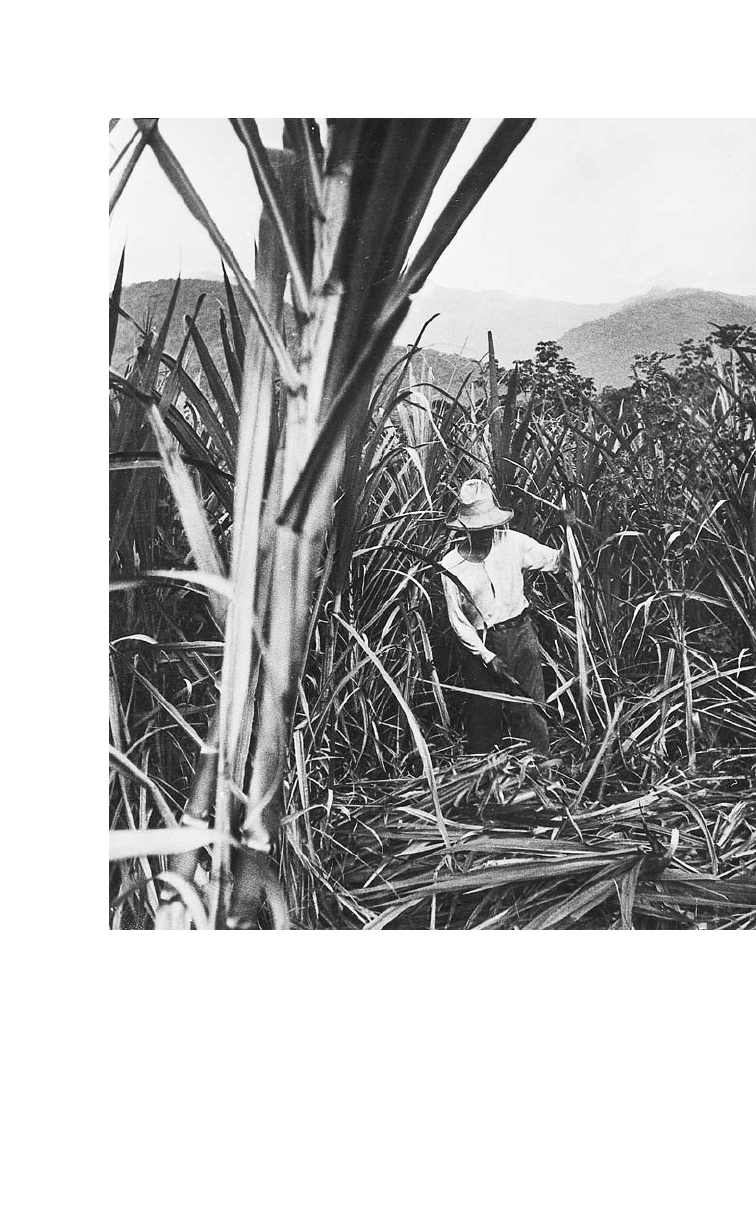
Cutting sugarcane (Reproduced with permission of the General Secretariat of the Organization
of American States)