
Hunefeldt C., Harris B. A Brief History of Peru
Подождите немного. Документ загружается.


Japanese Immigrants
Japanese immigrants arrived in Peru under very different conditions
than the earlier Chinese immigrants had experienced. In 1889 a few
Japanese technicians opened a silver mine in the Cerro de San Francisco.
Japan established diplomatic representation in Peru in 1897, and a year
later, the Peruvian government invited Japanese immigrants to work on
Peru’s coastal plantations. Augusto B. Leguía enticed the Japanese
Marioka Immigration Company to initiate the immigration process from
Japan. Contracts, most for four-year terms, were signed with individual
workers that specified the amount of salary and working hours. The first
Japanese immigrants arrived in 1899. In spite of many difficulties, by
1909, there were 6,000 Japanese immigrants in Peru.
After their labor contracts elapsed, some Japanese immigrants reset-
tled in the Amazon basin, especially in locations such as Madre de Dios
and Tambopata, where rubber was produced for the international mar-
ket. Some Japanese immigrants worked their way up and became
landowners on the coast. Especially in the Chancay Valley, they proved
to be very successful agrarian entrepreneurs producing cotton and fruit,
and a few even held political positions as local mayors. A future presi-
dent of Peru, Alberto Fujimori, was a descendant of Japanese immi-
grants and an agrarian engineer who owned land on the Peruvian
northern coast.
Proletarians Unite, Industrialization Nears
The regional and economic changes of the late 19th century produced
a new social structure, with new social actors, that had far-reaching
consequences for Peru’s development in the 20th century. Lima was the
only Peruvian city where a process of industrialization had already
begun by the end of the 19th century. Textile factories such as El Inca,
Vitarte, and Progreso employed more than 500 salaried workers.
Although few in number, these workers proved to have vital political
importance, especially during labor strikes. By 1920 Lima counted
30,255 artisans and 7,492 salaried workers. The first strike efforts were
led by Lima’s artisans, most prominently the bakers. In 1905 Lima’s
bakers were the first guild to demand an eight-hour work day. They
were followed by shoemakers, and the two unions joined efforts to help
bring Guillermo Billinghurst, outsider to the oligarchy, to power in
1912. Callao’s port workers, many of them Italians, also became actively
involved in the workers’ struggles for higher salaries and shorter work
days. It was 1913 when President Billinghurst decreed the eight-hour
A BRIEF HISTORY OF PERU
174

work day to some segments of the labor force, and in 1917 the eight-
hour work day was extended to all.
By then Peru’s workers had established international contacts with
other labor organizations whose predominant political doctrines were the
radical creeds of anarchism and anarco-syndicalism. Both philosophies
sought the destruction of existing governments and societies in order to
bring about a new age of equality and justice. Both also advocated the
indiscriminate use of violence to achieve their goals. Although anarco-
syndicalists celebrated the heroism and success of the workers in the
Russian Revolution of 1917, they criticized the Bolsheviks for betraying
workers’ political independence. As international winds changed and
Peru’s working class grew, workers gradually moved from anarco-syndi-
calism to party participation. The parties representing workers’ interests in
the 1920s were the Peruvian Socialist Party (Partido Socialista del Perú, or
PSP), led by José Carlos Mariátegui (1898–1930), and the Alliance for
Popular Revolution in America (Alianza Popular Revolucionaria
Americana, or APRA), led by Víctor Raúl Haya de la Torre (1895–1979).
Anarco-syndicalism had laid the foundations for workers’ initial
organization and—perhaps just as important—for a workers’ culture.
Organization and culture within the Peruvian labor movement were
widely influenced by immigrants from northern Italy, and several work-
ers’ unions produced newsletters between 1911 and 1926, among them
Plumadas de rebeldía (Strokes of rebellion), El hambriento (The hungry),
Los parias (The pariahs), El oprimido (The oppressed), and La protesta
(The protest). Newspapers and newsletters were widely read and, in
spite of irregular publication, had a strong bearing on the gradual con-
solidation of the labor movement. Theater and novels (sometimes pub-
lished as serials in newspapers and newsletters) dealt with workers’
issues, as well as workers’ lives and other concerns. Literary-musical
gatherings (veladas) were used to discuss the works of Bakunin,
Kr
opotkin, or Malatesta. Many workers’ initiatives counted on the sup-
port of renowned journalists and writers, among them César Falcón
and Mariátegui, and the university student leader Haya de la Torre.
Increasingly, politicians and journalists voiced their opinions
through the pages of newspapers and magazines, and there was also an
increasing tendency to think and write about both the past and the
future of the country. The number of publications grew, which indi-
cated a wide audience for such ruminations. From a total of 167 publi-
cations registered in 1918, the number rose to 443 by 1930.
The majority of such developments took place in Lima; however,
some minor initiatives emerged in other areas that counted at least some
175
THE TWENTIETH CENTURY: FIRST DECADES
A BRIEF HISTORY OF PERU
176
salaried workers, especially in locations where mines and coastal plan-
tations were producing for the international market. In 1905 Peru
counted 9,651 miners; their numbers rose to 19,515 in 1913, to 22,000
in 1922, and to 32,321 in 1929. Miners were concentrated in areas like
La Oroya and Cerro de Pasco, but many scattered mines located at more
than 12,000 feet of altitude employed fewer than 50 miners. The smaller
the mine, the more random was the political organization associated
with it. Besides mining, another industry in which rural laborers began
to organize was oil production. Oil production involved 5,831 workers
in 1928, of which 3,918 worked on the oil fields in Talara, owned by the
International Petroleum Company (IPC). Another important contingent
of salaried workers could be found on coastal plantations. About 16,000
workers produced rice around 1922. Twenty thousand workers pro-
duced cotton on 226 haciendas around 1915; this number rose to more
than 40,000 around 1922 and more than 65,000 around 1932.
Many of these nonurban workers, however, were not full-fledged
salaried workers but were still hired under noncapitalist, nonsalaried
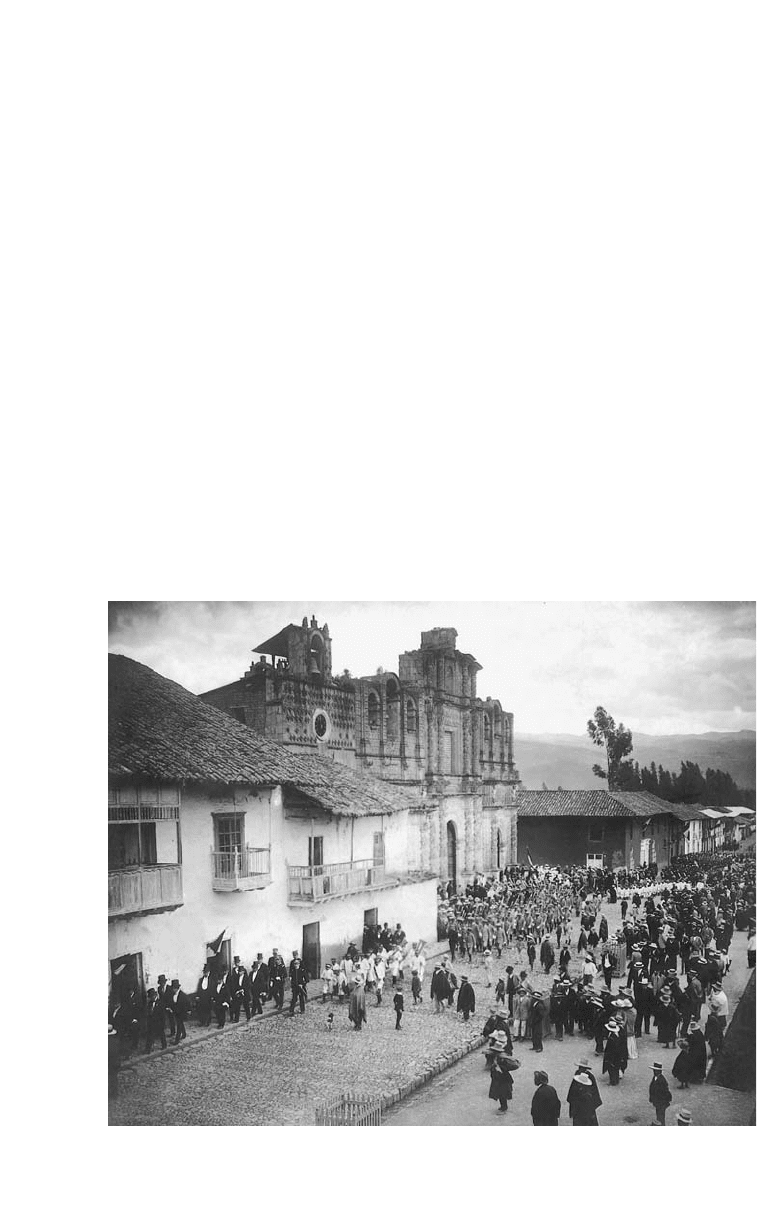
A military parade past the Cathedral of Santa Catalina in Cajamarca in 1919 (Reproduced
with permission of the General Secretariat of the Organization of American States)

conditions through the exploitative enganche debtor-enlistment system.
The greatest numbers of salaried workers were engaged in sugarcane
production, where the most efficient technology could be found.
Between 1912 and 1922 the amount of land cultivated for sugarcane
almost doubled (from 80,000 acres to around 145,000). This expansion
came with a concentration of landed property in fewer and fewer hands.
In 1910 there were 118 haciendas; in 1927 there remained only 70, and
by 1932 the number of haciendas was down to 64. The number of
workers increased steadily from 19,945 in 1912 to 30,159 in 1925. The
number of workers then decreased in the wake of the 1929 stock mar-
ket crash to around 25,000 but increased again to 28,294 in 1933.
Whereas around 27,000 workers labored in rice fields on 674 hacien-
das, 20,000 workers worked on 80 sugarcane haciendas. Thus, labor
was highly concentrated within sugarcane plantations. As a result of
geographical distance between haciendas, mines, and textile factories,
and because of different ownership and hiring patterns, little commu-
nication was possible or even allowed between workers in these differ-
ent sites.
Although scattered, social protest was on the rise. In 1912 workers
went on strike for several days in the Chicama valley, burning down the
sugarcane. Some people died during the protest. It was put down with
a strong military intervention from Lima.
An Emerging Professional and Intellectual Class
A new professional class, mainly employed in the service sector and in
an expanding state apparatus, was part of a changing social structure.
Peru needed to solve specific economic-export problems, and one result
was the founding of the School of Engineering and the School of
Agriculture. Consequently, Peru developed a larger and better qualified
corps of professionals. Initiatives sprang up not only to plan Peru’s
future, but also—more concretely—to reform the educational system as
a first step toward economic improvement. Many such plans hailed from
the provinces, especially from provincial universities. The most notable
efforts came from the Universidad San Antonio Abad in Cuzco, where
the election as chancellor of Alberto Giesecke, a U.S. citizen, changed
the educational outlook by focusing the college curricula on regional
problems and their solutions instead of mimicking European models.
Puno and Arequipa students read more newspapers from Buenos Aires
and Europe than from Lima. In general, intellectuals from the provinces
greatly influenced intellectual life and political debate in Lima.
177
THE TWENTIETH CENTURY: FIRST DECADES

A BRIEF HISTORY OF PERU
178
Previously barred from universities by the Partido Civil, this emerg-
ing intellectual middle class now swelled the ranks of the schools.
Students’ own resentment at their earlier exclusion and the influence of
the Mexican and Russian revolutions led to a radicalization of the stu-
dent movement. In turn the spread of radical, liberal, and even socialist
voices inspired a backlash that led to the formation in 1917 of the
Pontifical Catholic University in Lima (Pontificia Universidad Católica
del Perú, or PUC). The Catholic University became the conservative
counterpart to an increasingly radical student movement engaged in
reforms and based out of the San Marcos University (Universidad
Nacional Mayor de San Marcos, or UNMSM). Students and workers
closed ranks in a massive strike in 1919 that brought about substantial
gains for both. President Augusto B. Leguía, on the other side,
responded by co-opting intellectuals for his Patria Nueva policies, by
deporting irritating critics such as Haya de la Torre, or by handing out
official support, such as paying for the trips of Mariátegui and Falcón to
Europe. Despite the political climate and repression, Peru witnessed an
era of intellectual effervescence through its “generation of reformers.”
Intellectuals of the caliber of historians Jorge Basadre and Raúl Porras
Barrenechea, archaeologist Julio C. Tello, and political analyst and writer
Luis Alberto Sánchez were part of this socially committed generation.
El FÚtbol
S
occer, called fútbol in Spanish-speaking countries, was imported to
Peru originally by British sailors in the 1880s, who began playing
matches among themselves in Callao.The British merchant and business
colony in Lima soon took up the sport and established it as part of their
recreation sports clubs, such as the Lima Cricket and Football Club. In
1890 local Peruvians were allowed to join soccer clubs, and soon the
sport began to spread.Working-class teams sprang up, first among the
stevedores and sailors of Callao but soon in the poorer neighborhoods
of Lima. By the first decades of the 20th century, soccer clubs were
established parts of life in Lima and its environs, and workers used the
clubs as centers for social organization.The National Stadium opened
in the 1920s and hosted what became a continuing rivalry between two
teams:Alianza Lima, made up mostly of black players from the working-
class neighborhoods, and Universitario de Deportes, a club composed
of university students from middle- and upper-class families.

Academic publications aimed to reach larger audiences, and many aca-
demic articles were first published in journals and newspapers that were
more accessible to more people. Intellectuals founded public universities
meant to study Peruvian reality and to actively think about changing it.
An interesting side product of the rapid urbanization, social mobil-
ity, and state concerns was the emergence of sports as a means to
enhance public health and morale. Clubs and sport associations, many
of which still exist today, proliferated. Some of these associations pro-
moted several new sports, such as basketball, rowing, swimming, bik-
ing, and soccer, all of them of European origin. These sports gradually
replaced or complemented prior colonial social activities, such as reli-
gious processions, bullfights, and cockfights.
Indigenismo
A current of thought that described Peru’s Indians from a non-Indian
perspective, indigenismo was a movement within this larger intellectual
r
eformism. It also was part of a nascent regional nationalism and pride
and a reaction to the viewpoint, that Indians were an inferior race good
only for manual work, the army, and serfdom. Indigenistas, in contrast,
set out to r
evalue Indians’ history and culture and to ease their path
into modernity.
There were, in fact, many indigenismos. The movement began as a lit-
erar
y endeavor but soon involved politics, painting, social sciences,
archaeology, and even medicine. An oligarchic version of indigenismo
promoted Indians’ integration to Peruvian society through education,
hygiene, and r
eligion. Writer Manuel González Prada, in a more radical
version, held that the main problems Indians had were not religious or
cultural but social and economic. Mariátegui and Haya de la Torre took
González Prada’s argument still further. They argued that without a
redistribution of land nothing could or should be done for Indians. The
only way to redistribute land was by eliminating latifundia (the large
pr
operty-holding system that included haciendas) in the highlands.
Not all indigenistas proposed such radical measures. Many writers and
ar
tists portrayed how Indians lived: their daily sufferings at the hands
of unscrupulous landowners, priests, and state bureaucrats, but also the
rich traditions and culture that informed their living and social inter-
action. By focusing on these subjects academic indigenistas spread a
higher sensibility toward indigenous issues in Peru and beyond.
The novel Aves sin nido (Birds Without a Nest) by Clorinda Matto de
T
urner was published in 1889. It gained Matto de Turner instant
179
THE TWENTIETH CENTURY: FIRST DECADES
A BRIEF HISTORY OF PERU
180
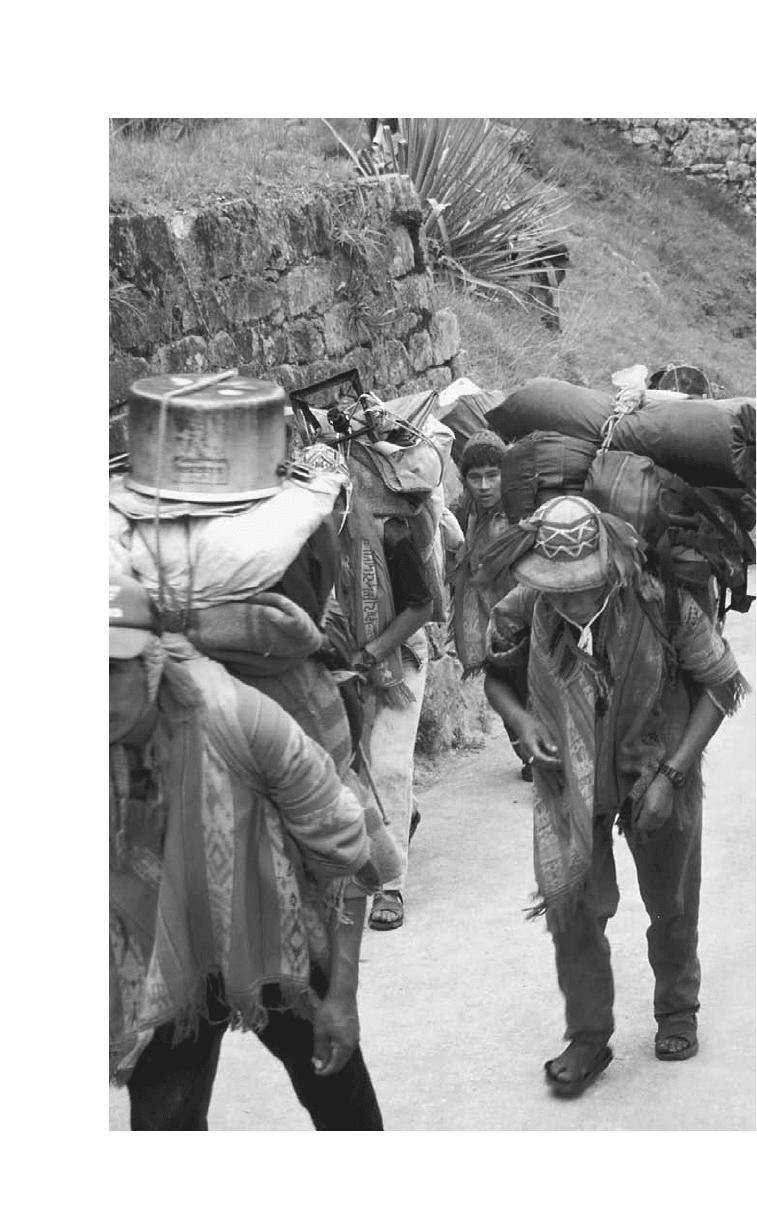
Peruvian peasants became the focus of the intellectual movement known as indigenismo
during the early decades of the 20th century.
(Photofrenetic/Alamy)

181
THE TWENTIETH CENTURY: FIRST DECADES
celebrity, excommunication from the Catholic Church (because she
questioned celibacy), and her exile until her death in Argentina in
1909. Along with Matto de Turner, Pedro Zulen, Dora Mayer, and
Joaquín Capelo were the most important protagonists of the literary
component within indigenismo. They attempted to organize Indians
into action gr
oups and wrote lengthy treatises on the miseries of Peru’s
Indians, compiled in a landmark publication, El deber proindígena (Our
pr
oindigenous duty). José Sabogal and Julia Codesido painted Indians
and their daily lives, while others, such as Daniel Alomia in his opera
El condor pasa (first presented in 1913, and with 3,000 performances in
the following five years), sang about Indians. In the social writings of
Hildebrando Castr
o Pozo, José Varallanos, José Luis Valcárcel, Uriel
García, and Ernesto Reyna, Indians appeared as historical subjects
rather than as objects of philanthropic and compassionate policies.
Tempestad en los Andes (Tempest in the Andes) by Valcárcel and El nuevo
indio (The new Indian) by García had long-lasting impacts. Political
writer González Prada often met with this group of ar
tists in the Lima
Literary Circle (Círculo Literario), and it was González Prada, who
through his strong critical voice against racial discrimination and vio-
lence, later awakened the thoughts of Mariátegui (founder of the PSP)
The Plight of the Indian
T
he following is an excerpt from a speech given by author Víctor
Andrés Belaúnde in Arequipa in 1915 when he was running for
deputy in a local election.
The colonial ties have not disappeared. Once I said that we all carry
the souls of encomenderos and corregidores. The illusion that
Indians could become individual pr
operty owners led us to abolish the
peasant communities. These communities, lacking a legal status and
not having the support of the state, have been continuously losing their
lands. The enganche has replaced the mita. Indians are still tied to the
land thr
ough serfdom, a situation that historically puts us in the heart
of the Middle Ages. . . . However, our situation is even worse. The
feudal lord in Europe lived on his estate and was there to defend it and
provide protection. He was the first one on the battlefield and often
the first one to die. . . . In our society, feudalism reigns, but without
religion, poetry, and glory (Belaúnde 1883, 127;
translated by Christine
Hunefeldt).

and Haya de la Torre (founder of APRA). Mariátegui opened the pages
of his journal Amauta to the indigenista writers because he was con-
vinced that without taking into account and per
haps even involving
Indians, Peru could not realize a socialist political program. Although
many of these intellectuals were sincerely committed to the “Indian
cause,” some did not see the contradiction between exalting Indians in
print while keeping indebted Indians on their landed properties. Often
intellectual discourse did not translate into reality.
Some indigenistas applied a hands-on strategy. Educator José Antonio
Encinas, for example, dir
ected a primary school in Puno between 1906
and 1911 in which Indian children learned in their native language. Some
of Encinas’s students later became teachers in their home communities.
Encinas himself called this “a new school,” and many of his ideas were
published in his 1932 book, Un ensayo de escuela nueva en el Perú.
There also was an “of
ficial” indigenismo, promoted by and through
the Peruvian state. President Leguía gave speeches in Quechua (a lan-
guage he did not know), facilitated a congress of Indian leaders in
Lima, introduced a holiday into the Peruvian calendar (Día del Indio,
June 24, coinciding with the Incan ritual of Inti Raymi), established an
agency devoted to indigenous issues, and promulgated laws to provide
official recognition to Indian peasant communities, thus providing
these communities with an organization to defend themselves against
attacks from large landowners. However, whenever peasant unrest
threatened local stability, Leguía sided with the landowners.
Peasant Unrest
During Leguía’s first presidency, from 1908 to 1912, peasant insurgen-
cies became more radical and more widespread. In fact, the first two
decades of the 20th century in Peru were of continued peasant unrest,
reaching a peak between 1919 and 1924 (during Leguía’s second presi-
dency), at a time when the end of World War I greatly reduced prices
of raw materials on the international market. Previously a hike of these
international prices had produced a massive attack on peasant commu-
nities’ lands in Peru’s highlands. Some signs of unrest were plainly vis-
ible in the first decade of the 20th century, but it was 1912 when
peasant unrest expanded, radicalized, and began questioning govern-
mental policies. In response, the new president, Guillermo Enrique
Billinghurst, further opened political opportunities for peasants and
provided them with a sense that matters could change for the better. In
1913 Billinghurst sent Major Teodomiro Gutiérrez Cuevas to Peru’s
A BRIEF HISTORY OF PERU
182

183
THE TWENTIETH CENTURY: FIRST DECADES
southern highlands. His mission was to investigate several complaints
by Indians in the region about their sufferings at the hands of local
gamonales. Gutiérrez Cuevas had been subprefecto of Chucuito in 1903
and of Huancayo in 1907, and had since then been known for his sen-
sitivity towar
d the plight of the Indian. He became known as Rumi
Maki (Quechua for “stone hand”) among Indians. With Billinghurst’s
loss of power in 1914, all official channels were closed, and Rumi
Maki—as some Indian leaders before him—was forced to resort to
direct action—that is, insurrection. Once again this peasant upheaval
was brutally suffocated.
Guillermo E. Billinghurst
G
uillermo Enrique Billinghurst was Peru’s first non-civilista president
since the mid-19th century. Born in Arica in 1851, he was a for-
mer nitrate field owner in southern Peru who lost his mines to Chile
in the aftermath of the War of the Pacific. Like most other leaders from
southern Peru, he supported Nicolás de Piérola’s Democratic Party.
Billinghurst would seem to have been a natural choice for the party’s
presidential candidate in the 1899 elections, but he was passed over and
subsequently retired briefly from politics. In 1909 he became mayor of
Lima, and three years later he became Peru’s first populist president.
Previously Peru’s congress had annulled the election of Antero Aspíllaga,
one of the sugar barons of the coast.The argument for annulment was
that the elected candidate had not received the required one-third of
the votes needed to legitimate his election. Democrats, however, knew
that in a national election process they would be unable to defeat the
civilistas, who had, over many decades, established vast electoral net-
works and thus controlled elections in the provinces. During elections,
the Democrats sabotaged the electoral process by physically burning
down the polling sites and by intimidating voters.The electoral tribunal,
in turn, annulled many election lists, making the one-third voting partic-
ipation impossible. All this was possible because the Democrats could
count on the support of Lima’s workers and more generally on Lima’s
urban working class, who had recently seen a significant hike in their liv-
ing costs. Begun in 1912, Billinghurst’s presidency lasted less than two
years.A coup d’état by Colonel Oscar R. Benavides, a military hero from
a border skirmish with Colombia over rubber fields, brought
Billinghurst’s presidency to an abrupt end in 1914. Once again, civilistas
regained power. Billinghurst died one year later in Tarapacá.