
Hunefeldt C., Harris B. A Brief History of Peru
Подождите немного. Документ загружается.


For some time, Indians continued to believe that some changes could
occur. When Leguía assumed the presidency again, in 1919, local (often
corrupt) bureaucrats were replaced by members of Leguía’s New Party.
The main change during Leguía’s regime was the official and legal recog-
nition of Peru’s peasant communities, which had a far-reaching impact
when used by Indians and Indian communities to defend their land.
On June 16, 1920, the Central Committee for Indian Rights
(Comisión Central Pro Derecho Indígena “Tahuantinsuyo”) was estab-
lished, and Indians paid a rama, a small amount of money (one sol), for
the committee’
s representation in lawsuits on their behalf. This rama
funded a significant infrastructure of representatives for Indians to the
central government in Lima that br
ought governmental concerns and
peasant grievances somewhat closer. In response delegates from the
government often visited local communities to hear their complaints.
By doing so, they created many expectations among peasants, particu-
larly that of regaining their land lost to gamonales, powerful local offi-
cials. Expectations wer
e further heightened when the first Indian
congress was held in Lima in 1924. In this congress, delegates approved
a declaration of the principles of the Comisión Central Tahuantinsuyo.
Four more congresses followed over the next few years, all important
landmarks in the struggle to uphold Indian peasants’ rights.
Legislative changes spilled over into actions. Beginning in September
1920 Indian peasant communities began mobilizing to regain their lost
land. Often, violent confrontations, ending sometimes with the killing
of hacienda managers, were the result. Around 1922, workers at vari-
ous levels in the haciendas joined the peasant communities in their
mobilization. The peasant movement not only gained numbers of par-
ticipants but also spread over a large region. Massive peasant unrest was
recorded in Huancané (Puno, 1923), La Mar (Ayacucho, 1923) and
Parcona (Ica, 1924).
Lima’s government and even some earlier supporters of indigenous
rights began turning their backs on peasants. The government abol-
ished the rama and founded a parallel institution to the Comisión
Central Tahuantinsuyo called the Patronato de la Raza Indígena, which
r
educed the Comisión’s power. With the loss of the rama the Comisión
lost its financial underpinnings. Not much later, in October 1922, the
Comisión itself was declar
ed illegal. After this pivotal moment Peru’s
government sided with the gamonales and engaged in severe repressive
measures against Indian peasants. Gamonales began organizing their
own paramilitar
y groups, which quite often consisted of hacienda
workers led by gamonales. Moreover, gamonales and their followers did
A BRIEF HISTORY OF PERU
184

not hesitate to use the military and government-paid police forces.
Although minor skirmishes continued, the big wave of Indian rebellion
had come to an end.
Peru’s Leaders: Oligarchs and Gamonales
Oligarchs held direct power until the 1930s and retained much influ-
ence until the late 1960s. A combination of extended family ties, nepo-
tism, consensus, and violence helped to keep them in power while
excluding, neutralizing, and controlling Peru’s lower and middle
classes. Peru’s oligarchy was a conglomerate of 40 to 200 families
(depending on where one draws the power line) that regarded them-
selves as the owners of the country. Their meeting place—where much
of the business was done and alliances forged—was the Club Nacional,
located in the heart of Lima.
These families owned the most important resources of the country,
especially the sugarcane-, cotton-, and rice-producing plantations as
well as the growing insurance companies, the banks, and the commer-
cial enterprises. Marriage alliances helped these families consolidate
their power and often extend their influence beyond Peru’s boundaries.
Daughters of Peru’s oligarchic families who married European bankers
not only extended their families’ economic ventures but also main-
tained their whiteness (or according to them even “enhanced” it). As in
many other Latin American countries, the practices of the oligarchy
deepened the already existing social and racial gaps within Peruvian
society. However, this class was not quite equivalent to the colonial
nobility. They engaged in new economic endeavors, employed new
ways of thinking, and developed far-reaching networks that reached
down in society.
After Billinghurst’s short, two-year Democratic presidency, the oli-
garchy and the Partido Civil, reinstalled their initial political agenda,
with some important additions and reforms. Their economic policies
continued to be outward looking—that is, promoting raw-material
exports and seeking foreign investment. However, they reorganized the
state apparatus. Peru’s oligarchs understood that a mounting social
unrest needed a state able and willing to mediate and integrate. Fiscal
and administrative modernization, a more professional army under
civilian control, and the development of the educational and health sys-
tem were the means used to reform the state apparatus. Indians, the oli-
garchy argued, would benefit from enhanced education and health and
would in the long run be better equipped to integrate into society.
185
THE TWENTIETH CENTURY: FIRST DECADES
A BRIEF HISTORY OF PERU
186
Municipalities, in charge of the educational system since 1876, had
been stripped of this prerogative during José Pardo y Barreda’s presi-
dency back in 1905. From there on education was a state issue, and
education became universal and free. Similarly the Board of Public
Health (Dirección de Salubridad Pública) had been created within the
Ministry of Public Works in 1903, largely in response to a plague epi-
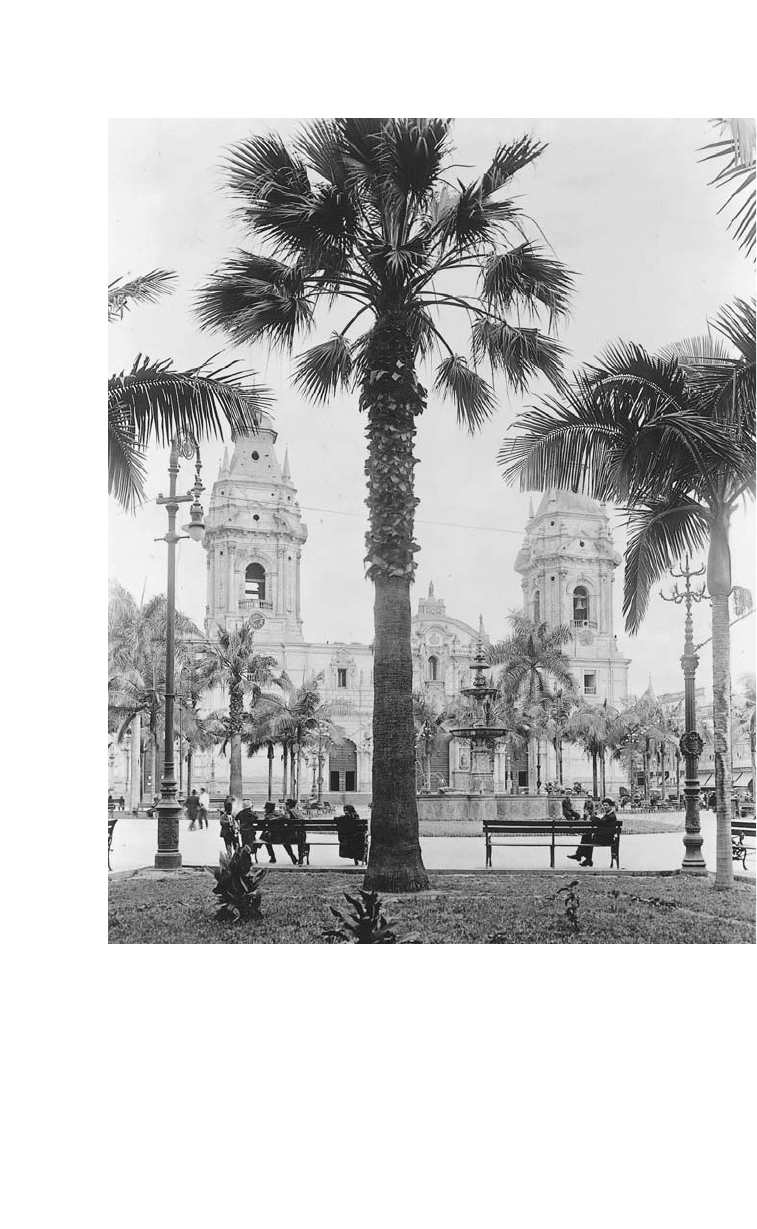
The cathedral facing the Plaza de Armas in Lima (Library of Congress)

demic in Lima that year. However, the board’s responsibilities grew
beyond its initial administrative boundaries, and in 1935 it became an
independent ministry of health. Following this modernizing trend
other important institutions came to life between 1895 and 1915: the
National Industrial Society (Sociedad Nacional de Industrias), the
National Mining Society (Sociedad Nacional de Minería), the Board of
Lawyers in Lima (Colegio de Abogados de Lima), the Engineering
Society (Sociedad de Ingeniería), the National Agrarian Society
(Sociedad Nacional Agraria), and the Peruvian Husbandry Association
(Asociación de Ganaderos del Perú).
Provincial caudillos and gamonales did not belong to the oligarchy and
ther
efore could not command as much political power, but they did nev-
ertheless have considerable power, especially in Peru’s highlands. Earlier
caudillos had lost much influence in the wake of the War of the Pacific,
and new caudillo-like leaders generally assumed regional power—mostly
through land ownership and by holding political positions—while Peru
diversified its export economy and enacted military reforms. These
gamonales tended to replace prefectos and subprefectos—the official, Lima-
appointed political leaders in the departments and provinces—in their
roles of military leaders, allowing the gamonales to expand their power in
tandem with their contr
ol of the best agrarian production sites. Military,
political, and economic power were thus in the hands of a few regional
bosses. Using their position they extended their social and political net-
works to control largely everything in their respective provinces.
However, their power was not stable; they could be removed by the cen-
tral government in Lima, and fights among gamonales over provincial
r
esources were frequent. These power struggles between gamonales often
involved the region’s Indians, too, as they chose sides. The r
esult was that
no real political predominance was established.
During the civilista period, Peru was highly dependent on foreign
capital and investments but experienced an impor
tant diversification of
exports, a limited industrialization, and a certain level of autonomous
development. Exports grew from 3.073 billion Peruvian pounds in
1899, to 9.138 billion in 1913, and to 35.304 billion in 1920. Unlike the
earlier guano camps, export sites were not enclaves but promoted links
to national producers (Thorp and Bertram 1985, 113, 132, 220).
Services and inputs for the export economy came from local producers.
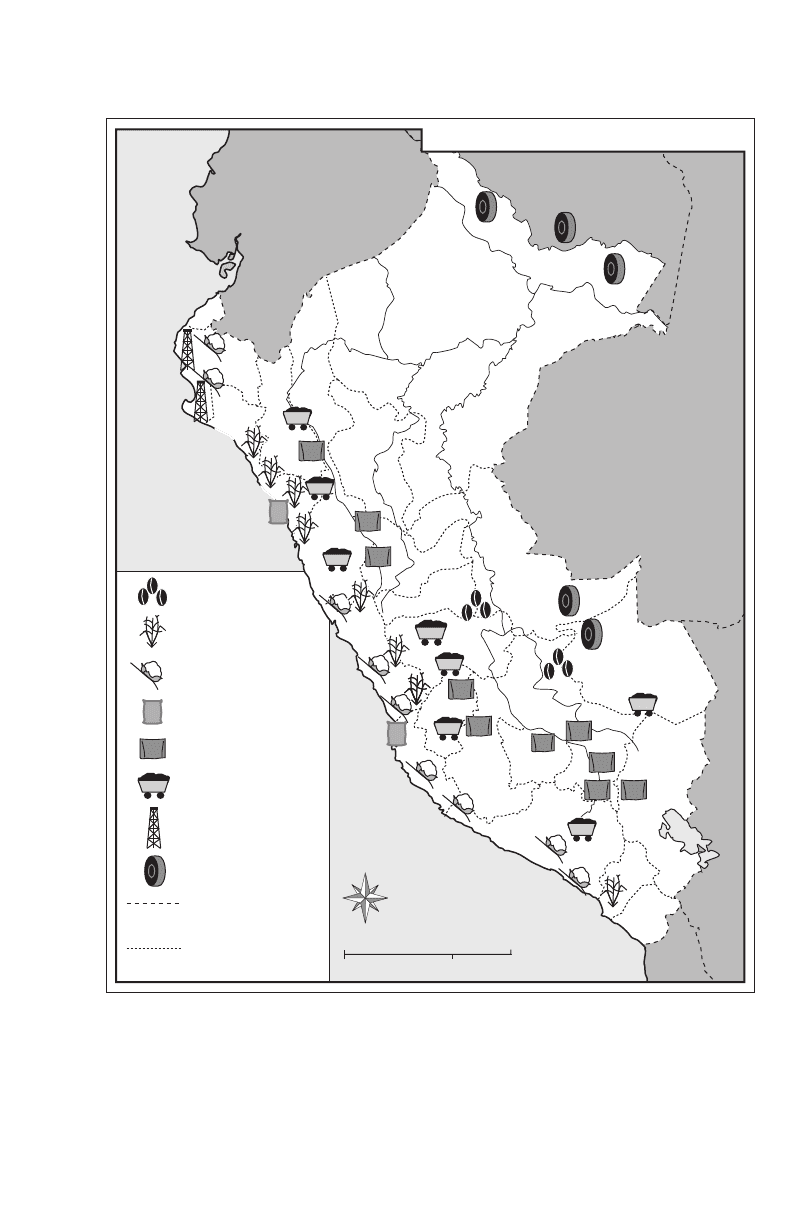
The addition of oil, copper, vanadium, and wool, diversified exports.
Diversification was intimately related to the opening of the Panama
Canal in 1914, World War I, and the continued efforts by the Peruvian
Corporation to extend the railroad network to Cerro de Pasco,
187
THE TWENTIETH CENTURY: FIRST DECADES

Huancayo, and Cuzco. Overall, this period was marked by Peru’s search
for material progress, social integration, and political and institutional
expansion, albeit with uneven results and varied repercussions for the
social groups involved.
Leguía’s Eleven Years
Augusto B. Leguía, initially committed to civilista principles, used gen-
eral dissatisfaction with oligarchic rule to prepare his path to Peru’s
presidency. Leguía lived in London from 1913 to 1919, when he
returned to Peru to present his candidacy against the civilistas, whose
sitting pr
esident, Pardo, had lost all support from workers and the mid-
dle class. Leguía, in turn, enjoyed the support of college students,
workers, and the middle class. Students of the San Marcos University
hailed him as the “maestro de la juventud” (mentor of Peru’
s youth).
Concomitantly Leguía believed the newly emerging social groups of
entrepreneurs, bureaucrats, professionals, and students, not the export-
oriented oligarchs, to be the modernizing elements of the country.
Antero Aspíllaga, a northern coast sugar baron, turned out to be a
weak civilista candidate, and the other parties in the presidential cam-
paign flagged: The Democratic Par
ty was debilitated after its leader,
Nicolás de Piérola, died in 1913; the Constitutional Party—whose candi-
date was Andrés Avelino Cáceres, the hero of the War of the Pacific—was
basically a conglomerate of war veterans; and the new Liberal Party—did
not have a social base or a defined political project. Leguía seized the
moment under these conditions and became president in 1919.
During his electoral campaign, Leguía had promised to solve the pend-
ing territorial issues with Chile, recover the provinces of Tacna and Arica,
lower the cost of living, increase public works, and boost national defense
(that is, the military). Together these promises formed an anti-civilista pro-
gram. Though the electorate seemed to favor him, Leguía did not await
the scheduled elections. On July 4, 1919, he instigated a coup d’état,
which he believed would increase his ultimate contr
ol of the state. Even if
Leguía had won the elections, he certainly would have found much oppo-
sition in congress, where only two-thirds of its members were newly
appointed every four years. The coup allowed Leguía to dissolve congress
and put together another that would support his policies. The national
assembly nominated Leguía as constitutional president and prepared a
new constitution to replace the 1860 constitution. The main changes in
the Constitution of 1920 were the cancellation of the one-third parlia-
mentary renewal clause, the extension of the presidential mandate from
A BRIEF HISTORY OF PERU
188

four to five years, the introduction of a progressive income tax, and the
formation of regional congresses in Peru’s north, center, and south. These
congresses were an attempt to decentralize Peru. However, soon after his
initial decentralization effort, Leguía moved in the opposite direction,
toward a heightened political and economic centralization in Lima.
Municipalities were turned into Assemblies of Notables (Juntas de
Notables), and the notables were hand-picked by the government.
By controlling elections such that he was the only presidential can-
didate, Leguía managed to stay in power for a second term from 1924
to 1929. His main electoral agenda was the consolidation of the “Patria
Nueva” (New Country), a program geared toward social progress and
the participation—mostly rhetorical—of the working class and Indians.
To finance the state’s course of modernization and growth, Leguía
increased export taxes despite fierce opposition from export barons,
resorted to foreign (especially U.S.) loans, and instituted income taxes,
which actually represented only a very small portion of total state rev-
enues. Incomes higher than 15,001 soles only paid 6 percent of income
tax; nevertheless, total state income grew from 66 million soles in 1919
to 123 million in 1925 and to 149 million in 1930. Peru’s foreign debt
increased in tandem, from 25 million soles in 1919, to 221 million only
10 years later. In spite of fiscal deficit, in 10 years the Peruvian sol only
lost about 15 percent of its exchange value against the U.S. dollar.
During his second term, Leguía continued in his efforts to under-
mine the civilistas’ political power. He also followed a populist policy
that af
fected gamonales in the south. Leguía officially recognized Peru’s
peasant communities, established the Patronato de la Raza Indígena to
defend Indians and the Day of the Indian (Día del Indio), and or
ganized
agrarian and technical learning centers in rural areas.
Gradually Leguía’s government put in place large-scale irrigation
projects, in the Chira and Olmos Valleys in Peru’s north and in the
Imperial Valley in the south, to expand the cultivation of sugarcane and
cotton. These projects were guided technically by U.S. expert Charles
Sutton. Leguía’s administration also added some new railroads to the
existing lines. The railway between Huancayo and Huancavelica was
inaugurated in 1926, and the railroad between Cuzco and Quillabamba
was begun. In 1923, the beginning of the construction of the Pan-
American Highway for the first time allowed travel by car between the
cities of Lima, Ica, and Trujillo, and Huancayo became connected to
Lima via the Central Highway. Regular airplane routes were established,
and air travel between Lima and the outside world, as well as between
Lima and other Peruvian cities, became an everyday experience. For
189
THE TWENTIETH CENTURY: FIRST DECADES
A BRIEF HISTORY OF PERU
190
international flights, Panagra airline opened its offices in Limatambo,
and for national flights to the interior Faucett Airlines was in charge. In
one of his many public speeches Leguía encapsulated his vision: “On
the coast I water, in the highlands I connect, in the jungle I colonize”
(Contreras and Cueto 2000, 223).
250 kilometers
0
250 miles
0
N
G
M
W
Coffee
Sugar
Cotton
Guano
Wool
Minerals
Oil
Rubber
Contemporary
national boundary
Contemporary
provincial boundary
HUANCAVELICA
APURÍMAC
AYACUCHO
U
r
u
b
a
m
b
a
R
.
PIURA
AMAZONAS
HUÁNUCO
A
p
u
r
í
m
a
c
R
.
TACNA
MOQUEGUAMOQUEGUA
AREQUIPA
PUNO
CUZCO
APURÍMAC
AYACUCHO
MADRE DE DIOS
HUANCAVELICA
ICA
PASCO
UCAYALI
LIMA
JUNÍN
PIURA
CAJAMARCA
SAN
MARTÍN
LAMBAYEQUE
AMAZONAS
LA LIBERTAD
ANCASH
HUÁNUCO
LORETO
Pacific Ocean
Lake
Titicaca
Y
a
v
a
r
i
R
.
N
a
p
o
R
.
A
m
a
z
o
n
R
.
P
a
s
t
a
z
a
R
.
U
c
a
y
a
l
i
R
.
H
u
a
l
l
a
g
a
R
.
U
r
u
b
a
m
b
a
R
.
P
u
t
u
m
a
y
o
R
.
M
a
r
a
ñ
ón
R.
A
p
u
r
í
m
a
c
R
.
CHILE
ECUADOR
COLOMBIA
BRAZIL
BOLIVIA
Principal Exports, circa 1910
G
G
M
M
M
M
M
M
M
M
W
W
W
W
W
W
W
W
W
W

191
THE TWENTIETH CENTURY: FIRST DECADES
Leguía also improved Peru’s cities with public health and hygiene
efforts, such as building water and sewage systems, paving streets and
sidewalks, and organizing trash collection and city lighting. During the
centennial anniversary of Peru’s independence from Spain, in 1921 and
1924, Lima saw the inauguration of the Hotel Bolívar, Hospital
Arzobispo Loayza, and Plaza San Martín. Soon, a network of roads con-
nected Lima’s expanding outlying areas with its center and its port city,
Callao. All such endeavors created new jobs (the number of business
and state employees in Lima grew from 6,821 in 1908 to 37,588 in
1930), the development of industries such as cement and civil con-
struction enterprises, and new business sites for local banks.
Another important product of governmental involvement was Peru’s
territorial boundaries. Colombia and Peru signed the Salomón Lozano
Treaty in 1922 by which Colombia gained access to the Amazon basin
through the Leticia Triangle. Treaty of Lima, with Chile, was signed in
1929, through which Peru recovered Tacna and Arica became part of
Elmer Faucett and Peru’s
First Airlines
L
ima’s modern airport is named after the American Elmer “Slim”
Faucett. Faucett, who was one of many pilots from the United
States and Europe who flew in Peru between 1915 and 1930, came to
Peru in June 1920 to attend flight school,graduating in 1921. In the same
year, the Peruvian government offered a reward to anyone who could
fly from Lima to Iquitos, crossing the country from west to east and
surmounting the high Andean mountain peaks. Faucett took up the chal-
lenge in his 150-horsepower Oriole Wright, a two-engine biplane with
an open cabin. Faucett did not reach Iquitos but landed only 40 miles
away. He got the reward and went on to open an airline in 1928 to
transport mail and passengers between Lima and the Talara oil fields.
The first commercial flight of the new airline, between Lima and
Chiclayo, was in September 1928, the same year that the first transat-
lantic flight from Paris to New York was undertaken. A few months ear-
lier, the commercial firm Grace, following a proposal from U.S. pilot
Harold Harris, who had been hired to fumigate cotton plantations in
the north of Peru, established the Panamerican Airways company, which
began its commercial flights between Lima and Buenos Aires. In 1929,
Faucett built the first commercial airport in Peru.

Chile; both provinces had been under Chilean command since the War
of the Pacific.
But not all that came from the presidential headquarters was so posi-
tive. A lack of labor was seen as the main obstacle to expanding Peru’s
internal road network, so in 1920 Leguía signed a law to conscript labor.
State service (the conscripción vial) was imposed on all males between 18
and 60 years of age. In practice, however
, it were essentially Indian peas-
ants who had to work. Men between 18 and 21, and 50 and 60, had to
work for the state for one week each year; all other age groups had to
deliver two weeks a year. Quite frequently this law was used to force
people to work for the state every Sunday. Although the law stipulated
that workers should do their service no more than eight miles away from
home, many peasants complained that they were forced to travel for
more than 20 or 30 miles without receiving any compensation for trav-
eling by foot or on mule-back. Indigenistas were alarmed by what they
interpr
eted as a “republican mita” and a new form of the Indian tribute.
Recruiting the labor
ers for state service was no minor task, and local
political authorities and engineers in charge of road building often had
to call on the Guardia Civil, a police force founded in 1923, to bring in
laborers. As might be expected, the use of force led to extended abuse
and complaints. Aside from the Guardia Civil, Leguía also established a
secret police force, commonly referred to as the soplones. A Spanish
gr
oup of experts invited by the Peruvian government gave technical and
military advice to Leguía’s secret police force.
Aside from internal unrest Leguía’s government was pierced by
unchecked corruption. Leguía’s own son and a Peruvian diplomat Juan
Leguía, faced severe criticism in 1932, when U.S. policy on foreign
loans was debated in the U.S. Congress. In these sessions the younger
Leguía was accused of obtaining illegal commissions, of hiding impor-
tant information under the cover of diplomatic immunity, and solicit-
ing loans at inflated prices for projects of little benefit to his country.
Once more, at the end of President Leguía’s second term, the Peruvian
government was taking out loans whose repayment depended on the
grant of future new loans to the government. In short, spending
exceeded by far the revenues obtained from exports and taxes.
Diagnosing Peruvian Reality and History:
Mariátegui and Haya de la Torre
The most severe critique of oligarchic rule came from the pens and
voices of two influential members of the Peruvian intelligentsia: José
A BRIEF HISTORY OF PERU
192

Carlos Mariátegui and Víctor Raúl Haya de la Torre. Their intellectual
and political philosophies shaped and framed much of the political
debate from the first decades of the 20th century to this day. Mariátegui
and Haya de la Torre founded the Peruvian Socialist Party (PSP) and the
Alliance for Popular Revolution in America (APRA) respectively.
Initially, at least, mariateguistas and apristas shared a common Marxist
underpinning, and the two men worked together
. Mariátegui gave lec-
tures at the Manuel González Prada Popular University, and he wel-
comed Haya de la Torre’s founding of the APRA party in Mexico in 1924
during his eight-year exile. Haya de la Torre conceived APRA as a pan-
national political movement that could coalesce general dissatisfaction
among several social groups throughout Latin America. Mariátegui’s
political journal Amauta opened its pages to aprista writers.
In 1927, however
, Haya de la Torre entered into a prolonged debate
with Eudocio Ravines, who at the time was an important agent of the
Third Communist International and Mariátegui’s designated successor
as leader of the socialist-communist groups in Peru. (Mariátegui was
sick with tuberculosis and did not have long to live.) In 1928 the APRA
launched a new party in Peru called the Partido Nacionalista Libertador
(Nationalist Liberation Party) and Haya de la Torre was the designated
presidential candidate. Mariátegui severely criticized this move. In his
view, the aprista effort to participate in elections negated his call for
patience and long-term preparation. Mariátegui thought it necessar
y to
engage in a long-term consciousness building and the organization of
the working class as a prerequisite to taking power.
Disagreement between the leaders was on more than strategic
grounds. Whereas Mariátegui made a socialist critique of the capitalist
establishment, Haya de la Torre was convinced that capitalism was a
necessary path to achieve development. In spite of his severe anti-impe-
rialist stand, Haya de la Torre admitted that capitalism had a positive
side. Imperialist money, he argued, brought needed investment and
thus progress to the country. In Haya de la Torre’s political view, an anti-
imperialist state, based on private enterprise, state capitalism, and
cooperativism, would negotiate with imperialist interests to save capi-
talism’s positive aspects and dismiss its negative aspects. He conceived
of the state as the assembly of all exploited classes: peasants, proletari-
ans, small bourgeoisie, and what he called a nationally oriented bour-
geoisie. The middle class, more educated, more numerous, and more
affected by imperialism than the proletarians, would lead this political
change. Imperialism—the last stage of capitalism in Europe—was, for
him, the first stage of capitalism in Latin America.
193
THE TWENTIETH CENTURY: FIRST DECADES