
Hunefeldt C., Harris B. A Brief History of Peru
Подождите немного. Документ загружается.


A BRIEF HISTORY OF PERU
194
Mariátegui thought otherwise. According to him, imperialism was
the same stage of capitalist development for Europe and Latin America,
and through it the capitalist centers of Europe became richer while the
periphery of Latin America was doomed to become poorer. National
liberation from the imperialist grip was impossible from within capital-
ism. In Mariátegui’s eyes salaried workers and eventually peasants were
the only ones who should and could offer an organized resistance to
capitalism, in spite of their small number, whereas the middle class was
JosÉ Carlos MariA´ tegui:
On Tradition
T
radition is alive and mobile, quite the opposite of what the tradi-
tionalists would like to imagine. It is created by those who reno-
vate and enrich it precisely in their resistance to it. It is suffocated by
those who want it dead and inert, who want to stretch the past into an
exhausted present . . .
As long as the colonial mentality has dominated this country, we
have been a people that imagined itself born of the Spanish conquest.
Lazily, the Creole national consciousness obeyed this prejudiced con-
viction of Spanish descendance.The history of Peru, in this view, began
with Pizarro, Lima’s founder.The Inca empire was felt only to be a pre-
history. Everything autochthonous was considered outside of our his-
tory and, by extension, outside our tradition. This traditionalism
impoverished the nation, shrinking it to mestizos and Creoles.
More recently, the national tradition has been stretched to reincor-
porate a sense of the Inca past. But this should not swing to the other
extreme of denying that other factors or values have also decisively
shaped our being and personality as a nation. With the conquest,
Spain’s language and religion entered permanently into Peruvian his-
tory, connecting and joining it to Western civilization. The gospel,
whether one takes it as a truth or as religious ideology, came to weigh
more than indigenous mythology. And, later, with the Independence
Wars, the concept of the Peruvian republic also entered forever into
our tradition.
When told about the “national tradition,” then, we must first estab-
lish which “tradition” is being talked about, because we have a triple tra-
dition [Spanish, Indian, African]. And also because tradition always
remolds itself before our eyes, which so frequently insist on imagining
it as motionless and exhausted (Starn et al. 1995, 228–229).

too dispersed and had a weak nationalistic outlook. Furthermore
Mariátegui was firmly convinced that any revolutionary process needed
to involve Peru’s peasant majority. Not only were peasants numerous;
also, through communal landownership and culturally distinct social
organization within the communities, peasants had developed an incip-
ient form of socialism. Mariátegui saw this as a sound basis for the
implementation of socialism throughout the country.
Such diverging views led to a deep split between the two anti-impe-
rialist leaders and their parties. In 1928 Mariátegui founded the PSP
and sent delegates to the first international socialist meeting in
Hispanic America that took place in Buenos Aires in 1929. He trans-
formed Amauta from a journal of the “new generation” or of “van-
guar
dism” to simply a “socialist journal.” Through Amauta socialism
gradually moved away fr
om the increasingly more conservative follow-
ers of Haya de la Torre. Mariátegui also began editing a journal (Labor)
explicitly written for workers. After only 10 issues, President Leguía’s
government shut down Labor. Mariátegui also promoted a workers’
or
ganization, the General Confederation of Peruvian Workers
(Confederación General de Trabajadores del Perú, CGTP), but it ended
with his abrupt death in April 1930, at age 35. One month later, his
handpicked successor, Ravines, renamed the PSP the Communist Party,
and from there on Amauta became a “class journal.” Only three editions
later Amauta disappeared.
By then, the ef
fects of the great stock market crash of 1929 had hit
Peru, and Leguía’s government was losing its earlier firm grip. Peru’s
popular classes became more radical, while political leadership—con-
fronted with a severe economic crisis—dispersed and new splinter par-
ties surfaced. Communists, intent on promoting a class confrontation
(proletarians against bourgeoisie), soon found themselves politically iso-
lated. Intellectuals and the middle class, who had been patiently won
over by Mariátegui and his journal Amauta, withdrew their political sup-
por
t and doomed Peru’s Communist Party to a marginal and sterile iso-
lation. Thereafter all social discontent was channeled through APRA. It
was in this context that Peru’s popular classes became part of the politi-
cal power struggle. They entered politics amid capitalism’s most severe
economic crisis, at a time when, in Europe, similar political struggles led
to the emergence of fascism, the defeat and obliteration of communists
in Germany, World War II, and, in its aftermath, the cold war.
195
THE TWENTIETH CENTURY: FIRST DECADES

11
Depression and Conflict
(1929–1948)
D
uring the 1930s and 1940s Peru’s history was dominated by the
effects of the global depression, which was signaled in autumn 1929
with the crash of the U.S. stock market, and then the economic and polit-
ical influences exerted by World War II. At the outset, Leguía’s presidency
came to an end, and he was replaced by the first of several military figures
who maintained steady control of the Peruvian government for decades
thereafter. The military and the oligarchy, which formed an uneasy
alliance, were challenged by Haya de la Torre and his aprista party, a chal-
lenge that often turned violent and was marked with government mas-
sacr
es, aprista uprising, and assassinations. Added to the mix was another
outbr
eak of the ongoing conflict with Ecuador over borders. By the end of
the World War II, however, Peru entered a period of economic recovery.
The Big Crash and Its Repercussions
In 1929 the U.S. stock market crashed, prompting worldwide economic
crisis. One of the immediate consequences was the abrupt end of
Leguía’s presidency. One day in 1930, returning from watching his
weekly horse race at the Santa Beatriz track, Leguía was confronted by
hundreds of angry citizens on his way to the presidential palace. Using
this demonstration as a pretext, a young colonel, Luis M. Sánchez Cerro
(nicknamed “El Mocho”), took Leguía prisoner and put him in a cell in
Lima’s largest jail, the Penitenciaría. The ailing Leguía was transferred
to the Bellavista Hospital, where he died in 1932. Sánchez Cerro shifted
the headquarters of his coup to Arequipa and Puno, where he set up a
military junta that governed Peru for six months. He became an instant
national hero and was compared to Julius Caesar, Jupiter, and Christ.
After taking over, Sánchez Cerro persecuted corrupt Leguía followers
and abolished the conscripción vial, the forced public work introduced
196

by Leguía. Sánchez Cerro was a mestizo in a country where people had
grown used to seeing white presidents. Many people, especially young
people in the army, perceived his access to power as a watershed
moment in Peru’s history. Surprisingly Peru’s oligarchy also saw Sánchez
Cerro as the right man for the difficult economic situation Peru was fac-
ing. According to their view Sánchez Cerro would keep popular unrest
in check and would also—given his popularity—prevent the Socialists
and Communists from taking advantage of the situation.
But maintaining control was not so easy in practice. The new gov-
ernment was greatly challenged by the severity of the world crisis. The
international depression brought a steep drop of Peruvian exports.
Between 1929 and 1932 copper exports dropped by 69 percent, wool
exports by 50 percent, cotton by 42 percent, and sugar by 22 percent.
During these same three years 18,000 mine workers out of 32,000 lost
their jobs. A virtual halt in construction resulted in 73 percent unem-
ployment among Lima’s painters. Masons recorded 70 percent unem-
ployment, carpenters 60 percent, plumbers 58 percent, and electricians
52 percent. The textile industry and agrarian enterprises did somewhat
better, with unemployment in the range of 12 percent. Simultaneously,
British and U.S. investments languished, as did foreign loans. Banks
went bankrupt. The state budget was cut from $50 million to $16 mil-
lion between 1929 and 1932. Devaluation, emission of state bonds, and
moratorium on payments followed.
Given this situation Sánchez Cerro lost control. Salary cuts and
unemployment led to violent protests in the streets, especially among
those who had been employed in the more modernized sectors of the
Peruvian economy. Many mine workers in Cerro de Pasco led by the
Communist Party were killed during a protest in 1930 when troops
were sent from Lima to repress the growing unrest. The leaders were
persecuted and jailed, and the Communist Party was banned.
Between February and December 1931, there were 18 military mini
coups all over the country, some of them led by sergeants and soldiers.
Street fights were part of daily life in the cities, and former president
Leguía’s properties were looted. Strikes continued in the textile facto-
ries, on the northern sugar plantations, among oil workers in Talara,
and even among bus drivers and telephone operators (most of them
women) in Lima. In the mines workers destroyed the machinery and
imprisoned firm employees. Mining enterprises responded to these
attacks with lockouts and massacres. Soon the fiscal disaster hit educa-
tion. For several months the San Marcos University was closed, profes-
sors did not receive their salaries, and in April 1931 teachers in public
197
DEPRESSION AND CONFLICT

VÍctor RaÚl
Haya De La Torre
H
aya de la Torre was born in Trujillo in 1895 into a middle-class
family that had suffered from the rapid modernization in Peru’s
northern coast sugar plantations. His father, the son of schoolteachers,
was born in Cajamarca. His mother was a daughter of small hacienda
owners. Haya de la Torre went to law school in Trujillo but in 1917 left
for Lima where he became a student leader at the San Marcos
University. He participated in workers’ strikes and in student move-
ments that led to university reform in 1919. Eventually he became chan-
cellor of Manuel González Prada Popular University, where he came
into close contact with the student body, Lima’s workers. In 1923, the
same year that Mariátegui returned to Lima, Haya de la Torre was
exiled. He founded the Alliance for Popular Revolution in America in
1924 in Mexico. He also visited other Latin American countries, as well
as Europe; in Russia he attended the Fifth International Communist
Congress and read Marxist literature. Initially his political agenda
included social justice, resistance to U.S. imperialism, political unity of
Latin America, nationalization of land and industries, and the interna-
tionalization of the Panama Canal.
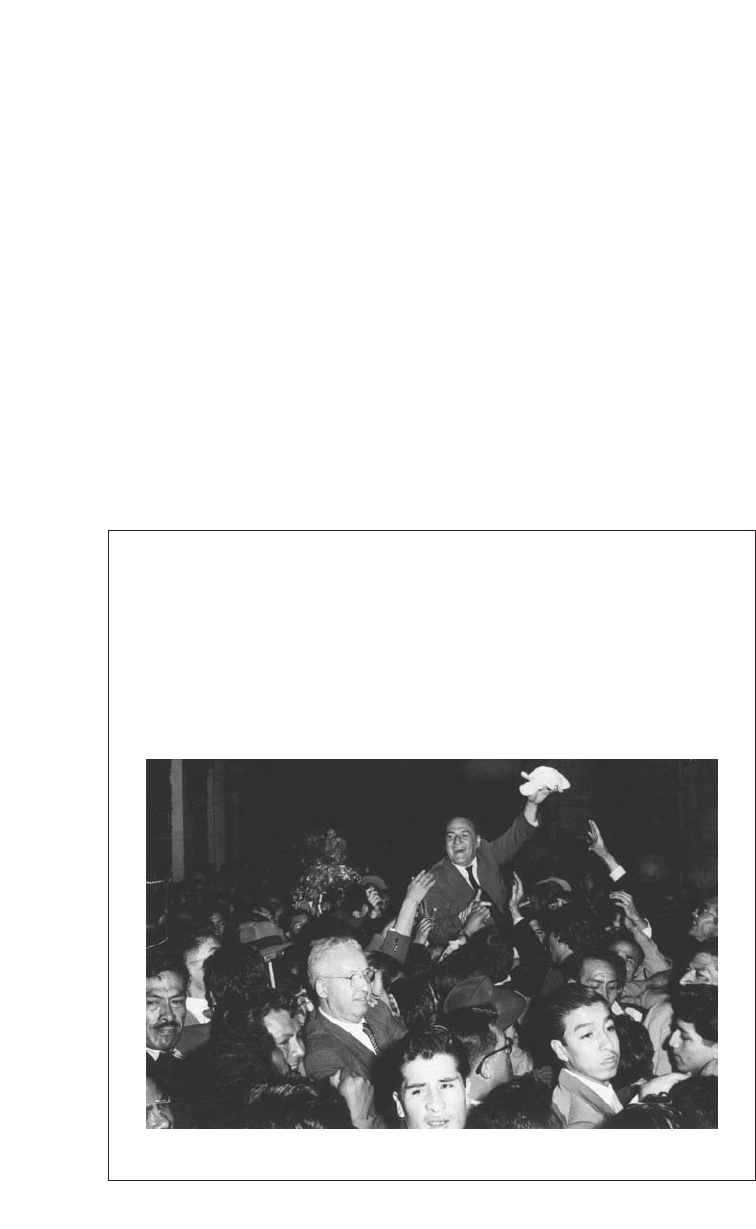
Upon his return to Peru in 1931, Haya de la Torre traveled exten-
sively throughout the country and organized a massive rally in Lima’s
bullfight arena, the Plaza de Acho. During his electoral campaign he
schools also stopped receiving their monthly payments. As in many
other countries around the world in 1930, the global fallout of the 1929
crash left Peru in complete economic, social, and political disarray.
Turbulent Elections and Civil War
In 1931 Haya de la Torre returned from eight years’ exile to run for
president. The Communist Party had been completely dismantled since
the crash, providing ample ground for APRA to grow. Haya de la Torre’s
political agenda sounded less radical than in 1928; in fact, the U.S.
ambassador in Lima reported to Washington that there was nothing to
fear from Haya de la Torre’s candidacy. Such mellowness enhanced
APRA’s chances to increase its following, and Haya de la Torre began
organizing the Partido Nacional Libertador along almost military lines.
A BRIEF HISTORY OF PERU
198
199
DEPRESSION AND CONFLICT
Then, and in later years, the APRA and its organization was often com-
pared to fascist parties in Europe. APRA provided its followers with a
new political identity as they saw that their opinions mattered. This
empowerment involved whole families and sustained an almost reli-
gious relationship between Haya de la Torre and his supporters. The
combination of politics and popular religiosity provided APRA with the
strength to survive much political turbulence over the many decades
until it would finally come to power (with Alán García in 1985).
Sánchez Cerro defeated Haya de la Torre by a small margin of 50,000
votes in the December 1931 election, although the apristas challenged
the r
esults, alleging fraud. Soon after the election, social unrest forced
Sánchez Cerro to declare a law whereby the state in an emergency situ-
ation could shut down mass media, incarcerate people, and prohibit
public meetings. Apristas were the targets of these dictatorial measures.
developed a governmental plan for immediate action, but it was less
radical than his earlier positions. He proposed to reform the state by
making it stronger and more redistributive and by engaging in reason-
able bargaining with international sources of capital, progressive nation-
alization, development of capitalism, tributary reform by abolishing
indirect taxes, universal and free education for all, social security, the
vote for women, and the economic integration of Latin America.
Victor Raúl Haya de la Torre (Photo by Caretas/Andes y Mares)

A BRIEF HISTORY OF PERU
200
In early 1931 a young aprista attempted to kill Sánchez Cerro during
one of his public addresses. Haya de la Torre retreated to Trujillo and
proclaimed himself Peru’s “moral president.”
A civil war resulted from these confrontations as apristas mobilized
on the nor
thern coast and in the central highlands, centering on Callao,
Arequipa, Chiclayo, and Piura. Haya de la Torre was arrested, and 21
aprista congress members were exiled. On July 7 Trujillo took up arms.
In r
esponse the national government sent out troops and planes to quell
the rebellion, then summarily executed 5,000 apristas by a firing squad
at the pr
e-Inca ruins of Chan Chan after condemning them in military
trials. In revenge apristas killed a group of officials in Trujillo. These
events became the basis for a long-lasting, hate-filled, bitter fight
between apristas and Peru’s military that lasted the next 50 years. The
immediate conflict culminated on April 30, 1933, when Sánchez Cerr
o
was assassinated by Abelardo Mendoza Leyva, an aprista, during a mil-
itar
y parade.
In the wake of the disturbances Vice President David Samanez
Ocampo called for presidential elections and gathered a group of intel-
lectuals and politicians to draft a new electoral law. Among these intel-
lectuals were the historian Jorge Basadre, educator José Antonio
Encinas, anthropologist Luis E. Valcárcel, demographer Alberto Arca
Parró, and aprista writer Luis Alberto Sánchez. Under the statute they
drafted, the departments were to become the basic electoral unit, the
vote was to be obligatory and secret, minorities were to gain parlia-
mentar
y representation, and a national electoral jury was to provide
some neutral and independent ground for elections. Women and illit-
erate people were still to be excluded from participating in elections.
The statute, however, was not implemented. Instead, in 1933, the
Constitutional Assembly nominated Oscar R. Benavides, the comman-
der in chief of the army, as president. Benavides stayed in power until
1939. With Benavides began another chapter of Peru’s political history
featuring violence and political confrontation, the absence of democra-
tic parties, and the predominance of the military.
Militarism Anew
Peru, like other countries in Latin America, has had more military than
civilian heads of government throughout its republican life. Whenever
there were signs of a national crisis, the military stepped forward to
seize power, usually claiming the need to keep order and repress popu-
lar protest. In contrast to Europe, where soldiers defended one country

against another country, in Latin America soldiers have mainly fought
internal wars, and Peru is no exception.
A period of uninterrupted military rule first occurred after Peru
achieved political independence from Spain, between 1821 and 1872, and
a second came in the aftermath of the War of the Pacific, from 1883 to
1895. A third era of military rule (called the “third militarism” by histo-
rian Jorge Basadre) began in 1930 with Sánchez Cerro, continued with
Benavides between 1933 and 1939, and reappeared between 1948 and
1956 with Manuel A. Odría as president and in the early 1960s with
Generals Ricardo Pérez Godoy (1961–62) and Nicolás López Lindley
(1962–63). With General Juan Velasco Alvarado (1968–75) and General
Francisco Morales Bermúdez (1975–80) the military cycles came to an
end, but the involvement of the military in national issues did not. A more
indirect involvement in politics surfaced in the 1980s, during the long-
term fight against the guerrilla group the Shining Path, and again in 1995
during President Alberto Fujimori’s (1990–2000) “self-coup” with sup-
port from the military.
The successive military governments were far from uniform. They
espoused differing political and economic policies that ran the gamut
from repressing labor to organizing labor and moved from market-
oriented economic strategies to state capitalism and cooperativism,
and back again.
The Military and the Oligarchy, 1933–1945
A distinctive feature of the third wave of militarism was that it coexisted
with a ruling elite, whereas the two prior military eras had been
responses to the temporary collapse of Peru’s governing elites. In this
new period of militarism Peru’s oligarchy used the military to achieve
what they themselves could no longer do, namely govern the country
as their sole property. With Sánchez Cerro assassinated and Benavides
in command, the oligarchy recovered some of its lost power. From here
on, the sugar and cotton barons withdrew from congress as Peru’s oli-
garchy began controlling the country from behind the scenes, using the
military to implement whatever it saw fit. Consensus was replaced by
violence and political strategies to avoid the dangers from below.
At the beginning of his presidency, Benavides attempted to negotiate
with apristas, and a general amnesty allowed Haya de la Torre out of jail
and into exile, after which popular protests subsided. Oligarchic reac-
tion to these initial negotiations was to stifle any government acquies-
cence to popular demands. APRA r
esorted to conspiracy and secrecy as
201
DEPRESSION AND CONFLICT

its main political weapons, but the party lacked the will to stage serious
revolution. While they still organized workers and called for mass
mobilization, APRA leaders always pulled back at the key moments.
This lack of resolve had high political costs, because the government
was able to crack down on the more radical union leaders and some
members in the army who sympathized with aprista demands.
In the 1936 pr
esidential election Lima’s former mayor, Luis Antonio
Eguiguren, won with the support of APRA, but Benavides annulled the
electoral results because APRA was considered an international party,
and according to the constitution, international parties could not par-
ticipate in national elections. Benavides stayed in power for three more
years governing the country through decrees in the absence of a con-
gress. To exclude the voices of the workers, peasants, and the middle
class, the military sought to persecute and dismantle the APRA and
whatever was left of the Communist Party, a task which came easily in
the aftermath of the government-run massacre of 5,000 Apristas at
Chan Chan in 1932. The San Marcos University was closed between
1931 and 1935.
The continued bargaining and fight between APRA and the govern-
ment deepened political rifts. The oligarchs no longer believed in
democratic ideals and became more conservative. They dismissed lib-
eral ideas, and some of their representatives openly and enthusiastically
applauded the fascist European leaders Adolf Hitler and Benito
Mussolini. Some conservatives admired the fascist states and consid-
ered them worthy of emulation. Peru’s oligarchs sided with Francisco
Franco against republicans during the Spanish civil war (1936–39),
receiving falangistas from Spain with open arms. When exiled Spanish
republicans had to flee their country, they could not come to Peru but
immigrated to Mexico and Argentina and became part of the intelli-
gentsia ther
e. Peru’s oligarchy harbored a fascist attitude rather than a
fascist doctrine, but this became an obstacle for any Communist or
aprista claims. Benavides himself used all avenues to profit fr
om fascism
(for instance, he frequently threatened to seek support from fascist
Europe if the United States was not willing to concede to his demands)
but stifled any fascist attempts to organize in Peru that could question
or jeopardize his control of social matters.
At the beginning of World War II (1939–45) in Europe, Peru remained
neutral, but in 1941 Manuel Prado Ugarteche (1889–1967), president
from 1939 to 1945, sided with the Allies after the Japanese bombing of
Pearl Harbor and withdrew Peruvian diplomats from Rome, Berlin, and
Tokyo. In 1943 Peru denounced the collaborationist French Vichy gov-
A BRIEF HISTORY OF PERU
202

ernment and its puppet president General Pétain and recognized General
Charles de Gaulle as France’s president in exile. A few months before the
war ended, Peru declared war siding with the Allied forces.
The Peruvian government publicly echoed the ideals of the Allies on
democracy and liberty, but at home the government ruled by authori-
tarianism and repression. World War II brought the United States and
Peru closer. The United States bought more Peruvian produce, built a
military base in Talara, and provided loans and technical assistance in
education and public health, and Peru accepted U.S. price controls on
its exported raw materials in exchange for lower U.S. import tariffs.
During the war more than 1,800 Japanese immigrants to Peru were
unjustly accused of siding with the enemy and were deported to intern-
ment in the United States, and the Peruvian government expropriated
several commercial and industrial businesses belonging to German and
Japanese citizens. The Banco Italiano was saved from expropriation but
forced to change its name to Banco de Crédito del Perú.
Economic Recovery
After weathering the effect’s of the worldwide economic downturn of
the late 1920s and early 1930s, the Peruvian economy began to recover
by the time Oscar Benavides became president in 1933, following the
assassination of Sánchez Cerro. Between then and the end of World
War II, Peru’s economy prospered, even though Lima’s government
managed to continue excluding workers, Indians, and women from
political participation, while co-opting willing intellectuals and exiling
those who insisted on criticizing the government. Demands from below
were partially and only grudgingly turned into state policies. In the
1930s and 1940s, the middle class kept expanding, literacy rates
increased, and more indigenous people learned to speak Spanish. A
new industry geared toward the internal market emerged, and the first
social policies (such as labor legislation), an improved health system,
and building schools were approved. Overall, state intervention in eco-
nomic matters increased.
The Great Depression and World War II worked to diminish Peru’s
dependency on the international market. Earlier attempts promoted by
President Leguía to restrain imports through protectionist tariffs were
expanded by Benavides and Prado. Gradually Peru’s exports began to
grow and diversify in the hands of small and medium-sized Peruvian
landowners, whereas the large sugar and copper enterprises shrank.
Cotton produced on the Peruvian coast became the main export product
203
DEPRESSION AND CONFLICT