
Hunefeldt C., Harris B. A Brief History of Peru
Подождите немного. Документ загружается.


during the 1930s, while—in response to governmental decrees—the
sugar-growing land was reduced by 10 percent. Many haciendas located
on the central and southern coast changed from sugar to cotton produc-
tion. By 1940 around 15 percent of the economically active population
on the coast worked on cotton fields. Former yanaconas (indentured
peasants who labor
ed on haciendas) became salaried workers, and many
smaller producers either owned the land or were able to rent it.
A similar process of nationalization occurred in the mines. Reduced
foreign investment permitted smaller mining enterprises to operate.
The formerly all-powerful Cerro de Pasco Corporation reduced its cap-
ital and its activities and engaged only in refining metals. New mining
sites were found and worked, increasing the kinds of minerals
extracted. Zinc, mercury, tin, and lead now complemented the tradi-
tional silver and copper exports. A new product—fish—became one of
Peru’s most important exports after World War II, when no fish from
Europe or Asia reached the U.S. market. Although it was a U.S. entre-
preneur, Wilbur Ellis, who first opened the Peruvian market to U.S.
consumers, domestic Peruvian investments promptly followed suit.
Mining exports decreased in quantity and importance, whereas agrar-
ian production and exports were on the rise. By 1945, 56 percent of
Peru’s total exports were of agrarian origin; however, Peruvian exports
still had not recovered to the level of their 1929 value.
The Peruvian government promoted industrialization by creating
new projects, financing industrial ventures, and opening new banks.
For instance, the Banco Agrícola opened its doors in 1931 and the
Banco Industrial in 1936. Devaluation of the Peruvian sol (from 2.50
soles to 6.50 soles per dollar) between 1929 and 1940 and higher
import tariffs increased the prices for imported goods and consequently
made domestic products more competitive. These macroeconomic poli-
cies stimulated new factories producing tires, shoes, glass, fertilizer,
milk, and construction materials.
To keep the cost of living low for a growing industrial labor force, the
government imposed a price control policy on agrarian producers,
starting around 1935.
Heightened governmental involvement also resulted in a set of new
laws. A new civil code came into being in 1936, for the first time reg-
ulating divorce. Until then divorce had been the exclusive realm of
the Catholic Church. Based on earlier pressures from APRA,
Benavides’s government also founded the Ministry of Education and
the Ministry of Public Health, Labor, and Social Well-being in 1936.
That same year a social security system was inaugurated to help fac-
A BRIEF HISTORY OF PERU
204

tory workers cover the health costs relating to disease, maternity,
invalidity, and old age. A few years later the social security was
extended to all salaried workers. The Ministry of Agriculture was put
in place in 1943. The state employed between 60,000 and 80,000
workers to build roads, especially in Peru’s southern highlands, thus
helping to reduce unemployment among Peru’s working class.
Benavides also opened the first public shelters (comedores) where
indigent people could get a meal and a temporar
y place to sleep.
Concomitantly public expenditures rose from 91 million soles in
1932 to 221 million by 1938. The state could not finance these higher
expenditures through foreign loans since a moratorium on loans to
Peru had been in place since 1931, so internal credit and higher taxes
were the only alternatives available.
Both Benavides and Prado came from the high ranks of Peruvian
finance and were the owners of large cattle-raising haciendas in the cen-
tral highlands and textile factories in Lima. Between their governments
there was a line of continuity in terms of the state’s economic involvement.
Prado had been exiled in 1921 by Leguía, and upon his return in 1932 he
worked at the Central Bank and became its president. Deemed a repre-
sentative of the “national bourgeoisie,” Prado won the 1939 elections with
the support of the Communists, the silence of apristas, and a collective
for
getfulness of his father Mariano I. Prado’s cowardly abandonment of the
country during the War of the Pacific. The brief and successful 1941 war
with Ecuador on border issues cemented his recognition.
Prado and his Frente Patriótico, which was an umbrella party for
many different political and social interest groups, won with 262,971
votes. His opponent, José Quesada, the leader of the profascist Unión
Revolucionaria got only 76,000 votes. The transition from Benavides’s
government to Prado’s was smooth, in spite of a strong earthquake that
shook Lima and other Peruvian cities on May 24, 1940. Prado pro-
moted-General Benavides to the rank of marshal and appointed him to
the most desired foreign diplomatic posting, the embassy in Madrid.
Prado’s government adopted an agenda of popular policies, especially
concerning urban workers. He established a minimum wage and
decreed an increase in workers’ salaries while keeping strict price con-
trols on urban rents and subsistence goods through the Superintendency
of Social Welfare (Superintendencia de Bienestar Social, founded in
1939). Overall—and for the first time in Peru’s history—direct taxes
increased their relative weight within the state’s total income. This was
also one of the very few moments in Peruvian history when there were
no foreign loans.
205
DEPRESSION AND CONFLICT

A BRIEF HISTORY OF PERU
206
In 1942 Prado created development agencies aimed at promoting
economic growth in areas untouched by private investors. These agen-
cies were the initial pillars of what later became public enterprises.
Prado’s initiatives, and some pressure from the United States, slowly
reopened political activities. He authorized unions and relegalized the
APRA and the Communist Party. The Peruvian Workers’ Confederation
The Peru-Ecuador
Border Dispute
E
cuador became an independent country in 1830 after it separated
from Simón Bolívar’s Gran Colombia. Ecuador and Peru had sev-
eral border conflicts during the 19th century, including a war in 1860.
That year Ecuador laid claim to three provinces in northern Peru—
Tumbes, Jaén, and Maynas. Peru argued the boundaries should be set as
they had been under Spanish colonial administration, or by self-deter-
mination of the inhabitants in the case of Jaén.
In 1910 the Peruvian embassy in Quito and the Peruvian consulate
in Guayaquil were attacked. Peru mobilized 20,000 men to its side but,
thanks to the mediation of other American states, war was avoided.
Since Ecuador declared that it would not follow the advice of the
Spanish king, the Spanish mediator never provided a verdict on this bor-
der issue.The border issue was latent until July 1941, when Ecuadorean
troops stationed in the Provincia del Oro occupied Peruvian border
posts in Aguas Verdes, La Palma, and Lechugal.This was the beginning of
a one-month war. Peru won the most important battle at Zarumilla and
occupied the Provincia del Oro, forcing Ecuador to surrender.
In January 1942 representatives of both countries signed a peace
treaty in Rio de Janeiro, Brazil, and the Peruvian army withdrew from
Provincia del Oro.The Protocol of Rio de Janeiro drew the borders and
entrusted its execution to a mixed commission. Guarantors of this
treaty were the United States,Argentina, Chile, and Brazil. However, 35
miles of the borderline in the Andean Cordillera del Cóndor could not
be physically marked because the region was inaccessible. This small
stretch of the border became the cause of more tensions between both
countries, and in 1960 Ecuador annulled the Rio protocol because it
could not be executed. Problems on the border resurfaced in 1981,
when Ecuadorean troops invaded the Cordillera del Cóndor once
again, and a few border skirmishes followed in 1992.

207
DEPRESSION AND CONFLICT
(Confederación de Trabajadores del Perú, or CTP) was founded in
1944, and very soon afterward several federations representing the var-
ied labor groups (workers in mines, oil, sugar, and cotton, employees,
and yanaconas) sent delegates to the confederation’
s meetings and polit-
ical debates. Communist leader Juan P. Luna became the CTP’s first
president. Eudocio Ravines, previously the Communist Party’s leader,
was expelled from the party during its first congress in 1942. Between
1940 and 1944 the Peruvian government officially recognized 118
unions, four times as many as between 1936 and 1939. Initially apris-
tas and Communists shared their political leadership in the unions.
Gradually, however
, apristas took over, and Luis Negr
eros became
APRA’s most visible union leader.
Despite these positive developments the economy took a turn for the
worse in the 1940. National defense expenditures before and after the war
with Ecuador and redistributive policies, including food subsidies,
drained the state budget. By 1942 Prado’s government resorted to loans
from Peru’s Central Bank to pay for the 536 million soles of state expen-
ditures. In contrast to a similar situation during Benavides’s presidency,
inflation resulted, albeit quite moderate by contemporary standards.
Between 1939 and 1944 the amount of circulating money tripled; inflation
Fiscal Income Between 1923 and 1949
(Percentage of Total Income)
Source
of
Income 1923–24 1925–29 1930–34 1935–39 1940–44 1945–49
Customs 32.5 21.8 26.0 33.2 40.4 46.8
Indir
ect
taxes 27.1 23.4 38.3 40.6 33.5 27.4
Direct
taxes 5.9 6.1 9.5 11.4 11.1 11.2
Public
services 2.7 2.6 5.5 5.0 4.4 3.0
External
loans 22.9 38.7 3.4 0.0 0.0 0.0
Other 8.9 7.4 17.3 9.8 10.6 11.6
Total 100.0 100.0 100.0 100.0 100.0 100.0
Source: Boloña (1994, 103, 120)
A BRIEF HISTORY OF PERU
208
reached a low of 8.2 percent in 1941 and a high of 14.3 percent in 1944.
Inflation did not result solely from the loans, however; it was also driven
by sugar exporters. Beginning in 1938 the sugar barons drove down the
value of Peruvian currency against the U.S. dollar. If the sugar producers
maintained low production costs, they received higher profits from sugar
exports. In 1940 banks and sugar producers reached a “gentlemen’s agree-
ment” by fixing the exchange rate at 6.50 soles to the dollar. When sugar
producers tried to play at currency speculation again in 1944, Prado, for
the first time in the 20th century, resorted to a fixed exchange rate to cur-
tail the barons’ manipulations. However, between 1939 and 1945, the cost
of living had already increased by 190 percent.
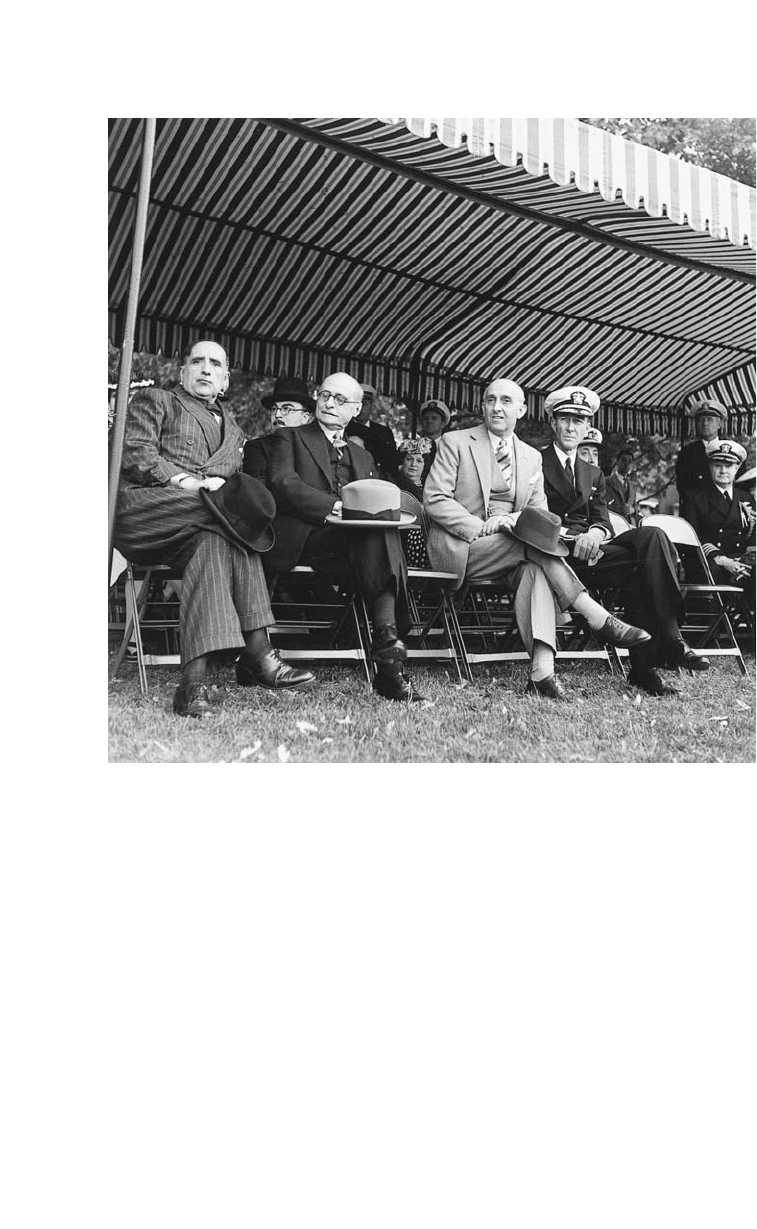
Peruvian president Manuel Prado Ugarteche, second from right, at an inspection at the U.S.
Naval Academy at Annapolis in the summer of 1942. Prado supported the Allied side during
World War II.
(Library of Congress)

Changes in the Amazon
Border skirmishes with Ecuador and Colombia stimulated Peru’s inter-
est in the Amazon, where large stretches of the border with these two
countries (and Brazil) are located. Cultivation and colonization had
been almost absent after the sporadic rubber boom. Aside from a few
cotton, coffee, coca, tobacco, and rice plantations and many different
Indian tribes, not much could be found in this region, in spite of its nat-
ural riches. In the central Amazon area, more closely linked to the cen-
tral highlands and thus to Lima markets, some European colonies
developed during the 19th century. In Oxapampa and Pozuzo, Germans
in 1891 and Austrians in 1857, respectively, found homes, albeit in
almost complete isolation until the railroad was expanded to Cerro de
Pasco. Italian and Asian immigrants came to Chanchamayo. These set-
tlers fared somewhat better because they had the city of Tarma as a link
to the coast. In Perene, the Peruvian Corporation began a colonization
project after the Grace Contract was signed in 1889. From it a bounti-
ful coffee production emerged and gradually expanded, leading to the
formation of another colony in Satipo in 1927.
A 1909 general law on Amazon lands and an Amazon settlement pro-
gram spearheaded by Leguía were meant to open the Amazon to free
colonization. The new laws completely disregarded the region’s indige-
nous inhabitants, and Ashaninka, Matsiguenga, and Yanesha Indians
(among others) were drawn into coffee plantations, mostly by force,
and used to build roads.
The southern Amazon remained much more isolated from urban cen-
ters and markets. With the discovery at the end of the 19th century of
the Fitzcarraldo isthmus (a heavily forested piece of land between two
jungle rivers), the Manu area (nowadays a large natural reserve) became
connected with Cuzco, which led to the opening of Puerto Maldonado
in 1902. In Puerto Maldonado two of the largest Amazon rivers con-
verge: the Madre de Dios and the Tambopata. The Department of Madre
de Dios was created in 1912 on an area formerly included in the
Department of Cuzco. Still, by 1940 the national census only recorded
1,032 inhabitants in Puerto Maldonado, the departmental capital. The
whole Department of Madre de Dios, a stretch of 35,000 square miles,
barely counted 5,000 people, most of them at a subsistence level, some
of them searching for gold on riverbeds. The first roads were not opened
in this southern part of the Amazon until 1960.
In the 1940s the Amazon witnessed a heightened interest from Peru’s
government and army and from national and foreign entrepreneurs.
These groups wanted variously to exploit Amazonian natural resources
209
DEPRESSION AND CONFLICT
A BRIEF HISTORY OF PERU
210
(including medical herbs and plants), “civilize” natives, improve mili-
tary posts, tighten links with Lima, and—last but not least—fight lep-
rosy, a disease that had spread in the region in the aftermath of the
rubber boom. Some religious orders joined in such efforts, especially
Augustinians and Dominicans. In 1948 a U.S. religious organization,
the Summer Linguistic Institute (Instituto Linguístico de Verano,
known as ILV) established itself in the town of Pucallpa. This institute
combined Protestant religious preaching and linguistic study. Over the
years the ILV has been repeatedly attacked by the Peruvian press and
accused of proselytizing and even practicing eugenics.
The 1940s also saw the advent of the U.S. government–owned North
American Rubber Reserve Company. The company’s goal was to find
new sources of rubber because Japan, at the beginning of World War II,
had occupied the rubber-producing Southeast Asian islands. (As a side
benefit Americans also collected quinine, a substance used to cure
malaria that was available in the Amazon, to save U.S. soldiers stationed
in Asia.) Goodyear, a private enterprise, opened a factory in Lima and
exported tires to the United States. The Peruvian government joined this
venture and founded in 1942 the Peruvian Corporation of the Amazon
(Corporación Peruana del Amazonas). Rubber production increased
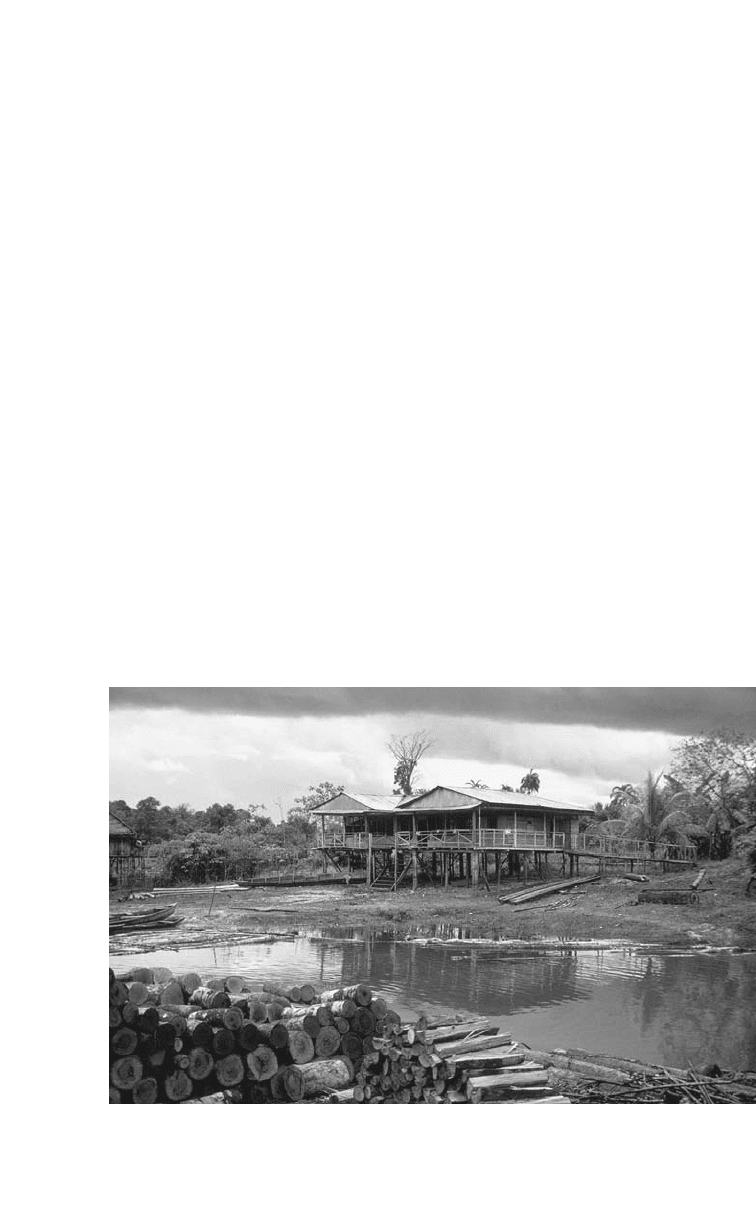
Stilt-supported houses at a settlement in the Amazon region of Peru. There was intense
but short-lived commercial interest in the area during the 1940s.
(© Philip Baird,
www.anthroarcheart.org)

dramatically as a result of all these efforts, from 130,000 pounds in 1941
to 2.84 million pounds in 1944. With the end of World War II, however,
interest in the Amazon and its natural resources declined and the
Amazon returned to official oblivion, at least for a while.
The 1945 Threshhold
The end of World War II marked the beginning of pressure from the
United States for democracy in Latin America. Leaders like Haya de la
Torre took the United States at its word and requested active political
support to end dictatorships in Latin America while still in exile.
Claiming democracy also meant that Peru could no longer marginalize or
ignore APRA, which had become the most important political voice in
the country. The National Democratic Front (Frente Democrático
Nacional, FDN) under President José Luis Bustamante y Rivero, an exec-
utive, lawyer, and law professor at the University in Arequipa, provided
APRA with a political venue. Bustamante had written Sánchez Cerro’s
takeover proclamation and briefly served as Sánchez Cerro’s minister of
justice. Until 1945 Bustamante was Peru’s ambassador in Bolivia.
Bustamante believed in the need for greater morality in government, the
reduction of state bureaucracy, balanced budgets, and decentralization.
Prado made several attempts to win Bustamante for his cause. Prado rep-
resented the right wing; Bustamante was an independent intellectual with
strong socially oriented political convictions and this is why he decided
to listen to Haya de la Torre’s propositions. Thus, instead of siding with
Prado, Bustamante allied himself with the now legalized APRA. APRA
became the “party of the people and for the people,” and its goal, in Haya
de la Torre’s expressed wish, was to create ownership for those who
owned nothing without taking ownership away from those who had it.
In the end Bustamante’s intellectual prestige, his defense of national sov-
ereignty, and his deeply rooted Catholicism made him an acceptable can-
didate among the oligarchy, APRA, the army, and the church. The FDN
won the elections against the official candidate, Marshall Eloy Ureta, vic-
torious commander in the war with Ecuador, with 300,000 (67 percent)
against 150,000 votes. APRA gained a parliamentary majority.
In spite of a happy beginning, a rift between APRA and President
Bustamante soon appeared. Bustamante meant to demonstrate that by
cooperating with APRA the movement had gained responsibility and
had shed its early Marxist extremism. Bustamante, however, was deter-
mined to go his own way. He appointed Rafael Belaúnde (brother of
Víctor Andrés Belaúnde) as his prime minister, passing over Haya de la
211
DEPRESSION AND CONFLICT

Torre, the APRA party leader. Elected aprista congressmen swore loy-
alty to their leader and proved this loyalty by systematically blocking
changes proposed by the executive branch, thereby following partisan
rather than national interests.
Violence broke out again when Apristas set bombs, burned down
buildings, and even assassinated their enemies, including the prefecto of
Cerr
o de Pasco. Lima’s two main newspapers, El Comercio and La
Pr
ensa, denounced this reign of terror and requested governmental
inter
vention. In parliament the aprista majority instead asked for press
censorship. When San Mar
cos students protested against censorship,
APRA strongarm squads (known as the búfalos) attacked them.
These incidents illustrate APRA inconsistencies. While assuring the
oligar
chy that properties would be respected, APRA also promised to
give more to the poor. All attempts to balance the fiscal budget were
systematically opposed in congress. APRA promoted salary increases by
simply increasing export taxes or regulating exchange rates. Without a
redistribution of wealth, higher salaries increased inflationary pres-
sures. In response, APRA demanded price controls, which led to
scarcity, corruption, and smuggling. In the end only those holding an
aprista membership card could get food without standing in long lines.
Economic cir
cumstances, however, did not favor Bustamante. His
initial plan included the reinforcing of the state, creating a stronger
internal market, promoting industrialization, attracting foreign invest-
ment, and recognizing the rights of workers. He did enact measures to
realize some of these goals. Pay for a day off on Sunday was introduced,
rents were frozen, the numbers of bureaucrats and the amount of their
salaries was increased, and secondary school was made free. A new law
in 1947 prohibited the use of free Indian labor, a measure geared toward
forcing sugar and cotton planters to pay adequate salaries to their work-
ers and to free these workers from the requirement to sell their produce
to the hacendado at below-market prices.
But Bustamante’s economic policies led to many distortions in Peru’s
economy. His attempts to control the exchange rate, to regulate food
prices, and to direct imports met a dead end and provoked growing
resistance. The oligarchy responded by drumming up the aprista-
Communist threat through their guild, the National Agrarian Society
(Sociedad Nacional Agraria), and the newspaper La Prensa, edited by
Luis Beltrán, a pr
ominent entrepreneur and economist who graduated
from the London School of Economics and was the Peruvian ambas-
sador to the United States. In January 1947 Francisco Graña Garland,
one of the directors of La Prensa, was killed, and APRA was the suspect.
A BRIEF HISTORY OF PERU
212

213
DEPRESSION AND CONFLICT
In response Bustamante dismissed his three APRA ministers and rebuilt
his cabinet with five military and five civilian ministers. Manuel A.
Odría became the minister of government. Pedro Beltrán called for an
anti-APRA alliance, and most parties responded to his invitation,
including Eudocio Ravines’s Socialist Party. At this point in his political
career Ravines proposed to defend the sugar and cotton barons for the
sake of capitalist development. In July 1947 the congress was unable to
reopen its doors due to a boycott from its independent representatives
and the legal manipulations of Héctor Boza, the leader of the Senate.
Negotiations to establish a congress failed, so APRA could no longer
govern the country through congress. With no congress Bustamante
continued his term using ad hoc decrees to govern the country.
In a last attempt at survival APRA sponsored an unsuccessful
strike, which was followed by governmental repression, the abolition
An Episode in the
Presidential Palace
H
istorian Frederick Pike in his 1967 history of Peru recounted
what happened when senate leader Héctor Boza went to the
presidential palace one day in 1947 in the midst of a terrible national
crisis. Boza’s faction in the senate had effectively shut down the
National Assembly by absenting themselves, a series of aprista-inspired
strikes had crippled the economy, and killings and violence were
increasing rapidly. The nation was suffering and the government
seemed paralyzed, so Boza wanted to consult with President José
Bustamante.
When he arrived, Boza was told the president was too busy with
important duties to see the senate leader and could not be disturbed.
Summoning all his authority Boza insisted and was finally admitted to
Bustamante’s private office, where he found the president seated before
a typewriter, busily typing in two-finger style what appeared to be a long
document. When asked what he was doing, President Bustamante
explained he was in the middle of an important project that had con-
sumed all his time and attention for the previous two weeks: He was
preparing a scholarly paper on legal theory that he was scheduled to
deliver to a legal convention.
Bustamante told Boza he did not have time to spare to discuss the
nation’s problems (Pike 1967, 287).