
Котлер Ф. Маркетинг менеджмент
Подождите немного. Документ загружается.

Глава
22.
Управление
комплексом
маркетинговых
усилий
1Г1ШПИгтиШЩ1|11Л1ШИГШтмШР1Г>Ш1М»Ш[ИШ»1|»Ь|Ш||И^|,д.Ь|1
И1МММШ|Пин||
пиши
----
НОВОЙ
ЭКОНОМИКИ
Маркетинг
и
справедливые
трудовые стандарты
Глобализация — реальность
для
всех
деятелей легкой промышленности. На
этикетках
с
названиями
«исконно» аме-
риканских
компаний
обычно значится,
что изделие произведено
в
другой, за-
частую
менее развитой стране Латин-
ской
Америки
или
Тихоокеанского
побережья.
В
середине
1990-х
гг. авто-
ры целого ряда публикаций привлекли
внимание
к тому факту, что для произ-
водства многих таких товаров исполь-
зовалась потогонная система,
труд
низкооплачиваемых или малолетних
работников.
Компания Nike оказалась
вовлечена
в
один
из
получивших
са-
мую широкую огласку конфликтов.
В 1997 г. соответствующий наблюда-
тельный орган опубликовал результаты
проведенной компанией
Ernst
&
Young
аудиторской проверки на
фабрике
Nike
во Вьетнаме,
в
ходе
которой были об-
наружены нарушения условий
труда.
Рабочих заставляли работать
65
часов
в
неделю, сверхурочные оплачивались
скудно; вентиляция на рабочих местах
не
соответствовала требованиям, кон-
центрация
канцерогенных веществ до-
стигала опасного уровня. Заработная
плата работников этого предприятия
составляла немногим более $10
в
неде-
лю. После того как СМИ опубликовали
факты
дальнейших
нарушений,
органи-
зации—
защитники
прав
человека
и
прав
рабочих обрушили свои
удары
на Nike.
Компания
Nike
предприняла
значитель-
ные
изменения в своей трудовой поли-
тике.
В
1998
г.
компания официально
заявила
о
внедрении новых
трудовых
стандартов.
В
том же
году
в
Nike было
создано отделение корпоративной
от-
ветственности, которое объединило ак-
тивные группы по улучшению условий
труда,
по
охране окружающей среды
и
защите интересов общества, которые
уже действовали
в
рамках компании.
Миссией
этого нового отделения ста-
ла «лидерство
в
корпоративной граж-
данской
ответственности путем вне-
дрения
программ, отражающих заботу
о
международной семье Nike, наших
товарищах по команде, наших потре-
бителях, и тех, кто предоставляет
услу-
ги компании Nike». Компания Nike
стала членом—основателем организо-
ванной
по
инициативе Белого дома
Ассоциации справедливого отноше-
ния
к
труду
(ACT), которая установи-
ла свод правил
для
международных
Производителей
и
ввела практику на-
блюдения
за
трудовыми процессами
в
отрасли. Получившая аккредитацию
ACT
компания
PricewaierhouseCoopers
была привлечена
к
ежегодным провер-
кам
каждой из 500 фабрик Nike.
Усилия
Nike
по улучшению и кон-
тролю условий
труда
вызвали смешан-
ную
реакцию.
В то
время
как
одни
хва-
лили Nike
за
вовлеченность
в
жизнь
общества, заботу
об
окружающей среде,
относительно высокую зарплату и чи-
стые
фабрики,
остальные продолжали
ее осуждать. Некоторые
критики
заяв-
ляли,
что
запланированные
ежегодные
проверки
будут
представлять искажен-
ную картину.
Другие
сетовали, что за-
работная плата
работников
Nike
меньше
прожиточного
минимума.
Чтобы опро-
вергнуть продолжающиеся обвинения,
компания
предприняла ряд мер
для
обеспечения публичного доступа
к
ин-
формации
об
условиях
труда
и ре-
зультатам аудиторских
проверок.
Этот
проект был назван «Transparency 101»,
и
первым шагом было достижение со-
глашения
о
размещении результатов
аудита
на
web-сайте
Nike
начиная
с
мар-
та
2000
г.
Во время весенних студен-
ческих каникул этого
же
года
16 сту-
дентов выпускных
курсов,
выразивших
желание посетить
фабрики
Nike,
побы-
вали
на
32 фабриках в разных странах.
Полные
тексты каждого отчета были
затем опубликованы
в
Интернете.
Кроме
того,
не все группы по защите
прав трудящихся были довольны отно-
шением
государства
к
данным
вопросам.
1998
г.
UNITE, профсоюз работников
•
легкой промышленности США, вышел
из
ACT. Ассоциация американских про-
изводителей текстильных изделий,
бу-
дучи
неудовлетворенной работой ACT,
разработала
свою
собственную программу
под названием
«За
ответственное изго-
товление текстильных изделий»,
с
по-
хожими стандартами и собственным ак-
кредитационным
агентством.
С
момента
начала реализации
этой
программы
в
Ню-
не
2000
г.
в ее агентстве зарегистрирова
1
-
лось более 225 фабрик со всего мира.
Хотя
UNITE
к
его
союзники
опасаются,
что производители
будут
вносить толь-
ко
Поверхностные
изменения,
а
сертифи-
кация
будет
только вводить в заблужде-
ние,
в
разногласиях
двух
сторон как раз
и
проявляются
их
общие убеждения:
трудовые коллективы должны рассмат-
риваться как важная заинтересованная
группа
в
деятельности каждого работо-
дателя. Справедливые условия
труда
яв-
ляются столь же важным вопросом мар-
кетинга, как и корпоративная этика.
Источники:
Vanessa
Groce,
«Chronicle»,
Eamshaw's
Infants,
Toddler,
and
Girls
and Bys
Wear
Review
(October 1996):
p.
36; Steven
Greenhouse,
«Voluntary
Rules on
Apparel
Labor Prove Hard to
Set»,
New
York
Times,
February
1,1997,
pp Ai, A7; «No
Sweat?
Sweatshop
Code is Just
a
First Step to End
Worker
Abuse».
Solidarity
(June—July
1997): p. 9. Также
см.
сайты
UNITE,
Corporate Watch, American
Apparel
Association;
кроме того:
www.wrapparel.com;
www.nikebi2.com;
Aaron Bernstein, «Nike Opens
its
Books
on Sweatshop
Audit»,
BusinessWeek,
April
27,2000;
«Nike
Offers
Students Chance to See
Conditions in Third-World Factories»,
Dawjones.com,
November
11,1999.
вые цены
или
неоправданную
ценовую
дискри-
минацию; препятствование
выходу
на рынок или
хищническую конкуренцию.
В настоящее время
плохо
зарекомендовавшие
себя компании
рискуют
быть
выставленными
для
всеобщего
осуждения
в
Интернете.
В
про-
шлом рассерженный клиент мог поделиться не-
благоприятным мнением
о
поставщике или про-
давце
только
с
12
другими
людьми,
а
сегодня он
может
поделиться своим недовольством
с
тыся-
чами
людей
с помощью Всемирной сети. Напри-
мер, деятельность компании
Microsoft
породила
создание
более
100
«антимайкрософтовских»
сайтов, среди которых были сайты
с
названиями
Часть
V. Управление маркетинговыми
программами
«Ненавижу
Microsoft»
и
«Бойкотируйте
Micro-
soft».
Путь
к
социально ответственному маркетин-
гу состоит
из
трех
этапов. Во-первых, общество
с
помощью закона должно как можно более четко
определить юридически недопустимые, асоциаль-
ные
и
препятствующие свободной конкуренции
действия. Во-вторых, компании должны соблю-
дать официальный моральный кодекс, работать
над созданием традиций этичного поведения,
возлагать
на
своих работников полную ответ-
ственность за
этические
и юридические
нарушения.
В-третьих,
работая с клиентами и представителя-
ми
других
заинтересованных в деятельности ком-
пании
групп, маркетологи должны руководство-
ваться «социальной совестью».
Вступая
в
новое тысячелетие, компании стал-
киваются лицом
к
лицу
с
массой новых, доселе
неизведанных возможностей. Технологические
преимущества солнечной энергии, компьютер-
ные
сети, кабельное
и
спутниковое телевидение,
генная
инженерия, телекоммуникации —
все это
изменит
мир
будущего
до
неузнаваемости.
В то
же время
социально-экономические,
культурные
и
природные силы приведут
к
появлению новых
ограничений
на бизнес вообще
и
маркетинг
в ча-
стности.
Успех
ждет
те
компании, которые най-
дут новые решения и примут на себя всю полноту
ответственности перед обществом. Рассмотрим
пример
Working
Assets.
Working
Assets.
Компания
Working
Assets
обеспе-
чивает
междугородную/международную
телефон-
ную связь.
Она на
равных конкурирует
с
такими
известными
американскими
компаниями,
как
А
Т&Т,
MCI
и
Sprint
(низкие тарифы, четкий трафик
по
волоконно-оптическим каналам связи, эффектив-
ность работы операторов, обслуживание
по
теле-
фонным
картам).
Но эта
фирма использует
еще
одно уникальное средство привлечения клиентов.
Working
Assets
перечисляет по крайней мере 1% го-
дового
дохода
на
благотворительные цели, давая
клиентам возможность проголосовать
за
то, какая
некоммерческая организация получит взнос.
Ее
кампания
под девизом:
«С
нами
ваш
голос
будет
услышан»
обращена
к
людям,
которые
хотят
оказать
посильную помощь
в
благих
начинаниях.
На от-
правляемых абонентам ежемесячных
счетах
фирма
печатает информацию
о
двух
актуальных пробле-
мах,
а
также имена
и
номера телефонов влиятель-
ных людей,
с
которыми абонент может поговорить
бесплатно
или
компания
за
определенную плату
подготовит им письмо
от
имени абонента,
Во
всей
своей деловой практике, компания
Working
Assets
проводит последовательную политику корпора-
тивной гражданской ответственности, которая со-
ответствует
этическим нормам
ее
целевого рынка.
Корпоративный
идеализм
Working
Assets
имел по-
ложительное влияние
и
на
ее
коммерческую дея-
тельность. С
$2
млн
в
1991 г. ее
доходы
выросли
до
$140
млн
в
1999
г., и в
течение пяти
лет
подряд
с 1992 по 1997 г. она
входила
в список самых быст-
рорастущих компаний
в
США.
46
ВЫВОДЫ
1.
В
эволюции организационной
структуры
марке-
тинга выделяют шесть этапов развития, каждый из
которых встречается
и в
деятельности сегодняш-
них
компаний.
В
компаниях, находящихся на пер-
вом этапе,
существует
простой
отдел
сбыта, на вто-
ром —
отдел
сбыта начинает выполнять некоторые
функции
маркетинга, такие как реклама
и
марке-
тинговые исследования.
На
третьем этапе создается
самостоятельный
отдел
маркетинга, выполняющий
возросшее количество маркетинговых
функций.
На
четвертом этапе
и
отдел
маркетинга,
и
отдел
сбыта
переходят под руководство одного вице-президен-
та. На пятом —
все
работники компании ориенти-
руются
в
своих действиях на рынок и покупателей.
На
шестом
все
маркетологи компании работают
в
основном
в
составе смешанных команд.
2. Известно множество способов организации совре-
менного маркетинга.
В
некоторых компаниях ор-
ганизация
строится
на
основе функциональной
специализации,
в
других
— по
географическому
и
региональному признакам. Третьи компании
организуют
работу
по
товарам
и
маркам либо
по
рыночным сегментам. Применяется
и
матричная
организация,
в
которой работают
и
менеджеры по
рынку,
и
менеджеры по товарам.
Наконец,
в
неко-
торых крупных компаниях сильно развит
корпора-
тивный маркетинг, в
других
он ограничен,
в
третьих
маркетинговые
службы
функционируют на уровне
подразделений.
3. Эффективную современную маркетинговую орга-
низацию
отличает скоординированное взаимодей-
ствие
и
ориентация
всех
отделов
—
маркетинга,
НИОКР,
инженерно-технического, закупочного,
производственного, оперативного, финансово
)
кредитования
и
бухгалтерии
— на потребителя.
4. Любой план маркетинга, каким бы замечательным
он
ни был, не имеет особой ценности без надлежа-
щего исполнения.
Для
претворения
в
жизнь
п
^
нов
маркетинга необходимы такие навыки,
умение понять
и
диагностировать проблему;
0П
Р
делить организационный уровень компании,
котором возникают проблемы; умение реализов
планы
и
оценивать результаты.
Глава
22.
Управление
комплексом
маркетинговых
усилий
5.
Отдел
маркетинга должен постоянно следить
за
вы-
"
полнением своих планов
и
контролировать
всю
маркетинговую деятельность. Цель
контроля
над
ежегодными
планами
—
подтверждение того,
что
компания
действительно достигла целей по
сбыту,
прибыли и
другим
установленным в них показате-
лям.
К
основным инструментам анализа относятся
анализ сбыта, доли
рынка,
соотношение затрат
и
объ-
ема сбыта, финансовый анализ и оценка рынка.
6.
Контроль прибыльности
направлен
на
измерение
рентабельности различных товаров; территорий,
на
которых осуществляется сбыт; групп покупате-
лей; сегментов рынка; каналов сбыта
и
размеров
партий заказов. Важная часть контроля прибыль-
ности
—
распределение затрат и составление отче-
тов
о
прибылях и
убытках.
7.
Контроль
эффективности
связан
с
нахождением
2.
способов повышения эффективности торговых ра-
ботников,
рекламы, стимулирования сбыта
и
рас-
пределения.
8.
Стратегический
контроль
подразумевает периоди-
ческий пересмотр
всех
целей
и
планов компании,
ее стратегического
подхода
к
рынку. Для этого при-
меняются такие средства, как анализ эффективно-
сти маркетинга и маркетинговый
аудит.
Компании
должны периодически переоценивать качество
маркетинга,
а
также отношение
к
этической
и
со-
циальной ответственности.
ПРАКТИКУМ
ТЕМА ДЛЯ
ОБСУЖДЕНИЯ:
УПРАВЛЕНИЕ
МАРКЕТИНГОМ
—
ЭТО
НАУКА
ИЛИ
ИСКУССТВО?
Некоторые исследователи рынка
утверждают,
что
хороший маркетинг сродни искусству
и не под-
дается строгому анализу
и
осмыслению.
Другие
выражают резкое несогласие
и
настаивают,
что
управление маркетинговой деятельностью явля-
ется занятием, которому можно научиться,
и
оно
имеет много общего
с
другими коммерческими
знаниями.
Каково
ваше мнение:
1)
управление марке-
тингом чем-то похоже
на
актерское искусство
и
поэтому весьма субъективно или 2) управление
маркетингом можно осуществлять
на
основе на-
учного
подхода
с
четко определенными принци-
пами
и
критериями?
МАРКЕТИНГ
И РЕКЛАМА
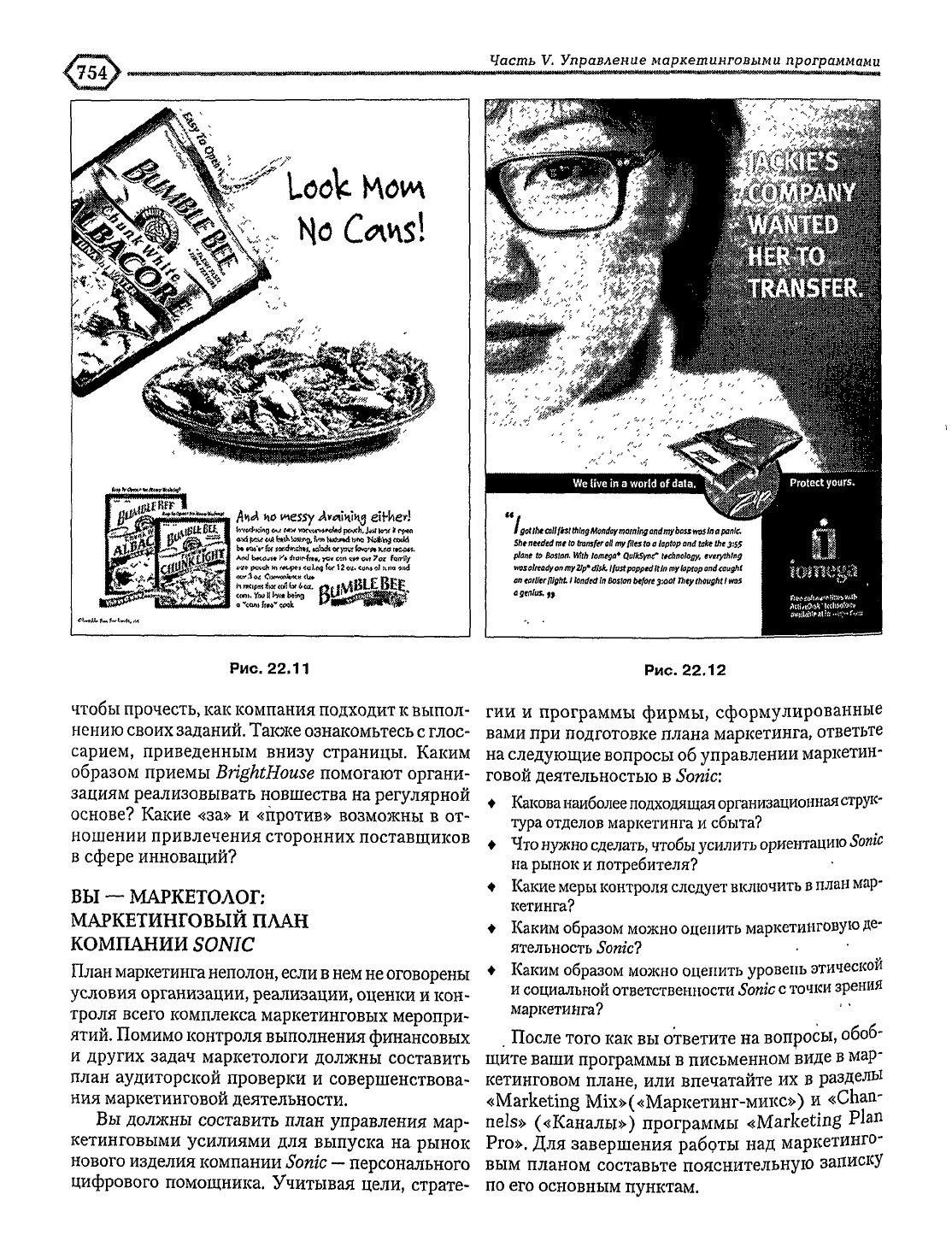
1. Когда
компания
Bumble
Bee
перешла
к
использова-
нию
новой вакуумной упаковки для своей продук-
ции
(рис.
22.11),
она
должна была скоординировать
работу
отдела
маркетинга
с
работой
других
отде-
лов
компании.
Каким
образом
отдел
маркетинга дол-
жен
был взаимодействовать
с
отделом закупок
в
про-
цессе разработки
и
внедрения новой упаковки для
продукции?
а.
Каким образом менеджер по товару должен был
взаимодействовать
с
коллегой
из
производст-
венного
отдела
в процессе создания новой упа-
ковки?
б. Опишите,
как
менеджеры
по
маркетингу ком-
пании
Bumble
Bee
должны были сотрудничать
с сотрудниками
финансового
и
кредитного отде-
ла и
бухгалтерии
во время планирования и осу-
ществления маркетинговых мероприятий
для
продукции
в
новой упаковке?
Реклама на
рис.
22.12 использует повествование от
первого лица, чтобы продемонстрировать,
как
тех-
нология
«Zip»
компании
Iomega
может помочь ком-
пании
обрести большую мобильность, а также при-
дать
солидный
вид
сотруднику. Какие критерии
могла использовать компания
Iomega
для
опреде-
ления
эффективности своей рекламной кампании
в
печатных изданиях?
а.
Какие
вопросы
исполнения
должны были
учесть
маркетологи компании
в
процессе планирова-
ния
этой рекламы?
б.
Какие
вопросы должны задать маркетологи ком-
пании
для определения необходимости коррек-
тирующих воздействий, если
результаты
рек-
ламы не
будут
соответствовать ожиданиям?
ОНЛАЙН-МАРКЕТИНГ
СЕГОДНЯ
Как
уже
говорилось выше, компания
BrightHouse
специализируется на помощи организациям
в
по-
иске инновационных маркетинговых идей. При-
глашая
для
этого сторонних специалистов, руко-
водство
компании
может приобрести свежий взгляд
и
определить новые пути использования марке-
тинговых возможностей. Например,
BrightHouse
помог
Coty
создать
духи
«Ghost
myst»
—
продукт,
который стал самым популярным
на
рынке
в
пер-
вый
же год. Для
поиска инновационных идей
BrightHouse
использует процесс, состоящий
из
четырех
этапов: исследования
(с
целью ознаком-
ления
с
ситуацией), «инкубационного
периода»
(времени на появление разных соображений), за-
тем освещения
и
иллюстрирования (этапы,
на
которых идеи обдумываются и снабжаются прак-
тическими деталями).
47
Узнайте больше
о
компании
BrightHouse,
посе-
тив
ее
web-сайт
(www.brighthouse.com).
Ознакомь-
тесь
с ее
домашней страницей,
а
затем
следуйте
по
ссылке
«Brightprofile»
(«Профиль компании»),
Часть
V.
Управление
маркетинговыми
программами
gotint
coll
fist
thing
Monday
morning
and my
boss
wo$ in
a
panic-
Sht netded
me
to
transfer
oil my pits to a laptop and
take
the
355
plane
to
Boston.
With
Iomega*
QufkSynf
technology,
everything
woso!readyonmyZ!p*dlsk.
I fust
popped
itin
my laptop ondcaught
an tattlerflight
I
landed in
Boston
before
3:00! they thought
twos
a
gtnfas.
«•
or yaw
kw;'»
KMJ
rtcp«*.
yew
Kit
c*» evi
7ex
fen-ii/
Рис. 22.11
чтобы прочесть, как компания
подходит
к выпол-
нению своих заданий. Также ознакомьтесь с глос-
сарием, приведенным внизу страницы. Каким
образом приемы
BrightHouse
помогают органи-
зациям
реализовывать новшества на регулярной
основе? Какие
«за»
и
«против»
возможны в от-
ношении
привлечения сторонних поставщиков
в сфере инноваций?
ВЫ —
МАРКЕТОЛОГ:
МАРКЕТИНГОВЫЙ
ПЛАН
КОМПАНИИ
SONIC
План
маркетинга
неполон,
если в нем
не
оговорены
условия организации, реализации, оценки и кон-
троля всего комплекса маркетинговых меропри-
ятий.
Помимо контроля выполнения финансовых
и
других
задач
маркетологи должны составить
план аудиторской проверки и совершенствова-
ния
маркетинговой деятельности.
Вы должны составить план управления мар-
кетинговыми усилиями для выпуска на рынок
нового изделия компании
Sonic
—
персонального
цифрового помощника. Учитывая цели, страте-
Рис. 22.12
гии и программы фирмы, сформулированные
вами при подготовке плана маркетинга,
ответьте
на
следующие
вопросы об управлении маркетин-
говой деятельностью в
Sonic:
•
Какова
наиболее подходящая организационная струк-
тура
отделов маркетинга и
сбыта?
•
Что
нужно сделать, чтобы усилить ориентацию
Sonic
на
рынок
и
потребителя?
•
Какие
меры
контроля
следует
включить
в
план
мар-
кетинга?
• Каким образом можно оценить маркетинговую
де-
ятельность
Sonic?
• Каким образом можно оценить уровень этической
и
социальной ответственности
Sonic
с
точки
зрения
маркетинга?
После
того
как вы ответите на вопросы, обоб-
щите ваши программы в письменном виде в мар-
кетинговом плане, или впечатайте их в разделы
«Marketing
М1х»(«Маркетинг-микс») и «Chan-
nels»
(«Каналы») программы
«Marketing
Plan
Pro». Для завершения работы над маркетинго-
вым планом составьте пояснительную записку
по
его основным пунктам.
ЛИТЕРАТУРА
ГЛАВА
1
1
Sam Hill and
Glenn
Rifkin, Radical Marketing, New
York:
HarperBusiness, 1999.
2
Jay
Conrad
Levinson
and Seth
Grodin,
The Guerrilla
Marketing Handbook, Boston: Houghton Mifflin,
1994.
3
Philip
Kotler,
«Dream Vacations: The Booming Mar-
ket for Designed Experiences»,
The
Futurist,
October
1984,
p.
7-i3;Joseph
Pine
II
andjames
Gilmore,
«Wel-
come to the Experience Economy»,
Harvard
Business
Review,
July-August
1998, pp. 97-105.
4
CM.
Irving
J. Rein,
Philip
Kotler,
Martin
Stoller,
High
Visibility,
Chicago: NTC Publishers, 1998.
5
Peter
Drucker,
Management: Tasks, Responsibilities,
Practices, New
York:
Harper & Row, 1973,
pp.
64-65.
6
Dictionary of Marketing Terms, 2d ed., ed.
Peter
D.
Benett,
Chicago: American Marketing Association,
1995.
7
CM.
Jeffrey
Rayport
and
John
Sviokla, «Managing in
the
Marketspace»,
Harvard
Business
Review,
Novem-
ber—December 1994, pp. 141-150. См. также дру-
гую работу этих авторов «Exploring the Virtual
Value
Chain»,
Harvard
Business
Review,
November-
December 1995, pp. 75-85.
8
Из лекции Моэна Сони в Школе менеджмента
Келлога Северо-Западного университета, 4 июня
1998 г.
9
Evert Gummesson, Total Relationship Marketing
(Boston: Butterworth—Heinemann, 1999);
Regis
McKenna, Relationship Marketing (Reading, MA:
Addison-Wesley,
1991); Martin
Christopher,
Adrian
Payne, and
David
Ballantyne, Relationship Marke-
ting: Bringing Quality, Customer Service, and Mar-
keting Together (Oxford, U.K; Butterworth-Heine-
mann,
1991).
10
E.Jerome
McCarthy,
Basic Marketing: A Managerial
Approach, 12th ed., Homewood, IL: Irwin, 1996.
11
RobertLauterborn,
«New Marketing Litany: 4P's Passe;
C-Words Take Over»,
AdvertisingAge,
October
1,1990,
p.
26;
см.
также
Frederick
E.
Webster
Jr., «Defining the
New Marketing Concept»,
Marketing
Management
2, no. 4, 1994, pp. 22-31;
Frederick
E.
Webster
Jr.,
Marketing
Management
3, no. 1, 1994, pp. 8-16;
Fjay
Menon and AnilMenon, «Enviropreneurial Marketing
Strategy: The Emergence of Corporate Environmcn-
talism as Marketing Strategy», Journal of Marketing
61,
no.
1,
January 1997, pp. 51-67.
12
См. классическую статью
Theodore
Levitt, «Marke-
•
ting Myopia»,
HarvardBusiness
Review,
July-
August
1960, pp. 45-56. Теперь с этой и другими классиче-
скими
теориями можно ознакомиться
и
на русском
языке.
См.: Классика маркетинга. — СПб.: Питер
Бук,
2000;
Мищберг
Г. Школа стратегий. — СПб.:
Питер,
2000.
13
Bruce
L Newman, ed., Handbook of Political Marke-
ting (Thousand Oaks, CA:
Sage
Publications, 1999);
and
Bruce
L.
Newman, The Mass Marketing of Politics
(Thousand Oaks, CA:
Sage
Publications, 1999).
14
Cu.John
B.
McKitterick,
«What
Is the Marketing Ma-
nagement Concept?» The Frontiers of Marketing
Thought and Action, Chicago: American Marketing
Association, 1957,
pp.
71-82;
FredJ.
Borch,
«The Mar-
keting Philosophy as a Way of Business
Life»,
The
Marketing Concept: Its Meaning to Management,
Marketing
Series,
no. 99, New
York:
American Ma-
nagement Association, 1957, pp. 3-5;
Robert
J. Keith,
«The Marketing Revolution», Journal of Marketing,
January 1960, pp. 35-38.
15
Levitt, «Marketing Myopia», p. 50.
16
Private conversation with Carpenter.
17
Gary
Hamel and С. К.
Prahalad,
Competing for the
Future,
Boston: Harvard Business School Press, 1994.
18
Akio
Morita,
Made in Japan, New
York:
Dutton,
1986,
ch.
1.
19
Hanish
Pringle
and
Marjorie
Thompson,
Brand
Soul:
How
Cause-Related
Marketing
Builds
Brands
(New
York:
John
Wiley
& Sons, 1999); Richard Earle, The
Ait of
Cause
Marketing
(Lincolnwood,
IL:
NTC,
2000.
ГЛАВА
2
1
George
S.
Day and
David
B.
Montgomery, «Charting
New Directions for Marketing».
Journal
of Marketing
(Special Issue 1999) pp. 3-13, and
Donna
L.
Hoffman
«The Revolution
Will
Not Be Televised: Introduc-
tion
to the Special Issue on Marketing Science and
the
Internet», Marketing Science (Winter 2000):
pp.
1-3.
2
Jeffrey
F-
Rayport
and
Bernard
J.
Jaworski,
e-com-
merce (New
York:
McGraw-Hill, 2001), p. 116.
ГЛАВА
3
1
MichaelJ.
Lanning,
Delivering
Profitable
Value,
Oxford,
UK:
Capstone, 1998.
2
Simon Knox and Stan Maklanm,
Competing
on
Value:
Bridging
the Gap
Between
Brand
and
Customer
Value,
London,
UK: Financial Times, 1998. См. также Ri-
chard
A.
Spreng,
Scott B. MacKenzie,
Richard
W.
Ol-
shawskiy,
«A Reexamination of the Determinants of
Consumer Satisfaction»,
Journal
of
Marketing
no. 3,
July 1996, pp.15-32.
Литература
3
TamaraJ.
Erickson
and С.
Everett
Shoreym,
«Business
Strategy: New Thinking for
1990s»,
Prism,
Fourth
Quarter 1992, p. 19-35.
4
T.
MichaelNevens,
Gregory
L.
Summe,
Bro
Uttal,
«Com-
mercializing Technology: What the Best Companies
Do»,
Harvard
Business
Review,
May—June 1990, p. 162.
5
С. К.
Prahalad
and
Gary
Hamel, «The Core Compe-
tence
of Corporation»,
Harvard
Business
Review,
May-June 1990, pp. 79-91.
6
George
S.
Day, «The Capabilities of Market-Driven Or-
ganizations»
Journal
of
Marketing,
October 1994,
pp.
38.
7
James
С
Collins
and
Jerry
I.
Porras,
Built to Last: Suc-
cessful
Habits of
Visionary
Companies, New-York:
HarperBusiness, 1994.
8
Gary
Hamel, «Strategy as Revolution»,
Harvard
Busi-
ness
Review,
July—August
1996, pp. 25-40.
9
Michael
E.
Porter,
Competitive Advantage: Creating
and
Sustaining Superior Performance, New
York:
Free
Press, 1985.
10
Jeffrey
Gitomer,
Customer Satisfaction Is Worthless:
Customer Loyalty Is Priceless: How to Make
Customers Love You, Keep Them Coming Back and
Tell Everyone They Know, Austin, TX: Bard Press,
1998.
11
Karl
Albrecht
and Ron Zemke, Service America!, Ho-
mewood IL: Dow Jones-Irwin, 1985, pp. 6-7.
12
Carl
Seweli
and Paul
Brown,
Customers for
Life
(New
York:
Pocket Books, 1990), p. 162.
13
Cited
in Don
Peppers
and Martha
Rogers,
The One to
One Future (New
York:
Currency, 1993), pp. 37-38.
14
Roland
T.
Rust,
Valerie
A.
Zeithaml,
and
Katherine
A.
Lemon, Driving Customer Equity (New
York:
Free
Press, 2000).
15
LeonardL.
Berry
and A.
Parasuraman,
Marketing Ser-
vices:
Competing Through Quality, New
York:
Free
Press, 1991, pp. 136-142.
Also
see
Richard
Cross
and
Janet Smith, Customer Bonding: Pathways to Lasting
Customer Loyalty, Lincolnwood, II: NTC Business
Books, 1995.
16
James
H.
Donnelly
Jr.,
Leonard
L.
Berry,
Thomas W.
Thompson, Marketing Financial Services — A Stra-
tegic
Vision,
Homewood, IL: Dow Jones-Irwin, 1985,
p.
113.
17
From a privately circulated paper, Lester Wunderman,
«The Most Elusive Word in Marketing», June 2000,
Also
see Lester Wunderman; Being Direct (New
York:
Random
House 1996).
18
Michael E. Porter, Competitive Strategy: Techniques
for
Analyzing
Industries and Competitors (New
York:
Free
Press, 1980).
19
«The Gurus of Quality: American Companies Are Hea-
ding the Quality Gospel Preached by Deming Juran,
Crosby, and Taguehi», Traffic
Management,
July 1990,
pp.
35-39.
20
Cyndee
Miller,
«U. S.
Firms
Lag in
Meeting Global
Quality Standards», Marketing News, February
15,
1993.
21
/
DanielBeckham, «Expect the Unexpected in Health
Care
Marketing Future»,
The
Academy Bulletin, July
1992, p.
3.
ГЛАВА
4
1
Steve
Harrell,
из речи на пленарной сессии American
Marketing Association's Educators' Meeting, Chica-
go,
August
5,1980.
2
Peter
Drucker,
Management: Tasks, Responsibilities
and
Practices, New
York:
Harper & Row, 1973,
ch.
7.
3
Theodore
Levitt, «Marketing Myopia»,
Harvard
Busi-
ness
Review,
July—August
1960, pp. 45-56.
4
Derek
Abell,
Defining the Business: The Starting Point
of Strategic Planning, Upper Saddle River,
NJ:
Pren-
tice Hall, 1980, ch. 3.
5
CM.
Roger
A.
Kerin,
Vijay
Mahajan, P. Rajan
Varada-
rajan,
Contemporary Perspectives on Strategic Plan-
ning, Boston:
Allyn
& Bacon, 1990,
6
Необходимо принять непростое решение
и
сделать
выбор между «уборкой урожая» и «ликвидацией»
бизнеса.
С одной стороны «уборка урожая» приве-
дет к уменьшению долгосрочной ценности бизне-
са, с другой
—
«ликвидация» способствует его под-
держанию и привлечению покупателей.
7
Peter
Patel
and Michael
Younger,
«A Frame of Re-
ference for Strategy Development»,
Long
Range
Plan-
ning,
April 1978,
pp.
6-12; S.J.
Q,
Robinson
et
al.,
«The
Directional
Policy Matrix
—
Tool for Strategic Plan-
< ning»,
Long
Range
Planning,
June 1978, pp. 8-15.
8
Матрица И. Ансоффа может быть увеличина до
9 квадрантов путем добавления модифицирован-
ной
продукции и модифицированных
рынков.
См.
S.J.Johnson
and
Conrad
Jones,
«How to Organize for
New Products»,
Harvard
Business
Review,
May—June
1957, pp. 49-62.
9
George
Stalk,
Philip
Evans, Lawrence E. Shulman, «Com-
peting Capabilities: The New Rules of Corporate
Strategy»,
Harvard
Business
Review,
March-April
1992, pp. 57-69.
10
Ram Charan and Noel M. Tichy, Every Business Is a
Growth
Business: How Your Company Can Prosper
Year
after
Year
(New
York:
Times Business, Random
House,
1998).
11
Michael
E.
Porter,
Competitive
Strategy:
Techinquesfor
Analyzing
Industries
and
Competitors
(New
York:
The
Free
Press, 1980), ch.2.
12
Michael
E.
Porter,
«What
Is
Strategy?»
Harvard
Bu-
siness
Review,
November—December 1996,
pp.
61
~'
°-
13
Thomas J.
Peters
and
Robert
H. Waterman, Jr., In
Search of Excellence: Lessons from America's Best-
Run
Companies, New
York:
Harper & Row, 1984
Литература
pp.
9-12. Такая же структура используется и в ра-
боте
Richard
Tanner
Pascale
and Anthony G.
Athos,
The
Art of Japanese Management: Application for
American Executives, New
York:
Simon & Schuster,
1981.
14
Michael J,
banning
and
Edward
G. Michaels, «A Bu-
siness Is a
Value
Delivery System», McKinsey Staff
Paper,
no.
41,
June 1988, McKinsey &
Co.,
Inc.
ГЛАВА
5
1
James С
Anderson
and
James A. Narus, Business Mar-
ket Management: Understanding, Creating and De-
livering Value, Upper Saddle River,
NJ:
Prentice
Hall,
1998, Chap. 2.
2
Kevin
J.
Clancy
and
Robert
S. Shulman, Marketing
Myths That Are Killing Business, New
York:
McGraw-
Hill,
1994, p. 58;
Phaedra
Hise,
«Comprehensive Com-
puServe»,
Inc.,
June 1994, p. 109; «Business Bulletin:
Studying the
Competition»,
Wall Street
Journal,
p.
A1.5.
3
О
финансировании
исследований
см.
Donald
R.
Leh-
mann, Sunil
Gupta,
Joel
Steckel,
Market Research, Rea-
ding, MA: Addison-Wesley, 1997.
4
Об источниках вторичных данных и маркетинго-
вых исследованиях см.
Гилберт
А. Черчилль, Мар-
кетинговые
исследования
—
СПб.:
«Питер», 2000.
5
Thomas
L
Greenbaum,
The
Handbook
for
Focus
Group
Research, New
York:
Lexington Books, 1993.
6
Kevin
Lane
Keller,
Strategic Brand Management (Up-
per
Saddle River,
NJ:
Prentice
Hall,
1998),
pp.
317-318;
Daniel
H.
Pink, «Metaphor Marketing», Fast Compa-
ny (April 1998): 214.
7
Brian Wansink, «Developing Useful and Accurate
Customer
Profiles», in
Values,
Lifestyles, and Psycho-
graphics, edited by Lynn R. Kahle and Larry Chiagou-
ris
(Mahwah.NJ:
Lawrence Erlbaum Associates, 1997).
8
,
John D.
C,
Little, «Decision Support Systems for Mar-
keting Managers»,
Journal
of
Marketing,
Summer
1979,
p.
11.
9
Gary
L. Lilien and
Arvind
Rangaswamy,
Marketing
Engineering: Computer-Assisted Marketing
Analysis
and
Planning, Reading, MA: Addison-Wesley, 1998.
10
«Will
the Have-Nots
Always
Be With Us?»
Fortune,
December
20,1999, pp. 28,8-89.
11
Подробнее об этом см.
Gary
L. Lilien,
Philip
Kotler,
K. SridharMoorthy, Marketing Models, Upper Saddle
River,
NJ:
Prentice Hall, 1992.
12
Russell
L
Ackoff,
A Concept of Corporate Planning,
New
York:
Wiley-Inter-science, 1970,
pp.
36-37.
13
Дополнительную информацию о САОКС вы мо-
жете получить на Web-сайте
U.S.
Bureau of the Cen-
sus по адресу
www.census.gov/epcd/www/naics.html.
14
Norman Dalkey and
Olaf
Helmer,
«An Experimental
Application of the Delphi Method to the Use of Ex-
perts», Management
Science,
April 1963, pp. 458-467.
Also
see
Roger
J.
Best,
«An Experiment in Delphi Esti-
mation
in
Marketing Decision Making»,Journal of Mar-
keting
Research,
November 1974,
pp.
447-452.
ГЛАВА
6
1
World
POP
Clock,
U.S.
Census Bureau,
<www.censusgov>,
September 1999.
2
Gerald
Celente,
Trend Tracking, New
York:
Warner
Books, 1991.
3
John Naisbitt and
Patricia
Aburdene,
Megatrends
2000, New
York:
Avon Books, 1990.
4
Taken from The World
Village
Project Web site,
<www.
WorldVillage.org>,
March 2000.
5
Donella
H.
Meadows,
Dennis
L.
Meadows,
Jorgen
Ran-
ders,
William
W.
Behrens
III,
The Limits to Growth,
New
York:
New American Library, 1972, p. 41.
6
/. Walker Smith and Ann
Clurman,
Rocking the
Ages:
The
Yankelovich Report on Generational Marketing,
New
York:
HarperBusiness, 1998.
7
Jacquelyn
Lynn,
«Tapping the Riches of Bilingual Mar-
kets», Management
Review,
March 1995,
pp.
56-61.
8
Francoise
L.
Simon,
«Marketing
Green
Products in the
Triad», The
Columbia
Journal
of
World
Business,
Fall
and
Winter 1992, pp. 268-285;
Jacquelyn
A. Ottman,
Green
Marketing: Responding to Environmental Con-
sumer Demands, Lincoln-wood, IL: NTC Business
Books, 1993.
9
Paul Hawken,
Amory
B. Lovins, and
L.
Hunter Lovins,
Natural
Capitalism: Creating the Next Industrial Re-
volution (Boston: Little, Brown, 1999).
10
«R&D Scoreboard: On a Clear Day You Can See Pro-
gress»,
Business
Wee&June 29,1992, pp.104-125.
11
Arnold
Mitchell of
the
Stanford Research
Institute,
pri-
vate publication.
ГЛАВА
7
1
Leon G. Schiffman and Leslie LazarKanuk, Consumer
Behavior, 6
th
ed., Upper Saddle River,
NJ:
Prentice
Hall,
1997.
2
Там
же.
3
Rosann L. Sphv, Persuasion in Family Desicion Ma-
king»,
Journal
of
Consumer
Research, March 1983,
pp.
393-402;
David
J.
Burns,
«Husband-Wife Innovative
Desicion
Making:
Exploring
the
Effectof Family Power»,
Psychology
&
Marketing,
May-June 1992,
pp.
175-189.
4
Tom
Peters,
«Opportunity Knoks»,
Forbes,
June 2,
1997,
p.
132.
5
Lawrence Lepisto, «A Life Span Perspective of Consu-
mer
Behavior», in
Advances
in
Consumer
Research,
Vol. 12, ed. Elizabeth Hirshman and Monis
Holbrook,
Provo,
UT: Assotiation for Consumer Research, 1985,
p.
47.
Литература
6
Arnold
Mitchell,
The Nine American
Lifestyles,
New
York:
Warner Books, pp. VIII-X, pp. 25-31; Perso-
nal
communication from the
VALS™
Program, Busi-
ness Intelligence Center, SRI Consulting, Menlo Park,
CA, February
1,1996.
7
Harold
H.
Kassarjian
and Mary Jane
Sheffet,
«Per-
sonality and Consumer Behavior: An Update», in
Perspectives in Consumer Behavior, ed.
Harold
H.
Kas-
sarjian
and Thomas
S.
Robertson,
Glenview, IL: Scott,
Foresman,
1981, pp. 160-180.
8
Jennifer
Aaker,
«Dimensions of Measuring Brand Perso-
nality», Journal of Marketing Research 34 (August
1997): pp. 347-356.
9
Jan
Callebaut
et al, The Naked Consumer: The Sec-
ret of Motivational Research in Global Marketing,
Antwerp, Belgium: Censydiam Institute, 1994.
10
Jack
Hitt,
«Does the Smell of Coffee
Brewing
Remind
You of Your Mother?» New
York
Times Magazine,
May 7, 2000, pp. 71-74.
1
'
Abraham
Maslow,
Motivation and Personality, New
York:
Harper & Row, 1954, pp. 80-106.
12
Frederick
Herzberg,
Work
and the Nature of Man,
Cleveland:
William
Collins, 1966.
13
Bernard
Berelson
and
Gary
A.
Steiner,
Human Beha-
vior:
An Inventory of Scientific Findings, New
York:
Harcourt
Brace Jovanovich, 1964, p. 88.
u
David
Krech,
Richard
S.
Crutchfield,
Egerton
L. Bal-
lachey,
Individual in Society, New
York:
McGraw-
Hill,
1962, ch. 2.
15
James
U.
McNeal, «Tapping the Three Kids' Markets»,
American Demographics (April 1998): pp. 37-41.
16
Benson
Shapiro, V.
Kasturi
Rangan, and
John
Sviokla,
«Staple
Yourself
to
an Order», Harvard Business
Review
Ouly-August
1992): pp. 113-122. See also
Carrie
M.
Heilman,
Douglas
Bowman, and
Gordon
P.
Wright,
«The Evolution of Brand Preferences and Choice
Behaviors of Consumers New to a Market»,
Journal
of
Marketing Research (May 2000), pp.139-155.
17
Другие модели потребительской оценки включают
модель
идеальной
марки, которая предполагает, что
потребитель сравнивает марки со своим идеалом и
выбирает из них ту, которая наиболее ему соответ-
ствует;
соединительную
модель,
когда потребитель
определяет минимальный уровень требований ко
всем характеристикам товара и рассматривает
только те марки, которые отвечают всем этим тре-
бованиям;
и, наконец,
разъединительную
модель,
предполагающую, что потребитель устанавливает
требования только к нескольким характеристикам
и
исключает те марки, которые им не отвечают.
18
Sandra
Vandermerwe,
Customer Capitalism: Increa-
sing
Returns in New Market Spaces
(London:
Nicholas
Brealey, 1999), pp. 91-95.
ГЛАВА
8
1
Frederic
E.
Webster
Jr. and
Yoram
Wind, Organiza-
tional Buying Behavior, Upper Saddle River,
NJ:
Pren-
•
tice Hall, 1972, p. 2.
2
PatrickJ.
Robinson,
Charles
W.
Faris,
Yoram
Wind,
Indu-
strial Buying and Creative Marketing, Boston:
Allyn
& Bacon, 1967. Ch. 6
3
Urban
B.
Ozanne
and
Gilbert
A.
Churchill,
Jr.,
«Five
Dimensions of the Industrial Adoption Process»,
Journal
of
Marketing
Research,
August
1971, pp. 322-
328.
4
Webster
and Wind, Organizational Buying Behavior,
p.
6
5
Там же, pp. 78-80.
6
Там же, pp. 33-37.
7
James
C.AndersonandJamesA.Narus,
Business Market
Management: Understanding, Creating and Delivering
Value,
Upper Saddle River,
NJ:
Prentice Hall, 1998.
8
Robert
E.
Wayland and Paul
M.
Cole,
Customer Con-
nection:
New Strategies for Growth, Boston: Harvard
Business School Press, 1997, pp. 161-168.
9
Robinson,
Faris,
Wind, Industrial Buying.
10
Donald
R. Lehmann
and
John
O'Shaughnessy,
«Diffe-
rences in Attribute Importance for Different Indu-
strial Products»,
Journal
of
Marketing,
April 1974,
pp.
36-42.
11
Paul
E.
Goulding,
«Q & A: Making Uncle Sam Your
Customer»,
Financial
Executive,
May-June 1998,
pp.
55-57.
ГЛАВА
9
1
Leonard
M.
Fuld,
The New Competitor Intelligence:
The Complete Resource for Finding, Analyzing, and
Using Information about Your Competitors (New
York:
John
Wiley,
1995);/о/шЛ.
Czepiel,
Competitive
Marketing Strategy (Upper Saddle River,
NJ:
Prentice
Hall,
1992).
2
Michael
E.
Porter,
Competitive Strategy (New
York:
The Free Press, 1980), pp. 22-23.
3
Hans Katayama, «Fated to Feud: Sony
versus
Matsu-
shita», Business Tokyo (November 1991):
pp-
28-32.
4
MichaelKrantz,
«Click Till You Drop,»
Time,
July 20,
1998,
pp.
34-39; Michael
Krauss,
«The Web Is Taking
Your Customers for
Itself,»
Marketing News, June 8,
1998,
p.
8.
5
Jonathan Gaw, «Britannica Gives in and Gets Online»,
Los
Angeles
Times, October 19,2000, p. Al.
6
Jay
Palmer,
«Palmed Off: Handy Gadgets Are Hot
Today, but the Future Belongs to
Wireless
Phones»,
Barron's, February 28,2000.
Литература
7
Kathryn
Rudie
Harrigan,
«The
Effect
of
Exit Barriers
upon Strategic
Flexibility»,
Strategic Management
Journall (1980): pp.
165-76.
8
Michael
E.
Porter,
Competitive
Advantage
(New
York:
The Free Press, 1985), pp.
225,485.
9
Porter,
Competitive
Strategy,
ch. 13.
10
J
e
ff
re
y
F-
Rat/port
and
BernardJ.Jaworski,
e-Commerce
(New
York:
McGraw-Hill, 2001), p. 53.
11
Porter,
Competitive
Strategy,
ch.
7.
12
«The
Hardest
Sell»,
Newsweek,
March
30,1992,
p. 41.
13
William
E.
Rothschild,
How
to
Gain (and Maintain)
the Competitive
Advantage
(New
York:
McGraw-Hill,
1989), ch.
5.
14
Robert
V.
L.
Wright,
A
System
for Managing
Diversity
(Cambridge, MA: Arthur D. Little, 1974).
15
The
following
has
been drawn from Bruce Hender-
son's
various
writings,
including
«The
Unanswered
Questions, the Unsolved
Problems»
(paper
delivered
in
a
speech
at
Northwestern University
in
1986);
Henderson on Corporate Strategy (New
York:
Men-
tor, 1982); and «Understanding the Forces
of
Stra-
tegic
and Natural Competition», Journal
of
Business
Strategy (Winter 1981): pp.
11-15.
16
For more
discussion,
see Leonard M. Fuld, Monitoring
the Competition (New
York:
John
Wiley,
1988).
17
«Spy
/Counterspy», Context (Summer 1998): pp.
20-
21.
18
Steven
Flax,
«How
to
Snoop
on
Your
Competitors»,
Fortune, May
14,1984,
pp. 29-33.
19
Porter,
Competitive
Advantage,
Ch.
6.
20
Ogale
Idudu, «London's Once-Stuffy
Selfridges
Now
Woos
Hipsters»,
Wall
Street Journal, September
19,
2000,
p.
Bl.
21
Paul
Lukast «First: Read Column, Rinse, Repeat»,
Fortune,
August
3,1998,
p.
50.
22
Carla
Rapoport,
«You
Can Make Money in Japan»,
Fortune, February
12,1990,
pp.
85-92;
Keithli.Ham-
•
monds,
«A
Moment Kodak
Wants
to Capture,»
Busi-
ness
Week,
August
27,1990,
pp. 52-53;
Alison
Fahey,
«Polaroid, Kodak, Fuji Get
Clicking,»
Advertising
Age, May 20,1991, p. 18;
Peter
Nulty,
«The
New Look
of Photography», Fortune,
July
1,1991,
pp. 36-41.
23
«Kodak Develops Own Strategy», Nikkei Weekly,
May
15,2001
24
Erika Rasmusson, «The
Jackpot»,
Sales
&
Marketing
Management (June 1998): pp. 35-41.
25
Ron
Winslow, «Missing
a
Beat: How
a
Breakthrough
Qui Broke Down for Johnson
&
Johnson: Its Stent
Device Transformed Cardiac Care, Then Left a Big
Opening for
Rivals:
Getting Kicked in the
Shins:
Wall
Street Journal, September
18,1998,
p.
Al,
26
The intensified
competition
that
has taken
place
worl-
dwide recent years has sparked management interest
in
models of
military
warfare; see Sun Tsu, The Art of
War (London: University Press, 1963); Miyamoto
Mushashi,
A
Book
off
Rings (Woodstock, NY: Over-
look Press, 1974); Carl
fon
Clausewitz,
On War
(London:
Routledge
&
Kegan Paul, 1908);
В.
Н. Lid-
dell-Hart, Strategy (New York: Praeger, 1967).
27
These
six
defense strategies, as well'as the
five
attack
strategies,
are
taken from Philip Kotler and Ravi
Singh, «Mark «Warfare in the 1980s»,
Journal
of Busi-
ness Strategy (Winter 1981): pp. 30-41. For additio-
nal
reading,
see
Gerald
A. Michaelson, Winning the
Marketing
War: A
Field Manual
for
Business
(Lanham,
MD:
Abt
Books, 1987);
AL
Ries and Jack
Trout,
Marketing Warfare (New York: New American
Library, 1986);
Jay
Conrad Levinson, Guerrilla
Marketing (Boston: Hough, Mifflin Co., 1984); and
Barrie
G.James,
Business Wargames,
(Harmondsworth,
England:
Penguin Books, 1984).
28
«Leader of
the
Pack», Pittsburgh
Post-Gazette,
April
1,
2000.
29
«Goodyear Timeline: 1990s»,
<www.goodyear.com>.
30
Porter, Competitive Strategy. Ch.
4.
31
Richard Thomkins, «Wal-Mart Invades Food Chain
Turf», Louis Post-Dispatch, October 7,1998, p.
Cl;
Maria Halkias, «Wal-Mart
to
Debut Local Grocery
Store», Dallas Morning News, August 4, 2000.
32
Relative market share is the business's
market
share in
its served market relative
to
the combined market
share
of
as three leading competitors, expressed
as a
percentage.
For example,
if
this business has
30
per-
cent
of
the market and
its
three largest competitors
have
20
percent,
10
percent
and 10
percent:
30/
(20110110)575 percent relative market share.
33
Sidney Schoeffler, Robert
D.
Buzzeu, and Donald
F.
Heany, «Impact
of
Strategic Planning on Profit Per-
formance», Harvard Business Review (March—April
1974): pp. 137-145; Robert D.Buzzell, Bradley
T.
Gale,
and
Ralph G. M. Sultan, «Market
Share:
A Key to Pro-
fitability», Harvard Business Review G
a
nuary—Feb-
ruary 1975): pp. 97-106.
34
Buzzeu. et al., «Market Share», pp. 97,100. The results
held up'
in
more recent PIMS studies, where
the
database now includes 2,600 business units in
a
wide
range
of
industries. See Robert D. Buzzell and Bradley
T.
Gale,
The PIMS Principles: Linking Strategy
to
Performance
(New York: The Free Press, 1987).
35
Richard
G.
Hamennesh,
M. I. Andersonjr.,
and/.
E.
Harris,
«Strategies
for Low
Market Share Businesses»,
Harvard
Business Review
(May—June
1978):
pp.
95-
102.
36
Carolyn Y. Woo
and
Arnold
С
Cooper,
«The Surprising
Case
for Low Market Share», Harvard Business Re-
view
(November-December
1982):
pp.
106-113; also
see their «Market-Share Leadership: Not Always
So
Литература
Good»,
Harvard
Business
Review
(January—February
1984):
pp. 2-4.
37
This curve assumes that pretax return on
sales
is
highly correlated with profitability and that company
revenue is a surrogate for market share. Michael
Porter,
in his Competitive Strategy (p. 43), shows a
similar V-shaped curve.
38
Patricia
Sellers,
«McDonald's Starts Overs», Fortune,
June
22,1998,
pp.
34-35; DavidLeonhardt, «McDonald's:
Can
It Regain Its Golden Touch?» Miami Herald,
August
3, 2000.
39
YochiJ.
Dreazen
and Shawn
Young,
«Regulators Stop
Short of a Verizon Split»,
Wall
Street
Journal,
March
23,2001, p. A3.
40
Philip
Kotler
and
Paul
N.
Bloom,
«Strategies
for
High
Market-Share
Companies»,
Harvard
Business
Review
(November—December
1975):
pp.
63-72.
Also
see
Porter,
Competitive
Advantage,
pp.
221-226.
41
RobertD.
BuzzelldSiA
Frederick
D.
Wiersema,
«Succes-
sful share-Building Strategies», Harvard Business
Review
January—February
1981): pp. 135-144.
42
Ronald
Henkoff,
«P&G: New & Improved»,
Fortune,
October
14,1996, pp. 151-160.
43
Zachary Schiller, «Ed Artzt's Elbow Grease Has P&G
Shining», Business Week, October 10,1994, pp. 84-
85.
44
Sarah Lorge, «Top of the Charts: Procter & Gamble»,
Sales & Marketing Management Quly 1998): p. 50;
Jane
Hodges,
«P&G
Tries
to Push Online
Adver-
tising»,
Fortune,
September
28,1998,
p. 280.
45
Robert J. Dolan,
«Models
of Competition: A
Review
of
Theory,
and Empirical
Evidence,»
in Ben M.
Ellis
and Kenneth J.
Roering,
(eds.),
Review
of
Marketing
(Chicago:
American
Marketing
Association,
1981),
pp.
224-234.
46
Kevin
Maney,
«Sun
Rises
on
Java's
Promise: CEO
McNealy
Sets
Sights
on
Microsoft,»
USA
Today,
July
14,1997,
p. Bl;
Robert
D. Hof, «A
Java
in
Every
Pot?
Sun
Aims
to
Make
It the
Language
of All Smart App-
liances,»
Business
Week,
July
27, 1998, p. 71;
Daniel
Lyons,
«Solar
Power»,
Forbes, January
22,2001,
p. 82.
47
Holman
W.Jenkins
Jr.,
«Business
World:
On a Happier
Note,
Orange
Juice»,
Wall
Street Journal,
September
23, 1998, p. A23;
Robert
J.
O'HarrowJr.,
«PepsiCo
to
Acquire
Quaker
for $14
Billion»,
Washington
Post,
December
5,2000,
p. E-01.
48
Martin Linstrom and Tim Frank Andersen, Brand Buil-
ding on the
Internet
(London: Kogan Page, 2000),
p.
44.
49
Theodore Levitt, «Innovative
Imitation»,
Harvard Busi-
ness Review (September-October 1966): p. 63. Also
see Steven P. Schnaars, Managing
Imitation
Strategies:
How
Later
Entrants
Seize
Markets
from
Pioneers
(New
York:
The
Free
Press,
1994).
50
Greg
Burns, «A
Fruit
Look by Any Other Name»,
Business Week, June 26,1995, pp. 72, 76.
51
Stuart F. Brown, «The Company
that
Out-Harleys
Harley»,
Fortune,
September 28,1998, pp. 56-57.
52
AllenJ.
McGrath, «Growth Strategies with a '90s Twist»,
Across the Board
(March
1995): pp. 43-46; Antonio
Ligi, «The Bottom Line: Logitech Plots Its Escape
from
Mouse Trap», Dow Jones Newswire, February
20,2001.
53
Richard A.
Melcher,
«From the Microbrewers Who
Brought You Bud, Coors...», BusinessWeek, April 24,
1995, pp. 66-70.
54
Melita Marie
Garza,
«Illinois Tool Works Stock Con-
tinues to Suffer Since Acquisition of Firm», Chicago
Tribune,
November 16, 2000.
55
Donald
K.
Clifford
and Richard E. Cavanaugh, The
Winning Performance: How America's High- and Mid-
size Growth Companies Succeed (New
York:
Bantam
Books, 1985).
56
Jim Kirk, «Company Finds
Itself,
Finds Success; Al-
berto-Culver Adopts Strategy of Knowing Its Stren-
gths and Promoting Small Brands, Rather Than Tack-
ling Giants», Chicago
Tribune,
January
22,1998, p. 1;
Ameet Sachdev, «Melrose Park, IH.-Based Hair, Skin
Firm
Sees Shares Surge in 2000», Chicago Tribune,
January
18,2001.
57
Reported in E. R. Linneman and L.J. Stanton, Making
Niche
Marketing Work (New
York:
McGraw-Hill,
1991).
58
Gabriella
Stem, «Arm & Hammer Is Losing Lead in
Baking-Soda Toothpaste Sales»,
Wall
Street
Journal,
December
28,1993; p. B8; Nikhil
Deogun,
and Emily
Nelson, «SmithKline Is a Leading Bidder for Block,
Wall
Street
Journal,
October 6, 2000, p. 8-16.
59
Bro
Uttal,
«Pitching Computers to Small Businesses»,
Fortune,
April 1, 1985, pp. 95-104; also see Stuart
Gannes,
«The Riches in Market Niches», Fortune,
April 27,1987, pp. 227-230.
60
Robert
Spector,
Amazon.com: Get Big Fast (New
York:
HarperBusiness, 2000), p. 151.
61
«Online Purchases Rebound, Says E-Commerce Index
from NextCard», CnetNews.com, September 11,2001,
<investor.cnet.com/investor/news/newsiternf-990v-
1028-7128874-0./гЫ>.
ГЛАВА
10
1
RegisMcKenna,
«Real-Time
Marketing»,
Harvard
Busi-
ness
Review
(July—August
1995):
p. 87,
2
James
с
Anderson
andjames
A.
Narus,
«Capturingtne
Value
of
Supplementary
Services»,
Harvard
Business
Review
(January—February
1995):
pp.
75-83.
3
Tevfik
Dalgic
and
Maarten
Leeuw,
«Niche
Marketing,
Revisited:
Concept,
Applications,
and
Some
European