
Yao N. Focused Ion Beam Systems: Basics and Applications
Подождите немного. Документ загружается.

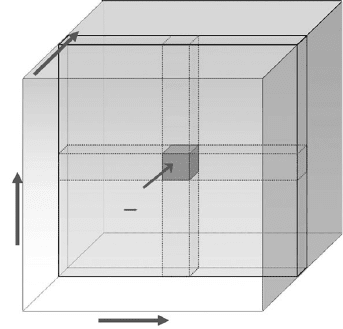
described in reference to Figure 6.1. Each voxel is defined in terms of its x, y,
and z position in the volume as well as by an information vector s repre-
senting the signal. The information contained in s can represent any number
of appropriate signals including a secondary electron (SE) signal, an X-ray
signal (XEDS), an electron backscatter diffraction signal (EBSD), a back-
scatter electron (BSE) signal, or an Auger electron signal to name a few. In
the context of this chapter FIB-SEM 3D reconstruction is an inclusive term
that refers to the platform enabling all the various forms of tomographic
data sets described above. Depending upon the information vector and
operating conditions the method classifies as FIB-SEM nanotomography
when the minimum analytical volume is sufficiently small to be considered
nanoscale.
Spatial resolution of CAT, MRI, and PET data can range from 1 mm (for
specialized equipment) to several millimeters (most commercial applications).
Spatial resolution of the FIB-SEM nanotomography methods described in
this context is 5–20 nm, but it is also a destructive technique. X-ray tomo-
graphy, MRI tomography, and PET scan methods can also be applied to
much larger volumes than is practical with the FIB-SEM 3D reconstruction
method. The niche for FIB-SEM nanotomography using a liquid-metal ion
gun (LMIG) lies in obtaining 3D detail on the nanometer scale over tens of
micrometers or less.
x
(x,y,z,s)
y
z
Voxel
Figure 6.1 The voxel is the term applied to the volume element in a 3D
reconstruction, analogous to a pixel in a 2D image. The voxel defines the
location in three-dimensional space of the signal s. Note the orient ation of
the axes. The x–y plane is the same reference frame seen in the SEM.
(Adapted graphic courtesy of Eric Lifshin.)
Focused ion beam systems148
6.2.1 Ultra-high-resolution tomographic techniques
Other tomographic techniques familiar to electron microscopists and mate-
rial scientists include transmission electron microscopy (TEM) tomography
and atom probe spectroscopy. TEM tomography is an established technique
involving acquisition of a tilt-series of TEM images or acquisition of
hundreds of images of identical structures, in the case of a single-particle
reconstruction. The single-particle reconstruction technique is usually
applied to biological structures. TEM tomography requires preparation of an
electron transparent lamella or preparation and imaging of a large number of
identical structures. Therefore the sample preparation requirements are
generally more restricted and the volumes are typically much smaller in TEM
tomography than the FIB-SEM tomographic method. However, TEM
tomography permits deep sub-nanometer or even angstrom level resolution.
Atom probe tomography is an emerging commercial analytical technique that
yields quantitative 3D compositional data for all elements and isotopes with
0.2 nm resolution. The instrumentation is a combination of a field ion micro-
scope (FIM) and a time-of-flight (TOF) spectrometer [8]. The position and
identification of each extracted atom is mapped to the original volume of the
sample, which consists of a sharp needle less than 10 nm in diameter. The atom
probe method offers very high spatial resolution but is limited to the pre-defined
volume of the tip. The most versatile and dominant method to prepare atom
probe tips is via FIB. In this sense, atom probe tomography can be also con-
sideredan FIB dependent tomographic technique. Thus while TEM tomography
provides higher spatial resolution in terms of image data and atom probe yields a
nearly ultimate compositional spatial resolution; FIB-SEM 3D reconstruction
methods are in a unique range of application, versatility, and resolution.
6.3 Electron beam imaging and signal detection for FIB-SEM
3D reconstruction on a CrossBeam
Parameters that define 3D reconstruction data will be discussed in terms of
the signal origin and information content. Paramount is optimization of the
electron microscope conditions and understanding the operation theory of
various detectors. This foundation of knowledge begins with an under-
standing of the origin of the various signals. Due to the importance of the
subject a section will be dedicated to outline the basic aspects of electron
interactions with solids. A following section will describe the requisite
hardware with particular emphasis on detection principles and unique
elements of the electron column design.
High-density FIB-SEM 3D nanotomography 149
6.3.1 Electron–solid interactions and resolution in
FIB-SEM tomography
The elastic and inelastic interactions of the electron beam with the solid
determine the lateral spatial resolution, depth resolution, and the information
content conveyed by signals used in the FIB-SEM 3D reconstruction method.
A description of the origin of the various signals employed will provide the
background to interpret the FIB-SEM nanotomography results presented in
this chapter and allow the reader to appreciate the detection principles
employed. This background will also help the analyst select data acquisition
parameters such as electron probe voltage, probe size, probe current, the type
of signal collection, and the frequency of image data collection. As
the following is an abbreviated discussion to define our strategy for FIB-
SEM 3D reconstruction, the interested reader is directed to reference
resources for further study [9,10].
Electron beam energy, interaction volume and information depth
As a first-order estimate of the resolution of the FIB-SEM nanotomography
we will examine the concept of electron interaction volume. An electron
interaction model is not a strictly rigorous estimate of the tomographic
resolution, but it serves as a useful visual aid to open discussion. In Figure 6.2
are shown two images of the same cluster of catalyst nanoparticles which
individually are on the order of 15–20 nm in characteristic dimension. The
image on the left was recorded at 0.8 kV while the one on the right was
imaged at 0.37 kV. Both images were acquired at an original screen magni-
fication of 500 k · and a field width of 750 nm. The 0.37 kV image was
acquired following the 0.8 kV image. The brightness setting is the same in
both images while the contrast setting is 2.8% higher in the lower voltage
image. Image data are paired with a Monte Carlo simulation of the electron
interaction volume at each respective voltage. The simulation was completed
using a freeware package, WinCasino [11], and employs the modified Bethe
expression of Joy and Luo [12]. The electron interaction volume data mod-
eling yielded an interaction volume for 0.8 kV electrons of approximately
21 nm. At 0.8 kV the interaction volume is similar to the characteristic
dimension of the average nanoparticle. At 0.37 kV the interaction volume is
on the order of 7 nm, which is less than the characteristic dimension of the
average nanostructure. Comparing the image data, more surface detail is
evident in the individual nanostructures in the image recorded at 0.37 kV.
The reduced interaction volume and change in secondary yield leads to
improved surface imaging sensitivity on the nanoparticle and demonstrates
Focused ion beam systems150
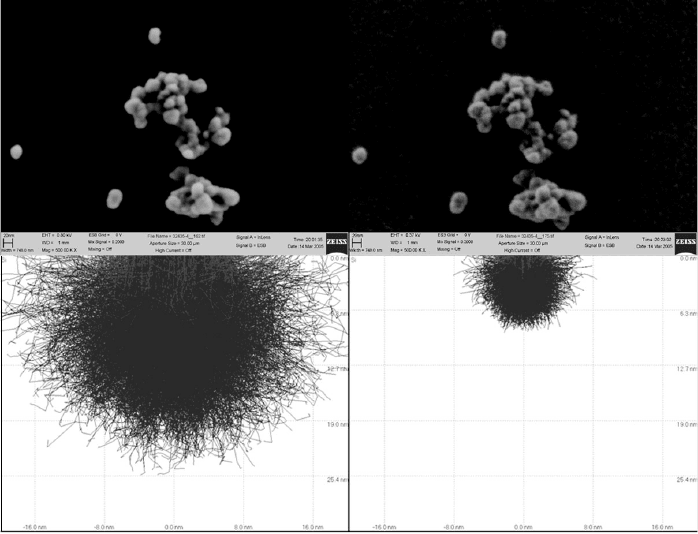
the benefit of extreme low voltage. The interaction volume simulation used
silicon as the model material but the interaction volume will vary significantly
depending upon probe voltage, electron beam geometry, and target material.
A high atomic mass material such as tungsten yields an interaction volume of
approximately 7 nm at 1 kV and less than 3 nm at 0.4 kV.
A more detailed examination of interplay between electron energy, interac-
tion volume, and resolution requires introduction of a term called the inelastic
mean free path, or IMFP. This fundamental material parameter carries units of
length and is given the designation l
0
. The IMFP is formally defined as the
average distance that an electron of a given energy may travel between suc-
cessive inelastic collisions in a given material. The IMFP thus determines the
maximum depth below the surface from which secondary electrons can origi-
nate and still be omitted from the surface without energy loss. The intensity
0.8 kV
0.37 kV
Figure 6.2 The influence of probe voltage on the interaction volume. The
interaction volume provides a first-order estimate of the equilateral resolution
limit in an FIB-SEM 3D nanotomographic reconstruction. The model data
suggest a resolution limit of 5–20 nm for a 0.8 kV beam. The Monte Carlo
simulation employed a package called WinCasino using the modified Bethe
expression and assumes a silicon material. See text for details on the imag e
data.
High-density FIB-SEM 3D nanotomography 151

distribution of emitted electrons at a given energy as a function of depth follows
an exponential decay according to the Beer–Lambert law:
IðE; zÞffiI
0
exp
z
l
0
cos
8
>
:
9
>
;
; ð6:1Þ
where I
0
is the initial arbitrary intensity, z is the depth variable and represents
the emission angle of the electron with respect to the sample normal. A value of
3l accounts for 95% of the total electron distribution and is a common value for
the electron attenuation length to estimate practical analysis volumes while 5l
represents 99.3% of the electron distribution and is preferred for numerical
calculations. As an example, an electron of approximately 1.4 kV energy tra-
veling in silicon dioxide has an IMFP of approximately 3.3 nm to yield a 3l
electron attenuation length of approximately 10 nm. Electrons traveling in
insulators have an IMFP approximately three to five times larger than electrons
traveling in conductors. The reduced attenuation length in conductors is due to
a higher density of free electrons in the conduction band that supply more
electron–electron scattering centers for energy loss and thereby attenuate elec-
trons traveling in a conductor more strongly. The value of l
0
may be determined
from experiment (i.e., TEM correlation), empirical formula, or some combi-
nation. The NIST reference at the end of the chapter offers free software to
generate IMFP data as well as effective attenuation length data from theoretical
models or from built-in database compilations (NIST database 82) [13].
Secondary and backscatter electrons
While the primary beam energy may range from 100 eV up to 30 kV the sec-
ondary electrons always comprise a low energy continuum which by definition
extends from 0 to 50 eV. But 90% of the secondary electron distribution is
below 10 eV. This would suggest that FIB-SEM nanotomography employing
secondary electrons may have spatial and depth resolution down to a few
nanometers or even less, regardless of the primary beam energy. But the
representation thus far is an incomplete scenario.
A typical secondary electron is the product or by-product of multiple
random scattering events with each event involving an energy loss interaction.
Further, the IMFP of an electron is a function of energy and the IMFP so-
called ‘‘universal curve’’ reaches a minimum at approximately 50 eV for
metals and then steadily increases again with decreasing electron energy. This
means a 10 eV electron may travel further between scattering events than a
50 eV electron. The IMFP increases below approximately 50 eV because lower
energy electrons lack the energy for a significant interaction probability
(a plasmon interaction for metals). Thus, random scattering processes and the
Focused ion beam systems152
low energy dependence of the IMFP collectively smear the spatial distribution
of secondary electrons.
Resolution of the low energy secondary electrons is further reduced from
the ideal because the total distribution of low energy secondary electrons
consists of two types of secondary electrons, given the designations SE
1
and
SE
2
electrons. While SE
1
and SE
2
electrons have similar energies they are
derived from two distinct processes. The former (SE
1
) represent secondary
electrons directly excited by the incident electron beam and carry high spatial
resolution information. The latter (SE
2
) are secondary electrons indirectly
excited by backscatter electrons (BSEs).
A BSE is defined as the primary electron that scatters through an angle >90
and escapes the surface with an energy greater than 50 eV and up to the primary
electron beam energy. The BSE family also consists of two broad categories of
electrons that collectively have experienced a mixture of elastic and inelastic
scattering events. Within the first category are those BSEs that have undergone
one or more large angle elastic scattering events through interaction with
atomic nuclei. The primary electron essentially recoils directly out of the
material. The category I BSEs (BSE
I
) will have energy close to the primary
beam energy and include a distribution that comprises the so-called elastic
peak. The BSE
I
display a small angular spread with respect to the primary
incident beam geometry and thereby retain high lateral spatial resolution. The
depth resolution of the BSE
I
will depend upon the primary beam energy and the
escape depth in the material. Category II BSEs span a broader continuum of
energy and lose energy through multiple inelastic scattering events transferring
energy to produce SE
2
electrons in the process prior to escaping from the
surface. The BSE
II
electron may emerge relatively far from the incident primary
beam after multiple scattering events and therefore this detected signal also
carries a lower lateral spatial resolution than either SE
1
or BSE
I
signals.
Therefore the total SE signal is a high resolution SE
1
signal convolved with
a delocalized contribution from SE
2
electrons generated by BSEs. At a vol-
tage greater than approximately 5 kV the contribution of the SE
2
signal to the
total detected SE signal may be 2–3 times greater than the intensity con-
tribution of the SE
1
. The SE
2
also follow the character of the BSE
II
signal
of deeper origin. Thus the SE
2
signal carries information influenced by
the distribution of subsurface features and has inherently lower resolution.
The influence of BSE
II
on the SE image data is particularly evident where the
composition is varying with depth (i.e., tungsten embedded in silicon) or in
the case of buried edges which display enhanced secondary electron pro-
duction. It would seem that the physics of electron scattering has conspired to
smear out the achievable resolution. Fortunately there are strategies that can
High-density FIB-SEM 3D nanotomography 153
be introduced to gain back some ground that will be employed in the FIB-SEM
3D reconstruction. This strategy is related to the low voltage scattering regime.
Low voltage electron scattering regime
As the energy of the primary beam is reduced toward 1 kV the volume from
which the SE signal is generated and the volume from which the BSE signal is
generated become very similar. It is experimentally problematic to distinguish
SE
2
generated by BSEs and SE
1
excited by the primary beam below 1 kV.
In many respects this is a welcome outcome because the limitation imposed
by the BSE production of SE
2
evaporates. At the same time the total BSE
signal depth resolution improves at low voltage as the penetration decreases
and the BSE
I
signal in particular remains a viable high spatial resolution
signal, approaching the resolution of the SE
1
signal. The most important
attribute of the BSE signal has not yet been emphasized. The BSE signal
intensity increases in a nearly monotonic manner with the atomic number of
the nuclei from which it scattered [14]. Hence, the local intensity in a BSE
image is proportional to the mass of the target atom and can be employed to
form a Z-contrast image. This is a very useful contrast discrimination scheme
for 3D reconstruction, as will be demonstrated.
We’ve now established that one possible strategy to optimize 3D resolution is
to acquire SE
1
and BSE
I
signals in a low voltage scattering regime. This phase
space must be balanced with the achievable performance of the electron column
in this regime to maintain a sufficiently bright focused primary electron beam at
low energy coupled with effective electron detection schemes. These topics will
be covered in a description to follow on hardware and detection principles.
Electron beam – sample geometry on a CrossBeam
Prior discussion has assumed an electron beam with normal incidence to the
sample surface. On an FIB-SEM platform there is a fixed angle between the
ion and electron column which is close to 35
. If an FIB cut is made with
the FIB axis normal to the surface then the incident electron beam will form
an angle with the cut face that is close to this 35
fixed angle (the precise value
varies a few degrees depending upon the instrument manufacturer). The
incident beam geometry means that the electron range will be reduced
roughly in proportion to the cosine of the incident angle. Penetration of
the electron beam normal to the cut face will then be approximately 20%
less than the normal incidence condition but the beam is also elongated in
the sample plane a complementary amount. Ultimately the beam geometry
does not dramatically change the depth resolution estimate at low voltage or
the information content. However, electronic tilt compensation must be
Focused ion beam systems154
employed to ensure that the scan area yields a correct dimension in both the
x and y planes of the cut face to allow accurate quantification. This com-
pensation is easily accommodated in all modern instruments.
6.3.2 Electron probe formation and electron detection principles
in the Gemini column and CrossBeam platform
Ideally we would like to enlist the SE
1
electron exclusively as this is an
inherently high-resolution signal. While it is not possible to purely separate
SE
1
and SE
2
electrons because they span the same energy range, it is possible
to collect a heavily SE
1
weighted signal using a proper in-lens detection
system. Likewise, in the strategy identified above to optimize 3D depth
resolution it is desired to form a high-brightness low voltage finely focused
electron probe to reduce interaction volume and minimize the delocalization
of SE and BSE signals. It is also desirable to extract a BSE
I
signal under these
same conditions. Finally, it would be very beneficial if we could collect these
signals simultaneously in real-time during the milling process in an auto-
mated fashion to maximize data density and gain high throughput. With
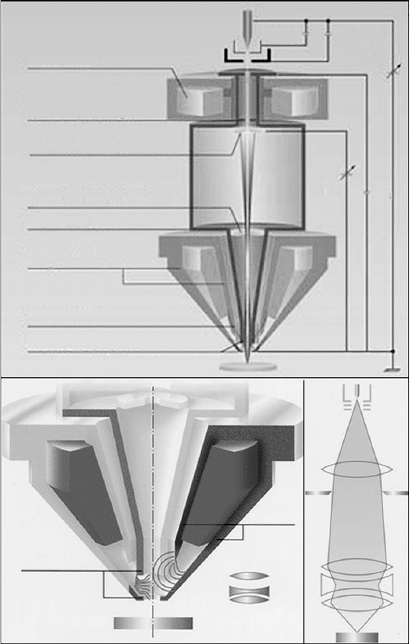
reference to the schematic cross section of the Gemini column in Figure 6.3
the principles of electron probe formation and electron detection will be
explained in the following paragraphs that allow those goals to be realized.
Figure 6.3(a) shows the schematic cross section overview with the optical
elements of the Gemini column labeled. The source is a Schottky field emitter
that combines high brightness, long lifetime, and excellent stability. The
aperture changing system is electromagnetic and requires no mechanical
adjustments. Note the position of the in-lens BSE detector which resides
above the in-lens secondary detector. Along the length of the column is a
liner tube element labeled as the beam booster. Beneath the in-lens secondary
is a combination electrostatic-electromagnetic objective lens, detailed in
Figure 6.3(b). Figure 6.3(c) depicts the crossover free beam path of the
electron column. The following paragraphs relate how the crossover free
beam path, the beam booster, the in-lens detection system and the electro-
static-electromagnetic objective lens combine to extract the data signals for
optimized 3D reconstruction at low voltage.
Crossover free beam path
Figure 6.3 (c) shows a representation of the condenser lens, but the strength of
this lens is never operated in a crossover condition (i.e., brought to a focal
point). Traditional electron columns contain one or more crossovers in the
electron beam path. The crossover free beam path column minimizes the
High-density FIB-SEM 3D nanotomography 155
Boersch effect, which is a term describing energy broadening of the electron
beam created by stochastic coulombic interactions between electrons. The
Boersch effect leads to chromatic aberration in the electron column and is
significant in areas of high electron density such as at a crossover condition
and at low voltage. By minimizing the Boersch effect with a crossover free
beam path the column reduces chromatic aberration and enhances low vol-
tage performance.
Beam boosted column The beam booster has two functions: (i) it is part of
the primary electron beam optics and (ii) it is part of the optical detection
system. The beam booster is an 8 kV voltage that is applied on top of the
Field lens
Electromagnetic
aperture changer
Annular EsB detector
Annular SE detector
Beam booster
Magnetic lens
Scan coils
Electrostatic lens
Specimen
Electrostatic lens
Specimen
Magnetic lens
U
F
U
B
U
ex
U
pe
U
SUP
(a)
(b) (c)
Figure 6.3 Schematic representation of key elements of the Gemini column.
(a) Overview of the optical elements. (b) Detail of the combination
electrostatic–electromagnetic Gemini objective lens. (c) The crossov er free
beam path with optical representations for the condenser lens and the
effective triplet formed by the objective lens.
Focused ion beam systems156
selected primary beam landing energy. For instance, if the selected landing
energy is 200 volts the actual primary beam energy coming down the column
is 8.2 kV. By maintaining a high potential at the source regardless of the
selected landing energy the tip brightness is kept high under all conditions.
One of the pitfalls of low voltage operation on traditional electron columns is
the severe reduction in brightness that follows when an emitter is operated at
low voltage. The beam booster obviates this problem and contributes to
excellent low voltage performance. The 8 kV potential is reduced to ground
potential at the final electrostatic lens element thereby creating an electro-
static deceleration field gradient as seen by the primary beam that reduces the
electron beam to the selected landing energy as it reaches the sample surface.
This deceleration field also has a negative aberration lensing effect on the
probe. However, the SE electrons produced on the sample surface experience
an electrostatic acceleration field gradient of equal but opposite sense as that
experienced by the primary electron beam. Due to the electrostatic accel-
eration field gradient the secondary electrons are pulled up the column across
the 8 kV potential. Therefore the beam booster is acting as part of the optical
collection and detection system. The beam booster potential also ‘‘stretches’’
the differences in small surface potentials, analogous to a contrast stretching
operation. Even for a low voltage primary beam the effect of the beam
booster also allows direct detection of both SEs and BSEs, as opposed to
conversion detection.
On-axis in-lens versus Everhart–Thornley secondary electron detection
As the secondary electrons are accelerated up the column by the beam
booster they pass through an electrostatic focus then follow a toroidal path
around the primary beam and impact an on-axis in-lens secondary electron
detector. On-axis in-lens detection maintains true optical projection geometry
to maximize contrast and detection efficiency. Alternative designs employ
variations of a ‘‘snorkel’’ lens where the detector is off-axis on one side of the
column and an electrostatic grid bends secondary electrons off the optic axis
and into the detector. The nonaxial collection field of a snorkel lens design
can distort the primary beam, particularly at low voltage. A second SE
detector, an Everhart–Thornley (ET) style scintillator is mounted on the side
of the main chamber. This detector generates topographic contrast due to its
asymmetric position on one side of the chamber but it also collects a larger
proportion of SE
2
and SE
3
secondary electrons (SE
3
are electrons produced
by interaction with the pole piece and surrounding chamber components).
Figure 6.4 shows a pair of images taken of a cross section from an uncoated
semiconductor device. The images were recorded at 890 eV and a 2 mm
High-density FIB-SEM 3D nanotomography 157