
Yao N. Focused Ion Beam Systems: Basics and Applications
Подождите немного. Документ загружается.

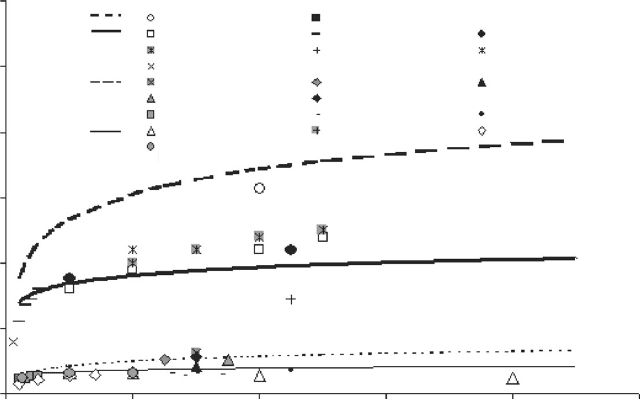
predicted by SRIM for two types of target substrates (Si and Au) using two
types of ion sources (Ga and Ar) at normal incidence as a function of the ion
energy. Ga and Ar are the two most popular ion species in FIB milling, while
Si and Au are the two most useful substrates used in nano-fabrication. They
will be used as the example ions and target materials for later discussions. As
shown, the sputter yield grows as the ion energy increases, but its rate of
increase reduces. Although the data are not shown, in most of the cases, the
sputter yield either levels off or decreases for ion energies higher than
100 keV, where the implantation becomes dominant, as ions penetrate into
the substrate and are trapped in the lattices. Since SRIM is based on the
Monte Carlo method, the number of ions used in the simulation can have an
effect on the results. Earlier studies indicate that the simulations become
converged when the ion number surpasses 500. To be conservative, one
thousand ions are used for all of the SRIM simulations presented here.
Figure 7.6 also shows that the sputter yield of the Au substrate is much
higher than that of the Si substrate, and that Ga can produce higher sputter
yields than Ar. In general, heavier ion sources or lower surface binding
energies (or sublimation energy) of target materials can produce higher sputter
yields [1]. Also, a decrease in the target sublimation energy causes higher
sputter yields due to the fact that sputtering is a phase change process: an atom
30
Sputter yield (atoms/ion)
25
20
15
10
5
0
0 20 40 60 80 100
Ion ener
gy
(keV)
Ion/target
Ga-Au
[23] [24]
[27]
[31]
[34]
[39]
[42]
[26]
[29]
[33]
[36]
[38]
[41]
[25]
[28]
[30]
[63]
[35]
[37]
[40]
Ar-Au
Ga-Si
Ar-Si
SRIM Experiment
[43]
Figure 7.6 Energy dependence of sputter yield of Au and Si substrates by Ga
and Ar ions at normal incidence.
Focused ion beam systems198
in a solid phase being ejected into a gas phase. The atomic (or ion) weights of
Ar and Ga are 39.95 and 69.72, respectively, while the binding energies of Au
and Si are 3.80 and 4.69 eV/atom, respectively.
To gauge their reliability, the SRIM predictions are further compared to a
large group of experimental data. As shown in Figure 7.6, the data for Ga
ions on Au substrates are reported by Blauner et al. [23] and Xu et al. [24],
while the data from Almen and Burce [25], Robinson and Southern [26],
Carter and Colligon [27], Nenadovic et al. [28], EerNisse [29], Mu
¨
ller et al.
[30], and Poate [31] are for the case of Ar ions on Au substrates. For Si
substrates, the results of Yamaguchi [32,63], Pellerin et al. [33], Santamore et
al. [34], Bischoff and Teichert [35], and Frey et al.[36] are shown for the case
of using a Ga FIB, while the data using Ar FIB are obtained from Southern
et al. [37], Sommerfeldt et al. [38], Andersen and Bay [39], Blank and
Wittmaack [40], Kang et al. [41], Morgan et al. [42], and Zalm [ 43]. As shown
in Figure 7.6, the SRIM predictions agree very well with the experimental
data for all the cases considered. Since the data presented by Lehrer et al. [44]
are almost identical to those of Frey et al.[36 ], only the latter is cited.
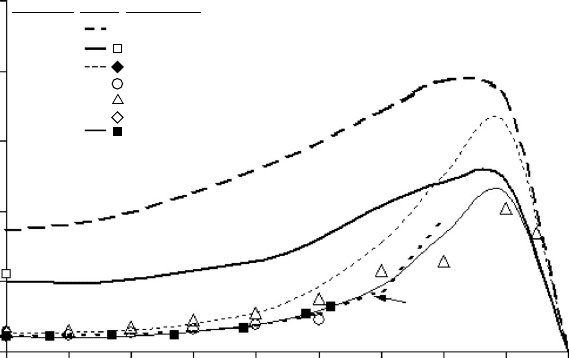
Figure 7.7 shows the SRIM simulation of the dependence of the sputter
yield on the incident angle at two different ion energies. Again, Ar and Ga, in
the sputtering of Au and Si substrates, are considered. As shown, for all the
cases considered, increasing the incidence angle increases the sputter yield
until it reaches its maximum near 80
then, it decreases very rapidly to zero as
50
40
30
20
10
0
0 102030405060708090
Incident an
g
le (de
g
rees)
Correlation: cos
–2
u
Ion/target
Ga-Au
Ar-Au [28]
[32]
[34]
[44]
[36]
[38]
Ga-Si
Ar-Si
SRIM Experiment
Sputter yield (atoms/ion)
Figure 7.7 Angular dependence of sputter yield of Ar and Ga ions on Au
and Si substrates.
Fabrication of nanoscale structures using ion beams 199
the incident angle approaches 90
. Roughly speaking, as the angle of collision
between the ions and target atoms increases from normal incidence, the
possibility of the target atoms escaping from the surface during the collision
cascades increases and this eventually leads to an increased sputter yield.
After reaching a maximum, the sputter yield decreases again as the ion
approaches glancing incidence because of the increase in reflected ions and
the fact that more and more collision cascades terminate at the surface before
they are fully developed.
Figure 7.7 also shows that the sputter yield of the Si substrate by Ar and
Ga ions at 30 keV increases about 12 times from the normal incidence to the
angle at its peak while the corresponding sputtering yield for the Au substrate
increases less than 2.5 times. The incidence angle that is normal to the target
surface is 0
. The experimental results reported by Santamore et al. [34] and
Lehrer et al. [44] for Ga ions/Si substrate at 30 keV and a normalized
correlation of 1/cos
2
, where is the incident angle, are also plotted in
Figure 7.7. As shown, a good agreement has been found between the SRIM
predictions and the experimental results, especially for incident angles less
than 60
. In fact, the experimental results fall in between the SRIM predic-
tions and the correlation. For larger incident angles, the SRIM prediction is
much higher than the experimental observation. At glancing angles, surface
channeling plays an important role and causes the sputtering yield to
decrease. The behavior of the angular dependence of sputter yields has been
widely observed by many other researchers, including Sommerfeldt et al.[38],
Yamamura et al.[45], and Vasile et al.[46].
Based on the above discussion, the material removal rate by sputtering, or
the sputter yield, is dependent not only on the substrate material, but also on
many processing parameters, including the ion energy, angle of incidence,
and scanning procedures.
Redeposition and amorphization
It has been found that the majority of the sputtered atoms (neutrals and ions)
can be ejected from the solid surface into a gas phase. Since the ejected atoms
are not in their thermodynamic equilibrium state, they tend to condense back
into the solid phase upon collision with any solid surface nearby. Conse-
quently, a portion of the ejected atoms can bump into the already sputtered
surface and redeposit onto it. For example, in trench milling, the atoms
ejected from the bottom of the milled channel have a certain possibility to
collide with the milled sidewalls and become redeposited.
The milling of different micro- and nanostructures from simplified 2D
(such as nanoholes and nanochannels) to complicated 3D geometries has
Focused ion beam systems200
been recently reviewed to characterize the basic sputtering, amorphization,
and redeposition phenomena [20]. For instance, Tseng [1] indicated that
redeposition could be greatly reduced if multiple passes instead of a single pass
are used in milling under the same amount of total ions. In multiple
passes, each successive pass removes redeposited material from the previous
pass. In general, redeposition is affected not only by the scanning pattern of
milling, but also by the milled geometry, the dynamics of the ejected atoms,
and the sticking coefficient of the target material. Normally, redeposition
reduces the milling rate and the aspect ratio of the milled structures. It also
makes the amount of the material milled difficult to be controlled and its final
geometry hard to predict because a certain portion of the ejected atoms can
be removed by the vacuum pumping system or can be redeposited outside the
milled area.
If the energy or dose level of the incident ions is not high enough for
sputtering, amorphization may occur in the bombarded area of a crystalline
substrate and induce the substrate to swell. For example, in the case of a
crystallized Si substrate bombarded by Ga ions, the dose level to cause
amorphization is in the order of 10
15
ions/cm
2
, while the effective sputtering
dose should be at least two orders of magnitude higher than the amorphi-
zation dose [36,47]. In amorphization, the incident ions in most cases are
buried in the target material and may also displace the target atoms from
their lattice sites so that the displaced atoms are relocated on the nearby
region. In the case of silicon, its density at the amorphous state is much lower
than that of crystalline silicon as reported by Custer et al. [48]. Also, since the
volume of swelling is much larger than the volume of the buried or implanted
ions, swelling should be mainly caused by the density changes or the amor-
phization rather than the volume increase caused only by the buried or
implanted ions. The magnitude of the swelling due to amorphization can be
as high as tens of nanometers. Thus, amorphization can diminish the
dimensional accuracy of nanostructures and should be important in nano-
fabrication. An understanding of swelling or amorphization should be the
first step to minimizing or controlling it.
Nanostructure milling
Li et al. [49] have used a 30 keV Ga
þ
FIB to mill an array of nanoholes (dots)
with a single pass on highly n-doped single-crystal Si(100) substrates. One of
the dot-array profiles milled at 1 pA with a dwell time of 2 s for each dot
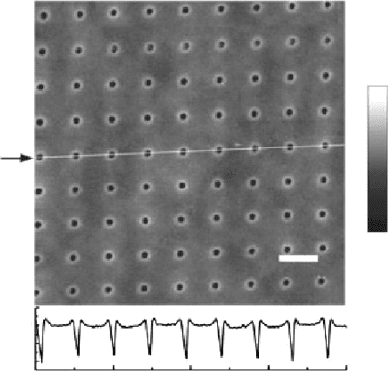
using a 10 nm (FWHM) diameter beam is shown in Figure 7.8. As shown,
the hole (dot) has a V-shaped cross section and is approximately 20 nm
in depth and 50 nm in diameter with a pronounced ring-shaped structure
Fabrication of nanoscale structures using ion beams 201
surrounding the crater. In fact, the protruded ring structure is the swelling of
the substrate due to amorphization and is the inherent shape obtained by
single-pass FIB milling. Since most of the FIB roughly resembles a Gaussian
ion distribution, the intensity at the fringe (tail) of the beam is much smaller
than that at the core (center region). Thus it is not strong enough to sputter
materials but is sufficient enough to cause amorphization that induces sub-
strate swelling [ 1]. The ridge or protrusion height shown in Figure 7.8 should
mainly be a result of the swelling of the substrate and can be as high as on the
order of 10 nm. Redeposition can add materials in the ridge, but the amount
of material added should be much less than that of swelling.
Tseng et al. [50, 52] studied the single-pass milling of several nano- and
microchannel patterns on a gold-coated substrate using a 90 keV As
2 þ
FIB
with a beam FWHM diameter of 50 nm at a current of 5 pA with a dwell time
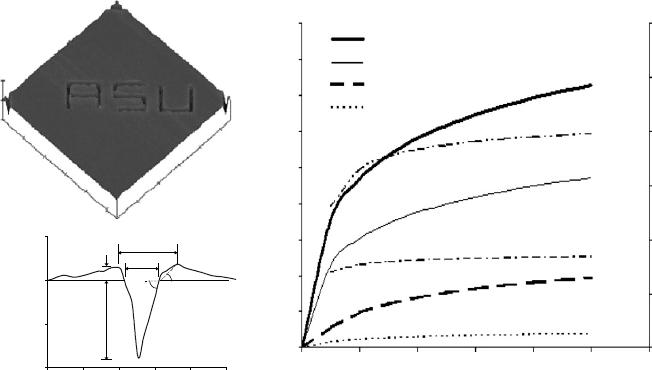
varying from 5 to 50 ms. As shown in Figure 7.9(a), the AFM image depicts
the pattern milled with 5 ms dwell time and indicates ridges being formed
along the channel banks (shoulders). Figure 7.9(b) delineates the corre-
sponding cross-sectional profile, displaying a V-shaped contour similar to
that of the milled hole-array shown in Figure 7.8. Figure 7.9(c) shows the
variations of four profile features with respect to the dwell time indicating
that although all of the features increase with the dwell time, the increase
rates are gradually reduced as the dwell time increases. This may indicate that
Height (nm)
10
0 1000 2000 3000 4000
Scan len
g
th (nm)
20.0 n
m
10.0 n
m
0.0 nm
500 nm
0
–10
–20
Figure 7.8 AFM image of hole (dot) array milled at 1 pA on Si substrate.
(Reprinted from [49] with permission from Institute of Physics and IOP
Publishing.)
Focused ion beam systems202
a large amount of sputtered materials are redeposited into the channel since
the mouth width and the milling depth should increase proportionally
with the dwell time without redeposition. The four features are defined in
Figure 7.9 (b): A is the ridge width, which is the distance between the ridge peaks,
B is the mouth width, which is the channel width with respect to the original
surface, C is the depth from the original surface, and D is the ridge height.
Also, the angles to characterize the steepness of the channel walls and the
ridge, which are defined in Figure 7.9 (b), are calculated and reported in
Figure 7.9 (c). The wall slope angle (fi ) approaches 90
if the wall is vertical
or parallel to the incident beam direction, while the ridge angle (fl) is zero
when no swelling occurs. As shown, the effects of the dwell time or
the amount of doses on the angles are insignificant except in the initial
transient stage. The ridge orfl angle varies from 15
to 17
with the dwell
time changing from 10 to 50 ms, while the corresponding wall slope or
fi angle increases from 33
to 39
, which is about twice the ridge angle. It is to
be noted that the swelling angle is highly dependent on the amount of the
density change by amorphization, while the wall angle can be dictated by the
number of the repetitive passes following the pattern that the larger
the number, the higher the wall angle.
Frey et al.[36] and Li et al. [49] have used a 30 keV Ga
þ
FIB to mill
nanoscale channels with a single pass on Si substrates. They used different
–40
–20
0
20
0 100 200 300 400 500
Coordinate (nm)
Channel depth (nm)
A
B
b
a
C
D
01
450
(a)
(c)
(b)
60
50
40
30
20
10
0
An
g
le (de
g
rees)
400
350
300
250
200
150
100
50
0
0 102030405060
Dwell time (ms)
Width between ridges (A)
Channel width at zero level (B)
Channel depth (C)
Ridge height (D)
(channel angle)
α
(ridge angle)
β
Fe
1
2
3
4
5
µm
Figure 7.9 ‘‘ASU’’ nanochannel pattern on gold layer milled by 90 keV As
2þ
FIB: (a) channel cross section profile and feature definition, (b) AFM image
at 5 ms dwell time, (c) profile measurements for various dwell times.
Fabrication of nanoscale structures using ion beams 203
beam diameters at different beam currents and all learned that the channel
profiles milled with a single pass have a ‘‘V’’ shape. Their results further
confirm that the V-shaped channel profile is the inherent shape obtained by
single-pass FIB milling. Also, the measurements shown in Figure 7.9 and in
[49] reveal that the mouth width of the V-shaped channel can be much larger
than the beam diameter by almost one order of magnitude. This may suggest
that at a higher dwell time, the ion intensity outside the core region of the
FIB is sufficiently high enough to produce a sizable amount of sputtering.
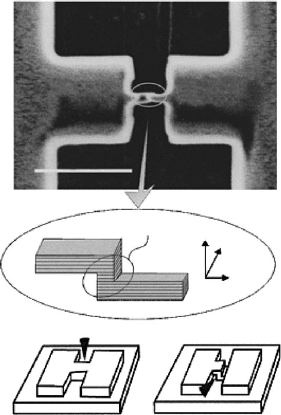
Kim et al. [ 51] used a 30 keV Ga
þ
FIB to mill an intrinsic Josephson
junction (IJJ) structure used as the basic element for quantum computation.
The IJJ is a Z-shaped stacked structure made by Bi
2
Sr
2
Cu
1
O
6þ–
(Bi-2201)
single crystal whiskers. As shown in the Figure 7.10(a), the intrinsic
Josephson junction has a 0.01 mm
2
(100 nm · 100 nm) tunneling stack area.
The 3D tunneling stacks were patterned on a special rotation stage. The steps
of the FIB milling process are shown in Figure 7.10(b). A width, depending
on the required junction size, was milled in the whisker thickness from the
perpendicular direction. By tilting the sample stage up to 90
, two grooves of
the bridge were then milled completely from the lateral sides in order to
create the required junction size. This technique, FIB in concert with a
Single crystal
whisker
Tunneling stack
(a)
(b)
FIB
Ste
p
1 Ste
p
2
c
b
a
1µm
Figure 7.10 Stacked nanostructure. (a) SIM image of intrinsic Josephson
junction with 0.01 mm
2
(100 nm · 100 nm) tunneling stack, (b) FIB
fabrication steps. (Reprinted from [51] with permission from American
Institute of Physics.)
Focused ion beam systems204
rotation stage, can fabricate nanoscale stacks from thin films and single
crystals.
7.3.4 FIB implantation (FIBI)
The FIB system not only has capabilities of performing subtractive (milling
and etching) processes, but it can also perform additive (implantation and
deposition) processes. In this subsection, the implantation ability of FIB will
be explored by showing the specific procedures in creating different nano-
structures.
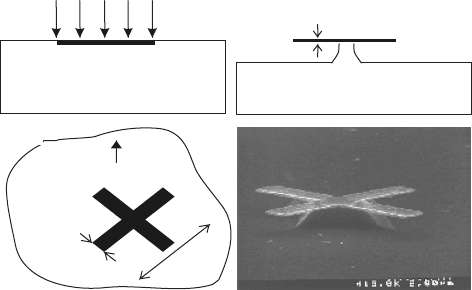
A combination of FIB implantation (FIBI) and wet etching has been used
to fabricate a nanoscale quad-cantilever on a Si (100) substrate having a 10 W
n-type background dope. As shown in Figure 7.11, the quad-cantilever is
first patterned by ion implantation using a 30 keV Ga
þ
FIB at a current of
100 pA in the Si substrate at a sufficiently high dose, i.e., higher than
10
15
ions/cm
2
. At this level of dose concentration, i.e., higher than 10
15
Ga
þ
ions/cm
2
in silicon, the etch rate of certain etchants, including KOH
(potassium hydroxide), can dramatically be reduced and the doped silicon
has been used as an etch stop or a mask in IC fabrication. The thickness of
the cantilever structure is dictated by the penetration depth (or the range)
of the implanted ion, which can be controlled by the incident energy of the
ions. Therefore, a selective etching is accomplished as the substrate is dipped
into the 40% KOH solution at 60
C, in which the silicon layer with no
(d)
Si
Mask layer by ion
implantation
(a)
Scanned by FIB
KOH etching
20–30 nm
Si
(c)
<110>
Si (100)
500 nm
5 µm
(b)
Figure 7.11 Nanoquad-cantilever. (a) Implantation by FIB scanning (cross
section), (b) top view of FIB scanned surface with quad-cantilever layout,
(c) KOH etching for nonimplanted substrate (cross section), (d) SEM image
of fabricated quad-cantilevers, 30 nm thick, 500 nm wide, and 5 mm long.
(Courtesy of J. Brugger of Swiss Federal Institute of Technology.)
Fabrication of nanoscale structures using ion beams 205
implantation is etched away at a rate of 250 nm per min, while the implanted
region stays relatively unaffected (Figure 7.11(c)). The 3D quad-cantilever is
20–30 nm thick, 500 nm wide, and 5 mm long, as shown in the SEM image
(Figures 7.11(b) and (d)). Using this implantation/wet etching combined
method, other types of nanoscale freestanding structures, including a nano-
cup and a U-shaped nanocantilever, have also been reported [20].
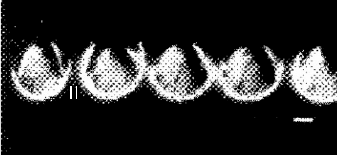
Utilizing a similar procedure, Hiramoto et al.[53] fabricated an array of
grooves on epitaxial AlGaAs layers by implantation combined with etching.
The implantation is performed by line scanning of an Si
þ
FIB with a 100 nm
FWHM diameter at 200 keV. They found that the cross sections of the doped
area could be varied from U to round shapes by reducing scanning speeds or
increasing the doses. Figure 7.12 shows the round-shaped grooves that are
wider in the interior and narrower near the surface. The grooves are formed
by selectively etching the highly doped region that is implanted at a scanning
speed of 0.1 mm/s with a line dose of 1.0 · 10
9
ions/mm using a hot HCl
etchant at 70
C. The round grooves are about 350 nm in diameter and the
distances between the etched grooves are about 30 nm. Since the groove
diameter is much larger than the beam diameter (100 nm), the implanted ions
are spread into the substrate and the grooves can be implanted very close at a
distance much less than the beam diameter. Hiramoto et al. [ 53] also applied
a similar technique to make very small GaAs conducting wires ranging from
20 to 100 nm in diameter.
FIB implantation has been used to irradiate polymeric resist materials to
increase their resistance to subsequent physical etching. Arshak et al. [11]
used a 30 keV Ga
þ
FIB with 1.17 · 10
2
C/cm
2
doses to make implanted
patterns in Shipley SPR660 positive photoresist layers, which can form a
Ga
2
O
3
compound against O
2
reactive ion etching (RIE). This process, also
known as graphitization, can harden the photoresist to be conveniently used as
an etching mask for O
2
dry etching. As shown in the FIB image in Figure 7.13,
two 100 nm negative resist lines with a 100 nm space (left) and two 30 nm
30 nm
100 nm
Figure 7.12 SEM image of round groove array fabricated by Si-FIB
implantation on AlGaAs substrates. (Modified from [53] with pe rmission
from American Institute of Physics.)
Focused ion beam systems206
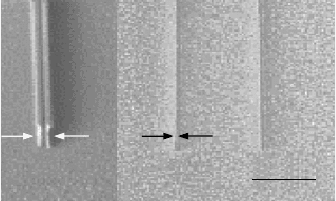
resist lines (right) were patterned after RIE in the SPR660 resist layer. This
demonstrates that anisotropic patterns can be achieved by graphitization and
can be directly incorporated into the standard photolithographic processes.
Ion implantation has also been used to change the electrical, optical, and
magnetic properties of different materials for making nanodevices. In the
case of changing electrical properties, Sumita et al. [54] fabricated a CDW
(charge-density-wave) device with a thickness of 40 nm and a width of
100 nm, and found that the device shows collective sliding and negative
resistance above some threshold electric field in the low temperature region.
This suggests that the quantum tunneling phenomena occur in the fabricated
CDW, which can only result from a condition that the structure is a true one-
dimensional conductor or is narrow enough to cause the collective sliding of
electrons without interferences. Shinada et al. [55] have improved FIB optics
for single-ion implantation and this high precision implantation instrument
can perform one-by-one doping of impurity ions into nanoscale semi-
conductor devices for various applications.
7.3.5 FIB induced deposition (FIBID)
The FIB can be used as a deposition tool for fabricating nanostructures. FIB
induced deposition (FIBID) uses ion energy to initiate and localize chemical
vapor deposition (CVD) in a specific location by a direct writing technique,
also known as FIBCVD. The FIB system should be equipped with a gas
nozzle to inject a variety of organo-metallic precursor gases on the target
surface in the vacuum chamber (Figure 7.14(a)). The high-energy ion beam
can decompose the organo-metallic molecules adsorbed onto the surface of
the substrate. This leads to the release of metal atoms, which are incorpo-
rated onto the surface, while the remainder resulting from the decomposition
300 nm
30 nm
1µm
Figure 7.13 Cross-sectional FIB image of double 100 nm (left) and 30 nm
(right) line patterns in SPR660 photoresist after O
2
RIE. (Courtesy of Khalil
Arshak of University of Limerick of Irelan d.)
Fabrication of nanoscale structures using ion beams 207